

The Occult Movement
in the Nineteenth Century
and its Relationship to World Culture
GA 254
16 October 1915, Dornach
Translated by Steiner Online Library
Third Lecture
[ 1 ] Today—since there are other matters to discuss—I would like to add just a brief episode to the reflections we have been sharing over the past few days. Tomorrow we will then have more specific things to say about the occult movement in the 19th century and its relationship to world culture. But I must now insert into the overall course of our discussion a point that is very important. If you recall the various discussions we have had—particularly the individual remarks I was able to make in response to Mr. von Wrangell’s pamphlet, *Science and Theosophy* —I must say this once more, even though I have already emphasized it—you will see that, precisely from the standpoint of our Spiritual Science, we were compelled to attach great significance to the rise of materialism and the materialistic worldview in the 19th century, and not merely to adopt a critical stance toward this rise of materialism.
[ 2 ] Adopting a critical stance is always the easiest thing to do when faced with an issue. It is therefore necessary to adopt an attitude that allows us to understand that, precisely in the 19th century, that current in human development—which we can call the materialist worldview—was bound to emerge. We have, after all, characterized it sufficiently. We can begin by citing two perspectives through which the full significance of the materialist worldview becomes clear to us.
[ 3 ] In the form in which materialism emerged as a worldview in the 19th century, it did not actually exist before that. Certainly, there were individual materialist philosophers such as Democritus and others—you can read about them in *The Riddles of Philosophy*—who, in a sense, were the precursors of this materialism as a theory. But if we compare their worldview, as it truly is, with what is expressed in 19th-century materialism, we must say: In the form in which materialism became a worldview in the 19th century, it did not exist before. In particular, it could not have existed in that form, say, in the Middle Ages or in the centuries that preceded the dawn of modern intellectual life. It could not have existed because people’s souls were still far too closely connected to the impulses of the spiritual world. To have a mental image of the entire world as nothing but a sum of moving atoms in space, which clump together to form molecules—and through this clumping all phenomena of life and spirit come into being—was a concept reserved for the 19th century.
[ 4 ] Now one might say: there is one thing that will always be there, like a common thread that one can follow, even in the very worst worldviews. And if one follows this common thread, which winds its way through the development of humanity, then this very thread will at the very least force one to recognize the impossibility of the materialistic worldview. And this common thread consists simply in the fact that human beings must think. For without thinking, it is impossible for a person to even arrive at a materialistic worldview. After all, it was conceived by human thought—this materialistic worldview! It’s just that in the materialistic worldview, people forget to practice self-knowledge—namely, that little bit of self-knowledge: You do think, and atoms cannot think. - If one practices just this little bit of self-knowledge, one has something to hold on to. And if one holds on to it, one will always find that materialism doesn’t work.
[ 5 ] But in order to truly realize that materialism was not the answer, it first had to be worked out in its true form. Just consider this: as long as one had, so to speak, a distorted image of materialism—an image in which spiritual impulses were still factored in—one could cling to the little bit of spirit that one still sought in natural phenomena and so on. Only then, once all spirit had been cast out—through the spirit, for thinking is possible only through the spirit—only once the spirit had been cast out of the worldview through the spirit itself, could the full force of the materialist worldview confront us. This entire force of the materialist worldview simply had to confront humanity at some point. But you see, what is necessary for this is self-reflection on thinking. It cannot be done without it. But as soon as we look even a little at this self-reflection on thinking, we must say to ourselves: At some point in the course of development, the entire bleak picture of materialism had to emerge so that people might become aware of what they have in it.
[ 6 ] That would be one way to describe it. But one cannot truly understand it unless one also describes it from the other side. Described from the other side, you see: a materialistic worldview—space—atoms in motion within that space—this is the universe. Essentially, everything would be merely an external consequence, an illusion arising from the one-sided reality of space and the atoms moving within it—that is, those tiniest particles of which we have already shown in previous lectures that thought cannot accept that they actually exist. But we keep coming back to these atoms. How do we actually find them? How does humanity actually arrive at the assumption of atoms?
[ 7 ] No one can have seen them, for they are imagined—they are truly imagined. Human beings must therefore have a reason, apart from reality, to conceive of an atomistic world. They must be prompted or inclined by something to conceive of an atomistic world. Nature itself certainly does not lead people to form a mental image of it in atomistic terms. One can discuss this very topic with a physicist—I am not speaking hypothetically here about something made up, but I have actually had such conversations with physicists—one can discuss this very topic with a physicist because he knows the observable aspects of physics. He really could not possibly fall into atomism! And one would have to say—as the more astute physicists in fact already realized in the 1980s—that atomism is an assumption, a working hypothesis, providing a shorthand, a unit of calculation, but one must be clear that it has nothing to do with reality. Thoughtful physicists would prefer to stick to what they perceive with their senses. But they keep falling back on atomism, time and again, just like a cat always lands on its feet.
[ 8 ] If you follow what we have worked out over the years—these matters have been discussed very often since I gave the lectures on the “Theosophy of the Rosicrucians” in Munich— if you follow that, you will see that human beings received the predisposition for the physical body on ancient Saturn, that they then gradually passed through the solar and lunar stages of development, and that during the ancient lunar era, their nervous system was integrated into their organism—specifically into what was present there of their physical organism.
[ 9 ] However, one would be completely mistaken if one were to assume that the nervous system during the ancient Lunar Age was as it appears today to an anatomist or physiologist. During the Lunar Period, the nervous system actually existed only as an archetype, as an imagination. It did not become physical—or rather, mineral, in the sense of its physical-chemical nature—until the Earth Period. And the entire structure, as it is now organized within our bodies, is a result of the Earth organization. During the Earth period, the mineral element—matter—was integrated into the imaginative archetypes of our nervous system as well as into the other archetypes. And this is how our present nervous system came into being.
[ 10 ] Well, the materialist says to himself: “With this nervous system, I think or perceive.”—We know that this is nonsense. For if we really want to create a mental image of the process, we can imagine any nerve running through the organism. But let’s now create a mental image of various nerves running through the organism. These nerves extend in such a way that they send out branches like tree limbs. A nerve, so to speak, has a trunk and then sends out branches; in fact, branches come close to other branches, and another strand continues from there. This is, of course, only a schematic and imprecise illustration.
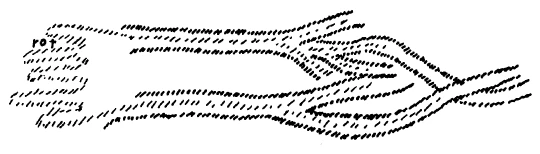
[ 11 ] How, then, does human soul life actually unfold within this nervous system? That is the question we must ask above all else. One cannot form any mental image of how soul life unfolds in the nervous system by considering only waking consciousness. But as soon as a person considers the moment when, with their “I” and their astral body, they slip out of the nervous system—slip out of the entire body and thus also out of the nervous system—and especially the moment when, upon waking, they slip back in again, they notice a peculiar phenomenon: one has actually been outside one’s nerves during sleep—that is, with one’s astral body and one’s “I.” One slips back into one’s nerves; one is then truly inside them. First one feels placed outside them, and then as if flowing back into the nerves. Thus, especially upon waking, one slips back into one’s nerves in this way.
[ 12 ] The process of waking up is much more complicated than can initially be represented schematically. And so, throughout the day, one is actually so deeply immersed in one’s body with one’s soul that, in addition to filling one’s physical body with one’s astral body as one normally does, one also fills the nerves. This filling is not like filling the physical body with a kind of mist, but rather a structured, organized filling. As one enters the various organs, one also slips, as if with sensory threads, into the outermost branches of the nerves.
[ 13 ] Please imagine this very vividly. I want to draw it schematically once more, but I can only draw it in such a way that it is, so to speak, reversed—like a kind of mirror image. I have to draw from the outside, but I would have to draw from the inside. Let’s assume this is the astral body and these are the feelers it extends (red). Everything I’m drawing now is part of the astral body. Here, it extends certain feelers into the nerve cords. I’ll draw it like this.
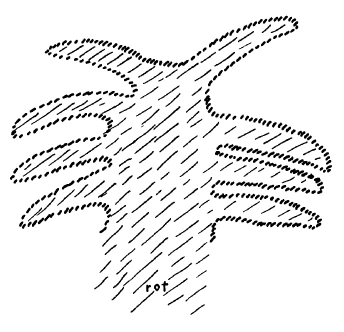
[ 14 ] Honestly, here he slips right into the nerve fibers. Imagine if the sleeve of my jacket were sewn shut at the front and I were to slip my arm into it as if into a sack. Imagine I had a hundred arms and were to stick them into sacks like that; then I would bump into the seams with all those arms. So that’s how we slip in—all the way to where the nerve tract ends. You can trace where the nerve tract ends in the physical body, and that’s as far as you slip in. As long as I’m slipping in there, I feel nothing. I only feel something when I reach the point where the sleeve is sewn shut. It’s the same with the nerves: we only feel the nerve where it ends. We’re immersed in the nervous tissue all day long and are constantly touching the ends of our nerves. Although a person is not consciously aware of this, it finds expression in their consciousness without them intending it. When they think—and they do think with their “I” and astral body—we can say: thinking is an activity that is carried out there and is transmitted from the “I” and astral body to the etheric body. Something else also slips in from the etheric body—at least its movement. The cause of consciousness is that, through thinking, I always reach a point where I encounter resistance. I encounter an infinite number of points when I slip in there, but I am not aware of them. This becomes conscious only to the one who consciously experiences the process of awakening: when he consciously plunges into the nerve sheath, he feels that it pricks him everywhere.
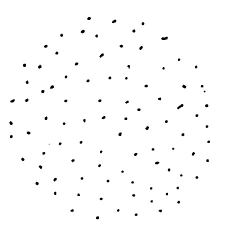
[ 15 ] I even once met an interesting person who had come to realize this in an extraordinary way, which I would like to describe as follows. This man was an outstanding mathematician and well-versed in the entire state of advanced mathematics at that time. Naturally, he had also devoted a great deal of time to differential and integral calculus. In mathematics, the differential represents the atomistic, the smallest unit—that which can still be conceived of as the smallest. I cannot say more about this today. Then, without it actually rising above the threshold of consciousness, it dawned on the man that he was being pricked everywhere whenever he delved into it. If it does not come into consciousness in the proper way—as it can be brought into consciousness through the exercises in *How to Attain Knowledge of the Higher Worlds?*—then unusual things can occur. Thus, he believed he could sense differentials all around him; he was full of differentials; everywhere he felt the differentials. “I am full of differentials,” he said, “I am not integral at all.” — He also proved this in a very astute way, demonstrating that he was brimming with differentials everywhere.
[ 16 ] Create a vivid mental image of these impulses. What does a person do with them if they do not rise into his consciousness? He projects them into space and fills the space with them, and those are then the atoms. That is, in truth, the origin of atomism. This is exactly what a person does—just as you would do if there were a mirror in front of us and you had no idea that a mirror was there. You would surely believe that there was another group of people out there. That is why a person creates a mental image of the entire space filled with what he projects into it. This entire nervous process is reflected back to the person because of the fact that he is making contact there. But people are not aware that they are making contact there, and the entire space around them therefore appears to be filled with atoms. The atoms are the pricks exerted by their nerve endings. Nature does not compel us anywhere to assume the existence of atoms, but human nature compels us to do so. The moment one comes to oneself upon waking, one delves into oneself and becomes aware of an innumerable number of points in space. At that moment, one is in exactly the same situation as when one approaches a mirror: one bumps into it and then knows that one cannot go beyond it. It is similar upon waking. At the very moment one wakes up, one comes up against one’s nerves, and one knows: you cannot go beyond this, you cannot get past it. — Thus, the entire atomic image is as if it were a mirrored wall: the moment one realizes that one cannot go beyond it, one understands the matter.
[ 17 ] And now take a statement that I have already cited to you as coming from Saint-Martin. What does the naturalist say? The naturalist says: Analyze natural phenomena and you will find the atomistic world. — We know that the atomistic world does not exist. In truth, only our nerve endings are there. What is there where the atomistic world is presumed to be? There is nothing! We must stop at the mirror, at the nerve endings. The human being is there, and the human being is a mirror apparatus. If one does not recognize that he is a mirror apparatus, one presumes all sorts of things behind him: namely, the materialistic worldview; but in truth, one must find the human being. But one cannot do that if one says: “Analyze natural phenomena”—for they lead one to atomism. There one must say: “Try to look beyond mere appearances!”—One must therefore say: “Try to see through the appearances!” - But then one cannot say: “And you will find the atomistic world”—rather, one must say: “You will find the human being!” - And now recall what Saint-Martin said—as if from a prophecy that he himself had not yet fully understood—in the sentence I wrote down for you: “Dissipez vos ténèbres matérielles et vous trouverez l’homme.” It is the same sentence; it is exactly the same, only it can be understood for the first time with the help of the analysis we have conducted.
[ 18 ] You see, through the way we bring together our Spiritual Science with natural science—and with the errors of natural science—we are fulfilling a program that has lived on in human longing ever since there have been people who sensed something of the impossibility of the modern materialistic worldview. This is precisely the infinitely significant reality whose effects overwhelm one when one grasps the full nature of our worldview: Spiritual Science exists because it has been longed for by those who had a sense of the True—of that which must come as the truth that alone can bring to humanity what humanity needs in modern times.
[ 19 ] Tomorrow I will have to show you why this particular error was bound to arise when the experiment with spiritualism was conducted in the 19th century. As I have shown you so many times, people were dealing with suggestions from living human beings, while they believed they were dealing with influences from the dead. These can only be attained by withdrawing into that part of the psychic human being which can be separated from the physical body. Everything that a person experiences between death and a new birth can only be explored through what the person can experience outside the physical body; thus, one cannot actually use mediums, in the true sense of the word, for this purpose. But more on that tomorrow. And this will also be connected to the chapter on life between death and a new birth, about which I already hinted in one of the last discussions that there is still more to come on this subject.