

The Occult Movement
in the Nineteenth Century
and its Relationship to World Culture
GA 254
11 October 1915, Dornach
Translated by Steiner Online Library
Second Lecture
[ 1 ] In today’s reflection, I would like to ask permission to interweave personal remarks with factual observations, because what I have to say in connection with yesterday’s discussion is precisely what makes today’s reflection necessary—and, after careful consideration, I believe it is right to examine it in greater detail here today.
[ 2 ] I would like to begin with a very specific experience related to our movement. As you know, outwardly we began our movement by affiliating ourselves—but only outwardly—with the so-called Theosophical Society, and by founding the so-called German Section within the Theosophical Society in Berlin in the fall of 1902. Then, in the course of 1904, we received a visit in various cities across Germany from distinguished members of the Theosophical Society. The experience I will be discussing took place during this visit. My book *Theosophy* had already been published by that time, in the spring of 1904, and the journal *Luzifer-Gnosis* had been established . And in the journal *Luzifer-Gnosis*, I had published, up to a certain point, articles dealing with the Atlantis problem and the nature of the Atlantean era. What I published in these articles in *Luzifer-Gnosis* was subsequently released as a special offprint titled *Our Atlantean Ancestors*. If you recall, you will find that a number of reports were included therein regarding the nature of the Atlantean world; in “Luzifer-Gnosis,” these were also traced back to the nature of the so-called Lemurian Age. So a large number of articles of this kind had been published, and just as the members of the Theosophical Society were visiting us at that time, one of these issues, which contained significant reports, was completed and sent out to subscribers. This happened precisely during the days when these Theosophists were here. A figure highly regarded within the Theosophical Society read these reports on the Atlantean world in that issue at the time and then asked me a question. And it is this question that I wish to mention as a remarkable experience, along with what happened yesterday.
[ 3 ] This member of the Theosophical Society, who had been involved in the most important matters at the very time the Society was founded by Blavatsky—and who was thus deeply immersed in the workings of the Theosophical Society—asked the following question after reading the reports on the Atlantean world: “How, exactly, did these communications about the Atlantean world actually come about?” — This question implied a great deal and was highly significant, for up to that point, that member had known only the manner in which such communications had come about within the Theosophical Society. They had, in fact, come about through the Theosophical Society’s use of a form of mediumistic research. The communications that had already been published in the Theosophical Society at that time had been based on research that, in a certain sense, had something to do with mediumistic research. That is to say, a person was brought into a kind of mediumistic state—one cannot call it a trance, but a kind of mediumistic state—and conditions were then created that made it possible for that person, who was not in the ordinary state of consciousness, to nevertheless convey messages about things that cannot be attained through ordinary consciousness. This was how the communications had come about at that time, and the member of the Theosophical Society in question believed that information about prehistoric events could only be obtained in this way and therefore asked which individual among us could be used as a medium for such research.
[ 4 ] Since I had to refuse to conduct research in this way and stood firmly on the ground of individual research, and since I had already discovered everything solely through my own personal research at that time, the person in question did not understand me at all. They did not understand what this was all about; they did not understand that it was something different from what had been done in the Theosophical Society up to that point. But that was the path that had been prescribed for me: to reject all previous methods of research, and—even if using the means of supersensory perceptions—to conduct research in the same way one does when relying solely on what can be given as revelation to the individual who is, at the same time, the researcher.
[ 5 ] In light of all this, as I must engage with the spiritual movement, there is no other option but to rigorously apply this method of research—which I have often described to you and which is undoubtedly necessary for the modern world and for humanity today. As you can see, there is a significant difference between the entire research method of Spiritual Science and the approaches adopted by the Theosophical Society. For all the communications they received from the spiritual world—including, for example, those in Scott-Elliot’s book on Atlantis—were obtained exclusively through the method described earlier, because this was regarded as the sole authoritative and objective approach. In this respect, therefore, the introduction of our Spiritual Science approach was, from the very beginning, something entirely new in comparison to the methods of the Theosophical Society. It was something that relied entirely on modern scientific methods, which had to be developed to the point where they could be used to ascend into the spiritual realms.
[ 6 ] This particular discussion is significant. It took place in 1904 and showed that there was a great difference between what was being done here in Spiritual Science and what was being done in the rest of the Theosophical Society; that what we have in Spiritual Science did not exist at that time, but that the Theosophical Society continued the method that had emerged as a compromise between the exotericists and the esotericists. This is, in fact, the inevitable result of the course of development I described yesterday. I said: Gradually, the gift of clairvoyance ceased, and there were only isolated cases of clairvoyants who could be turned into mediums and from whom something could be gained. Thus, so-called occult orders had formed, which, although they had a great many initiates, had no clairvoyants. They had first had to gradually develop the methods—which had long been common practice in the materialistic age—and they had first had to acquire the tools of research by seeking out individuals in whom mediumistic abilities, that is, atavistic clairvoyance, could still be developed, in order to extract something from them. They had extensive teachings and symbols. But if one truly wanted to conduct research, one was dependent on enlisting the help of such individuals with atavistic clairvoyance. This method was then continued in a certain way within the Theosophical Society, and the compromise I spoke of yesterday essentially consisted of nothing more than conducting such experiments in the lodges and various orders, through which spiritual influences were projected into the world; so that one could—or wanted to—show people: There are influences from the spiritual world acting upon human beings.
[ 7 ] So what had been practiced in esoteric schools was brought out into the open in this way. This experiment was a fiasco. For while it had been expected that truly spiritual laws governing the surrounding environment would emerge through the medium, the only result was that almost all the mediums fell into the error of believing that what was given to them originated from the dead; that is, they were inclined to rephrase what was given to them as messages that had come to them from the dead. This then led to a very specific consequence. If the older members among you look back on the early days of the Theosophical Movement and consider the literature that was published at that time under the influence of the Theosophical Society, you will know that the astral world—that is, the realm immediately following death—was described in Mrs. Besant’s books, which, however, merely reproduced what was written in Blavatsky’s *The Secret Doctrine* or what could be read in Leadbeater’s books. This was also the source of everything that was taught about human life between death and a new birth.
[ 8 ] If you now compare this with what I had to present in my *Theosophy*—what was written there about the realm of the soul and the realm of the spirits—people always sought to deny this in the early days, but I believe there are already enough people today who can think about it objectively—then you will find quite significant differences, precisely because the research methods for these areas were also different. For all the research methods employed by the Theosophical Society were based on the methods I have described; this includes the methods used to investigate the lives of the dead.
[ 9 ] So you see that what the Theosophical Society initially offered the world was, in a certain sense, a continuation of the occultists’ endeavor. We will now hear in what other respects this was not the case. But on the whole, it was a continuation of the endeavor that had already come about in the mid-19th century through a compromise between the exotericists and the esotericists; only that later, through the Theosophical Society, the matter was made somewhat more esoteric. Whereas previously attempts had been made to present the medium to the world at large, the members of the Theosophical Society preferred to do so only within their inner circle and then to communicate only the results. This is a fundamental difference, for it marked a return to a method of research that the various orders had recognized as common practice prior to the mid-19th century. I must emphasize this because I need to stress once and for all that, with the emergence of our Spiritual Science movement, a completely new method—one that takes full account of the attitudes of modern science—has been introduced into the occult movement.
[ 10 ] Now I told you: the compromise between the exotericists and the esotericists—to convince the materialistic world, through all sorts of media, that a spiritual world exists—has ended in a fiasco. This fiasco was evident in the fact that the mediums always spoke of a world that, under the existing circumstances, could not possibly be accessible to them: the world of the dead. They spoke of inspirations they claimed to have received from a world where the dead live. The fact of the matter was that both the exotericists and the esotericists realized that the attempt they had made did not lead to what they had actually intended.
[ 11 ] How did what happened there come about? I mean, what did this strange experiment—which came about through the compromise described—actually reveal? It became clear that a certain type of initiate had, so to speak, snatched the reins from the hands of those who had entered into the compromise. The initiates who were very far to the left had taken control of the movement, which had been supported in the manner I have described to you. They gained great influence because everything that came about through the mediums did not originate from the realm of the dead, but from the realm of the living—who were, at the same time, the initiators who established a remote or close rapport with the mediums. Because all of this was brought about through these initiators and through the mediums, it bore the stamp of the theories of those who sought to take control of these mediums. Those among the exotericists and esotericists who had made the compromise sought to teach people: “Look, there is still a spiritual world out there!”—That is what they sought to teach them. But when the guiding rope slipped from the hands of those who believed they could hold it, those occultists who stood very far to the left seized it and attempted to communicate their theories and views to the world through the medium—if I may use this tautology—of the media.
[ 12 ] Now, for those who had made this compromise for the sake of humanity’s salvation, the situation was actually a very dire one. They felt more and more strongly that, fundamentally, an ever-increasing number of false teachings about the supernatural were being introduced into the world. That was the state of affairs in the development of occultism in the 1840s, 1850s, and even into the 1860s of the past 19th century.
[ 13 ] However, while honest occultists were still pondering these matters, they found themselves in a dire situation. For the further to the left the occultists stood, the less they were concerned with presenting only what can be presented: namely, what is universally human. One is “on the left” in occultism when one seeks to achieve a specific end through the occult teachings one espouses. One is “on the right” in occultism when one propagates it solely for its own sake. The middle ground essentially amounts to making the esoteric—which is necessary in our time for the universal human—exoteric. Those who stand entirely on the left, however, are those who combine special purposes with what they propagate as occult teachings. One is on the left to the extent that one pursues specific purposes, leading people into the spiritual world, giving them all manner of revelations from the spiritual world, and implanting within them—in an incorrect manner—what is intended solely to serve the realization of such specific purposes. This, then, was the situation facing the leadership of the modern initiates. They saw the matter in the hands of people who were pursuing specific purposes. This was the situation facing the esotericists and exotericists who had reached the compromise mentioned above.
[ 14 ] Then one heard—though perhaps it is not entirely accurate to use this word, but one cannot choose the words precisely, because we are bound by external language, and communication among occultists is something other than what external language is capable of describing—that a significant event for the further continuation of spiritual development on Earth must be imminent, and this event was nothing other than what I must describe as follows. In the research methods of the individual orders, it had been preferred, well into later times, to make as little use as possible of female mediums. In the strict orders that sought to maintain the correct standpoint, female mediums were not used at all for revelations from the spiritual world.
[ 15 ] It is indeed true that, due to its structure, the female organism is better suited than the male organism to preserve atavistic clairvoyance. While male mediums were on the verge of extinction, female mediums were still present, and a large number of female mediums were utilized even in the compromise in question. But now a figure entered the occultists’ field of vision who was, to the utmost degree, a medium. This was Madame H. P. Blavatsky, a figure who was particularly well-suited to draw much—indeed, a great deal—from the spiritual world through certain subconscious aspects of her constitution. Let us now consider what this actually made possible for the world. Precisely at one of the most crucial moments in occult development, a figure entered the world who, due to the unique nature of her constitution, was brimming with every possibility of drawing forth the most diverse phenomena from the spiritual world through her subconscious abilities.
[ 16 ] The occultist who observed his time back then had to say to himself: Now, at just the right moment, a personality has appeared who, through the unique nature of his organism, can provide us with the most compelling evidence for what is an ancient, traditional teaching—one that exists among us only in symbols. — To the very highest degree, this was the case: there was a figure who, simply by virtue of her constitution, offered the possibility of once again proving much of what the age had long since ceased to know in any way other than through tradition. We were confronted with this fact precisely after we had suffered a fiasco, after we had reached such a dead end. We must certainly note this: we faced Blavatsky as a personality from whom, just as electrical sparks can be drawn from an electrically charged Leyden jar, occult truths could be extracted.
[ 17 ] Now, it would take us too far afield if I were to recount all the intermediate steps, but I must mention a few important points. The point was that there was a truly significant moment, which I can describe something like this—it is expressed more symbolically, but it captures the facts perfectly. Those occultists who stood on the right, in alliance with the centrist faction—that is, those who had reached a compromise—could say to themselves: Now it is possible to draw something very significant out of this personality. — But those who stood on the left could say to themselves: Now it is possible to achieve something in the world in the most intense way with the help of this personality! — And now a real struggle arose, a genuine struggle over this personality: on the one hand, with the sincere intention of finding confirmation of much of what the initiates knew; on the other hand, for the sake of powerful special purposes.
[ 18 ] I have often referred to the early period of H. P. Blavatsky’s life and shown how, in fact, attempts were initially made to extract a great deal from her. But the situation changed relatively quickly, and this was because H. P. Blavatsky relatively soon entered the sphere of those who, so to speak, were on the left wing. And although H. P. Blavatsky knew very well what she herself could perceive—she was also particularly significant in that she was not merely a passive medium, but possessed an extraordinarily strong memory for everything that was revealed to her from the higher worlds—certain personalities inevitably had to exert an influence on her if she wished to evoke messages from the spiritual world. That is why she always refers to what should actually be left out: the Mahatmas. They may well be behind it all, but that is not what matters when it comes to advancing humanity.
[ 19 ] H.P. Blavatsky was thus faced with a decision relatively soon. She got wind from a source on the left that she was an important figure. She knew well enough what she was dealing with, but she did not fully grasp the significance of her own role. It was only revealed to her by the Left. Nevertheless, at the core of her being she was a fundamentally honest person, and after hearing rumors from that side—which she likely did not find appealing at first, precisely because she was fundamentally honest—she initially attempted to reach a kind of compromise with an occult brotherhood in Europe. Something very beautiful could have come of it, because through her great mediumistic gift she could truly have provided phenomenally significant confirmations of what the initiates knew from theory and symbolism. But she was not only a fundamentally honest person; she was also what Germans call a “Frechdachs” (a cheeky rascal). That’s exactly what she was. She had a certain fundamental trait in her nature that is particularly characteristic of personalities inclined toward mediumship: namely, an inconsistency in her outward demeanor. So she had moments when she could become very cheeky. And in one such fit of cheekiness, she imposed conditions on the occult brotherhood—which was determined to carry out the experiment—that were impossible to fulfill. And since she knew that much could be accomplished through her, she decided to take on other brotherhoods as well. That is how she came into contact with an American brotherhood. This American brotherhood was one in which the majority constantly wavered between the right and the left, but which, in any case, stood before the possibility of uncovering something immensely significant about the spiritual worlds.
[ 20 ] It was also during this period that other brothers on the left showed the most intense interest in H. P. Blavatsky. These brothers on the left already had their own special interests back then. I do not wish to comment specifically on these special interests. Should it become necessary, I might speak about them at some point in the future. For now, it may suffice to say that these were brothers who had special interests—above all, strong political interests—who saw the possibility of accomplishing something political in America with people who had first been prepared through occult means. The result was that, at a time when H. P. Blavatsky had already acquired a vast amount of occult knowledge through her collaboration with that American lodge—that is, through her association with the American lodge—she had to be expelled from the lodge in question because it was discovered that there was now a political agenda behind it. So it was no longer possible.
[ 21 ] Now the situation was more difficult than ever—incredibly difficult. For what had been undertaken to draw the world’s attention to a spiritual realm had, in a sense, to be retracted by serious occultists because it had ended in a fiasco. It had to be shown that there was no substance to what Spiritism put forward, even though it had many followers. It was merely materialistic and the height of dilettantism. Only those scholars who sought to gain knowledge of a spiritual world through outwardly materialistic means were concerned with it. Furthermore, Blavatsky had made it clear to the American Lodge upon her departure that she was by no means willing to remain silent to the world about what she knew—and she knew a great deal, because she was able to recall afterward what had taken place with her. She had quite a bit of audacity!
[ 22 ] Now, as they say, good advice was hard to come by. What was to be done? And then something happened that I have already hinted at on several occasions; for I have mentioned bits and pieces of what I am saying today in this context time and again here and there. What came to pass was what is known in occultism as “occult imprisonment.” H. P. Blavatsky was placed in occult imprisonment. This consists in the fact that through certain acts—which can only be performed by certain brothers, and which are carried out only by brotherhoods that engage in arts that are strictly forbidden—that is, through certain arts and machinations, H. P. Blavatsky was made to live for a certain period of time in a world that cast all her occult knowledge inward.
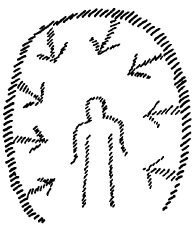
[ 23 ] If you imagine that this would be—symbolically speaking—Blavatsky, and that her aura contained occult knowledge, then certain events caused what lived within that aura to be cast back into her soul for a long time. So all the occult knowledge she possessed was to be locked away; she was to be cut off from the outside world and from her occultism.
[ 24 ] This came about at a time when H.P.B. could have become quite dangerous by disseminating information that was among the most fascinating developments on the horizon of the occult movement. Now, certain Indian occultists—who themselves leaned heavily toward the left and were primarily interested in shaping the occultism that H.P.B. had brought into the world in such a way that it would work in the world in accordance with their own special interests—learned of this matter. Through the efforts of these Indian occultists, who were familiar with the relevant practices, her confinement was lifted, she was set free once more, and she was now able to use her spiritual powers properly again, so that they were no longer held back.
[ 25 ] From this you can already see what had essentially been taking place within this soul, and what elements made up what came into the world through this personality. But because certain Indian occultists had earned the merit of freeing her from her confinement, they also had her in their power in a certain sense, and there was simply no way to prevent these Indian occultists from using the personality of Blavatsky to introduce into the world that aspect of occultism which suited them. Thus, something quite remarkable came about. It was, so to speak—if I may use such a crude expression—somewhat arranged. I can describe what was arranged roughly as follows. The Indian occultists wanted to assert their own specific aims against the specific aims of the others, and to that end they made use of Madame Blavatsky. H.P.B. was dependent on receiving an influence from outside: her mediumistic state always had to be induced from outside. That is why it was also possible to bring all sorts of things into the world through her.
[ 26 ] Around this time, H.P.B. became associated with a person who, strictly speaking, had no direct interest in Theosophy from the outset, but who possessed exceptional organizational talent: namely, Olcott. I cannot say for certain, but I suspect that a certain connection had already existed during the time when H.P.B. belonged to the American Lodge. Then, in a sense under the guise of a former individuality, a personality entered H.P.B.’s spiritual field of vision who was essentially the bearer of that which they wished to launch from India into the world. Some of you may know that Colonel Olcott, in his book *People from the Other World*, wrote extensively about this individual who now entered H.P.B.’s sphere of vision under the guise of a former individuality, who has been referred to as Mahatma Koot Hoomi. You may know that Olcott wrote a great deal about this Mahatma Koot Hoomi, including the fact that in 1874, Mahatma Koot Hoomi spoke about which individuality dwelt within him. He stated that his real name was John King and that he had been the individuality of a powerful pirate in the 17th century. This is recorded in Colonel Olcott’s book *People from the Other World*. Thus, Mahatma Koot Hoomi is said to be the spirit of a notorious 17th-century pirate who, in the 19th century, was responsible for the significant phenomena that occurred with the help of the medium H.P.B. and others. He brought teacups from afar; he caused all sorts of documents from the coffin of H.P.B.’s deceased father to appear, and so on. According to Colonel Olcott’s account, one would therefore have to assume that these were the deeds of the renowned 17th-century pirate.
[ 27 ] Colonel Olcott, for his part, made some curious remarks about this John King. He says that we may not be dealing at all with the spirit of that pirate, but perhaps with a being belonging to an order that exists among physical human beings as a visible order, while it is dependent on invisible beings for its results. Mahatma Koot Hoomi would thus have been a member of an order that, during his lifetime, engaged in the activities I have described—activities that were to be communicated to the world through H.P.B., but which were linked to all sorts of special interests. These interests consisted, in particular, of a strong urge to spread an Indian doctrine.
[ 28 ] This, then, was the state of affairs in the 1870s. You can see, then, that these were very significant events, but they must be viewed in context if one is to grasp the entire course of the occult movement. This same John King is the one who, through the process of precipitation, brought about Sinnett’s books—both the first book, *Letters from the Occult World*, and, in particular, the book *Esoteric Buddhism*.
[ 29 ] This book, *Esoteric Buddhism*, came into my hands—actually very shortly after it was published, just a few weeks later—and at the time I could see from it how, essentially, there was an effort, particularly from a certain quarter, to give the spiritual teaching a thoroughly materialistic form. For if you were to tackle *Esoteric Buddhism* with all the tools you have now acquired over time, you would be astonished by the materialistic forms in which the ideas are presented there. We are dealing with one of the worst forms of materialism. The spiritual world is portrayed there in a downright materialistic manner. No one who merely picks up the book *Esoteric Buddhism* can rise above this materialism. The material is indeed presented in a highly refined manner, but in Sinnett’s book, one cannot escape the material realm at all, no matter how high one climbs. So it was not only the case that those who were now H.P.B.’s spiritual breadwinners—forgive the materialistic analogy—had special interests in the Indian sense, but they also made the most sweeping concessions to the materialistic spirit of the age. And just how right they were in their speculation could be seen in the influence that Sinnett’s book had on a great many people. I have met natural scientists who were delighted by Sinnett’s book because everything fit right into their worldview, and yet they could still conceive of a spiritual world. The book catered to all the demands of materialism and yet offered the possibility of satisfying the need for a spiritual world, of acknowledging a spiritual world.
[ 30 ] Now you know that it was precisely in the context of the further development of these events that H.P.B.—it was at the end of the 1880s—wrote her *Secret Doctrine* and then died in 1891. This “Secret Doctrine” is written entirely in the style of “Esoteric Buddhism,” except that some very gross errors—which any occultist could have corrected immediately—have been rectified in the “Secret Doctrine.” I have spoken often about the peculiarities of Blavatsky’s “Secret Doctrine.” So I need not repeat that in this context. Then, on the basis of what had come about in this way, the Theosophical Society was founded and, in essence, retained its Indian character, albeit in a less intense manner than it had been under the influence of John King; but the Indian influence, the Indian flavor, remained throughout. So what I have just described to you was, in a sense, a new path that took the materialism of the age seriously but was intended to point out to humanity that we are dealing with a spiritual world and not merely with the outer material world.
[ 31 ] Now, many details—but we don’t have time for them—would have to follow what I have just described. But I want to get right to the point to show you how our Spiritual Science movement, as we call it, had to position itself within the movement that was already in place.
[ 32 ] As you know, we founded the German Section of the Theosophical Society in October 1902. Now, I had already been giving lectures in Berlin since the winter of 1900—and also in the winter of 1901—which can indeed be called theosophical lectures, since they were given within the circle of Berlin theosophists, that is, those theosophists who had invited me to give these lectures. The first lectures were those that became the book *Mysticism at the Dawn of Modern Spiritual Life*. These were given to a group of members of the Theosophical Society, of which I was not a member at the time. Let us first note that we were dealing with a widespread teaching—a teaching that had inspired people to turn their attention toward the spiritual world. So, in a sense, there were people all over the world who were primed to learn about the spiritual world. These people knew nothing of what I have told you today; they had no idea about it. They had a sincere longing for the spiritual world and, out of this longing, had joined the movement in which such a longing could be satisfied. Thus, within this movement, one found those hearts that yearned for an understanding of the spiritual world.
[ 33 ] Now you know that I am being accused, in a grotesquely comical way, of having made a sudden shift from an entirely different worldview, one that was most recently articulated in my book *Worldviews and Philosophies of Life in the 19th Century*. The first part was published in February 1900, and the second part in October 1900. I am accused of having shifted toward theosophy. I have often told you that not only was it the case that, for example, Sinnett’s book had fallen into my hands immediately after its publication, but that I had also had close ties with the very young Vienna Theosophical Society. You must summarize the circumstances of that time; and I would like to briefly give you an opportunity to look at this—I would say—background of the German Section in an open, objective manner. There were people there who yearned for the spiritual world, and it was in their circle that I had given the lectures. These were the lectures I gave in the small room at Count Brockdorff’s on mysticism and the mystics. I myself was not a member at that time. The preface to the printed edition of these lectures is dated September 1901. So I compiled the lectures that had been given during the winter of 1900–1901 in the summer of 1901, and the book was then published in September under the title *Mysticism at the Dawn of Modern Spiritual Life*.
[ 34 ] You must now take the first words of this book's preface. I will read them to you:
[ 35 ] “What I present in this work was previously the subject of lectures I gave last winter at the Theosophical Library in Berlin. I was invited by Countess and Count Brockdorff to speak on mysticism before an audience for whom the matters at hand are a vital question of life. — Ten years ago, I would not yet have dared to fulfill such a request. Not that the world of ideas I express today had not already been alive within me at that time. This world of ideas is already fully contained in my *Philosophy of Freedom* (Berlin 1894, Emil Felber). But to articulate this world of ideas as I do today, and to make it the foundation of a line of thought as it is done in this work, requires something quite different from being rock-solidly convinced of its intellectual truth. It requires an intimate engagement with this world of ideas, the kind that only many years of life can bring. Only now, having enjoyed this engagement, do I dare to speak as one will perceive in this work.”
[ 36 ] Now you can imagine why I incorporated what I had presented as lectures in a wide variety of circles into an occult movement. Already in the first volume of my *Welt- und Lebensanschauungen* (Worldviews and Philosophies of Life), the chapter on Schelling contains the following. I am quoting from the first edition, which was dedicated to Ernst Haeckel and published in February 1900. I will read aloud a few passages from it—passages that appear in a book said to have sprung from a worldview entirely different from that found in *Mysticism*:
[ 37 ] Page 80: “Now there are two ways to describe the one being that is both spirit and nature. One is: I point out the laws of nature that are actually at work. Or I show how the mind proceeds to arrive at these laws. In both cases, I am guided by one and the same thing. In one case, the regularity of nature, as it operates in nature, reveals itself to me; in the other, the mind shows me what it does to create a mental image of that same regularity. In one case, I pursue natural science; in the other, Spiritual Science. Schelling describes how these two belong together in a compelling way: “The necessary tendency of all natural science is to move from nature toward the intelligent. This, and nothing else, underlies the endeavor to develop a theory of natural phenomena. The highest perfection of natural science would be the complete spiritualization of all natural laws into laws of intuition and thought. The phenomena (the material) must disappear entirely, and only the laws (the formal) remain. Hence, the more the law-like nature of nature itself comes to the fore, the more the shell disappears, the phenomena themselves become more spiritual, and ultimately cease entirely. Optical phenomena are nothing other than a geometry whose lines are drawn by light, and this light itself is already of an ambiguous materiality. In the phenomena of magnetism, every trace of materiality has already vanished, and of the phenomena of gravity—which even natural scientists “believed they could comprehend” only as an immediately spiritual influence—an action at a distance—nothing remains but its law, the large-scale manifestation of which is the mechanism of celestial motions. The perfect theory of nature would be the one by virtue of which the whole of nature dissolves into an intelligence. The dead and unconscious products of nature are merely nature’s failed attempts to reflect upon itself; so-called “dead nature,” however, is an immature intelligence, and thus, even in its unconscious phenomena, its intelligent character is already discernible. Nature achieves its highest goal—to become an object entirely in itself—only through the highest and final reflection, which is nothing other than man, or more generally, what we call reason; through this, nature first returns completely to itself, and thereby it becomes evident that nature is originally identical with that which is recognized in us as intelligent and conscious.>»
[ 38 ] And, continuing in the vein of Schelling, I then say on page 85:
[ 39 ] “As his thinking progressed, Schelling’s view of the world became a contemplation of God, or theosophy. He was already fully grounded in such a contemplation of God when he published his *Philosophical Investigations into the Nature of Human Freedom and Related Subjects* in 1809. All questions of worldview now appeared to him in a new light. If all things are divine: how is it that there is evil in the world, since God can be nothing but perfect goodness? If the human soul is in God: how is it that it nevertheless pursues its own selfish interests? And if it is God who acts within me: how can I—who therefore do not act as an independent being at all—nevertheless be called free?”
[ 40 ] This worldview is not rejected. —- And further on, on page 90, I say:
[ 41 ] “With such views, Schelling has proven himself to be the boldest and most courageous of those philosophers who were inspired by Kant to adopt an idealistic worldview. Under the influence of this inspiration, people abandoned philosophizing about things that lie beyond what the human senses can observe and what thought says about those observations. People sought to be content with what lies within the realm of observation and thought. But while Kant concluded from the necessity of such modesty that one could know nothing about things beyond this world, the post-Kantians declared: since observation and thought point to no divine reality beyond this world, they themselves are the divine. And of those who made such a declaration, Schelling was the most forceful. Fichte incorporated everything into the “I”; Schelling extended the “I” over everything. Unlike Fichte, he did not seek to show that the “I” is everything, but rather, conversely, that everything is the “I.” And Schelling had the courage not only to declare the conceptual content of the “I” to be divine, but also the entire human spiritual personality. He made not only human reason divine, but also the very substance of human life into the divine, personal essence. An explanation of the world is called anthropomorphism when it proceeds from human beings and creates a mental image of a being that guides the course of the world as a whole just as human beings guide their own actions. Even those who attribute a general world reason to events are explaining the world anthropomorphically. For this general world reason is nothing other than human reason made universal. When Goethe says, “Man never realizes how anthropomorphic he is,” he is reminding us that even the simplest statements we make about nature contain hidden anthropomorphisms. When we say that a body continues to roll because another has pushed it, we form such a mental image based on our own “I.” We push a body, and it continues to roll. When we see a sphere moving toward another, and the latter then rolls on, we imagine that the first has pushed the second, analogous to the pushing force that we ourselves exert. Ernst Haeckel maintains that the anthropomorphic dogma “compares God’s creation and governance of the world to the artistic creations of an ingenious ‘technician’ or ‘mechanical engineer’ and to the governance of a wise ruler. God the Lord, as the Creator, Sustainer, and Ruler of the world, is thereby depicted in His thinking and actions as having a thoroughly human-like mental image.” Schelling had the courage to embrace the most consistent form of anthropomorphism. Ultimately, he declared humanity—with its entire substance of life—to be a deity. And since this substance of life includes not only the rational but also the irrational, he was able to account for the irrational within the world as well. To this end, however, he had to supplement the rational perspective with another that does not have its source in thought. This view, which he considered superior, he called “positive philosophy.” It “is the true free philosophy; whoever does not want it may disregard it—I leave it up to each individual—I only say that if, for example, one desires the true course of events, if one desires a free creation of the world and so on, one can attain all this only through such a philosophy. If rational philosophy is enough for him, and he demands nothing beyond it, then he may stick with it; he must simply give up the idea of wanting, through rational philosophy and within it, what it simply cannot possess—namely, the real God, the real course of events, and a free relationship between God and the world.” Negative philosophy will “remain primarily the philosophy for the school, while positive philosophy will be that for life. Only through both together will the complete initiation be granted that one must demand from philosophy. As is well known, in the Eleusinian initiations a distinction was made between the Lesser and the Greater Mysteries; the Lesser were regarded as a preliminary stage to the Greater... Positive philosophy is the necessary consequence of negative philosophy properly understood, and so one may well say: in negative philosophy the lesser mysteries of philosophy are celebrated, and in positive philosophy the greater ones.”
[ 42 ] This chapter in *Worldviews and Philosophies of Life* concludes with the following words:
[ 43 ] “If inner life is declared to be the divine, then it seems inconsistent to stop at only a part of that inner life. Schelling did not commit this inconsistency. The moment he said that ‘to explain nature is to create nature,’ he set the direction for his entire worldview. If the thoughtful contemplation of nature is a repetition of its creation, then the fundamental character of this creation must also correspond to that of human action; it must be an act of freedom, not one of geometric necessity. However, we cannot recognize free creation through the laws of reason; it must reveal itself through some other means.”
[ 44 ] I had to write a history of worldviews in the 19th century. I could not go any further; for what was then taking shape in the course of progressive development consisted entirely of amateurish attempts that had no influence on the advancement of philosophical research. That could not form a chapter in this book. But theosophy, insofar as it has been incorporated into serious thought, can be found there in the chapter on Schelling.
[ 45 ] Now, please note that the second part of this book—which deals exclusively with Hegel—bears the date October 1900. That was when I first began giving those lectures, and by September 1901, *Mysticism* had already been published. Truly not to make a personal point, but to enable you to form an unbiased judgment, I would like to draw your attention to a review of the book *Worldviews and Lifestyles in the 19th Century* that appeared on December 15, 1901, in *Der Freidenker*, the journal of the German Freethinkers’ League. In it, following an introduction and a statement that a readable account of the development of worldviews in the 19th century is lacking, the reviewer writes:
[ 46 ] “Particularly in the field of philosophy, where ‘one can argue admirably with words and construct a system with words,’ many sins have been committed in popular writings. The ‘Guardians of Zion’ and ‘disciples of order’ of every stripe, along with their scholarly clique—to which, unfortunately, many a university professor belongs—have much to answer for.”
[ 47 ] The following paragraph is intended merely to highlight the favorable reception the book received at the time:
[ 48 ] “It is therefore all the more cause for celebration that Dr. Steiner, a writer known as a modern thinker and activist, has undertaken to provide the German public with an objective account of the intellectual struggles over worldview that took place in Germany in the 19th century.”
[ 49 ] Then he quotes an excerpt from the book. But then something strange is said, and that is why I must share all of this with you. The person who wrote this review feels that something is missing from the book, and he expresses this as follows:
[ 50 ] “Even if Du Prel’s spiritualism and Tolstoy’s anchoritic early Christianity have become useless for cultural activity based on the idea of evolution, their symptomatic value cannot be overlooked. Likewise, Neo-Buddhism (Theosophy), which has developed its own jargon—a sort of ‘mystical gibberish’—could have found a place here. A psychology of modern belief in spirits by a man as witty as Steiner would certainly have been welcome. The language of the work is easy to understand. No lengthy, academic philosophical sentences interfere with the reader’s enjoyment.”
[ 51 ] This was written in December 1901, shortly after I had begun giving theosophical lectures in Berlin. One could say: objectively, it was required at that time; publicly, it was demanded that I speak out about what Theosophy stands for. It was not a matter of whim; it was a clear sign from karma, as they say.
[ 52 ] I had given the lectures on mysticism in the winter of 1900–1901, and in the winter of 1901–1902 I gave those that dealt in somewhat greater detail with the Greek and Egyptian mystery traditions; these were then published in the book *Christianity as a Mystical Fact* in the summer of 1902. A large portion of “Mysticism at the Dawn of Modern Spiritual Life” was immediately translated into English, even before I became a member of the Theosophical Society. Now, I could tell you many things—but there isn’t enough time for that—things that are important, but which can be told another time. There is one thing, however, that I must tell you.
[ 53 ] You can see how, unlike anywhere else, this continuous development shows no sudden leaps or anything of the sort, and how everything has come about in a completely natural way. However, even at the beginning of the lecture series I gave on the Greek and Egyptian mystery traditions—again at the library in Berlin in the Brockdorff House— that is, already during the second lecture series, I had a little opportunity to catch a glimpse of what was not so bad at the time, but which, if carried out further and more consistently, can lead to the things that have been discussed here under the title “Mystical Eccentrities.” I believe Mr. Bauer coined that title.
[ 54 ] So in 1901–1902 I spoke about the Greek and Egyptian mystery traditions, and Dr. Steiner’s wife was present at these lectures; she had also attended the lecture I gave at the Theosophical Society on Gustav Theodor Fechner in the winter of 1900. It was a special lecture that did not belong to the other series. So as early as the winter of 1900, Dr. Steiner’s wife was present at some of the lectures I gave at that time. It would be interesting to share a few small details about her attendance. But they can also be omitted; they would only add a bit of color to the story. That can happen another time, if necessary.
[ 55 ] After Dr. Steiner had been away from Berlin for a while, she returned to Berlin from Russia in the fall and then attended the first lectures of the second cycle in the winter of 1901–1902 with an acquaintance of Countess Brockdorff. At that time, after one of the lectures I had given on the Greek mysteries, that acquaintance came up to me and said—well, something along the lines of what I described earlier. This lady then became an increasingly fanatical follower of the Theosophical Society and later also attained a high position in the Order that was founded for the rebirth of Christ. This lady was also present at that time and approached me after a lecture I had given on the Greek mysteries; she assumed the demeanor of an initiate of the Theosophical Society—the demeanor of a deeply initiated person—who first attested to her initiation by saying: “Yes, you are speaking now of mysteries, but such things still exist today.” There are still very secret societies today. Did you know that, too?
[ 56 ] After the next lecture—again on the Greek mysteries—she approached me once more and said, “It’s clear that you still remember well what was taught when you were still involved in the Greek mysteries!” — That is what, in further training, already borders on the chapter ‘mystical eccentricity.’
[ 57 ] In this connection, I might mention that in the fall of 1901, that acquaintance of Countess Brockdorff hosted a tea party. Dr. Steiner always refers to it as “the chrysanthemum tea” because there were so many of those flowers there. The invitation came from that acquaintance, and in retrospect I have sometimes formed the impression that this lady wanted—well, I don’t know what. The date chosen was the anniversary of the founding of the Theosophical Society, a particularly important day for this lady. Perhaps she wanted to try to turn me into a committed collaborator in her cause; she felt her way around, and at times was quite insistent. But nothing else of significance came of it. However, I would now like to mention a conversation from the fall of 1901 that took place between the current Dr. Steiner and me at that “Chrysanthemum Tea,” during which she asked whether it might not, after all, be very necessary to launch a spiritual movement in Europe. In the course of the conversation, I clearly stated the following: Certainly, it is necessary to launch a movement in the field of Spiritual Science; but I will only support a movement that builds upon Western occultism—and exclusively upon it—and develops it further. —And I said in this regard that we must build upon Plato, Goethe, and so on. I pointed to the entire program, which was then also carried out.
[ 58 ] There was truly no place for unhealthy activities in this program, but of course many people with such inclinations did approach us, because we were dealing with individuals who were influenced from all sides by the movement I have told you about. However, as this program necessarily entailed a complete rejection of all forms of mediumship and atavism, you can see this from the conversation I had with a member of the English society, which I cited at the beginning of this lecture.
[ 59 ] You can see that, with full awareness, we have set out on the path that has guided us through these long years. Even though many elements have emerged along this path—including all manner of mediumistic and atavistic clairvoyance—we have not strayed from this path, and it has led us to where we are today.
[ 60 ] As a result, however, I was dependent on finding people within the Theosophical Movement who had the heart and mind for such a thoroughly sound method. All those who did not want such a sound—yet strictly scientific—movement, conducted under strict scientific accountability, have always treated what we have been doing in such a way that they first distorted our achievements in their own way, as you can see from the example that is now causing you so much of a headache—or perhaps not! — and which has then brought about so much hostility, as you can again see from this example. But what can become clear to you once more from a historical perspective is that running through all this work is a refusal to shy away from entering the highest spiritual worlds, insofar as they can now graciously open up to humanity from the higher world; but that, on the other hand, anything that could not be attained through sound means—not through the methods for the proper entry into the spiritual worlds—is strictly rejected. Anyone who can recognize, evaluate, and trace this historically need not accept it merely as an assurance; rather, they see it in the very nature of the work as it has been carried out over the years. We have had the opportunity to go much, much further in the actual exploration of the spiritual world than the Theosophical Society has ever been able to go. But we do not walk on uncertain paths; rather, we walk on sure paths. This may be said frankly and freely.
[ 61 ] That is why I have always refused to have anything to do with any kind of antiquated occultism or with any brotherhoods or communities of this sort in the field of esotericism. And only while maintaining complete independence did I work for a time in a certain outward connection with the Theosophical Society and its esoteric institutions, though not in accordance with their direction. As early as 1907, everything esoteric had been completely separated from the Theosophical Society, and you know full well what happened afterward. It also happened that occult brotherhoods made various proposals to me; and specifically, when a highly respected occult brotherhood proposed that I participate in the spread of an occultism that also called itself Rosicrucian, I left the proposal unanswered, even though it came from a highly respected occult movement. I must say this to show that we are pursuing an independent path appropriate to the present time, and that unhealthy elements must affect us in the most unpleasant way.