

The Occult Movement
in the Nineteenth Century
and its Relationship to World Culture
GA 254
10 October 1915, Dornach
Translated by Steiner Online Library
First Lecture
[ 1 ] If you consider the kinds of debates we have been having recently, you will see how, in our time—not out of human caprice, but, so to speak, out of a historical necessity—a materialist worldview and materialist thinking prevail.
[ 2 ] Anyone familiar with the development of humanity in regard to spiritual matters knows that, fundamentally speaking, all earlier centuries and millennia were marked by a greater participation of humanity in spiritual life than the last four to five centuries. We know, of course, what general phenomenon this is connected with. We know that, in the very earliest stages of Earth’s evolution, humanity inherited the gift of ancient lunar clairvoyance. We can also create a mental image of how, in the earliest times of Earth’s evolution, this ancient clairvoyance was very significant and very active, so that people back then were able to perceive an extraordinary amount of the spiritual realm, as it were. Then the ancient clairvoyance grew weaker and weaker; a time came when, for the vast majority of people, the ability to look into the spiritual world had faded away, and the time came when the Mystery of Golgotha stepped in as a substitute for human soul development. But a certain remnant of the old human soul capacities still remained, and we find this remnant, for example, when we turn our gaze to what constituted natural science as far back as the 14th, 15th, and even into the 16th and 17th centuries. For this was something entirely different from today’s natural science; it was a natural science that could still, in part—if not with clear imaginative clairvoyance, then at least with the remnants of ancient inspirations and intuitions—rely on these, which were then processed by the so-called alchemists. Such an alchemist, if he was honest and not seeking selfish gain, still worked in a certain sense with the old inspirations and intuitions. As he engaged in external practices, the old remnants of clairvoyance still worked within him, even if no longer with a strong sense of knowledge. But the number of people who possessed such old clairvoyant remnants grew ever smaller. I have often hinted at this: these clairvoyant remnants can very easily be drawn out of the human mind today through atavistic-visionary clairvoyance. We have demonstrated in various ways how this atavistic-visionary clairvoyance can manifest in our present age.
[ 3 ] From all this, however, it will become clear to you that, the closer we come to the present stage of human development, the more we are confronted with a decline in the old spiritual powers and the emergence of tendencies in the human soul that are more directed toward the observation of the external sensory world. This developed gradually and truly reached its peak in the 19th century, specifically in the middle of the 19th century. As unclear as this may still be today to people who are less concerned with these matters, it will be just as clear to the people of the future that, with regard to materialistic tendencies, the second half of the 19th century—particularly around the middle of the 19th century—truly marked a high point. The strongest materialistic tendencies developed at that time. But every tendency also results, at the same time, in the development of certain talents. And the greatness, the power that has developed within the materialistic scientific method stems precisely from the fact that these tendencies of the soul to cling to the external sensory world emerged at that time.
[ 4 ] Now, however, we must consider what has just been described, in a sense, as a stage in humanity’s development, alongside another phenomenon. If you transport yourself in spirit back to the earliest times of humanity’s spiritual development, you will find: At that time, particularly with regard to spiritual knowledge, human beings were in a relatively fortunate position. Most—almost all—people knew of the spiritual world through direct perception. Just as people today have perceptions of minerals, plants, and animals, just as they know about sounds and colors, so did these people know of the spiritual world. They also had very concrete knowledge of this spiritual world, so that in those ancient times there was virtually no one who, during the periods when full waking consciousness of the outer sensory world had dimmed—whether while sleeping or dreaming—did not have a connection with the dead who had been close to them in life. One could, so to speak, interact with the living while awake, and with the dead while asleep or dreaming. A doctrine asserting the immortality of the soul would, in the earliest times of humanity, have been a superfluous matter, just as it would be superfluous today to prove that plants exist. Imagine what it would be like if someone today wanted to prove that plants exist. That is how it would have been in the dawn of humanity if someone had wanted to prove that there is a life of the soul even after death.
[ 5 ] This ability to live in harmony with the spiritual world has gradually been lost among humankind. Certainly, there have always been individuals who cultivated clairvoyance, who took advantage of the opportunity still available to humankind to develop a special form of clairvoyance. But even that became increasingly difficult. How was a special form of clairvoyance cultivated in ancient times? You see, if, for example, one were to study Plato’s philosophy or what remains of Heraclitus’s philosophy with deep devotion even today, one would have to approach these philosophies—especially the older Greek philosophies—in a completely different way than the philosophies of later times. Try reading the first chapter of *The Riddles of Philosophy*, where I have described how these ancient philosophers—Thales, Parmenides, Anaximenes, and Heraclitus—are still connected to their “temperament.” This has not yet been described. It is presented for the first time in my book *The Riddles of Philosophy*. It will therefore take a long time before this is accepted. But that doesn’t matter. Up until Plato, one has the sense that the philosophy presented there still encompasses the whole person. This comes to an end with Aristotle. With him, one has the feeling that one is dealing with a learned, scholarly philosophy. That is why understanding Plato requires something more than what today’s philosophers are generally capable of mustering. This is also why there is a gulf between Plato and Aristotle. Aristotle is already a scholar in the modern sense, while Plato is the last philosopher in the ancient Greek sense—he is a philosopher who still possesses something of the living concepts. As long as such a philosophy exists, the connection with the spiritual world is not lost, and it persisted for a long time, well into the Middle Ages. The Middle Ages did not further develop philosophy but adopted Aristotelian philosophy. And, in relation to its own time, it did well to simply adopt this Aristotelian philosophy up to a certain point. Platonic philosophy was also adopted. | Now, as long as in ancient times at least the predispositions for a certain kind of clairvoyance were present, something very significant happened when people allowed this philosophy to take effect within them. Today, philosophy affects only the head, only thinking. That is why so many people avoid philosophy—because they do not love thinking. And especially because it offers no thrills, they do not want to study philosophy. Ancient philosophy, however, when taken into the human soul, still nourished the remaining vestiges of the clairvoyant faculties through its greater, living power. Such a philosophy was still the Platonic one, and even the Aristotelian one. They were not yet as abstract as today’s philosophies; they still nourished the clairvoyant faculties. And so it came to pass that those who devoted themselves to such philosophy nourished the clairvoyant faculties that would otherwise have sunk below the required level. Thus the clairvoyants arose. But because what one had to learn about the physical world—and philosophy as well—had significance only for the physical plane, yet was gaining ever greater importance, people drifted further and further away from the remnants of the old clairvoyance. It was no longer possible to go that far down. It became increasingly difficult to become a seer. This will only be possible again when the new method—the foundation of which was laid in *How to Attain Knowledge of the Higher Worlds*—begins to seem plausible to humanity.
[ 6 ] As you can see, things do indeed take a downward turn at first, leading to a materialistic period that, as we have seen, reached its peak—or, one might say, its low point—in the mid-19th century. One thing is certain: conditions are becoming increasingly difficult, but we must not, so to speak, sever the ties with humanity’s earlier developmental impulses.
[ 7 ] If we trace the lines showing how the Sehertum has developed, the picture is as follows:
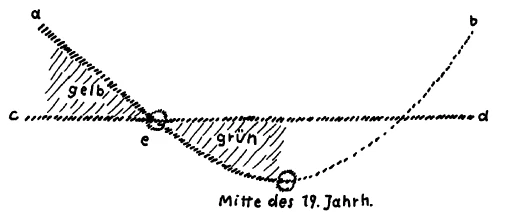
[ 8 ] Here (yellow), the seer tradition is still in full bloom; it is fading more and more (green); here we would have the mid-19th century, the low point, and from there it would have to rise again.
[ 9 ] But if we now consider the understanding of the spiritual world—indeed, the understanding of the spiritual world is something different from clairvoyance. Just as science is something different from mere sensory perception, so too is clairvoyance something different from the understanding of what is seen. This is why, in the earliest times, people were largely content with seeing, and never got around to thinking much at all; they had poured everything into their clairvoyance. But thinking also came to the fore more and more. So that I can draw the line of thinking about the spiritual worlds as follows (see diagram): This would be the line of gazing, of seeing: a–b, and this would be the line of thinking: c–d.
[ 10 ] In the ancient times of vision, human beings are absorbed in their seeing; thinking, so to speak, lies in the subconscious of the soul. The ancient seers do not think. Everything is given to them directly through their seeing. It is not until the period around the 3rd to 4th millennia that thinking takes hold of vision. There was a golden age in Indian, Persian, Egyptian-Chaldean, and also in very ancient Greek culture—a golden age in which, within the human soul, thinking, still quite fresh, united with vision. At that time, thinking was not yet as over-elaborated as it is in our time. People possessed a few great, comprehensive concepts, accompanied by vision (e). Such a state of affairs—albeit already in a weakened form—was particularly at home, for example, among the seers who founded the Samothracian Mysteries and introduced into them the great, monumental teaching of the four gods: Axieros, Axiokersos, Axiokersa, and Kadmillos. This great, monumental teaching of the four Kabiric gods, which once existed on the Thracian island of Samos, in Samothrace, was such that whoever was initiated into it received certain grand concepts and could then connect them with whatever remained of the achievements of the ancient seers. Perhaps we can also describe such things in greater detail at a later time.
[ 11 ] Then, in a sense, we see clairvoyance sink below the threshold of consciousness. It became increasingly difficult to bring clairvoyance up from the depths of the soul. But of course, it was possible to retain some of the concepts—and even develop them further—and so a time finally came when there were initiates who did not necessarily have to be clairvoyants; that is to say, initiates who did not necessarily have to be clairvoyants.
[ 12 ] At the various locations where these initiates had their gatherings—in the schools for initiates—they simply drew upon what had been preserved, in part, from ancient times—that is, things about which it could be said that ancient seers had seen them—and in part, they also drew upon what could be elicited from people who still possessed the atavistic faculties of clairvoyance. This was verified partly through historical traditions and partly through experiments. They became convinced that what they had thought was true. But little by little, there were fewer and fewer people in these societies who could still look into the spiritual world, and more and more who held a theoretical understanding of the spiritual world and expressed it through symbols and the like.
[ 13 ] Just think for a moment about what this must have led to around the middle of the 19th century, when people’s materialistic tendencies had reached a low point. Of course, there were people who knew that a spiritual world exists and who also knew what is contained within that spiritual world, but who had never actually seen it. Indeed, the most outstanding scholars of the 19th century were precisely those who had not actually seen anything at all of the spiritual world, but who knew that a spiritual world exists and were able to reflect upon it, and who could also discover new truths with the help of certain methods and a certain symbolism preserved in the ancient tradition. For example—to mention just one thing—if you draw a human figure, you cannot glean anything in particular from looking at the picture. But if one draws a human figure with a lion’s head and another with a bull’s head, then someone who has learned to interpret such things can glean a great deal from such a symbolic representation. Or if one paints a bull with a human head or a lion with a human head, then someone who is initiated into such matters can learn a great deal from it. Such symbols were recorded in great numbers, and there were serious societies where one could learn this symbolic language—about which I do not wish to say more than I have already said, since the schools of the initiated guarded these symbols very strictly and did not reveal them to anyone who had not pledged to remain silent about these matters. To be a true initiate, one needed nothing more than this symbolic language—that is, a certain symbolic script.
[ 14 ] Thus, in the mid-19th century, the general human race—especially the civilized portion of it—had, deep in its subconscious, an awareness of the spiritual realm, yet this same human race held only materialistic inclinations. But there was a large number of people who knew that a spiritual world exists, who knew that just as we are surrounded by air, we are surrounded by a spiritual world. At the same time, however, these people were burdened with a certain responsibility, for they could not point to any immediately available abilities to demonstrate that a spiritual world exists, and yet they did not want to let the outside world sink into its materialistic tendencies. Thus, those who were initiated faced a very special situation in the 19th century—the situation in which they had to ask themselves: Should we continue to preserve what has been handed down to us from ancient times only within narrow circles, within the circles of various societies, and should we stand by and watch as all of humanity, along with its culture and philosophy, sinks into materialism? Should we just stand by and watch? — They could not afford to stand by indifferently, especially those who took these matters very seriously.
[ 15 ] And so it came to pass that in the mid-19th century, among those who were initiated, the terms “esotericists” and “exotericists” took on a meaning different from their earlier one when used in private conversation. The occultists were, in effect, divided into two factions: the exotericists and the esotericists. If one were to use the terminology of today’s parliaments for comparison—which, of course, is fundamentally unsuitable—one could compare the exotericists to the parties sitting on the left in parliament, and the esotericists to the parties sitting on the right. The esotericists were, in fact, those who wished to continue adhering to the strict principle of not allowing anything from the sacred, traditional knowledge to become public, and not allowing anything that might lead a thinking person to penetrate the symbolic language to become public. The esotericists were thus, in a sense, the conservatives among the occultists. And the exotericists—yes, one might ask, what exactly are the exotericists? They are, in fact, those who wish to make a part of the esoteric public. Essentially, the exotericists were nothing other than the esotericists; they were simply inclined to heed their sense of responsibility and to publish a portion of the esoteric knowledge.
[ 16 ] This really sparked a widespread debate at the time—one of which the outside world, of course, knows nothing, but which was particularly intense in the mid-19th century. Truly, the disputes and discussions between the esotericists and exotericists were far more intense than the disputes between conservatives and liberals in the parliaments. The esotericists took the position that they would speak of the spiritual world—and impart knowledge of it—only to those who would undertake the strictest obligation of secrecy and wished to belong to a society. The exotericists said: In this way, those who do not join such a society or such a fellowship will sink into materialism.
[ 17 ] And now the exotericists proposed a path, and I can tell you this today: we are following the path that the exotericists proposed back then. The path we are following is the one the exotericists proposed, namely, to make a certain part of esoteric knowledge accessible to the general public. You can also see how we have worked using what can be found in popular writings, so that one can gradually ascend into the spiritual worlds.
[ 18 ] In the mid-19th century, people were not yet ready for anyone to dare admit such a thing based on their beliefs. Of course, in such circles, things do not work in such a way that votes are held. It is, to put it this way, already symbolic, but one can still say: in the first vote, the esotericists had prevailed, and the exotericists had to comply. People did not resist the community because they held fast to the good old precepts of solidarity. It is only in more recent times that things have reached the point where members are expelled or choose to resign. Such things did not happen in the past, because people understood what it means to stand together in brotherhood. So, naturally, the exotericists had no choice but to comply. But their responsibility—their responsibility toward all of humanity—weighed heavily upon them. They felt, in a sense, like guardians of evolution. This weighed heavily upon them, and so it came to pass that the matter did not remain at the first vote—if I may use that term again—but rather that they proceeded to what is called a compromise—I will again use a term borrowed from the outside world, and thus symbolic—a kind of compromise. This means the following.
[ 19 ] It was said—and even the esotericists admitted this—that it is urgently necessary for humanity at large to realize that there is not merely matter, nor merely material laws, and nothing spiritual in the world around us; rather, humanity must realize that just as we are surrounded by the material, we are also surrounded by the spiritual, and that human beings are not merely what they appear to be when we view them in a material sense, but that they also possess something within themselves that is of a spiritual and soul nature. We must preserve humanity’s ability to know such things. This was the agreement reached; that was the compromise.
[ 20 ] But the esotericists of the 19th century were not prepared to reveal esoteric knowledge. Esoteric knowledge was not to be revealed. Therefore, it was necessary to allow for another method that emerged in the world. How it came about is a complicated story. I have spoken of this on several occasions; particularly on the occasion of the founding of individual branches, I have often spoken of the events that took place there. So it was said: We do not want to publish esoteric knowledge; but we must take the materialism of the age into account. — In a sense, it was a well-founded principle based on experience, one from which the esotericists in particular proceeded. For when we see how esoteric knowledge is often received in the present day, we can certainly have understanding and sympathy for those who, as esotericists at that time, said: “We want nothing to do with the publication of esoteric knowledge.” — We need only realize that we can observe time and again how the publication of esoteric knowledge becomes nothing short of a calamity, and how those who receive esoteric knowledge themselves create obstacles and barriers to its dissemination. We have, after all, spoken about this many times in recent weeks: such barriers and obstacles that are erected are still given far too little consideration. One really has to go through the worst of experiences when it comes to publishing esoteric knowledge. Even with the best of intentions to help the individual, calamities arise even in the most basic matters! You wouldn’t believe how often it happens that this or that piece of advice is given to the individual. But the advice doesn’t please him. When the outside world speaks of an occultist who works as we do here having great authority, that is nothing but empty talk. As long as advice is given that pleases people, the occultist usually gets by. But when advice is given that no longer pleases them, they do not accept it. People even threaten, saying: “If you don’t give me different advice, I won’t be able to cope.” — It goes as far as threats, and yet the only thing that has happened is that what is good for the person in question has been told to them. But since he wants something else, he says: “I’ve waited long enough; now tell me what this is all about!” He was told this long ago, but he doesn’t like it. This then escalates further and further, ultimately leading to the point where those who were initially the most devout followers of authority become the most bitter enemies. For they expect the advice they want, and as soon as they receive advice other than what they want, they turn into bitter enemies. Our own time, therefore, teaches us that we cannot simply condemn the esotericists who said they would not engage in the popularization of esoteric truths.
[ 21 ] And so, in the mid-19th century, such a popularization did not take place; instead, people sought to capitalize on the materialistic tendencies of the age. Yes, it is difficult to put into words what needs to be said; I can only express it in words that have never been spoken before, but they are true. Back then, the esotericist said: “What am I to do with this humanity! I could lecture them at length on the true teachings of esotericism, but at best they’ll just laugh at me and at you.” At best, you’ll get a few gullible people—some gullible women, a few gullible men—but those who value scientific rigor, you won’t be able to win them over. You must take the prevailing tendencies of the age into account!
[ 22 ] As a result, attempts were made to find a method by which people could be made aware of the spiritual world—in much the same way that, from a materialistic perspective, people are made aware of something like the fact that, in criminals, the occipital lobe does not cover the cerebellum at all or only partially. Thus it came to pass that mediumship was deliberately staged. In a sense, the mediums were the agents of those who wanted to use this method to convince people of the existence of a spiritual world, because through them one could see with physical eyes what originated in the spiritual world, since they produced something that could be demonstrated on the physical plane. Mediumship was a means of teaching people that a spiritual world exists. The exotericists and esotericists had agreed to promote mediumship in order to accommodate the spirit of the age.
[ 23 ] Consider—for in a certain sense this is not a bad thing—what Mr. von Wrangell wrote on page 41 of his pamphlet: “It suffices to recall names such as Zöllner, Wallace, du Prel, Crookes, Butlerow, Rochas, Oliver Lodge, Flammarion, Morselli, Schiaparelli, Ochorowicz, James, and others.” How did they come to believe in a spiritual world? Because they had received messages from the spiritual world—and perhaps had to receive them. But everything that can be done through the spiritual world and through the world of the initiated is, at first, essentially an experiment with the human world. One must always assess what humanity is already ready for. So this promotion of mediumship and spiritualism was, in a sense, an experiment. And this experiment actually took the form that both the exotericists and the esotericists, who had reached a compromise, could only say: “Let’s see what comes of it.” — And what did come of it?
[ 24 ] Most of the media reported on a world inhabited by the dead. Just read the literature on this subject. What emerged from it was, for those in the know, deeply distressing. The worst possible outcome had come to pass. For, you see, two things were possible. One was: people used mediums. The mediums convey something. What they convey can only relate to the ordinary environment, which, after all, also contains spirit in its sensory elements. People had expected the mediums to reveal all sorts of secret laws of nature, elemental laws of nature. Nothing else could have come of it at first, for the reason that follows.
[ 25 ] We know that the human being consists of a physical body, an etheric body, an astral body, and the “I.” From the moment of falling asleep until waking up, the true human being is therefore present in the “I” and the astral body. At the same time, however, he is also in the world where the dead reside. But the medium sitting there is not an “I” and an astral body. In this medium sitting there, the “I” consciousness and the astral consciousness are suppressed; the physical and etheric bodies are made particularly active. This allows the medium to enter into a relationship with a hypnotist or an inspirer—that is, with another human being. Another person’s “I” or even the surroundings can then influence the medium. In fact, the medium lacks the ability to enter the realm of the dead, because it has precisely extinguished that which belongs to the realm of the dead. Thus, the mediums have failed. They have given accounts supposedly from that very realm in which the dead reside. It thus became clear that these experiments had achieved nothing other than spreading a great error. One could therefore conclude one fine day that a path had been taken which led people into error, for it led them into a purely Luciferic doctrine linked to purely Ahrimanic observations. Thus, an error had been spread, and nothing good could come of it. This was gradually recognized.
[ 26 ] So you can see how an attempt was made to take the materialistic tendencies of the age into account while still instilling in people an awareness that a spiritual world surrounds us. As we have seen, this path initially led to an error. But from this you can see how necessary it is to truly take the other path. This path—truly beginning to make a part of esoteric knowledge exoteric—must be taken, and one must take it even if it brings calamity upon calamity. The very fact that we are engaged in Spiritual Science is, so to speak, an acknowledgment of the necessity of carrying out the principle advocated by the exotericists of the mid-19th century. And the nature and aim of Spiritual Science we wish to pursue is nothing other than to carry out this principle in a certain way—to carry it out honestly.
[ 27 ] From all of this, however, you can see that materialism is not merely a subject for speculation, but something that must be understood in terms of the necessity of its emergence—particularly its peak or low point around the middle of the 19th century. The process, however, had already begun quite some time ago—three, four, or five centuries ago. During that time, people’s spiritual inclinations sank deeper and deeper into the subconscious. Thus, the mid-19th century merely marked the culmination of this process. But this was also necessary so that people’s purely materialistic talents could develop unhindered by occult abilities. A materialist philosopher like Kant—a materialist philosopher from the standpoint of the 19th-century idealists (as you can easily read in my book *The Riddles of Philosophy*)—would never have been possible had occult abilities not receded into the background. Certain abilities develop in human beings when others recede. But while, in a sense, one kind of ability—talent—develops outwardly, the other kind follows its inner path. These three, four, or five centuries of materialistic development were therefore by no means lost for the spiritual development of humanity. Beneath the threshold of consciousness, the spiritual has continued to develop; and when people reflect on what I hinted at in my discussion of Mr. von Wrangell’s pamphlet—on what he called the “dreamlike”—they will be able to bring forth the occult abilities that are merely waiting to unfold. They are there; they are abundantly present in people’s souls; they merely need to be brought to the surface—brought to the surface in the right way.
[ 28 ] These are the points I had to address first, so that tomorrow I can move on to the question of what prospects arise regarding the relationship between the living and the dead, once we take into account how enlightening—on the one hand—the wrong path has been, the one that resulted from the compromise between the exotericists and the esotericists. Precisely in order to recognize the nature of this compromise, we must consider the concepts of birth and death and then demonstrate the connection to materialistic methods.