

The Artistic World-Mission
GA 276
1 June 1923, Dornach
Translated by Steiner Online Library
Second Lecture
[ 1 ] One of the results of an anthroposophical Spiritual Science that is properly understood and truly integrated into modern civilization will be that it will have a stimulating effect on all artistic endeavors. It must be strongly emphasized, especially in our time, that human inclinations toward the arts have declined significantly. Indeed, it might even be said that within anthroposophical circles there is not always a full understanding of our aim to incorporate artistic elements into the anthroposophical movement to the greatest extent possible. This is, of course, connected to the aforementioned general aversion of modern humanity toward the artistic.
[ 2 ] It can be said that, in a profound way, Goethe ultimately perceived the entire intellectual life—and art within that intellectual life—as a single unity, and that art came to be seen more and more as something that does not actually belong in life as a necessity, but rather, in a sense, is added to life—one might almost say as a kind of luxury. No wonder, then, that under these circumstances, the artistic often takes on the form of a luxury.
[ 3 ] It was precisely characteristic of earlier times—which, as I have often described, maintained a living connection to the spiritual world through the remnants of ancient clairvoyance—to seek something in the arts without which a general civilization cannot exist. From today’s perspective, one might feel antipathy toward what we sometimes call the rigidity of Oriental or African art forms, but that is not the point. What matters to us at this moment is not how we relate to individual art forms, but rather how the artistic has been integrated into general civilization through the mindset of human beings. And we would like to discuss this today as a foundation for the reflections we intend to make now and in the following lectures. We must recognize a certain connection between the overall character of today’s spiritual life and the artistic mindset that I have just characterized in a few words.
[ 4 ] If one strives to view human beings—as is done today—solely and entirely as nature’s supreme product, as nature’s highest being, as the being that emerged at a certain point in Earth’s evolution within the evolutionary sequence of other beings, then one distorts humanity’s entire relationship to the world, because in truth, human beings cannot have that contented relationship with the external world if they surrender to the elemental impulses in their souls—impulses they would have to possess if it were true that they were, so to speak, merely the culmination of nature’s creation. If the animal kingdom had simply evolved in the way that is today regarded by science as the standard scientific view, then humanity—which could be nothing other than this very highest product of nature—would actually have to be completely satisfied with its place in the universe, in the cosmos. It would have no special urge to create anything beyond the natural. If, for example, one wishes to create something in art, as the Greeks did in their idealized representation of humanity, then one must, in a certain sense, be dissatisfied with what nature provides. For otherwise, if one were satisfied, one would not introduce anything into nature that goes beyond nature itself. If one were completely satisfied musically with the song of the nightingale and the lark, one would not compose sonatas and symphonies, for one would perceive that as something untrue, something false. The true, the natural, would have to be exhausted in the song of the nightingale and the lark. In fact, the current worldview demands that one be content with imitating nature if one wishes to create anything at all; for the moment one creates something beyond nature, one must perceive this act of creation as something false—unless one accepts a world other than the natural one. This is something one should certainly recognize.
[ 5 ] Of course, people today do not draw the artistic conclusion of naturalism. For what would result if one were to draw the artistic conclusion of naturalism? At most, one could assert that one should imitate only what exists in nature. Yes, a Greek—or even a member of an older civilization, say a Greek from the time before Aeschylus—would have said, if someone had tried to present him with something that merely imitates nature: “What’s the point of that? Why make people speak on stage the way they speak in real life? You just need to go out onto the street. Why do you need to have it portrayed on stage?” It’s completely unnecessary. On the street, you have what people say to you in ordinary earthly life—and it’s much better. —He wouldn’t have understood at all that one is simply supposed to imitate nature. For if one does not participate in a spiritual life, one has hardly any impulse for any form of expression that goes beyond the purely natural. Where else would one get it from if one does not participate in a spiritual life? Then one must simply draw it from the only thing one acknowledges, namely, nature. All the eras that were truly original and creative in the arts stood, from the perspective of the human soul, in a very specific relationship to the spiritual world. And it was from this spiritually attuned relationship to the spiritual world that the arts emerged. Art will never truly be able to emerge from anything other than humanity’s relationship to the spiritual world. An era that seeks to be nothing but naturalistic would, if it were inwardly true, inevitably become thoroughly unartistic—that is, philistine. And our era truly possesses the most diverse predispositions toward philistinism.
[ 6 ] Let us consider the individual arts themselves. Pure naturalism—or, if I may use the term, purely naturalistic philistinism—can hardly give rise to artistic architecture at all, if I may employ this pleonasm —architecture today often strays very far from art, even though it is called art—can hardly be created at all, because if people do not feel the need to gather in places where intellectual pursuits take place, and do not wish to build houses for these places, they will not build houses designed to inspire intellectual impulses. They will therefore erect purely utilitarian structures. And what will they say about these utilitarian structures? Well, they will say: We build to protect ourselves, to protect people, so that we do not have to camp out in the open—a shelter for the family or the individual. —- The idea of protection for the physical and natural will increasingly take center stage when speaking of architecture from a naturalistic standpoint. While this may not always be openly acknowledged in general—because people are embarrassed to admit it—it is certainly acknowledged in the details. Today there are countless people who take offense when a house intended for living in sacrifices even the slightest aspect deemed practical to a principle of beauty or artistry. One even often hears the saying today that “building artistically is too expensive.” People did not always think this way; above all, they could not have thought this way in those times when people felt a connection to the spiritual world in their souls. For in those times, people viewed human beings and their relationship to the world something like this: I stand here in the world, but as I stand here in this human form, inhabited by soul and spirit, I carry within me something that does not exist in the purely natural environment. — When that which is spirit and soul leaves this physical body, then it becomes apparent how the physical environment relates to this physical body. Then the physical environment consumes this physical form as a corpse. It is only then, when one is a corpse, that the laws of nature take effect. As long as one is not a corpse—as long as one lives on the physical earth—one, through what one has brought from the spiritual world—through the human soul and spirit—withholds the substances and forces that would otherwise remain in the corpse from the influence of the physical world.
[ 7 ] I have said this many times: food is not as simple as people usually have a mental image of it. We eat, but when food enters our organism, it becomes a natural product, a natural substance, and natural forces. These are completely foreign to us. We cannot possess them within our organism. We transform them within our organism. We turn them into something entirely different. And the forces and laws through which we transform food into something entirely different are not the laws of the physical earthly environment; they are the laws that we bring from another world into the physical world of Earth. This is how people used to think about this, and this is how they used to think about many other things when they had a connection to the spiritual world. Today people think: Well, the laws of nature—they act on the roast beef when it’s on the plate, they act on the roast beef when it’s on the tongue, when it’s in the stomach, when it’s in the intestines, when it’s in the blood—always the laws of nature! —That spiritual and soul-related laws interact with the roast beef—laws that human beings have brought into this world from another world and that transform it into something entirely different—this is not even in the consciousness of a purely naturalistic civilization, as paradoxical as it sounds; for, of course, materialistically minded people are embarrassed to express it in such grotesque terms. But in reality, they live in a way that reflects this mindset. This then carries over into their artistic sensibility as well, for ultimately—why do we build houses today? So that we are best protected while eating roast beef! Well, yes—this is, of course, just one detail singled out, but everything we think along these lines already tends in this direction.
[ 8 ] In contrast, during those times when people had a vivid awareness of humanity’s relationship to the spiritual universe, they based their most valuable structures on the principle of protecting the human soul on Earth from its earthly surroundings. Of course, when I express this in today’s terms, it sounds paradoxical. In earlier times, people did not express things in the same way as we do today. They were not abstract in the same sense. They felt things more deeply, sensed them unconsciously. But these feelings, these unconscious sensations, were spiritual. Today we clothe them in clear words. But that is precisely why they so accurately express what people experienced in their souls in earlier times. Back then, one would have said: When a person has passed through their earthly life, they must shed their physical body. Then, once they have shed this physical body, their soul-spiritual being must find its way out of the Earth and into the spiritual universe. — You see, this was an important feeling that people once had: How does the soul find its bearings once it is no longer placed within the earthly environment through the body? — It is there in death; it must find the way back from Earth into the spiritual worlds.
[ 9 ] Of course, people today do not worry about such things, but there were times when this was a fundamental, a primary concern for humanity: how the soul finds its way back out into the spiritual worlds. For people used to say to themselves: out there are stones, out there are plants, out there are animals. Everything that can be derived from stones, plants, and animals is processed by the human physical body when it is ingested. The physical body possesses the spiritual powers to transcend the mineral realm when, for example, it ingests something salt-like. It possesses the spiritual-soul powers to transcend the purely plant realm when it consumes plant matter. It possesses the spiritual-soul forces to transform the animal into the human when one eats animal matter. And the physical body serves as the mediator to that which is entirely foreign to the true human being—who descends from the spiritual worlds—on Earth. With the physical body, one can stand on Earth. With the physical body, one can be among earthly minerals, plants, and animals. But when the physical body is cast off, the soul stands there as if naked, existing as it can only exist in the spiritual world. Then, because it has cast off the physical body, the soul must ask itself: How do I pass through the impurity of the animals to emerge from the earthly realm? How can I pass through that which in plants processes the light, attracts the light, and condenses the light—how can I emerge from this plant realm, since I must go to the expanses of light and have become accustomed to living on Earth in the condensed light through the plants? How do I transcend the minerals that repel me everywhere as a soul, if I cannot dissolve them through my bodily fluids?
[ 10 ] These were religious and cultural concerns in the early stages of human development. At that time, people reflected on what they needed to do for the souls—especially those souls that were dear to them—so that these souls might find the lines, the surfaces, and the forms through which they could enter the spiritual world. Tomb vaults, funerary monuments, and the art of tomb construction were developed—forms that were essentially intended, first and foremost, to represent what must be there for the soul so that, once stripped of its physical body, it would not come into conflict with animals, plants, or minerals, but would find its way back to the spiritual world along architectural lines. That is why we see how, in older cultures, this characteristic developed directly out of the cult of the dead. If we want to understand how the older architectural forms came into being, we must always take into account how the soul, once stripped of its body, finds its way back into the spiritual world. It cannot find this path through minerals, plants, or animals. It was believed that through the forms that arched over it architecturally—since the soul stood in a certain relationship to the abandoned body—it could find this path out into the spiritual world. This perception lies at the heart of one of the fundamental impulses behind the emergence of ancient architectural forms. They arose from funerary structures, insofar as these architectural forms were artistic, not merely utilitarian. The artistic aspect of architecture is intimately connected with the cult of the dead, or with the fact that, as in Greece, temples were built for Athena and Apollo. For just as it was believed that the human soul could not unfold—if it was to unfold—in the face of the surrounding external nature in minerals, plants, and animals—so, too, was it attributed to the divine-spiritual essence of Apollo, Zeus, and Athena that they could not unfold if they were surrounded by mere nature, unless forms were created for them out of the human spirit through which the soul could unfold into the spiritual cosmos. One must study the relationship between the soul and the cosmos; then one will understand the proportions in the complex architectural forms of the ancient Orient. At the same time, these architectural forms of the ancient Orient are living proof that the people whose imagination gave rise to them said to themselves: Within, the human being does not belong to the world that surrounds him on earth. He belongs to another world. Therefore, he needs forms that belong to him, insofar as he is from another world. — No true historical art form can be understood from a purely naturalistic principle alone, so that one might ask: What lies in these architectural forms? — Well, for my part, here is the human body schematically, and here is the human soul. The human soul seeks to unfold in every direction. How it seeks to unfold—apart from the body—how it seeks to project its essence out into the cosmos—that becomes architectural form.
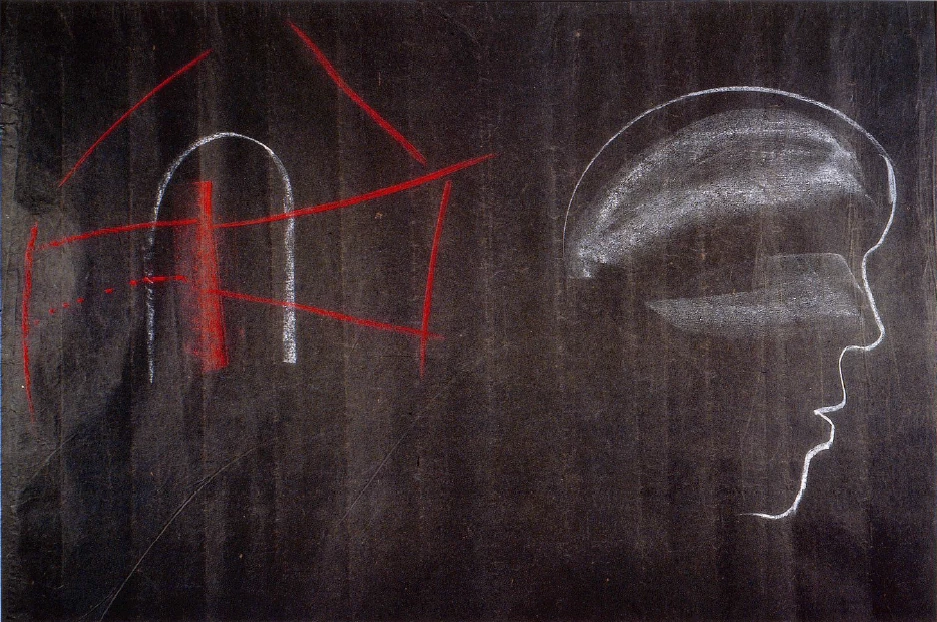
[ 11 ] Soul, if you wish to leave your physical body in order to establish a connection with the outer cosmos, what will you look like? — That was the question. The architectural forms were the tangible answers to that question.
[ 12 ] Oh, one can already sense, within the course of human development, how this feeling continued to exert its influence. In the age of abstractions, everything takes on a different character. But we do not wish to long for the return of old times; rather, we want to understand them. After all, when we visit places today where certain customs—some not even that old—have been preserved, we want to understand why, for example, we approach the church and see the graves all around it. Not everyone could have their own burial chamber, but the church served as the communal burial chamber for all. And the church is the answer to the question the soul asked itself: How might I first unfold myself in order to escape, in the right way, from the body, which alone connects me to the physical world, to the earth?—The form of the church expresses, in a sense, the soul’s longing for its own form once it has left the body.
[ 13 ] Cultural elements that date back to earlier times can only be understood when viewed in the context of the perceptions, feelings, and intuitions that people had of the spiritual world. One must truly have a sense of what it was like for those who originally built the church and the cemetery surrounding it. One must have a sense that they felt: “Dear souls who are passing away from us, what forms do you want us to build for you, so that when you are still hovering around your body, when you are still near your body, you will already have the forms you wish to assume after death?”—And there was the answer, which they wanted to provide once and for all to the inquiring souls: the form of the church, the architecture of the church. Thus we are directed toward one end of earthly life when we turn to the artistic aspect of architecture. Certainly, all of this undergoes a metamorphosis. That which has emerged from the cult of the dead can become the highest expression of life—as it indeed has become, as has been attempted at the Goetheanum. But one must understand these things; one must understand how architecture unfolds, in general, from the principle of the soul’s departure from the physical body, from the principle of the soul’s transcending the body—as it actually takes place in earthly life when a person passes through the gate of death.
[ 14 ] Let us turn our gaze to the other side of life—to birth, to a human being’s entry into the physical world. Here, however, I must tell you something that may cause you—or at least many of you—to smile a little inwardly; though perhaps not all of you will, in which case I would say: Thank God. But it is nonetheless a truth. You see, when the soul arrives on Earth to enter its body—if I may put it that way—it descends from the spiritual-soul worlds. In these spiritual-soul worlds, there are initially no spatial forms. The soul only becomes familiar with spatial forms when it leaves its body, where spatial elements still have an aftereffect. When the soul descends to take up residence in its body for the first time, it comes from a world in which spatial forms are unknown—a world in which, compared to our physical world, color intensities and color qualities are known, but not spatial lines or spatial forms. In the world I have often described to you recently—the one that a human being experiences between death and a new birth—he lives in a world of light, color, and sound imbued with soul and spirit, in a world of qualities and intensities, not in a world of quantities and extensions. And the person descends, immerses themselves in their physical body, and feels—I am now describing the sensation as it was experienced in certain primitive civilizations, almost forgotten by history—that they are submerging into their physical body. Through the physical body, they immediately establish a relationship with their surroundings: “Here I am growing into space.” - This physical body is already entirely attuned to space—that is foreign to me. It was not like that in the spiritual-soul world. Here I am immediately drawn into three dimensions. - These three dimensions have no meaning until one descends from the spiritual-soul world into the physical world. But color, color harmony, tone harmony, and melody—these have their own profound meaning in the spiritual world. In those ancient times, when people were still attuned to such things, human beings felt a deep need not to carry within themselves what was actually foreign to them. At most, they perceived their head as having been given from the spiritual world. For what the rest of their body—as I have often explained—was in earlier earthly lives has become the head. The rest of the body will only become a head in the next earthly life. People of those ancient times perceive this remaining part of the body as adapted to gravity, to the forces that circle around the Earth. As I said, they perceive it as being forced into space. And they feel: what enters their physical body from the surroundings—that does not fit at all with me as a human being who brings something down from the spiritual worlds. I must do something to make it fit.
[ 15 ] You see, this is how human beings bring the color of their clothing from the spiritual worlds into the physical world. Just as architecture leads us to the end of human life—death—so the art of clothing, in the spirit of ancient times when people found joy, cheerfulness, and appreciation in the vivid colors and artistic beauty of their garments, leads us to the beginning of life. In the clothing of old, one found what people had brought with them from their pre-earthly existence: a love for color and for harmony derived from the spiritual world. And it is no wonder at all that, in the era when the perspective on pre-earthly life was abolished, the art of clothing degenerated into dilettantism. For, isn’t it true that in today’s clothing you can hardly sense in any way that a person wishes to reflect in their appearance the way they lived in their pre-earthly existence? But if you truly study highly developed primitive cultures in their joy of color in clothing—with their often characteristically colorful garments— then you will see that the art of clothing is in fact a legitimate and great art through which human beings seek to carry their pre-earthly existence into earthly existence—just as, through the art of architecture, they seek to embrace their post-earthly existence, that existence in which they break free from space, still possess it, yet wish to be liberated from it, and express this in architectural forms. Even today, when you turn to peoples who have their traditional costumes, you can find the answer to this question in those costumes: How did a group of souls come together to express, through their clothing, the kinship they shared in their pre-earthly existence—and through which they found themselves united in a national community? — People wanted to create a memento of their appearance in heaven through their clothing. You will therefore often have to go back to earlier times if you wish to find meaningful clothing.
[ 16 ] But on the other hand, you can see how, in an era when everything human was captivated by the artistic—whether one became a painter or something else due to the specific circumstances from which one came or into which one was growing—it had a deep meaning when you look, for example, at a Magdalene in Raphael’s work or a Mary. They are dressed quite differently. But you will see that Raphael then retains the same attire for all his Magdalenes, and essentially the same attire for all his Marys as well, because he still had something alive—or at least a living tradition—in which the spiritual and soulful qualities brought down from heaven to earth are expressed through clothing. This is what gives the clothing its meaning. People today would say that it also gains meaning by keeping one warm. Well, certainly, that is the material meaning, but artistic forms do not arise from that. Artistic forms always arise through a connection to the spiritual. One must rediscover this connection to the spiritual if one wishes to advance once more toward what is truly artistic.
[ 17 ] Because anthroposophy seeks to grasp the spiritual in its immediacy, it can at the same time have a stimulating effect on art. For those things that one is compelled to reveal as the great mysteries of the world and of life through anthroposophical research ultimately find their expression in art. One must perceive this correctly. What was not the head in the previous earthly life is transformed in its balance of forces, becomes the head, becomes the central point in the subsequent earthly life. That it is then filled with physical earthly matter goes without saying. I have explained this many times before: one must not, of course, make the absurd objection that the physical body has completely perished—how can a head arise from it? Well, the other objections raised against anthroposophy aren’t generally much smarter either. Of course, the objection is very facile. But the point is not the physical substance, but rather the interplay of forces that permeates the spiritual world.
[ 18 ] The interplay of forces that exists today throughout our entire physical organism—our leg organism and so on—whether these forces are vertical or horizontal, whether they hold us together or push us apart—comes full circle and becomes the interplay of forces for our head in our next earthly life. But all the higher hierarchies are at work when this transformation—the metamorphosis of the legs, feet, and so on—into the human head takes place. All the heavenly spirits are at work here. No wonder, then, that the head initially takes on the form through which it appears as the image of the vast space that arches round above us, and that the next stage appears as the image of the atmosphere and atmospheric forces circling around the Earth. One might say that in the upper part of the head we have the true image of the heavens, while in the middle part of the head we already see the head’s adaptation to the chest—to that which is adapted to all that circles the Earth. In our chest, we need the air that circles the Earth; we need the light that weaves around the Earth, and so on. But just as our entire organism has no formal connection—only a material connection—with the upper vault of the head, so our chest is already related to the structure of the nose, to everything that constitutes the middle part of the head.
[ 19 ] And when we come down to the mouth, we see that the mouth is already related to the third member of the human threefold constitution: the digestive, the nutritive, and the motor organisms. We see how that which has passed through the heavens—in order to become a head on Earth out of the earlier headless bodily formation—still adapts to the heavens in its majestic arch at the top, yet how, in its middle section, it adapts to what the human being is through the Earth’s orbit, and how it is adapted to what the human being is in the fullest sense as an earthly human being—through gravity, through earthly substances, in the formation of the mouth.
[ 20 ] Thus, the human head contains—I might say, if we are to speak in the ancient terms of European mythology—Asgard, the castle of the gods, at the top; Midgard, the middle realm, the actual home of humankind on Earth; that which belongs to the Earth, Jotunheim, the home of the giants, the earthly spirits.
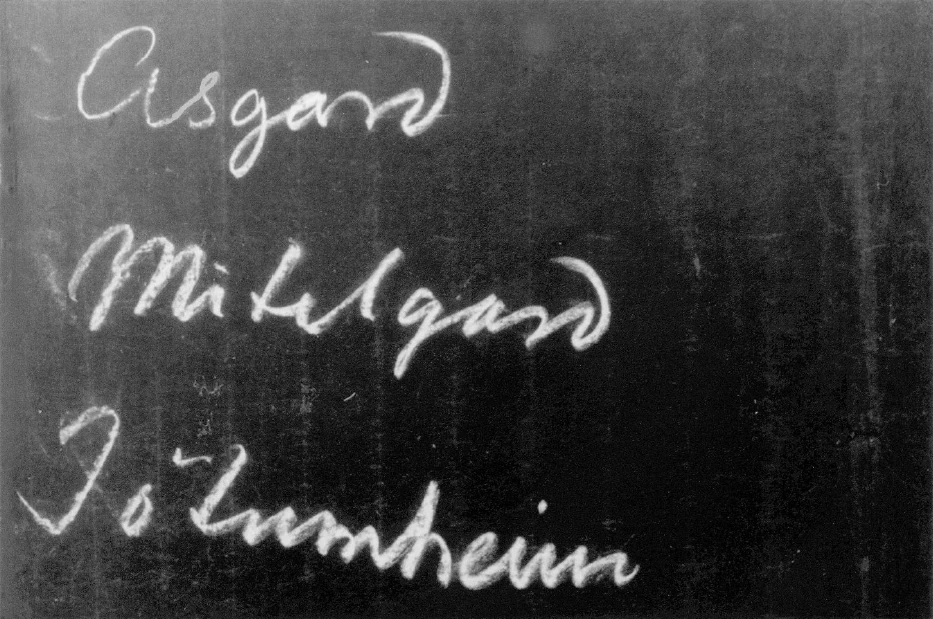
[ 21 ] However, none of this becomes clear if one considers it only in abstract terms; it all becomes clear when one artistically penetrates the human head in its relationship to its spiritual origin, when one sees, in a certain sense, heaven, earth, and hell within this human head—whereby hell, of course, is not merely the realm of the devil, but rather Jotunheim, the home of the giants. And so, in the human head, we indeed find the whole human being once again.
[ 22 ] One might say that one truly sees this human head when, in the curve that supports the head from above, one sees the purest memory of the human being’s previous earthly incarnation; when, in the middle section, the area below the eyes, and the area of the nose, the area around the ears, a memory already clouded by the Earth’s atmosphere; and in the shape of the mouth, the earlier human form subdued by the Earth—the human form already bound to the Earth. In the shape of his forehead, the human being carries with him, in a certain way, what has been karmically handed down to him from his previous earthly life. In the shape of his chin, he is already subdued by his present earthly life, already expressing the gentleness or stubbornness of this present life in the distinctive shape of his chin. He would have no chin if the earlier headless or extra-cranial organization had not been transformed into the present head organization. But with regard to the formation of the mouth and chin, the sum of the present earthly impulses is so strong that the past is already being pressed into and drawn into the present. Therefore, no one with an artistic sensibility will say that a person is striking because of a particularly prominent forehead. One would not say that if one has an artistic sensibility. One will always look at the curvature of the forehead, at the shaping of its surface; one will also, with regard to whether it protrudes or recedes, focus primarily on the curvature. As for the chin, one will say that it is stubbornly pointed forward, or that it is gently shaped backward. There one begins to understand the human form in relation to the entire universe—not merely the present universe (where one finds little), but the temporal universe, and ultimately the timeless one as well.
[ 23 ] One finds how an anthroposophical perspective simply draws one toward the artistic, and how, in truth, unartistic philistinism is actually no longer compatible with a genuine, living understanding of anthroposophy. That is why—I would say—it is such a struggle for unartistic souls to bring themselves into harmony with the whole of anthroposophy. They would, of course, very much like to see, in abstract terms, the fulfillment of past earthly lives in their present existence, but they are unable to truly engage with the forms that reveal themselves—as transformed figures—directly and artistically to spiritual contemplation. One must develop a sense for this when entering into the real, living world of anthroposophy.
[ 24 ] This, I would say, is the first chapter I wanted to present to show how the non-spiritual nature of our time manifests itself in all manner of fields. Among other things, this non-spiritual nature is evident in the non-spiritual attitude people take toward art. And if humanity is to save itself from this lack of spirituality at all, one of the factors in this salvation will be a turn toward the artistic. True life, in turn, can be found in the artistic—anthroposophy can lead to this.