

General Human Studies
as the Basis of Education
GA 293
26 August 1919, Stuttgart
Translate the original German text into any language:
Versions Available:
General Human Studies as the Basis of Education, tr. SOL
Fünfter Vortrag
Fifth Lecture
[ 1 ] Wir haben gestern die Wesenheit des Willens besprochen, insofern der Wille in den menschlichen Organismus eingegliedert ist. Wir wollen nun die Beziehungen des Willens zum Menschen, die wir kennengelernt haben, fruchtbar machen für die Anschauung der übrigen Wesenheit des Menschen.
[ 1 ] Yesterday we discussed the nature of the will insofar as it is integrated into the human organism. We will now use the relationships between the will and the human being that we have come to know to gain insight into the rest of the human being’s nature.
[ 2 ] Sie werden bemerkt haben, daß ich bei den bisherigen Besprechungen der menschlichen Wesenheit hauptsächlich Rücksicht genommen habe auf die intellektuelle, auf die Erkenntnistätigkeit auf der einen Seite und auf die Willenstätigkeit auf der anderen Seite. Ich habe Ihnen ja auch gezeigt, wie die Erkenntnistätigkeit im Zusammenhang steht mit dem Nervenwesen des Menschen, wie die Willensstärke im Zusammenhang steht mit der Bluttätigkeit. Sie werden, wenn Sie über die Sache nachdenken, sich fragen: Wie steht es denn nun mit der dritten Seelenfähigkeit, mit der Gefühlstätigkeit? - Die haben wir bisher noch wenig berücksichtigt. Aber gerade indem wir die Gefühlstätigkeit heute mehr ins Auge fassen, wird sich uns auch die Möglichkeit bieten, die anderen beiden Seiten der Menschennatur, die erkennende und die willensmäßige, intensiver zu durchdringen.
[ 2 ] You will have noticed that in my discussions of the human being thus far, I have focused primarily on intellectual activity—the activity of cognition—on the one hand, and on the activity of the will on the other. I have also shown you how cognitive activity is connected to the human nervous system, and how the strength of will is connected to the circulatory system. If you reflect on this, you will ask yourselves: What, then, of the third faculty of the soul—the activity of feeling?—We have given this little attention so far. But precisely by focusing more closely on the activity of feeling today, we will also have the opportunity to gain a deeper understanding of the other two aspects of human nature—the cognitive and the volitional.
[ 3 ] Wir müssen uns nur über eines noch klar werden, das ich ja in verschiedenen Zusammenhängen schon erwähnt habe. Man kann nicht die Seelenfähigkeiten so pedantisch nebeneinanderstellen: Denken, Fühlen, Wollen — weil in der ganzen lebendigen Seele die eine Tätigkeit immer in die andere übergeht.
[ 3 ] There is just one thing we need to clarify, which I have already mentioned in various contexts. One cannot so rigidly list the faculties of the soul side by side—thinking, feeling, willing—because within the living soul as a whole, one activity always flows into the next.
[ 4 ] Betrachten Sie einmal auf der einen Seite den Willen. Sie werden sich bewußt sein können, daß Sie nicht zu wollen imstande sind, was Sie nicht durchdringen mit Vorstellung, also mit erkenntnismäßiger Tätigkeit. Versuchen Sie in einer, wenn auch nur oberflächlichen Selbstbesinnung, auf Ihr Wollen sich zu konzentrieren. Sie werden immer finden: in dem Willensakt steckt immer irgendwie Vorstellen drinnen. Sie würden gar nicht Mensch sein, wenn Sie in dem Willensakt nicht Vorstellen drinnen hätten. Sie würden aus einer stumpfen, instinktiven Tätigkeit heraus alles das vollziehen, was aus Ihrem Willen strömt, wenn Sie nicht die Handlung, die aus dem Willen hervorquillt, mit vorstellender Tätigkeit durchdringen würden.
[ 4 ] Consider, for a moment, the will. You will realize that you are incapable of willing anything that you do not penetrate with a mental image—that is, with cognitive activity. Try, in a moment of self-reflection—even if only superficial—to concentrate on your willing. You will always find that an act of will always involves some form of mental image. You would not be human at all if your act of will did not involve a mental image. You would carry out everything that flows from your will as a result of a dull, instinctive activity if you did not permeate the action that springs from your will with mental image activity.
[ 5 ] Ebenso nun wie in aller Willensbetätigung das Vorstellen steckt, so steckt in allem Denken der Wille drinnen. Wieder wird Ihnen eine, wenn auch nur recht oberflächliche Betrachtung Ihres eigenen Selbstes die Erkenntnis liefern, daß Sie, indem Sie denken, immer in das Gedankenbilden den Willen hineinströmen lassen. Wie Sie Gedanken selber formen, wie Sie einen Gedanken mit dem anderen verbinden, wie Sie zu Urteil und Schluß übergehen, das alles ist von einer feineren Willenstätigkeit durchströmt.
[ 5 ] Just as the mental image is inherent in every act of the will, so too is the will inherent in all thinking. Once again, even a rather superficial examination of your own self will reveal to you that, as you think, you are always infusing the formation of thoughts with your will. The way you form thoughts yourself, the way you connect one thought with another, the way you proceed to judgment and conclusion—all of this is permeated by a more subtle activity of the will.
[ 6 ] Daher können wir eigentlich nur sagen: Die Willenstätigkeit ist hauptsächlich Willenstätigkeit und hat in sich die Unterströmung der Denktätigkeit; die Denktätigkeit ist hauptsächlich Denktätigkeit und hat in ihrer Unterströmung Willenstätigkeit. Also ein pedantisches Nebeneinanderstellen ist schon für die Beobachtung der einzelnen Seelenbetätigungen nicht möglich, weil eben die eine in die andere überfließt.
[ 6 ] Therefore, we can really only say: Volitional activity is primarily volitional activity and contains within itself an undercurrent of thought activity; thought activity is primarily thought activity and contains within its undercurrent volitional activity. Thus, a pedantic juxtaposition is not even possible when observing the individual activities of the soul, precisely because one flows into the other.
[ 7 ] Was Sie für die Seele erkennen können: das Ineinanderfließen der Seelentätigkeiten, das sehen Sie auch ausgeprägt in dem Leib, in dem sich die Seelentätigkeit offenbart. Betrachten Sie zum Beispiel das menschliche Auge. In das Auge hinein, wenn wir es in seiner Ganzheit betrachten, setzen sich fort die Nerven; aber es setzen sich in das Auge auch die Blutbahnen fort. Dadurch, daß sich die Nerven in das menschliche Auge hinein fortsetzen, strömt die Gedanken-, die Erkenntnistätigkeit ins Auge ein; dadurch, daß sich die Blutbahnen ins Auge fortsetzen, strömt die Willensbetätigung in das Auge ein. So ist bis in die Peripherie der Sinnesbetätigungen auch im Leibe Willensgemäßes und Vorstellungs- oder Erkenntnisgemäßes miteinander verbunden. Das ist für alle Sinne so, ist aber auch für alle Bewegungsglieder, die dem Wollen dienen, eben so: in unser Wollen, in unsere Bewegungen geht durch die Nervenbahnen das Erkenntnisgemäße und durch die Blutbahnen das Willensgemäße.
[ 7 ] What you can recognize about the soul—the interplay of the soul’s activities—is also clearly evident in the body, in which the soul’s activity manifests itself. Consider, for example, the human eye. When we consider the eye in its entirety, the nerves extend into it; but the blood vessels also extend into the eye. Because the nerves extend into the human eye, the activity of thought and cognition flows into the eye; because the blood vessels extend into the eye, the activity of the will flows into the eye. Thus, even in the body, activities of the will and activities related to mental images or cognition are interconnected right down to the periphery of sensory activity. This is true for all the senses, but it is equally true for all the limbs involved in movement that serve the will: into our will and into our movements, that which pertains to cognition flows through the nerve pathways, and that which pertains to the will flows through the blood vessels.
[ 8 ] Nun müssen wir aber auch die besondere Art der Erkenntnistätigkeit kennenlernen. Wir haben schon darauf hingewiesen, aber wir müssen uns voll bewußt werden, was in diesem ganzen Komplex von menschlicher Tätigkeit, der nach der Erkenntnis-, der Vorstellungsseite hinneigt, alles liegt. Wir haben schon gesagt: Im Erkennen, im Vorstellen lebt eigentlich Antipathie. So sonderbar es ist, alles, was nach dem Vorstellen hinneigt, ist durchdrungen von Antipathie. Sie werden sich sagen: Ja, wenn ich etwas anschaue, so übe ich in diesem Anschauen doch nicht Antipathie aus! — Doch, Sie üben sie aus! Sie üben Antipathie aus, indem Sie einen Gegenstand ansehen. Würde in Ihrem Auge nur Nerventätigkeit sein, so würde Ihnen jeder Gegenstand, den Sie mit Ihren Augen ansehen, zum Ekel sein, er wäre Ihnen antipathisch. Nur dadurch, daß sich in die Augentätigkeit hinein auch die Willenstätigkeit ergießt, die in Sympathie besteht, dadurch daß sich leiblich in Ihr Auge hineinerstreckt das Blutmäßige, nur dadurch wird für Ihr Bewußtsein die Empfindung der Antipathie im sinnlichen Anschauen ausgelöscht, und es wird durch einen Ausgleich zwischen Sympathie und Antipathie der objektive, gleichgültige Akt des Sehens hervorgerufen. Er wird da hervorgerufen, indem Sympathie und Antipathie sich ins Gleichgewicht stellen und uns dieses Ineinanderspielen von Sympathie und Antipathie gar nicht bewußt wird.
[ 8 ] Now, however, we must also come to understand the specific nature of cognitive activity. We have already pointed this out, but we must become fully aware of everything that lies within this entire complex of human activity, which is oriented toward cognition and imagination. We have already said: Antipathy actually lives in cognition and mental images. Strange as it may seem, everything that tends toward a mental image is permeated by antipathy. You will say to yourself: Yes, but when I look at something, I am not exercising antipathy in that act of looking! — But you do! You exercise antipathy by looking at an object. If there were only nervous activity in your eye, every object you looked at with your eyes would be repulsive to you; it would be antipathetic to you. Only because volitional activity—which consists of sympathy—also flows into the activity of the eye, and because the blood-related aspect physically extends into your eye—only through this is the sensation of antipathy in sensory perception extinguished for your consciousness, and the objective, indifferent act of seeing is brought about by a balance between sympathy and antipathy. It is brought about when sympathy and antipathy come into equilibrium, and we are not even aware of this interplay between sympathy and antipathy.
[ 9 ] Wenn Sie die Goethesche Farbenlehre, auf die ich in diesem Zusammenhang schon einmal aufmerksam gemacht habe, studieren, namentlich in ihrem physiologisch-didaktischen Teil, dann werden Sie sehen: weil Goethe eingeht auf die tiefere Tätigkeit des Sehens, so kommt dadurch für seine Betrachtung in den Farbennuancen gleich zum Vorschein das Sympathische und das Antipathische. Sie brauchen nur ein wenig hineindringen in die Tätigkeit eines Sinnesorgans, dann finden Sie sogleich das Sympathische und das Antipathische in der Sinnestätigkeit auftauchen. Es rührt eben auch in der Sinnestätigkeit das Antipathische her von dem eigentlichen Erkenntnisteil, von dem Vorstellungsteil, dem Nerventeil, und das Sympathische rührt her von dem eigentlichen Willensteil, von dem Blutteil.
[ 9 ] If you study Goethe’s theory of colors—which I have already drawn attention to in this context—particularly its physiological and didactic aspects, you will see that because Goethe delves into the deeper workings of vision, the sympathetic and the antipathetic immediately come to light in his observation of color nuances. You need only delve a little into the activity of a sense organ, and you will immediately find the sympathetic and the antipathetic emerging in sensory activity. Indeed, even in sensory activity, the antipathetic stems from the actual cognitive aspect—the aspect of imagination, the nervous aspect—while the sympathetic stems from the actual volitional aspect—the blood aspect.
[ 10 ] Es gibt einen bedeutungsvollen Unterschied, den ich auch schon in den allgemeinen anthroposophischen Vorträgen öfter hervorgehoben habe, zwischen den Tieren und den Menschen mit Bezug auf die Einrichtung des Auges. Es ist sehr eigentümlich, daß das Tier viel mehr von Bluttätigkeit im Auge hat als der Mensch. Bei gewissen Tieren finden Sie sogar Organe, welche dieser Bluttätigkeit dienen, wie den «Schwertfortsatz» und den «Fächer». Daraus können Sie entnehmen, daß das Tier viel mehr von Bluttätigkeit auch ins Auge hineinsendet - und so ist es auch bei den übrigen Sinnen - als der Mensch. Das heißt, das Tier entwickelt in seinen Sinnen viel mehr Sympathie, instinktive Sympathie mit der Umwelt als der Mensch. Der Mensch hat in Wirklichkeit mehr Antipathie zu der Umwelt als das Tier, aber sie kommt im gewöhnlichen Leben nicht zum Bewußtsein. Sie kommt nur zum Bewußtsein, wenn sich das Anschauen der Umwelt steigert bis zu dem Eindruck, auf den wir mit dem Ekel reagieren. Das ist nur ein gesteigerter Eindruck alles sinnlichen Wahrnehmens: Sie reagieren mit dem Ekel auf den äußeren Eindruck. Wenn Sie an einen Ort gehen, der übel riecht, und Sie empfinden in der Sphäre dieses Übelriechens Ekel, so ist dieses Ekelempfinden nichts anderes als eine Steigerung desjenigen, was bei jeder Sinnestätigkeit stattfindet, nur bleibt die Begleitung der Empfindung durch den Ekel in der gewöhnlichen Sinnesempfindung unter der Bewußtseinsschwelle liegend. Wenn wir Menschen aber nicht mehr Antipathie hätten zu unserer Umgebung als das Tier, so würden wir uns nicht so stark absondern von unserer Umgebung, als wir uns tatsächlich absondern. Das Tier hat viel mehr Sympathie mit der Umgebung, ist daher viel mehr mit der Umgebung zusammengewachsen, und es ist deshalb auch viel mehr angewiesen auf die Abhängigkeit vom Klima, von den Jahreszeiten und so weiter als der Mensch. Weil der Mensch viel mehr Antipathie hat gegen die Umgebung, deshalb ist er eine Persönlichkeit. Der Umstand, daß wir uns durch unsere unter der Schwelle des Bewußtseins liegende Antipathie absondern können von der Umgebung, diese Tatsache bewirkt unser gesondertes Persönlichkeitsbewußtsein.
[ 10 ] There is a significant difference—one that I have often emphasized in my general anthroposophical lectures—between animals and humans with regard to the structure of the eye. It is very peculiar that animals have much more blood activity in the eye than humans do. In certain animals, you will even find organs that serve this blood activity, such as the “sword-like process” and the “fan.” From this you can infer that animals direct much more blood flow into the eye—and this is also true of the other senses—than humans do. This means that animals develop much more sympathy—instinctive sympathy—with their environment through their senses than humans do. In reality, humans have more antipathy toward the environment than animals do, but this does not come to consciousness in everyday life. It only comes to consciousness when our perception of the environment intensifies to the point of an impression to which we react with disgust. This is merely an intensified impression of all sensory perception: you react with disgust to the external impression. When you go to a place that smells bad and you feel disgust within the sphere of that foul odor, this feeling of disgust is nothing other than an intensification of what occurs during any sensory activity; it is just that, in ordinary sensory perception, the accompaniment of this sensation by disgust remains below the threshold of consciousness. But if we humans did not feel more antipathy toward our surroundings than animals do, we would not separate ourselves from our surroundings as strongly as we actually do. Animals feel much more sympathy for their surroundings; they have therefore become much more intertwined with them, and are consequently much more dependent on the climate, the seasons, and so on than humans are. Because humans have much more antipathy toward their surroundings, they are individuals. The fact that we can separate ourselves from our surroundings through our antipathy—which lies below the threshold of consciousness—is what gives rise to our distinct sense of individuality.
[ 11 ] Damit aber haben wir auf etwas hingewiesen, was zur ganzen Auffassung des Menschen ein sehr Wesentliches beiträgt. Wir haben gesehen, wie in der Erkenntnis- oder Vorstellungstätigkeit zusammenfließen: Denken - Nerventätigkeit, leiblich ausgedrückt; und Wollen Bluttätigkeit, leiblich ausgedrückt.
[ 11 ] With this, however, we have pointed out something that contributes significantly to our overall understanding of the human being. We have seen how the following converge in the processes of cognition and imagination: thinking—expressed physically as nervous activity—and willing—expressed physically as blood activity.
[ 12 ] So aber fließen auch zusammen in der Willensbetätigung vorstellende und eigentliche Willenstätigkeit. Wir entwickeln immer, wenn wir irgend etwas wollen, Sympathie mit dem Gewollten. Aber es würde immer ein ganz instinktives Wollen bleiben, wenn wir uns nicht auch durch eine in die Sympathie des Wollens hineingeschickte Antipathie absondern könnten als Persönlichkeit von der Tat, von dem Gewollten. Nur überwiegt jetzt eben durchaus die Sympathie zu dem Gewollten, und es wird nur ein Ausgleich mit dieser Sympathie dadurch geschaffen, daß wir auch die Antipathie hineinschicken. Dadurch bleibt aber die Sympathie als solche unter der Schwelle des Bewußstseins liegend, es dringt nur etwas von dieser Sympathie ein in das Gewollte. In den ja nicht sehr zahlreichen Handlungen, die wir nicht bloß aus Vernunft vollbringen, sondern die wir in wirklicher Begeisterung, in Hingabe, in Liebe ausführen, da überwiegt die Sympathie so stark im Wollen, daß sie auch hinaufdringt über die Schwelle unseres Bewußtseins und unser Wollen selber uns durchtränkt erscheint von Sympathie, während es uns sonst als ein Objektives verbindet mit der Umwelt, sich uns so offenbart. Geradeso wie uns nur ausnahmsweise, nicht immer, unsere Antipathie mit der Umwelt ins Bewußtsein kommen darf im Erkennen, so darf uns unsere immer vorhandene Sympathie mit der Umwelt nur in Ausnahmefällen, in Fällen der Begeisterung, der hingebenden Liebe, zum Bewußtsein kommen. Sonst würden wir alles instinktiv ausführen. Wir würden uns niemals in das, was objektiv, zum Beispiel im sozialen Leben, die Welt von uns fordert, eingliedern können. Wir müssen gerade das Wollen denkend durchdringen, damit dieses Wollen uns eingliedert in die Gesamtmenschheit und in den Weltenprozeß als solchen.
[ 12 ] Thus, in the exercise of the will, mental images and actual volitional activity also converge. Whenever we want something, we always develop sympathy for what we want. But it would always remain a purely instinctive act of willing if we were not also able to separate ourselves—as a personality—from the act, from the object of our will, by introducing an antipathy into the sympathy of the will. It is just that the sympathy for the object of our will now completely predominates, and a balance with this sympathy is created only by our introducing the antipathy as well. As a result, however, sympathy as such remains below the threshold of consciousness; only a portion of this sympathy penetrates into the object of our will. In the—admittedly not very numerous—actions that we perform not merely out of reason, but with genuine enthusiasm, devotion, and love—sympathy predominates so strongly in our will that it also rises above the threshold of our consciousness, and our will itself appears to us as imbued with sympathy, whereas otherwise it connects us to the environment as an objective entity and reveals itself to us in this way. Just as our antipathy toward the external world may enter our consciousness only exceptionally—not always—in the process of cognition, so too may our ever-present sympathy with the external world enter our consciousness only in exceptional cases—in cases of enthusiasm or self-sacrificing love. Otherwise, we would carry out everything instinctively. We would never be able to integrate ourselves into what the world objectively demands of us—for example, in social life. We must penetrate the very act of willing through thought, so that this willing integrates us into the whole of humanity and into the world process as such.
[ 13 ] Sie werden sich das, was dabei geschieht, vielleicht klarmachen können, wenn Sie bedenken, welche Verheerungen es in der menschlichen Seele eigentlich anrichten würde, wenn im gewöhnlichen Leben diese ganze Sache, von der ich jetzt gesprochen habe, bewußt wäre. Wenn diese Sache im gewöhnlichen Leben fortwährend in der menschlichen Seele bewußt wäre, dann wäre dem Menschen ein gut Stück Antipathie bewußt, das bei allen seinen Handlungen begleitend wäre. Das wäre furchtbar! Der Mensch ginge dann durch die Welt und fühlte sich fortwährend in einer Atmosphäre von Antipathie. Das ist weise eingerichtet in der Welt, daß diese Antipathie als eine Kraft zwar notwendig ist zu unserem Handeln, daß wir uns ihrer aber nicht bewußt werden, daß sie unter der Schwelle des Bewußtseins bleibt.
[ 13 ] You may be able to grasp what happens here if you consider the devastation it would actually wreak on the human soul if, in everyday life, people were consciously aware of this whole matter I have just spoken of. If this matter were constantly present in the human soul in everyday life, then people would be aware of a great deal of antipathy that would accompany all their actions. That would be terrible! People would then go through the world feeling constantly immersed in an atmosphere of antipathy. It is wisely arranged in the world that, while this antipathy is indeed a necessary force for our actions, we do not become aware of it—that it remains below the threshold of consciousness.
[ 14 ] Nun schauen Sie da, ich möchte sagen, in ein merkwürdiges Mysterium der menschlichen Natur hinein, in ein Mysterium, das eigentlich jeder bessere Mensch empfindet, das aber der Erzieher und Unterrichter sich ganz zum Bewußtsein bringen sollte. Wir handeln ja, indem wir zuerst Kinder werden, mehr oder weniger aus bloßer Sympathie. So sonderbar es klingt: aber alles, was das Kind tut und tobt, ist aus Sympathie zu dem Tun und Toben vollbracht. Wenn die Sympathie geboren wird in der Welt, so ist sie starke Liebe, starkes Wollen. Aber sie kann nicht so bleiben, sie muß durchdrungen werden vom Vorstellen, sie muß gewissermaßen fortwährend erhellt werden vom Vorstellen. Das geschieht in umfassender Weise, indem wir eingliedern in unsere bloßen Instinkte die Ideale, die moralischen Ideale. Und jetzt werden Sie besser begreifen können, was eigentlich auf diesem Gebiete die Antipathie bedeutet. Blieben uns die Instinktimpulse, die wir in dem kleinen Kinde bemerken, durch das ganze Leben nur sympathisch, wie sie dem Kinde sympathisch sind, so würden wir uns unter dem Einfluß unserer Instinkte animalisch entwickeln. Diese Instinkte müssen uns antipathisch werden, wir müssen Antipathie in sie hineingießen. Dann, wenn wir Antipathie in sie hineingießen, tun wir das durch unsere moralischen Ideale, denen die Instinkte antipathisch sind und die zunächst für unser Leben zwischen Geburt und Tod Antipathie in die kindliche Sympathie der Instinkte hineinsetzen. Daher ist moralische Entwickelung immer etwas Asketisches. Es muß nur dieses Asketische im richtigen Sinne gefaßt werden. Es ist immer ein Üben in der Bekämpfung des Animalischen.
[ 14 ] Now look—I would say—into a strange mystery of human nature, a mystery that every decent person actually senses, but one that educators and teachers should fully bring to their awareness. After all, we act—by first becoming like children—more or less out of sheer sympathy. As strange as it may sound, everything a child does and all the way it romps about is done out of sympathy for that very doing and romping. When sympathy is born into the world, it is strong love, strong will. But it cannot remain that way; it must be permeated by mental images; it must, so to speak, be continually illuminated by mental images. This happens in a comprehensive way as we integrate moral ideals into our mere instincts. And now you will be better able to understand what antipathy actually means in this context. If the instinctual impulses we observe in the small child remained to us throughout our entire lives as sympathetic as they are to the child, we would develop in an animalistic manner under the influence of our instincts. These instincts must become antipathetic to us; we must infuse them with antipathy. When we infuse them with antipathy, we do so through our moral ideals, which are antipathetic to the instincts and which, for our lives between birth and death, initially instill antipathy into the childlike sympathy of the instincts. Therefore, moral development is always an ascetic endeavor. This asceticism must simply be understood in the proper sense. It is always a practice in combating the animalistic.
[ 15 ] Das alles soll uns lehren, in wie hohem Grade Wollen nicht nur Wollen in der praktischen Betätigung des Menschen ist, sondern inwiefern Wollen durchaus auch von Vorstellen, von erkennender Tätigkeit durchdrungen ist.
[ 15 ] All of this is meant to teach us not only to what extent volition is volition in human practical activity, but also to what extent volition is thoroughly permeated by mental images and by cognitive activity.
[ 16 ] Nun steht zwischen Erkennen, Denken und Wollen mitten drinnen die menschliche Gefühlstätigkeit. Wenn Sie sich das vorstellen, was ich jetzt als Wollen und Denken entwickelt habe, so können Sie sich sagen: Von einer gewissen mittleren Grenze strömt auf der einen Seite alles das aus, was Sympathie ist: Wollen; auf der anderen Seite strömt aus alles, was Antipathie ist: Denken. Aber die Sympathie des Wollens wirkt auch zurück in das Denken hinein, und die Antipathie des Denkens wirkt auch in das Wollen hinein. Und so wird der Mensch ein Ganzes, indem das, was sich auf der einen Seite hauptsächlich entwickelt, auch in die andere Seite hineinwirkt. Zwischendrinnen nun, zwischen Denken und Wollen, liegt das Fühlen, so daß das Fühlen nach der einen Richtung hin verwandt ist mit dem Denken, nach der anderen Richtung hin mit dem Wollen. Wie Sie schon in der ganzen menschlichen Seele nicht streng auseinanderhalten können erkennende oder denkerische Tätigkeit und Willenstätigkeit, so können Sie noch weniger auseinanderhalten im Fühlen das denkerische Element von dem Willenselement. Im Fühlen fließen ganz stark ineinander Willenselemente und Denkelemente.
[ 16 ] Now, human emotional activity lies right in the middle between cognition, thinking, and willing. If you have a mental image of what I have just described as willing and thinking, you can say to yourself: From a certain middle boundary, on one side flows everything that is sympathy: willing; on the other side flows everything that constitutes antipathy: thinking. But the sympathy of volition also exerts a reciprocal influence on thinking, and the antipathy of thinking also exerts an influence on volition. And so the human being becomes a whole, in that what develops primarily on one side also exerts an influence on the other side. In between, now, between thinking and willing, lies feeling, so that feeling is related to thinking in one direction and to willing in the other. Just as you cannot strictly distinguish between cognitive or thinking activity and volitional activity in the human soul as a whole, so you can distinguish even less clearly in feeling between the thinking element and the volitional element. In feeling, elements of the will and elements of thought flow very strongly into one another.
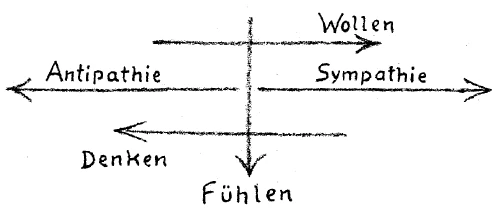
[ 17 ] Auch hier können Sie wieder durch die bloße Selbstbeobachtung, wenn Sie diese auch nur oberflächlich ausüben, sich von der Richtigkeit des eben Gesagten überzeugen. Schon was ich bis jetzt gesagt habe, führt Sie auf die Anschauung von dieser Richtigkeit, denn ich sagte Ihnen: Das Wollen, das im gewöhnlichen Leben objektiv verläuft, steigert sich bis zur Tätigkeit aus Enthusiasmus, aus Liebe heraus. Da sehen Sie ganz deutlich ein sonst von der Notwendigkeit des äußeren Lebens hervorgebrachtes Wollen durchströmt vom Fühlen. Wenn Sie etwas Enthusiastisches oder Liebevolles tun, so tun Sie das, was aus dem Willen fließt, indem Sie es durchdrungen sein lassen von einem subjektiven Gefühl. Aber auch bei der Sinnestätigkeit können Sie sehen, wenn Sie genauer zusehen — eben durch die Goethesche Farbenlehre -, wie sich in die Sinnestätigkeit hineinmischt das Fühlen. Und wenn sich die Sinnestätigkeit bis zum Ekel steigert oder auf der anderen Seite bis zum Einsaugen des angenehmen Blumenduftes, so haben Sie auch dabei die Gefühlstätigkeit in die Sinnestätigkeit ohne weiteres überfließend.
[ 17 ] Here, too, you can convince yourself of the truth of what has just been said simply through self-observation—even if you practice it only superficially. What I have said so far already leads you to an understanding of this truth, for I told you: The will, which in ordinary life operates objectively, rises to the level of action born of enthusiasm and love. There you can see quite clearly a will—otherwise brought about by the necessities of external life—permeated by feeling. When you do something enthusiastic or loving, you do what flows from the will by allowing it to be permeated by a subjective feeling. But even in sensory activity, if you look more closely—precisely through Goethe’s theory of colors—you can see how feeling intermingles with sensory activity. And when sensory activity intensifies to the point of revulsion or, on the other hand, to the point of inhaling the pleasant scent of a flower, you will also find that emotional activity naturally overflows into sensory activity.
[ 18 ] Aber auch in die Denktätigkeit fließt die Gefühlstätigkeit hinein. Es war einmal ein, äußerlich wenigstens, sehr bemerkenswerter philosophischer Streit — es gab ja in der Geschichte der Weltanschauungen viele philosophische Streitigkeiten - zwischen dem Psychologen Franz Brentano und dem Logiker Sigwart in Heidelberg. Die beiden Herren stritten miteinander über das, was in der Urteilstätigkeit des Menschen liegt. Sigwart meinte: Wenn der Mensch urteilt - sagen wir, er fällt das Urteil: Der Mensch soll gut sein -, so spräche in einem solchen Urteil immer ein Gefühl mit; die Entscheidung trifft das Gefühl. — Brentano meinte: Urteilstätigkeit und Gefühlstätigkeit, die in Gemütsbewegungen bestehen, seien so verschieden, daß die Urteilsfunktion, die Urteilsbetätigung gar nicht begriffen werden könnte, wenn man nur glaube, das Gefühl spiele da hinein. Er meinte, dadurch käme etwas Subjektives in das Urteil hinein, während doch unser Urteil objektiv sein wolle.
[ 18 ] But emotional activity also flows into the act of thinking. There was once—at least on the surface—a very remarkable philosophical dispute—and indeed there have been many such disputes in the history of worldviews—between the psychologist Franz Brentano and the logician Sigwart in Heidelberg. The two men argued with one another about what constitutes human judgment. Sigwart maintained: When a person judges—let’s say, he makes the judgment: “A person should be good”—then emotion always plays a part in such a judgment; the decision is made by emotion. — Brentano argued: The act of judgment and the act of feeling, which consist of emotional stirrings, are so different that the function of judgment—the very act of judging—could not be understood at all if one were to believe that feeling plays a role in it. He maintained that this would introduce something subjective into the judgment, whereas our judgment is meant to be objective.
[ 19 ] Ein solcher Streit zeigt dem Einsichtigen nur, daß weder die Psychologen noch die Logiker auf das gekommen sind, worauf sie kommen sollten — auf das Ineinanderfließen der Seelentätigkeiten. Bedenken Sie, was hier wirklich beobachtet werden muß. Wir haben auf der einen Seite die Urteilsfähigkeit, die natürlich entscheiden muß über etwas ganz Objektives. Daß der Mensch gut sein muß, darf nicht von unserem subjektiven Gefühl abhängen. Also der Inhalt des Urteils muß objektiv sein. Aber wenn wir urteilen, kommt ja noch etwas ganz anderes in Betracht. Die Dinge, die objektiv richtig sind, sind ja deshalb noch nicht bewußt in unserer Seele. Wir müssen sie erst bewußt in unsere Seele hereinbekommen. Und bewußt bekommen wir kein Urteil in unsere Seele herein, ohne daß die Gefühlstätigkeit mitwirkt. Daher müssen wir sagen, Brentano und Sigwart hätten sich dahin einigen müssen, daß sie beide gesagt hätten: Ja, der objektive Inhalt des Urteils steht außerhalb der Gefühlstätigkeit fest; damit aber in der subjektiven Menschenseele die Überzeugung von der Richtigkeit des Urteils zustande komme, muß die Gefühlstätigkeit sich entwickeln.
[ 19 ] To the discerning mind, such a dispute merely shows that neither psychologists nor logicians have arrived at what they should have—the interplay of mental activities. Consider what really needs to be observed here. On the one hand, we have the faculty of judgment, which must, of course, decide on something entirely objective. The fact that a person must be good must not depend on our subjective feelings. Thus, the content of the judgment must be objective. But when we judge, something entirely different comes into play. The things that are objectively true are not, for that reason alone, yet consciously present in our soul. We must first bring them consciously into our soul. And we cannot consciously bring a judgment into our soul without the activity of feeling playing a part. Therefore, we must say that Brentano and Sigwart should have agreed that they both would have said: Yes, the objective content of the judgment is established independently of the activity of feeling; but in order for the conviction of the judgment’s correctness to arise in the subjective human soul, the activity of feeling must develop.
[ 20 ] Sie sehen daraus, wie schwer es ist bei der ungenauen Art der philosophischen Betrachtungen, wie sie gegenwärtig gepflogen werden, überhaupt zu genauen Begriffen zu kommen. Zu solchen genauen Begriffen muß man sich ja erst erheben, und es gibt heute keine andere Erziehung zu genauen Begriffen als die durch Geisteswissenschaft. Die äußere Wissenschaft meint, sie habe genaue Begriffe, und sie ergeht sich sehr hochnäsig über das, was anthroposophisch orientierte Geisteswissenschaft liefert, weil sie keine Ahnung hat, daß die von dieser Seite gelieferten Begriffe gegenüber den heute gebräuchlichen viel genauer und exakter sind, weil sie aus der Wirklichkeit hergeholt sind, nicht aus dem bloßen Spiel mit den Worten.
[ 20 ] You can see from this how difficult it is, given the imprecise nature of philosophical reflections as they are currently practiced, to arrive at precise concepts at all. One must first rise to the level of such precise concepts, and today there is no other education leading to precise concepts than that provided by Spiritual Science. The external sciences believe they possess precise concepts, and they look down very haughtily on what anthroposophically oriented Spiritual Science provides, because they have no idea that the concepts provided by this approach are much more precise and exact than those commonly used today—because they are drawn from reality, not from mere wordplay.
[ 21 ] Indem Sie so das gefühlsmäßige Element nach der einen Seite verfolgen in dem Erkennenden, in dem Vorstellenden, und auf der anderen Seite in dem Willensgemäßen, werden Sie sich sagen: Das Gefühl steht als die mittlere Seelenbetätigung zwischen Erkennen und Wollen drinnen und strahlt seine Wesenheit nach den beiden Richtungen aus. — Gefühl ist sowohl noch nicht ganz gewordene Erkenntnis, wie noch nicht ganz gewordener Wille, zurückgehaltene Erkenntnis und zurückgehaltener Wille. Daher auch ist das Fühlen zusammengesetzt aus Sympathie und Antipathie, die sich nur verstecken, wie Sie gesehen haben, sowohl im Erkennen wie im Wollen. Beide, Sympathie und Antipathie, sind im Erkennen und Wollen vorhanden, indem leiblich Nerventätigkeit und Bluttätigkeit zusammenwirken, aber sie verstekken sich. Im Fühlen werden sie offenbar.
[ 21 ] As you trace the emotional element in this way—on the one hand in cognition and mental images, and on the other hand in volition—you will say to yourself: Feeling stands as the middle soul activity between cognition and volition and radiates its essence in both directions. — Feeling is both cognition that has not yet fully come into being and volition that has not yet fully come into being; it is restrained cognition and restrained volition. That is why feeling is composed of sympathy and antipathy, which, as you have seen, are merely concealed in both cognition and volition. Both sympathy and antipathy are present in cognition and volition through the interaction of physical nervous activity and blood circulation, but they remain hidden. In feeling, they become apparent.
[ 22 ] Wie schauen denn daher die leiblichen Offenbarungen des Fühlens aus? Sie werden ja im menschlichen Leibe überall finden, wie die Blutbahnen mit den Nervenbahnen in irgendeiner Weise sich berühren. Und überall dort, wo Blutbahnen mit Nervenbahnen sich berühren, entsteht eigentlich Gefühl. Nur ist, in den Sinnen zum Beispiel, sowohl der Nerv wie das Blut so verfeinert, daß wir nicht mehr das Gefühl spüren. Von einem leisen Gefühl ist all unser Sehen und Hören durchzogen, aber wir spüren es nicht; wir spüren es um so weniger, als das Sinnesorgan abgegrenzt, abgetrennt ist von dem übrigen Leib. Beim Sehen, bei der Augentätigkeit, spüren wir das gefühlsmäßige Sympathisieren und Antipathisieren fast gar nicht, weil das Auge, in der Knochenrundung eingebettet, fast ganz vom übrigen Organismus abgesondert ist. Und sehr verfeinert sind die Nerven, die sich ins Auge hineinerstrecken und auch die Blutbahnen, die sich ins Auge hineinerstrecken. Es ist das gefühlsmäßige Empfinden im Auge sehr unterdrückt. -— Weniger unterdrückt ist das Gefühlsmäßige beim Sinn des Hörens. Das Hören steht viel mehr als das Schauen mit der Gesamttätigkeit des Organismus in einem organischen Zusammenhang. Indem sich zahlreiche Organe im Ohre befinden, die ganz andersgeartet sind als die Organe des Auges, ist das Ohr in vieler Beziehung ein getreues Abbild desjenigen, was im ganzen Organismus vor sich geht. Daher wird das, was im Ohr als Sinnestätigkeit vor sich geht, sehr stark begleitet von Gefühlstätigkeit. Und hier wird es selbst Menschen, die sich gut auf das verstehen, was gehört wird, schwer, wirklich zur Klarheit zu kommen, was im Gehörten, besonders beim künstlerisch Gehörten, bloßes Erkennen und was Gefühlsmäßiges ist. Darauf beruht eine sehr interessante Erscheinung der neueren Zeit, die auch in die unmittelbare künstlerische Produktion hineingespielt hat.
[ 22 ] What, then, do the physical manifestations of sensation look like? You will find everywhere in the human body that the blood vessels and the nerve pathways come into contact with one another in some way. And wherever blood vessels and nerve pathways come into contact, sensation actually arises. However, in the senses, for example, both the nerves and the blood are so refined that we no longer perceive the sensation. All our seeing and hearing is permeated by a subtle sensation, but we do not perceive it; we perceive it all the less because the sense organ is delimited and separated from the rest of the body. When it comes to seeing—to the activity of the eye—we hardly feel the emotional sympathies and antipathies at all, because the eye, embedded in the curve of the skull, is almost completely separated from the rest of the organism. And the nerves that extend into the eye, as well as the blood vessels that extend into the eye, are highly refined. Emotional perception in the eye is greatly suppressed. — The emotional aspect is less suppressed in the sense of hearing. Hearing is much more closely connected, in an organic sense, to the organism’s overall activity than sight is. Because the ear contains numerous organs that are of a completely different nature than those of the eye, the ear is in many respects a faithful reflection of what is taking place throughout the entire organism. Therefore, what occurs in the ear as sensory activity is very strongly accompanied by emotional activity. And here, even people who are well versed in what is heard find it difficult to truly discern what in what is heard—especially in artistic listening—is mere cognition and what is emotional. This underlies a very interesting phenomenon of recent times, one that has also played a role in direct artistic production.
[ 23 ] Sie kennen alle in Richard Wagners «Meistersinger» die Figur des Beckmesser. Was sollte Beckmesser eigentlich darstellen? Er sollte darstellen einen musikalisch Auffassenden, der ganz vergißt, wie auch das gefühlsmäßige Element des ganzen Menschen in das Erkenntnismäßige der Gehörtätigkeit hineinwirkt. Wagner, der seine eigene Auffassung in dem Walter dargestellt hat, war wiederum ganz einseitig davon durchdrungen, daß hauptsächlich das Gefühlsmäßige im Musikalischen leben müsse. Was da im Walter und im Beckmesser aus einer mißverständlichen Auffassung - ich meine: bei beiden mißverständlichen Auffassung — sich gegenübergestellt wird, im Gegensatz zu der richtigen Auffassung, wie Gefühlsmäßiges und Erkenntnismäßiges im musikalischen Hören zusammenwirken, das kam in einer historischen Erscheinung dadurch zum Ausdruck, daß die Wagnersche Kunst bei ihrem Auftreten, namentlich aber bei ihrem Bekanntwerden einen Gegner fand in der Person von Eduard Hanslick in Wien, der alles, was in der Gefühlssphäre aufströmt in der Wagnerschen Kunst, als unmusikalisch ansah. Es gibt vielleicht wenig psychologisch so interessante Schriften auf dem Gebiete des Künstlerischen wie die «Vom MusikalischSchönen» von Eduard Hanslick. Darin wird hauptsächlich ausgeführt, daß der kein wahrer Musiker ist, keinen wahren musikalischen Sinn hat, der alles vom Gefühlsmäßigen in der Musik herholen möchte, sondern nur derjenige, der in der objektiven Verbindung von Ton zu Ton den eigentlichen Nerv des Musikalischen sieht, in der alles Gefühlsmäßige entbehrenden Arabeske, die sich zusammenfügt von Ton zu Ton. Mit einer wunderbaren Reinlichkeit wird da die Forderung, daß das höchste Musikalische nur im Tonbilde, in der Tonarabeske bestehen darf, ausgeführt in dem Buche «Vom Musikalisch-Schönen» von Eduard Hansliick, und es wird aller mögliche Spott über das ergossen, was gerade den Nerv des Wagnertums ausmacht als das Schaffen des Tonlichen aus dem Gefühlselemente heraus. Daß überhaupt ein solcher Streit wie der zwischen Hanslick und Wagner auftreten konnte auf dem Gebiete des Musikalischen, das bezeugt eben, daß psychologisch die Ideen über die Seelenbetätigungen in der neueren Zeit durchaus im unklaren waren, sonst hätte gar nicht eine solch einseitige Neigung, wie sie bei Hanslick hervortrat, entstehen können. Durchschaut man aber das Finseitige und gibt man sich dann hin den philosophisch starken Auseinandersetzungen von Hanslick, dann wird man sagen: das Büchelchen «Vom Musikalisch-Schönen» ist ein sehr geistreiches.
[ 23 ] You are all familiar with the character of Beckmesser in Richard Wagner’s *Meistersinger*. What was Beckmesser actually meant to represent? He was meant to represent a person who perceives music in such a way that he completely forgets how the emotional element of the whole human being influences the cognitive aspect of the act of listening. Wagner, who portrayed his own view in the character of Walter, was in turn completely and one-sidedly convinced that it is primarily the emotional aspect that must live in music. What is set in contrast in Walter and Beckmesser—arising from a misunderstanding, I mean, a misunderstanding on both sides—as opposed to the correct understanding of how the emotional and the cognitive interact in musical listening, was expressed in a historical phenomenon in that Wagner’s art, upon its emergence—and especially as it became widely known—found an opponent in the person of Eduard Hanslick in Vienna, who regarded everything that wells up in the sphere of emotion in Wagner’s art as unmusical. There are perhaps few writings in the field of the arts that are as psychologically interesting as Eduard Hanslick’s “On the Musical Beautiful.” It argues primarily that anyone who seeks to derive everything in music from the emotional realm is not a true musician and lacks a true musical sensibility; rather, a true musician is one who sees the very essence of music in the objective connection from note to note—in the arabesque, devoid of all emotion, that is woven together from note to note. With remarkable precision, the assertion that the highest form of music may consist solely in the tonal image, in the tonal arabesque, is expounded in Eduard Hanslick’s book *On the Musical-Beautiful*, and every possible scorn is heaped upon precisely what constitutes the very essence of Wagnerism: the creation of the musical from emotional elements. The very fact that a dispute such as that between Hanslick and Wagner could arise in the realm of music testifies precisely to the fact that, psychologically speaking, ideas about the workings of the soul in modern times were thoroughly unclear; otherwise, such a one-sided inclination as that evident in Hanslick could never have arisen. However, if one sees through the superficial aspects and then immerses oneself in Hanslick’s philosophically profound arguments, one will conclude that the little book *On Musical Beauty* is a very witty one.
[ 24 ] Sie sehen daraus, daß bei dem einen Sinne mehr, bei dem anderen weniger von dem ganzen Menschen, der zunächst als Gefühlswesen lebt, in die Peripherie hineindringt, erkenntnismäßig.
[ 24 ] From this you can see that, in terms of cognition, more of the whole human being—who initially lives as a sentient being—penetrates into the periphery through one sense than through the other.
[ 25 ] Das wird und muß auch Sie gerade zum Behufe pädagogischer Einsicht auf etwas aufmerksam machen, was eine große Verheerung im wissenschaftlichen Denken der Gegenwart anrichtet. Hätten wir hier nicht vorbereitend gesprochen und sprächen wir nicht vorbereitend über das, was Sie hinüberleiten soll zu einer reformatorischen Tätigkeit, so müßten Sie aus den jetzigen vorhandenen Pädagogiken, aus den bestehenden Psychologien und Logiken und aus den Erziehungspraktiken sich das zusammensetzen, was Sie in Ihrer Schultätigkeit ausüben wollen. Sie müßten das, was außen üblich geworden ist, in die Schultätigkeit hineintragen. Nun leidet aber das, was heute üblich geworden ist, von vornherein an einem großen Übelstand schon mit Bezug auf die Psychologie. Sie finden ja in jeder Psychologie zunächst eine sogenannte Sinneslehre. Indem man untersucht, worauf die Sinnestätigkeit beruht, gewinnt man die Sinnestätigkeit des Auges, des Ohres, der Nase und so weiter. Man faßt alles in einer großen Abstraktion «Sinnestätigkeit» zusammen. Das ist ein großer Fehler, ist ein beträchtlicher Irrtum. Denn nehmen Sie nur diejenigen Sinne, die zunächst dem heutigen Physiologen oder Psychologen bekannt sind, so werden Sie, wenn Sie zunächst nur auf das Leibliche sehen, beobachten können, daß eigentlich der Sinn des Auges etwas ganz anderes ist als der Sinn des Ohres. Auge und Ohr sind zwei ganz verschiedene Wesen. Und dann erst die Organisation des Tastsinnes, die überhaupt noch gar nicht erforscht ist, auch nicht in nur so befriedigender Weise, wie es beim Auge und Ohr der Fall ist! Aber bleiben wir beim Auge und Ohr stehen. Sie sind zwei ganz verschiedene Tätigkeiten, so daß die Zusammenfassung des Sehens und Hörens in eine «allgemeine Sinnestätigkeit» eine graue Theorie ist. Man müßte, wollte man richtig hier zu Werke gehen, mit einem konkreten Anschauungsvermögen zunächst überhaupt nur sprechen von der Betätigung des Auges, von der Betätigung des Ohres, von der Betätigung des Geruchsorgans und so weiter. Dann würde man eine so große Verschiedenheit finden, daß einem die Lust verginge, eine allgemeine Sinnesphysiologie, wie sie die heutigen Psychologien haben, aufzustellen.
[ 25 ] This will—and indeed must—draw your attention, precisely for the sake of pedagogical insight, to something that is wreaking great havoc on contemporary scientific thought. If we had not spoken here in preparation, and if we were not speaking now in preparation for what is to lead you toward reformative activity, you would have to piece together from the currently available pedagogies, from existing psychologies and logics, and from educational practices, what you wish to carry out in your school work. You would have to incorporate into your school work what has become common practice outside of it. But what has become common today suffers from the outset from a major flaw, even with regard to psychology. After all, in every system of psychology you first encounter what is called the “science of the senses.” By investigating what sensory activity is based on, one arrives at the sensory activity of the eye, the ear, the nose, and so on. Everything is lumped together under the broad abstraction of “sensory activity.” This is a major mistake, a considerable error. For if you take just those senses that are currently known to physiologists and psychologists, you will observe—if you look first and foremost at the physical aspect—that the sense of sight is actually quite different from the sense of hearing. The eye and the ear are two entirely different entities. And then there is the organization of the sense of touch, which has not yet been researched at all—not even in a manner as satisfactory as is the case with the eye and the ear! But let us stick with the eye and the ear. They are two entirely different activities, so that the grouping of seeing and hearing under a single “general sensory activity” is a vague theory. If one were to proceed correctly here, using concrete, intuitive understanding, one would first have to speak exclusively of the functioning of the eye, the functioning of the ear, the functioning of the olfactory organ, and so on. Then one would find such great diversity that one would lose the desire to establish a general physiology of the senses, as is the case in contemporary psychology.
[ 26 ] Man kommt in der Betrachtung der menschlichen Seele nur zu einer Einsicht, wenn man auf dem Gebiete stehenbleibt, das ich zu begrenzen versuchte in meinen Auseinandersetzungen sowohl in «Wahrheit und Wissenschaft» wie in der «Philosophie der Freiheit». Dann kann man von der einheitlichen Seele sprechen, ohne daß man dabei in Abstraktionen verfällt. Denn da steht man auf einem sicheren Boden; da geht man davon aus, daß der Mensch sich in die Welt hineinlebt und nicht die ganze Wirklichkeit hat. Sie können das in «Wahrheit und Wissenschaft» und in der «Philosophie der Freiheit» nachlesen. Der Mensch hat anfangs nicht die ganze Wirklichkeit. Er entwickelt sich erst weiter, und im Weiterentwickeln wird ihm das, was vorher noch nicht Wirklichkeit ist, durch das Ineinandergehen von Denken und Anschauung erst zur wahren Wirklichkeit. Der Mensch erobert sich erst die Wirklichkeit. In dieser Beziehung hat der Kantianismus, der sich in alles eingefressen hat, die furchtbarsten Verheerungen angerichtet. Was tut denn der Kantianismus? Er sagt von vornherein dogmatisch: Die Welt, die uns umgibt, haben wir zunächst anzuschauen, und in uns lebt eigentlich nur das Spiegelbild von dieser Welt. So kommt er zu allen seinen anderen Deduktionen. Kant ist sich nicht im klaren darüber, was in der wahrgenommenen Umgebung des Menschen ist. Denn die Wirklichkeit ist nicht in der Umgebung, ist auch nicht in der Erscheinung, sondern es ist so, daß die Wirklichkeit erst nach und nach auftaucht durch unser Frobern dieser Wirklichkeit, so daß das Letzte, was an uns herantritt, die Wirklichkeit erst ist. Im Grunde genommen wäre das die richtige Wirklichkeit, was der Mensch in dem Augenblicke erschaut, wo er sich nicht mehr aussprechen kann, in jenem Augenblicke nämlich, wo er durch die Pforte des Todes geht.
[ 26 ] One can only gain insight into the human soul by remaining within the realm that I attempted to define in my discussions in both *Truth and Science* and *The Philosophy of Freedom*. Only then can one speak of the unified soul without falling into abstractions. For there one stands on solid ground; there one assumes that human beings live their way into the world and do not possess the whole of reality. You can read about this in *Truth and Science* and in *The Philosophy of Freedom*. At the outset, human beings do not possess the whole of reality. They first develop further, and in the course of this development, what was not yet reality becomes true reality through the interplay of thought and perception. Human beings must first conquer reality for themselves. In this regard, Kantianism—which has permeated everything—has wrought the most terrible devastation. What does Kantianism do? It dogmatically asserts from the outset: We must first perceive the world around us, and within us lives, in fact, only the reflection of this world. This is how it arrives at all its other deductions. Kant is not clear about what exists in man’s perceived environment. For reality is not in the environment, nor is it in appearance; rather, reality emerges only gradually through our striving toward it, so that the very last thing to approach us is reality itself. Essentially, the true reality would be what a person beholds at the moment when he can no longer express himself—namely, at that very moment when he passes through the gates of death.
[ 27 ] Es sind sehr viele falsche Elemente eingeflossen in die neuere Geisteskultur, und das wirkt am einschneidensten auf dem Gebiete der Pädagogik. Daher müssen wir bestrebt sein, an die Stelle der falschen Begriffe die richtigen zu setzen. Dann werden wir das, was wir für den Unterricht zu tun haben, auch in der richtigen Weise ausüben können.
[ 27 ] A great many erroneous elements have found their way into modern intellectual culture, and this has the most profound effect in the field of education. Therefore, we must strive to replace the erroneous concepts with the correct ones. Then we will be able to carry out our teaching duties in the proper manner.