

General Human Studies
as the Basis of Education
GA 293
26 August 1919, Stuttgart
Translated by Steiner Online Library
Fifth Lecture
[ 1 ] Yesterday we discussed the nature of the will insofar as it is integrated into the human organism. We will now use the relationships between the will and the human being that we have come to know to gain insight into the rest of the human being’s nature.
[ 2 ] You will have noticed that in my discussions of the human being thus far, I have focused primarily on intellectual activity—the activity of cognition—on the one hand, and on the activity of the will on the other. I have also shown you how cognitive activity is connected to the human nervous system, and how the strength of will is connected to the circulatory system. If you reflect on this, you will ask yourselves: What, then, of the third faculty of the soul—the activity of feeling?—We have given this little attention so far. But precisely by focusing more closely on the activity of feeling today, we will also have the opportunity to gain a deeper understanding of the other two aspects of human nature—the cognitive and the volitional.
[ 3 ] There is just one thing we need to clarify, which I have already mentioned in various contexts. One cannot so rigidly list the faculties of the soul side by side—thinking, feeling, willing—because within the living soul as a whole, one activity always flows into the next.
[ 4 ] Consider, for a moment, the will. You will realize that you are incapable of willing anything that you do not penetrate with a mental image—that is, with cognitive activity. Try, in a moment of self-reflection—even if only superficial—to concentrate on your willing. You will always find that an act of will always involves some form of mental image. You would not be human at all if your act of will did not involve a mental image. You would carry out everything that flows from your will as a result of a dull, instinctive activity if you did not permeate the action that springs from your will with mental image activity.
[ 5 ] Just as the mental image is inherent in every act of the will, so too is the will inherent in all thinking. Once again, even a rather superficial examination of your own self will reveal to you that, as you think, you are always infusing the formation of thoughts with your will. The way you form thoughts yourself, the way you connect one thought with another, the way you proceed to judgment and conclusion—all of this is permeated by a more subtle activity of the will.
[ 6 ] Therefore, we can really only say: Volitional activity is primarily volitional activity and contains within itself an undercurrent of thought activity; thought activity is primarily thought activity and contains within its undercurrent volitional activity. Thus, a pedantic juxtaposition is not even possible when observing the individual activities of the soul, precisely because one flows into the other.
[ 7 ] What you can recognize about the soul—the interplay of the soul’s activities—is also clearly evident in the body, in which the soul’s activity manifests itself. Consider, for example, the human eye. When we consider the eye in its entirety, the nerves extend into it; but the blood vessels also extend into the eye. Because the nerves extend into the human eye, the activity of thought and cognition flows into the eye; because the blood vessels extend into the eye, the activity of the will flows into the eye. Thus, even in the body, activities of the will and activities related to mental images or cognition are interconnected right down to the periphery of sensory activity. This is true for all the senses, but it is equally true for all the limbs involved in movement that serve the will: into our will and into our movements, that which pertains to cognition flows through the nerve pathways, and that which pertains to the will flows through the blood vessels.
[ 8 ] Now, however, we must also come to understand the specific nature of cognitive activity. We have already pointed this out, but we must become fully aware of everything that lies within this entire complex of human activity, which is oriented toward cognition and imagination. We have already said: Antipathy actually lives in cognition and mental images. Strange as it may seem, everything that tends toward a mental image is permeated by antipathy. You will say to yourself: Yes, but when I look at something, I am not exercising antipathy in that act of looking! — But you do! You exercise antipathy by looking at an object. If there were only nervous activity in your eye, every object you looked at with your eyes would be repulsive to you; it would be antipathetic to you. Only because volitional activity—which consists of sympathy—also flows into the activity of the eye, and because the blood-related aspect physically extends into your eye—only through this is the sensation of antipathy in sensory perception extinguished for your consciousness, and the objective, indifferent act of seeing is brought about by a balance between sympathy and antipathy. It is brought about when sympathy and antipathy come into equilibrium, and we are not even aware of this interplay between sympathy and antipathy.
[ 9 ] If you study Goethe’s theory of colors—which I have already drawn attention to in this context—particularly its physiological and didactic aspects, you will see that because Goethe delves into the deeper workings of vision, the sympathetic and the antipathetic immediately come to light in his observation of color nuances. You need only delve a little into the activity of a sense organ, and you will immediately find the sympathetic and the antipathetic emerging in sensory activity. Indeed, even in sensory activity, the antipathetic stems from the actual cognitive aspect—the aspect of imagination, the nervous aspect—while the sympathetic stems from the actual volitional aspect—the blood aspect.
[ 10 ] There is a significant difference—one that I have often emphasized in my general anthroposophical lectures—between animals and humans with regard to the structure of the eye. It is very peculiar that animals have much more blood activity in the eye than humans do. In certain animals, you will even find organs that serve this blood activity, such as the “sword-like process” and the “fan.” From this you can infer that animals direct much more blood flow into the eye—and this is also true of the other senses—than humans do. This means that animals develop much more sympathy—instinctive sympathy—with their environment through their senses than humans do. In reality, humans have more antipathy toward the environment than animals do, but this does not come to consciousness in everyday life. It only comes to consciousness when our perception of the environment intensifies to the point of an impression to which we react with disgust. This is merely an intensified impression of all sensory perception: you react with disgust to the external impression. When you go to a place that smells bad and you feel disgust within the sphere of that foul odor, this feeling of disgust is nothing other than an intensification of what occurs during any sensory activity; it is just that, in ordinary sensory perception, the accompaniment of this sensation by disgust remains below the threshold of consciousness. But if we humans did not feel more antipathy toward our surroundings than animals do, we would not separate ourselves from our surroundings as strongly as we actually do. Animals feel much more sympathy for their surroundings; they have therefore become much more intertwined with them, and are consequently much more dependent on the climate, the seasons, and so on than humans are. Because humans have much more antipathy toward their surroundings, they are individuals. The fact that we can separate ourselves from our surroundings through our antipathy—which lies below the threshold of consciousness—is what gives rise to our distinct sense of individuality.
[ 11 ] With this, however, we have pointed out something that contributes significantly to our overall understanding of the human being. We have seen how the following converge in the processes of cognition and imagination: thinking—expressed physically as nervous activity—and willing—expressed physically as blood activity.
[ 12 ] Thus, in the exercise of the will, mental images and actual volitional activity also converge. Whenever we want something, we always develop sympathy for what we want. But it would always remain a purely instinctive act of willing if we were not also able to separate ourselves—as a personality—from the act, from the object of our will, by introducing an antipathy into the sympathy of the will. It is just that the sympathy for the object of our will now completely predominates, and a balance with this sympathy is created only by our introducing the antipathy as well. As a result, however, sympathy as such remains below the threshold of consciousness; only a portion of this sympathy penetrates into the object of our will. In the—admittedly not very numerous—actions that we perform not merely out of reason, but with genuine enthusiasm, devotion, and love—sympathy predominates so strongly in our will that it also rises above the threshold of our consciousness, and our will itself appears to us as imbued with sympathy, whereas otherwise it connects us to the environment as an objective entity and reveals itself to us in this way. Just as our antipathy toward the external world may enter our consciousness only exceptionally—not always—in the process of cognition, so too may our ever-present sympathy with the external world enter our consciousness only in exceptional cases—in cases of enthusiasm or self-sacrificing love. Otherwise, we would carry out everything instinctively. We would never be able to integrate ourselves into what the world objectively demands of us—for example, in social life. We must penetrate the very act of willing through thought, so that this willing integrates us into the whole of humanity and into the world process as such.
[ 13 ] You may be able to grasp what happens here if you consider the devastation it would actually wreak on the human soul if, in everyday life, people were consciously aware of this whole matter I have just spoken of. If this matter were constantly present in the human soul in everyday life, then people would be aware of a great deal of antipathy that would accompany all their actions. That would be terrible! People would then go through the world feeling constantly immersed in an atmosphere of antipathy. It is wisely arranged in the world that, while this antipathy is indeed a necessary force for our actions, we do not become aware of it—that it remains below the threshold of consciousness.
[ 14 ] Now look—I would say—into a strange mystery of human nature, a mystery that every decent person actually senses, but one that educators and teachers should fully bring to their awareness. After all, we act—by first becoming like children—more or less out of sheer sympathy. As strange as it may sound, everything a child does and all the way it romps about is done out of sympathy for that very doing and romping. When sympathy is born into the world, it is strong love, strong will. But it cannot remain that way; it must be permeated by mental images; it must, so to speak, be continually illuminated by mental images. This happens in a comprehensive way as we integrate moral ideals into our mere instincts. And now you will be better able to understand what antipathy actually means in this context. If the instinctual impulses we observe in the small child remained to us throughout our entire lives as sympathetic as they are to the child, we would develop in an animalistic manner under the influence of our instincts. These instincts must become antipathetic to us; we must infuse them with antipathy. When we infuse them with antipathy, we do so through our moral ideals, which are antipathetic to the instincts and which, for our lives between birth and death, initially instill antipathy into the childlike sympathy of the instincts. Therefore, moral development is always an ascetic endeavor. This asceticism must simply be understood in the proper sense. It is always a practice in combating the animalistic.
[ 15 ] All of this is meant to teach us not only to what extent volition is volition in human practical activity, but also to what extent volition is thoroughly permeated by mental images and by cognitive activity.
[ 16 ] Now, human emotional activity lies right in the middle between cognition, thinking, and willing. If you have a mental image of what I have just described as willing and thinking, you can say to yourself: From a certain middle boundary, on one side flows everything that is sympathy: willing; on the other side flows everything that constitutes antipathy: thinking. But the sympathy of volition also exerts a reciprocal influence on thinking, and the antipathy of thinking also exerts an influence on volition. And so the human being becomes a whole, in that what develops primarily on one side also exerts an influence on the other side. In between, now, between thinking and willing, lies feeling, so that feeling is related to thinking in one direction and to willing in the other. Just as you cannot strictly distinguish between cognitive or thinking activity and volitional activity in the human soul as a whole, so you can distinguish even less clearly in feeling between the thinking element and the volitional element. In feeling, elements of the will and elements of thought flow very strongly into one another.
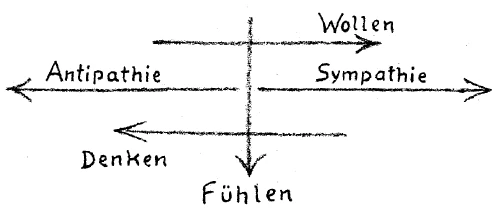
[ 17 ] Here, too, you can convince yourself of the truth of what has just been said simply through self-observation—even if you practice it only superficially. What I have said so far already leads you to an understanding of this truth, for I told you: The will, which in ordinary life operates objectively, rises to the level of action born of enthusiasm and love. There you can see quite clearly a will—otherwise brought about by the necessities of external life—permeated by feeling. When you do something enthusiastic or loving, you do what flows from the will by allowing it to be permeated by a subjective feeling. But even in sensory activity, if you look more closely—precisely through Goethe’s theory of colors—you can see how feeling intermingles with sensory activity. And when sensory activity intensifies to the point of revulsion or, on the other hand, to the point of inhaling the pleasant scent of a flower, you will also find that emotional activity naturally overflows into sensory activity.
[ 18 ] But emotional activity also flows into the act of thinking. There was once—at least on the surface—a very remarkable philosophical dispute—and indeed there have been many such disputes in the history of worldviews—between the psychologist Franz Brentano and the logician Sigwart in Heidelberg. The two men argued with one another about what constitutes human judgment. Sigwart maintained: When a person judges—let’s say, he makes the judgment: “A person should be good”—then emotion always plays a part in such a judgment; the decision is made by emotion. — Brentano argued: The act of judgment and the act of feeling, which consist of emotional stirrings, are so different that the function of judgment—the very act of judging—could not be understood at all if one were to believe that feeling plays a role in it. He maintained that this would introduce something subjective into the judgment, whereas our judgment is meant to be objective.
[ 19 ] To the discerning mind, such a dispute merely shows that neither psychologists nor logicians have arrived at what they should have—the interplay of mental activities. Consider what really needs to be observed here. On the one hand, we have the faculty of judgment, which must, of course, decide on something entirely objective. The fact that a person must be good must not depend on our subjective feelings. Thus, the content of the judgment must be objective. But when we judge, something entirely different comes into play. The things that are objectively true are not, for that reason alone, yet consciously present in our soul. We must first bring them consciously into our soul. And we cannot consciously bring a judgment into our soul without the activity of feeling playing a part. Therefore, we must say that Brentano and Sigwart should have agreed that they both would have said: Yes, the objective content of the judgment is established independently of the activity of feeling; but in order for the conviction of the judgment’s correctness to arise in the subjective human soul, the activity of feeling must develop.
[ 20 ] You can see from this how difficult it is, given the imprecise nature of philosophical reflections as they are currently practiced, to arrive at precise concepts at all. One must first rise to the level of such precise concepts, and today there is no other education leading to precise concepts than that provided by Spiritual Science. The external sciences believe they possess precise concepts, and they look down very haughtily on what anthroposophically oriented Spiritual Science provides, because they have no idea that the concepts provided by this approach are much more precise and exact than those commonly used today—because they are drawn from reality, not from mere wordplay.
[ 21 ] As you trace the emotional element in this way—on the one hand in cognition and mental images, and on the other hand in volition—you will say to yourself: Feeling stands as the middle soul activity between cognition and volition and radiates its essence in both directions. — Feeling is both cognition that has not yet fully come into being and volition that has not yet fully come into being; it is restrained cognition and restrained volition. That is why feeling is composed of sympathy and antipathy, which, as you have seen, are merely concealed in both cognition and volition. Both sympathy and antipathy are present in cognition and volition through the interaction of physical nervous activity and blood circulation, but they remain hidden. In feeling, they become apparent.
[ 22 ] What, then, do the physical manifestations of sensation look like? You will find everywhere in the human body that the blood vessels and the nerve pathways come into contact with one another in some way. And wherever blood vessels and nerve pathways come into contact, sensation actually arises. However, in the senses, for example, both the nerves and the blood are so refined that we no longer perceive the sensation. All our seeing and hearing is permeated by a subtle sensation, but we do not perceive it; we perceive it all the less because the sense organ is delimited and separated from the rest of the body. When it comes to seeing—to the activity of the eye—we hardly feel the emotional sympathies and antipathies at all, because the eye, embedded in the curve of the skull, is almost completely separated from the rest of the organism. And the nerves that extend into the eye, as well as the blood vessels that extend into the eye, are highly refined. Emotional perception in the eye is greatly suppressed. — The emotional aspect is less suppressed in the sense of hearing. Hearing is much more closely connected, in an organic sense, to the organism’s overall activity than sight is. Because the ear contains numerous organs that are of a completely different nature than those of the eye, the ear is in many respects a faithful reflection of what is taking place throughout the entire organism. Therefore, what occurs in the ear as sensory activity is very strongly accompanied by emotional activity. And here, even people who are well versed in what is heard find it difficult to truly discern what in what is heard—especially in artistic listening—is mere cognition and what is emotional. This underlies a very interesting phenomenon of recent times, one that has also played a role in direct artistic production.
[ 23 ] You are all familiar with the character of Beckmesser in Richard Wagner’s *Meistersinger*. What was Beckmesser actually meant to represent? He was meant to represent a person who perceives music in such a way that he completely forgets how the emotional element of the whole human being influences the cognitive aspect of the act of listening. Wagner, who portrayed his own view in the character of Walter, was in turn completely and one-sidedly convinced that it is primarily the emotional aspect that must live in music. What is set in contrast in Walter and Beckmesser—arising from a misunderstanding, I mean, a misunderstanding on both sides—as opposed to the correct understanding of how the emotional and the cognitive interact in musical listening, was expressed in a historical phenomenon in that Wagner’s art, upon its emergence—and especially as it became widely known—found an opponent in the person of Eduard Hanslick in Vienna, who regarded everything that wells up in the sphere of emotion in Wagner’s art as unmusical. There are perhaps few writings in the field of the arts that are as psychologically interesting as Eduard Hanslick’s “On the Musical Beautiful.” It argues primarily that anyone who seeks to derive everything in music from the emotional realm is not a true musician and lacks a true musical sensibility; rather, a true musician is one who sees the very essence of music in the objective connection from note to note—in the arabesque, devoid of all emotion, that is woven together from note to note. With remarkable precision, the assertion that the highest form of music may consist solely in the tonal image, in the tonal arabesque, is expounded in Eduard Hanslick’s book *On the Musical-Beautiful*, and every possible scorn is heaped upon precisely what constitutes the very essence of Wagnerism: the creation of the musical from emotional elements. The very fact that a dispute such as that between Hanslick and Wagner could arise in the realm of music testifies precisely to the fact that, psychologically speaking, ideas about the workings of the soul in modern times were thoroughly unclear; otherwise, such a one-sided inclination as that evident in Hanslick could never have arisen. However, if one sees through the superficial aspects and then immerses oneself in Hanslick’s philosophically profound arguments, one will conclude that the little book *On Musical Beauty* is a very witty one.
[ 24 ] From this you can see that, in terms of cognition, more of the whole human being—who initially lives as a sentient being—penetrates into the periphery through one sense than through the other.
[ 25 ] This will—and indeed must—draw your attention, precisely for the sake of pedagogical insight, to something that is wreaking great havoc on contemporary scientific thought. If we had not spoken here in preparation, and if we were not speaking now in preparation for what is to lead you toward reformative activity, you would have to piece together from the currently available pedagogies, from existing psychologies and logics, and from educational practices, what you wish to carry out in your school work. You would have to incorporate into your school work what has become common practice outside of it. But what has become common today suffers from the outset from a major flaw, even with regard to psychology. After all, in every system of psychology you first encounter what is called the “science of the senses.” By investigating what sensory activity is based on, one arrives at the sensory activity of the eye, the ear, the nose, and so on. Everything is lumped together under the broad abstraction of “sensory activity.” This is a major mistake, a considerable error. For if you take just those senses that are currently known to physiologists and psychologists, you will observe—if you look first and foremost at the physical aspect—that the sense of sight is actually quite different from the sense of hearing. The eye and the ear are two entirely different entities. And then there is the organization of the sense of touch, which has not yet been researched at all—not even in a manner as satisfactory as is the case with the eye and the ear! But let us stick with the eye and the ear. They are two entirely different activities, so that the grouping of seeing and hearing under a single “general sensory activity” is a vague theory. If one were to proceed correctly here, using concrete, intuitive understanding, one would first have to speak exclusively of the functioning of the eye, the functioning of the ear, the functioning of the olfactory organ, and so on. Then one would find such great diversity that one would lose the desire to establish a general physiology of the senses, as is the case in contemporary psychology.
[ 26 ] One can only gain insight into the human soul by remaining within the realm that I attempted to define in my discussions in both *Truth and Science* and *The Philosophy of Freedom*. Only then can one speak of the unified soul without falling into abstractions. For there one stands on solid ground; there one assumes that human beings live their way into the world and do not possess the whole of reality. You can read about this in *Truth and Science* and in *The Philosophy of Freedom*. At the outset, human beings do not possess the whole of reality. They first develop further, and in the course of this development, what was not yet reality becomes true reality through the interplay of thought and perception. Human beings must first conquer reality for themselves. In this regard, Kantianism—which has permeated everything—has wrought the most terrible devastation. What does Kantianism do? It dogmatically asserts from the outset: We must first perceive the world around us, and within us lives, in fact, only the reflection of this world. This is how it arrives at all its other deductions. Kant is not clear about what exists in man’s perceived environment. For reality is not in the environment, nor is it in appearance; rather, reality emerges only gradually through our striving toward it, so that the very last thing to approach us is reality itself. Essentially, the true reality would be what a person beholds at the moment when he can no longer express himself—namely, at that very moment when he passes through the gates of death.
[ 27 ] A great many erroneous elements have found their way into modern intellectual culture, and this has the most profound effect in the field of education. Therefore, we must strive to replace the erroneous concepts with the correct ones. Then we will be able to carry out our teaching duties in the proper manner.