

General Human Studies
as the Basis of Education
GA 293
27 August 1919, Stuttgart
Translated by Steiner Online Library
Sixth Lecture
[ 1 ] So far, we have attempted to understand human beings—insofar as this understanding is necessary for the education of the child—from a psychological perspective. We will, of course, have to distinguish between the three perspectives—the intellectual, the psychological, and the physical—and, in order to arrive at a complete anthropology, we will examine human beings from each of these perspectives. It makes the most sense to begin with the psychological perspective, because in everyday life, the psychological aspect is what is closest to human beings. And you will also have sensed that, by using antipathy and sympathy as our main concepts in this understanding of the human being, we have been aiming at the psychological realm. It would not be appropriate for us to move directly from the soul to the physical, for we know from our observations in Spiritual Science that the physical can only be understood when it is regarded as a manifestation of the spiritual and also of the soul. Therefore, we will now add to the psychological consideration we have outlined in general terms a consideration of the human being from a spiritual perspective, and only then will we delve more deeply into what is now called anthropology—the study of the human being as it manifests itself in the external physical world.
[ 2 ] If you wish to view human beings objectively from any perspective, you must repeatedly return to the division of the human soul’s activities into cognition—which takes place in thinking—feeling, and willing. So far, we have placed thinking or cognition, feeling, and willing within the context of antipathy and sympathy. Let us now consider willing, feeling, and cognition from a spiritual perspective.
[ 3 ] From a spiritual perspective, you will also find a difference between willing, feeling, and thinking. Just consider the following. As you recognize through thinking, you must feel—if I may first express this figuratively, though the figurative will help us arrive at concepts—that you are, so to speak, living in the light. You recognize and feel yourself fully immersed, together with your “I,” in this activity of recognition. In a sense, every part, every element of that activity you call cognition is contained within everything your “I” does; and conversely, what your “I” does is contained within the activity of cognition. You are fully in the light; you live in a fully conscious activity, if I may put it in conceptual terms. It would also be problematic if, while cognizing, you were not engaged in a fully conscious activity. Just imagine if you had to feel that, while you are forming a judgment, something is happening with your “I” somewhere in the subconscious, and that the result of this process is the judgment! Suppose you say, “This person is a good person”—that is, you are making a judgment. You must be aware that what you need to make this judgment—the subject “the person,” the predicate “he is a good”—are elements of a process that is fully present to you, a process that is entirely permeated by the light of consciousness. If you were to assume that some demon or mechanism of nature were to conflate the “person” with “goodness” while you are making the judgment, then you would not be fully conscious within this act of cognitive thinking, and part of the judgment would always remain in your unconscious. This is the essence of thinking and cognition: that you are fully immersed with your entire consciousness in the entire fabric of activity involved in thinking and cognition.
[ 4 ] It is not like that with volition. You know very well that when you engage in the simplest act of volition—walking—you are actually living fully consciously only within the mental image of that walking. You know nothing of what takes place within your muscles as you move one leg after the other forward, nor of what is happening in the mechanisms and organism of your body. Just think of all you would have to learn about the world if you had to consciously carry out all the processes necessary for the act of walking! You would then have to know exactly how much of the energy produced by the nutrients in the muscles of your legs and in your other muscles is consumed while you exert yourself to walk. You have never calculated how much of what your food provides you with you actually consume. You know very well: all of this happens in your physical being in a very, very unconscious way. Whenever we will, a deep unconscious constantly intervenes in our activity. This is not merely the case when we observe the nature of volition within our own organism. Even what we accomplish when we extend our will to the external world—we by no means fully grasp that either in the light of consciousness.
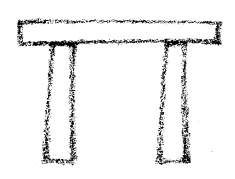
[ 5 ] Suppose you have two pillar-like stakes. You decide to place a third stake across them. Now distinguish precisely between what, in all that you have done here, constitutes fully conscious, cognitive activity, and what constitutes your fully conscious activity when you make the judgment: “A person is good”—where you are fully immersed in your cognition. Please distinguish what in this constitutes a cognitive activity from that of which you know nothing, even though you were fully engaged in it with your will: Why do these two columns, through certain forces, support the beam lying across them? After all, physics has only hypotheses about this to this day. And when people believe they know why the two stakes support the beam, they are merely imagining it. All the concepts we have—such as cohesion, adhesion, and the forces of attraction and repulsion—are, in essence, merely hypotheses for external knowledge. We rely on these external hypotheses when we act; we count on the fact that the two pegs, which are supposed to support the beam, will not buckle if they are of a certain thickness. But we cannot fully comprehend the entire process involved, any more than we can comprehend the movements of our legs when we strive forward. Here, too, an element that does not extend into our consciousness intervenes in our volition. Volition contains, to the greatest extent, an unconscious element within itself,
[ 6 ] And feeling lies right in the middle between willing and thinking cognition. Feeling is also such that it is partly permeated by consciousness and partly by the unconscious. In this way, feeling participates both in the nature of cognitive thinking and, on the other hand, in the nature of feeling or emotionally driven volition. What, then, is actually present here from a spiritual point of view?
[ 7 ] You will only be able to make sense of this if, from a spiritual perspective, you come to understand the facts described above in the following way. In our everyday life, we speak of being awake, of the waking state of consciousness. But we have this waking state of consciousness only in the activity of cognitive thinking. So if you want to speak very precisely about the extent to which a person is awake, you must say: A person is truly awake only as long as and to the extent that he or she is a thinking knower of something.
[ 8 ] What, then, about volition? You are all familiar with the state of consciousness—call it, if you will, a state of unconsciousness—of sleep. You know that while we sleep, from the moment we fall asleep until we wake up, what we experience is not present in our consciousness. But the same is true of everything that, as the unconscious, permeates our volition. Insofar as we are volitional beings as human beings, we are asleep even when we are awake. We always carry within us a sleeping human being—namely, the willing human being—and accompany this sleeping aspect with the waking, thinking, and perceiving human being; insofar as we are beings of will, we are also asleep from the moment we wake until we fall asleep. Something is always sleeping within us—namely, the inner essence of the will. We are no more aware of this than we are of the processes that take place within us during sleep. One cannot fully understand a person unless one knows that sleep plays a role in their waking state, in that a person is a being of will.
[ 9 ] Feeling is at the center, and we may now ask ourselves: What is consciousness like in feeling? — It, too, lies at the center between waking and sleeping. You are aware of the feelings that live in your soul just as you are aware of dreams, except that you remember dreams while you experience feelings directly. But the inner state of mind and mood you experience when you are aware of your feelings is no different from the one you have when you are aware of your dreams. When you are awake, you are not only a waking person—insofar as you recognize things through thought—and a sleeping person—insofar as you will—but you are also a dreaming person—insofar as you feel. Thus, three states of consciousness are in fact bestowed upon us during our waking hours: waking in the true sense through thinking and recognizing, dreaming through feeling, and sleeping through willing. From a spiritual point of view, ordinary dreamless sleep is nothing other than the surrender of the human being, with his entire soul-being, to that to which he is devoted through his will while he goes about his daily activities. The only difference is that in actual sleep we sleep with our entire soul-being, whereas in wakefulness we sleep only with our will. In dreaming—as it is commonly called in everyday life—we are devoted with our entire being to the state of the soul that we call a dream, whereas in waking life we are devoted to this dreamlike state of the soul only as feeling human beings.
[ 10 ] From an educational perspective, you will no longer be surprised if you view the matter in such a way that children differ in terms of the alertness of their consciousness. For you will find that children in whom the emotional life predominates by nature are dreamy children, so that such children—in whom full thinking has not yet awakened during childhood—will easily be given over to a dreamy disposition. You will then take this as an opportunity to influence such a child through strong emotions. And you will then be able to hope that these strong emotions will also awaken clear cognition in the child, for everything that is dormant tends, in accordance with the rhythm of life, to awaken after some time. If we now approach such a child—who is brooding dreamily in their emotional life—with strong emotions, then these strong emotions instilled in the child will, after some time, awaken of their own accord as thoughts.
[ 11 ] Children who brood even more, who are even dull to emotional life, will reveal to you that they are particularly strong-willed. You see: if you keep this in mind, you may be able to understand many of the mysteries of a child’s life. You may encounter a child at school who appears to be genuinely dull-witted. If you were to immediately pass judgment—saying, “This is a mentally deficient, dull-witted child”—and if you were to examine the child using experimental psychology, conducting memory tests and all sorts of other assessments—as is already done in psychological and educational laboratories—and then conclude: ‘A dull child by its very nature belongs in a school for the mentally disabled or even in the now-popular school for the less-able,’—with such a judgment you would not be getting close to the child’s true nature. Perhaps, however, this child is endowed with a particularly strong will; perhaps it is one of those children who, in later life, will transform their choleric temperament into energetic action. But for the time being, the will lies dormant. And if this child’s capacity for thinking and cognition is destined to emerge only later, then it must also be treated accordingly, so that it may later be called upon to accomplish something of substance. For the time being, it appears to be a real dullard, but perhaps it is not at all. And one must then have the insight to awaken the will in such a child; that is, one must work into its waking, sleeping state in such a way that it gradually comes to the point—since every sleep has a tendency to give way to awakening—of awakening, in later life, its sleep as a will that may be very strong but is merely dormant at present, drowned out by the sleeping nature. Such a child must be treated in such a way that you rely as little as possible on their cognitive abilities or their understanding, but rather, in a sense, instill in them certain things that have a strong effect on the will, so that as they speak, you allow them to proceed at their own pace. Take such a child—you won’t have very many of them, after all—out of the class, and—while this will be stimulating for the other children, for this child it will be educational—let the child accompany the words with movements as it speaks sentences. So: The (step) — human (step) — is (step) — good! — In this way, you connect the whole human being in the element of the will with the purely intellectual aspect of cognition, and you can gradually bring about a situation where, in such a child, the will to think awakens. Only the realization that, in the waking human being, we are already dealing with different states of consciousness—waking, dreaming, and sleeping—only this realization brings us to a true understanding of our tasks toward the developing human being.
[ 12 ] But we can now ask a question. We can ask: How does the true center of the human being—the “I”—relate to these various states? You will find this easiest to understand if you first assume—as is undeniably true—that what we call the world, what we call the cosmos, is a sum of activities. For us, these activities manifest themselves in the various realms of elemental life. We know that forces are at work in this elemental life. The life force, for example, is at work all around us. And woven between the elemental forces and the life force is everything that brings about, for example, heat and fire. Just think how deeply we are immersed in an environment in which fire brings about so much.
[ 13 ] In certain parts of the world, for example in southern Italy, all you have to do is light a paper ball, and at that very moment, thick smoke begins to rise from the ground. Why does this happen? It happens because, by lighting the paper ball and generating heat, you thin the air at that spot, and the forces that normally operate beneath the earth’s surface are drawn upward by the rising smoke; the moment you light the paper ball and throw it onto the ground, you are enveloped in a cloud of smoke. This is an experiment that any traveler visiting the Naples area can perform. I have cited this as an example to show that, if we do not view the world superficially, we must acknowledge: We live in an environment that is permeated by forces everywhere.
[ 14 ] Now, there are also forces higher than heat. They, too, are present in our surroundings. We constantly pass through them as we go through the world as physical human beings. Yes, our physical body—without us being aware of it in our ordinary perception—is such that we can endure this. With our physical body, we are able to walk through the world in this way.
[ 15 ] With our “I”—which is the most recent development in our evolution—we could not pass through these world forces if this “I” were to surrender itself directly to them. This “I” could not surrender itself to everything that is in its surroundings and of which it itself is a part. This “I” must still be protected from having to pour itself out into the forces of the universe. It will one day develop the ability to merge with the forces of the universe. It cannot do so yet. That is why it is necessary that, for the fully awake “I,” we not be transported into the real world that surrounds us, but only into the image of the world. Hence, in our thinking cognition, we have only the images of the world, as we have already noted from a psychological perspective.
[ 16 ] Now let us also consider this from a spiritual perspective. In thinking cognition, we live in images; and we humans, at our present stage of development within the cycle of birth and death, can—with our fully awakened “I”—live only in images of the cosmos, not yet in the real cosmos. Therefore, when we are awake, our body must first produce the images of the cosmos for us. Then our “I” lives in the images of this cosmos.
[ 17 ] Psychologists go to tremendous lengths to establish the relationship between body and soul. They speak of the interaction between body and soul, of psychophysical parallelism, and of other things as well. All of these are, at the root of it, childish concepts. For the actual process is this: When the “I” transitions into the waking state in the morning, it enters the body—not into the body’s physical processes, but into the world of images that the body generates from external events, extending into its deepest innermost being. Through this, thinking cognition is conveyed to the “I.”
[ 18 ] With feeling, it is different. Here, the “I” penetrates into the actual body, not merely into the images. But if it were fully conscious during this penetration—consider this in psychological terms—it would literally burn itself out psychologically. If the same thing happened to you in feeling as happens to you in thinking—that is, if you penetrated with your “I” into the images your body produces—then you would burn up psychologically. You would not be able to endure it. You can experience this penetration, which is what feeling entails, only in a dream, in a subdued state of consciousness. Only in a dream can you endure what is actually taking place in your body when you feel.
[ 19 ] And what takes place in the act of willing—you can only experience that at all by sleeping. It would be something truly terrible that you would experience if, in ordinary life, you had to witness everything that goes on with your will. For example, you would be seized by the most excruciating pain if, as I have already hinted, you really had to experience how the energy supplied to the organism through food is consumed in your legs as you walk. It is indeed your good fortune that you do not experience this—or rather, that you experience it only while asleep. For to experience this while awake would mean the greatest pain imaginable—a terrible pain. One could even say: If we could attain the waking state in our will, the pain—which otherwise remains latent and is numbed by the sleeping state in our will—would enter our consciousness.
[ 20 ] Therefore, you will understand when I now describe the life of the “I” during what is commonly called the waking state—which thus encompasses: full wakefulness, dream-like wakefulness, and sleep-like wakefulness—when I describe what the “I,” by living in the body during the ordinary waking state, actually experiences in reality. This “I” lives in thinking cognition as it awakens into the body; there it is fully awake. However, it lives there only in images, so that in his life between birth and death, unless a person engages in the exercises outlined in my book *How to Attain Knowledge of the Higher Worlds*, he continually lives only in images through his thinking cognition.
[ 21 ] Then, as it awakens, the “I” also sinks into the processes that give rise to feeling. Living through feeling: in this state, we are not fully awake, but rather awake in a dreamlike state. How, then, do we actually experience what we go through in this dreamlike waking state of feeling? We experience it, in fact, in what has always been called inspiration, inspired mental images, or unconsciously inspired mental images. There lies the source of everything that rises from the artist’s feelings into waking consciousness. That is where it is first experienced. That is also where everything is experienced that, in a waking person, often rises into waking consciousness as flashes of insight and then becomes images.
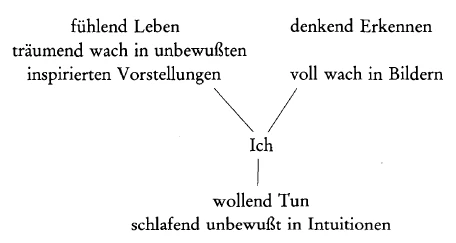
[ 22 ] What is called “inspiration” in my book *How Does One Attain Knowledge of the Higher Worlds?* is simply the experience—raised to a state of clarity and full consciousness—of what is unconsciously present as inspiration in every person’s emotional life. And when people with a special predisposition speak of their inspirations, they are actually speaking of what the world has placed within their emotional life and what, through their predispositions, rises into their full waking consciousness. It is just as much a part of the world’s content as the content of thought is. But in the life between birth and death, these unconscious inspirations reflect worldly processes that we can experience only in dreams; otherwise, our “I” would be consumed by these processes or it would suffocate—specifically, suffocate. This suffocation sometimes begins in humans under abnormal conditions. Just imagine for a moment that you are having a nightmare. Then a state that unfolds between you and the outside air—when not everything is in order in this interplay within a person—seeks to transition abnormally into something else. As it seeks to enter your ego-consciousness, it does not become conscious to you as a normal mental image, but as a tormenting mental image: as the nightmare. And just as agonizing as the abnormal breathing in a nightmare is, so agonizing would the entire act of breathing—every single breath—be if a person were to experience breathing with full consciousness. They would experience it through sensation, but it would be agonizing for them. It is therefore dulled, and thus it is not experienced as a physical process, but only as a dreamlike sensation.
[ 23 ] And as for the processes that take place during the act of willing—I have already hinted at this to you—it would be a terrible pain! Therefore, we can go on to say, as a third point: The “I” is dormant in the act of willing. What is experienced there is experienced with a greatly subdued consciousness—precisely in a sleeping consciousness—in unconscious intuitions. Human beings have unconscious intuitions constantly; but they live within their volition. They are asleep in their volition. That is why they cannot bring them to the surface in ordinary life. They emerge only in moments of happiness; then human beings experience the spiritual world in a very dim way.
[ 24 ] Now, there is something peculiar about ordinary human life. We are all familiar with full consciousness during wakefulness and thoughtful perception. There, we are, so to speak, in the light of consciousness; we know all about that. Sometimes, when people reflect on the world, they begin to say: “We have intuitions.” People then express vague feelings based on these intuitions. What they say can sometimes be quite confused, but it can also be unconsciously structured. And finally, when the poet speaks of his intuitions, it is certainly true that he does not initially draw them from the source closest to him—the inspired mental images of his emotional life—but rather brings forth his entirely unconscious intuitions from the realm of the dormant will.
[ 25 ] Anyone who looks deeply into these matters will see profound laws even in the apparent coincidences of life. For example, when one reads the second part of Goethe’s *Faust*, one is compelled to investigate thoroughly how these remarkable verses, with their unique structure, could have come into being. Goethe was already old when he wrote the second part of his *Faust*—at least the greater part of it. He wrote it in such a way that John, his secretary, sat at the desk and wrote down what Goethe dictated. Had Goethe had to write it himself, he probably would not have produced such remarkably finely crafted verses for the second part of his *Faust*. While dictating, Goethe walked back and forth continuously in his small Weimar study, and this pacing is an integral part of the conception of the second part of *Faust*. As Goethe developed this unconscious, willful activity through his pacing, something welled up from his intuitions, and what he had another person write down on paper was then revealed in his outward activity.
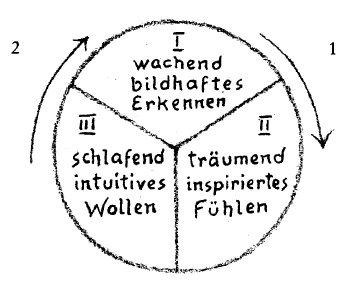
[ 26 ] If you want to form a picture of the life of the “I” within the body, you can do so in the following way:
I. Awake — Visual Perception
II. Dreaming — Inspired Feeling
III. Asleep — Intuitive or Intuitively Driven Will
[ 27 ] then you will not be able to fully understand why the intuitive—which people speak of instinctively—emerges more easily into the pictorial perception of everyday life than the more obvious inspired feeling. If you now draw the diagram correctly—because it’s drawn incorrectly here at the top—if you do it the way it’s shown in the drawing, then you’ll grasp the concept more easily. For then you’ll say to yourself: In the direction of arrow (1), pictorial perception descends into inspirations, and it rises again from intuitions (arrow 2). But this cognition, indicated by arrow 1, is the descent into the body. And now observe yourself; at first you are completely calm, sitting or standing, devoting yourself solely to thinking cognition, to the observation of the external world. There you live in the image. Whatever else the “I” experiences in these processes descends into the body—first into feeling, then into willing. You do not pay attention to what is in feeling, nor do you pay attention to what is in willing at first. Only when you begin to walk, when you begin to act, do you not first observe feeling externally, but rather willing. And there—as it descends into the body and ascends again, which is what happens in the direction of arrow 2—intuitive volition is closer to reaching pictorial consciousness than dreamlike, inspired feeling. That is why you will find that people so often say: “I have a vague intuition.” — What I call “intuitions” in my book *How Does One Attain Knowledge of the Higher Worlds?* is then confused with the superficial intuition of ordinary consciousness.
[ 28 ] Now you will begin to understand something about the structure of the human body. Imagine for a moment that you are walking while observing the world. Imagine this: It is not your lower body that would have to walk with your legs, but rather your head would have legs directly attached to it and would have to walk. Your observation of the world and your will would be interwoven into one, and the result would be that you could only walk while asleep. Because your head is set upon your shoulders and the rest of your body, it rests on the rest of your body. It rests, and you carry your head by moving only with the rest of your body. But the head must be able to rest on the body; otherwise, it could not be the organ of thinking cognition. It must be removed from the realm of sleeping volition, for the moment you set it in motion—the moment you were to transfer it from relative rest into a self-generated movement—it would fall asleep. It allows the body to carry out the actual will, and it lives inside this body as if in a carriage, allowing itself to be carried along by this vehicle. Only by allowing the head to be carried along by the body’s chariot, as if in a carriage, and by acting during this journey—during this state of rest—is a person awake and active. Only when you hold these things together in this way will you arrive at a true understanding of the form of the human body.