

General Human Studies
as the Basis of Education
GA 293
28 August 1919, Stuttgart
Translated by Steiner Online Library
Seventh Lecture
[ 1 ] It is important for you to understand what the human being actually is. In our journey through general pedagogy thus far, we have attempted to comprehend this human being first from a psychological perspective and then from a spiritual one. Today, we would like to continue exploring the latter. Of course, we will have to continually refer to concepts that are commonplace in the world of education, as well as in the realms of the soul and psychology; for, over time, you will have to engage with educational and psychological literature through reading, insofar as you have the time and leisure to do so.
[ 2 ] When we view human beings from a psychological perspective, we place the main emphasis on discovering antipathies and sympathies within the framework of universal laws; but when we view human beings from a spiritual perspective, we must place the main emphasis on discovering states of consciousness. And yesterday we dealt with the three states of consciousness that prevail in human beings: full wakefulness, dreaming, and sleep—and we showed how full wakefulness is actually present only in thinking cognition, while dreaming prevails in feeling and sleep in willing.
[ 3 ] All understanding is, in fact, a relating of one thing to another. But we cannot understand the world in any other way than by relating one thing to another. I would like to preface this with this methodological remark. As we relate to the world through cognition, we first observe. Either we observe with our senses, as we do in everyday life, or we develop a little further and observe with our soul and spirit, as we are able to do through imagination, inspiration, and intuition. But even spiritual observation is, after all, a form of observation, and it is necessary—as a complement to all observation—that we comprehend. Yet we can only comprehend if we relate one thing to another within the universe, within our surroundings. You can form sound concepts of body, soul, and spirit if you take the entire course of human life into account. You must, however, bear in mind that in making such connections—as I am about to suggest—you will always have only the very first, most basic foundations of understanding. You must then further develop the concepts you gain in this way.
[ 4 ] If you observe a child who has just come into the world—if you observe its form, its movements, its expressions of life, its crying, its babbling, and so on—then you gain a deeper understanding of the human body. But you can only gain a complete picture of the human body if you relate it to middle age and old age. In middle age, a person is more soul-oriented; in old age, they are most spirit-oriented. The latter point could easily be contested. Of course, some will say: But many elderly people do become mentally feeble again! — This is, in particular, an objection raised by materialism against the soul-spiritual realm—that one becomes mentally feeble again in old age—and the materialists indeed lecture with true persistence that even a great mind like Kant’s is said to have become feeble-minded in his old age. This objection by the materialists and this fact are correct. However, what they seek to prove, they do not prove. For even Kant, when he stood at the gates of death, was wiser than he had been in his childhood; it was simply that in his childhood his body was capable of absorbing everything that came from his wisdom; thereby it could become conscious in physical life. In old age, however, the body had become incapable of absorbing even what the spirit provided it. The body was no longer a proper instrument of the spirit. Therefore, on the physical plane, Kant could no longer become conscious of what lived within his spirit. Despite the apparent validity of the objection just outlined, one must nevertheless be clear that in old age one becomes wise and spiritually rich, that one draws closer to the spirits. Therefore, in such elderly people who retain elasticity and vitality for their spirit well into old age, one must recognize the qualities of the spiritual in their early stages. Such possibilities do indeed exist.
[ 5 ] There were once two professors in Berlin. One was Michelet, the Hegelian, who was already over ninety years old. Since he was quite witty, he had only managed to become an honorary professor, but even at such an advanced age, he still gave his lectures. Then there was another, Zeller, the historian of Greek philosophy. Compared to Michelet, he was a young man, for he was only seventy years old. People everywhere were saying that he felt the burden of old age, that he could no longer give his lectures, and that, above all, he wanted to limit the number of his lectures. Michelet always said in response: “I don’t understand Zeller; I could still lecture all day long, but Zeller, even in his youth, is always saying that it’s too much of a strain for him!”
[ 6 ] So you see, one might find—perhaps only in isolated cases—external, physical evidence to support what is posited here regarding the spirit of the age. But that is how it is.
[ 7 ] If, on the other hand, we consider human beings in their expressions of life—particularly in middle age—we find the starting points for observing the soul. Therefore, a person in middle age may, one might say, deny the soul to a greater extent. He may appear soulless or deeply animated. For the soul resides in human freedom, including in education. The fact that some people are very soulless in their middle years therefore does not disprove that middle age is, in fact, the truly spiritual stage of life. If one compares the more restless, unconsciously active physical nature of the child with the contemplative, calm physical nature of old age, one has, on the one hand, a body that particularly emphasizes its physicality in the child, and, on the other hand, a body that allows the physical to recede into the background—a body that, in a sense, denies itself as a body—in old age.
[ 8 ] If we apply this observation more specifically to the soul, we will say: Human beings possess within themselves thinking, feeling, and willing. When we look at a child, we see in the picture the child presents to us through its soul a close connection between willing and feeling. One might say that willing and feeling have grown together in the child. When the child wriggles and kicks, it makes precisely the movements that correspond to its feelings at that moment; it is not able to distinguish the movements from the feelings, so to speak.
[ 9 ] The situation is different for the elderly. In their case, the opposite is true: thinking, cognition, and feeling have become intertwined, and the will manifests itself in a certain independent way. The course of human life thus proceeds in such a way that feeling, which is initially bound to the will, gradually detaches itself from the will over the course of life. And this is precisely what we are often dealing with in education: the detachment of feeling from the will. Then the feeling that has been detached from the will unites with thinking and cognition. This is what later life is all about. We have properly prepared the child for later life only if we enable feeling to detach itself effectively from the will; then, in a later stage of life as a man or woman, the child will also be able to connect this detached feeling with thinking and cognition and will thus be able to cope with life. Why do we listen to the elderly person, even when they tell us about their life experiences? Because, over the course of their life, they have connected their personal feelings with their concepts and ideas. They do not tell us theories; they tell us what feelings they have personally been able to link to those ideas and concepts. In the case of the elderly person who has truly integrated his or her feelings with intellectual understanding, the concepts and ideas therefore sound warm, rich with reality, concrete, and personal; whereas in the case of the person who has remained more in the stage of manhood or womanhood, the concepts and ideas sound theoretical, abstract, and scientific. It is a fact of human life that the faculties of the human soul undergo a certain progression, in which the child’s feeling-willing develops into the elderly person’s feeling-thinking. Human life lies in between, and we will only be able to educate well for this human life if we are able to grasp such a process psychologically.
[ 10 ] Now we must take into account that, in all our observation of the world, something occurs first—and all schools of psychology describe it as the first thing that occurs when we observe the world: that is sensation. Whenever any of our senses comes into contact with the environment, we experience a sensation. We perceive color, sounds, warmth, and cold. Thus, sensation arises in our interaction with the environment.
[ 11 ] The way sensation is usually described in conventional psychological theories does not give you a true mental image of what sensation actually is. When psychologists speak of sensation, they say: A certain physical process is taking place outside—vibrations in the light ether or oscillations in the air—which flow toward our sense organ and stimulate it. — One then speaks of the stimulus, and one rises to an expression that one forms but does not seek to understand. For the stimulus triggers, through the sense organ, a sensation in our soul—a purely qualitative sensation—that arises from the physical process, for example, through the vibrations of air waves when we hear. Psychology—and contemporary science in general—cannot yet provide any explanation of how this comes about. This is usually stated in psychological works.
[ 12 ] You will come closer to understanding these things than through such psychological considerations if, by gaining insight into the nature of sensations themselves, you can answer the question: To which of the powers of the soul is sensation actually most closely related? - Psychologists take the easy way out; they simply classify sensation as a form of cognition and say: First we feel, then we perceive, then we form mental images, construct concepts, and so on. - At first glance, that does indeed seem to be how the process works. But they fail to take into account the true nature of sensation.
[ 13 ] If one truly examines sensation through sufficient self-observation, one recognizes that sensation is of a volitional nature with an emotional component. It is not, at first, related to thinking cognition, but rather to feeling will or willing feeling. I do not know how many schools of psychology—one cannot, of course, be familiar with all the countless schools of psychology that exist today—have grasped anything of the relationship between sensation and feeling-as-willing or willing-as-feeling. To say that sensation is related to volition is not strictly accurate, for it is related to feeling-as-volition and volition-as-feeling. But at least one psychologist, Moriz Benedikt in Vienna, who was distinguished by his particularly keen powers of observation, recognized in his work on psychology that sensation is related to feeling.
[ 14 ] Psychologists, however, tend to pay less attention to this branch of psychology. There is also something peculiar about it. First, according to his professional classification, Moriz Benedikt is a criminal anthropologist; yet he is now writing a work on psychology. Second, he is a naturalist, and he writes about the importance of poetic works of art in education, even analyzing poetic works of art to show how they can be used in education. It is a terrible thing: the man wants to be a scientist and believes that psychologists can learn something from poets! And third: this man is a Jewish naturalist who writes a work on psychology and dedicates it, of all people, to the priest, the Catholic philosopher of the Faculty of Theology at the University of Vienna—which he still was at the time—Laurenz Müllner. Three dreadful things that could never possibly prompt professional psychologists to take the man seriously. But if you were to read through his work on psychology, you would find so many truly insightful observations in the details that you would benefit greatly from them, even though you would have to reject the entire structure of this psychology, the entire materialist way of thinking of Moriz Benedikt—for that is what he stands for. You gain not the slightest thing from the book as a whole, but a great deal from the individual observations. Thus, one must seek out the best in the world wherever it is to be found. If someone is a keen observer of details and is repelled by the overall tendency evident in Moriz Benedikt’s work, that is no reason to reject his insightful observations in specific instances.
[ 15 ] Sensation, as it occurs in human beings, is therefore willing feeling or feeling will. Therefore, we must say: Wherever the human sensory sphere extends outward—for, to put it bluntly, we carry our senses on the outside of our bodies—there, in a certain sense, feeling-as-willing and willing-as-feeling are present in the human being. If we sketch a schematic diagram of the human being, we can say: On the outer surface of the human being—please bear in mind that all of this is meant schematically—there we have the sensory sphere; there, willing feeling and feeling will are present (see drawing on p. 114). What, then, do we do on this surface when feeling-will and will-feeling are present, insofar as this bodily surface is the sphere of the senses? We engage in an activity that is half sleep and half dream; we could also call it dreaming while asleep, or sleeping while dreaming. For we do not sleep only at night; we sleep continuously at the periphery, on the outer surface of our body, and as human beings we therefore do not fully comprehend our sensations because, in these regions where the sensations are, we merely dream while sleeping and sleep while dreaming. Psychologists have no inkling that the very same reason why they cannot grasp sensations is what also prevents us, when we wake in the morning, from bringing our dreams clearly into consciousness. You see, the concepts of sleeping and dreaming have a meaning quite different from the one we would apply in ordinary life. In everyday life, we know sleep only insofar as we know that at night, when we lie in bed, we sleep. We have no idea that this sleeping is something much more widespread, something we are constantly doing on the surface of our bodies; it is just that dreams are constantly intermingled with this sleeping on the surface of our bodies. These “dreams” are the sensory perceptions before they are grasped by the intellect and by thinking cognition.
[ 16 ] You must also seek out the child’s sphere of will and feeling within his or her senses. That is why we emphasize so strongly that, while educating the child intellectually, we must also continually influence the will; for in everything the child must observe and perceive, we must also nurture the will and feeling—otherwise we are actually contradicting the child’s sensibility. It is only with the elderly, only in the twilight of a person’s life, that we can speak to them in such a way that we also regard their feelings as having already undergone a metamorphosis. With the elderly, the feeling has already transitioned from feeling-based volition to feeling-based thinking or thinking-based feeling. For them, feeling has become something else. There, feelings take on a more thought-like character and are devoid of the restless nature of the will; they carry greater tranquility within them. Only with the elderly can we say that feelings have drawn closer to the concept, to the nature of ideas.
[ 17 ] Psychologists usually do not make this subtle distinction in perception. For them, an old person’s perception is the same as a child’s perception, because, for them, perception is simply perception. That is roughly the same logic as if you had a razor in front of you and said: “The razor is a knife, so let’s use it to cut meat, because a knife is a knife.”—Here, one derives the concept from the definition of the word. But one should never do that; rather, one should derive the concept from the facts. When it comes to perception, we would find that it, too, is alive, that it, too, undergoes a process of becoming in life, that in a child it has a more volitional character, while in an elderly person it has a more rational, intellectual character. Of course, it is easier for people to pick everything apart from words; that is why we have so many word-explainers, and some of them can have a truly appalling effect on one.
[ 18 ] I once had the opportunity to listen to a classmate after we had drifted apart somewhat. We had attended the same elementary school; I went on to a secondary school, while he went to a teachers’ college—a Hungarian one, at that—and in the 1970s, that meant quite a lot. We met again after a few years and discussed light. I had already learned what standard physics taught—that light had something to do with vibrations in the ether and so on. That could at least be considered one cause of light. My former classmate said: “We also learned what light is: Light is the cause of sight!”—A war of words! In this way, concepts become mere verbal explanations. And one can get a mental image of what this taught the students, knowing that this gentleman in question later went on to teach numerous students himself until he retired. — We must move beyond the words and get to the spirit of things. When we want to understand something, we must not immediately think of the word every time, but rather we must seek out the actual connections. If, when considering the word “Geist,” we trace its origins in Fritz Mauthner’s history of language and ask: How did the word “Geist” first appear?—then we will find the relationship between the word “Geist” and “Gischt” (spray) and “Gas” (gas). These connections do exist, but nothing particularly significant would come of them if one were to rely solely on them. Unfortunately, this method is sometimes concealed—and applied in a thoroughly concealed manner—in biblical scholarship. That is why the Bible is the book that is least understood by most people, especially by contemporary theologians.
[ 19 ] What this is all about is that we proceed appropriately in every instance; that is, we try not to derive a concept of the spirit from the history of the word, but rather by comparing the physical expression of a child with that of an elderly person. Through this correlation of facts, we arrive at real concepts.
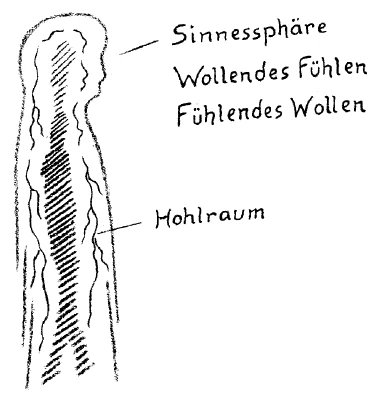
[ 20 ] And so we can only gain a true understanding of sensation when we realize that, in a child, it arises as willing feeling or feeling will in the body’s periphery—because, in the child, this body periphery is asleep relative to the more human inner self and is dreaming. You are therefore not only fully awake in thinking cognition, but you are fully awake only within the interior of your body. At the body’s periphery, on the body’s surface, you are also constantly asleep. And furthermore: What takes place in the vicinity of the body—or, to put it better, on the surface of the body—also takes place in a similar way within the head, and it occurs most intensely the deeper we go into the innermost parts of the human being, into the muscular and the blood-related. There, too, the human being sleeps and dreams. On the surface, a person sleeps and dreams, and even as we move deeper toward the inner self, they sleep and dream once again. Therefore, within us, that which is more of a soul-willed feeling—feeling-willing—our life of desire, and so on, remains in a dreaming sleep. So where, then, are we fully awake? In the intermediate zone, when we are fully awake.
[ 21 ] As you can see, we are now approaching this from a spiritual perspective by applying the facts of waking and sleeping to the human being in a spatial sense and relating this to his constitution, so that we can say: From a spiritual perspective, the human being sleeps on the surface of his body and within his internal organs, and can only be truly fully awake in the intermediate zone of life between birth and death. What organs are most highly developed in this intermediate zone? Those organs, especially in the head, that we call nerves—the nervous system. This nervous system sends its extensions into the outer surface zone and back into the interior; the nerves run through these areas, and in between are central zones such as the brain, specifically the spinal cord, and also the medulla oblongata. There we are given the opportunity to be truly awake. Where the nerves are most highly developed, there we are most awake. But the nervous system has a peculiar relationship to the spirit. It is an organ system that, through the body’s functions, has a constant tendency to decay and become mineralized. If you could separate the nervous system of a living human being from the rest of the glandular, muscular, and circulatory systems, as well as the skeletal system—though you could even leave the skeletal system attached to the nervous system—then what remained in the living human being would already be a corpse, a perpetual corpse. The process of human death is constantly taking place within the nervous system. The nervous system is the only system that has no direct connection to the spiritual-soul realm. Blood, muscles, and so on always have direct connections to the spiritual-soul realm; the nervous system, however, has no direct connection to it whatsoever; it is connected to the spiritual-soul realm only insofar as it is constantly withdrawing from the human organism—it is not present because it is constantly decaying. The other members are alive; therefore, they form direct connections to the spiritual-soul realm. The nervous system is constantly dying off; it is constantly saying to the human being: “You can develop because I offer you no obstacle, because I ensure that I am not there at all with my life!”—That is what is so peculiar. In psychology and physiology, you will find it described: the mediating organ of sensation, of thought, of the spiritual-psychic realm in general is the nervous system. But how is it this mediating organ? Only by the fact that it continually withdraws from life, that it presents no obstacles whatsoever to thinking and feeling, that it initiates no connections whatsoever with thinking and feeling, that it leaves the human being empty with regard to the spiritual-soul life right where it is. For the spiritual-psychic realm, there are simply empty spaces wherever the nerves are. Therefore, the spiritual-psychic realm can enter wherever these empty spaces exist. We must be grateful to the nervous system that it pays no attention to the spiritual-psychic realm, that it does none of the things that physiologists and psychologists attribute to it. If it did—if, for just five minutes, the nerves were to do what physiologists and psychologists describe them as doing—we would know absolutely nothing of the world or of ourselves during those five minutes: we would simply be asleep. For the nerves would then function like those organs that bring about sleep, that mediate feeling-willing and willing-feeling.
[ 22 ] Yes, it is true that today it is somewhat difficult to arrive at the truth in physiology and psychology, because people always say: “You’re turning the world upside down.” The truth is simply that the world is standing on its head, and that we must set it back on its feet through Spiritual Science. Physiologists say: “The organs of thought are the nerves, especially the brain.” — The truth is that the brain and nervous system are connected to thinking cognition precisely because they constantly exclude themselves from the human organism, and because this allows thinking cognition to unfold.
[ 23 ] Now look at something very closely and, please, focus your mental faculties. In the human environment—that is, within the sphere of the senses—real processes take place that are constantly interwoven with world events. Suppose light acts upon a person through the eye. In the eye—that is, within the sensory sphere—a real process takes place; something happens: a physical-chemical process. This process continues into the interior of the human body and then extends all the way into that inner region (the dark-hatched area in the drawing), where physical-chemical processes are also taking place. Now imagine that you are facing an illuminated surface, and rays of light are falling from this illuminated surface into your eye. There, physical-chemical processes arise once more, which continue into the muscular-blood nature within the human being. In between lies an empty zone. In this empty zone—which is left empty by the nervous system—processes such as those in the eye or within the human body, which are independent processes, do not develop; rather, what exists on the outside continues into it: the nature of light, the nature of colors themselves, and so on. So on the surface of our bodies, where the senses are located, we have real processes that depend on the eye, the ear, the organ of heat perception, and so on. Similar processes also occur inside the human body. But not in between, where the nerves actually extend; they clear the space, and there we can experience what is outside. The eye transforms light and color for you. But where you have nerves—where you are hollow in relation to life—light and color do not change; there, you experience light and color directly. You are separated from the external world only in relation to the sensory sphere, but internally, you experience the external processes as if within a shell. There you yourself become light; there you yourself become sound; there the events unfold, because the nerves are no obstacle to them, unlike the blood and the muscles.
[ 24 ] Now we begin to get a sense of what this means: We are awake in relation to a void that exists within us in relation to life, while on the outer surface and within, we sleep while dreaming and dream while sleeping. We only fully awaken in a zone that lies between the outside and the inside. This is in relation to space.
[ 25 ] However, when we consider human beings from a spiritual perspective, we must also relate their earthly existence to waking, sleeping, and dreaming.
[ 26 ] You learn something; you take it in so that it becomes part of your waking consciousness. While you’re engaged with it and when you think about it, it’s in your waking consciousness. Then you move on to other aspects of life. Other things capture your interest and your attention. What happens now to what you learned before and what you were engaged with? It begins to fall asleep, and when you remember it again, it wakes up again. You can only make sense of all these things if you replace all the verbal quibbling—what psychology calls “remembering” and “forgetting”—with real concepts. What is remembering? It is the awakening of a complex of mental images. And what is forgetting? The falling asleep of the complex of mental images. Here you can compare reality with what you have actually experienced; here you do not have mere verbal explanations. If you constantly reflect on waking and sleeping, if you experience yourself falling asleep or see someone else falling asleep, then you are observing a real process. You relate forgetting—this inner activity of the soul—to this real process—not to some word—compare the two, and tell yourself: Forgetting is merely falling asleep in one realm, and remembering is merely waking up in another realm.
[ 27 ] The only way to arrive at an intellectual understanding of the world is by comparing the real with the real. Just as you must compare childhood with old age in order to truly relate body and mind to one another—at least in the most basic terms—so too do you compare remembering and forgetting by relating them to something real: falling asleep and waking up.
[ 28 ] This is what will become so infinitely necessary for the future of humanity: that people take the time to immerse themselves in reality. People today think almost exclusively in words; they do not think in reality. Where would a person today even conceive of the reality—what we can have when we speak of remembering, of awakening? They will be able to hear all sorts of things in the realm of words to define remembering, but they will not think to find these things from reality itself, from the thing itself.
[ 29 ] Therefore, you will understand that when something like the threefold social order—which is derived entirely from reality, not from abstract concepts—is presented to people, they initially find it incomprehensible because they are not at all accustomed to deriving things from reality. They do not associate any concepts at all with deriving things from reality. And the socialist leaders, for example, associate the very fewest concepts with deriving things from reality in their theories; they represent the ultimate end, the final manifestation of decadence in the explanation of words. People believe more than anything else that they understand something about reality; but when they start to speak, they come up with the emptiest of empty phrases.
[ 30 ] That was just a side note, specifically related to the nature of the current trends of our time. But the educator must also understand the times in which he lives, because he must understand the children who are entrusted to him for education from these very times.