

General Human Studies
as the Basis of Education
GA 293
27 August 1919, Stuttgart
Translate the original German text into any language:
Versions Available:
General Human Studies as the Basis of Education, tr. SOL
Sechster Vortrag
Sixth Lecture
[ 1 ] Wir haben bisher versucht, den Menschen zu begreifen, insofern uns dieses Begreifen für die Erziehung des Kindes notwendig ist, vom seelischen Standpunkte aus. Wir werden ja die drei Standpunkte auseinanderhalten müssen — den geistigen, den seelischen und den physischen Standpunkt — und werden, um eine vollständige Anthropologie zu bekommen, von jedem dieser Standpunkte aus den Menschen betrachten. Es liegt am nächsten, die seelische Betrachtung zu vollziehen, weil dem Menschen im gewöhnlichen Leben eben das Seelische am nächsten liegt. Und Sie werden auch empfunden haben, daß wir, indem wir zu diesem Begreifen des Menschen als Hauptbegriffe verwendet haben Antipathie und Sympathie, damit auf das Seelische hingezielt haben. Es wird sich für uns nicht entsprechend erweisen, wenn wir vom Seelischen gleich auf das Leibliche übergehen, denn wir wissen aus unseren geisteswissenschaftlichen Betrachtungen heraus, daß das Leibliche nur gefaßt werden kann, wenn es als eine Offenbarung des Geistigen und auch des Seelischen aufgefaßt wird. Daher werden wir zu der seelischen Betrachtung, die wir in allgemeinen Linien skizziert haben, jetzt hinzufügen eine Betrachtung des Menschen vom geistigen Gesichtspunkte aus, und wir werden dann erst auf die eigentliche, jetzt so genannte Anthropologie, auf die Betrachtung des Menschenwesens, wie es sich in der äußeren physischen Welt zeigt, näher eingehen.
[ 1 ] So far, we have attempted to understand human beings—insofar as this understanding is necessary for the education of the child—from a psychological perspective. We will, of course, have to distinguish between the three perspectives—the intellectual, the psychological, and the physical—and, in order to arrive at a complete anthropology, we will examine human beings from each of these perspectives. It makes the most sense to begin with the psychological perspective, because in everyday life, the psychological aspect is what is closest to human beings. And you will also have sensed that, by using antipathy and sympathy as our main concepts in this understanding of the human being, we have been aiming at the psychological realm. It would not be appropriate for us to move directly from the soul to the physical, for we know from our observations in Spiritual Science that the physical can only be understood when it is regarded as a manifestation of the spiritual and also of the soul. Therefore, we will now add to the psychological consideration we have outlined in general terms a consideration of the human being from a spiritual perspective, and only then will we delve more deeply into what is now called anthropology—the study of the human being as it manifests itself in the external physical world.
[ 2 ] Wenn Sie von irgendeinem Gesichtspunkt aus den Menschen zweckmäßig betrachten wollen, so müssen Sie immer wieder und wieder zurückgehen auf die Gliederung der menschlichen Seelentätigkeiten in Erkennen, das im Denken verläuft, in Fühlen und in Wollen. Wir haben bis jetzt Denken oder Erkennen, Fühlen und Wollen in die Atmosphäre von Antipathie und Sympathie gerückt. Wir wollen jetzt einmal eben vom geistigen Gesichtspunkte aus Wollen, Fühlen und Erkennen ins Auge fassen.
[ 2 ] If you wish to view human beings objectively from any perspective, you must repeatedly return to the division of the human soul’s activities into cognition—which takes place in thinking—feeling, and willing. So far, we have placed thinking or cognition, feeling, and willing within the context of antipathy and sympathy. Let us now consider willing, feeling, and cognition from a spiritual perspective.
[ 3 ] Sie werden auch vom geistigen Gesichtspunkte aus einen Unterschied finden zwischen Wollen, Fühlen und denkendem Erkennen. Betrachten Sie nur das Folgende. Indem Sie denkend erkennen, müssen Sie empfinden — wenn ich mich zunächst bildlich ausdrücken darf, aber das Bildliche wird uns zu Begriffen verhelfen -, daß Sie gewissermaßen im Lichte leben. Sie erkennen und fühlen sich ganz drinnen mit Ihrem Ich in dieser Tätigkeit des Erkennens. Gewissermaßen jeder Teil, jedes Glied derjenigen Tätigkeit, die Sie Erkennen nennen, ist drinnen in alledem, was Ihr Ich tut; und wieder: was Ihr Ich tut, ist drinnen in der Tätigkeit des Erkennens. Sie sind ganz im Hellen, Sie leben in einer vollbewußten Tätigkeit, wenn ich mich begrifflich ausdrücken darf. Es wäre auch schlimm, wenn Sie beim Erkennen nicht in einer vollbewußten Tätigkeit wären. Denken Sie einmal, wenn Sie das Gefühl haben müßten: während Sie ein Urteil fällen, geht mit Ihrem Ich irgendwo im Unterbewußten etwas vor, und das Ergebnis dieses Vorganges sei das Urteil! Nehmen Sie an, Sie sagen: Dieser Mensch ist ein guter Mensch -, fällen also ein Urteil. Sie müssen sich bewußt sein, daß das, was Sie brauchen, um dieses Urteil zu fällen — das Subjekt «der Mensch», das Prädikat «er ist ein guter» -, Glieder sind eines Vorganges, der Ihnen ganz gegenwärtig ist, der für Sie ganz vom Lichte des Bewußtseins durchzogen ist. Müßten Sie annehmen, irgendein Dämon oder ein Mechanismus der Natur knäuele zusammen den «Menschen» mit dem «Gutsein», während Sie das Urteil fällen, dann wären Sie nicht vollbewußt in diesem erkennenden Denkakt drinnen, und Sie wären immer mit etwas vom Urteil im Unbewußten. Das ist das Wesentliche beim denkenden Erkennen, daß Sie in dem ganzen Weben der Tätigkeit beim denkenden Erkennen mit Ihrem vollen Bewußtsein drinnenstecken.
[ 3 ] From a spiritual perspective, you will also find a difference between willing, feeling, and thinking. Just consider the following. As you recognize through thinking, you must feel—if I may first express this figuratively, though the figurative will help us arrive at concepts—that you are, so to speak, living in the light. You recognize and feel yourself fully immersed, together with your “I,” in this activity of recognition. In a sense, every part, every element of that activity you call cognition is contained within everything your “I” does; and conversely, what your “I” does is contained within the activity of cognition. You are fully in the light; you live in a fully conscious activity, if I may put it in conceptual terms. It would also be problematic if, while cognizing, you were not engaged in a fully conscious activity. Just imagine if you had to feel that, while you are forming a judgment, something is happening with your “I” somewhere in the subconscious, and that the result of this process is the judgment! Suppose you say, “This person is a good person”—that is, you are making a judgment. You must be aware that what you need to make this judgment—the subject “the person,” the predicate “he is a good”—are elements of a process that is fully present to you, a process that is entirely permeated by the light of consciousness. If you were to assume that some demon or mechanism of nature were to conflate the “person” with “goodness” while you are making the judgment, then you would not be fully conscious within this act of cognitive thinking, and part of the judgment would always remain in your unconscious. This is the essence of thinking and cognition: that you are fully immersed with your entire consciousness in the entire fabric of activity involved in thinking and cognition.
[ 4 ] Nicht so ist es beim Wollen. Sie wissen ganz gut, wenn Sie das einfachste Wollen, das Gehen, entwickeln, so leben Sie eigentlich vollbewußt nur in der Vorstellung von diesem Gehen. Was innerhalb Ihrer Muskeln sich vollzieht, während Sie ein Bein nach dem anderen vorwärts bewegen, was da im Mechanismus und Organismus Ihres Leibes vorgeht, von dem wissen Sie nichts. Denken Sie nur, was Sie alles zu lernen haben würden von der Welt, wenn Sie alle die Vorrichtungen bewußt vollziehen müßten, welche beim Wollen des Gehens notwendig sind! Sie müßten dann genau wissen, wieviel von den Tätigkeiten, welche die Nahrungsstoffe in den Muskeln Ihrer Beine und in den anderen Körpermuskeln hervorrufen, verbraucht wird, während Sie sich anstrengen, zu gehen. Sie haben das nie ausgerechnet, wieviel Sie von dem verbrauchen, was Ihnen die Nahrung zuführt. Sie wissen ganz gut: Das alles geschieht in Ihrer Körperlichkeit sehr, sehr unbewußt. Indem wir wollen, mischt sich fortwährend in unsere Tätigkeit ein tiefes Unbewußtes hinein. Das ist nicht etwa bloß so, wenn wir das Wesen des Wollens an unserem eigenen Organismus betrachten. Auch was wir vollbringen, wenn wir unser Wollen auf die äußere Welt erstrecken, auch das umfassen wir keineswegs vollständig mit dem Lichte des Bewußtseins.
[ 4 ] It is not like that with volition. You know very well that when you engage in the simplest act of volition—walking—you are actually living fully consciously only within the mental image of that walking. You know nothing of what takes place within your muscles as you move one leg after the other forward, nor of what is happening in the mechanisms and organism of your body. Just think of all you would have to learn about the world if you had to consciously carry out all the processes necessary for the act of walking! You would then have to know exactly how much of the energy produced by the nutrients in the muscles of your legs and in your other muscles is consumed while you exert yourself to walk. You have never calculated how much of what your food provides you with you actually consume. You know very well: all of this happens in your physical being in a very, very unconscious way. Whenever we will, a deep unconscious constantly intervenes in our activity. This is not merely the case when we observe the nature of volition within our own organism. Even what we accomplish when we extend our will to the external world—we by no means fully grasp that either in the light of consciousness.
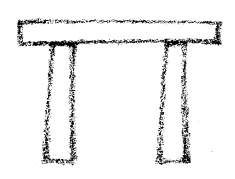
[ 5 ] Nehmen Sie an, Sie haben zwei säulenartige Pflöcke. Sie nehmen sich vor, Sie legen einen dritten Pflock quer darüber. Unterscheiden Sie jetzt genau, was in alledem, was Sie da getan haben, als vollbewußte erkennende Tätigkeit lebt, von dem, was in Ihrer vollbewußten Tätigkeit lebt, wenn Sie das Urteil fällen: Ein Mensch ist gut -, wo Sie mit Ihrem Erkennen ganz drinnenstecken. Unterscheiden Sie bitte, was darin als erkennende Tätigkeit lebt, von dem, wovon Sie nichts wissen, trotzdem Sie es mit Ihrem vollen Willen zu tun hatten: Warum stützen diese zwei Säulen durch gewisse Kräfte diesen darüberliegenden Balken? Dafür hat ja die Physik bis heute nur Hypothesen. Und wenn die Menschen glauben, daß sie wissen, warum die beiden Pflöcke den Balken tragen, so bilden sie es sich nur ein. Alles, was man hat als Begriffe der Kohäsion, der Adhäsion, der Anziehungs- und Abstoßungskraft, sind im Grunde genommen für das äußere Wissen nur Hypothesen. Wir rechnen mit diesen äußeren Hypothesen, indem wir handeln; wir rechnen damit, daß die beiden Pflöcke, die den Balken tragen sollen, nicht zusammenknicken werden, wenn sie eine gewisse Dicke haben. Aber durchschauen können wir den ganzen Vorgang, der damit zusammenhängt, nicht, geradesowenig wie wir unsere Beinbewegungen durchschauen können, wenn wir vorwärts streben. So mischt sich auch hier in unser Wollen ein nicht in unser Bewußtsein hineinreichendes Element hinein. Das Wollen hat im weitesten Umfange ein Unbewußtes in sich,
[ 5 ] Suppose you have two pillar-like stakes. You decide to place a third stake across them. Now distinguish precisely between what, in all that you have done here, constitutes fully conscious, cognitive activity, and what constitutes your fully conscious activity when you make the judgment: “A person is good”—where you are fully immersed in your cognition. Please distinguish what in this constitutes a cognitive activity from that of which you know nothing, even though you were fully engaged in it with your will: Why do these two columns, through certain forces, support the beam lying across them? After all, physics has only hypotheses about this to this day. And when people believe they know why the two stakes support the beam, they are merely imagining it. All the concepts we have—such as cohesion, adhesion, and the forces of attraction and repulsion—are, in essence, merely hypotheses for external knowledge. We rely on these external hypotheses when we act; we count on the fact that the two pegs, which are supposed to support the beam, will not buckle if they are of a certain thickness. But we cannot fully comprehend the entire process involved, any more than we can comprehend the movements of our legs when we strive forward. Here, too, an element that does not extend into our consciousness intervenes in our volition. Volition contains, to the greatest extent, an unconscious element within itself,
[ 6 ] Und das Fühlen steht zwischen Wollen und denkendem Erkennen mitten drinnen. Beim Fühlen ist es auch so, daß es zum Teil von Bewußtsein durchzogen wird, zum Teil von einem Unbewußten. Das Fühlen nimmt auch in dieser Weise teil an der Eigenschaft eines erkennenden Denkens, auf der anderen Seite an der Eigenschaft eines fühlenden oder gefühlten Wollens. Was liegt denn nun da eigentlich vom geistigen Gesichtspunkte aus vor?
[ 6 ] And feeling lies right in the middle between willing and thinking cognition. Feeling is also such that it is partly permeated by consciousness and partly by the unconscious. In this way, feeling participates both in the nature of cognitive thinking and, on the other hand, in the nature of feeling or emotionally driven volition. What, then, is actually present here from a spiritual point of view?
[ 7 ] Sie kommen nur zurecht, wenn Sie sich vom geistigen Gesichtspunkte aus die oben charakterisierten Tatsachen in der folgenden Art zum Begreifen bringen. Wir reden in unserem gewöhnlichen Leben vom Wachen, von dem wachen Bewußtseinszustande. Aber wir haben diesen wachen Bewußtseinszustand nur in der Tätigkeit des erkennenden Denkens. Wenn Sie also ganz genau davon reden wollen, inwiefern der Mensch wacht, so müssen Sie sagen: Wirklich wachend ist der Mensch nur, solange und insofern er ein denkender Erkenner von irgend etwas ist.
[ 7 ] You will only be able to make sense of this if, from a spiritual perspective, you come to understand the facts described above in the following way. In our everyday life, we speak of being awake, of the waking state of consciousness. But we have this waking state of consciousness only in the activity of cognitive thinking. So if you want to speak very precisely about the extent to which a person is awake, you must say: A person is truly awake only as long as and to the extent that he or she is a thinking knower of something.
[ 8 ] Wie steht es nun mit dem Wollen? Sie kennen alle den Bewußtseinszustand — nennen Sie es meinetwillen auch Bewußtseinslosigkeitszustand — des Schlafes. Sie wissen, während wir schlafen, vom Einschlafen bis zum Aufwachen, ist das, was wir erleben, nicht in unserem Bewußtsein drinnen. Geradeso ist es aber auch mit alledem, was als Unbewußtes unser Wollen durchzieht. Insofern wir wollende Wesen sind als Menschen, schlafen wir, auch wenn wir wachen. Wir tragen immer mit uns einen schlafenden Menschen, nämlich den wollenden Menschen, und begleiten ihn mit dem wachenden, mit dem denkend erkennenden Menschen; wir sind, insofern wir wollende Wesen sind, auch vom Aufwachen bis zum Einschlafen schlafend. Es schläft immer etwas in uns mit, nämlich die innere Wesenheit des Wollens. Der sind wir uns nicht stärker bewußt, als wir uns derjenigen Vorgänge bewußt sind, die sich mit uns abspielen während des Schlafes. Man erkennt den Menschen nicht vollständig, wenn man nicht weiß, daß das Schlafen in sein Wachen hereinspielt, indem der Mensch ein Wollender ist.
[ 8 ] What, then, about volition? You are all familiar with the state of consciousness—call it, if you will, a state of unconsciousness—of sleep. You know that while we sleep, from the moment we fall asleep until we wake up, what we experience is not present in our consciousness. But the same is true of everything that, as the unconscious, permeates our volition. Insofar as we are volitional beings as human beings, we are asleep even when we are awake. We always carry within us a sleeping human being—namely, the willing human being—and accompany this sleeping aspect with the waking, thinking, and perceiving human being; insofar as we are beings of will, we are also asleep from the moment we wake until we fall asleep. Something is always sleeping within us—namely, the inner essence of the will. We are no more aware of this than we are of the processes that take place within us during sleep. One cannot fully understand a person unless one knows that sleep plays a role in their waking state, in that a person is a being of will.
[ 9 ] Das Fühlen steht in der Mitte, und wir dürfen uns jetzt fragen: Wie ist das Bewußtsein im Fühlen? — Das steht nun auch in der Mitte zwischen Wachen und Schlafen. Gefühle, die in Ihrer Seele leben, kennen Sie gerade so, wie Sie Träume kennen, nur daß Sie die Träume erinnern und die Gefühle unmittelbar erleben. Aber die innere Seelenverfassung und Seelenstimmung, die Sie haben, indem Sie von Ihren Gefühlen wissen, ist keine andere als die, welche Sie gegenüber Ihren Träumen haben. Sie sind im Wachen nicht nur ein wachender Mensch, indem Sie denkend erkennen, und ein schlafender, insofern Sie wollen, Sie sind auch ein träumender, insofern Sie fühlen. So sind also tatsächlich drei Bewußtseinszustände während unseres Wachens über uns ergossen: das Wachen im eigentlichen Sinne im denkenden Erkennen, das Träumen im Fühlen, das Schlafen im Wollen. Der gewöhnliche traumlose Schlaf ist vom geistigen Gesichtspunkte aus angesehen nichts anderes als die Hingabe des Menschen mit seiner ganzen Seelenwesenheit an das, woran er hingegeben ist mit seinem Wollen, während er seinen Tageslauf vollbringt. Es ist nur der Unterschied, daß wir im eigentlichen Schlafen mit unserem ganzen Seelenwesen schlafen, daß wir im Wachen nur schlafen mit unserem Wollen. Beim Träumen, was man im gewöhnlichen Leben so nennt, ist es so, daß wir mit unserem ganzen Menschen an den Seelenzustand hingegeben sind, den wir Traum nennen, und daß wir im Wachen nur als fühlender Mensch an diesen träumerischen Seelenzustand hingegeben sind.
[ 9 ] Feeling is at the center, and we may now ask ourselves: What is consciousness like in feeling? — It, too, lies at the center between waking and sleeping. You are aware of the feelings that live in your soul just as you are aware of dreams, except that you remember dreams while you experience feelings directly. But the inner state of mind and mood you experience when you are aware of your feelings is no different from the one you have when you are aware of your dreams. When you are awake, you are not only a waking person—insofar as you recognize things through thought—and a sleeping person—insofar as you will—but you are also a dreaming person—insofar as you feel. Thus, three states of consciousness are in fact bestowed upon us during our waking hours: waking in the true sense through thinking and recognizing, dreaming through feeling, and sleeping through willing. From a spiritual point of view, ordinary dreamless sleep is nothing other than the surrender of the human being, with his entire soul-being, to that to which he is devoted through his will while he goes about his daily activities. The only difference is that in actual sleep we sleep with our entire soul-being, whereas in wakefulness we sleep only with our will. In dreaming—as it is commonly called in everyday life—we are devoted with our entire being to the state of the soul that we call a dream, whereas in waking life we are devoted to this dreamlike state of the soul only as feeling human beings.
[ 10 ] Pädagogisch betrachtet werden Sie sich jetzt nicht mehr verwundern, wenn Sie die Sache so ansehen, daß die Kinder verschieden sind mit Bezug auf die Wachheit ihres Bewußtseins. Denn Sie werden finden, daß Kinder, bei denen das Gefühlsleben der Anlage gemäß überwiegt, träumerische Kinder sind, so daß solche Kinder, bei denen in der Kindheit eben das volle Denken noch nicht aufgewacht ist, leicht hingegeben sein werden an ein träumerisches Wesen. Das werden Sie dann zum Anlaß nehmen, um durch starke Gefühle auf ein solches Kind zu wirken. Und Sie werden dann die Hoffnung haben können, daß diese starken Gefühle bei ihm auch das helle Erkennen erwecken werden, denn alles Schlafen hat dem Lebensrhythmus gemäß die Tendenz, nach einiger Zeit aufzuwachen. Wenn wir nun ein solches Kind, das träumerisch im Gefühlsleben dahinbrütet, mit starken Gefühlen angehen, dann werden diese in das Kind versetzten starken Gefühle nach einiger Zeit von selbst als Gedanken aufwachen.
[ 10 ] From an educational perspective, you will no longer be surprised if you view the matter in such a way that children differ in terms of the alertness of their consciousness. For you will find that children in whom the emotional life predominates by nature are dreamy children, so that such children—in whom full thinking has not yet awakened during childhood—will easily be given over to a dreamy disposition. You will then take this as an opportunity to influence such a child through strong emotions. And you will then be able to hope that these strong emotions will also awaken clear cognition in the child, for everything that is dormant tends, in accordance with the rhythm of life, to awaken after some time. If we now approach such a child—who is brooding dreamily in their emotional life—with strong emotions, then these strong emotions instilled in the child will, after some time, awaken of their own accord as thoughts.
[ 11 ] Kinder, die noch mehr brüten, die sogar stumpf sind gegenüber dem Gefühlsleben, die werden Ihnen offenbaren, daß sie besonders im Willen stark veranlagt sind. Sie sehen da: wenn Sie dies bedenken, können Sie erkennend vor manchem Rätsel im kindlichen Leben stehen. Sie können ein Kind in die Schule hereinbekommen, das sich ausnimmt wie ein echter Stumpfling. Wenn Sie da gleich das Urteil fällen: Das ist ein schwachsinniges, ein stumpfsinniges Kind -, wenn Sie es mit experimenteller Psychologie untersuchen würden, schöne Gedächtnisprüfungen vornähmen und allerlei, was ja jetzt auch schon in psychologisch-pädagogischen Laboratorien gemacht wird, und dann sagen würden: Stumpfes Kind seiner ganzen Anlage nach, gehört in die Schwachsinnigen-Schule oder auch in die jetzt beliebte Wenigerbefähigten-Schule, so würden Sie mit solchem Urteil nicht dem Wesen des Kindes nahekommen. Vielleicht aber ist dieses Kind besonders stark im Willen veranlagt, vielleicht ist es eines jener Kinder, die im späteren Leben aus ihrer Cholerik zu tatkräftigem Handeln übergehen. Aber der Wille schläft zunächst. Und wenn das denkende Erkennen bei diesem Kinde verurteilt ist, später erst hervorzutreten, dann muß es auch in der entsprechenden Weise behandelt werden, damit es dann später berufen sein kann, etwas Tatkräftiges zu vollbringen. Vorerst erscheint es als ein rechter Stumpfling, der ist es aber vielleicht gar nicht. Und man muß dann den Blick dafür haben, bei einem solchen Kinde den Willen zu erwecken; das heißt, man muß so in seinen wachen Schlafzustand hineinwirken, daß es nach und nach dahinkommt — weil ja jeder Schlaf die Tendenz hat, zum Erwachen zu kommen -, seinen Schlaf als Willen, der vielleicht sehr stark ist, der aber nur jetzt schläft, vom schlafenden Wesen übertönt wird, im späteren Lebensalter aufzuwecken. Ein solches Kind muß so behandelt werden, daß Sie möglichst wenig auf sein Erkenntnisvermögen, auf sein Begreifen bauen, sondern ihm gewissermaßen einhämmern einige recht stark auf den Willen wirkende Sachen, daß Sie es, indem es spricht, zu gleicher Zeit gehen lassen. Sie nehmen ein solches Kind, Sie werden ja nicht sehr viele davon haben, aus der Klasse heraus und - für die anderen Kinder wird es anregend sein, für dieses Kind ist es bildend - lassen es, indem es Sätze spricht, die Worte mit Bewegungen begleiten. Also: Der (Schritt) - Mensch (Schritt) - ist (Schritt) — gut! — Auf diese Weise verbinden Sie den ganzen Menschen im Willenselement mit dem bloß Intellektuellen im Erkennen, und Sie können es nach und nach dahin bringen, daß bei einem solchen Kinde der Wille zum Gedanken erwacht. Erst die Einsicht, daß man es im wachenden Menschen schon zu tun hat mit verschiedenen Bewußtseinszuständen — mit Wachen, Träumen und Schlafen -, erst diese Einsicht bringt uns zu einer wirklichen Erkenntnis unserer Aufgaben gegenüber dem werdenden Menschen.
[ 11 ] Children who brood even more, who are even dull to emotional life, will reveal to you that they are particularly strong-willed. You see: if you keep this in mind, you may be able to understand many of the mysteries of a child’s life. You may encounter a child at school who appears to be genuinely dull-witted. If you were to immediately pass judgment—saying, “This is a mentally deficient, dull-witted child”—and if you were to examine the child using experimental psychology, conducting memory tests and all sorts of other assessments—as is already done in psychological and educational laboratories—and then conclude: ‘A dull child by its very nature belongs in a school for the mentally disabled or even in the now-popular school for the less-able,’—with such a judgment you would not be getting close to the child’s true nature. Perhaps, however, this child is endowed with a particularly strong will; perhaps it is one of those children who, in later life, will transform their choleric temperament into energetic action. But for the time being, the will lies dormant. And if this child’s capacity for thinking and cognition is destined to emerge only later, then it must also be treated accordingly, so that it may later be called upon to accomplish something of substance. For the time being, it appears to be a real dullard, but perhaps it is not at all. And one must then have the insight to awaken the will in such a child; that is, one must work into its waking, sleeping state in such a way that it gradually comes to the point—since every sleep has a tendency to give way to awakening—of awakening, in later life, its sleep as a will that may be very strong but is merely dormant at present, drowned out by the sleeping nature. Such a child must be treated in such a way that you rely as little as possible on their cognitive abilities or their understanding, but rather, in a sense, instill in them certain things that have a strong effect on the will, so that as they speak, you allow them to proceed at their own pace. Take such a child—you won’t have very many of them, after all—out of the class, and—while this will be stimulating for the other children, for this child it will be educational—let the child accompany the words with movements as it speaks sentences. So: The (step) — human (step) — is (step) — good! — In this way, you connect the whole human being in the element of the will with the purely intellectual aspect of cognition, and you can gradually bring about a situation where, in such a child, the will to think awakens. Only the realization that, in the waking human being, we are already dealing with different states of consciousness—waking, dreaming, and sleeping—only this realization brings us to a true understanding of our tasks toward the developing human being.
[ 12 ] Wir können aber jetzt etwas fragen. Wir können fragen: Wie verhält sich das eigentliche Zentrum des Menschen, das Ich, zu diesen verschiedenen Zuständen? Sie kommen am leichtesten dabei zurecht, wenn Sie zunächst, was ja unleugbar ist, voraussetzen: Was wir Welt, was wir Kosmos nennen, das ist eine Summe von Tätigkeiten. Für uns drücken sich diese Tätigkeiten aus auf den verschiedenen Gebieten des elementaren Lebens. Wir wissen, daß in diesem elementaren Leben Kräfte walten. Die Lebenskraft waltet zum Beispiel um uns herum. Und zwischen den elementaren Kräften und der Lebenskraft eingesponnen ist alles, was zum Beispiel die Wärme und das Feuer bewirkt. Denken Sie nur, wie sehr wir in einer Umgebung stehen, in der durch das Feuer sehr vieles bewirkt wird.
[ 12 ] But we can now ask a question. We can ask: How does the true center of the human being—the “I”—relate to these various states? You will find this easiest to understand if you first assume—as is undeniably true—that what we call the world, what we call the cosmos, is a sum of activities. For us, these activities manifest themselves in the various realms of elemental life. We know that forces are at work in this elemental life. The life force, for example, is at work all around us. And woven between the elemental forces and the life force is everything that brings about, for example, heat and fire. Just think how deeply we are immersed in an environment in which fire brings about so much.
[ 13 ] In gewissen Gegenden der Erde, zum Beispiel in Süditalien, brauchen Sie nur eine Papierkugel anzuzünden, und in demselben Augenblick fängt es an, aus der Erde heraus mächtig zu rauchen. Warum geschieht das? Es geschieht, weil Sie durch das Anzünden der Papierkugel und die sich dadurch entwickelnde Wärme die Luft an dieser Stelle verdünnen, und das, was sonst unter der Erdoberfläche an Kräften waltet, wird durch den nach aufwärts gerichteten Rauch nach oben gezogen, und in dem Augenblick, wo Sie die Papierkugel anzünden und auf die Erde werfen, stehen Sie in einer Rauchwolke. Das ist ein Experiment, das jeder Reisende machen kann, der in die Gegend von Neapel kommt. Das habe ich als ein Beispiel dafür angeführt, daß wir, wenn wir die Welt nicht oberflächlich betrachten, uns sagen müssen: Wir leben in einer Umgebung, die überall von Kräften durchzogen ist.
[ 13 ] In certain parts of the world, for example in southern Italy, all you have to do is light a paper ball, and at that very moment, thick smoke begins to rise from the ground. Why does this happen? It happens because, by lighting the paper ball and generating heat, you thin the air at that spot, and the forces that normally operate beneath the earth’s surface are drawn upward by the rising smoke; the moment you light the paper ball and throw it onto the ground, you are enveloped in a cloud of smoke. This is an experiment that any traveler visiting the Naples area can perform. I have cited this as an example to show that, if we do not view the world superficially, we must acknowledge: We live in an environment that is permeated by forces everywhere.
[ 14 ] Nun gibt es auch höhere Kräfte als die Wärme. Die sind auch in unserer Umgebung. Durch sie gehen wir immer durch, indem wir als physische Menschen durch die Welt gehen. Ja, unser physischer Körper, ohne daß wir es im gewöhnlichen Erkennen wissen, ist so geartet, daß wir das vertragen. Mit unserem physischen Körper können wir so durch die Welt schreiten.
[ 14 ] Now, there are also forces higher than heat. They, too, are present in our surroundings. We constantly pass through them as we go through the world as physical human beings. Yes, our physical body—without us being aware of it in our ordinary perception—is such that we can endure this. With our physical body, we are able to walk through the world in this way.
[ 15 ] Mit unserem Ich, das die jüngste Bildung unserer Evolution ist, könnten wir nicht durch diese Weltenkräfte schreiten, wenn dieses Ich sich unmittelbar an diese Kräfte hingeben sollte. Dieses Ich könnte nicht an alles sich hingeben, was in seiner Umgebung ist und worin es selbst drinnen ist. Dieses Ich muß jetzt noch davor bewahrt werden, sich ergießen zu müssen in die Weltenkräfte. Es wird sich einmal dazu entwickeln, in die Weltenkräfte hinein aufgehen zu können. Jetzt kann es das noch nicht. Deshalb ist es notwendig, daß wir für das völlig wache Ich nicht versetzt werden in die wirkliche Welt, die in unserer Umgebung ist, sondern nur in das Bild der Welt. Daher haben wir in unserem denkenden Erkennen eben nur die Bilder der Welt, was wir vom seelischen Gesichtspunkte aus schon angeführt haben.
[ 15 ] With our “I”—which is the most recent development in our evolution—we could not pass through these world forces if this “I” were to surrender itself directly to them. This “I” could not surrender itself to everything that is in its surroundings and of which it itself is a part. This “I” must still be protected from having to pour itself out into the forces of the universe. It will one day develop the ability to merge with the forces of the universe. It cannot do so yet. That is why it is necessary that, for the fully awake “I,” we not be transported into the real world that surrounds us, but only into the image of the world. Hence, in our thinking cognition, we have only the images of the world, as we have already noted from a psychological perspective.
[ 16 ] Jetzt betrachten wir es auch vom geistigen Gesichtspunkte aus. Im denkenden Erkennen leben wir in Bildern; und wir Menschen auf der gegenwärtigen Entwickelungsstufe innerhalb von Geburt und Tod können mit unserem vollwachenden Ich nur in Bildern von dem Kosmos leben, noch nicht in dem wirklichen Kosmos. Daher muß, wenn wir wachen, unser Leib uns zuerst die Bilder des Kosmos hervorbringen. Dann lebt unser Ich in den Bildern von diesem Kosmos.
[ 16 ] Now let us also consider this from a spiritual perspective. In thinking cognition, we live in images; and we humans, at our present stage of development within the cycle of birth and death, can—with our fully awakened “I”—live only in images of the cosmos, not yet in the real cosmos. Therefore, when we are awake, our body must first produce the images of the cosmos for us. Then our “I” lives in the images of this cosmos.
[ 17 ] Die Psychologen geben sich furchtbar viel Mühe, die Beziehungen zwischen Leib und Seele zu konstatieren. Sie reden von Wechselwirkung zwischen Leib und Seele, reden vom psychophysischen Parallelismus und auch von anderen Dingen noch. Alle diese Dinge sind im Grunde genommen kindliche Begriffe. Denn der wirkliche Vorgang dabei ist der: Wenn das Ich des Morgens in den Wachzustand übergeht, so dringt es in den Leib ein, aber nicht in die physischen Vorgänge des Leibes, sondern in die Bilderwelt, die bis in sein tiefstes Inneres der Leib von den äußeren Vorgängen erzeugt. Dadurch wird dem Ich das denkende Erkennen übermittelt.
[ 17 ] Psychologists go to tremendous lengths to establish the relationship between body and soul. They speak of the interaction between body and soul, of psychophysical parallelism, and of other things as well. All of these are, at the root of it, childish concepts. For the actual process is this: When the “I” transitions into the waking state in the morning, it enters the body—not into the body’s physical processes, but into the world of images that the body generates from external events, extending into its deepest innermost being. Through this, thinking cognition is conveyed to the “I.”
[ 18 ] Beim Fühlen ist es anders. Da dringt schon das Ich in den wirklichen Leib ein, nicht bloß in die Bilder. Wenn es aber bei diesem Eindringen voll bewußt wäre, dann würde es - nehmen Sie das jetzt seelisch — buchstäblich seelisch verbrennen. Wenn Ihnen dasselbe passierte beim Fühlen, was Ihnen passiert beim Denken, indem Sie in die Bilder, die Ihnen Ihr Leib erzeugt, mit Ihrem Ich eindringen, dann würden Sie seelisch verbrennen. Sie würden es nicht aushalten. Sie können dieses Eindringen, welches das Fühlen bedeutet, nur träumend, im herabgedämpften Bewußtseinszustande erleben. Nur im Traume halten Sie das aus, was beim Fühlen in Ihrem Leib eigentlich vor sich geht.
[ 18 ] With feeling, it is different. Here, the “I” penetrates into the actual body, not merely into the images. But if it were fully conscious during this penetration—consider this in psychological terms—it would literally burn itself out psychologically. If the same thing happened to you in feeling as happens to you in thinking—that is, if you penetrated with your “I” into the images your body produces—then you would burn up psychologically. You would not be able to endure it. You can experience this penetration, which is what feeling entails, only in a dream, in a subdued state of consciousness. Only in a dream can you endure what is actually taking place in your body when you feel.
[ 19 ] Und was beim Wollen sich abspielt, das können Sie überhaupt nur erleben, indem Sie schlafen. Das wäre etwas ganz Schreckliches, was Sie erleben würden, wenn Sie im gewöhnlichen Leben alles miterleben müßten, was mit Ihrem Wollen vor sich geht. Der entsetzlichste Schmerz ergriffe Sie zum Beispiel, wenn Sie, was ich schon andeutete, wirklich erleben müßten, wie sich die durch die Nahrungsmittel dem Organismus zugeführten Kräfte beim Gehen verbrauchen in Ihren Beinen. Es ist schon Ihr Glück, daß Sie das nicht erleben beziehungsweise nur schlafend erleben. Denn wachend dies erleben, würde den denkbar größten Schmerz bedeuten, einen furchtbaren Schmerz. Man könnte sogar sagen: Könnten wir den Wachzustand im Wollen erreichen, so würde der Schmerz, der sonst latent bleibt, betäubt wird durch den Schlafzustand im Wollen, ins Bewußtsein treten.
[ 19 ] And what takes place in the act of willing—you can only experience that at all by sleeping. It would be something truly terrible that you would experience if, in ordinary life, you had to witness everything that goes on with your will. For example, you would be seized by the most excruciating pain if, as I have already hinted, you really had to experience how the energy supplied to the organism through food is consumed in your legs as you walk. It is indeed your good fortune that you do not experience this—or rather, that you experience it only while asleep. For to experience this while awake would mean the greatest pain imaginable—a terrible pain. One could even say: If we could attain the waking state in our will, the pain—which otherwise remains latent and is numbed by the sleeping state in our will—would enter our consciousness.
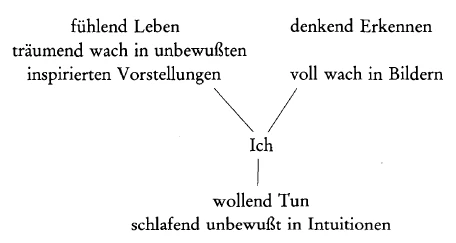
[ 20 ] Daher werden Sie verstehen, wenn ich Ihnen jetzt das Leben des Ich charakterisiere während dessen, was man im gewöhnlichen Leben Wachzustand nennt — was also umfaßt: voll Wachen, träumend Wachen, schlafend Wachen -, wenn ich charakterisiere, was das Ich, indem es im gewöhnlichen Wachzustande im Leibe lebt, eigentlich in Wirklichkeit durchlebt. Dieses Ich lebt im denkenden Erkennen, indem es aufwacht in den Leib; da ist es voll wach. Es lebt darin aber nur in Bildern, so daß der Mensch in seinem Leben zwischen Geburt und Tod, wenn er nicht solche Übungen macht, wie sie in meinem Buche «Wie erlangt man Erkenntnisse der höheren Welten?» angedeutet sind, fortwährend nur in Bildern durch sein denkendes Erkennen lebt.
[ 20 ] Therefore, you will understand when I now describe the life of the “I” during what is commonly called the waking state—which thus encompasses: full wakefulness, dream-like wakefulness, and sleep-like wakefulness—when I describe what the “I,” by living in the body during the ordinary waking state, actually experiences in reality. This “I” lives in thinking cognition as it awakens into the body; there it is fully awake. However, it lives there only in images, so that in his life between birth and death, unless a person engages in the exercises outlined in my book *How to Attain Knowledge of the Higher Worlds*, he continually lives only in images through his thinking cognition.
[ 21 ] Dann senkt sich erwachend das Ich auch ein in die Vorgänge, die das Fühlen bedingen. Fühlend leben: da sind wir nicht voll wach, sondern da sind wir träumend wach. Wie erleben wir denn eigentlich das, was wir da im träumenden Wachzustande fühlend durchmachen? Das erleben wir tatsächlich in dem, was man immer genannt hat Inspirationen, inspirierte Vorstellungen, unbewußt inspirierte Vorstellungen. Da ist der Herd von alledem, was aus den Gefühlen beim Künstler hinaufsteigt in das wache Bewußtsein. Dort wird es zuerst durchgemacht. Dort wird auch alles das durchgemacht, was beim wachen Menschen oftmals als Einfälle hinaufsteigt ins Wachbewußtsein und dann zu Bildern wird.
[ 21 ] Then, as it awakens, the “I” also sinks into the processes that give rise to feeling. Living through feeling: in this state, we are not fully awake, but rather awake in a dreamlike state. How, then, do we actually experience what we go through in this dreamlike waking state of feeling? We experience it, in fact, in what has always been called inspiration, inspired mental images, or unconsciously inspired mental images. There lies the source of everything that rises from the artist’s feelings into waking consciousness. That is where it is first experienced. That is also where everything is experienced that, in a waking person, often rises into waking consciousness as flashes of insight and then becomes images.
[ 22 ] Was in meinem Buche «Wie erlangt man Erkenntnisse der höheren Welten?» Inspirationen genannt wird, das ist nur das zur Helligkeit, zum Vollbewußtsein heraufgehobene Erleben desjenigen, was bei jedem Menschen unten im Gefühlsleben unbewußt an Inspirationen vorhanden ist. Und wenn besonders veranlagte Leute von ihren Inspirationen sprechen, so sprechen sie eigentlich von dem, was die Welt in ihr Gefühlsleben hineingelegt hat und durch ihre Anlagen heraufkommen läßt in ihr volles Wachbewußtsein. Es ist das ebenso Weltinhalt, wie der Gedankeninhalt Weltinhalt ist. Aber in dem Leben zwischen Geburt und Tod spiegeln diese unbewußten Inspirationen solche Weltenvorgänge, die wir nur träumend erleben können; sonst würde unser Ich in diesen Vorgängen sich verbrennen oder es würde ersticken, namentlich ersticken. Dieses Ersticken beginnt auch manchmal beim Menschen in abnormen Zuständen. Denken Sie nur einmal, Sie haben Alpdruck. Dann will ein Zustand, der sich abspielt zwischen Ihnen und der äußeren Luft, wenn bei einem Menschen in diesem Wechselverhältnis nicht alles in Ordnung ist, in abnormer Weise übergehen in etwas anderes. Indem das übergehen will in Ihr Ich-Bewußtsein, wird es Ihnen nicht als eine normale Vorstellung bewußt, sondern als eine Sie quälende Vorstellung: als der Alpdruck. Und so qualvoll wie das abnorme Atmen im Alpdruck, so qualvoll wäre das gesamte Atmen, wäre jeder Atemzug, wenn der Mensch das Atmen vollbewußt erleben würde. Er würde es fühlend erleben, aber qualvoll wäre es für ihn. Es wird daher abgestumpft, und so wird es nicht als physischer Vorgang, sondern nur in dem träumerischen Gefühl erlebt.
[ 22 ] What is called “inspiration” in my book *How Does One Attain Knowledge of the Higher Worlds?* is simply the experience—raised to a state of clarity and full consciousness—of what is unconsciously present as inspiration in every person’s emotional life. And when people with a special predisposition speak of their inspirations, they are actually speaking of what the world has placed within their emotional life and what, through their predispositions, rises into their full waking consciousness. It is just as much a part of the world’s content as the content of thought is. But in the life between birth and death, these unconscious inspirations reflect worldly processes that we can experience only in dreams; otherwise, our “I” would be consumed by these processes or it would suffocate—specifically, suffocate. This suffocation sometimes begins in humans under abnormal conditions. Just imagine for a moment that you are having a nightmare. Then a state that unfolds between you and the outside air—when not everything is in order in this interplay within a person—seeks to transition abnormally into something else. As it seeks to enter your ego-consciousness, it does not become conscious to you as a normal mental image, but as a tormenting mental image: as the nightmare. And just as agonizing as the abnormal breathing in a nightmare is, so agonizing would the entire act of breathing—every single breath—be if a person were to experience breathing with full consciousness. They would experience it through sensation, but it would be agonizing for them. It is therefore dulled, and thus it is not experienced as a physical process, but only as a dreamlike sensation.
[ 23 ] Und gar die Vorgänge, die sich beim Wollen abspielen, ich habe es Ihnen schon angedeutet: furchtbarer Schmerz wäre das! Daher können wir weiter sagen als drittes: Das Ich im wollenden Tun ist schlafend. Da wird das erlebt, was erlebt wird mit stark herabgedämpftem Bewußtsein — eben im schlafenden Bewußtsein — in unbewußten Intuitionen. Unbewußte Intuitionen hat der Mensch fortwährend; aber sie leben in seinem Wollen. Er schläft in seinem Wollen. Daher kann er sie auch nicht im gewöhnlichen Leben heraufholen. Sie kommen nur in Glückszuständen des Lebens herauf; dann erlebt der Mensch ganz dumpf die geistige Welt mit.
[ 23 ] And as for the processes that take place during the act of willing—I have already hinted at this to you—it would be a terrible pain! Therefore, we can go on to say, as a third point: The “I” is dormant in the act of willing. What is experienced there is experienced with a greatly subdued consciousness—precisely in a sleeping consciousness—in unconscious intuitions. Human beings have unconscious intuitions constantly; but they live within their volition. They are asleep in their volition. That is why they cannot bring them to the surface in ordinary life. They emerge only in moments of happiness; then human beings experience the spiritual world in a very dim way.
[ 24 ] Nun ist etwas Eigentümliches beim gewöhnlichen Leben des Menschen vorhanden. Das Vollbewußtsein im vollen Wachen beim denkenden Erkennen, das kennen wir ja alle. Da sind wir sozusagen in der Helligkeit des Bewußtseins, darüber wissen wir Bescheid. Manchmal fangen dann die Menschen an, wenn sie über die Welt etwas nachdenken, zu sagen: Wir haben Intuitionen. Unbestimmt Gefühltes bringen die Menschen dann aus diesen Intuitionen heraus vor. Was sie da sagen, kann manchmal etwas sehr Verworrenes sein, aber es kann auch unbewußt geregelt sein. Und schließlich, wenn der Dichter von seinen Intuitionen spricht, so ist das durchaus richtig, daß er sie zunächst nicht herausholt aus dem Herd, wo sie ihm am nächsten liegen, aus den inspirierten Vorstellungen des Gefühlslebens, sondern er holt hervor seine ganz unbewußten Intuitionen aus der Region des schlafenden Wollens.
[ 24 ] Now, there is something peculiar about ordinary human life. We are all familiar with full consciousness during wakefulness and thoughtful perception. There, we are, so to speak, in the light of consciousness; we know all about that. Sometimes, when people reflect on the world, they begin to say: “We have intuitions.” People then express vague feelings based on these intuitions. What they say can sometimes be quite confused, but it can also be unconsciously structured. And finally, when the poet speaks of his intuitions, it is certainly true that he does not initially draw them from the source closest to him—the inspired mental images of his emotional life—but rather brings forth his entirely unconscious intuitions from the realm of the dormant will.
[ 25 ] Wer in diese Dinge hineinsieht, der sieht selbst in scheinbaren Zufälligkeiten des Lebens tiefe Gesetzmäßigkeiten. Man liest zum Beispiel den zweiten Teil von Goethes «Faust», und man möchte sich ganz gründlich davon unterrichten, wie gerade diese merkwürdigen Verse in ihrem Bau hervorgebracht werden konnten. Goethe war schon alt, als er den zweiten Teil seines «Faust» schrieb, wenigstens den größten Teil davon. Er schrieb ihn so, daß John, sein Sekretär, am Schreibtische saß und das schrieb, was Goethe diktierte. Hätte Goethe selber schreiben müssen, so hätte er wahrscheinlich nicht so merkwürdig ziselierte Verse für den zweiten Teil seines «Faust» hervorgebracht. Goethe ging, während er diktierte, in seiner kleinen Weimarer Stube fortwährend auf und ab, und dieses Auf- und Abgehen gehört mit zur Konzeption des zweiten Teiles des «Faust». Indem Goethe dieses unbewußte wollende Tun im Gehen entwickelte, drängte aus seinen Intuitionen etwas herauf, und in seiner äußeren Tätigkeit offenbarte sich dann dasjenige, was er durch einen anderen auf das Papier schreiben ließ.
[ 25 ] Anyone who looks deeply into these matters will see profound laws even in the apparent coincidences of life. For example, when one reads the second part of Goethe’s *Faust*, one is compelled to investigate thoroughly how these remarkable verses, with their unique structure, could have come into being. Goethe was already old when he wrote the second part of his *Faust*—at least the greater part of it. He wrote it in such a way that John, his secretary, sat at the desk and wrote down what Goethe dictated. Had Goethe had to write it himself, he probably would not have produced such remarkably finely crafted verses for the second part of his *Faust*. While dictating, Goethe walked back and forth continuously in his small Weimar study, and this pacing is an integral part of the conception of the second part of *Faust*. As Goethe developed this unconscious, willful activity through his pacing, something welled up from his intuitions, and what he had another person write down on paper was then revealed in his outward activity.
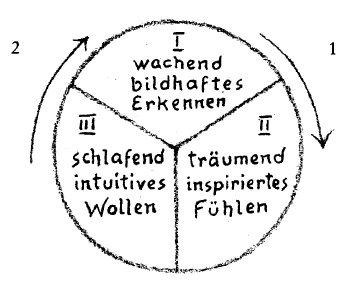
[ 26 ] Wenn Sie sich ein Schema machen wollen von dem Leben des Ich im Leibe, und Sie machen es sich in der folgenden Weise:
[ 26 ] If you want to form a picture of the life of the “I” within the body, you can do so in the following way:
I. wachend — bildhaftes Erkennen
II. träumend - inspiriertes Fühlen
III. schlafend - intuitierendes oder intuitiertes Wollen
I. Awake — Visual Perception
II. Dreaming — Inspired Feeling
III. Asleep — Intuitive or Intuitively Driven Will
[ 27 ] dann werden Sie sich nicht recht begreiflich machen können, warum das Intuitive, von dem die Menschen instinktiv sprechen, leichter heraufkomme ins bildhafte Erkennen des Alltags als das näherliegende inspirierte Fühlen. Wenn Sie sich nun das Schema jetzt richtig zeichnen - denn hier oben ist es falsch gezeichnet —, wenn Sie es in der Weise machen, wie in der Zeichnung, dann werden Sie die Sache leichter begreifen. Denn dann werden Sie sich sagen: In der Richtung des Pfeils (1) steigt das bildhafte Erkennen hinunter in die Inspirationen, und es kommt wieder herauf aus den Intuitionen (Pfeil 2). Aber dieses Erkennen, das mit dem Pfeil 1 angedeutet ist, ist das Hinuntersteigen in den Leib. Und jetzt betrachten Sie sich; Sie sind zunächst ganz ruhig, sitzend oder stehend, geben sich nur dem denkenden Erkennen hin, der Betrachtung der Außenwelt. Da leben Sie im Bilde. Was sonst das Ich erlebt an den Vorgängen, steigt hinunter in den Leib, erst ins Fühlen, dann ins Wollen. Was im Fühlen ist, beachten Sie nicht, was im Wollen ist, beachten Sie zunächst auch nicht. Nur wenn Sie anfangen zu gehen, wenn Sie anfangen zu handeln, dann betrachten Sie äußerlich nicht zuerst das Fühlen, sondern das Wollen. Und da, beim Hinuntersteigen in den Leib und beim Wiederheraufsteigen, was in der Richtung des Pfeiles 2 vor sich geht, da hat das intuitive Wollen es näher, zum bildhaften Bewußtsein zu kommen, als das träumende inspirierte Fühlen. Daher werden Sie finden, daß die Menschen so oft sagen: Ich habe eine unbestimmte Intuition. — Da wird dann das, was in meinem Buche «Wie erlangt man Erkenntnisse der höheren Welten ?» Intuitionen genannt wird, mit der oberflächlichen Intuition des gewöhnlichen Bewußtseins verwechselt.
[ 27 ] then you will not be able to fully understand why the intuitive—which people speak of instinctively—emerges more easily into the pictorial perception of everyday life than the more obvious inspired feeling. If you now draw the diagram correctly—because it’s drawn incorrectly here at the top—if you do it the way it’s shown in the drawing, then you’ll grasp the concept more easily. For then you’ll say to yourself: In the direction of arrow (1), pictorial perception descends into inspirations, and it rises again from intuitions (arrow 2). But this cognition, indicated by arrow 1, is the descent into the body. And now observe yourself; at first you are completely calm, sitting or standing, devoting yourself solely to thinking cognition, to the observation of the external world. There you live in the image. Whatever else the “I” experiences in these processes descends into the body—first into feeling, then into willing. You do not pay attention to what is in feeling, nor do you pay attention to what is in willing at first. Only when you begin to walk, when you begin to act, do you not first observe feeling externally, but rather willing. And there—as it descends into the body and ascends again, which is what happens in the direction of arrow 2—intuitive volition is closer to reaching pictorial consciousness than dreamlike, inspired feeling. That is why you will find that people so often say: “I have a vague intuition.” — What I call “intuitions” in my book *How Does One Attain Knowledge of the Higher Worlds?* is then confused with the superficial intuition of ordinary consciousness.
[ 28 ] Jetzt werden Sie etwas begreifen von der Gestalt des menschlichen Leibes. Denken Sie sich jetzt einmal einen Augenblick gehend, aber die Welt betrachtend. Denken Sie sich: Nicht Ihr Unterleib müßte mit den Beinen gehen, sondern Ihr Kopf würde direkt die Beine haben und müßte gehen. Da würde in eins verwoben sein Ihr Weltbetrachten und Ihr Wollen, und die Folge wäre, daß Sie nur schlafend gehen könnten. Indem Ihr Kopf aufgesetzt ist auf die Schultern und auf den übrigen Leib, ruht er auf dem übrigen Leibe. Er ruht, und Sie tragen Ihren Kopf, indem Sie sich nur mit dem anderen Leib bewegen. Der Kopf muß aber auf dem Leibe ruhen können, sonst könnte er nicht das Organ des denkenden Erkennens sein. Er muß dem schlafenden Wollen entzogen werden, denn in dem Augenblick, wo Sie ihn in die Bewegung überführen, wo Sie ihn aus der relativen Ruhe in eine selbstgemachte Bewegung überführen würden, da würde er zum Schlafen kommen. Das eigentliche Wollen läßt er den Leib vollziehen, und er lebt in diesem Leibe drinnen wie in einer Kutsche und läßt sich von diesem Wagen weiterbefördern. Nur dadurch, daß sich der Kopf wie in einer Kutsche von dem Wagen des Leibes weiterbefördern läßt und während dieses Weiterbeförderns, während dieses Ruhens handelt, ist der Mensch wachend handelnd. Nur wenn Sie die Dinge so zusammenhalten, kommen Sie auch zu einem wirklichen Begreifen der Gestalt des menschlichen Leibes.
[ 28 ] Now you will begin to understand something about the structure of the human body. Imagine for a moment that you are walking while observing the world. Imagine this: It is not your lower body that would have to walk with your legs, but rather your head would have legs directly attached to it and would have to walk. Your observation of the world and your will would be interwoven into one, and the result would be that you could only walk while asleep. Because your head is set upon your shoulders and the rest of your body, it rests on the rest of your body. It rests, and you carry your head by moving only with the rest of your body. But the head must be able to rest on the body; otherwise, it could not be the organ of thinking cognition. It must be removed from the realm of sleeping volition, for the moment you set it in motion—the moment you were to transfer it from relative rest into a self-generated movement—it would fall asleep. It allows the body to carry out the actual will, and it lives inside this body as if in a carriage, allowing itself to be carried along by this vehicle. Only by allowing the head to be carried along by the body’s chariot, as if in a carriage, and by acting during this journey—during this state of rest—is a person awake and active. Only when you hold these things together in this way will you arrive at a true understanding of the form of the human body.