

General Human Studies
as the Basis of Education
GA 293
1 September 1919, Stuttgart
Translate the original German text into any language:
Versions Available:
General Human Studies as the Basis of Education, tr. SOL
Zehnter Vortrag
Tenth Lecture
[ 1 ] Wir haben das Wesen des Menschen von dem seelischen und geistigen Gesichtspunkte aus besprochen. Wir haben wenigstens einige Streiflichter darauf geworfen, wie der Mensch zu betrachten ist vom geistigen, vom seelischen Gesichtspunkte aus. Wir werden dasjenige, was so von den zwei Gesichtspunkten aus betrachtet worden ist, dadurch zu ergänzen haben, daß wir zunächst verbinden die Gesichtspunkte des Geistigen, des Seelischen, des Leiblichen, damit wir einen vollständigen Überblick über den Menschen bekommen und dann übergehen können auf ein Erfassen, auf ein Begreifen auch der äußeren Leiblichkeit.
[ 1 ] We have discussed the nature of the human being from the psychological and spiritual perspectives. We have at least shed some light on how the human being should be viewed from the spiritual and psychological perspectives. We will need to supplement what has been considered from these two perspectives by first combining the spiritual, psychological, and physical perspectives, so that we may gain a complete overview of the human being and then move on to grasping and understanding the outer physicality as well.
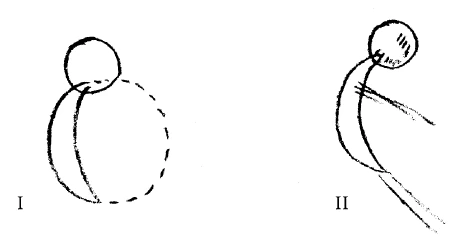
[ 2 ] Zuerst wollen wir uns noch einmal ins Gedächtnis rufen, was uns von verschiedenen Seiten her aufgefallen sein muß: daß der Mensch in den drei Gliedern seines Wesens verschiedene Formen hat. Wir haben darauf aufmerksam gemacht, wie im wesentlichen die Kopfform die Form des Kugeligen ist, wie in dieser kugeligen Kopfform das eigentliche leibliche Wesen des menschlichen Hauptes liegt. Wir haben dann darauf aufmerksam gemacht, daß der Brustteil des Menschen ein Fragment einer Kugel ist, so daß also, wenn wir schematisch zeichnen, wir dem Kopfe eine Kugelform, dem Brustteil eine Mondenform geben und daß wir uns klar sind, daß in dieser Mondenform ein Kugelfragment, ein Teil einer Kugel enthalten ist. Daher werden wir uns sagen müssen: Wir können ergänzen die Mondform des menschlichen Brustgliedes. Und Sie werden nur dann dieses Mittelglied der menschlichen Wesenheit, die menschliche Brustform, richtig ins Auge fassen können, wenn Sie sie auch als eine Kugel betrachten, aber als eine Kugel, von der nur ein Teil, ein Mond sichtbar ist und der andere Teil unsichtbar ist [Abb. I]. Sie sehen daraus vielleicht, daß in denjenigen älteren Zeiten, in denen man mehr die Fähigkeit gehabt hat als später, Formen zu sehen, man nicht unrecht hatte, von Sonne dem Kopf entsprechend, von Mond der Brustform entsprechend zu sprechen. Und wie man dann, wenn der Mond nicht voll ist, von dem Mond eben nur ein Kugelfragment sieht, so sieht man von dem menschlichen Mittelgliede in der Brustform eigentlich nur ein Fragment. Daraus können Sie ersehen, daß die Kopfform des Menschen hier in der physischen Welt etwas verhältnismäßig Abgeschlossenes ist. Die Kopfform zeigt sich physisch als etwas Abgeschlossenes. Sie ist gewissermaßen ganz dasjenige, als was sie sich gibt. Sie verbirgt am allerwenigsten von sich.
[ 2 ] First, let us remind ourselves once again of what must have struck us from various perspectives: that human beings have different forms in the three parts of their being. We have pointed out how the shape of the head is essentially spherical, and how the actual physical essence of the human head lies within this spherical form. We then pointed out that the human chest is a fragment of a sphere, so that, if we draw a schematic diagram, we give the head a spherical shape and the chest a lunar shape, and that we are clear that this lunar shape contains a fragment of a sphere, a part of a sphere. Therefore, we must say to ourselves: We can supplement the lunar shape of the human chest. And you will only be able to properly grasp this middle member of the human being—the human chest form—if you also regard it as a sphere, but as a sphere of which only one part—a moon—is visible, while the other part is invisible [Fig. I]. From this you may perhaps see that in those earlier times, when people had a greater ability than later to perceive forms, they were not wrong to speak of the sun as corresponding to the head and the moon as corresponding to the chest form. And just as, when the moon is not full, one sees only a fragment of a sphere, so too one actually sees only a fragment of the human middle member in the form of the chest. From this you can see that the human head shape here in the physical world is something relatively self-contained. The head shape manifests physically as something self-contained. It is, so to speak, entirely what it presents itself to be. It conceals the very least of itself.
[ 3 ] Der Brustteil des Menschen verbirgt schon sehr viel von sich; er läßt etwas von seiner Wesenheit unsichtbar. Es ist sehr wichtig für die Erkenntnis der Wesenheit des Menschen, das ins Auge zu fassen, daß vom Brustteil ein gut Stück unsichtbar ist. Und so können wir sagen: Der Brustteil zeigt uns nach der einen Seite, nach rückwärts, seine Leiblichkeit; nach vorwärts geht er in das Seelische über. Der Kopf ist ganz Leib; der Brustteil des Menschen ist Leib nach rückwärts, Seele nach vorwärts. Wir tragen also einen wirklichen Leib nur an uns, indem wir unser Haupt auf den Schultern ruhen haben. Wir haben an uns Leib und Seele, indem wir unsere Brust herausgliedern aus dem übrigen Brustteil und sie durcharbeiten, durchwirken lassen von dem Seelischen.
[ 3 ] The human chest conceals a great deal of itself; it keeps part of its essence hidden from view. It is very important for understanding the essence of the human being to recognize that a good portion of the chest region remains invisible. And so we can say: The chest region reveals its physicality to us on one side—toward the back—while toward the front it transitions into the soul. The head is entirely physical; the human chest region is physical toward the back and soul toward the front. We therefore possess a true body only insofar as our head rests upon our shoulders. We possess both body and soul by distinguishing our chest from the rest of the torso and allowing it to be permeated and worked through by the soul.
[ 4 ] Nun sind eingesetzt in diese beiden Glieder des Menschen, namentlich zunächst für die äußere Betrachtung in den Brustteil, die Gliedmaßen. Das dritte ist ja der Gliedmaßenmensch. Nun, wie können wir den Gliedmaßenmenschen eigentlich verstehen? Den Gliedmaßenmenschen können wir nur verstehen, wenn wir ins Auge fassen, daß andere Stücke übriggeblieben sind von der Kugelform als beim Brustteil. Beim Brustteil ist ein Stück von der Peripherie übriggeblieben. Bei den Gliedmaßen ist mehr übriggeblieben etwas von dem Inneren, von den Radien der Kugel, so daß also die inneren Teile der Kugel angesetzt sind als Gliedmaßen.
[ 4 ] Now, the limbs are situated within these two parts of the human being—namely, first of all, in the chest region, as seen from the outside. The third is, of course, the “limb-human.” Well, how can we actually understand the “limb-human”? We can only understand the “limb-human” if we consider that, unlike in the chest region, other parts of the spherical form have remained. In the chest region, a part of the periphery has remained. In the case of the limbs, more of the interior—specifically, the radii of the sphere—has remained, so that the inner parts of the sphere are attached as limbs.
[ 5 ] Man kommt eben nicht zurecht, wie ich Ihnen schon oftmals gesagt habe, wenn man nur schematisch eins ins andere gliedert. Man muß immer das eine mit dem anderen verweben, denn darin besteht das Lebendige. Wir sagen: Wir haben den Gliedmaßenmenschen, der besteht aus den Gliedmaßen. — Aber sehen Sie, auch der Kopf hat seine Gliedmaßen. Wenn Sie sich den Schädel ordentlich ansehen, dann finden Sie, daß zum Beispiel angesetzt sind an den Schädel die Knochen der oberen und der unteren Kinnlade [Abb. II]. Sie sind richtig eingesetzt wie Gliedmaßen. Der Schädel hat auch seine Gliedmaßen, und obere und untere Kinnlade sind als Gliedmaßen am Schädel angebracht. Sie sind nur am Schädel verkümmerrt. Sie sind richtig groß ausgebildet beim übrigen Menschen, am Schädel sind sie verkümmert, sind eigentlich nur Knochengebilde. Und noch einen Unterschied gibt es: wenn Sie die Gliedmaßen des Schädels betrachten, also obere und untere Kinnlade, so werden Sie sehen, daß es bei ihnen ankommt im wesentlichen darauf, daß der Knochen seine Wirksamkeit ausführt. Wenn Sie die Gliedmaßen, die an unserem gesamten Leib angesetzt sind, also die eigentliche Wesenheit des Gliedmaßenmenschen ins Auge fassen, dann werden Sie in der Umkleidung mit Muskeln und mit Blutgefäßen das Wesentliche suchen müssen. Gewissermaßen sind unserem Muskel- und Blutsystem für Arme und Beine, Hände und Füße nur eingesetzt die Knochen. Und gewissermaßen sind an der oberen und unteren Kinnlade als Gliedmaßen des Kopfes ganz verkümmert die Muskeln und die Blutgefäße. Was bedeutet das? — Sehen Sie, in Blut und Muskeln liegt die Organik des Willens, wie wir schon gehört haben. Daher sind ausgebildet für den Willen hauptsächlich Arme und Beine, Hände und Füße. Das, was dem Willen vorzugsweise dient, Blut und Muskeln, das ist ja, bis zu einem gewissen Grade, genommen den Gliedmaßen des Hauptes, weil in ihnen ausgebildet sein soll dasjenige, was zum Intellekt, zum denkerischen Erkennen hinneigt. Wollen Sie daher studieren, wie sich in den äußeren Leibesformen der Wille der Welt offenbart, so studieren Sie Arme und Beine, Hände und Füße. Wollen Sie studieren, wie sich das Intelligente der Welt offenbart, dann studieren Sie das Haupt als Schädel, als Knochengerüst, und wie sich dem Haupt angliedert obere Kinnlade, untere Kinnlade und auch anderes, was gliedmaßenähnlich aussieht am Haupte. Sie können nämlich überall die äußeren Formen als Offenbarungen des Inneren ansehen. Und Sie verstehen nur dann die äußeren Formen, wenn Sie sie als Offenbarungen des Inneren ansehen.
[ 5 ] As I have often told you, one simply cannot make sense of things by merely breaking them down schematically into separate parts. One must always interweave one thing with another, for that is what gives life. We say: We have the “limb-human,” who consists of the limbs. — But you see, even the head has its limbs. If you look closely at the skull, you will find, for example, that the bones of the upper and lower jaws are attached to it [Fig. II]. They are properly positioned just like limbs. The skull also has its limbs, and the upper and lower jaws are attached to the skull as limbs. They are simply atrophied on the skull. They are fully developed in the rest of the human body, but on the skull they are atrophied—they are essentially just bony structures. And there is another difference: if you consider the limbs of the skull—that is, the upper and lower jaws—you will see that their function essentially consists of the bone performing its role. If you consider the limbs attached to our entire body—that is, the very essence of the human being as a being of limbs—then you will have to look for the essential in the covering of muscles and blood vessels. In a sense, the bones are merely the framework for our muscular and circulatory systems in the arms and legs, hands and feet. And, in a sense, the muscles and blood vessels in the upper and lower jaws—as limbs of the head—are completely atrophied. What does this mean? — You see, as we have already heard, the organic basis of the will lies in the blood and muscles. Therefore, the arms and legs, hands and feet are primarily developed for the will. That which primarily serves the will—blood and muscles—is, to a certain extent, taken from the limbs of the head, because it is in them that what inclines toward the intellect and toward thinking cognition is to be developed. Therefore, if you wish to study how the will of the world manifests itself in the outer forms of the body, study the arms and legs, hands and feet. If you wish to study how the intelligent aspect of the world reveals itself, then study the head as the skull, as the bony framework, and how the upper jaw, lower jaw, and other features that resemble limbs are attached to the head. For you can regard the external forms everywhere as revelations of the inner. And you will understand the outer forms only when you regard them as revelations of the inner.
[ 6 ] Nun, sehen Sie, ich habe immer gefunden, daß für die meisten Menschen eine große Schwierigkeit darin liegt, wenn sie begreifen sollen, welche Beziehung zwischen den Röhrenknochen der Arme und Beine und zwischen den Schalknochen des Kopfes, des Hauptes besteht. Es ist nun gerade für den Lehrer gut, hier sich einen Begriff anzueignen, der dem gewöhnlichen Leben fernliegt. Und wir kommen dabei an ein sehr, sehr schwieriges Kapitel, vielleicht das schwierigste für die Vorstellung, das wir zu überschreiten haben in diesen pädagogischen Vorträgen.
[ 6 ] Well, you see, I have always found that most people have great difficulty understanding the relationship between the long bones of the arms and legs and the skull bones of the head. It is particularly important for teachers to grasp a concept here that is far removed from everyday life. And this brings us to a very, very difficult chapter—perhaps the most difficult for our mental images to grasp—that we must work through in these educational lectures.
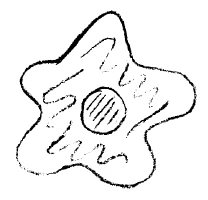
[ 7 ] Sie wissen, Goethe hat zuerst seine Aufmerksamkeit zugewendet der sogenannten Wirbeltheorie des Schädels. Was ist damit gemeint? Damit ist gemeint die Anwendung des Metamorphosengedankens auf den Menschen und seine Gestalt. Wenn man die menschliche Wirbelsäule betrachtet, so liegt ja ein Knochenwirbel über dem anderen. Wir können so einen Knochenwirbel mit seinen Fortsätzen, in dem dann das Rückenmark durchgeht, herausnehmen (es wird gezeichnet). Nun hat Goethe an einem Schöpsenschädel in Venedig zuerst beobachtet, wie alle Kopfknochen umgebildete Rückenwirbelknochen sind. Das heißt, wenn man sich irgendwelche Organe aufgeplustert und andere zurückgegangen denkt, so bekommt man aus dieser Wirbelform den schalgeformten Kopfknochen. Auf Goethe hat das einen großen Eindruck gemacht, denn er hat daraus den Schluß ziehen müssen — was für ihn sehr bedeutungsvoll war -, daß der Schädel eine umgebildete, eine höhergebildete Wirbelsäule ist.
[ 7 ] As you know, Goethe first turned his attention to the so-called “vertebral theory” of the skull. What does this mean? It refers to the application of the concept of metamorphosis to human beings and their form. If one looks at the human spine, one bone vertebra lies on top of another. We can isolate one such vertebral bone with its processes, through which the spinal cord then passes (it is drawn). Now, Goethe first observed on a sheep’s skull in Venice how all the bones of the head are transformed vertebral bones. This means that if one imagines certain organs having expanded and others having receded, this vertebral form gives rise to the bowl-shaped skull bones. This made a great impression on Goethe, for he was compelled to draw the conclusion—which was very significant to him—that the skull is a transformed, a higher-order spine.
[ 8 ] Man kann nun verhältnismäßig leicht einsehen, daß die Schädelknochen durch Umwandlung, durch Metamorphose aus den Wirbelknochen des Rückgrats hervorgehen. Aber nun wird es sehr schwierig, auch die Gliedmaßenknochen, schon die Gliedmaßenknochen des Kopfes, obere und untere Kinnlade — Goethe hat es versucht, aber auf äußerliche Weise noch — als Umformung, als Metamorphose der Wirbelknochen beziehungsweise der Kopfknochen aufzufassen. Warum ist das so? Ja, sehen Sie, das beruht darauf, daß ja allerdings ein röhriger Knochen, den Sie irgendwo haben, auch eine Metamorphose, eine Umwandlung des Kopfknochens ist, aber auf ganz besondere Art. Sie können verhältnismäßig leicht den Rückgratwirbel sich umgewandelt denken zum Kopfknochen, indem Sie sich einzelne Teile vergrößert, andere verkleinert denken. Aber Sie kriegen nicht so leicht aus dem Röhrenknochen der Arme oder der Beine heraus die Kopfknochen, die schaligen Kopfknochen. Da müssen Sie nämlich zuerst eine gewisse Prozedur vornehmen, wenn Sie die herausbekommen wollen. Sie müssen mit dem Röhrenknochen der Arme oder der Beine dieselbe Prozedur vornehmen, die Sie vornehmen würden, wenn Sie beim Anziehen eines Strumpfes oder eines Handschuhes das Innere zuerst nach außen wenden würden, also wenn Sie es umwenden würden. Nun ist es verhältnismäßig leicht, sich vorzustellen, wie ein Handschuh oder ein Strumpf aussieht, wenn das Innere nach außen gewendet wird. Aber der Röhrenknochen ist nicht gleichmäßig. Er ist nicht so dünn, daß er gleichmäßig im Inneren und außen gebaut wäre. Er ist verschieden im Inneren und außen gebaut. Würden Sie Ihren Strumpf so konstruieren und dann elastisch machen, daß Sie ihm äußerlich eine künstlerische Form geben würden mit allerlei Vorsprüngen und Einbuchtungen und ihn dann wenden, dann würden Sie nach außen nicht mehr dieselbe Form erhalten wie die, die dann im Inneren ist, wenn Sie ihn umgewendet haben. Und so ist es bei dem Röhrenknochen. Man muß das Innere nach außen und das Äußere nach innen kehren, dann kommt die Form des Kopfknochens heraus, so daß die menschlichen Gliedmafßen nicht nur umgewandelte Kopfknochen sind, sondern außerdem noch umgewendete Kopfknochen. Woher rührt das? Das rührt davon her, daß der Kopf seinen Mittelpunkt irgendwo im Inneren hat; er hat ihn konzentrisch. Nicht hat in der Mitte der Kugel die Brust ihren Mittelpunkt; die Brust hat den Mittelpunkt sehr weit weg. Das ist hier in der Zeichnung nur fragmentarisch angesetzt, denn es wäre sehr groß, wenn es ganz gezeichnet würde. Also weit weg hat die Brust den Mittelpunkt.
[ 8 ] It is now relatively easy to see that the skull bones arise from the vertebral bones of the spine through transformation, through metamorphosis. But now it becomes very difficult to regard even the limb bones—even the limb bones of the head, the upper and lower jaws—as a transformation, as a metamorphosis of the vertebral bones or the skull bones, as Goethe attempted to do, albeit in a superficial way. Why is that? Well, you see, it’s because, while a tubular bone—which you have somewhere—is indeed a metamorphosis, a transformation of the skull bone, it is so in a very specific way. You can relatively easily imagine a vertebral bone transforming into a skull bone by picturing some parts enlarged and others reduced in size. But you can’t so easily derive the skull bones—the shell-like skull bones—from the tubular bones of the arms or legs. In fact, you must first carry out a certain procedure if you want to derive them. You must apply the same procedure to the long bones of the arms or legs as you would when putting on a sock or a glove—that is, turning the inside out first, or turning it inside out. Now, it’s relatively easy to create a mental image of what a glove or a sock looks like when the inside is turned outward. But the tubular bone is not uniform. It is not so thin that its structure is uniform on the inside and outside. Its structure differs on the inside and outside. If you were to design your sock—and then make it elastic—in such a way that you gave it an artistic shape on the outside with all sorts of protrusions and indentations, and then turned it inside out, you would no longer see the same shape on the outside as the one that is on the inside once you’ve turned it inside out. And that is how it is with the tubular bone. You have to turn the inside out and the outside in; then the shape of the skull emerges, so that the human limbs are not only transformed skulls but also inverted skulls. Where does this come from? It stems from the fact that the skull has its center somewhere inside; it is concentric. The chest does not have its center in the middle of the sphere; the chest’s center is very far away. This is shown only fragmentarily in the drawing, for it would be very large if drawn in its entirety. The chest’s center is that far away.
[ 9 ] Und wo hat denn das Gliedmaßensystem den Mittelpunkt? Jetzt kommen wir auf die zweite Schwierigkeit. Das Gliedmaßensystem hat den Mittelpunkt im ganzen Umkreis. Der Mittelpunkt des Gliedmaßensystems ist überhaupt eine Kugel, also das Gegenteil von einem Punkt. Eine Kugelfläche. Überall ist der Mittelpunkt eigentlich; daher können Sie sich überallhin drehen und von überallher strahlen die Radien ein. Sie vereinigen sich mit Ihnen.
[ 9 ] And where, then, is the center of the limb system? Now we come to the second difficulty. The limb system has its center in the entire circumference. The center of the limb system is, in fact, a sphere—that is, the opposite of a point. A spherical surface. The center is actually everywhere; therefore, you can turn in any direction, and the radii converge on you from every direction. They meet at you.
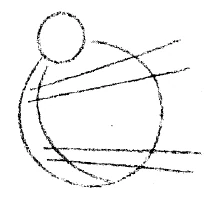
[ 10 ] Was im Kopfe ist, geht vom Kopfe aus; was durch die Gliedmaßen geht, vereinigt sich in Ihnen. Deshalb mußte ich auch in den anderen Vorträgen sagen: Sie müssen sich die Gliedmaßen eingesetzt denken. Wir sind wirklich eine ganze Welt, nur daß dasjenige, was da von außen in uns herein will, an seinem Ende sich verdichtet und sichtbar wird. Ein ganz winziger Teil von dem, was wir sind, wird in unseren Gliedmaßen sichtbar, so daß die Gliedmaßen etwas Leibliches sind, das aber nur ein ganz winziges Atom ist von dem, was eigentlich da ist im Gliedmaßensystem des Menschen: Geist. Leib, Seele und Geist ist im Gliedmaßensystem des Menschen. Der Leib ist in den Gliedmaßen nur angedeutet; aber in den Gliedmaßen ist ebenso das Seelische drinnen, und es ist drinnen das Geistige, das im Grunde genommen die ganze Welt umfaßt.
[ 10 ] What is in the head emanates from the head; what passes through the limbs converges within them. That is why I also had to say in the other lectures: You must imagine the limbs as being actively engaged. We truly are a whole world, except that what seeks to enter us from the outside ultimately condenses and becomes visible. A very tiny part of what we are becomes visible in our limbs, so that the limbs are something physical, but they are only a very tiny atom of what is actually present in the human limb system: spirit. Body, soul, and spirit are present in the human limb system. The body is only hinted at in the limbs; but the soul is also present in the limbs, and so is the spirit, which, in essence, encompasses the entire world.
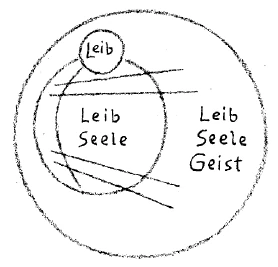
[ 11 ] Nun könnte man auch noch eine andere Zeichnung vom Menschen machen. Man könnte sagen: Der Mensch ist zunächst eine riesengroße Kugel, die die ganze Welt umfaßt, dann eine kleinere Kugel, und dann eine kleinste Kugel. Nur die kleinste Kugel wird ganz sichtbar; die etwas größere Kugel wird nur zum Teil sichtbar; die größte Kugel wird nur in ihren Einstrahlungen am Ende hier sichtbar, das übrige bleibt unsichtbar. So ist der Mensch aus der Welt heraus gebildet in seiner Form.
[ 11 ] Now, one could also draw another picture of the human being. One could say: The human being is, at first, a gigantic sphere that encompasses the entire world; then a smaller sphere; and finally, the tiniest sphere. Only the smallest sphere becomes fully visible; the somewhat larger sphere becomes only partially visible; the largest sphere becomes visible here only through its rays at the end, while the rest remains invisible. Thus, the human being is formed in its shape out of the world.
[ 12 ] Und wiederum im mittleren System, im Brustsystem, haben wir die Vereinigung des Kopfsystems und des Gliedmaßensystems. Wenn Sie das Rückgrat mit den Ansätzen der Rippen betrachten, so werden Sie sehen, daß das der Versuch ist, sich abzuschließen nach vorne. Nach rückwärts ist das Ganze abgeschlossen, nach vorne ist nur der Versuch gemacht des Abschließens; er gelingt nicht ganz. Je mehr die Rippen dem Kopfe zugeneigt sind, desto mehr gelingt es ihnen, sich abzuschließen, aber je weiter nach unten gelegen, desto mehr mißlingt es ihnen. Die letzten Rippen kommen nicht mehr zusammen, weil ihnen da entgegenwirkt diejenige Kraft, die dann in den Gliedmaßen von außen kommt.
[ 12 ] And again, in the middle system—the thoracic system—we find the union of the head system and the limb system. If you look at the spine with the rib attachments, you will see that this is an attempt to close off toward the front. Toward the back, the whole structure is closed off; toward the front, there is only an attempt at closure, which is not entirely successful. The more the ribs are inclined toward the head, the more successfully they close off; but the further down they are located, the more they fail to do so. The last ribs no longer come together because they are counteracted there by the force that then comes from the outside into the limbs.
[ 13 ] Von diesem Zusammenhang des Menschen mit dem ganzen Makrokosmos haben die Griechen noch ein sehr starkes Bewußtsein gehabt. Und die Ägypter wußten das sehr gut, nur wußten sie es etwas abstrakt. Daher können Sie sehen, wenn Sie ägyptische oder überhaupt ältere Plastiken anschauen, daß dieser Gedanke des Kosmos zum Ausdruck kommt. Sie verstehen sonst nicht, was die Menschen in alten Zeiten gemacht haben, wenn Sie nicht wissen, daß sie das gemacht haben, was ihrem Glauben entsprach: Der Kopf ist eine kleine Kugel, ein Weltkörper im Kleinen; die Gliedmaßen sind ein Stück vom großen Weltenkörper, wo er sich überall mit den Radien hineindrängt in die menschliche Gestalt. Die Griechen haben eine schöne, in sich harmonisch ausgebildete Vorstellung davon gehabt, daher waren sie gute Plastiker, gute Bildhauer. Und heute kann noch niemand die plastische Kunst der Menschen wirklich durchdringen, der sich nicht bewußt wird dieses Zusammenhanges des Menschen mit dem Weltall. Sonst patzt er immer nur äußerlich die Naturformen nach.
[ 13 ] The Greeks still had a very strong awareness of this connection between human beings and the entire macrocosm. And the Egyptians knew this very well, though they understood it in a somewhat abstract way. That is why, when you look at Egyptian or, indeed, any ancient sculptures, you can see that this idea of the cosmos is expressed. Otherwise, you cannot understand what people in ancient times created unless you realize that they created what corresponded to their beliefs: the head is a small sphere, a miniature celestial body; the limbs are a part of the great celestial body, whose radii extend into the human form from all directions. The Greeks had a beautiful, harmoniously developed mental image of this, which is why they were skilled sculptors. And even today, no one can truly grasp the sculptural art of humankind unless they become aware of this connection between the human being and the universe. Otherwise, they will merely imitate natural forms superficially.
[ 14 ] Nun werden Sie gerade aus dem, was ich Ihnen so gesagt habe, erkennen, meine lieben Freunde, daß die Gliedmaßen eben mehr der Welt zugeneigt sind, der Kopf mehr dem einzelnen Menschen zugeneigt ist. Wozu werden dann also die Gliedmaßen besonders neigen? Sie werden zur Welt neigen, in der der Mensch sich bewegt und selbst seine Stellung immerfort verändert. Sie werden zur Bewegung der Welt Beziehung haben. Fassen Sie das gut auf: die Gliedmaßen haben Beziehung zur Bewegung der Welt.
[ 14 ] Now, my dear friends, you will realize from what I have just told you that the limbs are more inclined toward the world, while the head is more inclined toward the individual human being. To what, then, will the limbs be particularly inclined? They will be inclined toward the world in which human beings move and constantly change their position. They will be related to the movement of the world. Take this to heart: the limbs are related to the movement of the world.
[ 15 ] Indem wir in der Weit herumgehen, indem wir handelnd auftreten in der Welt, sind wir der Mensch der Gliedmaßen. Was hat denn nun der Bewegung der Welt gegenüber der Kopf, unser Haupt, für eine Aufgabe? Er ruht auf den Schultern, das habe ich Ihnen ja von einem anderen Gesichtspunkte aus gesagt. Er hat auch die Aufgabe, in sich fortwährend die Bewegung der Welt zur Ruhe zu bringen. Wenn Sie sich mit Ihrem Geiste in den Kopf hineinversetzen, so können Sie sich wirklich von diesem Sich-Versetzen ein Bild machen dadurch, daß Sie sich denken für eine Weile, Sie säßen in einem Eisenbahnzug; er bewegt sich vorwärts, Sie sitzen ruhig drinnen. So sitzt Ihre Seele im Kopf, der sich von den Gliedmaßen weiterbefördern läßt, ruhig drinnen und bringt die Bewegung innerlich zur Ruhe. Wie Sie sich sogar hinstrecken können, wenn Sie in dem Eisenbahnwagen Platz haben, und ruhen können, trotzdem diese Ruhe eigentlich eine Unwahrheit ist, denn Sie sausen ja in dem Zuge, vielleicht im Schlafwagen, durch die Welt; dennoch, Sie haben das Gefühl der Ruhe - so beruhigt in Ihnen der Kopf dasjenige, was die Gliedmaßen als Bewegung vollbringen können in der Welt. Und der Brustteil steht mitten darinnen. Der vermittelt die Bewegung der Außenwelt mit dem, was das Haupt, der Kopf zur Ruhe bringt.
[ 15 ] As we move about in the world, as we act within it, we are the human being of the limbs. What, then, is the role of the head in relation to the movement of the world? It rests on the shoulders—as I have already told you from a different perspective. It also has the task of continually bringing the movement of the world to rest within itself. If you project your spirit into your head, you can truly form a picture of this projection by imagining for a moment that you are sitting in a train; it moves forward, while you sit calmly inside. In the same way, your soul sits calmly inside your head—which allows itself to be carried along by the limbs—and brings the movement to rest within. Just as you can even stretch out, if you have room in the train car, and rest, even though this rest is actually an illusion, for you are whizzing through the world in the train—perhaps in a sleeper car— nevertheless, you have the feeling of calm—just as the head calms within you that which the limbs are capable of accomplishing as movement in the world. And the chest region stands right in the middle of it all. It mediates the movement of the outside world with that which the head brings to rest.
[ 16 ] Denken Sie sich jetzt: es geht geradezu unsere Absicht als Mensch darauf hin, die Bewegung der Welt durch unsere Gliedmaßen nachzuahmen, aufzunehmen. Was tun wir denn da? Wir tanzen. Sie tanzen in Wirklichkeit; das andere Tanzen ist nur ein fragmentarisches Tanzen. Alles Tanzen ist davon ausgegangen, Bewegungen, die die Planeten, die anderen Weltenkörper ausführen, die die Erde selbst ausführt, in den Bewegungen, in den Gliederbewegungen der Menschen zur Nachahmung zu bringen.
[ 16 ] Now consider this: our very purpose as human beings is to imitate and take in the movement of the world through our limbs. What are we doing, then? We are dancing. You are dancing in reality; the other kind of dancing is merely a fragmentary form of dancing. All dancing has been based on the idea of imitating—in human movements, in the movements of the limbs—the motions performed by the planets, by other celestial bodies, and by the Earth itself.
[ 17 ] Aber wie ist denn das nun mit dem Kopfe und mit der Brust, wenn wir die kosmischen Bewegungen tanzend nachbilden in unseren Bewegungen als Mensch? Sehen Sie, da ist es so, im Kopfe und in der Brust, als wenn sich die Bewegungen, die wir in der Welt ausführen, stauen würden. Sie können sich nicht fortsetzen durch die Brust in den Kopf hinein, denn der Kerl ruht auf den Schultern, der läßt die Bewegungen nicht sich fortsetzen in die Seele hinein. Die Seele muß in Ruhe an den Bewegungen teilnehmen, weil der Kopf auf den Schultern ruht. Was tut sie daher? Sie fängt an, von sich aus dasjenige zu reflektieren, was die Glieder tanzend ausführen. Sie fängt an zu brummen, wenn die Glieder unregelmäßige Bewegungen ausführen; sie fängt an zu lispeln, wenn die Glieder regelmäßige Bewegungen ausführen, und sie fängt gar an zu singen, wenn die Glieder ausführen die harmonischen kosmischen Bewegungen des Weltalls. So setzt sich um die tanzende Bewegung nach außen in den Gesang und in das Musikalische nach innen.
[ 17 ] But what exactly happens in the head and chest when we, as human beings, reenact the cosmic movements through our own movements as we dance? You see, it is as if the movements we perform in the world were becoming blocked in the head and chest. They cannot continue through the chest and into the head, because the fellow rests on the shoulders; he does not allow the movements to continue into the soul. The soul must participate in the movements while at rest, because the head rests on the shoulders. So what does it do? It begins, of its own accord, to reflect what the limbs are performing as they dance. It begins to hum when the limbs perform irregular movements; it begins to murmur when the limbs perform regular movements; and it even begins to sing when the limbs perform the harmonious cosmic movements of the universe. Thus, the outward dancing movement is transformed inwardly into song and music.
[ 18 ] Die Sinnesphysiologie wird es, wenn sie den Menschen nicht als kosmisches Wesen nimmt, nie dahin bringen, die Empfindung zu begreifen; sie wird immer sagen: Draußen sind die Bewegungen der Luft, im Inneren nimmt der Mensch den Ton wahr. Wie die Bewegungen der Luft mit dem Ton zusammenhängen, das kann man nicht wissen. - Das steht in den Physiologien und in den Psychologien, in den einen am Ende, in den anderen am Anfang; das ist der ganze Unterschied.
[ 18 ] Sensory physiology, if it does not regard the human being as a cosmic being, will never succeed in understanding sensation; it will always say: Out there are the movements of the air; inside, the human being perceives the sound. How the movements of the air are related to the sound—that we cannot know. - This is stated in works on physiology and psychology—at the end of some, at the beginning of others; that is the only difference.
[ 19 ] Woher rührt denn das? Das rührt davon her, daß die Leute, die Psychologie oder Physiologie ausüben, nicht wissen, daß das, was der Mensch äußerlich in Bewegungen hat, im Inneren der Seele zur Ruhe gebracht wird und dadurch anfängt, in Töne überzugehen. Und so ist es mit allen anderen Sinnesempfindungen auch. Weil die Hauptesorgane nicht mitmachen die äußeren Bewegungen, strahlen sie diese Bewegungen in die Brust zurück und machen sie zum Ton, zur anderen Sinnesempfindung. Da liegt der Ursprung der Empfindungen. Da liegt aber auch der Zusammenhang der Künste. Die musischen, die musikalischen Künste entstehen aus den plastischen und architektonischen Künsten, indem das, was plastische und architektonische Künste nach außen sind, die musikalischen Künste nach innen sind. Die Reflexion der Welt von innen nach außen, das sind die musikalischen Künste. - So steht der Mensch drinnen im Weltenall. Empfinden Sie eine Farbe als zur Ruhe gekommene Bewegung. Die Bewegung nehmen Sie äußerlich nicht wahr, wie wenn Sie in einem Eisenbahnzug hingestreckt liegen und die Illusion haben könnten, Sie seien in Ruhe. Sie lassen den Zug draußen sich bewegen. So lassen Sie Ihren Leib durch feine Bewegungen der Gliedmaßen, die Sie nicht wahrnehmen, mitmachen die äußere Welt, und Sie selbst nehmen drinnen die Farben und Töne wahr. Sie verdanken das dem Umstand, daß Sie Ihr Haupt als Form tragen lassen in Ruhe von dem Gliedmaßenorganismus.
[ 19 ] Where does this come from? It stems from the fact that people who study psychology or physiology do not know that what a person expresses outwardly in movements is brought to rest within the soul and thereby begins to transform into sounds. And so it is with all other sensory perceptions as well. Because the head organs do not participate in the external movements, they reflect these movements back into the chest and transform them into sound, into another sensory perception. Therein lies the origin of sensations. But therein also lies the connection between the arts. The muses’ arts—the musical arts—arise from the plastic and architectural arts, in that what the plastic and architectural arts are outwardly, the musical arts are inwardly. The reflection of the world from the inside out—that is what the musical arts are. - This is how human beings stand within the universe. Perceive a color as movement that has come to rest. You do not perceive the movement externally, just as when you lie stretched out in a train and might have the illusion that you are at rest. You let the train move outside. In the same way, through subtle movements of your limbs—which you do not perceive—you allow your body to participate in the external world, while you yourself perceive the colors and sounds from within. You owe this to the fact that your head, as a form, is held at rest by the organism of your limbs.
[ 20 ] Ich sagte Ihnen, es ist das, was ich Ihnen da mitteilte, eine gewisse schwierige Sache. Es ist das aus dem Grunde besonders schwierig, weil für das Begreifen dieser Dinge ja in unserer Zeit überhaupt nichts getan wird. Es wird durch alles das, was wir heute als Zeitbildung aufnehmen, dafür gesorgt, daß die Menschen über so etwas unwissend bleiben, wie es die Dinge sind, die ich Ihnen heute vorgebracht habe. Was geschieht denn eigentlich durch unsere heutige Bildung? Ja, der Mensch lernt wirklich nicht einen Strumpf oder Handschuh ganz kennen, wenn er ihn nicht einmal auch umdreht, denn er weiß dann nie, was eigentlich vom Strumpf oder vom Handschuh seine Haut berührt; er weiß nur dasjenige, was nach außen gewendet ist. So weiß durch unsere heutige Bildung der Mensch auch nur, was nach außen gewendet ist. Er bekommt nur Begriffe für den halben Menschen. Denn nicht einmal die Gliedmaßen kann er begreifen. Denn die hat schon der Geist umgewendert.
[ 20 ] I told you that what I shared with you there is a rather difficult matter. It is particularly difficult for this reason: because in our time, absolutely nothing is being done to help people understand these things. Everything we absorb today as part of our modern education ensures that people remain ignorant of matters such as those I have presented to you today. What actually happens as a result of our modern education? Indeed, a person does not truly come to know a sock or a glove if they do not even turn it inside out, for then they will never know which part of the sock or glove actually touches their skin; they know only what is turned outward. In the same way, through our modern education, people know only what is turned outward. They acquire concepts for only half a human being. For they cannot even comprehend the limbs—since the spirit has already turned them inside out.
[ 21 ] Wir können dasjenige, was wir heute dargestellt haben, auch so bezeichnen, wir können sagen: Betrachten wir den ganzen, vollen Menschen, wie er in der Welt vor uns steht, zunächst als Gliedmaßenmenschen, so zeigt er sich als solcher nach Geist, Seele und Leib. Betrachten wir ihn als Brustmenschen, so zeigt er sich uns als Seele und Leib. Die große Kugel (siehe Zeichnung $. 152): Geist, Leib, Seele; die kleinere Kugel: Leib, Seele; die kleinste Kugel: bloß Leib. Auf dem Konzil des Jahres 869 haben die Bischöfe der katholischen Kirche der Menschheit verboten, etwas über die große Kugel zu wissen. Sie haben dazumal erklärt, es sei Dogma der katholischen Kirche, daß nur vorhanden sei die mittlere Kugel und die kleinste Kugel, daß der Mensch nur bestehe aus Leib und Seele, daß die Seele nur als ihre Eigenschaft etwas Geistiges enthalte; die Seele sei nach der einen Seite auch geistartig. Geist gibt es seit dem Jahre 869 für die vom Katholizismus ausgehende Kultur des Abendlandes nicht mehr. — Aber mit der Beziehung zum Geiste ist abgeschafft worden die Beziehung des Menschen zur Welt. Der Mensch ist mehr und mehr in seine Egoität hineingetrieben worden. Daher wurde die Religion selbst immer egoistischer und egoistischer, und heute leben wir in einer Zeit, wo man, ich möchte sagen, wiederum aus der geistigen Beobachtung heraus die Beziehung des Menschen zum Geiste und damit zur Welt kennenlernen muß.
[ 21 ] We can also describe what we have presented today in this way: If we consider the whole, complete human being as he stands before us in the world—first and foremost as a being composed of limbs—he reveals himself as such in terms of spirit, soul, and body. If we regard him as a “chest-human,” he reveals himself to us as soul and body. The large sphere (see drawing $152): spirit, body, soul; the smaller sphere: body, soul; the smallest sphere: body alone. At the Council of 869, the bishops of the Catholic Church forbade humanity from knowing anything about the large sphere. At that time, they declared it to be a dogma of the Catholic Church that only the middle sphere and the smallest sphere existed, that human beings consist only of body and soul, that the soul contains something spiritual only as an attribute; the soul is, in a sense, also spiritual in nature. Since the year 869, spirit has ceased to exist for Western culture as it has developed from Catholicism. — But with the abolition of the relationship to the spirit, humanity’s relationship to the world has also been abolished. Humanity has been driven more and more into its own egotism. Consequently, religion itself has become increasingly egotistical, and today we live in an age where, I would say, we must once again come to know humanity’s relationship to the spirit—and thus to the world—through spiritual observation.
[ 22 ] Wer hat denn eigentlich die Schuld, daß wir einen naturwissenschaftlichen Materialismus bekommen haben? Daß wir einen naturwissenschaftlichen Materialismus bekommen haben, daran hat die Hauptschuld die katholische Kirche, denn sie hat im Jahre 869 auf dem Konzil von Konstantinopel den Geist abgeschafft. Was ist damals eigentlich geschehen? Betrachten Sie den menschlichen Kopf. Er hat sich innerhalb der Tatsachenwelt des Weltgeschehens so ausgebildet, daß er heute das älteste Glied an dem Menschen ist. Der Kopf ist entsprungen zuerst aus höheren, dann weiter zurückgehend aus niederen Tieren. Mit Bezug auf unseren Kopf stammen wir ab von der Tierwelt. Da ist nichts zu sagen — der Kopf ist nur ein weiter ausgebildetes Tier. Wir kommen zur niederen Tierwelt zurück, wenn wir die Ahnen unseres Kopfes suchen wollen. Unsere Brust ist erst später dem Kopf angesetzt worden; die ist nicht mehr so tierisch wie der Kopf. Die Brust haben wir erst in einem späteren Zeitalter bekommen. Und die Gliedmaßen haben wir Menschen als die spätesten Organe bekommen; die sind die allermenschlichsten Organe. Die sind nicht umgebildet von den tierischen Organen, sondern die sind später angesetzt. Die tierischen Organe sind selbständig gebildet aus dem Kosmos zu den Tieren hin, und die menschlichen Organe sind später selbständig hinzugebildet zu der Brust. Aber indem die katholische Kirche das Bewußtsein des Menschen von seiner Beziehung zum Weltall, von der eigentlichen Natur seiner Gliedmaßen also, hat verbergen lassen, hat sie nur ein bißchen überliefert den folgenden Zeitaltern von der Brust und hauptsächlich vom Kopf, vom Schädel. Und da ist der Materialismus darauf gekommen, daß der Schädel von den Tieren abstammt. Und nun redet er davon, daß der ganze Mensch von den Tieren abstammt, während sich die Brustorgane und die Gliedmaßenorgane erst später hinzugebildet haben. Gerade indem die katholische Kirche dem Menschen verborgen hat die Natur seiner Gliedmaßen, seinen Zusammenhang mit der Welt, hat sie verursacht, daß die spätere materualistische Zeit verfallen ist in die Idee, die nur für den Kopf eine Bedeutung hat, die sie aber für den ganzen Menschen anwendet. Die katholische Kirche ist in Wahrheit die Schöpferin des Materialismus auf diesem Gebiet der Evolutionslehre. Es geziemt insbesondere dem heutigen Lehrer der Jugend, solche Dinge zu wissen. Denn er soll sein Interesse verknüpfen mit dem, was in der Welt geschehen ist. Und er soll die Dinge, die in der Welt geschehen, aus den Fundamenten heraus wissen.
[ 22 ] Who is actually to blame for the fact that we have ended up with scientific materialism? The Catholic Church bears the main blame for the fact that we have ended up with scientific materialism, because it abolished the spirit at the Council of Constantinople in 869. What actually happened back then? Consider the human head. It has developed within the factual world of earthly events in such a way that today it is the oldest part of the human being. The head first arose from higher animals and then, going further back, from lower animals. As far as our head is concerned, we are descended from the animal kingdom. There is no denying it—the head is simply a more highly developed animal. We must go back to the lower animal kingdom if we want to trace the ancestors of our head. Our chest was attached to the head only later; it is no longer as animal-like as the head. We acquired the chest only in a later age. And we humans acquired the limbs as the very last organs; they are the most human of all organs. They are not transformed from animal organs, but were added later. The animal organs were formed independently from the cosmos for the animals, and the human organs were later formed independently in connection with the chest. But by allowing the Catholic Church to conceal human awareness of our relationship to the universe—and thus of the true nature of our limbs—it has passed down only a little to subsequent ages regarding the chest and, primarily, the head and the skull. And this is how materialism came to the conclusion that the skull is derived from animals. And now it claims that the entire human being is derived from animals, while the organs of the chest and the limbs were formed only later. Precisely by concealing from humanity the nature of its limbs and its connection to the world, the Catholic Church has caused the later materialist era to fall into the idea that has significance only for the head, yet which it applies to the whole human being. The Catholic Church is, in truth, the creator of materialism in this realm of evolutionary theory. It is especially fitting for today’s teachers of youth to know such things. For they should connect their interests with what has happened in the world. And they should understand the things that happen in the world from their very foundations.
[ 23 ] Wir haben heute versucht, uns klarzumachen, wie es kommt, daß unsere Zeit materialistisch geworden ist, indem wir begonnen haben mit etwas ganz anderem: mit der Kugelform und Mondenform und mit der Radienform der Gliedmaßen. Das heißt, wir haben mit dem scheinbar ganz Entgegengesetzten begonnen, um eine große, gewaltige, kulturhistorische Tatsache uns klarzumachen. Das ist aber notwendig, daß insbesondere der Lehrer, der sonst mit dem werdenden Menschen gar nichts machen kann, die Kulturtatsachen aus den Fundamenten heraus zu erfassen in der Lage ist. Dann wird er etwas in sich aufnehmen, was notwendig ist, wenn er aus seinem Inneren heraus durch die un- und unterbewußten Beziehungen zum Kinde in der richtigen Weise erziehen will. Denn dann wird er vor dem Menschengebilde die richtige Achtung haben. Er wird in dem Menschengebilde überali die Beziehungen zur großen Welt sehen. Er wird anders an dieses menschliche Gebilde herantreten, als wenn er nur so etwas wie ein besser ausgebildetes Viehchelchen, einen besser ausgebildeten Tierleib im Menschen sieht. Heute tritt der Lehrer im Grunde genommen, wenn er sich auch manchmal in seinem Oberstübchen Illusionen darüber hingibt, er tritt mit dem deutlichen Bewußtsein vor den anderen Menschen hin, daß der aufwachsende Mensch ein kleines Viehchelchen, ein Tierlein ist und daß er dieses Tierlein zu entwickeln hat — etwas weiter, als es die Natur schon entwickelt hat. Anders wird er fühlen, wenn er sagt: Da ist ein Mensch, von dem gehen Beziehungen aus zur ganzen Welt, und in jedem einzelnen aufwachsenden Kind habe ich etwas, wenn ich daran etwas arbeite, tue ich etwas, was in der ganzen Welt eine Bedeutung hat. Wir sind da im Schulzimmer: in jedem Kinde liegt ein Zentrum von der Welt aus, vom Makrokosmos aus. Dieses Schulzimmer ist der Mittelpunkt, ja viele Mittelpunkte für den Makrokosmos. Denken Sie sich, lebendig das gefühlt, was das bedeutet! Wie da die Idee vom Weltenall und seinem Zusammenhang mit dem Menschen übergeht in ein Gefühl, welches durchheiligt alle einzelnen Vornahmen des Unterrichtes. Ohne daß wir solche Gefühle vom Menschen und vom Weltenall haben, kommen wir nicht dazu, ernsthaftig und richtig zu unterrichten. In dem Augenblick, wo wir solche Gefühle haben, übertragen sich diese durch unterirdische Verbindungen auf die Kinder. Ich habe Ihnen in anderem Zusammenhange gesagt, daß es auf einen immer wunderbar wirken muß, wenn man sieht, wie die Drähte in die Erde hinein zu Kupferplatten gehen und die Erde die Elektrizität ohne Drähte weiterleitet. Gehen Sie in die Schule hinein nur mit egoistischen Menschengefühlen, dann brauchen Sie alle möglichen Drähte - die Worte -, um sich mit den Kindern zu verständigen. Haben Sie die großen kosmischen Gefühle, wie sie entwickeln solche Ideen, wie wir sie eben entwickelt haben, dann geht eine unterirdische Leitung zu dem Kinde. Dann sind Sie mit den Kindern eins. Darin liegt etwas von geheimnisvollen Beziehungen von Ihnen zum Schulkinderganzen. Aus solchen Gefühlen heraus muß auch das aufgebaut sein, was wir Pädagogik nennen. Die Pädagogik darf nicht eine Wissenschaft sein, sie muß eine Kunst sein. Und wo gibt es eine Kunst, die man lernen kann, ohne daß man fortwährend in Gefühlen lebt? Die Gefühle aber, in denen man leben muß, um jene große Lebenskunst auszuüben, die Pädagogik ist, diese Gefühle, die man haben muß zur Pädagogik, die feuern sich nur an an der Betrachtung des großen Weltalls und seines Zusammenhanges mit dem Menschen.
[ 23 ] Today we have tried to understand how it is that our age has become materialistic, by beginning with something entirely different: the spherical shape, the lunar shape, and the radial shape of the limbs. In other words, we began with what appears to be the exact opposite in order to grasp a major, momentous fact of cultural history. But it is essential that teachers in particular—who otherwise cannot do anything with the developing human being—be able to grasp cultural facts from their very foundations. Then he will take in something that is necessary if he wants to educate the child in the right way, drawing from within himself through the unconscious and subconscious connections to the child. For then he will have the proper respect for the human being. He will see, everywhere within the human being, the connections to the wider world. He will approach this human being differently than if he were to see in it nothing more than a sort of better-trained little animal, a better-developed animal body in human form. Today, the teacher—even if he sometimes indulges in illusions about this in the back of his mind—essentially steps before others with the clear awareness that the growing human being is a little animal, a small creature, and that he must develop this little creature—a little further than nature has already developed it. He will feel differently when he says: Here is a human being from whom connections radiate out to the whole world, and in every single growing child I have something; when I work on this, I am doing something that has significance throughout the whole world. We are here in the classroom: in every child lies a center radiating out from the world, from the macrocosm. This classroom is the center—indeed, many centers—for the macrocosm. Just imagine, vividly feeling what that means! How the idea of the universe and its connection to humanity transforms into a feeling that sanctifies every single aspect of the lesson. Without having such feelings toward humanity and the universe, we cannot teach seriously and correctly. The moment we have such feelings, they are transmitted to the children through subterranean connections. I have told you in another context that it must always have a wondrous effect on one to see how wires go into the earth to copper plates and how the earth conducts electricity without wires. If you enter the school with only selfish human feelings, then you will need all kinds of wires—words—to communicate with the children. If you have the great cosmic feelings that give rise to ideas such as those we have just developed, then an underground connection is established with the child. Then you are one with the children. In this lies something of the mysterious relationship between you and the school community as a whole. What we call pedagogy must also be built upon such feelings. Pedagogy must not be a science; it must be an art. And where is there an art that one can learn without living continually in feelings? But the feelings one must live in to practice that great art of living that is pedagogy—these feelings necessary for pedagogy—are kindled only by contemplating the vast universe and its connection to humankind.