

General Human Studies
as the Basis of Education
GA 293
1 September 1919, Stuttgart
Translated by Steiner Online Library
Tenth Lecture
[ 1 ] We have discussed the nature of the human being from the psychological and spiritual perspectives. We have at least shed some light on how the human being should be viewed from the spiritual and psychological perspectives. We will need to supplement what has been considered from these two perspectives by first combining the spiritual, psychological, and physical perspectives, so that we may gain a complete overview of the human being and then move on to grasping and understanding the outer physicality as well.
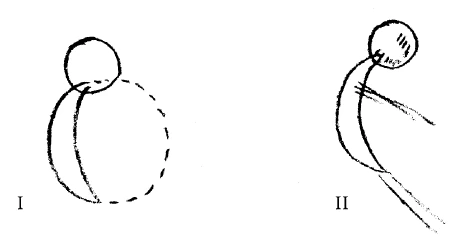
[ 2 ] First, let us remind ourselves once again of what must have struck us from various perspectives: that human beings have different forms in the three parts of their being. We have pointed out how the shape of the head is essentially spherical, and how the actual physical essence of the human head lies within this spherical form. We then pointed out that the human chest is a fragment of a sphere, so that, if we draw a schematic diagram, we give the head a spherical shape and the chest a lunar shape, and that we are clear that this lunar shape contains a fragment of a sphere, a part of a sphere. Therefore, we must say to ourselves: We can supplement the lunar shape of the human chest. And you will only be able to properly grasp this middle member of the human being—the human chest form—if you also regard it as a sphere, but as a sphere of which only one part—a moon—is visible, while the other part is invisible [Fig. I]. From this you may perhaps see that in those earlier times, when people had a greater ability than later to perceive forms, they were not wrong to speak of the sun as corresponding to the head and the moon as corresponding to the chest form. And just as, when the moon is not full, one sees only a fragment of a sphere, so too one actually sees only a fragment of the human middle member in the form of the chest. From this you can see that the human head shape here in the physical world is something relatively self-contained. The head shape manifests physically as something self-contained. It is, so to speak, entirely what it presents itself to be. It conceals the very least of itself.
[ 3 ] The human chest conceals a great deal of itself; it keeps part of its essence hidden from view. It is very important for understanding the essence of the human being to recognize that a good portion of the chest region remains invisible. And so we can say: The chest region reveals its physicality to us on one side—toward the back—while toward the front it transitions into the soul. The head is entirely physical; the human chest region is physical toward the back and soul toward the front. We therefore possess a true body only insofar as our head rests upon our shoulders. We possess both body and soul by distinguishing our chest from the rest of the torso and allowing it to be permeated and worked through by the soul.
[ 4 ] Now, the limbs are situated within these two parts of the human being—namely, first of all, in the chest region, as seen from the outside. The third is, of course, the “limb-human.” Well, how can we actually understand the “limb-human”? We can only understand the “limb-human” if we consider that, unlike in the chest region, other parts of the spherical form have remained. In the chest region, a part of the periphery has remained. In the case of the limbs, more of the interior—specifically, the radii of the sphere—has remained, so that the inner parts of the sphere are attached as limbs.
[ 5 ] As I have often told you, one simply cannot make sense of things by merely breaking them down schematically into separate parts. One must always interweave one thing with another, for that is what gives life. We say: We have the “limb-human,” who consists of the limbs. — But you see, even the head has its limbs. If you look closely at the skull, you will find, for example, that the bones of the upper and lower jaws are attached to it [Fig. II]. They are properly positioned just like limbs. The skull also has its limbs, and the upper and lower jaws are attached to the skull as limbs. They are simply atrophied on the skull. They are fully developed in the rest of the human body, but on the skull they are atrophied—they are essentially just bony structures. And there is another difference: if you consider the limbs of the skull—that is, the upper and lower jaws—you will see that their function essentially consists of the bone performing its role. If you consider the limbs attached to our entire body—that is, the very essence of the human being as a being of limbs—then you will have to look for the essential in the covering of muscles and blood vessels. In a sense, the bones are merely the framework for our muscular and circulatory systems in the arms and legs, hands and feet. And, in a sense, the muscles and blood vessels in the upper and lower jaws—as limbs of the head—are completely atrophied. What does this mean? — You see, as we have already heard, the organic basis of the will lies in the blood and muscles. Therefore, the arms and legs, hands and feet are primarily developed for the will. That which primarily serves the will—blood and muscles—is, to a certain extent, taken from the limbs of the head, because it is in them that what inclines toward the intellect and toward thinking cognition is to be developed. Therefore, if you wish to study how the will of the world manifests itself in the outer forms of the body, study the arms and legs, hands and feet. If you wish to study how the intelligent aspect of the world reveals itself, then study the head as the skull, as the bony framework, and how the upper jaw, lower jaw, and other features that resemble limbs are attached to the head. For you can regard the external forms everywhere as revelations of the inner. And you will understand the outer forms only when you regard them as revelations of the inner.
[ 6 ] Well, you see, I have always found that most people have great difficulty understanding the relationship between the long bones of the arms and legs and the skull bones of the head. It is particularly important for teachers to grasp a concept here that is far removed from everyday life. And this brings us to a very, very difficult chapter—perhaps the most difficult for our mental images to grasp—that we must work through in these educational lectures.
[ 7 ] As you know, Goethe first turned his attention to the so-called “vertebral theory” of the skull. What does this mean? It refers to the application of the concept of metamorphosis to human beings and their form. If one looks at the human spine, one bone vertebra lies on top of another. We can isolate one such vertebral bone with its processes, through which the spinal cord then passes (it is drawn). Now, Goethe first observed on a sheep’s skull in Venice how all the bones of the head are transformed vertebral bones. This means that if one imagines certain organs having expanded and others having receded, this vertebral form gives rise to the bowl-shaped skull bones. This made a great impression on Goethe, for he was compelled to draw the conclusion—which was very significant to him—that the skull is a transformed, a higher-order spine.
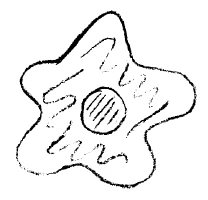
[ 8 ] It is now relatively easy to see that the skull bones arise from the vertebral bones of the spine through transformation, through metamorphosis. But now it becomes very difficult to regard even the limb bones—even the limb bones of the head, the upper and lower jaws—as a transformation, as a metamorphosis of the vertebral bones or the skull bones, as Goethe attempted to do, albeit in a superficial way. Why is that? Well, you see, it’s because, while a tubular bone—which you have somewhere—is indeed a metamorphosis, a transformation of the skull bone, it is so in a very specific way. You can relatively easily imagine a vertebral bone transforming into a skull bone by picturing some parts enlarged and others reduced in size. But you can’t so easily derive the skull bones—the shell-like skull bones—from the tubular bones of the arms or legs. In fact, you must first carry out a certain procedure if you want to derive them. You must apply the same procedure to the long bones of the arms or legs as you would when putting on a sock or a glove—that is, turning the inside out first, or turning it inside out. Now, it’s relatively easy to create a mental image of what a glove or a sock looks like when the inside is turned outward. But the tubular bone is not uniform. It is not so thin that its structure is uniform on the inside and outside. Its structure differs on the inside and outside. If you were to design your sock—and then make it elastic—in such a way that you gave it an artistic shape on the outside with all sorts of protrusions and indentations, and then turned it inside out, you would no longer see the same shape on the outside as the one that is on the inside once you’ve turned it inside out. And that is how it is with the tubular bone. You have to turn the inside out and the outside in; then the shape of the skull emerges, so that the human limbs are not only transformed skulls but also inverted skulls. Where does this come from? It stems from the fact that the skull has its center somewhere inside; it is concentric. The chest does not have its center in the middle of the sphere; the chest’s center is very far away. This is shown only fragmentarily in the drawing, for it would be very large if drawn in its entirety. The chest’s center is that far away.
[ 9 ] And where, then, is the center of the limb system? Now we come to the second difficulty. The limb system has its center in the entire circumference. The center of the limb system is, in fact, a sphere—that is, the opposite of a point. A spherical surface. The center is actually everywhere; therefore, you can turn in any direction, and the radii converge on you from every direction. They meet at you.
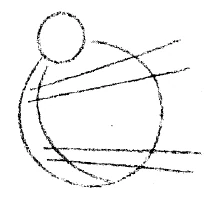
[ 10 ] What is in the head emanates from the head; what passes through the limbs converges within them. That is why I also had to say in the other lectures: You must imagine the limbs as being actively engaged. We truly are a whole world, except that what seeks to enter us from the outside ultimately condenses and becomes visible. A very tiny part of what we are becomes visible in our limbs, so that the limbs are something physical, but they are only a very tiny atom of what is actually present in the human limb system: spirit. Body, soul, and spirit are present in the human limb system. The body is only hinted at in the limbs; but the soul is also present in the limbs, and so is the spirit, which, in essence, encompasses the entire world.
[ 11 ] Now, one could also draw another picture of the human being. One could say: The human being is, at first, a gigantic sphere that encompasses the entire world; then a smaller sphere; and finally, the tiniest sphere. Only the smallest sphere becomes fully visible; the somewhat larger sphere becomes only partially visible; the largest sphere becomes visible here only through its rays at the end, while the rest remains invisible. Thus, the human being is formed in its shape out of the world.
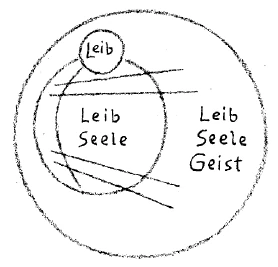
[ 12 ] And again, in the middle system—the thoracic system—we find the union of the head system and the limb system. If you look at the spine with the rib attachments, you will see that this is an attempt to close off toward the front. Toward the back, the whole structure is closed off; toward the front, there is only an attempt at closure, which is not entirely successful. The more the ribs are inclined toward the head, the more successfully they close off; but the further down they are located, the more they fail to do so. The last ribs no longer come together because they are counteracted there by the force that then comes from the outside into the limbs.
[ 13 ] The Greeks still had a very strong awareness of this connection between human beings and the entire macrocosm. And the Egyptians knew this very well, though they understood it in a somewhat abstract way. That is why, when you look at Egyptian or, indeed, any ancient sculptures, you can see that this idea of the cosmos is expressed. Otherwise, you cannot understand what people in ancient times created unless you realize that they created what corresponded to their beliefs: the head is a small sphere, a miniature celestial body; the limbs are a part of the great celestial body, whose radii extend into the human form from all directions. The Greeks had a beautiful, harmoniously developed mental image of this, which is why they were skilled sculptors. And even today, no one can truly grasp the sculptural art of humankind unless they become aware of this connection between the human being and the universe. Otherwise, they will merely imitate natural forms superficially.
[ 14 ] Now, my dear friends, you will realize from what I have just told you that the limbs are more inclined toward the world, while the head is more inclined toward the individual human being. To what, then, will the limbs be particularly inclined? They will be inclined toward the world in which human beings move and constantly change their position. They will be related to the movement of the world. Take this to heart: the limbs are related to the movement of the world.
[ 15 ] As we move about in the world, as we act within it, we are the human being of the limbs. What, then, is the role of the head in relation to the movement of the world? It rests on the shoulders—as I have already told you from a different perspective. It also has the task of continually bringing the movement of the world to rest within itself. If you project your spirit into your head, you can truly form a picture of this projection by imagining for a moment that you are sitting in a train; it moves forward, while you sit calmly inside. In the same way, your soul sits calmly inside your head—which allows itself to be carried along by the limbs—and brings the movement to rest within. Just as you can even stretch out, if you have room in the train car, and rest, even though this rest is actually an illusion, for you are whizzing through the world in the train—perhaps in a sleeper car— nevertheless, you have the feeling of calm—just as the head calms within you that which the limbs are capable of accomplishing as movement in the world. And the chest region stands right in the middle of it all. It mediates the movement of the outside world with that which the head brings to rest.
[ 16 ] Now consider this: our very purpose as human beings is to imitate and take in the movement of the world through our limbs. What are we doing, then? We are dancing. You are dancing in reality; the other kind of dancing is merely a fragmentary form of dancing. All dancing has been based on the idea of imitating—in human movements, in the movements of the limbs—the motions performed by the planets, by other celestial bodies, and by the Earth itself.
[ 17 ] But what exactly happens in the head and chest when we, as human beings, reenact the cosmic movements through our own movements as we dance? You see, it is as if the movements we perform in the world were becoming blocked in the head and chest. They cannot continue through the chest and into the head, because the fellow rests on the shoulders; he does not allow the movements to continue into the soul. The soul must participate in the movements while at rest, because the head rests on the shoulders. So what does it do? It begins, of its own accord, to reflect what the limbs are performing as they dance. It begins to hum when the limbs perform irregular movements; it begins to murmur when the limbs perform regular movements; and it even begins to sing when the limbs perform the harmonious cosmic movements of the universe. Thus, the outward dancing movement is transformed inwardly into song and music.
[ 18 ] Sensory physiology, if it does not regard the human being as a cosmic being, will never succeed in understanding sensation; it will always say: Out there are the movements of the air; inside, the human being perceives the sound. How the movements of the air are related to the sound—that we cannot know. - This is stated in works on physiology and psychology—at the end of some, at the beginning of others; that is the only difference.
[ 19 ] Where does this come from? It stems from the fact that people who study psychology or physiology do not know that what a person expresses outwardly in movements is brought to rest within the soul and thereby begins to transform into sounds. And so it is with all other sensory perceptions as well. Because the head organs do not participate in the external movements, they reflect these movements back into the chest and transform them into sound, into another sensory perception. Therein lies the origin of sensations. But therein also lies the connection between the arts. The muses’ arts—the musical arts—arise from the plastic and architectural arts, in that what the plastic and architectural arts are outwardly, the musical arts are inwardly. The reflection of the world from the inside out—that is what the musical arts are. - This is how human beings stand within the universe. Perceive a color as movement that has come to rest. You do not perceive the movement externally, just as when you lie stretched out in a train and might have the illusion that you are at rest. You let the train move outside. In the same way, through subtle movements of your limbs—which you do not perceive—you allow your body to participate in the external world, while you yourself perceive the colors and sounds from within. You owe this to the fact that your head, as a form, is held at rest by the organism of your limbs.
[ 20 ] I told you that what I shared with you there is a rather difficult matter. It is particularly difficult for this reason: because in our time, absolutely nothing is being done to help people understand these things. Everything we absorb today as part of our modern education ensures that people remain ignorant of matters such as those I have presented to you today. What actually happens as a result of our modern education? Indeed, a person does not truly come to know a sock or a glove if they do not even turn it inside out, for then they will never know which part of the sock or glove actually touches their skin; they know only what is turned outward. In the same way, through our modern education, people know only what is turned outward. They acquire concepts for only half a human being. For they cannot even comprehend the limbs—since the spirit has already turned them inside out.
[ 21 ] We can also describe what we have presented today in this way: If we consider the whole, complete human being as he stands before us in the world—first and foremost as a being composed of limbs—he reveals himself as such in terms of spirit, soul, and body. If we regard him as a “chest-human,” he reveals himself to us as soul and body. The large sphere (see drawing $152): spirit, body, soul; the smaller sphere: body, soul; the smallest sphere: body alone. At the Council of 869, the bishops of the Catholic Church forbade humanity from knowing anything about the large sphere. At that time, they declared it to be a dogma of the Catholic Church that only the middle sphere and the smallest sphere existed, that human beings consist only of body and soul, that the soul contains something spiritual only as an attribute; the soul is, in a sense, also spiritual in nature. Since the year 869, spirit has ceased to exist for Western culture as it has developed from Catholicism. — But with the abolition of the relationship to the spirit, humanity’s relationship to the world has also been abolished. Humanity has been driven more and more into its own egotism. Consequently, religion itself has become increasingly egotistical, and today we live in an age where, I would say, we must once again come to know humanity’s relationship to the spirit—and thus to the world—through spiritual observation.
[ 22 ] Who is actually to blame for the fact that we have ended up with scientific materialism? The Catholic Church bears the main blame for the fact that we have ended up with scientific materialism, because it abolished the spirit at the Council of Constantinople in 869. What actually happened back then? Consider the human head. It has developed within the factual world of earthly events in such a way that today it is the oldest part of the human being. The head first arose from higher animals and then, going further back, from lower animals. As far as our head is concerned, we are descended from the animal kingdom. There is no denying it—the head is simply a more highly developed animal. We must go back to the lower animal kingdom if we want to trace the ancestors of our head. Our chest was attached to the head only later; it is no longer as animal-like as the head. We acquired the chest only in a later age. And we humans acquired the limbs as the very last organs; they are the most human of all organs. They are not transformed from animal organs, but were added later. The animal organs were formed independently from the cosmos for the animals, and the human organs were later formed independently in connection with the chest. But by allowing the Catholic Church to conceal human awareness of our relationship to the universe—and thus of the true nature of our limbs—it has passed down only a little to subsequent ages regarding the chest and, primarily, the head and the skull. And this is how materialism came to the conclusion that the skull is derived from animals. And now it claims that the entire human being is derived from animals, while the organs of the chest and the limbs were formed only later. Precisely by concealing from humanity the nature of its limbs and its connection to the world, the Catholic Church has caused the later materialist era to fall into the idea that has significance only for the head, yet which it applies to the whole human being. The Catholic Church is, in truth, the creator of materialism in this realm of evolutionary theory. It is especially fitting for today’s teachers of youth to know such things. For they should connect their interests with what has happened in the world. And they should understand the things that happen in the world from their very foundations.
[ 23 ] Today we have tried to understand how it is that our age has become materialistic, by beginning with something entirely different: the spherical shape, the lunar shape, and the radial shape of the limbs. In other words, we began with what appears to be the exact opposite in order to grasp a major, momentous fact of cultural history. But it is essential that teachers in particular—who otherwise cannot do anything with the developing human being—be able to grasp cultural facts from their very foundations. Then he will take in something that is necessary if he wants to educate the child in the right way, drawing from within himself through the unconscious and subconscious connections to the child. For then he will have the proper respect for the human being. He will see, everywhere within the human being, the connections to the wider world. He will approach this human being differently than if he were to see in it nothing more than a sort of better-trained little animal, a better-developed animal body in human form. Today, the teacher—even if he sometimes indulges in illusions about this in the back of his mind—essentially steps before others with the clear awareness that the growing human being is a little animal, a small creature, and that he must develop this little creature—a little further than nature has already developed it. He will feel differently when he says: Here is a human being from whom connections radiate out to the whole world, and in every single growing child I have something; when I work on this, I am doing something that has significance throughout the whole world. We are here in the classroom: in every child lies a center radiating out from the world, from the macrocosm. This classroom is the center—indeed, many centers—for the macrocosm. Just imagine, vividly feeling what that means! How the idea of the universe and its connection to humanity transforms into a feeling that sanctifies every single aspect of the lesson. Without having such feelings toward humanity and the universe, we cannot teach seriously and correctly. The moment we have such feelings, they are transmitted to the children through subterranean connections. I have told you in another context that it must always have a wondrous effect on one to see how wires go into the earth to copper plates and how the earth conducts electricity without wires. If you enter the school with only selfish human feelings, then you will need all kinds of wires—words—to communicate with the children. If you have the great cosmic feelings that give rise to ideas such as those we have just developed, then an underground connection is established with the child. Then you are one with the children. In this lies something of the mysterious relationship between you and the school community as a whole. What we call pedagogy must also be built upon such feelings. Pedagogy must not be a science; it must be an art. And where is there an art that one can learn without living continually in feelings? But the feelings one must live in to practice that great art of living that is pedagogy—these feelings necessary for pedagogy—are kindled only by contemplating the vast universe and its connection to humankind.