

The Art of Education
GA 295
22 August 1919, Stuttgart
Translate the original German text into any language:
Versions Available:
Zweite Seminarbesprechung
Second Seminar Discussion
Rudolf Treichler berichtet über die Fragen: Erstens, wie äußert sich das sanguinische Temperament im Kinde, und zweitens, wie hat man es zu behandeln?
Rudolf Treichler discusses the following questions: First, how does the sanguine temperament manifest itself in children, and second, how should it be treated?
[ 1 ] Rudolf Steiner: Hier beginnen ja die Individualisierungen. Wir haben gesagt, daß wir nach den Temperamenten einteilen können. Man muß ja das Kind im Massenunterricht mit an dem allgemeinen Zeichenunterricht beschäftigen, und nun können wir bei den einzelnen Gruppen etwas individualisieren. Dann würde es sich darum handeln, in welcher Hinsicht Sie den Zeichenunterricht individualisieren wollten. Nachahmung wird man überhaupt weniger pflegen. Man wird im Zeichnen versuchen, das innere Formgefühl zu erwecken. Man wird nur darin individualisieren können. Man wird einen Unterschied machen können, ob man mehr geradlinige Formen oder mehr bewegte, ob man mehr einfache, übersichtliche Formen nimmt oder solche mit mehr Details. Kompliziertere, mehr Detailformen, würden für das Kind mit sanguinischem Temperament zu verwenden sein. Man wird nach dem "Temperament mehr die Art bestimmen, wie man den einen oder den anderen unterrichtet.
[ 1 ] Rudolf Steiner: This is where individualization begins. We have said that we can categorize students according to their temperaments. In a classroom setting, children must, of course, participate in general drawing instruction, and now we can individualize the approach somewhat for the individual groups. The question then becomes in what ways you would like to individualize the drawing instruction. Imitation will generally be emphasized less. In drawing, we will try to awaken the inner sense of form. It is only in this way that we will be able to individualize the instruction. We’ll be able to differentiate based on whether we use more linear forms or more dynamic ones, or whether we choose simpler, clearer forms or those with more detail. More complex, detailed forms would be suitable for children with a sanguine temperament. We’ll determine the teaching approach for each child based on their temperament.
Johannes Geyer und Hertha Koegel berichtet über dasselbe Thema.
Johannes Geyer and Hertha Koegel report on the same topic.
[ 2 ] Rudolf Steiner: Nicht wahr, bei solchen Dingen muß man sich immer ganz klar sein, daß namentlich die Behandlung doch nicht eindeutig sein muß. Es kann natürlich von dem einen etwas gemacht werden, was ganz gut ist in einem solchen Fall, und von dem anderen etwas anderes, was auch gut ist. Also die pedantische Eindeutigkeit braucht nicht angestrebt zu werden, doch gewisse große Richtlinien muß man schon einhalten, die müssen durchdrungen werden.
[ 2 ] Rudolf Steiner: Isn’t it true that with matters like these, one must always be very clear that the approach, in particular, does not have to be unambiguous? Of course, one can take one approach—which is quite good in such a case—and another can take a different approach, which is also good. So there’s no need to strive for pedantic certainty, but one must adhere to certain broad guidelines—they must be thoroughly internalized.
[ 3 ] Die Frage, ob ein sanguinisches Kind schwer oder leicht zu behandeln ist, ist schon sehr bedeutsam. Darüber müßte man sich schon eine Ansicht verschaffen und sich zum Beispiel folgendes klarmachen: Es kann passieren bei einem sanguinischen Kinde, daß man irgend etwas vorzubringen, zu erklären hat. Das Kind hat wohl die Sache aufgenommen, aber nach einiger Zeit merkt man, es ist gar nicht mehr dabei, sondern hat sich einer anderen Sache zugewendet. Dadurch wird der Fortschritt des Kindes beeinträchtigt. Was würden Sie tun, wenn Sie bemerken würden, Sie reden in der Schule vom Pferde, und nach einiger Zeit hat sich das sanguinische Kind sehr weit entfernt vom Gegenstande und hat seine Aufmerksamkeit einem ganz anderen Gegenstande zugewendet, so daß alles, was Sie besprechen, an seinen Ohren vorbeigehen könnte? Was würden Sie mit einem solchen Kinde tun?
[ 3 ] The question of whether a sanguine child is difficult or easy to deal with is indeed very significant. One really ought to form an opinion on this and, for example, realize the following: With a sanguine child, it can happen that you have to bring up or explain something. The child may have taken in the information, but after a while you notice that they are no longer paying attention at all—instead, they have turned their attention to something else. This hinders the child’s progress. What would you do if you noticed that you were talking about horses in school, and after a while the sanguine child had drifted far away from the subject and turned their attention to something completely different, so that everything you were discussing might be going in one ear and out the other? What would you do with such a child?
[ 4 ] Viel wird ja davon abhängen, wie weit man in solchem Falle individualisieren kann oder nicht. Hat man viele Kinder, so werden viele Maßregeln nicht leicht durchzuführen sein. Man hat ja, wenn man viele Kinder hat, die sanguinischen Kinder in einer Gruppe beisammen. Dann muß man vorbildlich wirken auf die sanguinischen durch die melancholischen Kinder. Wenn in der sanguinischen Gruppe irgend etwas nicht stimmt, sich zur melancholischen Gruppe wenden und dieses Temperament dann spielen lassen, um ausgleichend zu wirken! Gerade beim Massenunterricht ist das sehr ins Auge zu fassen. Da ist es wichtig, daß man nicht bloß selber den Ernst und die Ruhe bewahrt, sondern daß man den Ernst und die Ruhe der melancholischen Kinder in Wechselwirkung treten läßt mit der sanguinischen Gruppe.
[ 4 ] Much will depend on the extent to which one can—or cannot—tailor the approach to individual needs in such a case. If there are many children, many measures will not be easy to implement. After all, when there are many children, the sanguine children tend to be grouped together. In that case, one must use the melancholic children to set an example for the sanguine ones. If something isn’t quite right in the sanguine group, turn to the melancholic group and let that temperament come into play to create a balancing effect! This is something to keep in mind, especially in large-group instruction. There, it is important not only to maintain one’s own seriousness and calm, but also to allow the seriousness and calm of the melancholic children to interact with the sanguine group.
[ 5 ] Nehmen wir an, Sie sprechen über das Pferd. Sie sehen, ein sanguinisches Kind aus der Gruppe, das ist längst nicht mehr dabei. Jetzt versuchen Sie das zu konstatieren. Indem Sie das Kind etwas fragen, machen Sie, daß es wirklich hervortritt, daß das Kind nicht mehr dabei ist. Dann versuchen Sie, in der melancholischen Gruppe die Tatsache zu konstatieren, daß ein Kind, während Sie früher vom Kleiderschrank gesprochen haben und jetzt schon lange vom Pferd sprechen, noch immer an den Kleiderschrank denkt. Konstatieren Sie das: «Sieh, du hast schon längst das Pferd vergessen, dein Freund ist noch nicht vom Kleiderschrank weggekommen!»
[ 5 ] Let’s say you’re talking about the horse. You see, a sanguine child from the group—that child hasn’t been part of the conversation for quite some time. Now try to point that out. By asking the child a question, you make it really clear that the child is no longer part of the conversation. Then try to point out to the melancholic group the fact that, while you were talking about the closet earlier and have been talking about the horse for quite some time now, one child is still thinking about the closet. Point this out: “Look, you’ve long since forgotten about the horse, but your friend still hasn’t moved on from the closet!”
[ 6 ] Solche Tatsachen wirken stark. Auf diese Weise schleifen sich die Kinder aneinander ab. Dieses Selbstsehen der Kinder hat eine starke Wirkung. Die unterbewußte Seele hat ein starkes Gefühl davon, daß bei solchem Nicht-miteinander-Mitkommen das soziale Leben nicht weitergeht. Dieses Unbewußte in der Seele muß man stark benützen, dann kann sogar der Massenunterricht ein außerordentlich gutes Mittel sein, um vorwärtszukommen, wenn man die Eigenschaften der Kinder aneinander abschleift. Um den Kontrast zu zeigen, muß man eine wirklich leichte Hand haben und den Humor, so daß die Kinder sehen: man ärgert sich nie, man hat auch keinen Groll, sondern man behandelt die Dinge so, daß sie sich selber zeigen.
[ 6 ] Such facts have a powerful effect. In this way, the children shape each other. This self-perception among children has a powerful effect. The subconscious mind has a strong sense that, when children cannot get along with one another, social life cannot move forward. One must make full use of this unconscious aspect of the soul; then even classroom instruction can be an extraordinarily effective means of progress, provided one allows the children’s characteristics to shape one another. To demonstrate the contrast, one must have a truly light touch and a sense of humor, so that the children see: one never gets annoyed, one holds no grudges, but rather handles things in such a way that they reveal themselves.
[Stockmeyer spricht über das phlegmatische Kind.]
[Stockmeyer talks about the phlegmatic child.]
[ 7 ] Rudolf Steiner: Was würden Sie tun, wenn ein phlegmatisches Kind nun gar nicht herauskommt und Sie zur Verzweiflung bringt?
[ 7 ] Rudolf Steiner: What would you do if a phlegmatic child simply wouldn't open up and was driving you to despair?
Paul Baumann berichtet über die Behandlung der Temperamente vom musikalischen Standpunkt aus und in bezug auf die biblische Geschichte.
Paul Baumann discusses the temperaments from a musical perspective and in relation to biblical history.
| Phlegmatiker | Sanguiniker | Choleriker | Melancholiker |
|---|---|---|---|
| Harmonium und Klavier Harmonie | Blasinstrumente Melodie Rhythmus | Schlagzeuge und Trommel | Streichinstrumente Kontrapunkt (was mehr intellektuell durchgearbeitet werden muß) |
| Chorgesang | ganzes Orchester | Soloinstrumente | Sologesang |
| In bezug auf die biblische Geschichte: | |||
| Matthäus Evangelium (Mannigfaltigkeit) | Lukas Evangelium (Innigkeit) | Markus Evangelium (Kraft) | Johannes Evangelium (Geistige Vertiefung) |
| Phlegmatic | Sanguine | Choleric | Melancholic |
|---|---|---|---|
| Harmonium and piano: harmony | Wind instruments: melody, rhythm | Percussion and drums | String instruments: counterpoint (which requires more intellectual elaboration) |
| Choral singing | Full orchestra | Solo instruments | Solo singing |
| With regard to the biblical narrative: | |||
| Gospel of Matthew (Diversity) | Gospel of Luke (Intimacy) | Gospel of Mark (Power) | Gospel of John (Spiritual Depth) |
[ 8 ] Rudolf Steiner: Es ist vieles sehr richtig, namentlich auch in bezug auf die Instrumente und die Wahl des musikalischen Unterrichts. Ebensogut ist der Gegensatz von Sologesang beim Melancholiker, dem ganzen Orchester beim Sanguiniker, und Chorgesang beim Phlegmatiker. Die Dinge sind sehr gut, und auch die Evangelisten sind sehr gut. Aber die vier Künste sind deshalb weniger den Temperamenten zuzuteilen, weil es möglich ist, gerade durch die Vielheit des Künstlerischen auf jedes Temperament ausgleichend zu wirken. Innerhalb der einzelnen Kunst ist das Prinzip sehr richtig, aber ich würde nicht die Künste selbst verteilen. In bezug auf die Musik ist das richtig. Wenn Sie zum Beispiel den Phlegmatiker haben, können Sie unter Umständen sehr gut durch etwas, was ihn im Tanz ergreift oder in der Malerei ergreift, auf ihn wirken. Da möchte ich nicht verzichten auf das, was in den verschiedenen Künsten auf ihn wirken kann. In der einzelnen Kunst wird es wieder möglich sein, die Richtungen und Betätigungsgebiete der Kunst auf die Temperamente zu verteilen. Es würde nicht gut sein, wenn man da den Temperamenten zuviel nachgibt, während es doch notwendig ist, alles so zuzubereiten, wie es für die einzelnen richtig ist.
[ 8 ] Rudolf Steiner: Much of this is very true, particularly with regard to the instruments and the choice of musical instruction. Equally valid is the contrast between solo singing for the melancholic, the full orchestra for the sanguine, and choral singing for the phlegmatic. These points are very good, and the Evangelists are also very good. But the four arts should not be assigned to the temperaments simply because it is possible, precisely through the diversity of the arts, to have a balancing effect on each temperament. Within each individual art, the principle is quite correct, but I would not assign the arts themselves to specific temperaments. With regard to music, this is correct. If, for example, you have a phlegmatic person, you may, under certain circumstances, influence them very effectively through something that moves them in dance or in painting. In that case, I would not want to forgo what can influence them in the various arts. Within each individual art form, it will again be possible to allocate the various directions and fields of activity to the temperaments. It would not be good to give in too much to the temperaments in this regard, whereas it is necessary to prepare everything in a way that is appropriate for each individual.
Friedrich Oehlschlegelberichtet über das phlegmatische Temperament und sagt, daß das Kind mit offenem Munde dasitzt.
Friedrich Oehlschlegel discusses the phlegmatic temperament and says that the child sits there with its mouth open.
[ 9 ] Rudolf Steiner: Sie sind im Irrtum; das phlegmatische Kind wird nicht mit offenem Munde dasitzen, sondern mit zugemachtem Munde, aber mit hängenden Lippen. Man kann schon manchmal durch einen solchen Hinweis den Nagel auf den Kopf treffen. Dies zu berühren war sehr gut. Es wird in der Regel aber nicht der Fall sein; das phlegmatische Kind wird nicht mit offenem Munde dasitzen, sondern im Gegenteil. Das führt zurück auf die Frage: Wie kann man sich dem phlegmatischen Kinde gegenüber verhalten, wenn es uns zur Verzweiflung bringt?
[ 9 ] Rudolf Steiner: You are mistaken; the phlegmatic child will not sit there with an open mouth, but with a closed mouth and drooping lips. Sometimes such a remark can really hit the nail on the head. It was very good to bring this up. As a rule, however, this will not be the case; the phlegmatic child will not sit there with an open mouth, but quite the opposite. This brings us back to the question: How should one behave toward the phlegmatic child when it drives us to despair?
[ 10 ] Das Idealste, das man tun könnte, das wäre, die Mutter des Kindes zu bitten, es immer wenigstens eine Stunde früher aufzuwecken, als es gewohnt ist zu erwachen, und in dieser Zeit, die man ihm eigentlich wegnimmt — man wird es nicht beeinträchtigen, weil es in der Regel immer viel länger schläft als nötig —, es mit allem möglichen zu beschäftigen. Von der Zeit an, wo man es aufgeweckt hat, bis zu der Zeit, wo es sonst aufzuwachen gewohnt war, wird man es beschäftigen; das würde ein ideales Kurieren sein. Auf diese Weise würde man viel von seinem Phlegma wegnehmen. Das wird man in der Regel nicht können, weil die Eltern sich nicht darauf einlassen werden, aber man würde sehr viel damit tun können.
[ 10 ] The best thing one could do would be to ask the child’s mother to always wake him up at least an hour earlier than he is used to waking up, and during this time—which is actually being taken away from him (it won’t affect him, since he usually sleeps much longer than necessary)—to keep him occupied with all sorts of activities. From the time they wake the child until the time they would normally wake up, they should keep the child occupied; that would be an ideal treatment. In this way, much of the child’s phlegm would be alleviated. As a rule, this won’t be possible because the parents won’t go along with it, but it would be very effective.
[ 11 ] Man wird folgendes tun können, was ein Surrogat ist, was aber viel helfen kann: Wenn die Gruppe so dasitzt — mit offenem Munde wird sie nicht dasitzen — und Sie vorbeigehen, und Sie gehen öfter vorbei, könnten Sie so etwas machen (Dr. Steiner schlägt mit einem Schlüsselbund auf den Tisch), wodurch Sie einen Schock hervorrufen, um die Kinder aufzuwecken, wodurch die Kinder dann übergehen von dem zugemachten zu dem offenen Mund. In diesem Moment, wo Sie sie schockiert haben, versuchen Sie, sie während fünf Minuten zu beschäftigen. Man muß sie durch eine äußere Veranlassung aus ihrer Lethargie herausbringen, aufstampern. Man muß dadurch, daß man auf das Unbewußte wirkt, dieses unregelmäßige Verbundensein des Ätherleibes mit dem physischen Körper bekämpfen. Man wird immer wieder ein anderes Mittel finden müssen, das sie schockiert und sie dadurch von ihren hängenden Lippen zum offenen Munde bringt; das also gerade das hervorruft, was sie nicht gerne tun. So wäre diese Frage zu behandeln, wenn diese Kinder einen zur Verzweiflung bringen. Wenn man das mit Geduld fortsetzt und wirklich die phlegmatische Gruppe immerzu in dieser Weise aufrüttelt, dann wird man gerade da viel erreichen.
[ 11 ] You can do the following—it’s a substitute, but it can be very helpful: When the group is sitting there like that—they won’t be sitting there with their mouths open—and you walk by, and you walk by several times, you could do something like this (Dr. Steiner taps the table with a set of keys), which will startle them and wake them up, causing the children to shift from having their mouths closed to having them open. At that very moment, when you’ve startled them, try to keep them occupied for five minutes. You have to rouse them from their lethargy through an external stimulus, to shake them up. By acting on the unconscious, you must counteract this irregular connection between the etheric body and the physical body. You will have to keep finding a different method that shocks them and thereby brings them from their drooping lips to an open mouth—that is, one that provokes precisely what they do not like to do. This is how the issue should be addressed when these children drive you to despair. If you continue this with patience and truly keep shaking up the phlegmatic group in this way, you will achieve a great deal precisely in this area.
Stockmeyer:: Wäre es nicht möglich, die phlegmatischen Kinder eine Stunde früher zur Schule kommen zu lassen?
Stockmeyer:: Wouldn't it be possible to have the slow-moving children arrive at school an hour earlier?
[ 12 ] Rudolf Steiner: Ja, wenn man das machen würde und es dazu bringen könnte, daß die Kinder mit einem gewissen Geräusch aufgeweckt werden, das wäre natürlich sehr gut. Da wäre es auch gut, die phlegmatische Gruppe zu den am frühesten in die Schule Kommenden einzureihen. Wichtig ist beim Phlegmatiker, daß man aus einem veränderten Seelenzustand heraus seine Aufmerksamkeit in Anspruch nimmt.
[ 12 ] Rudolf Steiner: Yes, if one were to do that and could arrange for the children to be woken up by a certain sound, that would of course be very good. It would also be good to place the phlegmatic group among those who arrive at school earliest. With phlegmatic children, it is important to engage their attention from a changed state of mind.
Hertha Koegel schneidet die Frage der Ernährung an in Bezug auf die verschiedenen Temperamente der Kinder.
Hertha Koegel addresses the issue of nutrition in relation to children’s different temperaments.
[ 13 ] Rudolf Steiner: Man wird überhaupt darauf zu sehen haben, daß nicht gerade die Hauptverdauungszeit zugleich die Schulzeit ist, aber kleinere Mahlzeiten werden keine zu große Bedeutung haben. Im Gegenteil, wenn die Kinder gefrühstückt haben, werden sie besser aufpassen können, als wenn sie mit hungrigem Magen kommen. Wenn man sie natürlich überfüttert, was bei den phlegmatischen Kindern sehr in Betracht kommen wird, dann wird man ihnen gar nichts beibringen können. Den sanguinischen Kindern wäre nicht allzuviel Fleisch, den phlegmatischen nicht zuviel Eier zu geben. Dagegen können die melancholischen Kinder immerhin eine gut gemischte Nahrung bekommen, aber nicht allzuviel Wurzelzeug und Kohl. Bei melancholischen Kindern ist die Nahrung sehr individuell, da muß man beobachten. Bei sanguinischen und phlegmatischen Kindern kann man schon generalisieren.
[ 13 ] Rudolf Steiner: One must generally ensure that the main digestion period does not coincide with school hours, but smaller meals will not be of great importance. On the contrary, if the children have had breakfast, they will be able to pay better attention than if they come with an empty stomach. If, of course, they are overfed—which is very likely to be the case with phlegmatic children—then it will be impossible to teach them anything at all. Sanguine children should not be given too much meat, and phlegmatic children should not be given too many eggs. Melancholic children, on the other hand, can certainly be given a well-balanced diet, but not too many root vegetables or cabbage. For melancholic children, diet is highly individual; one must observe them closely. With sanguine and phlegmatic children, one can already make generalizations.
Es folgen Ausführungen von Caroline von Heydebrand über das melancholische Temperament der Kinder: [Früh bewusst, intellektuell, Gefühl in sich selbst, nicht nach außen. Sie gemeßen sich selbst, beobachten sich beim Weinen, dem Leben nicht gewachsen, scheuen Anstrengung, abhängig von der Witterung. Periodisch schüchtern, zärtlich. Fühlen sich beobachtet. Fürchten Lärm. Wollen die anderen Kinder bestimmen, religiös. Viel Grübeln, philosophische Fragen, abstrakter als andere Kinder. Nachahmung gelöst durch Reflexion. Behandlung: hören auf vernünftige Worte. Liebe, viel spazieren gehen, viel zeigen, viel erzählen, von sich ablenken. Märchen «Wenn einer das Fürchten lernen will». Viel mit ihnen beschäftigen. Haben viel Phantasie.]
The following are observations by Caroline von Heydebrand on the melancholic temperament in children: [Early awareness, intellectual, emotions turned inward, not outward. They are self-conscious, observe themselves when crying, unable to cope with life, shy away from effort, and are influenced by the weather. Periodically shy, tender. Feel as though they are being watched. They fear noise. They want to control the other children; they are religious. They brood a lot, ask philosophical questions, and are more abstract than other children. Imitation is replaced by reflection. Treatment: they respond to reasoned words. Love, plenty of walks, showing them many things, telling them many stories, and distracting them from themselves. The fairy tale “If Anyone Wants to Learn to Be Afraid.” Keep them busy. They have a vivid imagination.]
[ 14 ] Rudolf Steiner: Ja, das war sehr schön. Für den Unterricht wird aber noch das in Betracht kommen, daß melancholische Kinder leicht zurückbleiben, daß sie nicht leicht mitkommen. Das bitte ich noch zu berücksichtigen.
[ 14 ] Rudolf Steiner: Yes, that was very nice. However, when it comes to teaching, we must also take into account that melancholic children tend to fall behind and have difficulty keeping up. I ask that you keep this in mind as well.
Elfriede Herrmann spricht über dasselbe Thema.
Elfriede Herrmann discusses the same topic.
[ 15 ] Rudolf Steiner: Da ist die Bemerkung sehr gut, daß es sich bei melancholischen Kindern sehr darum handelt, wie man sich selbst zu ihnen stellt. Sie bleiben zurück auch mit dem Geborenwerden des Ätherleibes, der sonst mit dem Zahnwechsel frei wird. Daher sind diese Kinder viel zugänglicher für die Nachahmung. Was man ihnen vormacht, daran halten sie fest, wenn sie einen liebgewonnen haben. Das muß man bei ihnen benützen, daß sie das Imitationsprinzip länger haben.
[ 15 ] Rudolf Steiner: It is a very good point that, with melancholic children, a great deal depends on how one relates to them. They lag behind even in the development of the etheric body, which is otherwise released during the change of teeth. Therefore, these children are much more receptive to imitation. Once they have grown fond of you, they hold fast to whatever you demonstrate to them. We must make use of the fact that they retain the principle of imitation for a longer period of time.
Herbert Hahnberichtet ebenfalls über das melancholische Temperament.
Herbert Hahn also discusses the melancholic temperament.
[ 16 ] Rudolf Steiner: Besonders bitte ich zu berücksichtigen, daß man das melancholische Temperament sehr schwer wird behandeln können, wenn man nicht eins betrachtet, was fast immer da ist: der Melancholiker ist in einer merkwürdigen Selbsttäuschung; er ist der Meinung, daß die Erlebnisse, die er hat, nur ihn selbst betreffen. In dem Augenblick, wo man ihm beibringt, daß andere Leute diese und ähnliche Erlebnisse auch haben, ist das immer eine Art Kur für ihn, weil er bemerkt, daß er nicht allein so eine interessante Individualität ist, wie er glaubt. In dieser Illusion ist er befangen, daß er ganz auserlesen ist, so wie er gerade ist. Läßt man ihn das stark merken: «Du bist kein solch außerordentlicher Kerl, solche Exemplare gibt es viele, die das oder jenes erleben», dann ist das eine sehr starke Beeinträchtigung der Impulse, die gerade zur Melancholie führen. Deshalb ist es gut, ihn besonders mit Biographien großer Persönlichkeiten zu behandeln. Er wird sich weniger interessieren für die äußere Natur, aber mehr für die einzelnen Persönlichkeiten. Diese Biographien sollte man besonders gebrauchen, um ihn über seine Melancholie hinwegzubringen.
[ 16 ] Rudolf Steiner: I would especially ask you to bear in mind that it will be very difficult to treat the melancholic temperament unless you take into account something that is almost always present: the melancholic is caught in a peculiar self-deception; he believes that the experiences he has concern only himself. The moment one teaches them that other people also have these and similar experiences, it always serves as a kind of cure for them, because they realize that they are not the only interesting individual they believe themselves to be. They are caught up in the illusion that they are entirely unique, just as they are. If one makes this very clear to him—“You’re not such an extraordinary person; there are many others who experience this or that”—then this greatly curbs the impulses that lead directly to melancholy. That is why it is good to engage him specifically with biographies of great figures. He will be less interested in the external world and more in the individual personalities. These biographies should be used specifically to help him overcome his melancholy.
Leonie von Mirbach und Rudolf Meyer berichten über das cholerische Temperament: Choleriker: Herrschsucht.
Leonie von Mirbach and Rudolf Meyer discuss the choleric temperament: Choleric individuals: a desire for power.
Rudolf Steiner zeichnet folgende Figuren an die Tafel:
Rudolf Steiner draws the following figures on the blackboard:
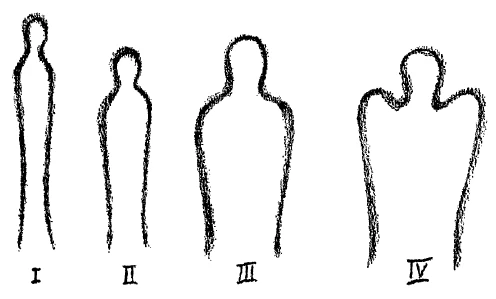
[ 17 ] Was ist das? Das ist auch eine Charakterisierung der vier Temperamente. Die melancholischen Kinder sind in der Regel schlank und dünn; die sanguinischen sind die normalsten; die, welche die Schultern mehr heraus haben, sind die phlegmatischen Kinder; die den untersetzten Bau haben, so daß der Kopf beinah untersinkt im Körper, sind die cholerischen Kinder.
[ 17 ] What is this? This is also a characterization of the four temperaments. Melancholic children are generally slender and thin; sanguine children are the most average in build; those with more prominent shoulders are phlegmatic children; and those with a stocky build, so that their head almost sinks into their body, are choleric children.
[ 18 ] [Bei Michelangelo und Beethoven haben Sie eine Mischung von melancholischem und cholerischem Temperament.]
[ 18 ] [Michelangelo and Beethoven both exhibit a mixture of melancholic and choleric temperaments.]
[ 19 ] Nun bitte ich, durchaus zu berücksichtigen, daß wir, wenn es sich um das Temperament beim Kinde handelt, als Lehrer durchaus nicht berufen sind, die betreffenden Temperamente von vornherein als «Fehler» anzusehen und bekämpfen zu wollen. Wir müssen das Temperament erkennen und uns die Frage stellen: Wie haben wir es zu behandeln, um ein wünschbares Lebensziel mit ihm zu erreichen, so daß aus dem Temperament das Allerbeste wird und die Kinder mit Hilfe des Temperaments das Lebensziel erreichen? Gerade beim cholerischen Temperament würde es ja sehr wenig helfen, wenn wir es austreiben wollten und etwas anderes an seine Stelle setzten. In der Tat geht aus dem Leben und der Leidenschaft des Cholerikers sehr viel hervor, und insbesondere in der Weltgeschichte wäre vieles anders geworden, wenn es nicht die Choleriker gegeben hätte. Aber gerade beim Kind muß man sehen, daß man es trotz seines Temperaments zu entsprechenden Lebenszielen bringt.
[ 19 ] Now I ask that you keep in mind that, when it comes to a child’s temperament, we as teachers are by no means called upon to regard the temperaments in question as “flaws” from the outset and to seek to combat them. We must recognize the temperament and ask ourselves: How should we deal with it in order to achieve a desirable life goal together with the child, so that the very best can come of the temperament and the children can achieve their life goal with the help of their temperament? Particularly in the case of the choleric temperament, it would be of very little help if we tried to suppress it and replace it with something else. In fact, a great deal emerges from the life and passion of the choleric person, and especially in world history, many things would have turned out differently if it weren’t for the choleric individuals. But especially with children, we must ensure that, despite their temperament, they are guided toward appropriate life goals.
[ 20 ] Beim Choleriker sind möglichst zu berücksichtigen erdichtete Situationen, künstlich gebildete Situationen, die man in die Aufmerksamkeitssphäre des Kindes bringt. Man sollte zum Beispiel bei einem tobenden Kind die Aufmerksamkeit auf erdichtete Situationen lenken und diese erdichteten Situationen selbst cholerisch behandeln, so daß ich dem jungen Choleriker zum Beispiel erzähle von einem wilden Kerl, dem ich begegnet bin, den ich ihm vormale wie eine Wirklichkeit. Dann würde ich in Ekstase kommen, würde schildern, wie ich ihn behandle, wie ich ihn beurteile, so daß er die Cholerik an anderem sieht, an Ausgeklügeltem, so daß er die Tat sieht. Dadurch wird man in ihm die Kraft sammeln, daß er auch anderes gut begreifen kann.
[ 20 ] With a choleric child, one should, as much as possible, introduce imaginary situations—artificially created scenarios—into the child’s sphere of attention. For example, when a child is throwing a tantrum, one should direct their attention to fictional situations and react to these fictional situations in a choleric manner oneself, so that I might tell the young choleric child, for instance, about a wild fellow I encountered, whom I describe to them as if he were real. Then I would become animated, describing how I deal with him and how I judge him, so that the child sees the choleric temperament manifested in someone else—in a well-thought-out way—and thus observes the action itself. Through this, the child will develop the inner strength to understand other things well as well.
Jemand ruft dazwischen: Die Szene zwischen Napoleon und seinem Sekretär! Darauf ein anderer: Was ist das?
Someone calls out: “The scene between Napoleon and his secretary!” Another person replies: “What's that?”
[ 21 ] Rudolf Steiner: Da müßte man erst die Baukommission um Erlaubnis fragen! — Diese in der Rede vorgemalte Szene müßte die redende Person so behandeln, daß Cholerisches dabei herauskommt. Das wird immer Kraft sammeln beim cholerischen Kinde, so daß man es dann weiter behandeln kann. Ein Ideal wäre: der cholerischen Gruppe eine Situation vormalen, um auf diese Weise wiederum Kraft gesammelt zu haben. Dann hält es immer ein paar Tage an. Die Kinder werden dann ein paar Tage hindurch gar nicht gehindert sein, die Dinge aufzunehmen. Sonst toben sie innerlich an gegen Dinge, die sie begreifen sollten.
[ 21 ] Rudolf Steiner: First, one would have to ask the building committee for permission! — The speaker should present the scene described in the speech in such a way that it brings out the choleric temperament. This will always help the choleric child gather strength, so that one can then continue working with them. An ideal approach would be to describe a situation to the choleric group so that they, in turn, can gather strength. Then the effect will last for a few days. For a few days, the children will not be hindered at all from taking things in. Otherwise, they will be inwardly rebelling against things they are supposed to understand.
[ 22 ] Nun möchte ich, dass Sie versuchen Folgendes: Von diesem Behandeln der Temperamente sollte etwas bleiben, und da würde ich bitten Fräulein von Mirbach, auf höchstens sechs Seiten eine zusammenfassende Darstellung zu geben von der Eigentümlichkeit der Temperamente und ihrer Behandlung, aufgrund alles dessen, was ich hier besprochen habe, sodass Sie uns vielleicht dies, es braucht nicht schon morgen zu sein -, dass Sie uns eine Art Darstellung gäben.
[ 22 ] Now I would like you to try the following: Something should remain from this discussion of the temperaments, and I would ask Miss von Mirbach to provide, in no more than six pages, a summary of the characteristics of the temperaments and their treatment, based on everything I have discussed here, so that you might—it doesn’t have to be tomorrow—provide us with a kind of summary.
[ 23 ] Dagegen möchte ich bitten Frau Koegel, sich vorzustellen, sie hätte zwei Gruppen vor sich: sanguinische Kinder und melancholische Kinder, und sie sollte so abwechseln mit einer Art Zeichenunterricht, einfache Zeichenmotive, dass das eine Mal gedient wäre den sanguinischen, das andere Mal den melancholischen Kindern.
[ 23 ] On the other hand, I would like to ask Mrs. Koegel to create a mental image in which she has two groups in front of her: sanguine children and melancholic children, and she should alternate between them with a kind of drawing lesson—simple drawing motifs—so that one session would be tailored to the sanguine children and the next to the melancholic children.
[ 24 ] Jetzt möchte ich außerdem noch bitten: Herr Stockmeyer kann machen dieselbe Sache mit dem Zeichnen für phlegmatische und cholerische Kinder, sodass Sie uns dann dies morgen vorführen können, so wie Sie es sich zurechtgelegt haben.
[ 24 ] Now I would also like to ask: Mr. Stockmeyer can do the same thing with drawing for phlegmatic and choleric children, so that you can then demonstrate this to us tomorrow, just as you have planned it.
[ 25 ] Dann würde ich vielleicht Fräulein Herrmann, Fräulein Dr. Heydebrand und Herrn Pastor Geyer bitten, folgende Aufgaben zu behandeln: Sie denken sich, Sie sollen ein und dasselbe Märchen erzählen, zweimal hintereinander, so, dass Sie nicht ganz gleich erzählen, sondern in verschiedene Sätze einkleiden und so weiter. Das erste Mal nehmen Sie mehr Rücksicht auf sanguinische, das zweite Mal auf melancholische Kinder, sodass beide etwas davon haben.
[ 25 ] Then I would perhaps ask Miss Herrmann, Dr. Heydebrand, and Pastor Geyer to tackle the following tasks: Imagine that you are to tell the same fairy tale twice in a row, but not in exactly the same way—instead, rephrase it using different sentences and so on. The first time, you’ll cater more to sanguine children; the second time, to melancholic children, so that both groups benefit.
[ 26 ] Dann würde ich bitten, dass vielleicht Herr Meyer und Herr Dr. Treichler sich mit der schwierigen Aufgabe befassen, die individuelle Beschreibung eines Tieres oder einer Tiergattung zu geben, das eine Mal für cholerische zuzurichten, das andere Mal für phlegmatische Kinder zuzurichten.
[ 26 ] Then I would ask that perhaps Mr. Meyer and Dr. Treichler take on the difficult task of providing an individual description of an animal or animal species—tailored once for choleric children and the other time for phlegmatic children.
[ 27 ] Herr Oehlschlegel, Herr Hahn, und vielleicht hilft auch Herr Baumann mit, die würde ich bitten, einmal die Aufgabe zu lösen, wie man im Rechnen Rücksicht nehmen könnte auf die vier Temperamente, gerade nur im Rechnen.
[ 27 ] Mr. Oehlschlegel, Mr. Hahn, and perhaps Mr. Baumann as well—I would ask them to tackle the problem of how to take the four temperaments into account in arithmetic, specifically in arithmetic.
[ 28 ] Nicht wahr, wenn Sie nun auf solche Dinge wie auf die Temperamente so Ihre Aufmerksamkeit lenken, um darnach die Klasse für den Unterricht einzuteilen, müssen Sie vor allen Dingen darauf Rücksicht nehmen, daß der Mensch als solcher ein fortwährend Werdender ist. Und das ist etwas, was wir uns in unserem Erzieherbewußtsein immerwährend aneignen müssen, daß der Mensch ein fortwährend Werdender ist, daß er Metamorphosen unterliegt im Verlaufe seines Lebens. Und ebensogut wie wir stark reflektieren auf die einzelnen Temperamentsanlagen der einzelnen Kinder, können wir reflektieren auf das Werdende, und können sagen: In der Hauptsache sind alle Kinder Sanguiniker, ob sie auch im einzelnen phlegmatisch oder cholerisch sind. Alle Jünglinge und Jungfrauen sind eigentlich Choleriker, und wenn es nicht so ist, wenn es in dieser Zeit nicht da ist, ist es eine ungesunde Entwickelung. Im Mannes- und Frauenalter ist der Mensch Melancholiker. Und im Greisenalter ist er phlegmatisch.
[ 28 ] Isn't it true that when you focus your attention on things like temperaments in order to divide the class for instruction, you must, above all, take into account that human beings, as such, are constantly in the process of becoming. And this is something we must constantly internalize in our approach to education: that human beings are constantly in the process of becoming, that they undergo metamorphoses over the course of their lives. And just as we reflect deeply on the individual temperamental tendencies of each child, we can reflect on this process of becoming and say: Essentially, all children are sanguine, even if they may individually be phlegmatic or choleric. All young men and women are actually choleric, and if this is not the case—if it is not present at this stage—it indicates an unhealthy development. In adulthood, a person is melancholic. And in old age, they are phlegmatic.
[ 29 ] Das beleuchtet wiederum doch ein wenig die Situation in bezug auf die Temperamente, denn Sie sehen da etwas, was ganz besonders notwendig ist, in unserer jetzigen Zeit zu berücksichtigen. Wir lieben in unserer Jetzigen Zeit, uns starre, fest definierte Begriffe zu machen. In Wirklichkeit geht alles ineinander, so daß man in dem Augenblick, wo man gesagt hat, der Mensch bestehe aus Kopf-, Brust- und Gliedmaßenmensch, sich auch klarmachen muß, daß eben alles ineinandergeht. So ist ein cholerisches Kind nur der Hauptsache nach cholerisch, ein sanguinisches nur der Hauptsache nach sanguinisch und so weiter. Gelegenheit, vollcholerisch zu sein, hat man eigentlich erst im Jünglings- und Jungfrauenalter. Manche bleiben ihr ganzes Leben hindurch Jünglinge, weil sie sich das Jünglingsalter ihr ganzes Leben hindurch bewahren. Nero und Napoleon kamen überhaupt nicht über das Jünglingsalter hinaus. Wir ersehen daraus, wie sich Dinge, die eigentlich im Werden miteinander wechseln, doch wieder im Wechsel ineinanderschieben.
[ 29 ] This, in turn, sheds a little light on the situation regarding the temperaments, for you can see there something that is particularly important to take into account in our present time. In our present time, we love to create rigid, firmly defined concepts for ourselves. In reality, everything is intertwined, so that the moment one says a person consists of a head, chest, and limb, one must also realize that everything is indeed intertwined. Thus, a choleric child is choleric only in the main, a sanguine child is sanguine only in the main, and so on. One actually has the opportunity to be fully choleric only during adolescence. Some remain adolescents their entire lives because they preserve their adolescent state throughout their lives. Nero and Napoleon never progressed beyond adolescence at all. From this we see how things that are actually in a state of becoming—alternating with one another—nevertheless interweave with one another in this alternation.
[ 30 ] Worauf beruht des Dichters, wie überhaupt geistige Produktivität? Worauf beruht es, daß man Dichter werden kann? Darauf, daß man gewisse Eigenschaften des Jünglings- und Kindesalters das ganze Leben hindurch bewahrt. Man hat um so mehr Anlage zur Dichtkunst, je mehr man jung geblieben ist. Es ist in gewissem Sinne ein Unglück für den Menschen, wenn man sich nicht die Möglichkeit bewahrt, gewisse Jugendeigenschaften, ein gewisses Sanguinisches, so für das ganze Leben zu bewahren. Es ist sehr wichtig für den Erzieher, sanguinisch durch Entschluß werden zu können. Das ist außerordentlich wichtig, daß man das als Erzieher berücksichtigt, so daß man diese glückliche Veranlagung des Kindes als etwas ganz Besonderes pflegt.
[ 30 ] What is the basis of the poet’s creativity—and of intellectual productivity in general? What makes it possible for someone to become a poet? It is the fact that one retains certain qualities of youth and childhood throughout one’s entire life. The more one has remained young at heart, the greater one’s aptitude for poetry. In a certain sense, it is a misfortune for a person not to preserve the ability to retain certain youthful qualities—a certain sanguine disposition—for one’s entire life. It is very important for the educator to be able to become sanguine through determination. It is extraordinarily important for educators to take this into account, so that they nurture this fortunate disposition in the child as something truly special.
[ 31 ] Alle produktiven Eigenschaften, alles, worauf das Gedeihen des geistig-kulturellen Gliedes des sozialen Organismus beruhen wird, das werden die jugendlichen Eigenschaften des Menschen sein, das wird gemacht werden von Menschen, die Jugendtemperament bewahrt haben.
[ 31 ] All productive qualities—everything upon which the flourishing of the spiritual-cultural member of the social organism will depend—will be the youthful qualities of human beings; they will be brought about by people who have retained their youthful spirit.
[ 32 ] Alles Wirtschaftliche beruht darauf, daß im Menschen Alterseigenschaften hereinragen, auch wenn wir jung sind. Denn alles wirtschaftliche Urteil beruht auf der Erfahrung. Erfahrung wird nicht besser bewirkt als dadurch, daß in den Menschen gewisse Alterseigenschaften hereinragen, und der Greis ist ja Phlegmatiker. Der Geschäftsmann gedeiht am besten, wenn er in die übrigen Merkmale und Eigenschaften des Menschen ein gewisses Phlegma beigemischt hat, das eigentlich schon ein Greisenhaftes ist. Das ist das Geheimnis sehr vieler Geschäftsleute, daß sie sonst sehr gute Geschäftsleute sind, aber etwas Greisenhaftes beigemischt haben, namentlich in Dispositionen und so weiter. Derjenige, der in der Wirtschaft nur das sanguinische Temperament entwickeln würde, der würde nur zu Jugendprojekten kommen, die nie fertig werden. Der Choleriker, der jünglinghaft geblieben ist, würde sich durch gewisse spätere Maßregeln frühere verderben. Der Melancholiker kann ja sowieso nicht Geschäftsmann werden. Dagegen ist eine harmonische Geschäftsentwickelung mit einer greisenhaften Fähigkeit verbunden, die einen in die Lage versetzt, Erfahrungen aus dem Wirtschaftsleben zu sammeln. Wer Neigung zur Erfahrung hat, der ist stets ein phlegmatischer Greis. Harmonische Temperamente mit Phlegma, das gibt die beste Wirtschaftskonstellation.
[ 32 ] Everything in business is based on the fact that certain characteristics of old age are already present in people, even when we are young. For all business judgment is based on experience. Experience is best acquired when certain characteristics of old age are already present in people, and the elderly are, after all, phlegmatic. A businessman thrives best when he has blended a certain phlegmatic quality—which is, in fact, already a trait of old age—into his other human characteristics and traits. This is the secret of many businesspeople: they are otherwise very good businesspeople, but they have incorporated something of the elderly, particularly in their disposition and so on. Anyone who were to develop only the sanguine temperament in business would end up with nothing but youthful projects that are never completed. The choleric individual who has remained youthful would ruin his earlier endeavors through certain later missteps. The melancholic, after all, cannot become a businessman anyway. In contrast, harmonious business development is linked to a senile capacity that enables one to gather experience from business life. Anyone with a penchant for experience is always a phlegmatic old man. Harmonious temperaments combined with phlegm—that is the best business constellation.
[ 33 ] Sie sehen, daß man, wenn man die Zukunft der Menschheit bedenkt, solche Dinge beachten, Rücksicht darauf nehmen muß. Man ist als dreißigjähriger Dichter oder Maler nicht nur dreißigjähriger Mensch, sondern es haben sich zugleich kindliche, jugendliche Eigenschaften in den Menschen hereingeschoben. Wenn einer produktiv ist, kann man sehen, wie ein Zweiter in ihm lebt, in dem er mehr oder weniger kindlich geblieben ist, in dem das Kindliche in ihn hereingeschoben ist.
[ 33 ] You see that, when considering the future of humanity, one must take such things into account and give them due consideration. As a thirty-year-old poet or painter, one is not merely a thirty-year-old person; at the same time, childlike and youthful qualities have found their way into the person. When someone is productive, one can see how a second self lives within them—one in which they have remained more or less childlike, into which the childlike has found its way.
[ 34 ] Alle diese angeführten Dinge müssen Gegenstand einer neuartigen Psychologie werden.
[ 34 ] All of the things mentioned here must become the subject of a new kind of psychology.