

The Art of Education
GA 295
23 August 1919, Stuttgart
Translate the original German text into any language:
Versions Available:
Dritte Seminarbesprechung
Third Seminar Discussion
Elfriede Herrmann erzählt das Märchen vom «Marienkind» zunächst für melancholische und dann für sanguinische Kinder.
Elfriede Herrmann tells the fairy tale of “Marienkind”—first for melancholic children and then for sanguine ones.
[ 1 ] Rudolf Steiner: Ich meine, Sie werden in Zukunft berücksichtigen müssen, die Sachen artikuliert zu geben. Sie haben die beiden Fassungen in zu gleicher Art vorgebracht. Der Unterschied muß auch in der Artikulation liegen. Wenn Sie diese Details in etwas eindringlicherer Art vorbringen, werden Sie bei melancholischen Kindern den Eindruck nicht verfehlen. Bei Sanguinikern würde ich den Vortrag, besonders am Anfang, etwas mehr mit Zwischenpausen gestalten, so daß das Kind gezwungen ist, die Aufmerksamkeit, die es hat fallen lassen, immer von neuem wieder aufzunehmen.
[ 1 ] Rudolf Steiner: I think you will have to make a point of articulating these things clearly in the future. You presented both versions in the same manner. The difference must also lie in the articulation. If you present these details in a somewhat more forceful manner, you will certainly make an impression on melancholic children. With sanguine children, I would structure the presentation—especially at the beginning—with a few more pauses, so that the child is compelled to repeatedly refocus the attention it has let slip.
[ 2 ] Nun möchte ich aber noch fragen: Wie würden Sie diese Erzählung weiter verwenden, wenn Sie wirklich konkret zu unterrichten hätten? Stellen Sie sich vor, Sie stünden vor Ihrer Klasse, was würden Sie dann tun? — Ich würde Ihnen raten, nachdem Sie die melancholische Fassung vorgebracht haben, sie sich nacherzählen zu lassen von einem sanguinischen Kinde und umgekehrt.
[ 2 ] But now I’d like to ask: How would you use this story in your teaching if you actually had to teach it? Imagine you were standing in front of your class—what would you do? — I would advise you, after presenting the melancholic version, to have a sanguine child retell it—and vice versa.
Caroline von Heydebrand: Ich will vorausschicken, daß ich für ratsam halte, das sanguinische Kind straff vor sich zu setzen und dauernd in der Blickrichtung zu halten, während für die melancholischen Kinder möglichst eine behagliche, gemütliche Stimmung zu erzeugen ist.
Caroline von Heydebrand: I would like to begin by saying that I consider it advisable to seat the sanguine child upright and keep them within your line of sight at all times, while for melancholic children, a comfortable, cozy atmosphere should be created as much as possible.
[ 3 ] Rudolf Steiner: Sehr gut bemerkt.
[ 3 ] Rudolf Steiner: Very well observed.
Caroline von Heydebrand erzählt das Märchen vom «Meerkätzchen» zunächst in der Fassung für das sanguinische und dann für das melancholische Kind und bemerkt dazu, daß die melancholischen Kinder nicht viel Trauriges erzählt haben wollen.
Caroline von Heydebrand tells the fairy tale of the “Little Sea Cat,” first in the version for the sanguine child and then for the melancholic child, noting that melancholic children do not want to hear many sad stories.
[ 4 ] Rudolf Steiner: So etwas kann man berücksichtigen. Aber die Kontrastierung war gut.
[ 4 ] Rudolf Steiner: That’s something to keep in mind. But the contrast was good.
[ 5 ] Nun würde ich meinen, daß noch übergegangen werden muß auf die Art, wie man das nun nach einiger Zeit weiter behandelt. Ich würde am nächsten Tage oder am darauffolgenden Tage nicht das Kind bestimmen, das erzählen soll, sondern ich würde sagen (lebhaft): « Jetzt merkt ihr euch das! Ihr könnt euch wählen, welches ihr euch merken wollt, um es selbst zu erzählen!» Am nächsten oder zweitnächsten Tag würde ich das Kind sich melden lassen.
[ 5 ] Now, I would think we need to move on to how we’ll handle this after some time has passed. The next day or the day after, I wouldn’t single out a specific child to tell the story; instead, I would say (enthusiastically): “Now remember this! You can choose which one you want to remember so you can tell it yourselves!” The next day or the day after that, I would let the children volunteer.
Johannes Geyer erzählt das Märchen vom «Similiberg» in beiden Fassungen.
Johannes Geyer tells the fairy tale of “Similiberg” in both versions.
[ 6 ] Rudolf Steiner: Nicht wahr, Sie haben doch alle das Gefühl, daß solch eine Sache auf verschiedene Weise gemacht werden kann. Nun ist es wirklich von einer großen Bedeutung, daß man sich gerade, wenn man als Lehrer wirken will, die unnötige Kritisiererei abgewöhnt; daß man als Lehrer ein starkes Gefühl dafür entwickelt, daß man sich bewußt wird, es kommt schließlich nicht darauf an, daß man immer auf etwas, was getan wird, etwas Besseres daraufsetzen muß. Eine Sache kann in mannigfaltiger Weise gut sein. Deshalb würde ich es auch für gut halten, wenn dieses hier Vorgebrachte als etwas betrachtet würde, was durchaus so ausgeführt werden kann, wie wir es gehört haben.
[ 6 ] Rudolf Steiner: Don’t you all feel that something like this can be done in various ways? Now it is truly of great importance that, especially if one wishes to work as a teacher, one breaks the habit of unnecessary criticism; that as a teacher one develops a strong sense of the fact that one must realize it does not, after all, matter that one always has to come up with something better than what is being done. A thing can be good in many different ways. That is why I would also consider it a good thing if what has been presented here were regarded as something that can certainly be carried out exactly as we have heard it.
[ 7 ] Ich möchte aber etwas anderes daran knüpfen. Bei allen drei Erzählungen glaube ich eines bemerkt zu haben: das ist, daß immer die erste Fassung auch in ihrer Zielsetzung die bessere war. Was haben Sie, Fräulein A., in Ihrer Seele zuerst ausgebildet, was haben Sie gefühlt, daß Sie besser machen würden?
[ 7 ] But I’d like to add something else to that. In all three stories, I think I’ve noticed one thing: namely, that the first draft was always the better one, even in terms of its intent. What did you, Miss A., first form in your heart; what did you feel you could do better?
Es wird festgestellt, daß die zuerst von Elfriede Herrmann in der Seele ausgebildete Fassung die für das melancholische Temperament war, und daß diese die bessere war.
It is noted that the version first developed by Elfriede Herrmann in *Die Seele* was the one for the melancholic temperament, and that this was the better one.
[ 8 ] Rudolf Steiner: Nun möchte ich empfehlen: arbeiten Sie alle drei auch noch die Fassung für das phlegmatische Kind aus. Das ist von großer Bedeutung für das Stilgemäße der Form. Aber ich bitte Sie, versuchen Sie, womöglich diese Fassung sich heute noch auszuarbeiten, provisorisch, dann darüber zu schlafen und die endgültige Fassung morgen zu beschließen. Es ist eine Erfahrung, daß man, wenn man so etwas machen will, das Umgestaltete nur aus einem anderen Geiste heraus bekommt, wenn man es nach Vorbereitung durch den Schlaf hindurchgehen läßt. Bringen Sie uns am Montag eine Umgestaltung ins Phlegmatische, die Sie aber, bevor Sie die endgültige Ausgestaltung vornehmen, vorbereiten. Das ist ja möglich, weil der Sonntag dazwischen liegt.
[ 8 ] Rudolf Steiner: Now I would like to recommend that all three of you also work out the version for the phlegmatic child. This is of great importance for the stylistic appropriateness of the form. But I ask you to try, if possible, to work out this version today—provisionally—then sleep on it and finalize the version tomorrow. Experience shows that when you want to do something like this, you can only achieve a truly transformed version—one born of a different spirit—if you let it pass through sleep after preparing it. On Monday, bring us a version adapted for the phlegmatic child, but be sure to prepare it before finalizing the details. This is possible, of course, because Sunday lies in between.
Hertha Koegel zeigt eine Zeichnung vor, ein Motiv in Blau-Gelb für ein melancholisches Kind (Farbtafel, Figur 1). Rudolf Steiner zeichnet dazu dasselbe Motiv in Grün-Rot für ein sanguinisches Kind (Farbtafel, Figur 2).
Hertha Koegel presents a drawing—a motif in blue and yellow for a melancholic child (color plate, Figure 1). Rudolf Steiner draws the same motif in green and red for a sanguine child (color plate, Figure 2).
[ 9 ] Da kann man zu den Kindern sprechen: «Das Blau-Gelbe schaut man am besten am Abend an, wenn es dunkel wird, vor dem Einschlafen. Das nehmt ihr auch herein in euren Schlaf, denn das ist die Farbe, womit ihr vor Gott erscheinen könnt. — Das Grün-Rote nehmt ihr vor morgens beim Erwachen, damit könnt ihr nach dem Erwachen leben. An dem erfreut euch den ganzen Tag!»
[ 9 ] There you can say to the children: “The blue and yellow are best viewed in the evening, when it gets dark, before falling asleep. Take that with you into your sleep, for that is the color in which you can appear before God. — Take in the green and red in the morning when you wake up; that is what you can live by after waking up. Rejoice in it all day long!”
Nun zeigt Hertha Koegel eine Zeichnung vor für ein sanguinisches Kind, Rot auf weißem Grund (Farbtafel, Figur 5).
Hertha Koegel now presents a drawing of a sanguine child, red on a white background (color plate, Figure 5).
Rudolf Steiner zeichnet dasselbe Motiv für ein melancholisches Kind, lang und schlank, Blau auf schwarzem Grund (Farbtafel, Figur 6). Die frech vorragende Form heißt er «Kickerling». Beim melancholischen Motiv zieht sie sich einwärts.
Rudolf Steiner draws the same motif for a melancholic child—tall and slender, blue on a black background (color plate, Figure 6). He calls this cheekily protruding form “Kickerling.” In the melancholic motif, it curves inward.
[ 10 ] Nun, sehen Sie, das würde ein solcher Gegensatz sein, daß Sie mehr die Farben benützen würden, um auf das eine Kind und auf das andere zu wirken. Sie müßten doch motivieren, daß Sie zweimal dieselbe Sache vorbringen. Was würden Sie zu den Kindern sagen?
[ 10 ] Well, you see, that would be such a contrast that you would use the colors more to appeal to one child and then to the other. You would have to explain why you’re bringing up the same thing twice. What would you say to the children?
Hertha Koegel: Ich würde fragen, welches ihnen besser gefällt.
Hertha Koegel: I would ask which one you like better.
[ 11 ] Rudolf Steiner: Da würden Sie Ihre eigenen Erfahrungen machen! Das sanguinische Kind würden Sie erkennen an seiner Freude an diesem Farbenkontrast.
[ 11 ] Rudolf Steiner: Then you would have your own experiences! You would recognize the sanguine child by the joy he or she takes in this contrast of colors.
[ 12 ] Natürlich, solche einfache Formen, die sollte man nicht versäumen, für Kinder wirklich zu pflegen.
[ 12 ] Of course, we really shouldn't neglect to cultivate such simple forms for children.
Rudolf Steiner zeichnet dasselbe Motiv für ein melancholisches Kind, lang und schlank, Blau auf schwarzem Grund (Farbtafel II, Figur 6). Die frech vorragende Form heißt er «Kickerling».
Rudolf Steiner draws the same motif for a melancholic child—tall and slender, in blue on a black background (Color Plate II, Figure 6). He calls this cheekily protruding form “Kickerling.”
[ 13 ] Beim melancholischen Motiv zieht sie sich einwärts.
[ 13 ] When the melancholic motif arises, she withdraws into herself.
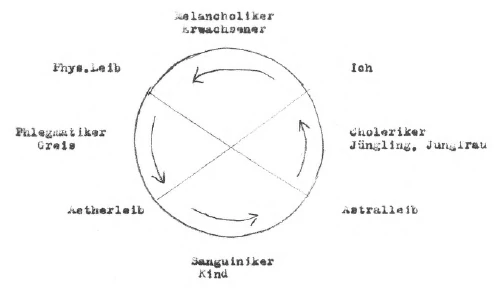
Karl Stockmeyer gibt folgende schematische Übersicht über die vier Temperamente in Bezug zu den vier Gliedern des Menschen und ihre Verschiebung von der Kindheit zum Greisenalter.
Karl Stockmeyer provides the following schematic overview of the four temperaments in relation to the four parts of the human body and their changes from childhood to old age.
Karl Stockmeyer empfiehlt für den Choleriker Formen, die nach außen spitz sind,
Karl Stockmeyer recommends shapes that taper outward for the choleric type,

Für den Phlegmatiker empfiehlt er den umgekehrten Weg: Vom Kreis auszugehen und Figuren einzeichnen zu lassen, oder den Kreis in irgendeiner Weise zu zerschneiden.
For the phlegmatic person, he recommends the opposite approach: starting from the circle and letting figures emerge from it, or cutting the circle apart in some way.

[ 14 ] Rudolf Steiner: Ich würde nun beim phlegmatischen Kinde für diese Methode noch das Folgende anwenden. Ich würde sagen: «Nun sieh einmal, das ist ein Kreis: Nicht wahr, den magst du ganz gerne haben!
[ 14 ] Rudolf Steiner: With a phlegmatic child, I would apply the following to this method. I would say: “Now look, this is a circle: Don’t you really like that one?”
[ 15 ] Aber ich werde dir noch etwas anderes machen: Sieh einmal, ich nehme einfach diese Sachen weg, den Rand, jetzt ist es erst richtig: Du mußt dir angewöhnen, nicht alles mögliche durcheinander zu machen. Versuche das Gleiche von Anfang an zu machen.»
[ 15] But I'm going to do something else for you: Look, I'll just take these things away—the border—now it's right: You have to get into the habit of not mixing everything up. Try to do the same thing from the very beginning.»
[ 16 ] Durch Zeichnen und Auslöschen ist das phlegmatische Kind aus seinem Phlegma herauszureißen.
[ 16 ] Drawing and erasing can help pull the phlegmatic child out of his phlegmatic state.

[ 17 ] Nun würde ich Sie bitten, dieselbe Methode des Beschlafens anzuwenden, und Frau E. bitten, dasselbe Motiv auch für andere Temperamente auszuarbeiten.
[ 17 ] Now I would ask you to apply the same method of inducing sleep, and ask Ms. E. to develop the same approach for other temperaments as well.
Rudolf Meyer beschreibt einen Gorilla in zweierlei Fassung.
Rudolf Meyer describes a gorilla in two different versions.
[ 18 ] Rudolf Steiner: Man kann natürlich das tun, ohne das andere auszuschließen [auf eine Frage von Rudolf Meyer], Es ist natürlich nichts dagegen einzuwenden, dass man auch erfindet, ohne dass man sich anlehnt an bestimmte Naturforscher, von denen man sich zwar anregen lassen kann.
[ 18 ] Rudolf Steiner: Of course, one can do one thing without ruling out the other [in response to a question from Rudolf Meyer]. There is, of course, nothing wrong with inventing things without relying on certain natural scientists, from whom one can, however, draw inspiration.
[ 19 ] Ich möchte Sie jedoch bitten, einen größeren Kontakt mit den Schülern bei einer solchen Erzählung hervorzurufen. Es würde möglich sein, auch eine lange Erzählung zu verwenden und Eindruck damit zu machen. Aber Sie müßten nicht in sich versunken sein, sondern mehr in Kontakt mit den Schülern stehen. Wenn Sie es so versunken machen, könnten Sie den Kontakt vielleicht verlieren.
[ 19 ] However, I would like to ask you to establish greater rapport with the students when telling such a story. It would be possible to use a long story as well and make an impression with it. But you shouldn’t be lost in thought; rather, you should maintain more contact with the students. If you become too absorbed in it, you might lose that connection.
Rudolf Treichler schildert das Pferd für phlegmatische und cholerische Kinder.
Rudolf Treichler describes the horse as suitable for phlegmatic and choleric children.
[ 20 ] Rudolf Steiner: Bei Tierbeschreibungen wird es nun aber ganz besonders wichtig sein, daß wir in jeder Einzelheit besonders ins Auge fassen, daß der Mensch eigentlich das ganze Tierreich ist. Das ausgebreitete Tierreich ist der Mensch. Nicht wahr, solche Ideen kann man den Kindern nicht theoretisch beibringen. Das soll man auch nicht. Aber nehmen wir an, jemand sollte die Sache ausführen, die Herr L. angeschlagen hat, aber den Unterschied machen zwischen Phlegmatiker- und Cholerikergruppe. Die Phlegmatischen werden wenig leicht erfaßbar sein. Und es wird das nicht leicht haften, was Sie mit ihnen durchnehmen über ein bekanntes Tier. Sie haben das Pferd oft gesehen, haben daher nur wenig Interesse dafür. Solche Dinge sollen aber haften. Da würde ich zu den phlegmatischen Kindern sagen: «Seht einmal, wie unterscheidet ihr euch denn eigentlich von einem Pferde? Wir wollen nur kleine Unterschiede nehmen. Nicht wahr, ihr habt alle einen solchen Fuß:
[ 20 ] Rudolf Steiner: When describing animals, however, it will be particularly important that we keep in mind, in every detail, that the human being is, in fact, the entire animal kingdom. The entire animal kingdom is embodied in the human being. After all, such ideas cannot be taught to children in a purely theoretical way. Nor should they be. But let’s suppose someone were to carry out the approach Mr. L. has suggested, while distinguishing between the phlegmatic and choleric groups. The phlegmatics will be difficult to grasp. And what you go over with them using a familiar animal won’t stick easily. They’ve seen horses often, so they have little interest in them. But such things are meant to stick. So I would say to the phlegmatic children: “Look, how do you actually differ from a horse? Let’s just look at small differences. After all, you all have a foot like this:
[ 21 ] Da sind die Zehen, da ist die Ferse, da ist der Mittelfuß. Das ist euer Fuß.
[ 21] There are the toes, there is the heel, there is the midfoot. That is your foot.

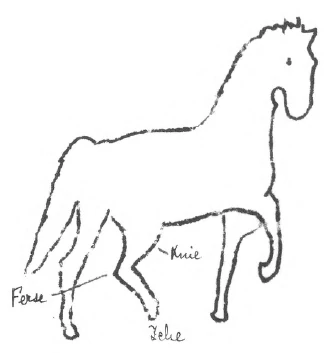
[ 22 ] Jetzt einmal seht ihr euch einmal den Pferdefuß an: Das ist der Hinterfuß vom Pferde. Wo sind die Zehen? Wo ist die Ferse und wo ist der Mittelfuß? Bei euch ist dann weiter herauf das Knie. Wo ist das Knie beim Pferde? Da seht einmal: Da sind die Zehen, die Ferse ist da ganz. oben, das Knie ist da noch weiter oben. Da ist das ganz anders. Nun stellt euch einmal vor, wie anders so ein Pferdefuß aussieht als euer Fuß!» Das wird das phlegmatische Kind in Spannung versetzen, und es wird das schon behalten.
[ 22 ] Now take a look at the horse's foot: that's the horse's hind foot. Where are the toes? Where is the heel, and where is the metatarsus? On your foot, the knee is further up. Where is the knee on a horse? Take a look: there are the toes, the heel is all the way up there, and the knee is even higher up. It’s completely different there. Now create a mental image of how different a horse’s foot looks compared to your foot!” This will capture the phlegmatic child’s attention, and they’ll remember it.
[ 23 ] Bei dem cholerischen Kinde würde ich eine Geschichte erzählen, wie das Kind ganz draußen ein Pferd findet im Walde. Das Pferd läuft, weit hinten läuft der Mann, dem es durchgegangen ist, nach, und das Kind muß das Pferd abfangen beim Zügel. Wenn ich weiß, daß ich ein cholerisches Kind habe, kann ich versuchen, ihm das beizubringen, wie es das machen soll, wie es die Zügel erfaßt. Es in die Phantasie zu versetzen, wie es das Pferd abfängt, das ist sehr gut. Auch das cholerische Kind hat im geheimen etwas Angst vor dieser Prozedur, aber man kommt einem cholerischen Temperament entgegen, wenn man ihm zumutet, das zu tun. Es wird dann etwas beschämt sein, etwas bescheidener. Es ist ihm etwas zugemutet, was man nur einem cholerischen Kinde zumuten kann.
[ 23 ] For a choleric child, I would tell a story about how the child finds a horse all by itself in the woods. The horse is running, and far behind it runs the man whose horse has bolted, and the child must catch the horse by the reins. If I know I’m dealing with a choleric child, I can try to teach them how to do this—how to grab the reins. Helping them imagine catching the horse is very effective. Even the choleric child is secretly a little afraid of this procedure, but you can accommodate a choleric temperament by asking the child to do this. The child will then feel a little ashamed, a little more modest. You’re asking the child to do something that only a choleric child can be asked to do.
[ 24 ] Dann möchte ich bemerken, daß Sie namentlich im Anfang diese Dinge sehr kurz gestalten sollten. Daher würde ich in diesem Falle Herrn M. bitten, seine Erzählung auch für sanguinische und melancholische Kinder auszuführen, aber beide Male furchtbar kurz. Ebenso Herrn L., aber Einzelheiten herauszuheben, die dann bleiben, die dazu dienen, das Kind in Spannung zu versetzen.
[ 24 ] I would like to point out that, especially at the beginning, you should keep these things very brief. Therefore, in this case, I would ask Mr. M. to adapt his story for both sanguine and melancholic children, but to keep it extremely brief both times. The same goes for Mr. L.—he should highlight details that will stick with the children and serve to build suspense.
[ 25 ] Wir müssen uns klar sein, daß wir den Unterrichtsstoff hauptsächlich dazu verwenden, um die Willens-, Gemüts- und Denkfähigkeiten des Kindes zu ergreifen, daß es uns viel weniger darauf ankommt, was das Kind gedächtnismäßig behält, als daß das Kind seine seelischen Fähigkeiten ausgestaltet.
[ 25 ] We must be clear that we use the curriculum primarily to engage the child’s powers of will, emotion, and thought; that what matters to us is not so much what the child retains in memory as the development of the child’s spiritual capacities.
Friedrich Oehlschlegel führt aus, wie man im Rechnen Rücksicht nehmen könnte auf die vier Temperamente, erwähnt aber, daß er mit seiner Aufgabe nicht richtig fertig geworden wäre.
Friedrich Oehlschlegel explains how the four temperaments could be taken into account in arithmetic, but mentions that he was unable to fully complete the task.
[ 26 ] Rudolf Steiner: Das ist etwas, was ich vorausgesehen habe, denn die Aufgabe ist etwas sehr Schwieriges. Sie werden das ganz gründlich beschlafen müssen.
[ 26 ] Rudolf Steiner: That is something I foresaw, because the task is a very difficult one. You will have to think it over very thoroughly.
[ 27 ] Aber nehmen Sie folgendes als neue Aufgabe: Denken Sie sich eine Klasse, in der acht- bis neunjährige Kinder sitzen. Es kommt ja natürlich in dem Unterricht der Zukunft darauf an, daß möglichst viel soziale Instinkte, sozialer Wille, soziales Interesse erzogen werde. Nun denken Sie sich drei Kinder, wovon das eine ausgesprochen phlegmatisch, das andere ausgesprochen cholerisch und das dritte ausgesprochen melancholisch ist. Ich will ihre übrigen Eigenschaften nicht erwähnen. Die kämen in der dritten bis vierten Woche, nachdem der Unterricht begonnen hat, und sagen zu Ihnen: «Mich können alle anderen Kinder nicht leiden!» Diese werden sich nun gleichsam erweisen als die Aschenbrödel, denen gegenüber sich die andere Klasse etwas ablehnend verhält, die gepufft werden, die man stößt, die man überall zurücksetzt. — Ich möchte Sie bitten, bis Montag darüber nachzudenken, wie der Erzieher versuchen wird, diesem Übel am besten abzuhelfen. Wie man diese Kinder zu beliebten Kindern machen könne, das ist eine wichtige Aufgabe für die ganze Erziehung. Ich bitte Sie, das recht geistvoll durchzudenken, und das als eine sehr wichtige pädagogische Aufgabe zu betrachten.
[ 27 ] But try this as a new exercise: Imagine a classroom filled with eight- to nine-year-old children. Of course, the key to the education of the future is to cultivate as much social instinct, social will, and social interest as possible. Now imagine three children, one of whom is decidedly phlegmatic, another decidedly choleric, and the third decidedly melancholic. I won’t mention their other characteristics. They’ll come to you in the third or fourth week after classes have begun and say, “None of the other children like me!” These children will, so to speak, turn out to be the Cinderellas—toward whom the rest of the class behaves somewhat dismissively, who are pushed around, shoved, and left behind in everything. — I would ask you to think about this until Monday: how the teacher will best try to remedy this problem. Figuring out how to make these children well-liked is an important task for the entire educational process. I ask you to think this through very carefully and to regard it as a very important pedagogical task.