

The Art of Education
GA 295
23 August 1919, Stuttgart
Translated by Steiner Online Library
Third Seminar Discussion
Elfriede Herrmann tells the fairy tale of “Marienkind”—first for melancholic children and then for sanguine ones.
[ 1 ] Rudolf Steiner: I think you will have to make a point of articulating these things clearly in the future. You presented both versions in the same manner. The difference must also lie in the articulation. If you present these details in a somewhat more forceful manner, you will certainly make an impression on melancholic children. With sanguine children, I would structure the presentation—especially at the beginning—with a few more pauses, so that the child is compelled to repeatedly refocus the attention it has let slip.
[ 2 ] But now I’d like to ask: How would you use this story in your teaching if you actually had to teach it? Imagine you were standing in front of your class—what would you do? — I would advise you, after presenting the melancholic version, to have a sanguine child retell it—and vice versa.
Caroline von Heydebrand: I would like to begin by saying that I consider it advisable to seat the sanguine child upright and keep them within your line of sight at all times, while for melancholic children, a comfortable, cozy atmosphere should be created as much as possible.
[ 3 ] Rudolf Steiner: Very well observed.
Caroline von Heydebrand tells the fairy tale of the “Little Sea Cat,” first in the version for the sanguine child and then for the melancholic child, noting that melancholic children do not want to hear many sad stories.
[ 4 ] Rudolf Steiner: That’s something to keep in mind. But the contrast was good.
[ 5 ] Now, I would think we need to move on to how we’ll handle this after some time has passed. The next day or the day after, I wouldn’t single out a specific child to tell the story; instead, I would say (enthusiastically): “Now remember this! You can choose which one you want to remember so you can tell it yourselves!” The next day or the day after that, I would let the children volunteer.
Johannes Geyer tells the fairy tale of “Similiberg” in both versions.
[ 6 ] Rudolf Steiner: Don’t you all feel that something like this can be done in various ways? Now it is truly of great importance that, especially if one wishes to work as a teacher, one breaks the habit of unnecessary criticism; that as a teacher one develops a strong sense of the fact that one must realize it does not, after all, matter that one always has to come up with something better than what is being done. A thing can be good in many different ways. That is why I would also consider it a good thing if what has been presented here were regarded as something that can certainly be carried out exactly as we have heard it.
[ 7 ] But I’d like to add something else to that. In all three stories, I think I’ve noticed one thing: namely, that the first draft was always the better one, even in terms of its intent. What did you, Miss A., first form in your heart; what did you feel you could do better?
It is noted that the version first developed by Elfriede Herrmann in *Die Seele* was the one for the melancholic temperament, and that this was the better one.
[ 8 ] Rudolf Steiner: Now I would like to recommend that all three of you also work out the version for the phlegmatic child. This is of great importance for the stylistic appropriateness of the form. But I ask you to try, if possible, to work out this version today—provisionally—then sleep on it and finalize the version tomorrow. Experience shows that when you want to do something like this, you can only achieve a truly transformed version—one born of a different spirit—if you let it pass through sleep after preparing it. On Monday, bring us a version adapted for the phlegmatic child, but be sure to prepare it before finalizing the details. This is possible, of course, because Sunday lies in between.
Hertha Koegel presents a drawing—a motif in blue and yellow for a melancholic child (color plate, Figure 1). Rudolf Steiner draws the same motif in green and red for a sanguine child (color plate, Figure 2).
[ 9 ] There you can say to the children: “The blue and yellow are best viewed in the evening, when it gets dark, before falling asleep. Take that with you into your sleep, for that is the color in which you can appear before God. — Take in the green and red in the morning when you wake up; that is what you can live by after waking up. Rejoice in it all day long!”
Hertha Koegel now presents a drawing of a sanguine child, red on a white background (color plate, Figure 5).
Rudolf Steiner draws the same motif for a melancholic child—tall and slender, blue on a black background (color plate, Figure 6). He calls this cheekily protruding form “Kickerling.” In the melancholic motif, it curves inward.
[ 10 ] Well, you see, that would be such a contrast that you would use the colors more to appeal to one child and then to the other. You would have to explain why you’re bringing up the same thing twice. What would you say to the children?
Hertha Koegel: I would ask which one you like better.
[ 11 ] Rudolf Steiner: Then you would have your own experiences! You would recognize the sanguine child by the joy he or she takes in this contrast of colors.
[ 12 ] Of course, we really shouldn't neglect to cultivate such simple forms for children.
Rudolf Steiner draws the same motif for a melancholic child—tall and slender, in blue on a black background (Color Plate II, Figure 6). He calls this cheekily protruding form “Kickerling.”
[ 13 ] When the melancholic motif arises, she withdraws into herself.
Karl Stockmeyer provides the following schematic overview of the four temperaments in relation to the four parts of the human body and their changes from childhood to old age.
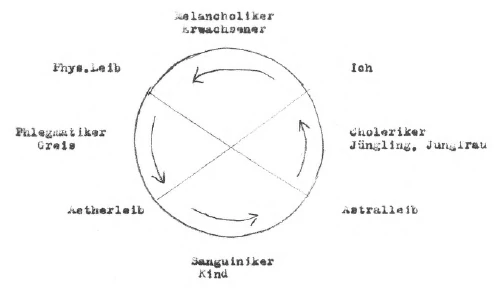
Karl Stockmeyer recommends shapes that taper outward for the choleric type,

For the phlegmatic person, he recommends the opposite approach: starting from the circle and letting figures emerge from it, or cutting the circle apart in some way.

[ 14 ] Rudolf Steiner: With a phlegmatic child, I would apply the following to this method. I would say: “Now look, this is a circle: Don’t you really like that one?”
[ 15] But I'm going to do something else for you: Look, I'll just take these things away—the border—now it's right: You have to get into the habit of not mixing everything up. Try to do the same thing from the very beginning.»
[ 16 ] Drawing and erasing can help pull the phlegmatic child out of his phlegmatic state.

[ 17 ] Now I would ask you to apply the same method of inducing sleep, and ask Ms. E. to develop the same approach for other temperaments as well.
Rudolf Meyer describes a gorilla in two different versions.
[ 18 ] Rudolf Steiner: Of course, one can do one thing without ruling out the other [in response to a question from Rudolf Meyer]. There is, of course, nothing wrong with inventing things without relying on certain natural scientists, from whom one can, however, draw inspiration.
[ 19 ] However, I would like to ask you to establish greater rapport with the students when telling such a story. It would be possible to use a long story as well and make an impression with it. But you shouldn’t be lost in thought; rather, you should maintain more contact with the students. If you become too absorbed in it, you might lose that connection.
Rudolf Treichler describes the horse as suitable for phlegmatic and choleric children.
[ 20 ] Rudolf Steiner: When describing animals, however, it will be particularly important that we keep in mind, in every detail, that the human being is, in fact, the entire animal kingdom. The entire animal kingdom is embodied in the human being. After all, such ideas cannot be taught to children in a purely theoretical way. Nor should they be. But let’s suppose someone were to carry out the approach Mr. L. has suggested, while distinguishing between the phlegmatic and choleric groups. The phlegmatics will be difficult to grasp. And what you go over with them using a familiar animal won’t stick easily. They’ve seen horses often, so they have little interest in them. But such things are meant to stick. So I would say to the phlegmatic children: “Look, how do you actually differ from a horse? Let’s just look at small differences. After all, you all have a foot like this:
[ 21] There are the toes, there is the heel, there is the midfoot. That is your foot.

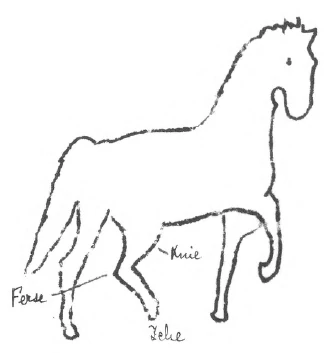
[ 22 ] Now take a look at the horse's foot: that's the horse's hind foot. Where are the toes? Where is the heel, and where is the metatarsus? On your foot, the knee is further up. Where is the knee on a horse? Take a look: there are the toes, the heel is all the way up there, and the knee is even higher up. It’s completely different there. Now create a mental image of how different a horse’s foot looks compared to your foot!” This will capture the phlegmatic child’s attention, and they’ll remember it.
[ 23 ] For a choleric child, I would tell a story about how the child finds a horse all by itself in the woods. The horse is running, and far behind it runs the man whose horse has bolted, and the child must catch the horse by the reins. If I know I’m dealing with a choleric child, I can try to teach them how to do this—how to grab the reins. Helping them imagine catching the horse is very effective. Even the choleric child is secretly a little afraid of this procedure, but you can accommodate a choleric temperament by asking the child to do this. The child will then feel a little ashamed, a little more modest. You’re asking the child to do something that only a choleric child can be asked to do.
[ 24 ] I would like to point out that, especially at the beginning, you should keep these things very brief. Therefore, in this case, I would ask Mr. M. to adapt his story for both sanguine and melancholic children, but to keep it extremely brief both times. The same goes for Mr. L.—he should highlight details that will stick with the children and serve to build suspense.
[ 25 ] We must be clear that we use the curriculum primarily to engage the child’s powers of will, emotion, and thought; that what matters to us is not so much what the child retains in memory as the development of the child’s spiritual capacities.
Friedrich Oehlschlegel explains how the four temperaments could be taken into account in arithmetic, but mentions that he was unable to fully complete the task.
[ 26 ] Rudolf Steiner: That is something I foresaw, because the task is a very difficult one. You will have to think it over very thoroughly.
[ 27 ] But try this as a new exercise: Imagine a classroom filled with eight- to nine-year-old children. Of course, the key to the education of the future is to cultivate as much social instinct, social will, and social interest as possible. Now imagine three children, one of whom is decidedly phlegmatic, another decidedly choleric, and the third decidedly melancholic. I won’t mention their other characteristics. They’ll come to you in the third or fourth week after classes have begun and say, “None of the other children like me!” These children will, so to speak, turn out to be the Cinderellas—toward whom the rest of the class behaves somewhat dismissively, who are pushed around, shoved, and left behind in everything. — I would ask you to think about this until Monday: how the teacher will best try to remedy this problem. Figuring out how to make these children well-liked is an important task for the entire educational process. I ask you to think this through very carefully and to regard it as a very important pedagogical task.