

The Art of Education
GA 295
25 August 1919, Stuttgart
Translated by Steiner Online Library
Fourth Seminar Discussion
[ 1 ] Rudolf Steiner: We will now continue with the task we have set for ourselves and move on to what Mr. N. has to say about teaching arithmetic from the perspective of children’s temperaments. The focus will be more on the approach to teaching arithmetic.
Herbert Hahn demonstrates how to make a break clear by breaking a piece of chalk.
[ 2 ] Rudolf Steiner: I’d just like to point out one thing to start with: for example, I wouldn’t use chalk because it’s a shame to break it. I’d choose something less valuable. A piece of wood or something like that would be enough, wouldn’t it? It is not good to get children used to breaking useful objects at an early age,
Herbert Hahn asks whether, if a child does not maintain a completely vertical posture—that is, does not stand up straight—this might make it more difficult for the child to perceive spatial and geometric shapes.
[ 3 ] Rudolf Steiner: To a remarkable degree, this is not the case. In such matters, the tendencies according to which the human organism is structured are far more important than the structure of individual human personalities. I once encountered particularly strong opposition to this after a lecture in Munich, where I explained that it is of some significance for the human constitution that the spine lies in the line of the Earth’s diameter, whereas the animal’s spine is horizontal in relation to it. Afterward, a learned physician from Karlsruhe came up to me and argued that when a person sleeps, their spine is, after all, in a horizontal line! — So I said: What matters is not whether a human being can place their spine in various positions, but rather that the entire human structure is architecturally arranged in such a way that their spine is vertical in the normal posture, even if they can also place it in slanted or other positions. — If you did not take this into account, you would never be able to understand how certain orientations for the human senses—which are still present in the intellect—nonetheless occur, for example, in people born blind. Human beings are constituted in such a way that their intellect tends toward the eye, so that even in people born blind, one can still evoke mental images directed toward the eye, provided the person is of a nature similar to, for example, the blind Helen Keller. What matters is the tendency, the general predispositions of the human organism, not what accidental circumstances may bring about.
[ 4 ] I would like to add the following to Mr. Hahn’s remarks. It is less important that we criticize these things, because that can always be done. What matters is that such issues are raised, and that we try to understand them.
[ 5 ] Let’s start with addition—specifically, the way we understand it. Suppose I have some beans or a small pile of elderberry berries. For the sake of this example, I’ll assume that the children already know how to count, which is something they still have to learn. The child counts: there are 27. — “27,” I say, “that’s the sum.” We start with the sum, not the addends! You can explore the psychological significance of this in my theory of knowledge. We now divide this sum into addends, into parts, or into little piles. One pile of elderberry berries, let’s say 12; then another pile, let’s say 7; then another, let’s say 3; then another, let’s say 5. Then we will have used up all the elderberries: \(27 = 12 + 7 + 3 + 5\). After all, we are performing the calculation starting from the sum of 27. I now have a number of children with a distinctly phlegmatic temperament perform this process. People will gradually realize that this method of addition is particularly well-suited for phlegmatic children. — Then, since the process can be retraced, I will call on choleric children and have them throw the elderberries together again, but in such a way that they are arranged as follows: 5, 3, 7, and 12 equal 27.
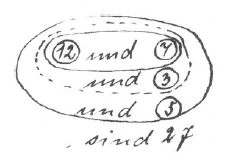
[ 6 ] So the choleric child does the opposite. Addition is particularly the preferred method of calculation for phlegmatic children.
[ 7 ] Now I pick out one of the melancholic children. I say, “Here’s a handful of elderberries; count them!” The child counts them out—let’s say 8. “See, I don’t want 8; I only want 3. How many of the elderberries have to be set aside so that I get only 3?” Then it will turn out that 5 have to be taken away. Subtraction in this form is primarily the way melancholic children do math. — Now I call on a sanguine child and have them do the calculation in reverse. Now I say: “What was taken away?” And I have the child tell me: If I take 5 away from 8, I’m left with 3. — I have the sanguine child perform the reverse calculation again. I just want to say that subtraction—but carried out the way we do it—is “preferably” for melancholic children.
[ 8 ] Now I’ll pick a child from the group of sanguine types. I’ll toss out a number of elderberry beads again, but I’ll make sure it works out somehow. After all, I have to set it up that way; otherwise, the exercise would turn into simple arithmetic too quickly. So, now I have them count: 56 elderberry pellets. — “Well, look at that—I have 8 elderberry pellets here. Now you have to tell me how many times the 8 elderberry pellets fit into the 56.” You see, the multiplication leads to a division. The result is 7. Now I have the melancholic child reverse the calculation and say: “But now I don’t want to examine how many times 8 is contained in 56, but rather how many times is 7 contained in 56? How many times does 7 come up?” I always have the reverse calculation performed by the child with the opposite temperament.
[ 9 ] To the choleric child, I first present division—from the smaller to the larger—by saying: “Look, here you have a pile of 8. Now I want you to tell me what number contains 8 seven times.” And he must figure out: 56; a pile of 56. Then I have the phlegmatic child perform the reverse, the usual division. For the choleric child, I apply division in this form. For in this form, it is specifically the method of calculation used by choleric children.
[ 10 ] In this way, by consistently applying this method, I am able to use the four types of arithmetic to correspond to the four temperaments: addition corresponds to the phlegmatic, subtraction to the melancholic, multiplication to the sanguine, and division—with the return to the dividend—to the choleric. — This is what I ask you to keep in mind following what Mr. N. has said.
[ 11 ] It is particularly important not to plod along monotonously—spending half a year just adding, then subtracting, and so on—but rather, we will work through these four types of arithmetic one after another, as quickly as possible, and then practice all four! At first, just up to about 40. In this way, we will teach arithmetic not according to the usual lesson plan, but so that, through practice, these four operations are mastered almost simultaneously. You will find that this approach is very efficient, and that it allows the children to integrate the concepts into one another. — After all, division is related to subtraction, and multiplication is really just repeated addition. So you can also switch things up and, for example, introduce subtraction to the hot-tempered child.
Alexander Strakosch suggests starting with stereometry.
[ 12 ] Rudolf Steiner: For adults, one can start with bodies, but why do you feel the need to start with the body when it comes to children and then move on to the plane? You see, spatial concepts are generally confusing—very confusing, especially for a child. It is not easy to teach a child anything other than a very vague mental image of space. Even the child’s imagination suffers when one expects the child to immediately visualize solid objects.
[ 13 ] They assume that the body is the concrete and the line is the abstract; that is not the case. A triangle, as such, is already quite concrete; it is, in and of itself, something in space. The child perceives things primarily as flat surfaces. It feels overwhelmed when it is expected to enter the third dimension—the dimension of depth. If the child is to use its imagination to visualize a solid, it must already possess the elements for this mental image beforehand. It must actually already be able to visualize the line and the triangle before it can, for example, visualize the tetrahedron. It is better if the child already has a real mental image of the triangle. The triangle is a thing in itself; it is not merely an abstraction from the body. I would suggest that geometry should not be taught first as stereometry, but rather as planimetry—the study of figures and the planes between them—which is highly desirable because it can support what the child naturally wants to focus their understanding on, including through the integration of geometry with art classes. A child will be able to draw a triangle relatively soon, and one should not wait too long to have the child trace what they are observing geometrically.
Hertha Koegel presents yesterday's sign motif today for a choleric child (color plate, Figure 3) and for a phlegmatic child.
[ 14 ] Rudolf Steiner: For the choleric child, this is a very good motif. For the phlegmatic child, I would prefer to make the design speckled—that is, I would prefer a checkered pattern like this for the phlegmatic child (color chart, Figure 4). What you have here is one possibility, but it does not draw the phlegmatic child’s attention enough.
Stockmeyer then provides drawings of the melancholic and the sanguine child.
[ 15 ] Rudolf Steiner: With this method, it is worth considering that one could certainly accommodate the sanguine and melancholic child by placing great emphasis on repetition—and varied repetition—with the sanguine child. Perhaps one could have the sanguine child draw a motif like this:

[ 16 ] Then three more of those things:

[ 17 ] Then, once again:

[ 18 ] so that much of it amounts to repetition.
[ 19 ] With a melancholic child, it would be good to pay attention to what triggers their reflection. Let’s assume that the melancholic child first creates a shape like this (drawing a) and then its counterpart (drawing b), so that they complement each other.

[ 20 ] This stimulates the imagination. I’ll hatch what is the original form (a), and the opposite form (b) like this. What is hatched here as (a) would be empty here as (b). If you imagine filling in the empty space, you would get this form (a) again. Thus, the outer forms (b) are opposites of the inner forms (a). — So here you have the opposite of those drawings where repetition occurs. Here is something that is conceptual, united with visual perception for the melancholic child. And where repetition occurs—with tendrils and so on—that is for the sanguine child.
Elfriede Herrmann tells the fairy tale of “Marienkind” in a version for phlegmatic children.
[ 21 ] Rudolf Steiner: It would be important to get used to well-articulated language and thus help the children move away from dialect. Dr. Steiner will give a presentation.
Caroline von Heydebrand tells the fairy tale of the “Little Sea Kitten” in a version for laid-back children.
[ 22 ] Rudolf Steiner: I would simply advise that, in such a case, you also try to use supplementary storytelling techniques. Especially with a phlegmatic child, I would often pause in the middle of a sentence, then look at the children, and then take advantage of the fact that their imagination continues to work. Stir up their curiosity at key moments so that they think a little further ahead and imagine things for themselves: “The king’s daughter—she was—very beautiful—but—not so good!” This approach is particularly effective for phlegmatic children.
Johannes Geyer tells the “Sesame Fairy Tale” for phlegmatic people.
[ 23 ] Rudolf Steiner: Make use of the element of surprise, the element of curiosity.
Rudolf Treichler tells a story for sanguine children about a horse, a donkey, and a camel. Which do you like better, the horse or the donkey?
[ 24 ] Rudolf Steiner: Some melancholic children will prefer the donkey. — Yes, my only request regarding these descriptions of animals would be to take care, as much as possible, to guide the child toward observing the animals, so that such descriptions might contain genuine natural history.
Rudolf Meyer describes, for sanguine and melancholic types, a monkey that fled into the roof trusses.
[ 25 ] Rudolf Steiner: Yes, that might make quite a good impression on the melancholic under certain circumstances, but even there I think there is still some work to be done to ensure that the observation of animals as such is encouraged.
[ 26 ] I would just like to note that the child’s “temperament” should not be overlooked, but that one should take the first three to five weeks to observe the students’ temperaments and then divide them into groups as we have discussed here.
[ 27 ] You would do well to also consider the extremes of temperament. Based on his worldview, Goethe coined the beautiful idea that one can study the normal by examining the abnormal. Goethe looks at an abnormal plant, a malformed plant, and through the nature of the malformation he comes to understand what is normal. In the same way, one can draw connections from what is entirely normal to the malformations of the physical-psychic being, and you yourself will find the line leading from the temperaments to the abnormal soul being.
[ 28 ] When the melancholic temperament degenerates abnormally and does not remain within the bounds of the psyche but spills over into the physical realm, madness ensues. Insanity is the degeneration of the essentially melancholic temperament. The degeneration of the phlegmatic temperament is feeble-mindedness or stupidity. The degeneration of the sanguine temperament is folly. The degeneration of the choleric temperament is rage. You will sometimes see such outbursts of madness, feeble-mindedness, folly, and rage arise from perfectly normal mental states when a person is in the grip of emotion. It is indeed necessary to attune oneself to the observation of the entire life of the soul.
[ 29 ] Now let’s move on to the other task. I asked what our friends would do if, with the eight- to nine-year-old children in front of them, they observed that three to four weeks after school started, a phlegmatic child, a choleric child, and a melancholic child became, so to speak, the three Cinderellas of the class—that they were shunned by everyone, that no one wanted to associate with them, and so on. So, if that were to happen, how would the teachers and educators respond to this?
Friedrich Oehlschlegel and Caroline von Heydebrand comment on this, followed by Elfriede Hermann, Rudolf Meyer, and Leonie von Mirbach.
[ 30 ] Rudolf Steiner: Never let children tattle on one another; instead, find out in some other way what is causing their “Cinderella” situation. The children themselves are not necessarily to blame.
[ 31 ] You see, one often finds oneself in the position of having to help with raising children. When children start getting into all sorts of mischief, mothers and fathers come and say, for example: “My child is lying.”—Well, one would hardly go wrong in giving the following advice. One says: Think up a scenario, a story in which a child who lies is led to the point of absurdity, such that the child’s own lie leads them into a situation they must recognize as unreasonable. If you tell the child one such story, then another, and then yet another of that sort, you will usually cure the child of their tendency to lie.
Now, drawing on the story of the three Cinderellas, Rudolf Steiner observes the following:
[ 32 ] In a similar vein, I think you could remedy the situation by compiling the various things that were said today about the three Cinderellas—along with everything you can find out and learn about these children—into a story that you would then present to the entire class. This would serve to offer the three Cinderellas some comfort and make the others feel a little ashamed. If you achieve this, you will likely succeed right from the start, and if you repeat it a second time, you will surely once again foster a sense of social harmony and mutual sympathy among the children. Such a story is very difficult to create. However, a rough draft should be completed by the end of the seminar.
[ 33 ] Tomorrow, there will be another situation—one that actually happens—and it certainly won’t be resolved by telling a story that comforts some children while shaming others.
[ 34 ] Imagine you have a class of relatively young children, eight to nine years old, and one of these little ones has picked up a particularly naughty habit. Things like that happen. He picked it up outside, and he managed to get the whole class to do it, so that the entire class is engaging in this misbehavior during recess.
[ 35 ] A rigid schoolteacher will end up punishing the entire class. But I hope you’ll come up with a somewhat more rational—that is, more effective—method by tomorrow. Because this old way of punishing puts the teacher in a difficult position. With corporal punishment and detention, there’s always something left unresolved. It’s not good when something remains unresolved.
[ 36 ] I have a specific case in mind that actually happened, and in which the teacher in question did not handle the situation very well: The little kid had managed—and succeeded—to spit on the ceiling of the room. It took the teacher a very long time to figure it out. It was impossible to single anyone out, because everyone had copied him, and the entire classroom was a mess.
[ 37 ] Please think through this moral dilemma by tomorrow. In general, you know only that the entire class has been infected. You must not assume that you know from the outset who the instigator is. You will have to consider whether it might not be better to refrain from identifying the culprit through denunciation.
[ 38 ] How would you respond to that?