

The Art of Education
GA 295
26 August 1919, Stuttgart
Translated by Steiner Online Library
Fifth Seminar Discussion
[ 1 ] Rudolf Steiner: It is truly of great importance that we also make a point of speaking clearly in our everyday lives. It has a certain influence, a certain effect. Now, on another occasion, I once formulated some sentences that are designed less to convey a particularly deep meaning than to set the speech organs in motion in a natural, organic way—and to move them in all directions. I would now like you, without any hesitation, to pass these sentences around so that everyone can repeat them, so that by practicing them frequently, we can make our speech organs supple—as it were, put them through a form of exercise. Dr. Steiner will recite these phrases correctly, and I ask each participant to repeat them afterward. These phrases are not designed for understanding or meaning, but rather for exercising the speech organs.
[ 2 ] We must not praise him for lying to you
[ 3 ] In actual conversation, it isn't pronounced that way, but for now, you should focus on the syllables and say each letter one at a time.
[ 4 ] Don't take nuns to tireless mills
[ 5 ] The “n” keeps coming back, but in different combinations, and that's when the vocal apparatus works just right. This is also evident in the way two “n”s come together; the “m”s linger longer in “nimm.” Long “i,” short “i.”
[ 6 ] Guess several of my riddles correctly
[ 7 ] This is how the organs engage in proper gymnastic activity. I would recommend that you pay particular attention to really immersing yourself in the sounds, in the syllables—to truly grow into them—and to be genuinely mindful of this clear process of growing into them, so that you are aware: you are pronouncing every sound. You bring every single sound into your consciousness. That is, after all, the weakness one very often has in speech—that one skips over sounds—whereas speech is meant to be understood and should sound more like this: one initially emphasizes syllables in a somewhat exaggerated way that are not normally emphasized at all. Actors practice saying not “Freunderl” but “Freunderl.” So pronounce every letter with full awareness! It would even be good for you to practice such exercises, even if not as regularly as Demosthenes did. As you know, when he could no longer speak, he placed small stones on his tongue and, through practice, strengthened his voice to the point that it drowned out the roar of the river, in order to master a way of speaking in which he could be heard by the Athenians.
[ 8 ] Now I would like to ask Miss B. to explain the concept of temperaments to us. Since we want to tailor our instruction to the individual, it is appropriate that we pay particular attention to the concept of temperaments. Of course, when teaching a class, it is not possible to tailor instruction to each individual child. But a great deal of individualization occurs simply because, on the one hand, you have, let’s say, phlegmatic and melancholic children, and on the other, sanguine and choleric children; and by engaging them in a lively mix—sometimes involving these, sometimes those—sometimes turning to the group with that temperament, and again prioritizing the others in your responses—addressing one group with this, the other with that—individualization naturally takes place in the class.
Leonie von Mirbach provides her summary of the temperaments and their treatment.
Characteristics and Treatment of the Four Temperaments in Children
General Information
Within the diversity of children’s temperaments, four distinct groups can be identified: the sanguine, phlegmatic, choleric, and melancholic temperaments. These four groups must be distinguished from one another in the classroom. For only by addressing their unique abilities, weaknesses, and needs separately will it be possible to design and tailor instruction in a fruitful and individualized manner. Furthermore, grouping children of the same temperament type provides a natural means of fostering harmony among the individual temperaments within a group and among all temperament groups. In fact, a significant harmonization of the various character dispositions can be achieved in this way by the age of 14, provided this external measure is supplemented by the teacher’s precise knowledge of the four temperaments and a methodical approach based on that knowledge.
[...]
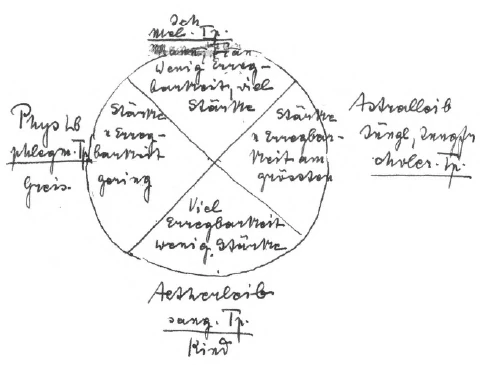
When we spoke earlier of harmonizing the temperamental dispositions, we did not, of course, mean suppressing them, but rather bringing their unique potential to fruition. For it is not a matter of building a character from scratch, but rather of remodeling and expanding it—and this can only succeed by delving into the distinctive nature of the four temperaments.
We will therefore proceed to examine the specific characteristics and treatment of the four temperaments.
[...]
What the sanguine child does naturally, instruction must first bring about in the melancholic child—namely, an orientation toward the outside world. The teacher must repeatedly and unobtrusively direct such a child’s attention to the environment in order to draw the child out of itself, so to speak. If this is achieved, then the child’s will—whose weakness is interrelated with their limited interest in the outside world—will simultaneously grow stronger. Of course, this alone is not enough; direct training of the will through frequently repeated actions must also be added in order not only to open the melancholic child up to the environment but also to integrate them into it in a fruitful way.
The particular obstacle that arises for the melancholic temperament from the delusion of being and experiencing something entirely unique can be effectively countered by reading biographies of great men and by consciously placing oneself within the universal context of nature.
[...]
[ 9 ] Rudolf Steiner: That is your explanation. Well, what has been said here in conversation is very well put. But perhaps you are going too far when you go so far as to claim that the melancholic temperament tends toward pronounced piety. The only thing missing here is the little word “often.” But it can certainly also be the case that the melancholic disposition in children is based on pronounced selfishness, and that it is by no means a religious inclination. In adults, one can omit the word “often”; in young children, the melancholic disposition is very often a mask for pronounced selfishness. — Melancholic children are often influenced by the weather; this tendency also manifests itself in melancholic children. The sanguine child is also influenced by the weather, but in terms of mood, more emotionally, whereas the melancholic child is influenced by it more physically and unconsciously.
[ 10 ] If I were to discuss this question in depth from a Spiritual Science perspective, I would have to show you how, in particular, a child’s temperament fits into karma—how something truly emerges in the child’s temperament that can be described as a consequence of experiences in a previous earthly existence. Let’s take, for example, a person who, in one lifetime, must take a very strong interest in himself. Simply because he is lonely, he must take an interest in himself. Because they must very often occupy themselves with themselves, they are thus placed in a position—compelled by circumstances—to shape the soul within the structure of their physical being, and they carry into their next incarnation a very strongly developed physical constitution in relation to their interaction with the outside world. He becomes a sanguine type. Consequently, if someone is forced into solitude by his incarnation and would otherwise have been held back, he compensates for this in his next incarnation by being a sanguine type who is attentive to everything. We must not, of course, view karma from a moral perspective; we must view it causally. The fact that he can become a sanguine person, reliant on observing the external world, can indeed be a great benefit to life if he is brought up in the right way. Temperament is, after all, closely linked to the general antecedents of the human being, of the human emotional life.
[ 11 ] Karl Stockmeyer asks what underlies the shift in temperaments over the course of a person's life, from youth to adulthood.
[ 12 ] Rudolf Steiner: If you recall a series of lectures I once gave in Kassel, “The Gospel of John in Relation to the Other Three Gospels,” you will find remarks in it about a child’s relationship to its parents. You will find it explained there how the paternal principle continues to exert a very strong influence in the physical body and in the “I,” and how the maternal principle predominates in the etheric and astral bodies. Goethe sensed this when he made the beautiful statement:
I got my build from my father—in terms of my physical body
Living Life Seriously—As It Relates to the Self
From “The Cheerful Little Mother”—What Is Bound to the Etheric Body
And a desire to spin tales—which is bound to the astral body.
[ 13 ] There is actually quite extraordinary wisdom in these words. You can see that what is actually within the human being is blended together in a remarkable way. The human being is, after all, a thoroughly complex entity. There is a certain relationship between the “I” and the physical body, and a relationship between the etheric body and the astral body. Over the course of life, therefore, one can transition into the other. For example, in the melancholic temperament, the predominance of the “I” shifts to the predominance of the physical body. And in the choleric temperament, it even bypasses heredity and shifts from the maternal to the paternal, for it shifts from the predominance of the astral to the predominance of the “I.”
[ 14 ] In a child with a melancholic temperament, the “I” predominates; in an adult, the physical body predominates. In a child with a sanguine temperament, the etheric body predominates; in an adult, the astral body predominates. In a child with a phlegmatic temperament, the physical body predominates; in an adult, the etheric body does. In a child with a choleric temperament, the astral body predominates; in an adult, the “I” does.
[ 15 ] You will only be able to view such things correctly if you strictly adhere to the principle that things cannot be placed side by side—and this is all the more true the higher you ascend into the realms of the spirit.
Walter Johannes Stein: A similar shift in the order of characters can be found in the character lists of *The Guardian of the Threshold* and *The Awakening of the Soul*.
[ 16 ] Rudolf Steiner: There is a transformation taking place there that may well correspond to reality. You must approach these mysteries in such a way that you take them in as little theoretically as possible. I cannot provide any information at all if the question is posed theoretically, because I have only ever had them before me exactly as they are, in a purely concrete way. The characters are all drawn from reality. I recently spoke here on a certain occasion about how Felix Balde actually existed in Trumau, and that old shoemaker who still knew the archetype of Felix Balde is named Scharinger, from Münchendorf. The figure of Felix is also still part of the local tradition there. So all these characters you find in my Mysteries are individual, real people.
Herbert Hahn: When we speak of national character, can we also speak of an individual’s connection to the character of his or her people? — And furthermore: Is national character expressed in language?
[ 17 ] Rudolf Steiner: The first statement is correct; the second is not entirely so. In a real sense, one can speak of a national temperament. Nations do indeed have their own temperaments, but the individual can very well stand out from the national temperament; it does not predispose the individual. One must be careful not to equate the individuality of a single person with the temperament of the entire nation. For example, it would be entirely wrong to equate a single Russian today with the temperament of the Russian people. The latter would be melancholic, whereas the individual Russian, as such, might be more sanguine today. Everyone has the opportunity to develop their own temperament.
[ 18 ] The nature of a people’s temperament is expressed even in their individual languages. One can therefore certainly say: the language of one people is like this, that of another like that. One can say: The English language is thoroughly phlegmatic, and the Greek language is sanguine in the most eminent sense. Such statements can certainly be made as descriptions of real realities. The German language, as is often the case in German—where a middle ground frequently exists—has very strong melancholic and very strong sanguine traits. You can see this when the German language is expressed in its most fundamental form, particularly in more philosophical discourse. I would like to draw your attention to the wonderful style of philosophical discourse in Fichte and to certain passages in Hegel’s *Aesthetics*. There you will find that the fundamental character of the German language is expressed with particular clarity.
[ 19 ] The Italian national spirit has a special affinity with the air; the French one, a special connection with all things liquid; the Anglo-American—namely, the English—one, a connection with the solid, and the American one even with the subterranean, namely with the Earth’s magnetism and electricity. Then there is the Russian spirit, which is connected to light—but specifically to the light reflected by the earth and by plants. The German spirit is connected to heat, which you will soon discover has a dual character: namely, internal and external—body heat and atmospheric heat. Here, too, you will immediately find a polar character, even in the allocation to these elemental states. Here, too, we find this polar nature, this ambivalence of the German character, which is thus present in everything.
Rudolf Steiner later says in a private conversation: “The Italian temperament is choleric; the French temperament is choleric-sanguine.”
The question is: Should children be told about this classification of temperaments?
[ 20 ] Rudolf Steiner: That is what must be kept behind the scenes. It is very important that the teacher tactfully knows what he must keep behind the scenes. Everything we are discussing here is intended to confer authority upon the teacher. If he were to give himself away, he would not succeed.
[ 21 ] Students should not be seated according to their academic performance. It is actually helpful not to take into account students' requests to sit next to each other.
Question: Can older students also be grouped by temperament?
[ 22 ] Rudolf Steiner: Yes, even all the way up to the university level; but after the age of twenty-five, that is no longer necessary. They would no longer follow you even then.
Rudolf Treichler asks: Is there a connection between temperaments and the choice of languages for children with different temperaments?
[ 23 ] Rudolf Steiner: That would be correct in theory, but it is not advisable to take it into account under today’s circumstances. One will not be in a position to consider solely what is right according to the child’s disposition, but must also take into account that the child must get along in the world, and that one must give the child what it will need to get along. If it should turn out in the near future that a great many German children are not suited to learning the English language, it would be good not to give in to this weakness. It is precisely those who show such a weakness who will need the English language all the more.
Next is a discussion of the incidents that occurred yesterday: that the entire class, incited by a single student, committed a serious act of misbehavior—for example, spitting on the ceiling. Several opinions on the matter are expressed.
Rudolf Steiner makes several comments on this subject:
[ 24 ] Rudolf Steiner makes various comments on this: Working toward making such an activity boring, so that the children then stop doing it on their own, is quite appropriate. — One must always distinguish whether something is done out of malice or out of exuberance.
[ 25 ] I would like to make one point: Even the best teacher will not be able to prevent misbehavior. But if the whole class joins in, then the teacher is usually to blame. If the teacher is not at fault, there will always be some students who side with the teacher and take his or her defense. Only when the teacher is at fault does the entire class join in.
[ 26 ] However, if property damage has occurred, then it is certainly true that it must be repaired, and the children themselves must make amends—but through their own efforts, not just by paying for it. They can use one Sunday, or two or three Sundays, to work together to repair the damage.
[ 27 ] So it's true—humor is also a good way to reduce things to absurdity, especially when it comes to minor misbehaviors. But in this case, the whole thing was based on incitement.
[ 28 ] I posed this question so that people could see how to intervene in a situation that arises from incitement. In such cases, one must take the circumstances of the case into account.
[ 29 ] To highlight the main point, I’d like to tell you the following true story: In a class where such incidents had occurred frequently—and the teachers didn’t know what to do about it—one of the boys, who was about ten to twelve years old, climbed up onto the teacher’s desk during a break and said: “You little rascals, aren’t you ashamed of doing things like this over and over again? Just think—you’d all remain completely stupid if the teachers didn’t teach you anything.” — This had the greatest effect.
[ 30 ] We can learn the following from this case: When something like this happens—when, at the instigation of one or a few students, a large portion of the class engages in such behavior—then it is reasonable to expect that, through the influence of a few students, the situation can be rectified. If there are some who are the instigators, there will be others—two or three—who speak their minds to the class. There are usually leaders. The teacher should therefore identify two or three such leaders and organize a discussion with the two or three students he considers suitable for such a discussion. The teacher should make it clear to them how such a situation makes teaching impossible, and how they should recognize this and exert their influence on the class. They will then have just as much influence as the instigators and can make this clear to their classmates. In such a situation, one must simply take into account how the children influence one another.
[ 31 ] This is primarily about evoking feelings that cause one to step back from the issue at hand. Harsh punishment on the part of the teacher would only instill fear and similar emotions. It does not evoke the feelings that lead to improvement. The teacher must remain as calm as possible and behave objectively. This does not mean that he should not assert his authority. He can certainly say: “You would learn nothing and remain ignorant without the teacher.” The teacher should not be too modest to discuss this with the three students who stand up for him. However, the teacher should have the punishment carried out by the classmates themselves, so that they instill a sense of shame in their peers. This appeals to their feelings, not to their judgment. But if the entire class repeatedly turns against you, then you must look for the fault within yourself. A good part of the misbehavior stems from the fact that the children are bored and have no connection to the teacher.
In response to a comment by Paul Baumann, Rudolf Steiner notes:
[ 32 ] It is also very good—provided the matter is not too serious—to do whatever the students are doing; for example, when the students are humming, the teacher might say, “Well, I can hum, too,” and treat the situation, so to speak, homeopathically. Being “homeopathic” is an exceptionally good approach to moral education. Simply redirecting their attention to something else is also a good method. But I would never appeal to the students’ ambition.
[ 33 ] In general, we won't have much to complain about when it comes to such misbehavior.
[ 34 ] If one allows classmates themselves to correct a class’s misbehavior, this appeals to their emotions, thereby restoring the authority that has been undermined. When another student emphasizes the gratitude one must feel toward the teacher, authority is restored.
Rudolf Steiner then commented on the idea of classmates themselves correcting misbehavior in a class:
[ 35 ] The key will be to pick the right ones. You have to know the class and identify those who might be suited for such a mission. If I were teaching a class, I could take that chance. I would try to single out the ringleader and force him to rant—to rant as much as he possibly can about the matter—and I wouldn’t let on in the slightest that he was the one who did it. I would then bring the matter to a quick close, leaving a trace of ambiguity behind, and you’ll see that it is precisely within that trace of ambiguity that much would be achieved. Getting a mischievous student involved in the incident to describe the situation accurately and objectively will not lead to hypocrisy. I would consider any actual punishment unnecessary—indeed, even harmful. What matters is creating an awareness of the objective harm that has been done and of the need to make amends for that harm. And if time has been lost due to a disruption in class, it is necessary—not to punish, but to make up for what was missed—to make up that time outside of school hours. The gesture of punishment must not be used at all. One must allow the status quo to be restored calmly, in the form of a necessity.
[ 36 ] Now I would like to pose a question that delves more into the psychological realm: If there are so-called “harmful pietists” in the class—people who try to curry favor in all sorts of ways, who have a tendency to come at you with all kinds of things over and over again—how would you like to deal with them?
[ 37 ] Of course, you can make things terribly simple. You can say: I’ll just ignore them. — But then this trait will manifest itself in other ways in children who are predisposed to it. These little rascals will develop into something that is detrimental to the class if one simply adopts a dismissive attitude. One must consider what is best for them throughout the entire course of instruction and education.