

The Art of Education
GA 295
22 August 1919, Stuttgart
Translated by Steiner Online Library
Second Seminar Discussion
Rudolf Treichler discusses the following questions: First, how does the sanguine temperament manifest itself in children, and second, how should it be treated?
[ 1 ] Rudolf Steiner: This is where individualization begins. We have said that we can categorize students according to their temperaments. In a classroom setting, children must, of course, participate in general drawing instruction, and now we can individualize the approach somewhat for the individual groups. The question then becomes in what ways you would like to individualize the drawing instruction. Imitation will generally be emphasized less. In drawing, we will try to awaken the inner sense of form. It is only in this way that we will be able to individualize the instruction. We’ll be able to differentiate based on whether we use more linear forms or more dynamic ones, or whether we choose simpler, clearer forms or those with more detail. More complex, detailed forms would be suitable for children with a sanguine temperament. We’ll determine the teaching approach for each child based on their temperament.
Johannes Geyer and Hertha Koegel report on the same topic.
[ 2 ] Rudolf Steiner: Isn’t it true that with matters like these, one must always be very clear that the approach, in particular, does not have to be unambiguous? Of course, one can take one approach—which is quite good in such a case—and another can take a different approach, which is also good. So there’s no need to strive for pedantic certainty, but one must adhere to certain broad guidelines—they must be thoroughly internalized.
[ 3 ] The question of whether a sanguine child is difficult or easy to deal with is indeed very significant. One really ought to form an opinion on this and, for example, realize the following: With a sanguine child, it can happen that you have to bring up or explain something. The child may have taken in the information, but after a while you notice that they are no longer paying attention at all—instead, they have turned their attention to something else. This hinders the child’s progress. What would you do if you noticed that you were talking about horses in school, and after a while the sanguine child had drifted far away from the subject and turned their attention to something completely different, so that everything you were discussing might be going in one ear and out the other? What would you do with such a child?
[ 4 ] Much will depend on the extent to which one can—or cannot—tailor the approach to individual needs in such a case. If there are many children, many measures will not be easy to implement. After all, when there are many children, the sanguine children tend to be grouped together. In that case, one must use the melancholic children to set an example for the sanguine ones. If something isn’t quite right in the sanguine group, turn to the melancholic group and let that temperament come into play to create a balancing effect! This is something to keep in mind, especially in large-group instruction. There, it is important not only to maintain one’s own seriousness and calm, but also to allow the seriousness and calm of the melancholic children to interact with the sanguine group.
[ 5 ] Let’s say you’re talking about the horse. You see, a sanguine child from the group—that child hasn’t been part of the conversation for quite some time. Now try to point that out. By asking the child a question, you make it really clear that the child is no longer part of the conversation. Then try to point out to the melancholic group the fact that, while you were talking about the closet earlier and have been talking about the horse for quite some time now, one child is still thinking about the closet. Point this out: “Look, you’ve long since forgotten about the horse, but your friend still hasn’t moved on from the closet!”
[ 6 ] Such facts have a powerful effect. In this way, the children shape each other. This self-perception among children has a powerful effect. The subconscious mind has a strong sense that, when children cannot get along with one another, social life cannot move forward. One must make full use of this unconscious aspect of the soul; then even classroom instruction can be an extraordinarily effective means of progress, provided one allows the children’s characteristics to shape one another. To demonstrate the contrast, one must have a truly light touch and a sense of humor, so that the children see: one never gets annoyed, one holds no grudges, but rather handles things in such a way that they reveal themselves.
[Stockmeyer talks about the phlegmatic child.]
[ 7 ] Rudolf Steiner: What would you do if a phlegmatic child simply wouldn't open up and was driving you to despair?
Paul Baumann discusses the temperaments from a musical perspective and in relation to biblical history.
| Phlegmatic | Sanguine | Choleric | Melancholic |
|---|---|---|---|
| Harmonium and piano: harmony | Wind instruments: melody, rhythm | Percussion and drums | String instruments: counterpoint (which requires more intellectual elaboration) |
| Choral singing | Full orchestra | Solo instruments | Solo singing |
| With regard to the biblical narrative: | |||
| Gospel of Matthew (Diversity) | Gospel of Luke (Intimacy) | Gospel of Mark (Power) | Gospel of John (Spiritual Depth) |
[ 8 ] Rudolf Steiner: Much of this is very true, particularly with regard to the instruments and the choice of musical instruction. Equally valid is the contrast between solo singing for the melancholic, the full orchestra for the sanguine, and choral singing for the phlegmatic. These points are very good, and the Evangelists are also very good. But the four arts should not be assigned to the temperaments simply because it is possible, precisely through the diversity of the arts, to have a balancing effect on each temperament. Within each individual art, the principle is quite correct, but I would not assign the arts themselves to specific temperaments. With regard to music, this is correct. If, for example, you have a phlegmatic person, you may, under certain circumstances, influence them very effectively through something that moves them in dance or in painting. In that case, I would not want to forgo what can influence them in the various arts. Within each individual art form, it will again be possible to allocate the various directions and fields of activity to the temperaments. It would not be good to give in too much to the temperaments in this regard, whereas it is necessary to prepare everything in a way that is appropriate for each individual.
Friedrich Oehlschlegel discusses the phlegmatic temperament and says that the child sits there with its mouth open.
[ 9 ] Rudolf Steiner: You are mistaken; the phlegmatic child will not sit there with an open mouth, but with a closed mouth and drooping lips. Sometimes such a remark can really hit the nail on the head. It was very good to bring this up. As a rule, however, this will not be the case; the phlegmatic child will not sit there with an open mouth, but quite the opposite. This brings us back to the question: How should one behave toward the phlegmatic child when it drives us to despair?
[ 10 ] The best thing one could do would be to ask the child’s mother to always wake him up at least an hour earlier than he is used to waking up, and during this time—which is actually being taken away from him (it won’t affect him, since he usually sleeps much longer than necessary)—to keep him occupied with all sorts of activities. From the time they wake the child until the time they would normally wake up, they should keep the child occupied; that would be an ideal treatment. In this way, much of the child’s phlegm would be alleviated. As a rule, this won’t be possible because the parents won’t go along with it, but it would be very effective.
[ 11 ] You can do the following—it’s a substitute, but it can be very helpful: When the group is sitting there like that—they won’t be sitting there with their mouths open—and you walk by, and you walk by several times, you could do something like this (Dr. Steiner taps the table with a set of keys), which will startle them and wake them up, causing the children to shift from having their mouths closed to having them open. At that very moment, when you’ve startled them, try to keep them occupied for five minutes. You have to rouse them from their lethargy through an external stimulus, to shake them up. By acting on the unconscious, you must counteract this irregular connection between the etheric body and the physical body. You will have to keep finding a different method that shocks them and thereby brings them from their drooping lips to an open mouth—that is, one that provokes precisely what they do not like to do. This is how the issue should be addressed when these children drive you to despair. If you continue this with patience and truly keep shaking up the phlegmatic group in this way, you will achieve a great deal precisely in this area.
Stockmeyer:: Wouldn't it be possible to have the slow-moving children arrive at school an hour earlier?
[ 12 ] Rudolf Steiner: Yes, if one were to do that and could arrange for the children to be woken up by a certain sound, that would of course be very good. It would also be good to place the phlegmatic group among those who arrive at school earliest. With phlegmatic children, it is important to engage their attention from a changed state of mind.
Hertha Koegel addresses the issue of nutrition in relation to children’s different temperaments.
[ 13 ] Rudolf Steiner: One must generally ensure that the main digestion period does not coincide with school hours, but smaller meals will not be of great importance. On the contrary, if the children have had breakfast, they will be able to pay better attention than if they come with an empty stomach. If, of course, they are overfed—which is very likely to be the case with phlegmatic children—then it will be impossible to teach them anything at all. Sanguine children should not be given too much meat, and phlegmatic children should not be given too many eggs. Melancholic children, on the other hand, can certainly be given a well-balanced diet, but not too many root vegetables or cabbage. For melancholic children, diet is highly individual; one must observe them closely. With sanguine and phlegmatic children, one can already make generalizations.
The following are observations by Caroline von Heydebrand on the melancholic temperament in children: [Early awareness, intellectual, emotions turned inward, not outward. They are self-conscious, observe themselves when crying, unable to cope with life, shy away from effort, and are influenced by the weather. Periodically shy, tender. Feel as though they are being watched. They fear noise. They want to control the other children; they are religious. They brood a lot, ask philosophical questions, and are more abstract than other children. Imitation is replaced by reflection. Treatment: they respond to reasoned words. Love, plenty of walks, showing them many things, telling them many stories, and distracting them from themselves. The fairy tale “If Anyone Wants to Learn to Be Afraid.” Keep them busy. They have a vivid imagination.]
[ 14 ] Rudolf Steiner: Yes, that was very nice. However, when it comes to teaching, we must also take into account that melancholic children tend to fall behind and have difficulty keeping up. I ask that you keep this in mind as well.
Elfriede Herrmann discusses the same topic.
[ 15 ] Rudolf Steiner: It is a very good point that, with melancholic children, a great deal depends on how one relates to them. They lag behind even in the development of the etheric body, which is otherwise released during the change of teeth. Therefore, these children are much more receptive to imitation. Once they have grown fond of you, they hold fast to whatever you demonstrate to them. We must make use of the fact that they retain the principle of imitation for a longer period of time.
Herbert Hahn also discusses the melancholic temperament.
[ 16 ] Rudolf Steiner: I would especially ask you to bear in mind that it will be very difficult to treat the melancholic temperament unless you take into account something that is almost always present: the melancholic is caught in a peculiar self-deception; he believes that the experiences he has concern only himself. The moment one teaches them that other people also have these and similar experiences, it always serves as a kind of cure for them, because they realize that they are not the only interesting individual they believe themselves to be. They are caught up in the illusion that they are entirely unique, just as they are. If one makes this very clear to him—“You’re not such an extraordinary person; there are many others who experience this or that”—then this greatly curbs the impulses that lead directly to melancholy. That is why it is good to engage him specifically with biographies of great figures. He will be less interested in the external world and more in the individual personalities. These biographies should be used specifically to help him overcome his melancholy.
Leonie von Mirbach and Rudolf Meyer discuss the choleric temperament: Choleric individuals: a desire for power.
Rudolf Steiner draws the following figures on the blackboard:
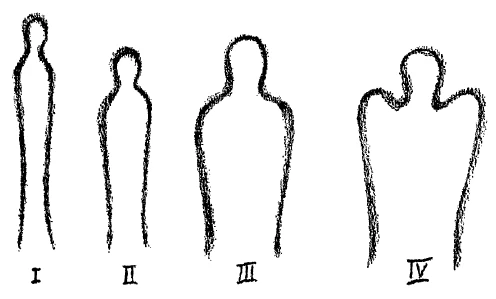
[ 17 ] What is this? This is also a characterization of the four temperaments. Melancholic children are generally slender and thin; sanguine children are the most average in build; those with more prominent shoulders are phlegmatic children; and those with a stocky build, so that their head almost sinks into their body, are choleric children.
[ 18 ] [Michelangelo and Beethoven both exhibit a mixture of melancholic and choleric temperaments.]
[ 19 ] Now I ask that you keep in mind that, when it comes to a child’s temperament, we as teachers are by no means called upon to regard the temperaments in question as “flaws” from the outset and to seek to combat them. We must recognize the temperament and ask ourselves: How should we deal with it in order to achieve a desirable life goal together with the child, so that the very best can come of the temperament and the children can achieve their life goal with the help of their temperament? Particularly in the case of the choleric temperament, it would be of very little help if we tried to suppress it and replace it with something else. In fact, a great deal emerges from the life and passion of the choleric person, and especially in world history, many things would have turned out differently if it weren’t for the choleric individuals. But especially with children, we must ensure that, despite their temperament, they are guided toward appropriate life goals.
[ 20 ] With a choleric child, one should, as much as possible, introduce imaginary situations—artificially created scenarios—into the child’s sphere of attention. For example, when a child is throwing a tantrum, one should direct their attention to fictional situations and react to these fictional situations in a choleric manner oneself, so that I might tell the young choleric child, for instance, about a wild fellow I encountered, whom I describe to them as if he were real. Then I would become animated, describing how I deal with him and how I judge him, so that the child sees the choleric temperament manifested in someone else—in a well-thought-out way—and thus observes the action itself. Through this, the child will develop the inner strength to understand other things well as well.
Someone calls out: “The scene between Napoleon and his secretary!” Another person replies: “What's that?”
[ 21 ] Rudolf Steiner: First, one would have to ask the building committee for permission! — The speaker should present the scene described in the speech in such a way that it brings out the choleric temperament. This will always help the choleric child gather strength, so that one can then continue working with them. An ideal approach would be to describe a situation to the choleric group so that they, in turn, can gather strength. Then the effect will last for a few days. For a few days, the children will not be hindered at all from taking things in. Otherwise, they will be inwardly rebelling against things they are supposed to understand.
[ 22 ] Now I would like you to try the following: Something should remain from this discussion of the temperaments, and I would ask Miss von Mirbach to provide, in no more than six pages, a summary of the characteristics of the temperaments and their treatment, based on everything I have discussed here, so that you might—it doesn’t have to be tomorrow—provide us with a kind of summary.
[ 23 ] On the other hand, I would like to ask Mrs. Koegel to create a mental image in which she has two groups in front of her: sanguine children and melancholic children, and she should alternate between them with a kind of drawing lesson—simple drawing motifs—so that one session would be tailored to the sanguine children and the next to the melancholic children.
[ 24 ] Now I would also like to ask: Mr. Stockmeyer can do the same thing with drawing for phlegmatic and choleric children, so that you can then demonstrate this to us tomorrow, just as you have planned it.
[ 25 ] Then I would perhaps ask Miss Herrmann, Dr. Heydebrand, and Pastor Geyer to tackle the following tasks: Imagine that you are to tell the same fairy tale twice in a row, but not in exactly the same way—instead, rephrase it using different sentences and so on. The first time, you’ll cater more to sanguine children; the second time, to melancholic children, so that both groups benefit.
[ 26 ] Then I would ask that perhaps Mr. Meyer and Dr. Treichler take on the difficult task of providing an individual description of an animal or animal species—tailored once for choleric children and the other time for phlegmatic children.
[ 27 ] Mr. Oehlschlegel, Mr. Hahn, and perhaps Mr. Baumann as well—I would ask them to tackle the problem of how to take the four temperaments into account in arithmetic, specifically in arithmetic.
[ 28 ] Isn't it true that when you focus your attention on things like temperaments in order to divide the class for instruction, you must, above all, take into account that human beings, as such, are constantly in the process of becoming. And this is something we must constantly internalize in our approach to education: that human beings are constantly in the process of becoming, that they undergo metamorphoses over the course of their lives. And just as we reflect deeply on the individual temperamental tendencies of each child, we can reflect on this process of becoming and say: Essentially, all children are sanguine, even if they may individually be phlegmatic or choleric. All young men and women are actually choleric, and if this is not the case—if it is not present at this stage—it indicates an unhealthy development. In adulthood, a person is melancholic. And in old age, they are phlegmatic.
[ 29 ] This, in turn, sheds a little light on the situation regarding the temperaments, for you can see there something that is particularly important to take into account in our present time. In our present time, we love to create rigid, firmly defined concepts for ourselves. In reality, everything is intertwined, so that the moment one says a person consists of a head, chest, and limb, one must also realize that everything is indeed intertwined. Thus, a choleric child is choleric only in the main, a sanguine child is sanguine only in the main, and so on. One actually has the opportunity to be fully choleric only during adolescence. Some remain adolescents their entire lives because they preserve their adolescent state throughout their lives. Nero and Napoleon never progressed beyond adolescence at all. From this we see how things that are actually in a state of becoming—alternating with one another—nevertheless interweave with one another in this alternation.
[ 30 ] What is the basis of the poet’s creativity—and of intellectual productivity in general? What makes it possible for someone to become a poet? It is the fact that one retains certain qualities of youth and childhood throughout one’s entire life. The more one has remained young at heart, the greater one’s aptitude for poetry. In a certain sense, it is a misfortune for a person not to preserve the ability to retain certain youthful qualities—a certain sanguine disposition—for one’s entire life. It is very important for the educator to be able to become sanguine through determination. It is extraordinarily important for educators to take this into account, so that they nurture this fortunate disposition in the child as something truly special.
[ 31 ] All productive qualities—everything upon which the flourishing of the spiritual-cultural member of the social organism will depend—will be the youthful qualities of human beings; they will be brought about by people who have retained their youthful spirit.
[ 32 ] Everything in business is based on the fact that certain characteristics of old age are already present in people, even when we are young. For all business judgment is based on experience. Experience is best acquired when certain characteristics of old age are already present in people, and the elderly are, after all, phlegmatic. A businessman thrives best when he has blended a certain phlegmatic quality—which is, in fact, already a trait of old age—into his other human characteristics and traits. This is the secret of many businesspeople: they are otherwise very good businesspeople, but they have incorporated something of the elderly, particularly in their disposition and so on. Anyone who were to develop only the sanguine temperament in business would end up with nothing but youthful projects that are never completed. The choleric individual who has remained youthful would ruin his earlier endeavors through certain later missteps. The melancholic, after all, cannot become a businessman anyway. In contrast, harmonious business development is linked to a senile capacity that enables one to gather experience from business life. Anyone with a penchant for experience is always a phlegmatic old man. Harmonious temperaments combined with phlegm—that is the best business constellation.
[ 33 ] You see that, when considering the future of humanity, one must take such things into account and give them due consideration. As a thirty-year-old poet or painter, one is not merely a thirty-year-old person; at the same time, childlike and youthful qualities have found their way into the person. When someone is productive, one can see how a second self lives within them—one in which they have remained more or less childlike, into which the childlike has found its way.
[ 34 ] All of the things mentioned here must become the subject of a new kind of psychology.