

The Art of Education
GA 295
21 August 1919, Stuttgart
Translated by Steiner Online Library
First Seminar Discussion
[ 1 ] My dear friends, this afternoon I would like to discuss informally what should be included in your lesson plans, the organization of the school system, the structure of classes, and similar matters. In the first few days, we will likely focus mainly on the topic of how we interact with the children.
[ 2 ] When we interact with children, we soon realize that they are all different, and despite mass education—even in large classes—we must take these individual differences into account. First, regardless of anything else, let us bring to mind what is, in a sense, an ideal necessity. We need not be overly concerned that classes might be overcrowded, for a competent teacher, if it should become necessary to teach in overcrowded classes, will be able to manage even such situations. What must be taken into account is the diversity of human beings—of children.
[ 3 ] This diversity can be traced back to four basic types, and it is the most important task of the educator and teacher to truly understand these four basic types, which are called the temperaments. Since ancient times, a distinction has been made between the four basic types: the sanguine, the melancholic, the phlegmatic, and the choleric temperaments. We will always find that the character of every child can be classified into one of these temperament categories. We must first acquire the ability to distinguish between the different types—from a deeper anthroposophical perspective, for example, to truly distinguish the sanguine from the phlegmatic.
[ 4 ] In the sense of Spiritual Science, we divide the human being into the I, the astral body, the etheric body, and the physical body. Now, in the case of the ideal human being, the harmony prescribed by the cosmic order would naturally prevail among these four aspects of the human being. In reality, however, this is not the case for any human being. And from this alone, one can see that the human being is not actually fully formed as it is delivered to the physical plane, but that education and instruction are meant to serve the purpose of making a complete human being out of the human being. One of the four elements predominates in each person, and it must be the result of education and instruction to bring about harmony among the four members.
[ 5 ] If the ego is particularly dominant—that is, if the ego is already very strongly developed in the child—then the child presents us with a melancholic temperament. It is very easy to overlook this fact, because melancholic children are sometimes regarded as special beings. In fact, the melancholic disposition in a child stems from a predominance of the ego in the very earliest years.
[ 6 ] When the astral body predominates, we encounter the choleric temperament.
[ 7 ] When the etheric body predominates, we encounter the sanguine temperament.
[ 8 ] When the physical body predominates, we encounter the phlegmatic temperament.
[ 9 ] These aspects are structured somewhat differently in later-stage human beings. Therefore, you will find a slight variation in a lecture I gave on the temperaments. In that lecture, the temperaments were discussed in relation to the four limbs of the adult human being. But when it comes to children, we will certainly arrive at a correct assessment if we consider the classification in this way.
[ 10 ] Now, in a sense, we must keep such knowledge in the background when dealing with the child and try to discern the child’s fundamental temperament through the child’s entire outward demeanor and bearing.
[ 11 ] If a child shows only a brief interest in all sorts of things and quickly loses interest, then we must describe the child as sanguine. We should certainly make it a point—even if we have many children to raise—to identify which children take a quick interest in external impressions and let that interest fade just as quickly. These children have a sanguine temperament.
[ 12 ] Then we should know exactly which children tend toward inner brooding and contemplation; these are the melancholic children. They are not easily swayed by impressions from the outside world. They brood quietly within themselves, but we never get the impression that they are actually idle on the inside. We get the impression that they are inwardly engaged.
[ 13 ] If, on the other hand, we get the impression that children are mentally unengaged, that they are lost in their own thoughts and yet show no outward interest, then we are dealing with phlegmatic children.
[ 14 ] Children who strongly assert their will through a kind of boisterous behavior are the choleric children.
[ 15 ] Of course, there will be many other characteristics through which these four temperament types manifest themselves in children. However, it is essential that we focus on this during the first few months of our instruction, observing the children for these four characteristics during this time so that we can identify these types in them. This will allow us to divide a class into four sections, or four groups. It is desirable that we gradually reassign the children to different groups. If we have mixed-gender classes, we will have eight groups. We will divide the boys and girls separately into four groups each: a choleric, a sanguine, a phlegmatic, and a melancholic group.
[ 16 ] This serves a very specific purpose. We are teaching; and as we teach, we will address various topics, have various things to say and show, and as teachers we must be mindful that when we show something to be observed, it is different from when we pass judgment on it. When we pass judgment, we address a different group than when we show something. When we have something to demonstrate that is intended to appeal particularly to the senses, we direct our attention especially to the sanguine group. When we offer any reflection on what has been observed, we address the melancholic children. Further details will be provided later. But it is necessary that we acquire the skill of always directing our notes and addresses to different groups. This ensures that what one group lacks is compensated for by the other group. Show the melancholic children something they can evaluate; show the sanguine children something they can observe. In this way, they complement each other, learn from one another, and direct their interest toward one another—these two groups.
[ 17 ] You must be patient with yourself, because this approach to the world of children must become second nature. You have to have a feel for which group you are addressing; it must, so to speak, come naturally. If you were to make a conscious effort to do so, you would lose your natural ease. So, as a kind of teaching habit, we must take this approach to the various temperamental dispositions into account.
[ 18 ] Now, you should not rush through your preparation, but rather build up your strength for the work. Therefore, I do not think you should spend the little time you have left each day on extensive external preparations. Nevertheless, one can only truly make these things one’s own if one processes them emotionally. It is therefore our task to apply this understanding of the teacher’s relationship to the children’s temperamental dispositions in a truly appropriate manner. We will organize the teachers so that I will ask one group to focus on the sanguine temperament, a second group on the phlegmatic, a third on the melancholic, and a fourth on the choleric temperament.
[ 19 ] I ask that you reflect on the following two questions: How does the temperament I just described manifest itself in a child belonging to each of the groups? Tomorrow, during the open discussion, you will address these points: First, how you believe the temperament in question manifests itself in the child. Second, how should one deal with that temperament?
[ 20 ] I would like to say a few more things about this “treatment.” As you can see from the lecture I gave years ago, it is the worst possible method to try to overcome a temperament by, so to speak, cultivating the opposite traits in the child. Let’s suppose we have a sanguine child. If we try to “train” the child by attempting to eradicate these traits, we will be treating the child poorly. What is important is that we respond directly to the temperament, accommodate it, bring as much as possible within the sanguine child’s sphere of attention, allow the child to engage in sensitive activities, and thereby, in a sense, accommodate the child’s natural inclinations. As a result, the predisposition that binds the child will gradually diminish and harmonize with the other temperaments.
[ 21 ] Furthermore, when a child is throwing a tantrum, we should not try to prevent the tantrum from happening, but rather try to address the child’s tantrum-prone tendencies in such a way that we respond to the child appropriately from the outside. Now, it is difficult to always let a child work off their energy.
[ 22 ] There is a clear difference between a phlegmatic child and a choleric child. A phlegmatic child is apathetic and not very engaged internally. Now, as a teacher, try to muster a great deal of compassion for such a child within yourself, to awaken it, and to take an interest in every aspect of the child’s life. There is always an opportunity to do so. The phlegmatic child can become very interesting if you find a way to break through their apathy. But do not express this inner interest; try to appear indifferent. Try to split your own being. Have a great deal of interest within yourself, but outwardly present yourself in such a way that the child sees in you a reflection of his or her own nature. Then you will be able to have an educational influence.
[ 23 ] With a choleric child, on the other hand, try to remain emotionally detached inside, watching with a cool head as the child rages. For example, if the child throws the inkwell on the floor, try to remain as phlegmatic and calm as possible on the outside in the face of this outburst—do not let anything affect you! And, on the contrary, try to discuss as many of these things as possible with the child in a sympathetic manner, but not immediately afterward! Appear as calm as possible on the outside and say as calmly as you can: “You’ve just smashed the inkwell.” The next day, when the child is calm, discuss the matter with him or her sympathetically. Talk about what he or she did, and show the utmost sympathy. In this way, encourage the child to replay the entire scene in his or her mind afterward. Also calmly condemn the actions—how he or she threw the inkwell on the floor and smashed it. You can achieve an extraordinary amount with children who are throwing tantrums in this way. There is no other way to get them to stop throwing tantrums.
[ 24 ] This can help guide you in trying to address the two questions we’ll be asking ourselves by tomorrow. We’ll approach this in such a way that each of you can present whatever you have to say. Take brief notes on what you’ve come up with, and we’ll then discuss those notes.
[ 25 ] There must always be time set aside for discussions of this and similar nature among the teaching staff. In such discussions, which have a more republican character, a substitute must be found for the dictatorial leadership typical of a principal’s office, so that every single teacher is constantly involved in the affairs and interests of the others. We will begin this very tomorrow in a sort of debate. As a guide, I would like to give you a sort of outline that you can use as a basis for your work.
[ 26 ] When a person speaks, you can tell from their overall disposition whether they focus strongly or weakly on something; whether they feel strongly about something external or feel strongly about their inner states.
[ 27 ] Then we must distinguish between the different ways of changing. Either one remains steadfast and changes little, or one is less steadfast and changes a great deal. This is what distinguishes the temperaments.
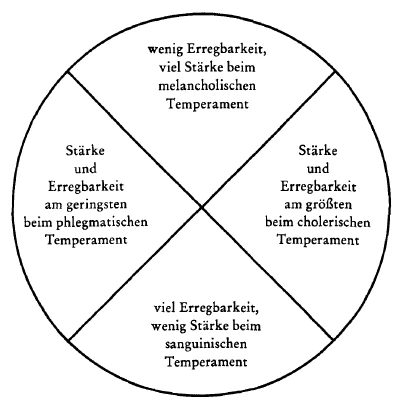
[ 28 ] If you keep this in mind, you will simultaneously see a certain hint of it in the diagram. Sanguine and phlegmatic temperaments often coexist, and that is how they are depicted in the diagram. A phlegmatic temperament never easily transitions into a choleric one. They are as different as the North and South Poles. Similarly, melancholic and sanguine temperaments are opposites. They are polar opposites. Temperaments that lie next to each other merge into one another; their boundaries blur. In contrast, it is best to follow the grouping system as follows: When you assemble a phlegmatic group, it is best to have the choleric group as its opposite pole, with the other two—the melancholic and the sanguine—positioned between them.
[ 29 ] All these things go back to what was said this morning. The inner, spiritual aspect is of the utmost importance when interacting with a child. The child is taught and raised from soul to soul. An immense amount is at play in the hidden connections that run from soul to soul. And so, an extraordinary amount is at stake when dealing with a choleric child if you remain indifferent, and with a phlegmatic child if you show inner interest. Through your own inner spiritual disposition, you will have a supersensible educational influence on the child. Education takes place through who you are—that is, in this case, through the role you assume within the group of children. You must never lose sight of this.
[ 30 ] However, children also influence one another. And here is the peculiar thing: if one divides children into four groups based on similar temperamental dispositions and seats those with similar dispositions next to one another, these dispositions do not reinforce one another but rather cancel each other out. A group of sanguine children, for example, do not reinforce their temperamental tendencies; rather, they wear each other down. If you then focus on the choleric children during class, the sanguine children will absorb this influence, and vice versa. As a teacher, you must allow the mood of your own soul to influence the child, while similar temperamental moods among the children tend to wear each other down. Chatting with one another—including chatting during breaks—reflects an inner tendency to wear each other down. Choleric children will chat less with one another than when they are seated next to others. We must not view and judge things from an external perspective.
[ 31 ] I would like to point out right from the start that we will place great emphasis on making the lessons as focused as possible. If we do not do this, we cannot take into account all the things I just mentioned—namely, the different temperaments. Therefore, we will not have what is commonly referred to as a “timetable.” In this respect, we will be working in direct opposition to the system that represents the ideal of modern materialistic education. In Basel, for example, they speak of the “forty-minute system.” One activity is immediately followed by another. This amounts to nothing less than erasing everything that took place in the preceding forty minutes and causing terrible confusion in the students’ minds.
[ 32 ] We will carefully consider which subject matter is appropriate for a child’s specific age level, and then we will focus on that subject—reading, for example—for a certain period of time. This means that the child will spend six to eight weeks on reading in the morning, then writing will take its place, followed by arithmetic, so that the child focuses on one subject at a time throughout the entire period. So, to illustrate this schematically, our lessons would consist of starting—if possible—in the morning—though “if possible” is key, since all sorts of adjustments will inevitably occur—with reading, so that we spend a few weeks on reading, then writing, then arithmetic.
[ 33 ] We will supplement this actual instruction with activities that take the form of storytelling. In the first school year, we will mainly tell fairy tales. In the second school year, we will strive to present the lives of animals in narrative form. We will move from fables to the truth about how animals relate to one another. However, the lessons will be structured so that the child’s attention remains focused on the same subject for weeks at a time. Then, at the end of the school year, we will follow up with review sessions to refresh what was covered at the beginning. We will set aside and consistently cultivate only the arts. Either in the afternoon or, if there is sufficient time, in the morning, we will cultivate the arts as a special form of will development.
[ 34 ] Now, it would be in keeping with the ideal of instruction that a child actually needs no more than one and a half hours a day for concentrated learning, which requires mental effort. Then we can spend another half hour telling fairy tales. In addition, there is still the possibility of incorporating artistic activities into about one and a half hours. And for children up to about the age of twelve, we would then have no more than three and a half hours a day. From these three and a half hours, we would set aside on any given day the small amount necessary for religious instruction, so that we would also have the opportunity to teach the children in a way that allows for variety.
[ 35 ] So if we have a lot of children in a class, we can arrange it so that we have one group consisting of seven to ten children and another group consisting of one-quarter to one-quarter of the remaining children, so that we can make do with the classroom in this way.
[ 36 ] That would be the ideal scenario: that we wouldn’t keep any child occupied for more than three and a half hours. We will always have new children coming in, and our only task will be to figure out what to do with the children in the large gardens during the time when there are no classes. They can play in the open spaces in the summer; but in the winter, in the gym, it will be difficult to keep them occupied. One hour a week for physical education and one hour for eurythmy should be scheduled. It will be good for the children to be able to be there even when there are no classes, so they can play and do similar activities. I believe it doesn’t make much difference whether classes begin first thing in the morning or later, so we can easily divide them into two groups.
[ 37 ] Now you will have the task of dealing with all sorts of things. We will gradually come to the integration of work as we address it in our discussions. But I believe it would be good for you to consider what exactly you need to focus on during story time with the children. The actual lessons will then follow from our general pedagogical principles. But for the storytelling sessions, you will need to select material that can be presented to the children in a relaxed, narrative tone throughout their entire school years, from ages seven to fourteen.
[ 38 ] It will therefore be necessary to have a certain treasure trove of fairy tales available during the early school years. Then, in the time that follows, you would need to focus on presenting stories from the animal kingdom in connection with fables. Then biblical history, incorporated into general history, separate from other religious instruction. Then scenes from ancient history, scenes from medieval history, and from modern history. Then you must be able to present narratives about the various peoples—what their characteristics are, which is more closely related to their natural foundations. Then the mutual relationships among the peoples—Indians, Chinese, Americans—what their distinctive characteristics are and so on; that is, knowledge of the peoples. This is a very special necessity arising from the present era.
[ 39 ] I wanted us to set these specific tasks for ourselves today. You’ll see how we’ll use these seminar sessions. Today, everything should just be outlined.
[ 40 ] While speaking, Rudolf Steiner had written the following overview on the blackboard:
[ 41 ] 1. A Certain Treasure Trove of Fairy Tales
2. Stories from the Animal Kingdom Related to Fables
3. Biblical History as Part of General History (Old Testament)
4. Scenes from ancient history
5. Scenes from medieval history
6. Scenes from modern history
7. Tales about the tribes
8. Understanding of the peoples.
Q&A
[ 42 ] The question is raised about the images for sounds and letters—such as the fish for the letter F—which had been discussed that morning in the first lecture of the methodological-didactic course.
[ 43 ] Rudolf Steiner: One must find such things, such images, for oneself. There is no need to search for what history has provided. One should let the free, yet restrained imagination work and have confidence in what one finds for oneself; this applies also to forms of activity, for example, to S. What you work out for yourself!
[ 44 ] L. asks about the Latin script.
[ 45 ] Rudolf Steiner: Yes, the Latin script is the starting point, because it contains the characteristic forms. And only when it becomes necessary does one switch to the German, Gothic script, which should actually disappear entirely.
[ 46 ] O. asks about the treatment of melancholic children.
[ 47 ] Rudolf Steiner: The teacher approaches the melancholic child in this way: The melancholic disposition stems from the fact that the spiritual-soul aspect of the human being has not yet fully subdued the metabolism. The nervous-sensory aspect of the human being is the least spiritual part of the human being; it is the most physical aspect. The least physical is the metabolic human. The spiritual human is most deeply embedded in the metabolic organism, yet is least fully realized there. The metabolic organism requires the most work. When the metabolism causes too much distress, the inner striving toward the spirit reveals itself in brooding.
[ 48 ] When dealing with a melancholic child, we as teachers should show as much visible interest as possible in the external aspects of their surroundings; we should, as much as possible, act as if we were sanguine individuals and describe the outside world in that manner. Toward the sanguine child, we behave seriously, providing them with vivid, lasting descriptions of the external world with inner seriousness. In the nervous-sensory type, the spirit has penetrated the human being the most; in the metabolic type, the least; there, it has the strongest tendency to assert itself.
[ 49 ] The question of textbooks is raised.
[ 50 ] Rudolf Steiner: We have to look at the standard ones. If we can manage without books, so much the better. If the children don’t have to take public exams, then there’s no need for books. In Austria, children would have to take public exams. We would have to determine how we are expected to demonstrate that the educational goals have been achieved. The ideal would be to have no exams at all. The final exam is a compromise with the authorities. We need to know, without exams, where the children stand. Exam anxiety before puberty is very dangerous for the entire physiological structure of a person. It has the effect of disrupting a person’s physiological and psychological constitution. The best solution would be to abolish the entire examination system. The children will become much more quick-witted.
[ 51 ] Temperament wears off; by the age of ten, differences in temperament will have been overcome.
[ 52 ] Boys and girls should not be separated. We separate them only because of public opinion. Romantic relationships develop; there’s no need to get upset about it, but people will hold it against us. The quality of instruction does not suffer if the teacher has authority.
[ 53 ] We need subject teachers for the arts that influence the will, as well as for languages, which are taught separately. The arts are the domain of the subject teacher. The homeroom teacher’s primary role is to act as a unifying teacher. Through his or her overall instruction, the homeroom teacher influences the intellect and the emotions in particular. The arts—gymnastics, eurythmy, drawing, and painting—appeal to the will.
[ 54 ] The teacher moves up with the students until the end. The teacher of the last class becomes the teacher of the first class again.