

The Art of Education
GA 295
1 September 1919, Stuttgart
Translate the original German text into any language:
Versions Available:
Zehnte Seminarbesprechung
Tenth Seminar Discussion
[ 1 ] Sprechübungen:
[ 1 ] Speaking exercises:
Pfiffig pfeifen aus Näpfen
Pfäffische Pferde schlüpfend
Pflegend Pflüge hüpfend
Pferchend Pfirsiche knüpfendKopfpfiffig pfeifen aus Näpfen
Napfpfäffische Pferde schlüpfend
Wipfend pflegend Pflüge hüpfend
Tipfend pferchend Pfirsiche knüpfend
Whistling cleverly from bowls
Horses hatching from bowls
Tending plows while hopping
Herding peaches while tying knotsWhistling cleverly from bowls
Horses hatching from bowls
Bouncing while tending to plows
Tapping while herding and tying peaches
[ 2 ] Rudolf Steiner: Das «pf» sollte recht regsam turnerisch gemacht werden.
[ 2 ] Rudolf Steiner: The “pf” should be performed in a lively, gymnastic manner.
[ 3 ] Ein Stück, wobei zum Teil auf die Form, zum Teil auf den Inhalt zu achten ist, ist das Folgende:
[ 3 ] The following is a piece in which attention should be paid partly to the form and partly to the content:
[ 4 ] Aus den «Galgenliedern» von Christian Morgenstern:
[ 4 ] From Christian Morgenstern’s “Galgenlieder”:
Das Gebet
Die Rehlein beten zur Nacht, Hab acht!
Halb neun!
Halb zehn!
Halb elf!
Halb zwölf!
Zwölf!Die Rehlein beten zur Nacht,
Hab acht!
Sie falten die kleinen Zehlein,
die Rehlein.
The Prayer
The little fawns pray at night, watch out!
Half past eight!
Half past nine!
Half past ten!
Half past eleven!
Half past twelve!
Twelve!The little fawns pray at night,
Watch out!
They fold their little toes,
the little fawns.
[ 5 ] Rudolf Steiner: Jetzt werden wir unsere Betrachtungen über die Pflanzenwelt fortsetzen.
[ 5 ] Rudolf Steiner: Now we will continue our reflections on the plant world.
Es folgen Ausführungen einiger Kursteilnehmer.
Below are comments from some of the course participants.
[Paul Baumann schildert Entsprechungen: Schlaf - Sommer, Blüte - Sehen, Duft - Riechen, Stoffe - Geschmack, Grün - Haupteindruck, Liebe - Duft, Opfer - Frucht, Sorge - Stamm. Wurzelpflanzen, Stammpflanzen etc.; Rose als Sinnbild der Schönheit und Liebe.
[Paul Baumann describes correspondences: sleep—summer; bloom—sight; fragrance—smell; substances—taste; green—overall impression; love—fragrance; sacrifice—fruit; worry—stem. Root plants, stem plants, etc.; the rose as a symbol of beauty and love.
Er möchte, dass die Schüler die Pflanzen nach wissenschaftlichen Begriffen kennenlernen.]
He wants the students to learn about the plants using scientific terms.]
Rudolf Steiner macht mehrfache Zwischenbemerkungen dazu:
Rudolf Steiner makes several comments on this:
[ 6 ] [Für die Einzelpflanze gut.] — Es wird später einmal solche Schüler geben, die das Pflanzenreich kennenlernen mehr nach wissenschaftlichen Begriffen, die da wären: Moose, Flechten, Algen, Monokotyledonen, Dikotyledonen. Dies systematische Kennenlernen nach wissenschaftlichen Grundsätzen wird manchmal in die Schule hineingetragen. Aber jeder Mensch, der in der Jugend Pflanzen nach wissenschaftlichen Grundsätzen kennenlernt, sollte sie zuerst kennenlernen so, wie wir sie beschreiben, durch Vergleich mit den menschlichen Seeleneigenschaften. Niemand sollte zuerst wissenschaftliche Botanik kennenlernen. Nachher, später kann er dann an das mehr wissenschaftliche Pflanzensystem herankommen. Es ist ein Unterschied, ob wir erst versuchen die Pflanzen zu beschreiben, und nachher wissenschaftlich an sie herankommen, oder umgekehrt. Man verdirbt sehr viel beim Menschen, wenn man ihm gleich wissenschaftliche Botanik beibringt, wenn er nicht zuerst solche Begriffe bekommt, wie wir sie jetzt darzustellen versuchten. Er sollte aus der Seele, aus dem Gedächtnis herausbringen solche allgemein menschlichen Pflanzenbegriffe, wenn er an die wissenschaftliche Systematik herankommt.
[ 6 ] [Good for the individual plant.] — There will be students in the future who come to know the plant kingdom more in terms of scientific classifications, such as: mosses, lichens, algae, monocots, and dicots. This systematic study based on scientific principles is sometimes introduced in school. But anyone who learns about plants according to scientific principles in their youth should first get to know them as we describe them—by comparing them to the qualities of the human soul. No one should start with scientific botany. Later on, they can then approach the more scientific system of plant classification. There is a difference between first trying to describe plants and then approaching them scientifically, and doing it the other way around. A great deal of harm is done to a person if they are taught scientific botany right away without first acquiring the concepts we have just attempted to present. When they approach scientific taxonomy, they should draw upon these general human concepts of plants from their soul and from their memory.
Hannah Lang gibt eine weitere Darstellung.]
Hannah Lang provides another account.]
[ 7 ] Die Pflanzenwelt ist die sichtbar gewordene Seelenwelt der Erde. Die Nelke ist kokett. Die Sonnenblume ist so richtig bäurisch. Die Sonnenblumen lieben so bäurisch zu glänzen. Recht große Blätter von Pflanzen würden seelisch bedeuten: mit nichts fertig werden, lange zu allem brauchen, ungeschickt sein, namentlich nicht fertig werden können. Man glaubt, er ist fertig, er ist aber immer noch dabei. — Das Seelische in den Pflanzenformen suchen!
[ 7 ] The plant world is the Earth’s spiritual realm made visible. The carnation is coquettish. The sunflower is truly rustic. Sunflowers love to shine in such a rustic way. Quite large leaves on plants would symbolize, in spiritual terms: being unable to cope with anything, taking a long time to do everything, being clumsy—in particular, being unable to finish what one starts. One thinks he is finished, but he is still at it. — Seek the spiritual in plant forms!
Friedrich Oehlschlegel und Elfriede Hermann äußern sich.]
Friedrich Oehlschlegel and Elfriede Hermann share their views.]
[ 8 ] Wenn der Sommer herankommt, schon wenn der Frühling herankommt, so breitet sich Schlaf über die Erde aus. Der wird immer dichter und dichter; es ist nur ein Räumlich-Ausbreiten. Wenn die Pflanze am meisten sich entfaltet, schläft sie am meisten. Und im Herbst vergeht der Schlaf, da sind die Pflanzen nicht mehr da, da ist der Schlaf nicht mehr über die Erde ausgebreitet. Beim Menschen gehen die Gefühle, Leidenschaften und Affekte und so weiter mit hinein in den Schlaf, aber dadrinnen würden sie aussehen wie die Pflanzen. Was wir an der Seele unsichtbar haben, verborgene Eigenschaften der Menschen, sagen wir Koketterie, wird sichtbar in den Pflanzen. Beim wachenden Menschen sehen wir das nicht, am schlafenden Menschen aber könnte es hellseherisch beobachtet werden. Koketterie: so sieht sie aus, wie eine Nelke. Eine kokette Dame, die würde aus ihrer Nase fortwährend Nelken hervortreiben. Da würde ein langweiliger Mensch riesige Blätter aus seinem ganzen Leibe hervortreiben, wenn Sie ihn sehen könnten.
[ 8 ] As summer approaches—indeed, even as spring approaches—sleep spreads across the earth. It grows ever denser and denser; it is merely a spatial expansion. When a plant is at the height of its growth, it sleeps the most. And in the fall, the sleep passes; the plants are no longer there, and the sleep is no longer spread over the earth. In human beings, feelings, passions, emotions, and so on go along with sleep, but within it they would look like the plants. What we have in the soul that is invisible—the hidden qualities of human beings, let’s say coquetry—becomes visible in the plants. We do not see this in a waking person, but in a sleeping person it could be observed clairvoyantly. Coquetry: this is what it looks like—a carnation. A coquettish lady would constantly sprout carnations from her nose. A boring person, on the other hand, would sprout enormous leaves from his entire body, if you could see him.
[ 9 ] Wenn der Gedanke angeschlagen wird, daß die Erde schläft, muß man auch weitergehen. Man muß festhalten: die Pflanzenwelt wächst im Sommer. Die Erde schläft im Sommer, im Winter wacht sie. Die Pflanzenwelt ist die Seele der Erde. Beim Menschen hört alles auf, was Seelenleben ist, wenn er einschläft; bei der Erde fängt es recht an, wenn sie einschläft. Das Seelische äußert sich am schlafenden Menschen aber nicht. Wie führt man das Kind über diese Schwierigkeit hinweg?
[ 9 ] Once the idea that the Earth is asleep is raised, one must take it a step further. One must bear in mind: the plant world grows in the summer. The Earth sleeps in the summer; in the winter, it awakens. The plant world is the soul of the Earth. In human beings, all soul life ceases when they fall asleep; in the Earth, it truly begins when it falls asleep. But the soul does not manifest itself in the sleeping human being. How does one help a child overcome this difficulty?
Ein Kursteilnehmer hatte gemeint, die Pflanzen seien als die Träume der Erde anzusehen.
One course participant had suggested that plants should be viewed as the dreams of the Earth.
[ 10 ] Rudolf Steiner: Aber die Pflanzenwelt des Sommers sind nicht die Träume der Erde. Die Erde schläft im Sommer. Träume können Sie nur das nennen, wie die Pflanzenwelt aussieht im Frühling und im Herbst. Nur in den ersten Anfängen, meinetwegen das Märzveilchen, wenn es noch grün ist, nicht aber mehr, wenn es blüht, und dann die Zeit, wo das Laub wieder abfällt, können Sie mit Träumen vergleichen. Versuchen Sie, von da den Übergang zu gewinnen zu dem wirklichen Begreifen der Pflanze.
[ 10 ] Rudolf Steiner: But the plant world of summer is not the Earth’s dreams. The Earth sleeps in summer. You can only call what the plant world looks like in spring and fall “dreams.” Only in the very early stages—take the March violet, for example—when it is still green, but not once it blooms, and then the time when the leaves fall again, can you compare it to dreams. Try to make the transition from there to a true understanding of the plant.
[ 11 ] Sie müßten zum Beispiel folgendes mit dem Kinde anfangen: «Sieh dir einmal an einen Hahnenfuß, irgendeine Pflanze, die wir ausgraben können aus der Erde, die uns unten Wurzeln zeigt, Stengel, Blätter, Blüten, und dann Staubgefäße, Stempel, um daraus die Frucht zu entwikkeln.» - Solch eine Pflanze führe man dem Kinde wirklich vor.
[ 11 ] For example, you should do the following with the child: “Take a look at a buttercup—any plant we can dig up from the ground—that shows us roots at the bottom, a stem, leaves, flowers, and then stamens and a pistil, from which the fruit develops. ” — You should actually show the child a plant like this.
[ 12 ] Dann führe man dem Kinde vor einen Baum und sage ihm: «Sieh einmal, stelle dir neben der Pflanze diesen Baum vor! Wie ist es mit diesem Baum? Ja, er hat da unten auch Wurzeln, allerdings, aber dann ist kein Stengel da, sondern ein Stamm. Dann breitet er erst die Äste aus, und dann ist es so, als ob auf diesen Ästen erst die eigentlichen Pflanzen wüchsen. Denn da sind viele Blätter und Blüten auf den Ästen darauf; da wachsen kleine Pflanzen wie auf den Ästen selber oben darauf. So daß wir tatsächlich, wenn wir wollen, die Wiese so anschauen können: Da wachsen zum Beispiel so gelbe Hahnenfüße über die ganze Wiese hin. Sie ist bedeckt mit einzelnen Pflanzen, die ihre Wurzeln in der Erde haben, und die da wachsen über die ganze Wiese hin. Aber beim Baum ist es, wie wenn man die Wiese genommen hätte, hätte sie hinaufgehoben, hätte sie gebogen, und dann wachsen erst da droben die vielen Blüten. Der Stamm ist ein Stück Erde selbst. Der Baum ist dasselbe wie die Wiese, auf der die Pflanzen wachsen.
[ 12 ] Then take the child to a tree and say to him: “Look, imagine this tree next to the plant! What do you notice about this tree? Yes, it has roots down there too, of course, but it doesn’t have a stem—it has a trunk. Then it spreads out its branches, and it’s as if the actual plants were growing on those branches. Because there are many leaves and flowers on the branches; little plants grow there, just as if they were growing on the branches themselves up there. So that, if we want to, we can actually look at the meadow this way: For example, yellow buttercups are growing all over the meadow. It is covered with individual plants that have their roots in the earth and grow across the entire meadow. But with the tree, it is as if one had taken the meadow, lifted it up, bent it, and only then do the many flowers grow up there. The trunk is a piece of earth itself. The tree is the same as the meadow on which the plants grow.
[ 13 ] Dann gehen wir vom Baum über zum Löwenzahn oder zur Kamille, Da ist etwas Wurzelhaftes in der Erde darinnen; es wächst etwas heraus wie Stengel, Blätter. Aber da ist oben ein Blütenkörbchen, da stehen lauter kleine Blüten nebeneinander. Beim Löwenzahn ist es ja so, daß der da oben ein Körbchen macht, und da hat er lauter kleine Blüten, vollständige Blüten, die da drinnen stecken im Löwenzahn. Jetzt, nicht wahr, haben wir: den Baum, den Korbblütler und die gewöhnliche Pflanze, die Stengelpflanze. Beim Baum ist es so, wie wenn die Pflanzen erst da oben wachsen würden. Beim Korbblütler ist die Blüte da oben; das sind aber keine Blumenblätter, das sind unzählige, vollentwickelte Blumen.
[ 13 ] Then let’s move from the tree to the dandelion or the chamomile. There’s something root-like in the soil inside; something grows out of it—stems and leaves. But at the top there’s a flower head, with lots of little flowers lined up next to each other. With the dandelion, what happens is that it forms a flower head up there, and it has lots of little flowers—complete flowers—inside the dandelion. Now, don’t we have: the tree, the composite flower, and the ordinary plant, the stemmed plant? With the tree, it’s as if the plants were growing only up there. With the composite flower, the bloom is up there; but those aren’t petals—they’re countless, fully developed flowers.
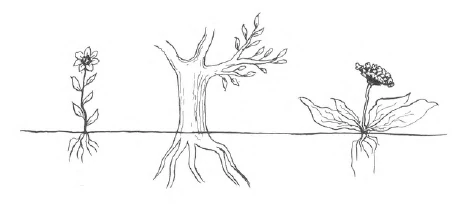
[ 14 ] Jetzt denken wir, es wäre die Geschichte gerade so, als ob die Pflanze alles da unten behält in der Erde. Sie will die Wurzeln entfalten, bringt es aber nicht dazu. Sie will Blätter entfalten, bringt es nicht dazu. Nur da oben, dasjenige, was sonst in der Blüte drinnen ist, entfaltet sich: da kommt ein Pilz heraus. Und wenn es zur Not ist und die Wurzel da unten mißglückt und nur Blätter herauskommen: da kommen Farne heraus. Das sind alles verschiedene Formen, aber es sind alles Pflanzen.»
[ 14 ] Now we think the story goes something like this: as if the plant were keeping everything down there in the soil. It wants to unfurl its roots, but can’t manage it. It wants to unfurl its leaves, but can’t manage it. Only up there—what would otherwise be inside the flower—unfolds: a mushroom emerges. And if it comes down to it, and the roots down there fail and only leaves come out: ferns emerge. These are all different forms, but they are all plants.”
[ 15 ] Zeigen Sie dem Kinde den Hahnenfuß, wie der seine Würzelchen ausbreitet, wie der seine fünf gelben gefransten Blütenblätter hat. Dann zeigen Sie ihm den Baum, wie da darauf erst das Pflanzliche wächst; dann Korbblütler, dann den Pilz, dann Farnkraut, nicht sehr wissenschaftlich, sondern so, daß die Kinder die Form im allgemeinen kennen. Dann sagen Sie dem Kinde: «Ja, was glaubst du eigentlich, warum ist denn eigentlich der Pilz ein Pilz geblieben? Warum ist der Baum ein Baum geworden? - Vergleichen wir einmal den Pilz mit dem Baum. Was ist denn da für ein Unterschied? Ist es denn nicht so, als ob die Erde in ihrer Kraft sich herausgedrängt hätte, wie wenn sich ihr Innerstes im Baum herausgedrängt hätte in den äußeren Raum, in die Höhe, um da draußen erst die Blüten und Früchte zu entwickeln? Und beim Pilz hat sie da drinnen behalten, was sonst über die Erde emporwächst, und nur das Alleroberste sind die Pilze. Beim Pilz ist der Baum unter der Erde, er ist nur in den Kräften vorhanden. Der Pilz ist, was sonst ÄAußerstes des Baumes ist. Wenn sich viele, viele Pilze über der Erde ausbreiten, dann ist das so, wie wenn da unten ein Baum wäre, nur ist er in der Erde drinnen. Wenn wir einen Baum sehen, ist es so, wie wenn die Erde sich selbst aufgestemmt, aufgestülpt hätte und ihr Inneres nach außen bringen würde.»
[ 15 ] Show the child the buttercup—how it spreads its little roots, how it has its five yellow, fringed petals. Then show them the tree—how the herbaceous plants grow on it first; then the composite flowers; then the mushroom; then the fern—not in a very scientific way, but so that the children become generally familiar with the shapes. Then say to the child: “Well, what do you actually think—why has the mushroom remained a mushroom? Why did the tree become a tree?—Let’s compare the mushroom with the tree. What’s the difference there? Isn’t it as if the earth, in its power, had pushed itself outward—just as if its innermost essence had pushed itself out of the tree into the outer space, upward, to develop the blossoms and fruits out there? And in the case of the mushroom, it has kept inside what would otherwise grow up above the earth, and the mushrooms are only the very top. With the mushroom, the tree is underground; it exists only in its vital forces. The mushroom is what would otherwise be the outermost part of the tree. When many, many mushrooms spread out above the earth, it is as if there were a tree down there, only it is inside the earth. When we see a tree, it is as if the earth had pushed itself up, turned itself inside out, and brought its innermost essence to the outside.”
[ 16 ] Jetzt kommen Sie schon näher dem, wie die Sache eigentlich ist: «Wenn da die Pilze wachsen, da mit den wachsenden Pilzen, da nimmt die Erde etwas auf, was sie nach außen befördert, wenn sie Bäume wachsen läßt. Wenn die Erde also Pilze wachsen läßt, so behält sie die Kraft des wachsenden Baumes in sich. Wenn die Erde aber Bäume wachsen läßt, dann kehrt sie die wachsende Kraft des Baumes nach außen.»
[ 16 ] Now you’re getting closer to how things really are: “When mushrooms grow there—with those growing mushrooms—the earth absorbs something that it then channels outward when it causes trees to grow. So when the earth allows mushrooms to grow, it retains within itself the power of the growing tree. But when the earth allows trees to grow, it directs the tree’s growing power outward.”
[ 17 ] Jetzt haben Sie etwas, was allerdings, wenn es Sommer wird, nicht in der Erde darinnen ist, sondern herauskommt aus der Erde; und wenn es Winter ist, da geht es hinunter in die Erde. — «Wenn es Sommer ist, da sendet die Erde durch diese Kraft des Baumes ihre eigene Kraft in die Blüten hinein, läßt sie entfalten, und wenn es Winter ist, nimmt sie sie wieder zurück in sich selber. Wo ist eigentlich die Kraft, die im Sommer da außen in den Bäumen kreist - nur klein sich zeigt in dem Veilchen, groß in den Bäumen -, im Winter? Die ist da drunten in der Erde im Winter. Und was tun denn die Bäume, die Korbblütler und dies alles, wenn es tief Winter ist? Da entfalten sie sich dann ja ganz unter der Erde, da sind sie da drinnen in der Erde, da entfalten sie das Seelenleben der Erde. Das haben die alten Leute gewußt. Deshalb haben sie Weihnachten, wo man das Seelenleben sucht, nicht auf den Sommer gesetzt, sondern auf den Winter.
[ 17 ] Now you have something that, when summer comes, is not inside the earth but comes out of the earth; and when it is winter, it goes back down into the earth. — “When it is summer, the earth sends its own power into the blossoms through the tree’s power, allowing them to unfold, and when it is winter, it draws them back into itself. Where, actually, is the power that circulates outside in the trees in summer—manifesting itself only slightly in the violet, but greatly in the trees—during winter? It is down there in the earth in winter. And what do the trees, the composite flowers, and all the rest do when it is the depths of winter? Then they unfold entirely beneath the earth; there they are, inside the earth, unfolding the soul life of the earth. The ancients knew this. That is why they did not set Christmas—a time for seeking the soul life—in the summer, but in the winter.
[ 18 ] Geradeso wie beim Menschen, wenn er einschläft, sein Seelenleben nach außen geht, und wenn er wacht, nach innen, nach dem Leibe geht, so geschieht es ja bei der Erde auch. Im Sommer, wenn sie schläft, schickt sie ihre safttragende Kraft nach außen. Im Winter nimmt sie sie zurück, wacht auf, indem sie all die verschiedenen Kräfte in sich hat. Denkt, Kinder, wie diese Erde alles empfindet, alles fühlt! Denn dasjenige, was ihr den ganzen Sommer da seht in Blüten und Blättern, was im Sommer da strotzt, wächst, blüht, in den Hahnenfüßchen, den Rosen, den Nelken: im Winter ist es unter der Erde, da fühlt, zürnt, freut sich das, was unter der Erde ist.»
[ 18 ] Just as with human beings—when they fall asleep, their inner life turns outward, and when they wake up, it turns inward, toward the body—so it is with the Earth as well. In summer, when she sleeps, she sends her sap-bearing power outward. In winter, it draws it back, awakening with all these various forces within itself. Think, children, how this Earth perceives everything, feels everything! For what you see all summer long in blossoms and leaves—what bursts forth, grows, and blooms in the buttercups, the roses, and the carnations—in winter it is beneath the earth, and what lies beneath the earth feels, rages, and rejoices.”
[ 19 ] So bekommt man nach und nach den Begriff des unter der Erde im Winter lebenden Lebens. Das ist die Wahrheit! Und das ist gut, wenn man das den Kindern beibringt. Das ist nicht etwas, was die materialistischen Menschen für eine Schwärmerei halten könnten. Aber man geht da zu dem über, was wirklich als das Ganze in dem Pflanzenleben besteht. Die Kinder werden abgeleitet von dem gewöhnlichen In-denPflanzen-Aufgehen in das, was die Säfte im Sommer in der Hitze über die Erde treibt, im Winter wieder zurücknimmt in die Erde hinein, in dieses Aufundabflutende.
[ 19 ] This is how one gradually comes to understand the concept of life that exists underground during the winter. That is the truth! And it is good to teach this to children. This is not something that materialistic people might consider mere fantasy. But it leads one to what truly constitutes the whole of plant life. The children are led away from the usual notion of “merging with the plants”—that is, what drives the sap up through the earth in the summer heat and draws it back into the earth in the winter—toward this ebb and flow.
[ 20 ] Auf diese Weise bekommen Sie dasjenige, was wirkliches Seelenleben der Erde ist, sich spiegelnd in den Pflanzen. Farne, Moose, Pilze entfalten unter der Erde alles das, was ihnen fehlt, nur bleibt es Äthersubstanz, wird nicht physische Substanz. Wenn diese Ätherpflanze über die Erdoberfläche herauskommt, dann verwandelt sie das, was da herausdringt, durch die Wirkung der äußeren Kräfte in diese Rudimente von Blättern, was die Pilze, Moose, Farne sind. Drunten unter einer Moosfläche, oder einer von Pilzen bewachsenen Fläche, ist etwas wie ein Riesenbaum, und wenn die Erde das da unten nicht aufzehren kann, nicht bei sich behalten kann, dann drängt es sich nach außen.
[ 20 ] In this way, you come to understand what the true soul life of the Earth is, as reflected in the plants. Ferns, mosses, and fungi develop underground everything they lack, yet it remains etheric substance; it does not become physical substance. When this etheric plant emerges above the Earth’s surface, the part that breaks through is transformed—through the action of external forces—into these rudimentary leaves, which are the fungi, mosses, and ferns. Beneath a patch of moss, or an area overgrown with fungi, there is something like a giant tree, and if the earth cannot consume what is down there, cannot retain it, then it pushes its way outward.
[ 21 ] Der Baum ist ein Stückchen der Erde selbst, Stamm und Äste. Da wird nur das, was bei den Pilzen und Farnen noch da drunten ist, herausgehoben. So daß der Baum, wenn er langsam hineingeschoben würde in die Erde, alles ändern würde; wenn man ihn untertauchen ließe, würden aus den Blättern und Blüten werden Farne, Moose, Pilze, und es würde für ihn dann Winter werden. Nur entzieht er sich dem Winterwerden. Er ist dasjenige, was sich etwas dem Winterwerden entzieht. Würde ich aber so einen Pilz oder Farn beim Schopf packen können und immer weiter herausziehen aus der Erde, so daß das, was unten an Äthersubstanz ist, an die Luft käme, so würde ich einen ganzen Baum herausziehen, und was Pilze wären, würden außen Blüten werden und aussehen wie Bäume. Und die einjährigen Pflanzen stehen mitten drinnen. Die Korbblüte ist, nur in einer einzelnen Form, dasjenige, was da dann entsteht. Wenn ich die Korbblüte herunterschicken würde, dann würden sich auch lauter einzelne Blüten entwickeln. Die Korbblüte ist etwas, was man nennen könnte einen zu schnell aufgeschossenen Baum.
[ 21 ] The tree is a small part of the earth itself—trunk and branches. Only what remains down there in the mushrooms and ferns is brought to the surface. So that if the tree were slowly pushed back into the earth, it would change everything; if one were to submerge it, the leaves and blossoms would turn into ferns, mosses, and mushrooms, and winter would then come for it. But it eludes the onset of winter. It is that which eludes the onset of winter to some extent. But if I could grab such a mushroom or fern by the root and pull it further and further out of the earth, so that what is etheric substance at the bottom were exposed to the air, I would pull out an entire tree, and what were mushrooms would become flowers on the outside and look like trees. And the annual plants stand right in the middle. The composite flower, in a single form, is what then arises there. If I were to send the composite flower down, then a multitude of individual flowers would also develop. The composite flower is something one might call a tree that has sprouted too quickly.
[ 22 ] So kann auch in der Erde ein Wunsch leben. Die Erde hat das Bedürfnis, den Wunsch ins Schlafleben versinken zu lassen. Das tut sie im Sommer, und der Wunsch steigt auf als Pflanze. Oben wird er dann erst sichtbar, als Wasserlilie. Unten in der Erde lebt er als Wunsch, oben wird er dann Pflanze.
[ 22 ] In this way, a desire can also live within the earth. The earth feels the need to let the desire sink into the realm of sleep. It does this in the summer, and the desire rises up as a plant. It only becomes visible above ground as a water lily. Below, in the earth, it lives as a desire; above, it becomes a plant.
[ 23 ] Die Pflanzenwelt ist die sichtbar gewordene Seelenwelt der Erde, und daher mit der Seele des Menschen zu vergleichen. Aber man soll nicht bloß vergleichen, sondern die wirklichen Formen der Pflanzen hineinbekommen. Erst aus dem Gesamtvergleich kann man zu den einzelnen Pflanzen kommen.
[ 23 ] The plant world is the visible manifestation of the Earth’s soul, and can therefore be compared to the human soul. But one should not merely make comparisons; rather, one must grasp the actual forms of the plants. Only through a comprehensive comparison can one arrive at an understanding of the individual plants.
[ 24 ] Ein leises Schlafen werden Sie vergleichen mit den gewöhnlichen Pflanzen, ein Wachen während des Schlafes mit den Pilzen - wo viele Pilze sind, da ist eine Stelle, wo die Erde wacht während des Sommers -, ein ganz gründliches, tiefes Schlafen mit den Bäumen. Daraus ersehen Sie, daß die Erde nicht so schläft wie der Mensch, sondern daß die Erde an verschiedenen Stellen mal mehr schläft, mehr wacht, mehr schläft, mehr wacht. So auch der Mensch, der ja im Auge und in den übrigen Sinnesorganen gleichzeitig nebeneinander hat Schlafen, Wachen und Träumen.
[ 24 ] You will compare a light sleep to ordinary plants, waking during sleep to mushrooms—where there are many mushrooms, there is a spot where the earth is awake during the summer—and a very deep, sound sleep to trees. From this you can see that the earth does not sleep like a human being, but rather that in different places the earth sometimes sleeps more, sometimes is more awake, sometimes sleeps more, and sometimes is more awake. So too with human beings, who, after all, experience sleeping, waking, and dreaming simultaneously and side by side in the eyes and the other sense organs.
[ 25 ] Aufgabe für morgen: Machen Sie ein Verzeichnis und stellen Sie auf: links ein Register der menschlichen Seeleneigentümlichkeiten, vom Gedanken herunter durch alle seelischen Affekte, Lust-, Unlustgefühle, aktive, heftige Affekte, Zorn, Trauer und so weiter bis zum Willen herunter. Mit dem Plan der menschlichen Seelenwelt können bestimmte Pflanzenformen verglichen werden.
[ 25 ] Assignment for tomorrow: Create a list and organize it as follows: on the left, a catalog of the characteristics of the human soul, starting with thought and proceeding through all emotional states—feelings of pleasure and displeasure, active and intense emotions, anger, grief, and so on—down to the will. Certain plant forms can be compared to this map of the human soul.
[ 26 ] Rechts führen Sie dann an die zugehörigen einzelnen Pflanzengestaltungen, so daß Sie in diesem Glied oben haben die Gedankenpflanzen, unten die Willenspflanzen, in der Mitte alle die übrigen Pflanzen [alle Schattierungen dazwischen].
[ 26 ] On the right, you then list the corresponding individual plant classifications, so that in this section you have the “thought plants” at the top, the “will plants” at the bottom, and all the other plants in the middle [all shades in between].
| Seelische Äußerungen | Pflanzengattungen |
|---|---|
| Unlustgefühle: Lustgefühle: Aktive, heftige Affekte: Trauer: Vom Gedanken durch Gefühle bis in den Willen |
Gedankenpflanzen ↓ Willenspflanzen |
| Psychological Expressions | Plant Genera |
|---|---|
| Feelings of Dislike: Feelings of Pleasure: Active, intense emotions: Grief: From thought through feelings to the will |
Thought plants ↓ Will plants |
[ 27 ] Rudolf Steiner gibt darauf noch eine anschauliche Erläuterung des pythagoreischen Lehrsatzes und verweist auf einen Artikel von Dr. Ernst Müller - in Ostwalds «Annalen der Naturphilosophie»: «Bemerkung über eine erkenntnistheoretische Grundlegung des pythagogoreischen Lehrsatzes.»
[ 27 ] Rudolf Steiner then provides a clear explanation of the Pythagorean theorem and refers to an article by Dr. Ernst Müller—in Ostwald’s *Annalen der Naturphilosophie*: “Remarks on an Epistemological Foundation of the Pythagorean Theorem.”

In der Zeichnung liegt der rote Teil des Flächeninhaltes der beiden Kathetenquadrate bereits innerhalb des Hypotenusenquadrates. Der übrige Teil dieses Kathetenquadrat-Inhaltes wird durch Verschiebung des blauen und grünen Dreiecks in der Richtung der Pfeile mit den innerhalb des Hypotenusenquadrates liegenden, noch ungedeckten Flächen zur Deckung gebracht.
In the drawing, the red portion of the area of the two leg squares is already contained within the hypotenuse square. The remaining portion of this leg square area is brought into alignment with the uncovered areas within the hypotenuse square by shifting the blue and green triangles in the direction of the arrows.
[ 28 ] Rudolf Steiner: Man muß das Ganze aus Pappe ausschneiden, dann wird es erst anschaulich.
[ 28 ] Rudolf Steiner: You have to cut the whole thing out of cardboard; only then does it become clear.