

The Art of Education
GA 295
1 September 1919, Stuttgart
Translated by Steiner Online Library
Tenth Seminar Discussion
[ 1 ] Speaking exercises:
Whistling cleverly from bowls
Horses hatching from bowls
Tending plows while hopping
Herding peaches while tying knotsWhistling cleverly from bowls
Horses hatching from bowls
Bouncing while tending to plows
Tapping while herding and tying peaches
[ 2 ] Rudolf Steiner: The “pf” should be performed in a lively, gymnastic manner.
[ 3 ] The following is a piece in which attention should be paid partly to the form and partly to the content:
[ 4 ] From Christian Morgenstern’s “Galgenlieder”:
The Prayer
The little fawns pray at night, watch out!
Half past eight!
Half past nine!
Half past ten!
Half past eleven!
Half past twelve!
Twelve!The little fawns pray at night,
Watch out!
They fold their little toes,
the little fawns.
[ 5 ] Rudolf Steiner: Now we will continue our reflections on the plant world.
Below are comments from some of the course participants.
[Paul Baumann describes correspondences: sleep—summer; bloom—sight; fragrance—smell; substances—taste; green—overall impression; love—fragrance; sacrifice—fruit; worry—stem. Root plants, stem plants, etc.; the rose as a symbol of beauty and love.
He wants the students to learn about the plants using scientific terms.]
Rudolf Steiner makes several comments on this:
[ 6 ] [Good for the individual plant.] — There will be students in the future who come to know the plant kingdom more in terms of scientific classifications, such as: mosses, lichens, algae, monocots, and dicots. This systematic study based on scientific principles is sometimes introduced in school. But anyone who learns about plants according to scientific principles in their youth should first get to know them as we describe them—by comparing them to the qualities of the human soul. No one should start with scientific botany. Later on, they can then approach the more scientific system of plant classification. There is a difference between first trying to describe plants and then approaching them scientifically, and doing it the other way around. A great deal of harm is done to a person if they are taught scientific botany right away without first acquiring the concepts we have just attempted to present. When they approach scientific taxonomy, they should draw upon these general human concepts of plants from their soul and from their memory.
Hannah Lang provides another account.]
[ 7 ] The plant world is the Earth’s spiritual realm made visible. The carnation is coquettish. The sunflower is truly rustic. Sunflowers love to shine in such a rustic way. Quite large leaves on plants would symbolize, in spiritual terms: being unable to cope with anything, taking a long time to do everything, being clumsy—in particular, being unable to finish what one starts. One thinks he is finished, but he is still at it. — Seek the spiritual in plant forms!
Friedrich Oehlschlegel and Elfriede Hermann share their views.]
[ 8 ] As summer approaches—indeed, even as spring approaches—sleep spreads across the earth. It grows ever denser and denser; it is merely a spatial expansion. When a plant is at the height of its growth, it sleeps the most. And in the fall, the sleep passes; the plants are no longer there, and the sleep is no longer spread over the earth. In human beings, feelings, passions, emotions, and so on go along with sleep, but within it they would look like the plants. What we have in the soul that is invisible—the hidden qualities of human beings, let’s say coquetry—becomes visible in the plants. We do not see this in a waking person, but in a sleeping person it could be observed clairvoyantly. Coquetry: this is what it looks like—a carnation. A coquettish lady would constantly sprout carnations from her nose. A boring person, on the other hand, would sprout enormous leaves from his entire body, if you could see him.
[ 9 ] Once the idea that the Earth is asleep is raised, one must take it a step further. One must bear in mind: the plant world grows in the summer. The Earth sleeps in the summer; in the winter, it awakens. The plant world is the soul of the Earth. In human beings, all soul life ceases when they fall asleep; in the Earth, it truly begins when it falls asleep. But the soul does not manifest itself in the sleeping human being. How does one help a child overcome this difficulty?
One course participant had suggested that plants should be viewed as the dreams of the Earth.
[ 10 ] Rudolf Steiner: But the plant world of summer is not the Earth’s dreams. The Earth sleeps in summer. You can only call what the plant world looks like in spring and fall “dreams.” Only in the very early stages—take the March violet, for example—when it is still green, but not once it blooms, and then the time when the leaves fall again, can you compare it to dreams. Try to make the transition from there to a true understanding of the plant.
[ 11 ] For example, you should do the following with the child: “Take a look at a buttercup—any plant we can dig up from the ground—that shows us roots at the bottom, a stem, leaves, flowers, and then stamens and a pistil, from which the fruit develops. ” — You should actually show the child a plant like this.
[ 12 ] Then take the child to a tree and say to him: “Look, imagine this tree next to the plant! What do you notice about this tree? Yes, it has roots down there too, of course, but it doesn’t have a stem—it has a trunk. Then it spreads out its branches, and it’s as if the actual plants were growing on those branches. Because there are many leaves and flowers on the branches; little plants grow there, just as if they were growing on the branches themselves up there. So that, if we want to, we can actually look at the meadow this way: For example, yellow buttercups are growing all over the meadow. It is covered with individual plants that have their roots in the earth and grow across the entire meadow. But with the tree, it is as if one had taken the meadow, lifted it up, bent it, and only then do the many flowers grow up there. The trunk is a piece of earth itself. The tree is the same as the meadow on which the plants grow.
[ 13 ] Then let’s move from the tree to the dandelion or the chamomile. There’s something root-like in the soil inside; something grows out of it—stems and leaves. But at the top there’s a flower head, with lots of little flowers lined up next to each other. With the dandelion, what happens is that it forms a flower head up there, and it has lots of little flowers—complete flowers—inside the dandelion. Now, don’t we have: the tree, the composite flower, and the ordinary plant, the stemmed plant? With the tree, it’s as if the plants were growing only up there. With the composite flower, the bloom is up there; but those aren’t petals—they’re countless, fully developed flowers.
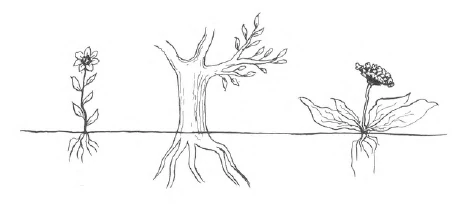
[ 14 ] Now we think the story goes something like this: as if the plant were keeping everything down there in the soil. It wants to unfurl its roots, but can’t manage it. It wants to unfurl its leaves, but can’t manage it. Only up there—what would otherwise be inside the flower—unfolds: a mushroom emerges. And if it comes down to it, and the roots down there fail and only leaves come out: ferns emerge. These are all different forms, but they are all plants.”
[ 15 ] Show the child the buttercup—how it spreads its little roots, how it has its five yellow, fringed petals. Then show them the tree—how the herbaceous plants grow on it first; then the composite flowers; then the mushroom; then the fern—not in a very scientific way, but so that the children become generally familiar with the shapes. Then say to the child: “Well, what do you actually think—why has the mushroom remained a mushroom? Why did the tree become a tree?—Let’s compare the mushroom with the tree. What’s the difference there? Isn’t it as if the earth, in its power, had pushed itself outward—just as if its innermost essence had pushed itself out of the tree into the outer space, upward, to develop the blossoms and fruits out there? And in the case of the mushroom, it has kept inside what would otherwise grow up above the earth, and the mushrooms are only the very top. With the mushroom, the tree is underground; it exists only in its vital forces. The mushroom is what would otherwise be the outermost part of the tree. When many, many mushrooms spread out above the earth, it is as if there were a tree down there, only it is inside the earth. When we see a tree, it is as if the earth had pushed itself up, turned itself inside out, and brought its innermost essence to the outside.”
[ 16 ] Now you’re getting closer to how things really are: “When mushrooms grow there—with those growing mushrooms—the earth absorbs something that it then channels outward when it causes trees to grow. So when the earth allows mushrooms to grow, it retains within itself the power of the growing tree. But when the earth allows trees to grow, it directs the tree’s growing power outward.”
[ 17 ] Now you have something that, when summer comes, is not inside the earth but comes out of the earth; and when it is winter, it goes back down into the earth. — “When it is summer, the earth sends its own power into the blossoms through the tree’s power, allowing them to unfold, and when it is winter, it draws them back into itself. Where, actually, is the power that circulates outside in the trees in summer—manifesting itself only slightly in the violet, but greatly in the trees—during winter? It is down there in the earth in winter. And what do the trees, the composite flowers, and all the rest do when it is the depths of winter? Then they unfold entirely beneath the earth; there they are, inside the earth, unfolding the soul life of the earth. The ancients knew this. That is why they did not set Christmas—a time for seeking the soul life—in the summer, but in the winter.
[ 18 ] Just as with human beings—when they fall asleep, their inner life turns outward, and when they wake up, it turns inward, toward the body—so it is with the Earth as well. In summer, when she sleeps, she sends her sap-bearing power outward. In winter, it draws it back, awakening with all these various forces within itself. Think, children, how this Earth perceives everything, feels everything! For what you see all summer long in blossoms and leaves—what bursts forth, grows, and blooms in the buttercups, the roses, and the carnations—in winter it is beneath the earth, and what lies beneath the earth feels, rages, and rejoices.”
[ 19 ] This is how one gradually comes to understand the concept of life that exists underground during the winter. That is the truth! And it is good to teach this to children. This is not something that materialistic people might consider mere fantasy. But it leads one to what truly constitutes the whole of plant life. The children are led away from the usual notion of “merging with the plants”—that is, what drives the sap up through the earth in the summer heat and draws it back into the earth in the winter—toward this ebb and flow.
[ 20 ] In this way, you come to understand what the true soul life of the Earth is, as reflected in the plants. Ferns, mosses, and fungi develop underground everything they lack, yet it remains etheric substance; it does not become physical substance. When this etheric plant emerges above the Earth’s surface, the part that breaks through is transformed—through the action of external forces—into these rudimentary leaves, which are the fungi, mosses, and ferns. Beneath a patch of moss, or an area overgrown with fungi, there is something like a giant tree, and if the earth cannot consume what is down there, cannot retain it, then it pushes its way outward.
[ 21 ] The tree is a small part of the earth itself—trunk and branches. Only what remains down there in the mushrooms and ferns is brought to the surface. So that if the tree were slowly pushed back into the earth, it would change everything; if one were to submerge it, the leaves and blossoms would turn into ferns, mosses, and mushrooms, and winter would then come for it. But it eludes the onset of winter. It is that which eludes the onset of winter to some extent. But if I could grab such a mushroom or fern by the root and pull it further and further out of the earth, so that what is etheric substance at the bottom were exposed to the air, I would pull out an entire tree, and what were mushrooms would become flowers on the outside and look like trees. And the annual plants stand right in the middle. The composite flower, in a single form, is what then arises there. If I were to send the composite flower down, then a multitude of individual flowers would also develop. The composite flower is something one might call a tree that has sprouted too quickly.
[ 22 ] In this way, a desire can also live within the earth. The earth feels the need to let the desire sink into the realm of sleep. It does this in the summer, and the desire rises up as a plant. It only becomes visible above ground as a water lily. Below, in the earth, it lives as a desire; above, it becomes a plant.
[ 23 ] The plant world is the visible manifestation of the Earth’s soul, and can therefore be compared to the human soul. But one should not merely make comparisons; rather, one must grasp the actual forms of the plants. Only through a comprehensive comparison can one arrive at an understanding of the individual plants.
[ 24 ] You will compare a light sleep to ordinary plants, waking during sleep to mushrooms—where there are many mushrooms, there is a spot where the earth is awake during the summer—and a very deep, sound sleep to trees. From this you can see that the earth does not sleep like a human being, but rather that in different places the earth sometimes sleeps more, sometimes is more awake, sometimes sleeps more, and sometimes is more awake. So too with human beings, who, after all, experience sleeping, waking, and dreaming simultaneously and side by side in the eyes and the other sense organs.
[ 25 ] Assignment for tomorrow: Create a list and organize it as follows: on the left, a catalog of the characteristics of the human soul, starting with thought and proceeding through all emotional states—feelings of pleasure and displeasure, active and intense emotions, anger, grief, and so on—down to the will. Certain plant forms can be compared to this map of the human soul.
[ 26 ] On the right, you then list the corresponding individual plant classifications, so that in this section you have the “thought plants” at the top, the “will plants” at the bottom, and all the other plants in the middle [all shades in between].
| Psychological Expressions | Plant Genera |
|---|---|
| Feelings of Dislike: Feelings of Pleasure: Active, intense emotions: Grief: From thought through feelings to the will |
Thought plants ↓ Will plants |
[ 27 ] Rudolf Steiner then provides a clear explanation of the Pythagorean theorem and refers to an article by Dr. Ernst Müller—in Ostwald’s *Annalen der Naturphilosophie*: “Remarks on an Epistemological Foundation of the Pythagorean Theorem.”

In the drawing, the red portion of the area of the two leg squares is already contained within the hypotenuse square. The remaining portion of this leg square area is brought into alignment with the uncovered areas within the hypotenuse square by shifting the blue and green triangles in the direction of the arrows.
[ 28 ] Rudolf Steiner: You have to cut the whole thing out of cardboard; only then does it become clear.