

The Art of Education
GA 295
30 August 1919, Stuttgart
Translated by Steiner Online Library
Ninth Seminar Discussion
[ 1 ] Speaking Exercises:
Don't take from me what, if I give it to you willingly, makes you happy.
[ 2 ] Rudolf Steiner: The saying is intended more for the faculty of meaning, so that you have the following: First, a short sentence: “Do not take from me,” and then the sentence: “what makes you happy,” which is, however, interrupted by the other: “if I willingly give it to you.” The intention is for this to come across in speech. Note that you pick up again the same pattern of emphasis that you omitted with “what” and reintroduce with “you.”
Truly wise
Gloriously armed
Viciously avenging
Calmly rolling
Penitent steedsDon’t take nuns into tireless mills
Whistling cleverly
Priestly horses
Tending plows
Enclosing peaches
[ 3 ] Weekly verse (last week of August) from the “Seelenkalender”:
I feel a foreign power taking root
Strengthening me and bestowing itself upon me,
I sense the seed maturing
And a luminous premonition weaving
Within, the power of selfhood.
[ 4 ] Rudolf Steiner: Now we come to today’s challenging task. Yesterday I asked you to think about how you would like to structure the lessons in which you plan to work through the lower and higher plants with the children using some kind of example—in the same spirit that I demonstrated to you with the octopus, the mouse, the horse, and the human being, showing how this should be done for animals. I would just like to preface this by saying that proper instruction must have the study of animals precede the treatment of the natural-historical relationships among plants. The reason for this will become clear as you make an effort—to the extent that you can provide examples using one plant or another—to characterize the plant lesson.
[ 5 ] Well, perhaps it would be a good idea to start by asking: Who has taught botany before? That person could get things started. The others could then follow their lead.
If Karl Stockmeyer were to choose a specific plant as an example, he would choose the apple tree... The plant has an instinctive yearning for the sun. The blossoms turn toward the sun, even before it has risen. Draw attention to the difference between the life of desire in animals and humans, and the plant’s pure striving to turn toward the sun. In its purity, the plant represents a goal, an ideal, for human beings. The plant cannot live at all without light. Then explain to the child the concept of the plant’s being caught between the sun and the earth. At every opportunity, mention the relationship between the plant and its environment, especially the contrast between plants and humans, and between plants and animals. Use this to awaken ethical impulses in the child. Humans, too, could not live without plants; the child should learn to sense this. Discuss the plant’s inhalation and exhalation. Help the child sense that it is precisely from “stale” air, through the power of the sun, that the plant rebuilds what later serves as food for humans. When discussing humans’ dependence on food, point out the importance of a good harvest and so on. On the growth process: Every plant, even a leaf, grows only at the base, not at the tip. The actual growth process is always concealed. The leaf, which grows out from the interior of the plant and exposes itself to the light, thereby loses its true life and approaches death. That which is truly alive always remains hidden.
[ 6 ] Rudolf Steiner: What does it mean to say that a leaf grows only from the base? It is the same with human fingernails. And if you consider other parts of the human body—the skin, the surface of the hand, and deeper layers—it is the same there as well. What, then, does growth actually consist of?
Karl Stockmeyer: Essentially, it involves pushing the dead out of the living.
[ 7 ] Rudolf Steiner: Yes, that is correct. All growth is a pushing forth of the living from within and a dying off and gradual peeling away of the outer layer. Therefore, nothing can ever grow onto the outside. The substantial must always push forward from the inside to the outside and peel away at the surface. This is the general law of growth—that is, the relationship between growth and matter.
Karl Stockmeyer: One can gently suggest that matter need not at all be regarded as the primal substance; that one never sees matter transforming into the living, but rather always sees the living transforming into the dead. We can build on this by considering the leaf. For what happens to the leaf—that it actually dies when it exposes itself to the sun, sacrificing itself, so to speak—occurs in a heightened form in the flower. It dies once it has been fertilized. Only what is hidden within remains alive and continues to develop. —I have no specific mental image of how one should approach the lower plants. Perhaps one could draw attention to the fact that there are plants—such as fungi—that bear a resemblance to the seeds of higher plants, while the lower plants resemble, above all, the leaves of plants. Perhaps by highlighting the similarities between higher and lower plants, one can bring order to the matter.
[ 8 ] Rudolf Steiner: You have said many good things, but it would be desirable for the student to become familiar with the parts of a single plant in the course of such a presentation. After all, you are compelled to speak constantly about the parts of the plant—the leaf, the flower, and so on. It would be good, then, if the student became familiar with certain parts of the plant, following the principle you have correctly chosen: observing the plant in relation to the sun and the earth. There needs to be some life brought into the observation of plants, and from there the bridge must then be built to the human being. You have not yet succeeded in building this bridge, for what you have said consists more or less of utilitarian accounts—how plants are useful to humans—or of external comparisons. What needs to be worked out here—so that the child in particular can truly benefit greatly from such an observation—is this: After clarifying the relationship between animals and humans, one must also strive to clarify the relationship between plants and humans. For it is usually around the eleventh age that we begin to deal with such matters, at which point we can take into account what the child has already learned—or rather, that the child has already learned these things in some way and must now apply them. —We must not fail to present the plant itself, in accordance with its form, in a way that is accessible to the child’s comprehension.
Rudolf Meyer: Children are shown the germination process, using a bean as an example. First, the bean as a seed, then the sprout at various stages. The plant’s changes throughout the seasons are demonstrated.
[ 9 ] Rudolf Steiner: This is something that, strictly speaking, should only be undertaken with students who are already past the age of fourteen or fifteen. If you were to do that, you would see for yourself that children who are still in elementary school cannot yet truly understand the process of germination. It would therefore be premature to introduce the process of germination to younger children—the story about the bean and so on. Internally, this is very foreign to the children.
Rudolf Meyer: I just wanted to point out the similarities between a young plant and a young animal—as well as the differences. The animal is cared for by its mother until it can provide for itself; the plant is sent out into the world while still small. I wanted to present the matter in a more lighthearted way.
[ 10 ] Rudolf Steiner: These sentimental mental images are also unsuitable for children. They would not resonate with children.
Rudolf Meyer: Can parts of a plant be compared to parts of the human body? For example, the root to the head, and so on?
[ 11 ] Rudolf Steiner: You must place the plants—as Mr. Ts. correctly described—within the context of nature as a whole: the sun, the earth, and so on; and you must, as it were, leave the plant in connection with the world. Then you will arrive at a perspective that, if properly structured, will already strike a chord of understanding even in a child.
Johannes Geyer describes how plants and humans can be compared—for example, a tree and a human: torso = trunk; limbs = branches and twigs; head = root system. When we eat, food travels from top to bottom in humans, but from bottom to top in trees. Differences: Humans and animals can move freely and experience pleasure and suffering, whereas plants cannot. Each plant species corresponds—though only outwardly—to a human character trait: the oak = pride, and so on; lichens and mosses are modest.
[ 12 ] Rudolf Steiner: This says a great deal, but of course no attempt has yet been made to introduce the plant itself—in terms of its forms—to the child.
Rudolf Treichler: I thought it might be possible to translate this into something spiritual: Just as a plant forms leaf after leaf, leading up to the flower, so too can human beings, in a sense, develop upward. But that might become too abstract in form. I’ve already had the idea of depicting plants as the hair of the earth in a mythological sense. I would like to associate minerals with bones, plants with hair, and plant sap with blood. The green plant sap becomes red blood in animals and humans. The plant is more innocent; it has “purer blood” in the figurative sense. The fact that it ultimately must serve as food for animals and humans could illustrate its connection to the entire order of nature. When plants are cut down or mowed, they experience a sense of liberation; when they are uprooted, it causes them pain. Is it appropriate to point this out, or is that asking too much of the children? The plant has no voice, no language. First, I would have shown the children the mosses—lichens, mosses, and ferns. (Coral, which lies between plants and animals.) Then move on to the grasses, which are not true flowers like the actual flowers. Then to shrubs and trees.
[ 13 ] Rudolf Steiner: How about if you tried the following, for example? You could ask something like: “Have you ever gone for a walk toward the end of summer? Haven’t you seen those kinds of flowers growing in the fields—when you blow on them, bits of them fly away. They have these little little fans that fly away. Then you must have seen these flowers a little earlier, too, when we weren’t quite so close to summer yet. Back then, it looked as if there were only the yellow, leaf-like structures at the top. And even earlier, closer to spring, there were only the green leaves, which are very sharply notched.

[ 14 ] What we’re looking at here, at three different times, is always the same plant! It’s just that at first it’s mainly green leaves, then it’s mainly flowers, and later it’s mainly fruit. Because those are just the fruits flying around. The whole thing is a dandelion! First it grows leaves—the green ones; then it produces flowers; and finally it bears fruit. How does all this happen? How is it that this dandelion, which you know, appears first with only green leaves, then with flowers, and finally with little fruits?
[ 15 ] Here’s why: When the green leaves sprout from the ground, it’s not that hot yet in the year. The heat isn’t that strong yet. But around the green leaves—what’s there? You know. It’s something you only feel when the wind blows, but it’s always around you: the air. You know this, of course; we’ve already talked about it. The air is primarily what brings forth the green leaves, and when the air becomes more infused with warmth—when it gets warmer—the leaves are no longer just leaves; the topmost leaves turn into flowers.
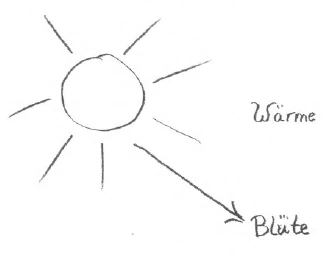
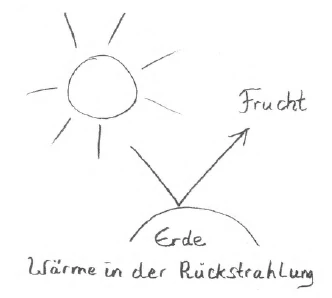
[ 16 ] But the heat doesn’t just go to the plant; it also goes into the earth and then back again. You’ve surely been in a place where a piece of metal was lying. There you will have noticed that the metal first absorbs heat from the sun and then radiates it back out again. Actually, every object does this. And this is how heat works: when it’s still shining down, when the earth hasn’t gotten quite that warm yet, that’s when the flower forms. And when the heat radiates back up from the earth toward the plant, that’s when the fruit forms. That’s why the fruit has to wait until fall.”
[ 17 ] If you do it this way, you introduce the organs, but at the same time you relate these organs to conditions of air and heat. Now you can take this line of thought further, and in this way you can try to elaborate on the idea introduced at the very beginning of today’s lecture: relating plants to the external elements. This will lead you to bring the morphological, the form of the plants, into some contact with the outside world as well. Try doing that.
Caroline von Heydebrand, Herbert Hahn, and Hertha Koegel provide detailed responses to the questions posed [regarding botany instruction]; Hermann Heisler does as well.
[ 18 ] Rudolf Steiner: Many excellent points have been made, but we must work toward giving the children an overview of plants: first the lower ones, then the middle ones, then the higher ones. The scholarly aspects can be left out entirely. Creating a general overview of plants is not easy, but it can become something very significant for the classroom, and this can be developed through the plant world.
[Several teachers provide more detailed explanations. Hertha Koegel says, “The root serves to nourish the plant.”]
[ 19 ] Rudolf Steiner: One should avoid the term “serve.” It is not the root that “serves” as nourishment; rather, the root is connected to the water life of the earth, to the sap life, while the leaves develop in the air. But what the plant draws from the soil is not its primary source of nourishment; rather, that is the carbon from above, from the air. The plant absorbs nourishment from above.
[ 20 ] Children won't immediately grasp the concept of metamorphosis, but they will understand the connection between water and roots, air and leaves, and warmth and flowers.
[Hermann Heisler wants to describe the process of fertilization.]
[ 21 ] It is not a good idea to discuss the process of fertilization in plants too early—at least not at the age when one begins to study botany. The reason is not that the child lacks an understanding of this process. One can describe it, but one will find no inner understanding of it in the child.
[ 22 ] This is because the process of fertilization in plants is not nearly as remarkably extraordinary as is assumed in today’s abstract, scientific era. Just read Goethe’s beautiful essays from the 1820s, where he wrote about “pollination” and so on, where he defends metamorphosis against the actual process of fertilization, and where he rails at length against the fact that people consider it so terribly important to depict the fields as a perpetual, continuous wedding bed. Goethe resented the fact that too much emphasis was placed on the process of fertilization in plants. Metamorphosis is far more important than fertilization. Even if we can no longer share Goethe’s belief today that fertilization is actually a secondary matter and that the plant grows primarily through metamorphosis, through itself—even if, according to current scientific understanding, the process of fertilization must be regarded as important— it remains true that we are actually doing a disservice by emphasizing the process of fertilization in plants as much as we do today. We must give it less prominence and instead focus on the plant’s relationship to its environment. It is far more important to describe how air, heat, light, and water affect the plant than to focus on this abstract process of fertilization, which is given such prominence today. I would like to emphasize this point in particular. And because this is truly a crux of the matter and of particular importance, I would like you to cross this Rubicon and continue exploring in this direction: Seek out the correct methodology, the correct way of treating plants.
[ 23 ] I would like to point out that you might easily ask: What are the similarities between animals and humans? You will find a wide variety of opinions. But the method of external comparison breaks down very quickly when one looks for similarities between plants and humans. Yet one might also ask: Are we perhaps simply looking in the wrong place when we seek such comparisons?
[ 24 ] What came closest to what we were supposed to be discussing here was what Pastor Geyer touched upon but then dropped and did not elaborate on.
[ 25 ] We can now start from something you already know, but which you cannot teach a child at that age. However, perhaps by the time of our next meeting, you can think about how to express what you know very well—albeit in a more theoretical sense—in terms a child can understand.
[ 26 ] Well, we can’t directly compare human beings, as they appear to us, with plants, but there are certain similarities. Yesterday I tried to sketch the human torso as a kind of imperfect sphere. What belongs to it—what one would get if one were to complete the sphere—has a certain resemblance to the plant in its interrelationship with the human being. Yes, one could go even further and say: If you were to take the human being—especially with regard to the middle senses, the sense of warmth, the sense of sight, the sense of taste, and the sense of smell—forgive the comparison! You would have to translate this into a childlike form—“stuff it,” so to speak—and you would obtain all kinds of plant forms. Simply by stuffing a soft material into the human being, it would of its own accord take on plant forms. The plant world is, in a certain sense, a kind of negative for the human being: it is the complement.
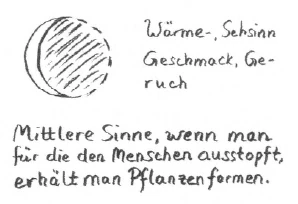
[ 27 ] In other words: When you fall asleep, your true soul leaves your body; when you wake up, your soul—your “I” and your true soul—returns to your body. You cannot really compare this body, which remains lying in bed, to the plant world. But you can certainly compare the plant world to the soul itself, which goes out and comes in. And when you walk through the fields and meadows and see plants glowing with their blossoms, you can quite easily ask yourself: What kind of temperament is coming out of them? It’s fiery! — You can compare these bursting forces, which meet you from the blossoms, to soul qualities. - Or you walk through the forest and see sponges and mushrooms, and ask yourself: What kind of temperament is coming out of that? Why isn’t it out in the sun? These mushrooms are the phlegmatics.
[ 28 ] So when you turn to the spiritual realm, you will find points of comparison with the plant world everywhere. Just try to develop these insights! While you must compare the animal kingdom more with the physicality of the human being, you must compare the plant kingdom more with the human soul—with that which “fills” the human being, specifically fills him as a soul, when he wakes up in the morning. The plant kingdom complements the human being just as his soul complements him. If we were to “fill out” the forms, we would obtain plant forms. You would also see—if you were able to preserve a human being like a mummy, and upon removing all the blood vessels and nerve pathways, leaving them empty, and then pouring a very soft substance into the hollows—that you would obtain all manner of forms through the hollow structures of the human body.
[ 29 ] The plant world relates to human beings in the way I have just explained to you, and you must try to make it clear to the children how the roots are more closely related to human thoughts, and the flowers more closely to human feelings—indeed, even to emotions.
[ 30 ] This is why the most perfect plants—the higher flowering plants—have the least animal-like characteristics. The most animal-like characteristics are found in fungi and the lowest forms of plants, which are also the least comparable to the human soul.
[ 31 ] So work toward extending this idea—of starting from the spiritual and seeking out the plant characteristics—across the widest variety of plants. In doing so, you characterize the plants in such a way that some develop the fruit characteristic more strongly: the fungi and so on; while others develop the leaf character more: ferns, the lower plants; even the palms have their mighty leaves. It’s just that these organs are developed in different ways. A cactus is a cactus precisely because its leaves grow in a sprawling manner; its flower and fruit are merely something interspersed among the sprawling leaves.
[ 32 ] So try to translate the idea I hinted at to you into something truly childlike. Use your imagination so that by next time you can vividly describe the plant world across the earth—as something that, like the soul of the earth, shoots up into growth and blossoms, the visible, the soul that is revealed.
[ 33 ] And consider the various regions of the Earth—the warm zone, the temperate zone, and the cold zone—in terms of their predominant plant life, just as the various sensory realms within the human soul each make their own contributions. Try to understand how one type of vegetation can be compared to the world of sound that a person takes into their soul. How another type of vegetation can be compared to the world of light, another to the world of smell, and so on.
[ 34 ] Then let this thought take root, so that you can understand the difference between annual and perennial plants, and between the flora of Western, Central, and Eastern Europe. Let the thought take root that, in fact, the whole earth sleeps in the summer and wakes in the winter.
[ 35 ] You see, when you do something like this, you will awaken in the child a deep appreciation for meaning and spirituality. The child will later understand much better, once he or she is a fully grown adult, how nonsensical it is to believe that a person, in terms of his or her soul, ceases to exist in the evening and begins again in the morning—if you have compared the correspondence between body and soul in human beings to the interrelationship that exists between the human world and the plant world, just as it does between body and soul. How, then, does the earth affect the plant? The earth affects the plant just as the human body affects the soul. The plant world is everywhere the opposite of the human world, so that when you consider the plant world, you must compare the human body to the earth—and to something else as well; you will have to figure that out for yourselves. I only wanted to offer some hints so that you can use your imagination to come up with even more ideas by next time. Then you will see that you do the children a great deal of good when you teach them not external comparisons, but internal ones.