

The Art of Education
GA 295
30 August 1919, Stuttgart
Translate the original German text into any language:
Versions Available:
Neunte Seminarbesprechung
Ninth Seminar Discussion
[ 1 ] Sprechübungen:
[ 1 ] Speaking Exercises:
Nimm mir nicht, was, wenn ich freiwillig dir es reiche, dich beglückt.
Don't take from me what, if I give it to you willingly, makes you happy.
[ 2 ] Rudolf Steiner: Der Spruch ist mehr gemeint für die Sinnabteilung, sodaß Sie folgendes haben: Erst einen Satz, der kurz ist: «Nimm mir nicht», und dann den Satz: «was dich beglückt», der aber unterbrochen ist durch den anderen: «wenn ich freiwillig dir es reiche». Es ist die Absicht diese, daß das im Sprechen zur Geltung kommt. Man muß merken, Sie nehmen denselben Betonungscharakter wiederum auf, den Sie bei «was» ausgelassen haben und bei «dich» wiederum einsetzen lassen.
[ 2 ] Rudolf Steiner: The saying is intended more for the faculty of meaning, so that you have the following: First, a short sentence: “Do not take from me,” and then the sentence: “what makes you happy,” which is, however, interrupted by the other: “if I willingly give it to you.” The intention is for this to come across in speech. Note that you pick up again the same pattern of emphasis that you omitted with “what” and reintroduce with “you.”
Redlich ratsam
Rüstet rühmlich
Riesig rächend
Ruhig rollend
Reuige RosseNimm nicht Nonnen in nimmermüde Mühlen
Pfiffig pfeifen
Pfäffische Pferde
Pflegend Pflüge
Pferchend Pfirsiche
Truly wise
Gloriously armed
Viciously avenging
Calmly rolling
Penitent steedsDon’t take nuns into tireless mills
Whistling cleverly
Priestly horses
Tending plows
Enclosing peaches
[ 3 ] Wochenspruch (letzte August-Woche) aus dem «Seelenkalender»:
[ 3 ] Weekly verse (last week of August) from the “Seelenkalender”:
Ich fühle fruchtend fremde Macht
Sich stärkend mir mich selbst verleihn,
Den Keim empfind ich reifend
Und Ahnung lichtvoll weben
Im Innern an der Selbstheit Macht.
I feel a foreign power taking root
Strengthening me and bestowing itself upon me,
I sense the seed maturing
And a luminous premonition weaving
Within, the power of selfhood.
[ 4 ] Rudolf Steiner: Jetzt kommen wir zu unserer heutigen schweren Aufgabe. Ich habe Sie gestern gebeten, darüber nachzudenken, wie Sie die Unterrichtsstunden einrichten wollen, in denen Sie die niederen und die höheren Pflanzen in irgendeinem Beispiel mit den Kindern durchnehmen wollten, so aus demselben Geiste heraus, wie ich es Ihnen gezeigt habe bei Tintenfisch, Maus, Pferd und Mensch, wie man das für die Tiere machen muß. Vorausschicken will ich nur, daß ein sachgemäßer Unterricht die Betrachtung über die Tiere vorausgehen lassen muß der Behandlung der naturgeschichtlichen Verhältnisse an den Pflanzen. Das wird sich nun ergeben, warum das so ist, indem Sie sich anstrengen werden, soweit Sie Beispiele geben können an der einen oder anderen Pflanze, die Pflanzenunterrichtsstunde zu charakterisieren.
[ 4 ] Rudolf Steiner: Now we come to today’s challenging task. Yesterday I asked you to think about how you would like to structure the lessons in which you plan to work through the lower and higher plants with the children using some kind of example—in the same spirit that I demonstrated to you with the octopus, the mouse, the horse, and the human being, showing how this should be done for animals. I would just like to preface this by saying that proper instruction must have the study of animals precede the treatment of the natural-historical relationships among plants. The reason for this will become clear as you make an effort—to the extent that you can provide examples using one plant or another—to characterize the plant lesson.
[ 5 ] Nun wird es ja vielleicht gut sein, wenn wir zuerst fragen: Wer hat schon Pflanzenunterricht gegeben? Der könnte zunächst einmal anfangen. Darnach könnten sich die anderen richten.
[ 5 ] Well, perhaps it would be a good idea to start by asking: Who has taught botany before? That person could get things started. The others could then follow their lead.
Karl Stockmeyer würde, wenn er eine bestimmte Pflanze als Beispiel wählen sollte, den Apfelbaum wählen ... Die Pflanze hat ein triebmäßiges Sehnen nach der Sonne. Die Blüten wenden sich der Sonne zu, auch wenn sie noch nicht aufgegangen ist. Aufmerksam machen auf den Unterschied zwischen dem Wunschleben des Tieres und des Menschen, und dem reinen Streben der Pflanze, sich der Sonne zuzuwenden. Die Pflanze in ihrer Reinheit stellt für den Menschen ein Ziel, ein Ideal hin. Die Pflanze kann ohne Licht überhaupt nicht leben. Dann dem Kinde klarmachen den Begriff des Eingespanntseins der Pflanze zwischen Sonne und Erde. Bei jeder Gelegenheit die Beziehung zwischen der Pflanze und ihrer Umgebung erwähnen, besonders die Gegensätzlichkeit zwischen Pflanze und Mensch, Pflanze und Tier. Hieraus erwecken ethische Impulse für das Kind. Der Mensch könnte auch nicht leben ohne die Pflanze; das soll das Kind empfinden lernen. Das Aus- und Einatmen der Pflanze besprechen. Das Kind fühlen lassen, dass gerade aus der «verdorbenen» Luft durch die Kraft der Sonne die Pflanze das wieder aufbaut, was nachher dem Menschen zur Nahrung dient. Wenn man die Abhängigkeit des Menschen bezüglich der Nahrung bespricht, kann man hinweisen auf die Wichtigkeit einer guten Ernte und so weiter. Über den Wachstumsprozess: Jede Pflanze, selbst das Blatt, wächst nur am Grunde, nicht aber an der Spitze. Der eigentliche Wachstumsprozess ist stets verhüllt. Das Blatt, das herauswächst aus dem Innern der Pflanze und sich dem Lichte aussetzt, verliert dadurch das eigentliche Leben, kommt dem Sterben nahe. Das eigentlich Lebende bleibt immer verborgen.
If Karl Stockmeyer were to choose a specific plant as an example, he would choose the apple tree... The plant has an instinctive yearning for the sun. The blossoms turn toward the sun, even before it has risen. Draw attention to the difference between the life of desire in animals and humans, and the plant’s pure striving to turn toward the sun. In its purity, the plant represents a goal, an ideal, for human beings. The plant cannot live at all without light. Then explain to the child the concept of the plant’s being caught between the sun and the earth. At every opportunity, mention the relationship between the plant and its environment, especially the contrast between plants and humans, and between plants and animals. Use this to awaken ethical impulses in the child. Humans, too, could not live without plants; the child should learn to sense this. Discuss the plant’s inhalation and exhalation. Help the child sense that it is precisely from “stale” air, through the power of the sun, that the plant rebuilds what later serves as food for humans. When discussing humans’ dependence on food, point out the importance of a good harvest and so on. On the growth process: Every plant, even a leaf, grows only at the base, not at the tip. The actual growth process is always concealed. The leaf, which grows out from the interior of the plant and exposes itself to the light, thereby loses its true life and approaches death. That which is truly alive always remains hidden.
[ 6 ] Rudolf Steiner: Was heißt das, ein Blatt wächst nur am Grunde? Bei den Fingernägeln des Menschen ist es ebenso. Und wenn Sie etwas anderes am Menschen nehmen, die Haut, die Handoberfläche und tie fer gelegene Teile, da ist es ebenso. Worin besteht denn eigentlich das Wachsen?
[ 6 ] Rudolf Steiner: What does it mean to say that a leaf grows only from the base? It is the same with human fingernails. And if you consider other parts of the human body—the skin, the surface of the hand, and deeper layers—it is the same there as well. What, then, does growth actually consist of?
Karl Stockmeyer: Eigentlich in einem Herausschieben des Toten aus dem Lebenden.
Karl Stockmeyer: Essentially, it involves pushing the dead out of the living.
[ 7 ] Rudolf Steiner: Ja, so ist es. Alles Wachsen ist ein Herausschieben des Lebendigen aus dem Inneren und ein Absterben und allmähliches Abschälen des Äußeren. Daher kann niemals außen etwas anwachsen. Es muß sich immer das Substantielle von innen nach außen vorschieben und an der Oberfläche abschuppen. Das ist das allgemeine Gesetz des Wachstums, das heißt des Zusammenhanges des Wachstums mit der Materie.
[ 7 ] Rudolf Steiner: Yes, that is correct. All growth is a pushing forth of the living from within and a dying off and gradual peeling away of the outer layer. Therefore, nothing can ever grow onto the outside. The substantial must always push forward from the inside to the outside and peel away at the surface. This is the general law of growth—that is, the relationship between growth and matter.
Karl Stockmeyer: Man kann zart andeuten, dass man durchaus nicht die Materie als Ursprüngliches anzusehen braucht; dass man niemals die Materie in Lebendiges übergehen sieht, dagegen stets Lebendiges in Totes. Dies weiter aufbauen in der Betrachtung des Blattes. Denn was am Blatt geschieht, dass eigentlich das Blatt stirbt, wenn es sich der Sonne aussetzt, gewissermaßen sich opfert, das geschieht erhöht in der Blüte. Sie stirbt, wenn sie befruchtet ist. Es bleibt bloß das im Innern Verborgene leben, was sich weiterentwickelt. - Ich habe keine bestimmte Vorstellung, wie man die niederen Pflanzen behandeln muss. Vielleicht könnte man aufmerksam machen darauf, dass es Pflanzen gibt wie zum Beispiel die Pilze, die Ähnlichkeit haben mit dem Samen der höheren Pflanzen, die niederen Pflanzen vor allen Dingen Ähnlichkeit haben mit den Blättern der Pflanzen. Vielleicht kann man durch das Hervorheben der Ähnlichkeiten zwischen den höheren und niederen Pflanzen die Sache ordnen.
Karl Stockmeyer: One can gently suggest that matter need not at all be regarded as the primal substance; that one never sees matter transforming into the living, but rather always sees the living transforming into the dead. We can build on this by considering the leaf. For what happens to the leaf—that it actually dies when it exposes itself to the sun, sacrificing itself, so to speak—occurs in a heightened form in the flower. It dies once it has been fertilized. Only what is hidden within remains alive and continues to develop. —I have no specific mental image of how one should approach the lower plants. Perhaps one could draw attention to the fact that there are plants—such as fungi—that bear a resemblance to the seeds of higher plants, while the lower plants resemble, above all, the leaves of plants. Perhaps by highlighting the similarities between higher and lower plants, one can bring order to the matter.
[ 8 ] Rudolf Steiner: Sie haben ja manches Gute gesagt, aber es wäre doch zu wünschen, daß der Zögling im Verlaufe einer solchen Darstellung bekannt würde mit den Gliedern einer einzelnen Pflanze. Sie sind ja auch genötigt, fortwährend von den Gliedern der Pflanze zu sprechen, vom Blatt, Blüte und so weiter. Es wäre nun gut, wenn der Zögling bekannt würde mit gewissen Gliedern der Pflanze, nach dem Prinzip, das Sie ja richtig gewählt haben: Die Pflanze an Sonne und Erde betrachten. Da muß etwas Leben hineinkommen in die Pflanzenbetrachtung, und von da aus muß dann die Brücke geschlagen werden zum Menschen. Es ist Ihnen noch nicht gelungen, diese zu schlagen, denn das, was Sie gesagt haben, sind mehr oder weniger Utilitätsgeschichten, wie die Pflanzen dem Menschen nützlich sind, oder auch äußere Vergleiche. Was da herausgearbeitet werden muß, damit wirklich gerade das Kind sehr viel hat von einer solchen Betrachtung, das ist: Man wird versuchen müssen, nachdem man die Beziehung des Tieres zum Menschen klargelegt hat, doch auch die Beziehung der Pflanze zum Menschen klarzumachen. Denn es ist ja wohl zumeist im elften Jahr, wo wir mit so etwas einzusetzen haben, wo man also berücksichtigen kann, was das Kind schon gelernt hat, oder besser gesagt, daß das Kind die Dinge in irgendeiner Weise schon gelernt hat, die es da verwerten muß. — Nicht versäumt darf werden, die Pflanze selbst, nach ihrer Gestaltung, an die Fassungskraft des Kindes heranzubringen.
[ 8 ] Rudolf Steiner: You have said many good things, but it would be desirable for the student to become familiar with the parts of a single plant in the course of such a presentation. After all, you are compelled to speak constantly about the parts of the plant—the leaf, the flower, and so on. It would be good, then, if the student became familiar with certain parts of the plant, following the principle you have correctly chosen: observing the plant in relation to the sun and the earth. There needs to be some life brought into the observation of plants, and from there the bridge must then be built to the human being. You have not yet succeeded in building this bridge, for what you have said consists more or less of utilitarian accounts—how plants are useful to humans—or of external comparisons. What needs to be worked out here—so that the child in particular can truly benefit greatly from such an observation—is this: After clarifying the relationship between animals and humans, one must also strive to clarify the relationship between plants and humans. For it is usually around the eleventh age that we begin to deal with such matters, at which point we can take into account what the child has already learned—or rather, that the child has already learned these things in some way and must now apply them. —We must not fail to present the plant itself, in accordance with its form, in a way that is accessible to the child’s comprehension.
Rudolf Meyer: Man zeigt den Kindern den Keimprozess, etwa an der Bohne. Zunächst die Bohne als Samenkorn, dann den Keim in verschiedenen Stadien. Man zeigt die Verschiedenheit der Pflanze durch die Jahreszeiten hindurch.
Rudolf Meyer: Children are shown the germination process, using a bean as an example. First, the bean as a seed, then the sprout at various stages. The plant’s changes throughout the seasons are demonstrated.
[ 9 ] Rudolf Steiner: Das ist etwas, was eigentlich rationell erst vorgenommen werden sollte mit Zöglingen, die schon das vierzehnte, fünfzehnte Jahr überschritten haben. Wenn Sie das machen würden, so würden Sie sich überzeugen, daß die Kinder, die noch in der Volksschule sind, den Keimvorgang noch nicht wirklich verstehen können. Das würde also verfrüht sein, den Keimvorgang vor den jüngeren Kindern zu entwickeln, die Geschichte mit der Bohne und so weiter. Innerlich ist das den Kindern sehr fremd.
[ 9 ] Rudolf Steiner: This is something that, strictly speaking, should only be undertaken with students who are already past the age of fourteen or fifteen. If you were to do that, you would see for yourself that children who are still in elementary school cannot yet truly understand the process of germination. It would therefore be premature to introduce the process of germination to younger children—the story about the bean and so on. Internally, this is very foreign to the children.
Rudolf Meyer: Ich wollte auch hier nur auf die Ähnlichkeit aufmerksam machen zwischen der jungen Pflanze und dem jungen Tier, und auch auf die Unterschiede. Das Tier wird von der Mutter versorgt, bis es selbst für seinen Unterhalt sorgen kann, die Pflanze wird klein in die Welt geschickt. Mehr gemüthaft wollte ich die Sache vorbringen.
Rudolf Meyer: I just wanted to point out the similarities between a young plant and a young animal—as well as the differences. The animal is cared for by its mother until it can provide for itself; the plant is sent out into the world while still small. I wanted to present the matter in a more lighthearted way.
[ 10 ] Rudolf Steiner: Auch diese gemüthaften Vorstellungen taugen nicht für das Kind. Sie würden kein Verständnis finden bei dem Kinde.
[ 10 ] Rudolf Steiner: These sentimental mental images are also unsuitable for children. They would not resonate with children.
Rudolf Meyer: Kann man Teile der Pflanze mit dem Menschen vergleichen? Zum Beispiel die Wurzel mit dem Kopfe und so weiter?
Rudolf Meyer: Can parts of a plant be compared to parts of the human body? For example, the root to the head, and so on?
[ 11 ] Rudolf Steiner: Sie müssen die Pflanzen, wie es richtig war bei Herrn Ts. Ausführung, in die ganze Natur, Sonne, Erde und so weiter hineinstellen und müssen die Pflanze gleichsam im Zusammenhang mit der Welt lassen. Dann bekommen Sie eine Betrachtung heraus, die, wenn sie richtig gestaltet wird, auch schon beim Kinde auf ein gewisses Verständnis trifft.
[ 11 ] Rudolf Steiner: You must place the plants—as Mr. Ts. correctly described—within the context of nature as a whole: the sun, the earth, and so on; and you must, as it were, leave the plant in connection with the world. Then you will arrive at a perspective that, if properly structured, will already strike a chord of understanding even in a child.
Johannes Geyer beschreibt, wie man Pflanze und Mensch vergleichen kann, zum Beispiel den Baum mit dem Menschen: Rumpf = Stamm; Gliedmaßen = Äste und Zweige; Kopf = Wurzelwerk. Wenn wir essen, geht die Nahrung beim Menschen von oben nach unten, beim Baum von unten nach oben. Verschiedenheit: Mensch und Tier können sich frei bewegen, können Lust und Leid empfinden, die Pflanze nicht. Jede Pflanzenart entspricht, aber nur äußerlich, einer menschlichen Charaktereigentümlichkeit, Eiche = Stolz und so weiter, Flechten und Moose sind bescheiden.
Johannes Geyer describes how plants and humans can be compared—for example, a tree and a human: torso = trunk; limbs = branches and twigs; head = root system. When we eat, food travels from top to bottom in humans, but from bottom to top in trees. Differences: Humans and animals can move freely and experience pleasure and suffering, whereas plants cannot. Each plant species corresponds—though only outwardly—to a human character trait: the oak = pride, and so on; lichens and mosses are modest.
[ 12 ] Rudolf Steiner: Damit ist wieder vieles gesagt, aber es ist natürlich noch immer nicht der Versuch gemacht worden, die Pflanze selbst, ihren Formen nach, an das Kind heranzubringen.
[ 12 ] Rudolf Steiner: This says a great deal, but of course no attempt has yet been made to introduce the plant itself—in terms of its forms—to the child.
Rudolf Treichler: Ich habe gedacht, es ließe sich vielleicht eben in Geistiges überführen: Wie die Pflanze Blatt nach Blatt bildet, zur Blüte hin, so kann sich auch der Mensch gewissermaßen heraufentwickeln. Aber das würde vielleicht zu abstrakt werden in der Form. Ich habe schon die Idee gehabt, die Pflanzen als Haar der Erde im mythologischen Sinne zu zeigen. Ich möchte das Mineral mit den Knochen, die Pflanzen mit dem Haar, den Pflanzensaft mit dem Blute in Verbindung bringen. Der grüne Pflanzensaft wird zum roten Blut bei Tier und Mensch. Die Pflanze ist unschuldiger; sie hat ein «reineres Blut» im Sinne der Sprache. Dass sie schließlich dem Tier und dem Menschen als Nahrung dienen muss, könnte ihren Zusammenhang zeigen mit der ganzen Naturverwaltung. Wenn die Pflanzen abgeschnitten werden, gemäht werden, haben sie ein Gefühl der Erlösung; wenn sie mit den Wurzeln ausgerissen werden, tut es ihnen weh. Darf man darauf hinweisen oder ist das den Kindern zu viel zugemutet? Die Pflanze hat keinen Laut, keine Sprache. Zunächst hätte ich die Moose den Kindern vorgeführt, Flechten, Moose und Farn. (Koralle zwischen Pflanze und Tier) Dann übergehen zu den Getreidearten, die ja keine Kelchblumen sind wie die eigentlichen Blumen. Dann zu Strauch und Baum.
Rudolf Treichler: I thought it might be possible to translate this into something spiritual: Just as a plant forms leaf after leaf, leading up to the flower, so too can human beings, in a sense, develop upward. But that might become too abstract in form. I’ve already had the idea of depicting plants as the hair of the earth in a mythological sense. I would like to associate minerals with bones, plants with hair, and plant sap with blood. The green plant sap becomes red blood in animals and humans. The plant is more innocent; it has “purer blood” in the figurative sense. The fact that it ultimately must serve as food for animals and humans could illustrate its connection to the entire order of nature. When plants are cut down or mowed, they experience a sense of liberation; when they are uprooted, it causes them pain. Is it appropriate to point this out, or is that asking too much of the children? The plant has no voice, no language. First, I would have shown the children the mosses—lichens, mosses, and ferns. (Coral, which lies between plants and animals.) Then move on to the grasses, which are not true flowers like the actual flowers. Then to shrubs and trees.
[ 13 ] Rudolf Steiner: Wie wäre es, wenn Sie zum Beispiel folgendes machen würden. Sie würden etwa fragen: «Seid ihr noch niemals spazierengegangen gegen den Sommer hin? Habt ihr da nicht auf den Feldern solche Blumen stehen sehen, wenn man sie anbläst, fliegen von ihnen Teile fort. Sie haben so kleine Fächerchen, die fliegen dann fort. Dann habt ihr diese Blumen doch auch etwas früher gesehen, wenn wir noch nicht so nahe am Sommer waren. Da schaut das so aus, daß oben nur die gelben blattartigen Gebilde waren. Und noch früher, mehr dem Frühling zu, da waren nur die grünen Blätter da, die sehr spitz gekerbt sind.
[ 13 ] Rudolf Steiner: How about if you tried the following, for example? You could ask something like: “Have you ever gone for a walk toward the end of summer? Haven’t you seen those kinds of flowers growing in the fields—when you blow on them, bits of them fly away. They have these little little fans that fly away. Then you must have seen these flowers a little earlier, too, when we weren’t quite so close to summer yet. Back then, it looked as if there were only the yellow, leaf-like structures at the top. And even earlier, closer to spring, there were only the green leaves, which are very sharply notched.

[ 14 ] Das, was wir da betrachten, zu drei verschiedenen Zeiten, das ist immer dieselbe Pflanze! Nur ist sie zuerst hauptsächlich grünes Blatt, nachher ist sie hauptsächlich Blüte, und nachher ist sie hauptsächlich Frucht. Denn das sind nur die Früchte, die da herumfliegen. Das Ganze ist ein Löwenzahn! Zuerst bekommt er Blätter, die grünen; dann treibt er Blüten und nachher kriegt er seine Früchte. Wodurch geschieht denn das alles? Wie kommt es denn, daß dieser Löwenzahn, den ihr kennt, sich einmal zeigt bloß mit grünen Blättern, dann mit Blüten und nachher mit Früchtchen?
[ 14 ] What we’re looking at here, at three different times, is always the same plant! It’s just that at first it’s mainly green leaves, then it’s mainly flowers, and later it’s mainly fruit. Because those are just the fruits flying around. The whole thing is a dandelion! First it grows leaves—the green ones; then it produces flowers; and finally it bears fruit. How does all this happen? How is it that this dandelion, which you know, appears first with only green leaves, then with flowers, and finally with little fruits?
[ 15 ] Das kommt davon her: Wenn die grünen Blätter aus der Erde herauswachsen, da ist es noch nicht so heiß im Jahr. Da wirkt noch nicht so stark die Wärme. Aber um die grünen Blätter herum, was ist denn da? Ihr wißt es. Es ist etwas, was ihr nur spürt, wenn der Wind geht, aber immer ist es um euch herum: die Luft. Ihr kennt das ja, wir haben schon davon gesprochen. Die Luft bringt hauptsächlich die grünen Blätter hervor, und wenn dann die Luft mehr durchzogen ist von der Wärme, wenn es wärmer wird, dann bleiben die Blätter nicht mehr Blätter, dann werden die obersten Blätter zur Blüte.
[ 15 ] Here’s why: When the green leaves sprout from the ground, it’s not that hot yet in the year. The heat isn’t that strong yet. But around the green leaves—what’s there? You know. It’s something you only feel when the wind blows, but it’s always around you: the air. You know this, of course; we’ve already talked about it. The air is primarily what brings forth the green leaves, and when the air becomes more infused with warmth—when it gets warmer—the leaves are no longer just leaves; the topmost leaves turn into flowers.
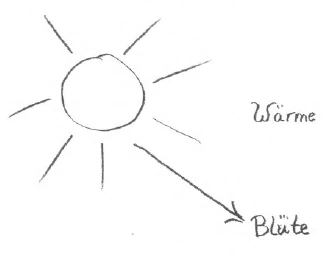
[ 16 ] Aber die Wärme geht ja nicht bloß zur Pflanze hin, sondern sie geht auch zu der Erde und dann wiederum zurück. Ihr seid gewiß schon einmal da gewesen, wo ein Stückchen Blech lag. Da werdet ihr bemerkt haben, daß das Blech die Wärme erst empfängt von der Sonne und dann sie wiederum ausstrahlt. Das tut eigentlich jeder Gegenstand. Und so macht es die Wärme: wenn sie noch herunterstrahlt, wenn die Erde noch nicht gar so warm geworden ist, da bildet sie die Blüte. Und wenn die Wärme wieder zurückstrahlt von der Erde zu der Pflanze herauf, dann bildet sie erst die Frucht. Daher muß die Frucht warten bis zum Herbst.»
[ 16 ] But the heat doesn’t just go to the plant; it also goes into the earth and then back again. You’ve surely been in a place where a piece of metal was lying. There you will have noticed that the metal first absorbs heat from the sun and then radiates it back out again. Actually, every object does this. And this is how heat works: when it’s still shining down, when the earth hasn’t gotten quite that warm yet, that’s when the flower forms. And when the heat radiates back up from the earth toward the plant, that’s when the fruit forms. That’s why the fruit has to wait until fall.”
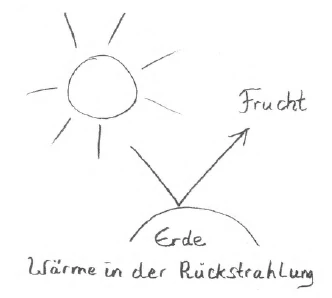
[ 17 ] Wenn Sie es so machen, dann bringen Sie die Organe, aber Sie bringen diese Organe zu gleicher Zeit in Beziehung zu dem, was Luft- und Wärmeverhältnisse sind. Nun können Sie in einer solchen Betrachtung dann weitergehen, und Sie können auf diese Weise versuchen, den zuallererst heute angeschlagenen Gedanken weiter auszuführen, die Pflanzen in Beziehung zu bringen zu den äußeren Elementen. Dadurch kommen Sie dazu, das Morphologische, das Gestaltliche der Pflanzen auch mit der Außenwelt etwas in Berührung zu bringen. Versuchen Sie das einmal zu machen.
[ 17 ] If you do it this way, you introduce the organs, but at the same time you relate these organs to conditions of air and heat. Now you can take this line of thought further, and in this way you can try to elaborate on the idea introduced at the very beginning of today’s lecture: relating plants to the external elements. This will lead you to bring the morphological, the form of the plants, into some contact with the outside world as well. Try doing that.
Caroline von Heydebrand, Herbert Hahn und Hertha Koegel geben längere Ausführungen zu den gestellten Fragen [über den Pflanzenunterricht], Hermann Heisler ebenfalls.
Caroline von Heydebrand, Herbert Hahn, and Hertha Koegel provide detailed responses to the questions posed [regarding botany instruction]; Hermann Heisler does as well.
[ 18 ] Rudolf Steiner: Da ist viel Treffliches gesagt worden, aber man muß darauf hinarbeiten, daß die Kinder eine Übersicht bekommen über die Pflanzen: erst die niederen, dann mittlere, dann höhere. Das Gelehrte kann ganz wegbleiben. Eine Übersicht über die Pflanzen zu schaffen, das ist nicht leicht, aber das kann etwas sehr Bedeutsames werden für den Unterricht, und das kann an der Pflanzenwelt herausentwickelt werden.
[ 18 ] Rudolf Steiner: Many excellent points have been made, but we must work toward giving the children an overview of plants: first the lower ones, then the middle ones, then the higher ones. The scholarly aspects can be left out entirely. Creating a general overview of plants is not easy, but it can become something very significant for the classroom, and this can be developed through the plant world.
[Mehrere Lehrer geben längere Ausführungen. Dabei sagt Hertha Koegel: «die Wurzel dient zur Ernährung der Pflanze».]
[Several teachers provide more detailed explanations. Hertha Koegel says, “The root serves to nourish the plant.”]
[ 19 ] Rudolf Steiner: Den Ausdruck «dienen» sollte man vermeiden. Nicht die Wurzel «dient» zur Ernährung, sondern die Wurzel hängt zusammen mit dem Wasserleben der Erde, mit dem Säfteleben, während sich an der Luft die Blätter entwickeln. Aber was die Pflanze aus dem Boden saugt, ist nicht die hauptsächlichste Nahrung der Pflanze, sondern das ist der Kohlenstoff von oben, aus der Luft. Die Pflanze nimmt Nahrung von oben her auf.
[ 19 ] Rudolf Steiner: One should avoid the term “serve.” It is not the root that “serves” as nourishment; rather, the root is connected to the water life of the earth, to the sap life, while the leaves develop in the air. But what the plant draws from the soil is not its primary source of nourishment; rather, that is the carbon from above, from the air. The plant absorbs nourishment from above.
[ 20 ] Den Metamorphosengedanken werden Kinder unmittelbar nicht aufnehmen, aber den Zusammenhang zwischen Wasser und Wurzel, Luft und Blättern, Wärme und Blüten.
[ 20 ] Children won't immediately grasp the concept of metamorphosis, but they will understand the connection between water and roots, air and leaves, and warmth and flowers.
[Hermann Heisler will den Befruchtungsvorgang schildern.]
[Hermann Heisler wants to describe the process of fertilization.]
[ 21 ] Es ist nicht gut, den Befruchtungsvorgang bei der Pflanze zu früh zu besprechen; jedenfalls nicht in dem Alter, wo man anfängt, Botanik zu treiben. Aus dem Grunde nicht, weil das Kind diesem Befruchtungsvorgang nicht wirklich ein Verständnis entgegenbringt. Man kann ihn schildern, aber man findet beim Kinde dafür kein inneres Verständnis.
[ 21 ] It is not a good idea to discuss the process of fertilization in plants too early—at least not at the age when one begins to study botany. The reason is not that the child lacks an understanding of this process. One can describe it, but one will find no inner understanding of it in the child.
[ 22 ] Das hängt damit zusammen, daß der Befruchtungsvorgang bei der Pflanze gar nicht einmal etwas so furchtbar Hervorragendes ist, als es von der heutigen, abstrakten naturwissenschaftlichen Zeit angenommen wird. Lesen Sie nur einmal die schönen Aufsätze Goethes aus den zwanziger Jahren des 19. Jahrhunderts, wo er über die «Verstäubung» und so weiter geschrieben hat, wo er die Metamorphose verteidigt gegen den eigentlichen Befruchtungsvorgang, und wo er weidlich schimpft darüber, daß die Menschen es für so furchtbar wichtig halten, die Fluren eigentlich als fortwährendes, kontinuierliches Hochzeitsbett zu schildern. Das widerstrebte Goethe, daß man den Befruchtungsvorgang zu sehr in den Vordergrund stellte bei der Pflanze. Da ist die Metamorphose viel wichtiger als der Befruchtungsvorgang. Wenn man auch heute nicht mehr den Glauben Goethes teilen kann, daß eigentlich die Befruchtung etwas Nebensächliches ist und die Pflanze hauptsächlich durch Metamorphose, durch sich selbst wächst, wenn auch heute nach den fortgeschrittenen Erkenntnissen der Befruchtungsvorgang als wichtig angesehen werden muß, so bleibt doch dieses bestehen, daß wir eigentlich schon unrecht tun, wenn wir den Befruchtungsvorgang bei der Pflanze so sehr hervorkehren, wie wir es heute tun. Wir müssen ihn mehr zurücktreten lassen und müssen an diese Stelle die Beziehungen der Pflanze zur Umwelt setzen. Es ist viel wichtiger, zu schildern, wie Luft und Wärme und Licht und Wasser an der Pflanze wirken als diesen abstrakten Befruchtungsvorgang, der heute so sehr in den Vordergrund gestellt wird. Das möchte ich ganz besonders betonen. Und ich möchte, weil dieses wirklich eine Crux ist und von besonderer Wichtigkeit, daß Sie über diesen Rubikon kommen und weiterschürfen nach dieser Richtung: Suchen Sie die richtige Methodik, die richtige Behandlungsweise der Pflanzen.
[ 22 ] This is because the process of fertilization in plants is not nearly as remarkably extraordinary as is assumed in today’s abstract, scientific era. Just read Goethe’s beautiful essays from the 1820s, where he wrote about “pollination” and so on, where he defends metamorphosis against the actual process of fertilization, and where he rails at length against the fact that people consider it so terribly important to depict the fields as a perpetual, continuous wedding bed. Goethe resented the fact that too much emphasis was placed on the process of fertilization in plants. Metamorphosis is far more important than fertilization. Even if we can no longer share Goethe’s belief today that fertilization is actually a secondary matter and that the plant grows primarily through metamorphosis, through itself—even if, according to current scientific understanding, the process of fertilization must be regarded as important— it remains true that we are actually doing a disservice by emphasizing the process of fertilization in plants as much as we do today. We must give it less prominence and instead focus on the plant’s relationship to its environment. It is far more important to describe how air, heat, light, and water affect the plant than to focus on this abstract process of fertilization, which is given such prominence today. I would like to emphasize this point in particular. And because this is truly a crux of the matter and of particular importance, I would like you to cross this Rubicon and continue exploring in this direction: Seek out the correct methodology, the correct way of treating plants.
[ 23 ] Ich mache Sie darauf aufmerksam, daß Sie leicht fragen können: Welches sind die Ähnlichkeiten des Tieres mit dem Menschen? Sie werden mannigfaltige Ansichten finden. Aber die äußere Vergleichsmerhode versagt sehr bald, wenn man sucht nach Ähnlichkeiten der Pflanze mit dem Menschen. Aber man kann sich doch auch fragen: Suchen wir nicht vielleicht bloß falsch, wenn wir solche Vergleiche suchen?
[ 23 ] I would like to point out that you might easily ask: What are the similarities between animals and humans? You will find a wide variety of opinions. But the method of external comparison breaks down very quickly when one looks for similarities between plants and humans. Yet one might also ask: Are we perhaps simply looking in the wrong place when we seek such comparisons?
[ 24 ] Am nächsten kam dem, wovon hier ausgegangen werden sollte, das, was Herr Pastor Geyer berührt hat, aber dann fallen gelassen hat und nicht weiter ausführte.
[ 24 ] What came closest to what we were supposed to be discussing here was what Pastor Geyer touched upon but then dropped and did not elaborate on.
[ 25 ] Wir können jetzt ausgehen von etwas, was Sie ja wissen, was Sie aber dem Kinde im kindlichen Alter nicht beibringen können. Aber Sie können vielleicht bis zu unserer nächsten Zusammenkunft nachdenken darüber, wie Sie das in kindlich-verständliche Worte kleiden können, was Sie mehr theoretisch sehr gut wissen können.
[ 25 ] We can now start from something you already know, but which you cannot teach a child at that age. However, perhaps by the time of our next meeting, you can think about how to express what you know very well—albeit in a more theoretical sense—in terms a child can understand.
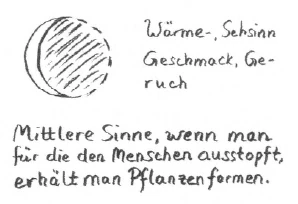
[ 26 ] Also, nicht wahr, unmittelbar vergleichen können wir den Menschen, so wie er uns entgegentritt, nicht mit der Pflanze, aber es gibt gewisse Ähnlichkeiten. Ich habe gestern versucht, den menschlichen Rumpf aufzuzeichnen wie eine Art unvollkommene Kugel. Das, was dazugehört, was man da bekommen würde, wenn man die Kugel ergänzte, das hat nämlich so eine gewisse Ähnlichkeit mit der Pflanze im Wechselverhältnis mit dem Menschen. Ja, man könnte noch weitergehen und könnte sagen: Wenn Sie, namentlich für die mittleren Sinne, für den Wärmesinn, den Sehsinn, den Geschmackssinn, den Geruchssinn, den Menschen - verzeihen Sie den Vergleich! Sie werden ihn ins Kindliche umsetzen müssen — «ausstopfen», so würden Sie allerlei Pflanzenformen bekommen. Einfach indem Sie ein weiches Material in den Menschen hineinstopfen, würde das von selbst Pflanzenformen annehmen. Die Pflanzenwelt ist in gewissem Sinne eine Art Negativ für den Menschen: es ist das die Ergänzung.
[ 26 ] Well, we can’t directly compare human beings, as they appear to us, with plants, but there are certain similarities. Yesterday I tried to sketch the human torso as a kind of imperfect sphere. What belongs to it—what one would get if one were to complete the sphere—has a certain resemblance to the plant in its interrelationship with the human being. Yes, one could go even further and say: If you were to take the human being—especially with regard to the middle senses, the sense of warmth, the sense of sight, the sense of taste, and the sense of smell—forgive the comparison! You would have to translate this into a childlike form—“stuff it,” so to speak—and you would obtain all kinds of plant forms. Simply by stuffing a soft material into the human being, it would of its own accord take on plant forms. The plant world is, in a certain sense, a kind of negative for the human being: it is the complement.
[ 27 ] Mit anderen Worten: Wenn Sie einschlafen, geht Ihr eigentlich Seelisches aus dem Leibe heraus; wenn Sie aufwachen, geht Ihr Seelisches, Ich und eigentliche Seele, wiederum in den Leib hinein. Mit diesem Leibe, der im Bette liegen bleibt, können Sie nicht gut die Pflanzenwelt vergleichen. Wohl aber können Sie die Pflanzenwelt vergleichen mit der Seele selbst, die hinaus- und hereingeht. Und Sie können ganz gut, wenn Sie über die Felder und Wiesen gehen und sehen die durch ihre Blüten leuchtende Pflanze, sich fragen: Was ist das für eine Temperament, das da herauskommt? Das ist feurig! — Mit seelischen Eigenschaften können Sie diese strotzenden Kräfte, die Ihnen aus den Blüten entgegenkommen, vergleichen. - Oder Sie gehen durch den Wald und sehen Schwämme, Pilze, und fragen sich: Was ist das für ein Temperament, das da herauskommt? Warum ist das nicht an der Sonne? Das sind die Phlegmatiker, diese Pilze.
[ 27 ] In other words: When you fall asleep, your true soul leaves your body; when you wake up, your soul—your “I” and your true soul—returns to your body. You cannot really compare this body, which remains lying in bed, to the plant world. But you can certainly compare the plant world to the soul itself, which goes out and comes in. And when you walk through the fields and meadows and see plants glowing with their blossoms, you can quite easily ask yourself: What kind of temperament is coming out of them? It’s fiery! — You can compare these bursting forces, which meet you from the blossoms, to soul qualities. - Or you walk through the forest and see sponges and mushrooms, and ask yourself: What kind of temperament is coming out of that? Why isn’t it out in the sun? These mushrooms are the phlegmatics.
[ 28 ] Also wenn Sie zu dem Seelischen übergehen, finden Sie überall Vergleichsmomente mit der Pflanzenwelt. Versuchen Sie die nur auszubilden! Während Sie die Tierwelt mehr vergleichen müssen mit der Leiblichkeit des Menschen, müssen Sie die Pflanzenwelt mehr vergleichen mit dem Seelischen des Menschen, mit dem, was den Menschen «ausstopft», und zwar als Seele ausstopft, wenn er am Morgen aufwacht. Die Pflanzenwelt ergänzt den Menschen, wie seine Seele ihn ergänzt. Würden wir die Formen ausstopfen, so würden wir die Pflanzenformen bekommen. Sie würden auch sehen, wenn Sie das zustande brächten, den Menschen zu konservieren wie eine Mumie, und beim Herausnehmen nur alle Blutgefäßbahnen, alle Nervenbahnen leer ließen, und würden da hineingießen einen sehr weichen Stoff, dann würden Sie alle möglichen Formen bekommen durch die Hohlformen des Menschen.
[ 28 ] So when you turn to the spiritual realm, you will find points of comparison with the plant world everywhere. Just try to develop these insights! While you must compare the animal kingdom more with the physicality of the human being, you must compare the plant kingdom more with the human soul—with that which “fills” the human being, specifically fills him as a soul, when he wakes up in the morning. The plant kingdom complements the human being just as his soul complements him. If we were to “fill out” the forms, we would obtain plant forms. You would also see—if you were able to preserve a human being like a mummy, and upon removing all the blood vessels and nerve pathways, leaving them empty, and then pouring a very soft substance into the hollows—that you would obtain all manner of forms through the hollow structures of the human body.
[ 29 ] Die Pflanzenwelt steht zum Menschen so, wie ich Ihnen eben ausgeführt habe, und Sie müssen versuchen, den Kindern klarzumachen, wie die Wurzeln mehr verwandt sind mit den menschlichen Gedanken, die Blüten mehr mit den menschlichen Gefühlen, ja schon mit den Affekten, den Emotionen.
[ 29 ] The plant world relates to human beings in the way I have just explained to you, and you must try to make it clear to the children how the roots are more closely related to human thoughts, and the flowers more closely to human feelings—indeed, even to emotions.
[ 30 ] Daher ist es auch, daß die vollkommensten Pflanzen, die höheren Blütenpflanzen, am wenigsten Tierisches haben. Am meisten Tierisches haben die Pilze und die niedrigsten Pflanzen, die man auch am wenigsten mit der menschlichen Seele vergleichen könnte.
[ 30 ] This is why the most perfect plants—the higher flowering plants—have the least animal-like characteristics. The most animal-like characteristics are found in fungi and the lowest forms of plants, which are also the least comparable to the human soul.
[ 31 ] Also arbeiten Sie darauf hin, daß Sie jetzt diesen Gedanken, von dem Seelischen auszugehen und die pflanzlichen Charaktere zu suchen, über die verschiedensten Pflanzen hin ausdehnen. Dadurch charakterisieren Sie ja die Pflanzen, daß die einen mehr ausbilden den Fruchtcharakter: die Pilze und so weiter; die anderen mehr den Blattcharakter: die Farne, die niederen Pflanzen; auch die Palmen haben ja ihre mächtigen Blätter. Nur sind diese Organe in verschiedener Weise ausgebildet. Ein Kaktus ist dadurch ein Kaktus, daß die Blätter wuchern in ihrem Wachstum; ihre Blüte und Frucht ist ja nur etwas, was da eingestreut ist in die wuchernden Blätter.
[ 31 ] So work toward extending this idea—of starting from the spiritual and seeking out the plant characteristics—across the widest variety of plants. In doing so, you characterize the plants in such a way that some develop the fruit characteristic more strongly: the fungi and so on; while others develop the leaf character more: ferns, the lower plants; even the palms have their mighty leaves. It’s just that these organs are developed in different ways. A cactus is a cactus precisely because its leaves grow in a sprawling manner; its flower and fruit are merely something interspersed among the sprawling leaves.
[ 32 ] Also versuchen Sie, den Gedanken, den ich Ihnen andeutete, so recht ins Kindliche zu übersetzen. Strengen Sie Ihre Phantasie an, daß Sie bis zum nächsten Mal die Pflanzenwelt über die Erde hin ganz lebendig schildern können wie etwas, was wie die Seele der Erde ins Kraut, ins Blühen schießt, die sichtbare, die offenbar werdende Seele.
[ 32 ] So try to translate the idea I hinted at to you into something truly childlike. Use your imagination so that by next time you can vividly describe the plant world across the earth—as something that, like the soul of the earth, shoots up into growth and blossoms, the visible, the soul that is revealed.
[ 33 ] Und verwenden Sie die verschiedenen Gegenden der Erde, warme Zone, gemäßigte Zone, kalte Zone, nach dem vorwiegenden Pflanzenwachstum, so wie im Menschen die verschiedenen Sinnesgebiete in seiner Seele ihre Beiträge liefern. Versuchen Sie sich klarzumachen, wie eine ganze Vegetation verglichen werden kann mit der Tonwelt, die der Mensch aufnimmt in seine Seele. Wie eine andere Vegetation verglichen werden kann mit der Lichtwelt, eine andere mit der Geruchswelt und so weiter.
[ 33 ] And consider the various regions of the Earth—the warm zone, the temperate zone, and the cold zone—in terms of their predominant plant life, just as the various sensory realms within the human soul each make their own contributions. Try to understand how one type of vegetation can be compared to the world of sound that a person takes into their soul. How another type of vegetation can be compared to the world of light, another to the world of smell, and so on.
[ 34 ] Dann machen Sie den Gedanken fruchtbar, wodurch Sie herauskriegen den Unterschied zwischen einjährigen und mehrjährigen Pflanzen, zwischen westlicher, mitteleuropäischer, osteuropäischer Pflanzenwelt. Machen Sie den Gedanken fruchtbar, daß eigentlich im Sommer die ganze Erde schläft und im Winter wacht.
[ 34 ] Then let this thought take root, so that you can understand the difference between annual and perennial plants, and between the flora of Western, Central, and Eastern Europe. Let the thought take root that, in fact, the whole earth sleeps in the summer and wakes in the winter.
[ 35 ] Sehen Sie, wenn Sie so etwas tun, werden Sie viel Sinn im Kinde erwecken für Sinnigkeit und für Geistigkeit. Das Kind wird später viel mehr begreifen, wenn es einmal ein ausgewachsener Mensch ist, wie unsinnig es ist, zu glauben, daß der Mensch seiner Seele nach am Abend aufhört zu sein, und morgens wieder anfängt zu sein, wenn man ihm das Entsprechen von Leib und Seele beim Menschen verglichen haben wird mit dem, was sich ergibt als Wechselverhältnis zwischen der Menschenwelt und der Pflanzenwelt ebenso wie zwischen Leib und Seele. Wie wirkt denn die Erde auf die Pflanze? Die Erde wirkt auf die Pflanze, wie eben der menschliche Leib wirkt auf die Seele. Die Pflanzenwelt ist überall das Umgekehrte zum Menschen, so daß Sie, wenn Sie an die Pflanzenwelt kommen, den menschlichen Leib mit der Erde — und noch mit etwas anderem, da werden Sie selbst darauf kommen vergleichen müssen. Ich wollte nur Andeutungen geben, damit Sie dann möglichst erfinderisch auf noch mehr kommen bis zum nächsten Mal. Dann werden Sie sehen, daß Sie den Kindern sehr viel Gutes tun, wenn Sie ihnen nicht äußerliche Vergleiche beibringen, sondern innerliche.
[ 35 ] You see, when you do something like this, you will awaken in the child a deep appreciation for meaning and spirituality. The child will later understand much better, once he or she is a fully grown adult, how nonsensical it is to believe that a person, in terms of his or her soul, ceases to exist in the evening and begins again in the morning—if you have compared the correspondence between body and soul in human beings to the interrelationship that exists between the human world and the plant world, just as it does between body and soul. How, then, does the earth affect the plant? The earth affects the plant just as the human body affects the soul. The plant world is everywhere the opposite of the human world, so that when you consider the plant world, you must compare the human body to the earth—and to something else as well; you will have to figure that out for yourselves. I only wanted to offer some hints so that you can use your imagination to come up with even more ideas by next time. Then you will see that you do the children a great deal of good when you teach them not external comparisons, but internal ones.