

The Art of Education
GA 295
3 September 1919, Stuttgart
Translate the original German text into any language:
Versions Available:
Zwölfte Seminarbesprechung
Twelfth Seminar Discussion
[ 1 ] Sprechübungen:
[ 1 ] Speaking exercises:
Ketzerkrächzer petzten jetzt kläglich
Letztlich plötzlich leicht skeptischKopfpfiffig pfeifen aus Näpfen
Napfpfäffische Pferde schlüpfend
Wipfend pflegend Pflüge hüpfend
Tipfend pferchend Pfirsiche knüpfendErfüllung geht
Durch Hoffnung
Geht durch Sehnen
Durch Wollen
Wollen weht
Im Webenden
Weht im Bebenden
Webt bebend
Webend bindend
Im Finden
Findend windend
Kündend
Heretics now whined pitifully
Ultimately, suddenly a bit skepticalWhistling cleverly from bowls
Horses hatching from bowls
Bobbing, tending, plows hopping
Tapping, penning, peaches knottingFulfillment comes
Through hope
Comes through longing
Through will
Will blows
In the weaving
Blows in the trembling
Weaves, trembling
Weaving, binding
In finding
Finding, winding
Proclaiming
[ 2 ] Rudolf Steiner: Erst dann sind die Dinge richtig, wenn man sie auswendig herschnurren kann. Bewußt jede Silbe sprechen!
[ 2 ] Rudolf Steiner: Things are only right when you can recite them by heart. Speak every syllable consciously!
Nur renn nimmer reuig
Gierig grinsend
Knoten knipsend
Pfänder knüpfend
Just don't ever run away
Grinning greedily
Snapping knots
Tying pledges
[ 3 ] Aus «Wir fanden einen Pfad» von Christian Morgenstern:
[ 3 ] From “We Found a Path” by Christian Morgenstern:
Wer vom Ziel nicht weiß,
Kann den Weg nicht haben,
Wird im selben Kreis
All sein Leben traben;
Kommt am Endehin,
Wo er hergerückt,
Hat der Menge Sinn
Nur noch mehr zerstückt.Wer vom Ziel nichts kennt,
Kann’s doch heut erfahren;
Wenn es ihn nur brennt
Nach dem Göttlich-Wahren;
Wenn in Eitelkeit
Er nicht ganz versunken
Und vom Wein der Zeit
Nicht bis oben trunken.
Whoever does not know the goal,
Cannot find the path,
Will trot in the same circle
All his life;
And when he finally arrives,
Where he started out,
The meaning of the whole
Will be even more fragmented.Whoever knows nothing of the goal,
Can still discover it today;
If only he yearns
For the Divine and True;
If in vanity
He is not wholly lost
And by the wine of time
Is not drunk to the brim.
Rudolf Steiner: Die Nuancen, in denen die Strophen gelesen werden müssen, werden wir erst morgen nach Vorlesung der dritten Strophe ersehen können.
Rudolf Steiner: We will only be able to see the nuances with which the stanzas must be read tomorrow, after the third stanza has been read aloud.
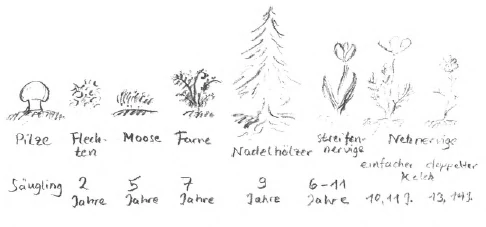
Einige Kursteilnehmer geben die als Aufgabe gestellte zusammenfassende Darstellung der bisher besprochenen Pflanzengeschichte. Rudolf Treichler wiederholt die Behandlung der Pflanzen.
Some course participants submit their summaries of the history of plants discussed so far, as assigned. Rudolf Treichler reviews the material on plants.
| Erde | 1 Pilze | schlaf. Säugling, schlafendes Denken, Kopfgeist des Säuglings |
| 2 Algen, Moose | Gehen, Sprechen | |
| Licht | 3 Farne | seelisches Erwachen |
| 4 Nadelhölzer | Ich-Erlebnis 4-5 J. | |
| Wärme | 5 streifennervige Pfl. | 6 bis 11 J. |
| Luft | 6 mit einfacher Blütenhülle netznervige Pflanzen | 11 J. |
| 7 mit doppelter Blütenhülle | 13, 14-jähr.] |
| Earth | 1 Fungi | sleep. Infant, sleeping thought, the infant's mind |
| 2 Algae, mosses | Walking, speaking | |
| Light | 3 Ferns | Spiritual awakening |
| 4 Conifers | Sense of self, ages 4–5 | |
| Warmth | 5 plants with striate veins | Ages 6–11 |
| Air | 6 plants with a simple perianth and reticulate venation | 11 years |
| 7 plants with a double perianth | 13, 14 years |
[ 4 ] Rudolf Steiner: Möglichst viele Beispiele geben!
[ 4 ] Rudolf Steiner: Give as many examples as possible!
Caroline von Heydebrand stellt die Botanik für das neunte bis zwölfte Lebensjahr dar. Dabei berührt sie auch den Metamorphosegedanken.
Caroline von Heydebrand presents botany for children ages nine through twelve. In doing so, she also touches on the concept of metamorphosis.
[ 5 ] Rudolf Steiner: Der Metamorphosegedanke und der Gedanke des Keimens ist für die Kinder unter vierzehn Jahren, besonders für Kinder von neun bis elf Jahren noch nicht verständlich.
[ 5 ] Rudolf Steiner: The concept of metamorphosis and the concept of germination are not yet comprehensible to children under the age of fourteen, especially those between the ages of nine and eleven.
[ 6 ] Da ist noch etwas zu bemerken, was sehr wichtig ist. Sie haben ganz gewiß verfolgt, daß in der neueren Zeit von allen Seiten her die Frage erörtert worden ist über die sogenannte sexuelle Aufklärung der Kinder. Nun ist ja dabei alles mögliche pro und kontra angegeben worden. In der Hauptsache ergeben sich drei Fragen.
[ 6 ] There is one more point to note that is very important. You have certainly followed the fact that, in recent times, the issue of so-called sex education for children has been debated from all sides. All sorts of arguments for and against have been put forward. Essentially, three questions arise.
[ 7 ] Es ist in Betracht zu ziehen: Wer soll die sexuelle Aufklärung geben? Wer sich im Ernst mit aller Verantwortung des Erziehers in die Schule hineindenkt, der wird bald merken, daß es außerordentlich schwer ist, diese Aufgabe zu übernehmen. Ich glaube, Sie würden alle nicht gern zwölf- bis vierzehnjährigen Rangen und Ranginnen sexuelle Aufklärung geben.
[ 7 ] We must consider this: Who should provide sex education? Anyone who seriously considers the role of an educator and the responsibilities that come with it will soon realize that it is extremely difficult to take on this task. I believe none of you would be eager to provide sex education to 12- to 14-year-old boys and girls.
[ 8 ] Zweitens handelt es sich darum: Wie soll man die Aufklärung geben? Auch das ist nicht so ganz leicht, wie man zu Werke gehen soll.
[ 8 ] Second, the question is: How should one go about providing this education? It’s not entirely clear how to go about it either.
[ 9 ] Drittens handelt es sich darum: Wo soll man sie geben? Wo soll man sie anbringen? Beim naturwissenschaftlichen Unterricht und so weiter?
[ 9 ] Third, the question is: Where should they be given? Where should they be administered? In science classes and so on?
[ 10 ] Wenn man den Unterricht nach richtigen pädagogisch-didaktischen Grundsätzen erteilen würde, so würde die Sache sich ganz von selbst ergeben. Wenn Sie so vorgehen, daß Sie den Kindern den Wachstumsvorgang in Zusammenhang mit Licht, Luft, Wasser, Erde und so weiter erklären, dann nimmt das Kind solche Begriffe auf, daß Sie langsam bei den Pflanzen übergehen können zum Befruchtungsvorgang, und dann bei den Tieren und beim Menschen. Aber Sie müßten im großen die Sache betrachten, die Pflanzen entstehen lassen an Licht, Wasser, Erde, kurz, jene Vorstellungen vorbereiten, die überhaupt den komplizierten Wachstums- und Befruchtungsvorgang vorstellungsgemäß beim Kinde veranlagen. Daß so viel geschwätzt wurde über die sexuelle Aufklärung, ist ein Beweis dafür, daß die Methoden des Unterrichtes heute nicht in Ordnung sind, sonst würde man die Elemente schon ganz früh geschaffen haben aus solchen keuschen, reinen Vorstellungen heraus wie den Erklärungen des Wachstumsvorganges im Zusammenhang mit Licht, Luft, Wasser und so weiter.
[ 10 ] If lessons were taught according to sound pedagogical and didactic principles, the matter would resolve itself quite naturally. If you proceed by explaining to the children the process of growth in connection with light, air, water, soil, and so on, then the child will grasp these concepts in such a way that you can gradually move on from plants to the process of fertilization, and then to animals and humans. But you would have to view the matter from a broader perspective—show how plants come into being through light, water, and soil—in short, prepare those mental images that lay the conceptual foundation in the child for understanding the complex processes of growth and reproduction. The fact that there has been so much idle talk about sex education is proof that today’s teaching methods are flawed; otherwise, the foundational elements would have been established very early on through such chaste, pure mental images as the explanations of the growth process in connection with light, air, water, and so on.
Caroline von Heydebrand und Hannah Lang erhalten die Aufgabe, ihre beiden Arbeiten zusammen zu verschmelzen.
Caroline von Heydebrand and Hannah Lang are tasked with merging their two works.
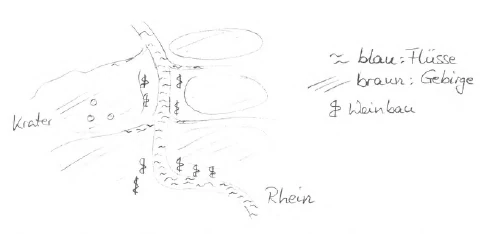
Rudolf Meyer macht geografische Ausführungen über Gegenden am mittleren und unteren Rhein.
Rudolf Meyer provides geographical descriptions of regions along the middle and lower Rhine.
[ 11 ] Rudolf Steiner: [Beim Kartenzeichnen sollte man die Gebirge braun, die Flüsse blau zeichnen. Den Fluss sollte man immer seinem Lauf gemäß vom Ursprung an zeichnen, nie von der Mündung aus. Eine Karte für die Bodenverhältnisse und die Naturgrundlage, Kohle, Eisen, Gold, Silber; dann eine zweite für die Städte (Essen, Dortmund, Solingen, Hagen, Seidenraupe (Krefeld) Tuchfabrikation, Baumwolle. Alter der Stadt Köln. Ältere Bedeutung von Köln. Römische Gründung, der römischen Kirche getreueste Stadt, jesuitischer Einfluss. Vulkanischer Boden? Granit (aus dem Wasser abgesetzt?), Kohlensäure? Weinbau), die Industrie und so weiter.]
[ 11 ] Rudolf Steiner: [When drawing maps, one should draw the mountains in brown and the rivers in blue. One should always draw the river according to its course, starting from its source, never from its mouth. One map for soil conditions and natural resources—coal, iron, gold, silver—and then a second for the cities (Essen, Dortmund, Solingen, Hagen, silkworms [Krefeld], cloth manufacturing, cotton). Age of the city of Cologne. Historical significance of Cologne. Roman foundation; the city most faithful to the Roman Church; Jesuit influence. Volcanic soil? Granite (deposited from the water?), carbon dioxide? Viticulture), industry, and so on.]
[ 12 ] Ich mache darauf aufmerksam, daß es wichtig ist, eine Auswahl zu treffen und so zu gliedern, daß man öfter einmal zurückkommt auf dieses Gebiet. Auch ist die Art des Vortrages da recht wichtig. Versuchen Sie, sich recht in den Stoff hineinzulegen, so daß das Kind immer das Gefühl hat, man schildert, sich absolut hineinlebend, wenn man Industrie schildert, immer so, als wenn man selber dort arbeitete. Beim Bergbau wieder so und so weiter. Möglichst lebendig! Je lebendiger man schildert, um so mehr arbeiten die Kinder da mit.
[ 12 ] I would like to point out that it is important to make a selection and structure it in such a way that you return to this topic more often. The style of the lecture is also quite important here. Try to really immerse yourself in the material so that the child always feels that you are describing it with complete empathy—when describing industry, for example, always as if you were working there yourself. The same goes for mining, and so on. Be as vivid as possible! The more vividly you describe it, the more actively the children will engage with it.
Friedrich Oehlschlegel schildert geografisch das Mississippigebiet.
Friedrich Oehlschlegel provides a geographical description of the Mississippi region.
Karl Stockmeyer entwickelt die Flächenberechnung, ausgehend vom Quadrat und übergehend zum Rechteck, Parallelogramm, Trapez, Dreieck.
Karl Stockmeyer develops the formula for calculating area, starting with the square and moving on to the rectangle, parallelogram, trapezoid, and triangle.
[ 13 ] Rudolf Steiner: Es ist schwierig, dem Kinde beizubringen, was ein Winkel wirklich ist. Könnten Sie eine Methode bringen, um dem Kinde das zu zeigen? Vielleicht erinnern Sie sich, wie schwer es Ihnen geworden ist, das zu unterscheiden, ganz abgesehen davon, daß es Herrschaften hier geben könnte, die noch nicht wissen, was ein Winkel wirklich ist.
[ 13 ] Rudolf Steiner: It is difficult to teach a child what an angle really is. Could you suggest a method for showing this to a child? Perhaps you remember how difficult it became for you to distinguish between them, not to mention that there may be people here who do not yet know what an angle really is.
[ 14 ] Auf diese Weise werden Sie dem Kinde beibringen, was ein großer und ein kleiner Winkel ist, indem Sie zuerst Winkel zeichnen, wobei Sie die Schenkel einmal groß, einmal klein machen.
[ 14 ] In this way, you will teach the child what a large angle and a small angle are by first drawing angles, making the sides of one large and the other small.

[ 15 ] Welcher Winkel ist größer? — Sie sind beide gleich groß!
[ 15 ] Which angle is larger? — They are both the same size!
[ 16 ] Dann lassen Sie zwei Kinder zweimal gleichzeitig von demselben Punkte aus laufen und machen ihnen klar, daß sie das erste Mal unter einem großen, das zweite Mal unter einem kleinen Winkel gelaufen sind. Wenn sie unter einem kleinen Winkel gelaufen sind, so sind ihre Wege näher beieinander; wenn unter einem großen, sind sie weiter auseinander. Auch beim Ellbogen läßt sich das zeigen.
[ 16 ] Then have two children run twice at the same time from the same point and make it clear to them that the first time they ran at a large angle and the second time at a small angle. When they ran at a small angle, their paths are closer together; when they ran at a large angle, they are farther apart. This can also be demonstrated using the elbow.

[ 17 ] Es ist gut, daß schon vorher eine Vorstellung vom großen und kleinen Winkel da ist, ehe man beginnt, durch den Kreis den Winkel zu messen.
[ 17 ] It is helpful to have a mental image of large and small angles before you begin measuring angles using a protractor.
Karl Stockmeyer spricht weiter über die Verwandlung eines Parallelogramms in ein Rechteck, um klarzumachen, daß die Fläche gleich Grundlinie mal Höhe ist.
Karl Stockmeyer goes on to discuss the transformation of a parallelogram into a rectangle to illustrate that the area is equal to the base times the height.
[ 18 ] Rudolf Steiner: Man kann schon so vorgehen. Aber wenn Sie die ganze Überlegung bis morgen noch einmal auf einen etwas anderen Boden bringen, so würde sich vielleicht doch empfehlen, darüber nachzudenken, ob man nicht den Begriff der Fläche als solcher und den der Größe der Fläche dem Kinde auf irgendeine Weise rationell beibringen könnte. Das Kind kennt die Figur des Quadrates, und Sie wollen jetzt dem Kinde beibringen, daß das eine Fläche ist und daß die Fläche gröRer und kleiner sein könnte.
[ 18 ] Rudolf Steiner: You can certainly proceed that way. But if you were to rethink the whole matter from a slightly different perspective by tomorrow, it might be advisable to consider whether the concept of area as such—and that of the size of an area—could be taught to the child in some rational way. The child is familiar with the shape of a square, and you now want to teach the child that this is an area and that the area can be larger or smaller.
[ 19 ] Zweitens: Denken Sie bis morgen nach, wie Sie den Kindern Aufgaben stellen würden, wo sie das Rechnen, ohne Zahlen zu schreiben, ausführen könnten, was man sonst immer Kopfrechnen genannt hat.
[ 19 ] Second: Think about it until tomorrow and come up with ways to give the children problems where they can do the calculations without writing down the numbers—what used to be called mental arithmetic.
[ 20 ] Denken Sie einmal, Sie würden dem Kinde die Aufgabe stellen: Von irgendwo geht ein Bote ab, der macht so und so viele Meilen, und weit hinterher geht ein anderer Bote ab, der geht nicht, sondern der fährt mit dem Fahrrad, der macht so und so viele Meilen. Wann hat der Bote mit dem Fahrrad den gehenden Boten eingeholt? Dieses ist so zu behandeln, daß die Kinder eine gewisse Geistesgegenwart entwickeln im Ergreifen von Situationen und im Überblicken von [rechnerischen] Situationen.
[ 20 ] Imagine you were to give the child the following problem: A messenger sets out from somewhere and travels so many miles; far behind him, another messenger sets out—not on foot, but by bicycle—and travels so many miles. When did the messenger on the bicycle catch up with the messenger on foot? This should be approached in such a way that the children develop a certain quick-wittedness in grasping situations and in getting an overview of [mathematical] situations.