

The Art of Education
GA 295
3 September 1919, Stuttgart
Translated by Steiner Online Library
Twelfth Seminar Discussion
[ 1 ] Speaking exercises:
Heretics now whined pitifully
Ultimately, suddenly a bit skepticalWhistling cleverly from bowls
Horses hatching from bowls
Bobbing, tending, plows hopping
Tapping, penning, peaches knottingFulfillment comes
Through hope
Comes through longing
Through will
Will blows
In the weaving
Blows in the trembling
Weaves, trembling
Weaving, binding
In finding
Finding, winding
Proclaiming
[ 2 ] Rudolf Steiner: Things are only right when you can recite them by heart. Speak every syllable consciously!
Just don't ever run away
Grinning greedily
Snapping knots
Tying pledges
[ 3 ] From “We Found a Path” by Christian Morgenstern:
Whoever does not know the goal,
Cannot find the path,
Will trot in the same circle
All his life;
And when he finally arrives,
Where he started out,
The meaning of the whole
Will be even more fragmented.Whoever knows nothing of the goal,
Can still discover it today;
If only he yearns
For the Divine and True;
If in vanity
He is not wholly lost
And by the wine of time
Is not drunk to the brim.
Rudolf Steiner: We will only be able to see the nuances with which the stanzas must be read tomorrow, after the third stanza has been read aloud.
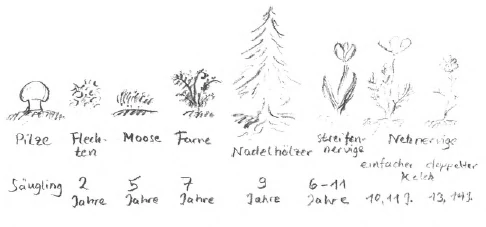
Some course participants submit their summaries of the history of plants discussed so far, as assigned. Rudolf Treichler reviews the material on plants.
| Earth | 1 Fungi | sleep. Infant, sleeping thought, the infant's mind |
| 2 Algae, mosses | Walking, speaking | |
| Light | 3 Ferns | Spiritual awakening |
| 4 Conifers | Sense of self, ages 4–5 | |
| Warmth | 5 plants with striate veins | Ages 6–11 |
| Air | 6 plants with a simple perianth and reticulate venation | 11 years |
| 7 plants with a double perianth | 13, 14 years |
[ 4 ] Rudolf Steiner: Give as many examples as possible!
Caroline von Heydebrand presents botany for children ages nine through twelve. In doing so, she also touches on the concept of metamorphosis.
[ 5 ] Rudolf Steiner: The concept of metamorphosis and the concept of germination are not yet comprehensible to children under the age of fourteen, especially those between the ages of nine and eleven.
[ 6 ] There is one more point to note that is very important. You have certainly followed the fact that, in recent times, the issue of so-called sex education for children has been debated from all sides. All sorts of arguments for and against have been put forward. Essentially, three questions arise.
[ 7 ] We must consider this: Who should provide sex education? Anyone who seriously considers the role of an educator and the responsibilities that come with it will soon realize that it is extremely difficult to take on this task. I believe none of you would be eager to provide sex education to 12- to 14-year-old boys and girls.
[ 8 ] Second, the question is: How should one go about providing this education? It’s not entirely clear how to go about it either.
[ 9 ] Third, the question is: Where should they be given? Where should they be administered? In science classes and so on?
[ 10 ] If lessons were taught according to sound pedagogical and didactic principles, the matter would resolve itself quite naturally. If you proceed by explaining to the children the process of growth in connection with light, air, water, soil, and so on, then the child will grasp these concepts in such a way that you can gradually move on from plants to the process of fertilization, and then to animals and humans. But you would have to view the matter from a broader perspective—show how plants come into being through light, water, and soil—in short, prepare those mental images that lay the conceptual foundation in the child for understanding the complex processes of growth and reproduction. The fact that there has been so much idle talk about sex education is proof that today’s teaching methods are flawed; otherwise, the foundational elements would have been established very early on through such chaste, pure mental images as the explanations of the growth process in connection with light, air, water, and so on.
Caroline von Heydebrand and Hannah Lang are tasked with merging their two works.
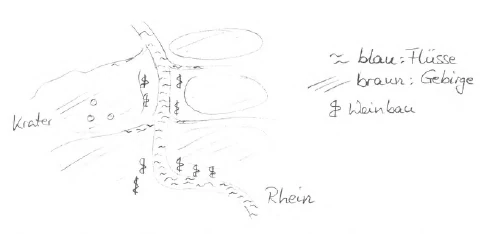
Rudolf Meyer provides geographical descriptions of regions along the middle and lower Rhine.
[ 11 ] Rudolf Steiner: [When drawing maps, one should draw the mountains in brown and the rivers in blue. One should always draw the river according to its course, starting from its source, never from its mouth. One map for soil conditions and natural resources—coal, iron, gold, silver—and then a second for the cities (Essen, Dortmund, Solingen, Hagen, silkworms [Krefeld], cloth manufacturing, cotton). Age of the city of Cologne. Historical significance of Cologne. Roman foundation; the city most faithful to the Roman Church; Jesuit influence. Volcanic soil? Granite (deposited from the water?), carbon dioxide? Viticulture), industry, and so on.]
[ 12 ] I would like to point out that it is important to make a selection and structure it in such a way that you return to this topic more often. The style of the lecture is also quite important here. Try to really immerse yourself in the material so that the child always feels that you are describing it with complete empathy—when describing industry, for example, always as if you were working there yourself. The same goes for mining, and so on. Be as vivid as possible! The more vividly you describe it, the more actively the children will engage with it.
Friedrich Oehlschlegel provides a geographical description of the Mississippi region.
Karl Stockmeyer develops the formula for calculating area, starting with the square and moving on to the rectangle, parallelogram, trapezoid, and triangle.
[ 13 ] Rudolf Steiner: It is difficult to teach a child what an angle really is. Could you suggest a method for showing this to a child? Perhaps you remember how difficult it became for you to distinguish between them, not to mention that there may be people here who do not yet know what an angle really is.
[ 14 ] In this way, you will teach the child what a large angle and a small angle are by first drawing angles, making the sides of one large and the other small.

[ 15 ] Which angle is larger? — They are both the same size!
[ 16 ] Then have two children run twice at the same time from the same point and make it clear to them that the first time they ran at a large angle and the second time at a small angle. When they ran at a small angle, their paths are closer together; when they ran at a large angle, they are farther apart. This can also be demonstrated using the elbow.

[ 17 ] It is helpful to have a mental image of large and small angles before you begin measuring angles using a protractor.
Karl Stockmeyer goes on to discuss the transformation of a parallelogram into a rectangle to illustrate that the area is equal to the base times the height.
[ 18 ] Rudolf Steiner: You can certainly proceed that way. But if you were to rethink the whole matter from a slightly different perspective by tomorrow, it might be advisable to consider whether the concept of area as such—and that of the size of an area—could be taught to the child in some rational way. The child is familiar with the shape of a square, and you now want to teach the child that this is an area and that the area can be larger or smaller.
[ 19 ] Second: Think about it until tomorrow and come up with ways to give the children problems where they can do the calculations without writing down the numbers—what used to be called mental arithmetic.
[ 20 ] Imagine you were to give the child the following problem: A messenger sets out from somewhere and travels so many miles; far behind him, another messenger sets out—not on foot, but by bicycle—and travels so many miles. When did the messenger on the bicycle catch up with the messenger on foot? This should be approached in such a way that the children develop a certain quick-wittedness in grasping situations and in getting an overview of [mathematical] situations.