

The Art of Education
GA 295
4 September 1919, Stuttgart
Translated by Steiner Online Library
Thirteenth Seminar Discussion
[ 1 ] Speaking Exercises:
Clip-clap-click-clack
Sounds just right
Clattering along
The clatter of hooves
[ 2 ] Rudolf Steiner: Practice by Heart!
[ 3 ] From “We Found a Path” by Christian Morgenstern:
Whoever does not know the goal,
Cannot find the path,
Will trot in the same circle
All his life;
Arrives in the end
Where he started,
Having only further fragmented
The meaning of the whole.Who knows nothing of the goal,
Can still discover it today;
If only he burns
For the Divine and True;
If in vanity
He is not wholly lost
And by the wine of time
Is not drunk to the brim.For one must ask
About the silent things,
And one must dare,
If one wishes to attain light;
Whoever cannot seek,
As only a free spirit can,
Remains under the spell of delusion
Behind a sevenfold veil.
Karl Stockmeyer attempts to make the concept of area concrete for nine-year-old children. (Have them cut out squares to measure other, larger square areas; use stencils.)
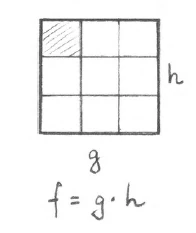
[ 4 ] Rudolf Steiner: Isn’t it true that it is easy to understand that if the length of a side of a square is 3 meters, the area is 9 square meters? But this keeps us within the realm of constructing concepts from such concrete examples, and it will still be very difficult to evoke a true mental image of the area.
[ 5 ] What I meant was: What is the correct approach, and at what age can such an approach be introduced, in order to actually help children understand that an area is an area and becomes an area when you multiply length by width? How does one go about introducing this concept of area to a child? — That depends on where one introduces this lesson on area. It must be said: It is not good to introduce the lesson on area before the student has completed the lesson on letter calculations. We can only teach area effectively once we have already covered algebraic operations. So the answer is: We wait to teach area until we have covered algebraic operations.
[ 6 ] And now, moving on to the question: How do you go about helping the children transition from ordinary numerical calculations to letter-based calculations? I’ll guide you through this, and then you can elaborate further. Before moving on to letter calculations, you must have already worked through interest calculations with the children: Interest equals principal times the percentage, times the time, divided by 100
[ 7 ] $$Interest = \frac{Principal \cdot Percentage \cdot Time}{100}$$
[ 8 ] If we abbreviate using the first letters, we can write:
[ 9 ] $$Z = \frac{K \cdot P \cdot T}{100}$$
[ 10 ] \(T\) = tempus, Latin for “time,” is the most common abbreviation for time.
[ 11 ] By arriving at this formula, you start with ordinary numbers, and the child understands relatively easily what capital is, what interest is, what time is, and so on.
Karl Stockmeyer develops the interest calculation using numbers (Problem 1).
[ 12 ] So you will try to explain this process to the child and make sure that most of the children have understood it. And from there, you would move on to the form described above, always making sure that the rule is incorporated.
[ 13 ] \(K\) is = capital; \(P\) is = percent; \(T\) is = time; \(Z\) stands for interest. Then what is stated above is a formula that I simply memorize as a basic formula. By doing so, I have already taken the first step toward transitioning to algebra. Once the child has this formula, they only need to plug the number into it, and the result will always be correct. Do you have the formula derived from this:
$$K = \frac{Z \cdot 100}{T \cdot P}$$
[ 14 ] As a mnemonic, you can remember that you can swap the three letters \(K\), \(P\), and \(T\) in any order, resulting in the following possibilities:
$$T = \frac{Z \cdot 100}{T \cdot P} \qquad P = \frac{Z \cdot 100}{K \cdot T}$$
[ 15 ] In this way, we have taught the child how to do word problems, and now we can move on to arithmetic problems. You can safely say: We have learned,
[ 16 ] The sum of 25 was equal to 8 plus 7 plus 5 plus 5,
$$25 = 8 + 7 + 5 + 5.$$
[ 17 ] Isn't that right? The child understood that once. Now that you’ve explained it to them, you can say: “But there (instead of 25) could also be a different sum, and there (instead of 8, 7, 5, 5) could be other numbers, so that we could also say there is ‘any’ number there.” So, for example, there could be: \(S\), a sum. And there could be: \(a + b + c + c\). But if there were a \(c\) there instead of the first 5, then it must also be there instead of the second 5. Just as I substitute the letter c in place of any capital K, I substitute the letter c in this spot.”
[ 18 ] Once you have demonstrated the transition from numbers to letters in a specific example, you can then introduce the concept of multiplication, and from this specific example \(9 \cdot 9\), you can derive \(a \cdot a\). Or you can generalize \(a \cdot 2\) to \(a \cdot b\), and so on. So that would be the path from these numerical calculations to algebraic calculations. And from there to area calculations: \(a \cdot a = a^2.\)
[ 19 ] Assignment for tomorrow: Interest calculations—develop a clever and clear explanation for children in their eleventh and twelfth years, including all related concepts, with the reverse process: percentage, time, and principal calculations. — Then, building on that, explain how to calculate discount. Next, teach the child how to calculate rebates and packaging costs, and how to understand the concept and calculation of a bill of exchange. This should be covered in the twelfth and thirteenth years so that it stays with them for life; otherwise, it will be forgotten time and again later on. One can certainly approach it in a simple way, but it belongs there. If someone can do this properly, then they have mastered the methodology of all arithmetic. Compound interest calculations do not belong in these years.
[ 20 ] Then move organically on to arithmetic with letters, up to multiplication, and from there to area calculations.
[ 21 ] Now I would like to ask that we address the other questions from yesterday. Because there, too, it is important that you encourage the children to think on their feet by giving them problems to solve.
Here are some comments from individual course participants; for example, Hannah Lang suggests setting up a small kiosk selling fruit, [vegetables], potatoes, and so on, where the children would have to shop, sell, pay, [give change], and calculate everything on their own.
[ 22 ] Rudolf Steiner: This business principle is quite good for the second grade. And it is good to insist that the person to whom you have given a bill actually pay it themselves, and that you not let anyone else pay it on their behalf. Always keep everyone’s interest alive!
We're talking about mental math—calculating without writing anything down.
[ 23 ] Rudolf Steiner recounts that Gauss, as a six-year-old boy, once arrived at the following solution: The problem was to add the numbers from 1 to 100. Gauss reasoned that, to arrive at the result quickly, it would be more advantageous and simpler to take the same numbers again, but to arrange them in the first sequence from 1 to 100 in such a way that one could visualize the first sequence—written as usual from left to right—as 1, 2, 3, 4, 5... 100, but with the second sequence—100, 99, 98, 97, 96… 1—arranged in reverse order directly below it, so that 100 appears below the 1, 99 below the 2, and 98 below the 3. Then, each time, the two numbers directly below one another, when added together, would yield the sum 101. The sum must be taken a hundred times, resulting in 10,100, and then—since it consists of adding the numbers from 1 to 100 twice, once forward and once backward—it must simply be halved, resulting in 5,050. This is how Gauss solved this problem in his head at the time, much to the astonishment of his teacher.
Karl Stockmeyer cites, among other things, two [types of problems]: First, calculating time and distance when locomotives with different wheel diameters and circumferences are given; second, problems involving filling and emptying vessels with spouts of varying widths.
Rudolf Meyer provides yet another example to illustrate calculations involving measurements.
[ 24 ] Rudolf Steiner: You can use your imagination when devising math problems. You can cultivate quick thinking through movement exercises. You can put yesterday’s example into practice by saying: “I sent a courier on his way with a letter. The letter has become meaningless.” I have to send another messenger. How fast must he travel to arrive before the letter has caused any harm? The child should be able to calculate this, at least approximately—that’s quite good.
A participant points out calculation errors.
[ 25 ] Rudolf Steiner: Such error calculations are very common. It is customary to factor in the errors right from the start. Well, there is one point today where such an error calculation is being made, and it will have to be corrected at some point. When Copernicus established his “Copernican System,” he formulated three principles. If one were to use all three to outline the Earth’s path through space, one would arrive at a movement entirely different from what is currently assumed by our astronomers and taught in our schools. This elliptical motion is only possible by disregarding the third principle. When the astronomer points his telescope outward, the observations do not match reality. To account for this, errors are factored in; through Bessel’s equations, errors are incorporated each year to correct for what is actually incorrect. Bessel’s error equations—that is where Copernicus’s third principle lies.
[ 26 ] Methodologically, one must proceed in such a way that the child is not merely occupied with hypothetical examples, but that one arrives at practical examples drawn from real life. Everything must be brought down to the practical level. In doing so, one can always use what follows to enrich what came before, and vice versa.
[ 27 ] What would you use to calculate all these motion problems—the flow of liquids through small holes (slowly) and through large ones (quickly), and the circular motion problems involving machines with wheels of different sizes—what would you use to work these out?
[ 28 ] It would be best to move on to explaining clocks to the children in their various forms, such as pendulum clocks, pocket watches, and so on.
[ 29 ] Assignments for tomorrow: First: Hertha Kögel, Rudolf Treichler, and Leonie von Mirhach are to address a historical topic following the model example provided earlier, [in the context of cultural history].
[ 30 ] Second: [Rudolf Meyer, Friedrich Oehlschlegel, Hannah Lang, and Johannes Geyer:] Discuss any topic related to the natural world—the rising and setting of the sun, the seasons [or similar subjects]—that comes naturally to you. The key is to emphasize the teaching method.
[ 31 ] Third: [Paul Baumann:] On the Principles of Music in the Very First School Year.
[ 32 ] Fourth: [Herbert Hahn:] How should poetry be presented in English and French? How can children be taught to appreciate poetry in English and French?
[ 33 ] Fifth: [Alexander Strakosch:] How is it possible to teach a child the concepts of the ellipse, the hyperbola, the circle, the lemniscate, and the concept of a locus? — All of this must be taught to children immediately before they leave school.
[ 34 ] Sixth: to depict something from the structure of the world.