

The Art of Education
GA 295
5 September 1919, Stuttgart
Translated by Steiner Online Library
Fourteenth Seminar Discussion
Paul Baumann develops the principles of music instruction [in the first and second grades]. Goal for the first year: Singing simple melodies—preferably ones the children have not yet heard—with simple rhythmic patterns. Melodies based on vowels. Singing simple canons (in unison). Familiarity with simple consonances and dissonances; use dissonances as little as possible. Singing and listening to the instrument. Scales (for now, only major scales); do not yet name the notes. Simple rhythm. Objective for the second school year: Singing simple songs and folk songs; singing simple canons in two-part harmony; singing in two- and three-part harmony. Scales, major scales (minor scales later); note names initially in Italian, then later also in German. In the second half of the year, have the child begin with solo instruments (string and wind instruments, ocarina, flutes).
[ 1 ] Rudolf Steiner: One should not neglect to also let the child hear the objective, the instrument, which is separate from the human being. Care must always be taken to ensure that the child begins learning a solo instrument well before the age of nine, in the second half of the second school year, so that the piano can be introduced later for those who are suitable candidates. That is, after all, the essential point: that we start off on the right foot in this area.
Karl Stockmeyer provides a continuation of the lesson on interest calculations, leading into the lesson on letter calculations, and notes that students must first have covered fractions, decimal calculations, the rule of three, and the main points of the process of deduction. Students should begin learning about interest calculations before the age of 12.
If \(E\) = final capital, \(A\) = initial capital, \(Z\) = interest, \(P\) = percentage, and \(T\) = time, then \(E = A + Z\). Furthermore, since \(Z = \frac{A \cdot P \cdot T}{100}\), we have \(E = A + \frac{A \cdot P \cdot T}{100}\)
[ 2 ] Rudolf Steiner: You can never invest capital in this way today. This form only has any practical value if \(7\) is equal to or less than one year. For in reality, there are two possible scenarios: either you withdraw the interest annually, in which case the initial capital always remains the same, or you leave the interest with the principal, in which case you need to use compound interest calculations. If you omit \(T\)—that is, if you calculate for one year—then it is realistic. It is necessary to present reality to the children.
Karl Stockmeyer goes on to discuss the discount calculation, explaining how it assumes that borrowed capital is repaid earlier than required and how the compensation that can be claimed for this is calculated based on the interest earned on the capital over a period equal to the amount by which the payment was made early. This is followed by a discussion of the discount calculation—which is essentially a percentage calculation that does not take time into account—and then an explanation of the concept of a bill of exchange (exercises with real-world examples are recommended).
[ 3 ] It would be good to work diligently to ensure that the transition to written calculations is actually made. First, the transition from addition to multiplication will be developed, then from subtraction to division.
[ 4 ] Rudolf Steiner then explains the transition from arithmetic with numbers to arithmetic with letters using the following example. First, one writes down a sum of numbers in which the addends are all different:
$$20 = 7 + 5 + 6 + 2$$
[ 5 ] Individual addends can also be equal:
$$25=5+5+9+6$$
[ 6 ] And all the addends can be equal:
$$18=6+6+6$$
[ 7 ] If we now proceed, as described yesterday, to replace the numbers with letters, I have, first, the sum \(S_1 = a + a + a\), which is three \(a\), three times \(a = 3 \cdot a\); then, \(S_2 = a + a + a + a + a\), five \(a\)’s, \(5 \cdot a\); then \(S_3 = a + a + a + a + a + a\), seven \(a\)’s, \(7 \cdot a\), and so on.
[ 8 ] I do this over and over; I can do it nine times, twenty-one times, twenty-five times. I do it \(m\) times: \(S_m = a + a + a + a + a...\) \(m\) times -( = m \cdot a.\)
[ 9 ] Thus, from the indeterminacy of the number of addends, I obtain one factor, while the addend itself is the other factor. In this way, multiplication can easily be derived from and understood through addition. This is how we make the transition from specific numbers to algebraic quantities, to \( a \cdot a = a^2, a \cdot a \cdot a = a^3.\)
[ 10 ] Similarly, division can be derived from subtraction. If we subtract \(b\) from a very large number \(a\), we get the remainder \(r_1.\)
$$r_1 = a - b$$[ 11 ] If we subtract 5 again, we get the remainder
$$r_2 = a - b - b = a - 2b$$[ 12 ] Subtracting 5 a third time gives \(r_3 = a - b - b - b = a -3b\) and so on. We can continue doing this until there is no remainder left of the number \(a\); we can do this \(n\) times:
$$r_n = a - b - b - b - b \ldots n = a - nb$$[ 13 ] If there is no remainder left—that is, if the last remainder is \(0\)—then
$$0 = a - nb.$$[ 14 ] Then \(a\) is completely factored out, since there is no remainder left: \(a = nb\). I subtracted \(b\) \(n\) times, breaking \(a\) down into a series of \(b\)s; \(\frac{a}{b} = n\), so \(a\) is completely used up. I found that I can do this \(n\) times, and in doing so, I moved from subtraction to division.
[ 15 ] One can therefore say: Multiplication is a special case of addition, and division is a special case of subtraction—except that one adds or subtracts repeatedly rather than just once.
The conversation turns to negative and imaginary numbers.
[ 16 ] Rudolf Steiner: A negative number is a subtrahend for which there is no longer a minuend; a call for an operation for which there is no longer any material, and which cannot be carried out. - Eugen Dühring dismissed imaginary numbers as nonsense and said of Gauss’s definition of the imaginary that it was a piece of nonsense, not reality, just some far-fetched rubbish.
[ 17 ] So you always derive multiplication from addition, and then exponentiation from multiplication. And then division from subtraction, and taking the root from division.
| add multiply raise to a power |
subtract divide take a root |
| Treat the definition of division as the conclusion | |
[ 18 ] It is only after beginning algebra, from the eleventh to the twelfth year, that one moves on to exponents and roots, because the process of raising an algebraic polynomial to a power plays a role in finding roots.
[ 19 ] In this context, the following should also be considered: gross, net, tare, and packaging charges.
A question is asked regarding the use of formulas.
[ 20 ] Rudolf Steiner: The question now is whether you would prefer to avoid using the formula very often and instead follow the train of thought again and again—which, of course, allows you to cultivate your language skills, as you rightly point out—or whether you would prefer to adopt the formula after all. If you do so tactfully, ensuring that the formula is well understood, this is also quite useful for practicing linguistic refinement to a certain extent.
[ 21 ] But at a certain point, it is also good to turn the formula into something the child can feel. To turn the formula into something that has an inner life, so that, for example, when at
$$Z = \frac{K \cdot P \cdot T}{100}$$
[ 22 ] As \(T\) increases, the child gains a sense of the whole growing.
[ 23 ] This would thus have conveyed what I wanted to say at this point: that one should use concrete numbers in situations such as interest and percentage calculations to make the transition to algebraic calculations, and to use them to develop multiplication, division, exponentiation, and root-taking. These are, after all, things that definitely need to be practiced with the children already.
[ 24 ] Now I would like to raise the following question: Do you think it is a good idea to cover exponentiation and taking roots—that is, extracting roots—before you have done letter calculations, or would you do it afterward?
Karl Stockmeyer: Raise to a Power First, Take the Root Later.
[ 25 ] Rudolf Steiner: So you are proceeding as planned, and you should continue to assume that, as soon as possible—starting in the eleventh or twelfth year—you will begin with letter calculations and only then move on to exponentiation and taking roots. For after letter calculation, squaring, cubing, raising to a power, and taking roots can be taught to the children in a very simple and efficient manner, whereas previously an enormous amount of time was spent on these operations. You will be able to teach easily and efficiently once you have first discussed letter calculation with the children.
Hertha Koegel writes a [historical] paper for high school seniors on the founding and development of cities and refers to the period of the Magyar invasions as “Germany.”
[ 26 ] Rudolf Steiner: I would be quite careful not to let unconsciously muddled mental images arise. Of course, back then, during the time of Henry the so-called “City Builder,” there was no such thing as Germany. One must put it something like this: cities on the Rhine or the Danube, in the places that later became German.
Hertha Koegel continues her account and goes on to discuss the Magyar incursions.
[ 27 ] After all, before the 10th century, we weren’t dealing with Magyars; before that, such incursions were carried out by the Huns and Avars. From the 10th century onward, we can already speak of “Germany.”
[ 28 ] You see, I would, for example—this is an activity we do with students in the final grades of elementary school—try to teach the children a sense of chronology. When you say something like “9th, 10th century,” the mental image becomes too abstract. How would you go about helping the children develop a concrete mental image of time?
[ 29 ] See, you could explain it to the child this way: “If you’re this old now, how old are your mother and father? Then, how old are your grandfather and grandmother?” — That way, you lay out the entire generational sequence and can explain to the child that three generations like that amount to about a hundred years. So in a hundred years, there would be three generations. A hundred years ago, then, the great-grandparents were children. Nine centuries ago, there were not three, but 9:3 = 27 generations. — “Suppose,” you say to the child, “you’re holding your father’s hand, and he’s holding your grandfather’s hand, and he’s holding your great-grandfather’s hand, and so on. If they were all standing side by side like that, which man would be Henry I, and which man would have faced the Magyars around the year 926? It would be the twenty-seventh person.” - I would then illustrate that quite vividly. After I’ve helped the children concretely grasp the mental image of just how long ago that was, I would describe the Magyar invasions to them. I would make it clear to them how the Magyars overran Central Europe back then. How the Magyars swept in with such ferocity that everyone had to flee—except for the small children in their cradles, who had to be carried to the mountain peaks. How the invading Magyars then burned villages and forests. I would describe the Magyar invasion in a very vivid way.
Hertha. Koegel goes on to describe how Heinrich, realizing that he had been able to resist the Magyars in the fortified town of Goslar, resolved to establish fortified towns, and that this led to the founding of numerous towns.
[ 30 ] Rudolf Steiner: Could you please present this account once more from a cultural-historical perspective? Because the idea that Henry founded these cities is nothing more than a historical legend embellished with monarchical flair. All of these 10th-century cities already existed in their basic form—as market towns—at that time. Their expansion was merely spurred by the fact that people living in the vicinity of these towns joined forces to gain an easier means of defense against the invading Magyars, thereby strengthening these settlements. It was primarily economic factors that were at work here and led to the formation of these towns. Henry did not contribute all that much to this.
Hertha Koegel goes on to describe: the migration of a portion of the nobility to the cities; the formation, development, and expansion of cities as their wealth increased; and the cultivation and flourishing of art and architecture.
[ 31 ] I would simply ask you to present all of this in a very vivid way, to make it come alive, so that the children can form clear mental images and truly grasp everything. You must engage their imagination and use the kinds of methods I have shown you for making time concrete. It’s actually of no use to know, for example, in what year the Battle of Zama took place and so on, but if you imagine—if you know that Charlemagne goes back thirty generations, and if you were to reach out and hold hands across all those generations—then you gain a vivid, concrete mental image of time. That brings this time much closer—yes, indeed, it brings it much closer!—when one knows that Charlemagne can be traced back to the thirtieth ancestor.
Karl Stockmeyer: Wouldn't it be good, when describing cultures in this way, to also point out the very different ways of thinking and feeling among people during those periods?
[ 32 ] Rudolf Steiner: Yes, I have always pointed that out in my lectures and elsewhere. Above all, you bring to life quite vividly the great turning point around the 15th century—the completely different ways people perceived, felt, and thought before and after that time. For example, Lamprecht—though I do not particularly wish to recommend him—also endeavors to establish that people’s thinking, perception, and feelings were quite different before this period. — The documents have not yet been used for this purpose.
[ 33 ] If you want to get a feel for cultural-historical analysis, you must first and foremost develop a certain intuition; and once you have this intuition—for both the broader and more specific aspects of what the authors are saying, for the more narrow-minded and the more open-minded—then you can gain a more accurate mental image of cultural history.
[ 34 ] In response to an inquiry regarding a purchase for the teachers' library, Rudolf Steiner recommends:
Buckle, History of Civilization in England.
Lecky, History of the Enlightenment in Europe.
[ 35 ] These works can be used to develop a method for cultural-historical analysis. The older sections of Lamprecht’s work might be suitable, but much of it is flawed and subjective.
[ 36 ] If you have not acquired this instinct for the true driving forces of cultural history, then you will run the risk of—with truly Wildenbruch-like stupidity, with Wildenbruch-like dilettantism—regarding, for example, the dramas of emperors and kings and such family squabbles as those between Louis the Pious and his sons as significant events in cultural history.
In response to a reference to Gustav Freytag’s writings, Rudolf Steiner says:
[ 37 ] Gustav Freytag’s *Pictures from Germany’s Past* is quite good, but one mustn’t let oneself be too swept away by the cozy atmosphere of this historical account written for old ladies. Especially today, we must break free from the style of thought and feeling that was so prevalent among these authors of “border guard” literature in the mid-19th century—Gustav Freytag, Julian Schmidt, and so on. Lassalle called it “Schmulian Jüd”; coming from Lassalle, it didn’t sound anti-Semitic.
In response to a reference to Houston Stewart Chamberlain’s *The Foundations of the Nineteenth Century*, Rudolf Steiner says:
[ 38 ] Rudolf Steiner: With Chamberlain, too, one must develop a good instinct all the more, for a quarter of what he writes is witty, and three-quarters is wild, unhealthy stuff. There is a great deal of very good material in his work, but one must survey it all for oneself and form one’s own judgment. The descriptions of cultural history are better in Buckle and Lecky. Chamberlain is more of a tuxedo-wearing sort. He is, after all, a somewhat vain gentleman who cannot exactly be considered an authority, but who has nevertheless observed many things correctly. His end, too, was not a pleasant one—I am referring to the lawsuit with the *Frankfurter Zeitung*.
Kautsky's writings are mentioned.
[ 39 ] Rudolf Steiner: Yes, if one generally assumes the opposite of what he presents there. One can obtain good and interesting factual material from modern socialists, provided one does not allow oneself to be blinded by the theories that permeate their accounts.
[ 40 ] Mehring also presents a peculiar picture: in his book, *A History of Social Democracy*, he rails against the Social Democrats as long as he was a Liberal; later, after he had joined the Social Democrats, he simply shifted his criticism to the Liberals.
Rudolf Meyer provides a somewhat comprehensive introduction to the basic concepts of mathematical geography [for 13-year-old students], including observations of sunrise and the sun's path.
[ 41 ] Rudolf Steiner: Once you have sent the children outside, you can later have them translate what they saw into a drawing and ensure that there is a certain parallelism between the drawing and what the children observed outside. It is only advisable not to introduce too much of this linear work all at once. It is very important to teach these things to the children, but if you try to cover too much at once, you’ll reach a point where the children can no longer grasp it. You can incorporate this into geography and geometry. The approximate conclusion of such lessons would be to develop the concepts of the ecliptic and coordinates.
Elfriede Herrmann explores the same topic—sunrise and sunset—for younger children and attempts to illustrate the paths of the sun and the planets using a schematic drawing.
[ 42 ] Rudolf Steiner: Well, this view will become less and less significant, because what has been assumed about these movements up to now is not entirely correct. In reality, we are dealing with a movement like this (Rudolf Steiner draws on the board):

[ 43 ] For example (1st position), here is the Sun; there are Saturn, Jupiter, and Mars; and there are Venus, Mercury, and Earth. Now they all move in the indicated direction (helical path) one after the other in such a way that, when the Sun has moved over here (2nd position), Saturn, Jupiter, and Mars are here, while Venus, Mercury, and Earth are there. And now the Sun continues to rotate and moves over there (3rd position). This creates the illusion that the Earth is revolving around the Sun. In reality, the Sun leads the way, and the Earth is always trailing behind.
Leonie von Mirbach provides an account of ancient Egyptian culture.
[ 44 ] Rudolf Steiner: Above all, we must begin to emphasize what constitutes the entirely different principle of representation. The ancient Egyptians suffered from a lack of perspective in their view of the world. The ancient Egyptians painted the face in profile and the rest of the body full-face. This peculiarity of perception should be taught to children from an early age.
[ 45 ] Then one would have to establish the connection between Egyptian drawing and painting and the natural-historical principle behind them—namely, that they depicted humans with animal heads and so on. Even in ancient times, the comparison of humans with animals was taken to extremes. One could then teach the child what is inherent in every human mind and what the child still perceives to some extent today. The Egyptians still perceived this kinship between human physiognomy and animals. They were still at this childlike stage of perception.
In her discussion of the pyramids, Leonie von Mirbach asks what one should actually tell children about them.
[ 46 ] Rudolf Steiner: Yes, it is, of course, extremely important to gradually try to replace what is wrong with what is right, even for the children. In fact, the pyramids were indeed places of initiation. And so we come to the point where we teach children about the concept of higher Egyptian instruction, which was at the same time an initiation. We must tell them something about what took place there. Religious rituals were performed there, just as they are performed in churches today, but these rituals also led to an understanding of the universe. The ancient Egyptians learned precisely in this way: through solemn rituals, they were shown what takes place in the universe and in the evolution of humanity. Religious practice and instruction were one and the same. In fact, instruction and religious ritual were essentially one and the same.
Leonie von Mirbach describes the work on the pyramids and obelisks and says that one must assume that several million people would have been needed to transport, cut, and install the enormous blocks. One has to wonder how it was even possible, with the technical tools available at the time, to move and stack the large, heavy limestone and granite blocks.
[ 47 ] Rudolf Steiner: Yes, but you will only give the children a completely accurate mental image if you tell them that if people worked with the physical strength they have today, we would need two and a half times as many people. But in reality, the Egyptians did have two and a half times as much physical strength as people today—at least those who worked on the pyramids and so on. Of course, there were also weaker people.
Leonie von Mirbach asks whether mythology should also be addressed.
[ 48 ] Rudolf Steiner: Yes, isn’t that right? If one cannot present Egyptian mythology in its true form, then one simply has to leave it out. But if one can present Egyptian mythology in its true form, then one should do so. In the Waldorf school, it would be quite good to teach the children the correct concepts of Egyptian mythology—which you know quite well—if one wishes to address the subject at all.
Alexander Strakosch now explains the development of the concept of “geometric locus” using the circle, ellipse, hyperbola, and lemniscate as examples:
How is it possible to teach children the concepts of the ellipse, hyperbola, circle, lemniscate, and the concept of a locus? Of course, this can only happen toward the end of elementary school, that is, at age 14. The concept of a locus is inseparable from the curves mentioned, and these can be used specifically to help children understand it.
You can lay the groundwork as early as the previous lesson by pointing out the lines along which certain conditions apply or are met; for example, by using a natural object visible from a distance to demonstrate that there is a line connecting all the points from which this object is just barely visible—by having the children locate this line and then mark it on a sketch map. Similarly, draw attention to vegetation boundaries in both horizontal and vertical directions—for example, the northernmost limit of viticulture, the altitude limit for grain cultivation, and the boundary of perpetual snow.
However, in geometry class, models can often be constructed directly through certain simple problems, for example: Where are the vertices of all triangles that share a common base and have the same area? (On two parallel lines.) Or: Where are all the points that are equidistant from two given points? (On a line that is perpendicular to the line connecting the two points and bisects that line.) The latter problem is particularly important because it naturally leads to the bipolar (two-pole) system in which the lines mentioned above must be represented. We can now speak to the children something like this: Let’s not apply arithmetic to numerical examples for once; instead, let’s visualize the four basic arithmetic operations in terms of their underlying principles using geometric figures. Let’s picture them clearly in our minds by performing the four basic arithmetic operations not with digits, but geometrically on a plane. The four arithmetic operations are: addition, subtraction, etc. But in order to begin with addition, we must have identical objects in front of us and realize that the units from which we started—and which are contained in every number—must all be considered equal to one another; otherwise, we cannot even begin to count. So we ask:
First: Where are all the points that are equidistant from a given point? Drive a nail into the blackboard, tie a piece of chalk to a string, attach the string to the nail, and draw a circle in this way; this is more intuitive than using a compass; then one can show that there are large and small circles. This line is called the circle of equality, and all points that are the same distance from a given point lie on its circumference.
Second: Where are all the points for which the sum of the distances from two given points is always the same, that is:
$$a + b = c?$$
Here we must define two points from which we can, as it were, project into space distances that are equal in sum but generally different from one another—just as we must have two numbers to add together. If we were to plot the distances from a single point, we would merely be measuring one number against another, comparing it to that number, but not adding them together. Depending on whether we place the two points closer together or farther apart—while keeping c constant—we can obtain various shapes of the ellipse (that is the name of this curve).
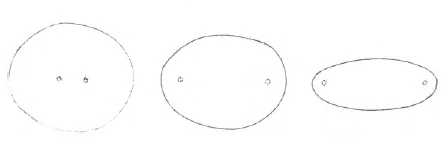
We insert two pins into the board, tie a string with its two ends to each of the pins, but in such a way that it is not taut but hangs down quite loosely; then we thread the string through a piece of chalk and move the chalk as required by the string, which must remain taut at all times, and in this way obtain the ellipse. The two fixed points where we insert the pins are called foci. (When considering circles, we are accustomed to focusing more superficially on their consistently unchanging outer shape; when examining the various forms of the ellipse, we must learn to appreciate the nature of the curvature inherent to the ellipse.)
Third: The representation of the line of subtraction—the hyperbola—requires a little preparation; this line is the set of all points for which the difference in distances from two given points is equal. So take two pieces of string and tie them together at equal intervals with a thread, so that two unequal ends remain, the difference between which represents the constant difference of all radius vectors (rays of light)—that is, the lines leading from any point on the curve to the two focal points.
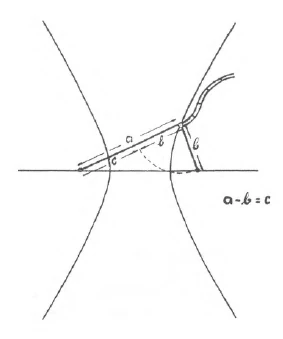
If we insert the two pins back into the board, attach the unequal ends to each one, stretch the strings with the chalk, and mark a point there, that is a point on the hyperbola. We repeat the same process downward and obtain a point that is symmetrical to the first with respect to the line connecting the foci; then we cut open the first loop, stretch the strings again, and obtain a second point and the point symmetrical to it, and so on, as long as the string or the board allows. If we connect all these points, we obtain a line that is not closed like a circle or an ellipse, but rather moves farther and farther away from the foci on both sides. Since subtraction can be performed in two different ways, we still need to swap the two ends with respect to their attachment to the pins. If one then repeats the same process, one obtains the second branch of the hyperbola; it is symmetric to the first with respect to a straight line that is perpendicular to the line connecting the two foci. Only together do both branches form the hyperbola, which can also take on different characteristics depending on the choice of foci and constants. The challenge here, then, is to perceive two unrelated lines as a single curve—a further step toward immersing oneself in mathematical laws.
Fourth: Multiplication presents an even richer variety of geometric forms. Here, depending on the choice of constants, the constant product, and the distance between the foci, the curve takes on three different forms. The first form resembles an ellipse but, of course, has a completely different curvature; the second incidentally takes the shape of a horizontal figure-eight; the third consists of two branches, each of which, in turn, forms a closed curve. This latter form differs from the second essentially in that the central section does not lie in three-dimensional space; when we trace the curve in the second form, we move continuously from one point to another, but when we do so in the third form, we must—in the direction of the arrows, where the dotted line appears—make a jump out of space and back into space. The two segments are not open, like the branches of a hyperbola that diverge at infinite distance but remain within the plane; nor are there points outside the plane of construction but within space—the curve leaves space.
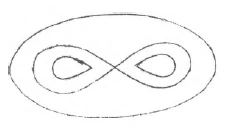
Rudolf Steiner adds that the two lines relate to each other like the heart and the pineal gland.
Alexander Strakosch continues: This becomes most vivid when you carry out the construction yourself—which, of course, must be done in class anyway—and then observe how the real points converge into the two closed branches, after which the points become imaginary, meaning that the compass cuts no longer intersect. The conditions for the construction are that the product of the radius vectors must always remain constant, i.e., \{a \dot b = c \dot c\}. We can therefore also write a \(\dot b = c^2\), which gives us an expression representing, on one side, a rectangle \(a \dot b\), and on the other side, a square \(c^2\) with the same area. We thus obtain all radius vectors—or guiding rays—by constructing all, or at least a sufficient number, of rectangles that have the same area as the given square; the sides of each such rectangle are then two corresponding guiding rays, which, when extended upward and downward from the two foci, each yield four points on the curve. Taking into account the commutativity of the factors in the multiplication, one must first draw from the right focal point and then from the left focal point; that is, place the point in the compass and use it to describe a circle, then repeat the same process with \(b\).
The construction is performed using the well-known triangle transformation, since every parallelogram can be thought of as composed of two congruent triangles lying along the diagonal.
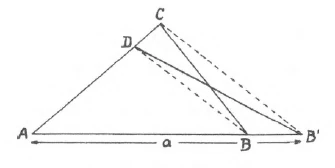
A triangle ABC is to be transformed into another triangle with a given base \(a\) but the same area. Connect the endpoint \(B’\) of the new base to vertex \(C\) to form a triangle \(AB’C\), such that the hatched triangle \(B’CA\) is now larger than the original one. If we now draw a line parallel to \(B’C\) through \(B\), we obtain a trapezoid \(BB’CD\), and the triangles \(B’CB\) and \(B’CD\) have equal areas; they share a common base and have equal heights because their vertices \(D\) and \(B\) lie on a line parallel to the common base \(B’C\). So if we add a triangle \(B’CB\) to the triangle \(ABC\) and then remove a triangle \(B’DB\) with the same area as this second triangle, we obtain a triangle \(AB’D\) with the same area as the original triangle \(ABC\); Thus, in the given square \(= c^2\), we draw a diagonal; we then perform the transformation just described once more on the resulting triangle and thereby obtain a series of guiding rays.
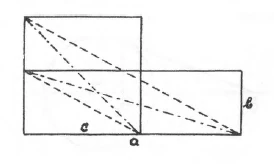
A second construction is even simpler and is based on the theorem of geometric proportions. In the figure below, \(a : c = c : b\), so \(a - b = c^2\).
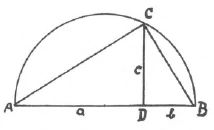
Since the angle in the semicircle is a right angle, we rotate the triangle—which was transformed during the drawing process—around its upper vertex C. This yields segments on either side of point D along the horizontal line defined by A and B: \(a’\), \(b’\), \(a”\), \(b”\), which again represent pairs of guide rays.
Fifth: Finally, we must represent division. Every ratio can be viewed as an unperformed division. We obtain a series of proportions when we intersect the two sides of an acute angle with a set of parallel lines.
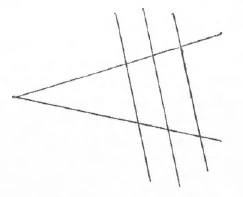
In this case, the segments cut off by the sides of the triangle at the parallels and the length of the side up to the respective parallel are always proportional.
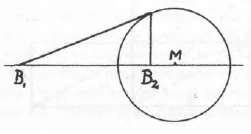
The construction results in a circle whose center lies on the line connecting the focal points but does not coincide with any of them. (Of course, one could also swap the focal points or the guiding rays here, as we did before, and would then obtain a second circle. In this case, however—since we are dealing with the representation of division, that is, an irreversible type of calculation—the second circle has no significance.) It is important to point out how different the unit circle and the division circle are in terms of their origin and nature. The former is formed from a center point and encompasses the area enclosed by it without any relation to the part of the plane lying outside it; the latter arises entirely from the outside; the imaginary points all lie outside the area enclosed by it; it cuts out, as it were, a negative portion from the entire plane. This juxtaposition contains an important emotional element—[...] the circle of equal parts and the circle of division [are], as operations, formally the same structure in both cases, but essentially fundamentally different and even polar opposites.