

The Art of Education
GA 295
6 September 1919, Stuttgart
Translate the original German text into any language:
Versions Available:
Zweiter Lehrplanvortrag
Second Lecture on the Curriculum
[ 1 ] Meine lieben Freunde! Wir kommen nun dazu, den weiteren Unterrichtsstoff zu verteilen auf die verschiedenen Schulstufen.
[ 1 ] My dear friends! We will now move on to dividing the remaining course material among the various grade levels.
[ 2 ] Da seien wir uns nur ja recht klar darüber, daß wir gegen das neunte Jahr zu, also im dritten Schuljahr, damit beginnen, die Tiere in entsprechender Auswahl zu behandeln, und immer so in Beziehung zum Menschen zu bringen, wie ich das probeweise dargestellt habe.
[ 2 ] Let us be very clear about this: around the ninth year—that is, in the third grade—we begin to study a selection of animals, always relating them to human beings in the way I have tentatively described.
[ 3 ] Da setzen wir dann im vierten Schuljahr fort, so daß wir also im dritten und vierten Schuljahr naturwissenschaftlich die Tierwelt in Beziehung zum Menschen der Betrachtung unterwerfen.
[ 3 ] We will then continue with this in the fourth grade, so that in the third and fourth grades we will examine the animal world in relation to human beings from a scientific perspective.
[ 4 ] Dann gehen wir im fünften Schuljahr dazu über, unbekanntere Tierformen noch hinzuzufügen, beginnen aber auch in diesem fünften Schuljahr mit der Pflanzenlehre und treiben sie dann namentlich so, wie wir das im didaktischen Teil unseres Seminars besprochen haben.
[ 4 ] Then, in the fifth school year, we move on to adding less familiar animal forms, but we also begin studying botany in this fifth school year and proceed with it exactly as we discussed in the didactic portion of our seminar.
[ 5 ] Dann setze man die Pflanzenlehre im sechsten Schuljahr fort und gehe über zur Behandlung der Mineralien. Aber die Behandlung der Mineralien geschehe durchaus im Zusammenhang mit der Geographie.
[ 5 ] Then, botany should be continued in the sixth grade, and the curriculum should move on to the study of minerals. However, the study of minerals should be taught in close connection with geography.
[ 6 ] Im siebenten Schuljahr kehre man wiederum zum Menschen zurück und versuche namentlich das beizubringen, worauf ich gestern hingedeutet habe, was in bezug auf die Ernährungs- und Gesundheitsverhältnisse dem Menschen beigebracht werden sollte. - Und man versuche mit dem, was an physikalischen und chemischen Begriffen gewonnen wird, eine zusammenfassende Anschauung hervorzurufen über Erwerbsverhältnisse, Betriebsverhältnisse — also diesen oder jenen Betrieb - und Verkehrsverhältnisse; das alles im Zusammenhang mit dem physikalischen, chemischen und geographischen Unterricht, aus der Naturgeschichte heraus.
[ 6 ] In the seventh school year, one should return once again to the subject of human beings and attempt, in particular, to teach what I alluded to yesterday—namely, what should be taught to students regarding nutrition and health. - And one should attempt, using the physical and chemical concepts acquired, to foster a comprehensive understanding of economic conditions, industrial conditions—that is, this or that business—and transportation conditions; all of this in connection with physical, chemical, and geographical instruction, drawing from natural history.
[ 7 ] Im achten Schuljahr werden Sie den Menschen so aufzubauen haben, daß Sie dasjenige darstellen, was von außen in ihn hineingebaut ist: die Knochenmechanik, die Muskelmechanik, der innere Bau des Auges und so weiter. - Dann geben Sie jetzt wiederum eine zusammenfassende Darstellung der Betriebsverhältnisse und Verkehrsverhältnisse im Zusammenhang mit Physik, Chemie und Geographie.
[ 7 ] In the eighth school year, you will need to construct a model of the human body in such a way that it represents what is built into it from the outside: the mechanics of the bones, the mechanics of the muscles, the internal structure of the eye, and so on. - Then, in turn, provide a summary of industrial and transportation conditions in relation to physics, chemistry, and geography.
[ 8 ] Wenn Sie namentlich den naturgeschichtlichen Unterricht so gestalten, wie wir es eben besprochen haben, dann werden Sie ihn ungeheuer lebendig machen können, und Sie werden aus der Naturgeschichte heraus dem Kinde ein Interesse erwecken für alles Weltliche und alles Menschliche.
[ 8 ] If you structure your natural history lessons, in particular, in the way we have just discussed, you will be able to make them incredibly lively, and through natural history you will awaken in the child an interest in all things in the world and all things human.
[ 9 ] Mit dem Physikunterricht beginnen wir im sechsten Schuljahr, und zwar so, daß wir ihn durchaus an dasjenige anknüpfen, was die Kinder gewonnen haben durch den Musikunterricht. Wir beginnen den Physikunterricht, indem wir die Akustik herausgebären lassen aus dem Musikalischen. Also Sie knüpfen durchaus die Akustik an die musikalische Tonlehre an und gehen dann über zur Besprechung der physikalisch-physiologischen Beschaffenheit des menschlichen Kehlkopfes. Das menschliche Auge können Sie hier noch nicht besprechen, aber den Kehlkopf können Sie besprechen. Dann gehen Sie über - indem Sie nur die wichtigsten Dinge durchnehmen - zur Optik und zur Wärmelehre. Auch die Grundbegriffe der Elektrizität und des Magnetismus bringen Sie in dieses sechste Schuljahr hinein.
[ 9 ] We begin physics lessons in the sixth grade, and we do so in a way that builds directly on what the children have learned through music lessons. We begin physics lessons by allowing acoustics to emerge from the study of music. So you definitely link acoustics to the musical theory of tone and then move on to discussing the physical and physiological nature of the human larynx. You cannot yet discuss the human eye at this stage, but you can discuss the larynx. Then you move on—covering only the most important points—to optics and thermodynamics. You also introduce the basic concepts of electricity and magnetism in this sixth grade.
[ 10 ] Dann gehen Sie im siebenten Schuljahr über zu der Erweiterung des Akustischen, des Thermischen, also des Wärmelehreunterrichts, des optischen Unterrichts, des Elektrizitäts- und Magnetismusunterrichts. Und erst von da aus gehen Sie über zu den wichtigsten mechanischen Grundbegriffen, also Hebel, Rad an der Welle, Rolle, Flaschenzug, Rollenzug, Schiefe Ebene, Walze, Schraube und so weiter.
[ 10 ] Then, in the seventh grade, you move on to expanding your knowledge of acoustics, thermodynamics (i.e., the study of heat), optics, and electricity and magnetism. And only then do you move on to the most important basic mechanical concepts—namely, the lever, the wheel on a shaft, the pulley, the block and tackle, the roller, the inclined plane, the roller, the screw, and so on.
[ 11 ] Dann gehen Sie aus von einem solchen Vorgang wie von der Verbrennung und suchen von einem solchen alltäglichen Vorgang dann den Übergang zu gewinnen zu einfachen chemischen Vorstellungen.
[ 11 ] Then take a process such as combustion as your starting point and use such an everyday process to make the transition to simple chemical concepts.
[ 12 ] Im achten Schuljahr erweitern Sie wiederum wiederholentlich dasjenige, was im sechsten gepflogen worden ist, und gehen über zur Hydraulik, also zu der Lehre von der Kraft, die durch das Wasser wirkt. Also alles dasjenige nehmen Sie vor, was zu dem Begriff, wie Seitendruck im Wasser, Auftrieb gehört: alles, was zum Archimedischen Prinzip, was also in die Hydraulik gehört.
[ 12 ] In the eighth school year, you repeatedly expand upon what was covered in the sixth year and move on to hydraulics—that is, the study of the force exerted by water. So you cover everything related to concepts such as lateral pressure in water and buoyancy—everything related to Archimedes’ principle, which is part of hydraulics.
[ 13 ] Es würde reizvoll gewesen sein, drei Jahre lang über Pädagogik hier Vorträge zu halten, und alles einzelne, was Sie aus eigener Erfindung heraus sich gestalten müssen, auch einmal durch Musterbeispiele zu behandeln. Aber das kann nicht sein. Wir müssen uns eben mit dem begnügen, was wir hier angeführt haben.
[ 13 ] It would have been appealing to give lectures here on pedagogy for three years and to address, using exemplary cases, every single aspect that you must develop on your own. But that is not possible. We must simply be content with what we have presented here.
[ 14 ] Dann schließen Sie gewissermaßen den physikalischen Unterricht ab durch die Aeromechanik, also durch die Mechanik der Luft, wobei alles zur Sprache kommt, was zusammenhängt mit der Klimatologie, Barometer- und Witterungskunde.
[ 14 ] Then, in a sense, you conclude the physics course with aeromechanics—that is, the mechanics of air—which covers everything related to climatology, barometry, and meteorology.
[ 15 ] Und Sie führen die einfachen chemischen Begriffe weiter, so daß das Kind auch begreifen lernt, wie industrielle Prozesse mit chemischen zusammenhängen. Sie versuchen, im Zusammenhang mit den chemischen Begriffen dasjenige zu entwickeln, was zu sagen ist in bezug auf die Stoffe, die den organischen Körper aufbauen: Stärke, Zucker, Eiweiß, Fett.
[ 15 ] And you build on these simple chemical concepts so that the child also learns to understand how industrial processes are related to chemical ones. You try to use these chemical concepts to explain the substances that make up the human body: starch, sugar, protein, and fat.
[ 16 ] Nun wird es uns obliegen, auch alles, was sich auf Rechnen, Mathematik, Geometrie bezieht, zu verteilen auf die acht Schulstufen.
[ 16 ] Now it will be up to us to distribute everything related to arithmetic, mathematics, and geometry across the eight grade levels.
[ 17 ] Sie wissen ja, die äußere Methodik schreibt vor, im ersten Schuljahr vorzugsweise die Zahlen im Zahlenraum bis 100 zu behandeln. Man kann sich an das auch halten, denn es ist ziemlich gleichgültig, wenn man bei den einfacheren Zahlen bleibt, wie weit man den Zahlenraum im ersten Schuljahr treibt. Die Hauptsache ist, daß sie, insofern Sie den Zahlenraum gebrauchen, die Rechnungsarten darin so betreiben, daß Sie eben dem Rechnung tragen, was ich gesagt habe: die Addition zuerst aus der Summe heraus, die Subtraktion aus dem Rest heraus, die Multiplikation aus dem Produkt heraus und die Division aus dem Quotienten heraus entwickelt. Also gerade das Umgekehrte von dem, was gewöhnlich gemacht wird. Und erst nachdem man gezeigt hat, 5 ist 3 plus 2, zeigt man das Umgekehrte: durch Addition von 2 und 3 entsteht 5. Denn man muß starke Vorstellungen im Kinde hervorrufen, daß 5 gleich 3 plus 2 ist, daß 5 aber auch 4 plus 1 ist und so weiter. Also die Addition erst als zweites nach der Auseinanderteilung der Summe; und die Subtraktion, nachdem man gefragt hat: Was muß ich von einem Minuenden abziehen, damit ein bestimmter Rest bleibt und so weiter. Wie gesagt, daß man das dann mit den einfacheren Zahlen im ersten Schuljahr macht, ist selbstverständlich. Ob man nun gerade den Zahlenraum bis 100 oder bis 105 oder bis 95 benützt, das ist im Grunde nebensächlich.
[ 17 ] As you know, the standard methodology recommends focusing primarily on numbers up to 100 during the first year of school. You can certainly follow this guideline, because as long as you stick to the simpler numbers, it doesn’t really matter how far you extend the number range in the first year. The main thing is that, insofar as you use this number range, you practice the types of calculations within it in such a way that you take into account what I have said: develop addition starting from the sum, subtraction starting from the remainder, multiplication starting from the product, and division starting from the quotient. In other words, exactly the opposite of what is usually done. And only after showing that 5 is 3 plus 2 should you demonstrate the reverse: that adding 2 and 3 results in 5. For you must instill strong mental images in the child that 5 equals 3 plus 2, but that 5 is also 4 plus 1, and so on. So, addition comes second, after breaking down the sum; and subtraction comes after asking: What must I subtract from a minuend so that a certain remainder remains, and so on. As I said, it goes without saying that this is done with simpler numbers in the first year of school. Whether one uses the number range up to 100, 105, or 95 is, in essence, irrelevant.
[ 18 ] Dann aber beginne man, wenn das Kind mit dem Zahnwechsel fertig ist, ja gleich damit, es das Einmaleins lernen zu lassen, und meinetwillen sogar das Einspluseins; wenigstens, sagen wir, bis zur Zahl 6 oder 7. Also das Kind möglichst früh das Einmaleins und Einspluseins einfach gedächtnismäßig lernen zu lassen, nachdem man ihm nur prinzipiell erklärt hat, was das eigentlich ist, es prinzipiell an der einfachen Multiplikation erklärt hat, die man so in Angriff nimmt, wie wir das gesagt haben. Also kaum daß man imstande ist, dem Kinde den Begriff des Multiplizierens beizubringen, übertrage man ihm auch schon die Pflicht, das Einmaleins gedächtnismäßig zu lernen.
[ 18 ] But once the child has finished losing its baby teeth, one should begin right away to have it learn the multiplication tables—and, as far as I’m concerned, even “one plus one”; at least, let’s say, up to the number 6 or 7. So, have the child learn the multiplication tables and “one plus one” by heart as early as possible, after explaining to them in principle what these actually are—explaining them in principle through simple multiplication, which is approached as we have described. So as soon as one is able to teach the child the concept of multiplication, one should also assign them the task of memorizing the multiplication tables.
[ 19 ] Dann führe man im zweiten Schuljahr für einen größeren Zahlenraum die Rechnungsarten weiter. Man versuche, einfache Aufgaben auch ohne Schriftliches, eben im Kopfe, mündlich mit dem Schüler zu erledigen. Man versuche, unbenannte Zahlen womöglich zuerst zu entwickeln an Dingen - ich habe Ihnen ja gesagt, wie Sie an Bohnen oder was auch, die unbenannten Zahlen entwickeln können. Aber man sollte doch auch das Rechnen im Zusammenhang mit benannten Zahlen nicht aus dem Auge verlieren.
[ 19 ] Then, in the second grade, continue teaching the different types of arithmetic operations using a wider range of numbers. Try to solve simple problems with the student orally, without writing anything down—just in your head. Try, if possible, to first develop unnamed numbers using concrete objects—I’ve already told you how you can develop unnamed numbers using beans or whatever else. But you shouldn’t lose sight of arithmetic involving named numbers either.
[ 20 ] Im dritten Schuljahr wird alles für kompliziertere Zahlen fortgesetzt, und es werden schon die vier Rechnungsarten, wie sie im zweiten Schuljahr gepflogen worden sind, in Anwendung gebracht auf gewisse einfache Dinge des praktischen Lebens.
[ 20 ] In the third school year, the curriculum continues with more complex numbers, and the four arithmetic operations—as practiced in the second school year—are already applied to certain simple situations in everyday life.
[ 21 ] Im vierten Schuljahr wird das fortgesetzt, was in den ersten Schuljahren gepflogen worden ist. Aber jetzt müssen wir übergehen zur Bruchlehre und namentlich zur Dezimalbruchlehre.
[ 21 ] In the fourth grade, we continue what was introduced in the earlier grades. But now we must move on to the study of fractions, and specifically to the study of decimal fractions.
[ 22 ] Wir wollen dann im fünften Schuljahr mit der Bruchlehre und mit der Dezimalbruchlehre fortsetzen und alles dasjenige an das Kind heranbringen, was ihm die Fähigkeit beibringt, sich innerhalb ganzer, gebrochener, durch Dezimalbrüche ausgedrückter Zahlen frei rechnend zu bewegen.
[ 22 ] In the fifth grade, we will then continue with the study of fractions and decimal fractions, and teach the child everything necessary to enable him or her to calculate freely with whole numbers, fractions, and numbers expressed as decimal fractions.
[ 23 ] Dann gehe man im sechsten Schuljahr über zur Zins- und Prozentrechnung, zur Diskontrechnung, zur einfachen Wechselrechnung und begründe damit die Buchstabenrechnung, wie wir es gezeigt haben.
[ 23 ] Then, in the sixth grade, students move on to interest and percentage calculations, discount calculations, and simple bill of exchange calculations, thereby laying the foundation for algebra, as we have shown.
[ 24 ] Nun bitte ich zu beachten, daß wir bis zum sechsten Schuljahr die geometrischen Formen: Kreis, Dreieck und so weiter herausgeholt haben aus dem Zeichnen, nachdem wir zuerst in den ersten Jahren das Zeichnen für den Schreibunterricht getrieben haben. Dann sind wir allmählich dazu übergegangen, aus dem Zeichnen, das wir für den Schreibunterricht getrieben haben, beim Kinde kompliziertere Formen zu entwickeln, die um ihrer selbst willen, um des Zeichnens willen betrieben werden; auch Malerisches zu betreiben, das um des Malerischen willen betrieben wird. In diese Sphäre leiten wir den Zeichen- und Malunterricht im vierten Schuljahr, und im Zeichnen lehren wir, was ein Kreis ist, eine Ellipse ist und so weiter. Aus dem Zeichnen heraus lehren wir dieses. Da setzen wir noch fort, durchaus auch immer zu plastischen Formen hinführend, indem wir uns des Plastilins bedienen wenn es zu haben ist; sonst kann man irgend etwas anderes benützen, und wenn es Straßenkot wäre, das macht nichts! -, um auch Formenanschauung, Formenempfindung hervorzuholen.
[ 24 ] Now I would like to point out that by the sixth grade, we had introduced the geometric shapes—the circle, the triangle, and so on—into our drawing lessons, after having initially focused on drawing for the purpose of writing instruction during the early years. Then we gradually moved on from the drawing we had practiced for writing instruction to developing more complex forms in the child—forms pursued for their own sake, for the sake of drawing itself—and to engaging in painting for the sake of painting itself. We introduce drawing and painting instruction into this sphere in the fourth school year, and in drawing we teach what a circle is, what an ellipse is, and so on. We teach this through drawing. We continue in this vein, always aiming toward three-dimensional forms, using modeling clay when it is available; otherwise, one can use something else—even if it were mud from the street, it doesn’t matter!—to bring out an appreciation of form and a sense of form.
[ 25 ] Von dem, was auf diese Weise im Zeichnen gelehrt worden ist, übernimmt nun der Mathematikunterricht, der geometrische Unterricht das, was die Kinder können. Jetzt geht man erst über dazu, geometriegemäß zu erklären, was ein Dreieck, ein Quadrat, ein Kreis ist und so weiter. Also die raumesmäßige Auffassung dieser Form wird aus dem Zeichnen hervorgeholt. Und was die Kinder aus dem Zeichnen heraus gelernt haben, daran gehe man jetzt im sechsten Schuljahr mit dem geometrischen Begreifen erst heran. Dafür werden wir dann sehen, daß wir in das Zeichnerische etwas anderes aufnehmen.
[ 25 ] Mathematics instruction—specifically, geometry instruction—now builds upon what the children have learned through drawing. Only then do we move on to explaining, in accordance with geometry, what a triangle, a square, a circle, and so on are. In other words, the spatial conception of these shapes is derived from drawing. And what the children have learned through drawing is what we now begin to approach in the sixth grade through geometric understanding. In return, we will then see that we incorporate something else into the drawing curriculum.
[ 26 ] Dann, im siebenten Schuljahr versuche man, nachdem man zur Buchstabenrechnung übergegangen ist, Potenzieren, Radizieren beizubringen; auch das, was man das Rechnen mit positiven und negativen Zahlen nennt. Und vor allen Dingen versuche man, die Kinder in das hereinzubringen, was im Zusammenhang mit freier Anwendung des praktischen Lebens die Lehre von den Gleichungen genannt werden kann.
[ 26 ] Then, in the seventh year of school, after moving on to algebra, one should attempt to teach exponentiation and root-taking, as well as what is known as arithmetic with positive and negative numbers. And above all, one should try to introduce the children to what, in the context of its free application to practical life, can be called the theory of equations.
[ 27 ] Da setze man dann das, was mit der Gleichungslehre zusammenhängt, im achten Schuljahr fort, soweit man die Kinder bringen kann, und füge dazu Figuren- und Flächenberechnungen und die Lehre von den geometrischen Orten, wie wir sie gestern wenigstens gestreift haben.
[ 27 ] Then, in the eighth grade, one should continue with topics related to the theory of equations, as far as the children are able to grasp them, and add to this the calculation of figures and areas and the theory of geometric loci, as we at least touched upon yesterday.
[ 28 ] Das gibt Ihnen ein Bild, wie Sie sich in Mathematik und Geometrie mit den Kindern zu verhalten haben.
[ 28 ] This gives you an idea of how to work with the children in math and geometry.
[ 29 ] Jetzt treiben wir, wie wir gesehen haben, in den ersten Schuljahren den zeichnerischen Unterricht so, daß wir zuerst dem Kinde ein gewisses Empfinden an runden, an eckigen Formen und so weiter beibringen. Aus der Form heraus entwickeln wir das, was wir dann für den Schreibunterricht brauchen.
[ 29 ] As we have seen, in the early school years we conduct drawing lessons in such a way that we first teach the child a certain sense of round and angular shapes, and so on. From these shapes, we develop what we then need for writing instruction.
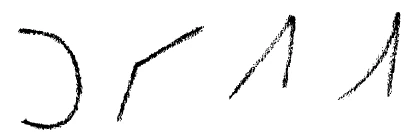
[ 30 ] Wir vermeiden es am Beginne dieses elementarischen Zeichenunterrichts ganz, irgend etwas nachzuahmen. Vermeiden Sie es, soviel Sie nur können, das Kind zuerst einen Stuhl oder eine Blume oder irgend etwas nachahmen zu lassen, sondern bringen Sie ihm soviel als möglich Linienformen aus sich selbst hervor: runde, spitzige, halbrunde, elliptische, gerade Formen und so weiter. Rufen Sie im Kinde das Gefühl hervor, was für ein Unterschied ist zwischen Kreisbiegung und Ellipsenbiegung. Kurz, erwecken Sie das Formengefühl, bevor der Nachahmungstrieb erwacht ist! Erst später lassen Sie das, was in den Formen gepflegt worden ist, auf das Nachahmen anwenden. Lassen Sie das Kind erst einen Winkel zeichnen, so daß es in der Form den Winkel begreift. Dann zeigen Sie ihm den Stuhl und sagen ihm: «Siehst du, da ist ein Winkel, und da ist noch einmal ein Winkel» und so weiter. Lassen Sie das Kind nichts nachahmen, bevor Sie nicht in ihm aus innerem Gefühl heraus die Form in ihrer Selbsttätigkeit gepflegt haben, die dann später erst auch nachgeahmt werden kann. Und so halten Sie es auch noch, wenn Sie zur mehr selbständigen Behandlung des Zeichnens und des Malerischen und auch des Bildnerischen übergehen.
[ 30 ] At the beginning of this elementary drawing instruction, we avoid imitating anything at all. Avoid, as much as you possibly can, having the child imitate a chair, a flower, or anything else at first; instead, encourage the child to produce as many line forms as possible from within themselves: round, pointed, semicircular, elliptical, straight forms, and so on. Help the child develop a sense of the difference between the curve of a circle and that of an ellipse. In short, awaken a sense of form before the urge to imitate arises! Only later should you allow the child to apply what has been cultivated in the forms to imitation. First have the child draw an angle so that they grasp the concept of an angle through its form. Then show them the chair and say, “See, there’s an angle there, and there’s another angle there,” and so on. Do not let the child imitate anything until you have cultivated within them, out of an inner sense, an understanding of the form in its own right—which can then be imitated later on. And continue to follow this approach even as you move on to a more independent approach to drawing, painting, and the visual arts.
[ 31 ] Dann lassen Sie im sechsten Schuljahr einfache Projektions- und Schattenlehre auftreten, die Sie sowohl mit freier Hand behandeln wie auch mit dem Lineal und Zirkel und dergleichen. Sehen Sie darauf, daß das Kind einen guten Begriff bekommt und nachzeichnen, nach bilden kann, wie, wenn hier ein Zylinder ist, hier eine Kugel, und die Kugel vom Lichte beschienen wird, wie der Schatten von der Kugel auf dem Zylinder ausschaut.
[ 31 ] Then, in the sixth grade, introduce simple concepts of projection and shadows, covering them both freehand and using a ruler, compass, and similar tools. Make sure that the child gains a good understanding and can trace and reproduce shapes—for example, if there is a cylinder here and a sphere here, and the sphere is illuminated by light, what the shadow cast by the sphere on the cylinder looks like.
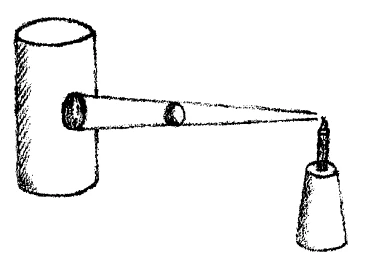
[ 32 ] Wie Schatten geworfen werden! Also einfache Projektions- und Schattenlehre muß im sechsten Schuljahr auftreten. Das Kind muß eine Vorstellung bekommen und muß nachahmen können, wie Schatten auf ebenen Flächen, auf gekrümmten Flächen, von anderen mehr oder weniger ebenen oder von körperlichen Dingen geworfen werden. Das Kind muß in diesem sechsten Schuljahr einen Begriff davon bekommen, wie sich Technisches mit Schönem verbindet, wie ein Stuhl zu gleicher Zeit technisch geeignet sein kann für einen Zweck, und wie er nebenbei eine schöne Form haben kann. Und diese Verbindung von Technischem mit Schönem soll dem Kinde in den Begriff, in den Griff hineingehen.
[ 32 ] How shadows are cast! Therefore, a basic introduction to projection and shadows must be introduced in the sixth grade. The child must develop a mental image of—and be able to imitate—how shadows are cast on flat surfaces, on curved surfaces, by other objects that are more or less flat, or by three-dimensional objects. In this sixth school year, the child must gain an understanding of how the technical and the beautiful are connected—how a chair can simultaneously be technically suitable for a purpose and, at the same time, have a beautiful form. And this connection between the technical and the beautiful should become part of the child’s understanding and grasp.
[ 33 ] Dann sollte im siebenten Schuljahr alles das gepflegt werden, was sich auf Durchdringungen bezieht. Also als einfaches Beispiel sagen Sie: «Da haben wir einen Zylinder, der wird von einem Pfosten durchdrungen. Der Pfosten muß durchgesteckt werden durch den Zylinder.» Sie müssen zeigen, was da in dem Zylinder für eine Schnittfläche entsteht beim Hiineingehen und beim wieder Herausgehen. Das muß mit dem Kinde gelernt werden.
[ 33 ] Then, in the seventh grade, everything related to penetration should be explored. As a simple example, say: “Here we have a cylinder that is penetrated by a rod. The rod must be inserted through the cylinder.” You must show what kind of cross-sectional area is created inside the cylinder as the pole goes in and comes out again. This must be learned together with the child.
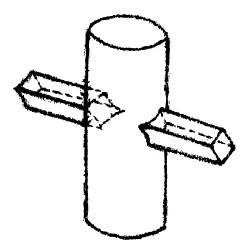
[ 34 ] So etwas muß es lernen, was entsteht, wenn sich Körper oder Flächen gegenseitig durchdringen, so daß es weiß, welcher Unterschied ist, ob eine Ofenröhre oben senkrecht durchs Plafond geht, wobei ein Durchdringen im Kreis erfolgt, oder schief, wobei ein Durchdringen in der Ellipse erfolgt. - Dann muß das Kind in diesem Jahr eine gute Vorstellung beigebracht erhalten vom Perspektivischen. Also einfaches perspektivisches Zeichnen, Verkürzung in der Entfernung, Verlängerung in der Nähe, Überdeckungen und so weiter. Und dann wiederum die Verbindung des Technischen mit dem Schönen, so daß man in dem Kinde eine Vorstellung davon hervorruft, ob es schön oder unschön ist, wenn irgendeine, sagen wir, teilweise Überdeckung einer Wand eines Hauses durch einen Vorsprung hervorgerufen wird. Ein solcher Vorsprung kann schön oder unschön eine solche Wand überdecken. Solche Dinge wirken ungeheuer, wenn sie einem Kinde gerade im siebenten Schuljahre, also wenn es dreizehn, vierzehn Jahre alt ist, beigebracht werden.
[ 34 ] The child must learn what happens when solids or surfaces intersect, so that he or she understands the difference between a stove pipe passing vertically through the ceiling—where the intersection forms a circle—and one passing at an angle—where the intersection forms an ellipse. - Then, this year, the child must be taught a good mental image of perspective. That is, simple perspective drawing: foreshortening at a distance, elongation up close, overlapping, and so on. And then, again, the connection between the technical and the aesthetic, so that one evokes in the child a mental image of whether it is beautiful or unattractive when, say, a wall of a house is partially obscured by a protrusion. Such a projection can cover a wall in a way that is either beautiful or unattractive. Such concepts have a tremendous impact when taught to a child in the seventh grade—that is, when the child is thirteen or fourteen years old.
[ 35 ] Das alles steigert man ins Künstlerische, indem man gegen das achte Schuljahr hingeht.
[ 35 ] All of this is elevated to an artistic level as students approach their eighth school year.
[ 36 ] Und in einer ähnlichen Weise, wie diese Dinge gepflegt worden sind, müssen nun auch die restlichen Dinge gepflegt werden. Wir werden dann heute Nachmittag darauf zurückkommen und einiges noch ergänzend zu unserem Lehrplan hinzuzufügen haben. Da wird vor allen Dingen darauf gesehen werden müssen, wie auch das Musikalische in dem ersten Schuljahr möglichst aus dem Einfachen, Elementarischen hervorgeholt wird, und wie dann in das Kompliziertere übergegangen wird etwa vom dritten Schuljahr an. So daß nach und nach das Kind sowohl am Instrument — und namentlich am Instrument — wie auch im Gesanglichen dasjenige aufnimmt, was gerade bildnerisch, bildend für die Fähigkeiten des Kindes ist.
[ 36 ] And in a similar way to how these matters have been handled, the remaining matters must now also be addressed. We will return to this this afternoon and will have a few additional points to add to our curriculum. Above all, we will need to focus on how music in the first school year can be derived as much as possible from the simple and elementary, and how we can then transition to more complex material, starting around the third school year. So that, little by little, the child absorbs—both on the instrument—and especially on the instrument—as well as in singing—what is truly formative and educational for the child’s abilities.
[ 37 ] Herausgeholt werden muß nun aus allem übrigen Künstlerischen das Turnen und die Eurythmie. Aus dem Musikalischen, und auch aus dem sonstigen Künstlerischen, muß das Turnen und die Eurythmie herausgeholt werden.
[ 37 ] Gymnastics and eurythmy must now be separated from all other artistic disciplines. Gymnastics and eurythmy must be separated from music and from other artistic disciplines as well.