

The Art of Education
GA 295
6 September 1919, Stuttgart
Translated by Steiner Online Library
Second Lecture on the Curriculum
[ 1 ] My dear friends! We will now move on to dividing the remaining course material among the various grade levels.
[ 2 ] Let us be very clear about this: around the ninth year—that is, in the third grade—we begin to study a selection of animals, always relating them to human beings in the way I have tentatively described.
[ 3 ] We will then continue with this in the fourth grade, so that in the third and fourth grades we will examine the animal world in relation to human beings from a scientific perspective.
[ 4 ] Then, in the fifth school year, we move on to adding less familiar animal forms, but we also begin studying botany in this fifth school year and proceed with it exactly as we discussed in the didactic portion of our seminar.
[ 5 ] Then, botany should be continued in the sixth grade, and the curriculum should move on to the study of minerals. However, the study of minerals should be taught in close connection with geography.
[ 6 ] In the seventh school year, one should return once again to the subject of human beings and attempt, in particular, to teach what I alluded to yesterday—namely, what should be taught to students regarding nutrition and health. - And one should attempt, using the physical and chemical concepts acquired, to foster a comprehensive understanding of economic conditions, industrial conditions—that is, this or that business—and transportation conditions; all of this in connection with physical, chemical, and geographical instruction, drawing from natural history.
[ 7 ] In the eighth school year, you will need to construct a model of the human body in such a way that it represents what is built into it from the outside: the mechanics of the bones, the mechanics of the muscles, the internal structure of the eye, and so on. - Then, in turn, provide a summary of industrial and transportation conditions in relation to physics, chemistry, and geography.
[ 8 ] If you structure your natural history lessons, in particular, in the way we have just discussed, you will be able to make them incredibly lively, and through natural history you will awaken in the child an interest in all things in the world and all things human.
[ 9 ] We begin physics lessons in the sixth grade, and we do so in a way that builds directly on what the children have learned through music lessons. We begin physics lessons by allowing acoustics to emerge from the study of music. So you definitely link acoustics to the musical theory of tone and then move on to discussing the physical and physiological nature of the human larynx. You cannot yet discuss the human eye at this stage, but you can discuss the larynx. Then you move on—covering only the most important points—to optics and thermodynamics. You also introduce the basic concepts of electricity and magnetism in this sixth grade.
[ 10 ] Then, in the seventh grade, you move on to expanding your knowledge of acoustics, thermodynamics (i.e., the study of heat), optics, and electricity and magnetism. And only then do you move on to the most important basic mechanical concepts—namely, the lever, the wheel on a shaft, the pulley, the block and tackle, the roller, the inclined plane, the roller, the screw, and so on.
[ 11 ] Then take a process such as combustion as your starting point and use such an everyday process to make the transition to simple chemical concepts.
[ 12 ] In the eighth school year, you repeatedly expand upon what was covered in the sixth year and move on to hydraulics—that is, the study of the force exerted by water. So you cover everything related to concepts such as lateral pressure in water and buoyancy—everything related to Archimedes’ principle, which is part of hydraulics.
[ 13 ] It would have been appealing to give lectures here on pedagogy for three years and to address, using exemplary cases, every single aspect that you must develop on your own. But that is not possible. We must simply be content with what we have presented here.
[ 14 ] Then, in a sense, you conclude the physics course with aeromechanics—that is, the mechanics of air—which covers everything related to climatology, barometry, and meteorology.
[ 15 ] And you build on these simple chemical concepts so that the child also learns to understand how industrial processes are related to chemical ones. You try to use these chemical concepts to explain the substances that make up the human body: starch, sugar, protein, and fat.
[ 16 ] Now it will be up to us to distribute everything related to arithmetic, mathematics, and geometry across the eight grade levels.
[ 17 ] As you know, the standard methodology recommends focusing primarily on numbers up to 100 during the first year of school. You can certainly follow this guideline, because as long as you stick to the simpler numbers, it doesn’t really matter how far you extend the number range in the first year. The main thing is that, insofar as you use this number range, you practice the types of calculations within it in such a way that you take into account what I have said: develop addition starting from the sum, subtraction starting from the remainder, multiplication starting from the product, and division starting from the quotient. In other words, exactly the opposite of what is usually done. And only after showing that 5 is 3 plus 2 should you demonstrate the reverse: that adding 2 and 3 results in 5. For you must instill strong mental images in the child that 5 equals 3 plus 2, but that 5 is also 4 plus 1, and so on. So, addition comes second, after breaking down the sum; and subtraction comes after asking: What must I subtract from a minuend so that a certain remainder remains, and so on. As I said, it goes without saying that this is done with simpler numbers in the first year of school. Whether one uses the number range up to 100, 105, or 95 is, in essence, irrelevant.
[ 18 ] But once the child has finished losing its baby teeth, one should begin right away to have it learn the multiplication tables—and, as far as I’m concerned, even “one plus one”; at least, let’s say, up to the number 6 or 7. So, have the child learn the multiplication tables and “one plus one” by heart as early as possible, after explaining to them in principle what these actually are—explaining them in principle through simple multiplication, which is approached as we have described. So as soon as one is able to teach the child the concept of multiplication, one should also assign them the task of memorizing the multiplication tables.
[ 19 ] Then, in the second grade, continue teaching the different types of arithmetic operations using a wider range of numbers. Try to solve simple problems with the student orally, without writing anything down—just in your head. Try, if possible, to first develop unnamed numbers using concrete objects—I’ve already told you how you can develop unnamed numbers using beans or whatever else. But you shouldn’t lose sight of arithmetic involving named numbers either.
[ 20 ] In the third school year, the curriculum continues with more complex numbers, and the four arithmetic operations—as practiced in the second school year—are already applied to certain simple situations in everyday life.
[ 21 ] In the fourth grade, we continue what was introduced in the earlier grades. But now we must move on to the study of fractions, and specifically to the study of decimal fractions.
[ 22 ] In the fifth grade, we will then continue with the study of fractions and decimal fractions, and teach the child everything necessary to enable him or her to calculate freely with whole numbers, fractions, and numbers expressed as decimal fractions.
[ 23 ] Then, in the sixth grade, students move on to interest and percentage calculations, discount calculations, and simple bill of exchange calculations, thereby laying the foundation for algebra, as we have shown.
[ 24 ] Now I would like to point out that by the sixth grade, we had introduced the geometric shapes—the circle, the triangle, and so on—into our drawing lessons, after having initially focused on drawing for the purpose of writing instruction during the early years. Then we gradually moved on from the drawing we had practiced for writing instruction to developing more complex forms in the child—forms pursued for their own sake, for the sake of drawing itself—and to engaging in painting for the sake of painting itself. We introduce drawing and painting instruction into this sphere in the fourth school year, and in drawing we teach what a circle is, what an ellipse is, and so on. We teach this through drawing. We continue in this vein, always aiming toward three-dimensional forms, using modeling clay when it is available; otherwise, one can use something else—even if it were mud from the street, it doesn’t matter!—to bring out an appreciation of form and a sense of form.
[ 25 ] Mathematics instruction—specifically, geometry instruction—now builds upon what the children have learned through drawing. Only then do we move on to explaining, in accordance with geometry, what a triangle, a square, a circle, and so on are. In other words, the spatial conception of these shapes is derived from drawing. And what the children have learned through drawing is what we now begin to approach in the sixth grade through geometric understanding. In return, we will then see that we incorporate something else into the drawing curriculum.
[ 26 ] Then, in the seventh year of school, after moving on to algebra, one should attempt to teach exponentiation and root-taking, as well as what is known as arithmetic with positive and negative numbers. And above all, one should try to introduce the children to what, in the context of its free application to practical life, can be called the theory of equations.
[ 27 ] Then, in the eighth grade, one should continue with topics related to the theory of equations, as far as the children are able to grasp them, and add to this the calculation of figures and areas and the theory of geometric loci, as we at least touched upon yesterday.
[ 28 ] This gives you an idea of how to work with the children in math and geometry.
[ 29 ] As we have seen, in the early school years we conduct drawing lessons in such a way that we first teach the child a certain sense of round and angular shapes, and so on. From these shapes, we develop what we then need for writing instruction.
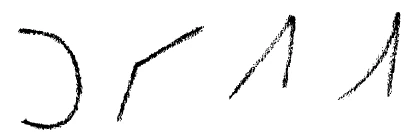
[ 30 ] At the beginning of this elementary drawing instruction, we avoid imitating anything at all. Avoid, as much as you possibly can, having the child imitate a chair, a flower, or anything else at first; instead, encourage the child to produce as many line forms as possible from within themselves: round, pointed, semicircular, elliptical, straight forms, and so on. Help the child develop a sense of the difference between the curve of a circle and that of an ellipse. In short, awaken a sense of form before the urge to imitate arises! Only later should you allow the child to apply what has been cultivated in the forms to imitation. First have the child draw an angle so that they grasp the concept of an angle through its form. Then show them the chair and say, “See, there’s an angle there, and there’s another angle there,” and so on. Do not let the child imitate anything until you have cultivated within them, out of an inner sense, an understanding of the form in its own right—which can then be imitated later on. And continue to follow this approach even as you move on to a more independent approach to drawing, painting, and the visual arts.
[ 31 ] Then, in the sixth grade, introduce simple concepts of projection and shadows, covering them both freehand and using a ruler, compass, and similar tools. Make sure that the child gains a good understanding and can trace and reproduce shapes—for example, if there is a cylinder here and a sphere here, and the sphere is illuminated by light, what the shadow cast by the sphere on the cylinder looks like.
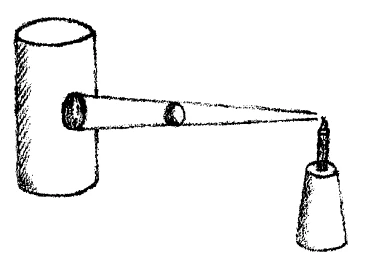
[ 32 ] How shadows are cast! Therefore, a basic introduction to projection and shadows must be introduced in the sixth grade. The child must develop a mental image of—and be able to imitate—how shadows are cast on flat surfaces, on curved surfaces, by other objects that are more or less flat, or by three-dimensional objects. In this sixth school year, the child must gain an understanding of how the technical and the beautiful are connected—how a chair can simultaneously be technically suitable for a purpose and, at the same time, have a beautiful form. And this connection between the technical and the beautiful should become part of the child’s understanding and grasp.
[ 33 ] Then, in the seventh grade, everything related to penetration should be explored. As a simple example, say: “Here we have a cylinder that is penetrated by a rod. The rod must be inserted through the cylinder.” You must show what kind of cross-sectional area is created inside the cylinder as the pole goes in and comes out again. This must be learned together with the child.
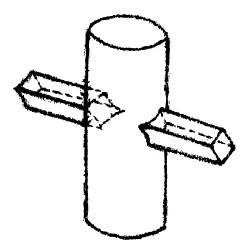
[ 34 ] The child must learn what happens when solids or surfaces intersect, so that he or she understands the difference between a stove pipe passing vertically through the ceiling—where the intersection forms a circle—and one passing at an angle—where the intersection forms an ellipse. - Then, this year, the child must be taught a good mental image of perspective. That is, simple perspective drawing: foreshortening at a distance, elongation up close, overlapping, and so on. And then, again, the connection between the technical and the aesthetic, so that one evokes in the child a mental image of whether it is beautiful or unattractive when, say, a wall of a house is partially obscured by a protrusion. Such a projection can cover a wall in a way that is either beautiful or unattractive. Such concepts have a tremendous impact when taught to a child in the seventh grade—that is, when the child is thirteen or fourteen years old.
[ 35 ] All of this is elevated to an artistic level as students approach their eighth school year.
[ 36 ] And in a similar way to how these matters have been handled, the remaining matters must now also be addressed. We will return to this this afternoon and will have a few additional points to add to our curriculum. Above all, we will need to focus on how music in the first school year can be derived as much as possible from the simple and elementary, and how we can then transition to more complex material, starting around the third school year. So that, little by little, the child absorbs—both on the instrument—and especially on the instrument—as well as in singing—what is truly formative and educational for the child’s abilities.
[ 37 ] Gymnastics and eurythmy must now be separated from all other artistic disciplines. Gymnastics and eurythmy must be separated from music and from other artistic disciplines as well.