

The Art of Education
GA 295
6 September 1919, Stuttgart
Translated by Steiner Online Library
Fifteenth Seminar Discussion and Third Curriculum Lecture
[ 1 ] Speaking Exercises:
Snake, slither swiftly
Winding Fundewecken, be goneWinding Fundewecken
Swiftly, snake, slither awayMarch, languishing
Rattling rascal
Crackling, babbling, clumsy
Nimble, off from the frontCrackling, babbling, clumsy
Nimble, off from the front
March, languishing
Rattling rascal
[ 2 ] Rudolf Steiner: That’s a good way to begin. Point to the person who is to continue; then the next person or someone else continues.
Third Lecture on the Curriculum
[ 3 ] As we pointed out this morning: just as only general guidelines can be provided for the visual arts, so too can only general guidelines be provided for music. The specifics must, of course, be left to pedagogical discretion. And so I would ask that you view these general guidelines in such a way that, in essence, they allow for the inclusion of everything that can be considered reasonable in music education.
[ 4 ] In the first, second, and third school years, one will essentially be dealing with simple musical relationships. And these simple musical relationships should be used in such a way that the guiding principle is this: to use what is pedagogically structured in music to develop the vocal training and aural perception of the individual—the developing individual. In other words, the aim is to structure musical instruction in such a way that it is suited to encouraging the individual to develop their vocal and tonal abilities properly and to listen correctly. We certainly understand this.
[ 5 ] Then come the fourth, fifth, and sixth grades. By then, students will already be familiar with note values and musical notation. They’ll be able to do comprehensive exercises on the scale. Especially in the fifth and sixth grades, they’ll be able to explore keys. By then, students will already be familiar with D major and so on. It’s best to wait as long as possible before introducing minor keys, but they can still be introduced to the child during this time.
[ 6 ] But the whole point of this is, in a sense, to work toward the opposite: to adapt the child to the demands of music, that is, to shift the instruction more toward the aesthetic side. First and foremost, the child should be the focus. Everything should be arranged so that the child learns to listen and sing. But then, after having been given a head start during the first three years of school, the child should adapt to the artistic demands of music. That is the pedagogical aspect that must be taken into account.
[ 7 ] And in the last two school years—the seventh and eighth—I ask that you bear in mind that the child no longer feels at all as if he or she is being “trained” to do anything, but rather that the child already feels that he or she is making music because it gives him or her pleasure, because he or she wants to enjoy it as an end in itself, for the sake of joy. This is what so-called music instruction should aim to achieve. Therefore, during these two years, musical judgment can be awakened and developed. Attention can already be drawn to the character of one musical work of art and that of another—the character of a Beethoven composition and that of a Brahms composition. Thus, using simple forms, one should guide the child toward musical judgment. Previously, one must hold back musical judgment, but now one must cultivate it.
[ 8 ] It will now be of particular importance that a certain understanding be reached. As you know, I made exactly the same point this morning regarding a work of visual art. I said: First, we use drawing in such a way that writing can emerge from it. Then drawing is used as an end in itself. So art then becomes what really matters. At the moment when the child transitions from utilitarian forms to developing free, artistic forms in drawing and painting—that is, between the third and fourth grades—the transition must also take place in music, just as I have described: first, work in a way that focuses on the child’s physiological development; then working in a way that requires the child to adapt to the art of music. So these transitions in drawing and painting and in music should actually correspond to one another.
[ 9 ] Now, there is one thing in the official curriculum that works in our favor: there is no physical education at all during the first three years of school. So that is when we begin with eurythmy. And it would be wonderful if, in the first year of school, eurythmy were practiced in harmony with music, so that the integration of geometry and music in eurythmy is given special attention.
[ 10 ] In the second year of school, students would begin learning the letters, a process that would then continue into the third year; this would always be done in a way that ties back to music, geometry, and drawing.
[ 11 ] And then, in the fourth, fifth, and sixth grades, the cases are introduced—that is, for concrete and abstract nouns and so on—and children are able to grasp these concepts because they have by then made such progress in grammar.
[ 12 ] Then we'll continue this in the seventh and eighth grades with more complex forms.
[ 13 ] Starting in the fourth grade, we combine the art of eurythmy with physical education in such a way that in the fourth, fifth, and sixth grades, we have “limb movements” in physical education, followed by everything related to running, jumping, and climbing, as well as only simple apparatus exercises.
[ 14 ] More complex apparatus exercises should not be introduced until the seventh and eighth school years, during which free exercises are also continued. However, all free exercises should be related to running, climbing, and jumping.
[ 15 ] If you think through everything you have been able to consider for yourself, you will find that it all aligns with what has now been attempted to be described in this way.
Continuation of the seminar discussion
Alexander Strakosch discusses the ellipse, the hyperbola, the circle, the lemniscate, and the concept of the geometric locus. He mentions how the lemniscate (Cassinian curve) can take on a Form III, in which one branch of the curve leaves the space and re-enters it as the other branch.
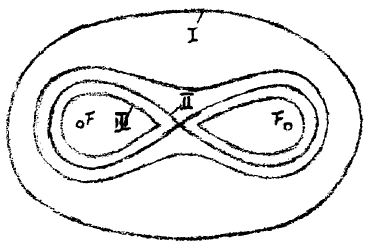
[ 16 ] Rudolf Steiner: This has an inner, organic counterpart. The two parts relate to each other like the pineal gland and the heart. One branch is located in the head—the pineal gland—and the other branch is located in the chest—the heart. However, one—the pineal gland—is less developed, while the heart is more so.
Caroline von Heydebrand talks about the Migration Period.
Rudolf Steiner: A Side Note on Caroline von Heydebrand’s Lecture:
[ 17 ] The reasons often cited for the Migration Period are very frequently based on historical constructs. The key point, when one gets to the heart of the matter regarding the actual Migration Period—when the Goths and others were advancing—is that the Romans had money, while the Germanic peoples had none, and that there was a tendency for the Germanic peoples to seek to acquire Roman money in one way or another wherever there was a border. That is why they became mercenaries and took on all sorts of roles. After all, entire legions of Germanic tribesmen entered Roman service. The Migration Period is an economic and financial issue. It was only on this basis that the spread of Christianity could then take place. The Migration Period as such, however, stems from the greed of the Germanic tribes, who wanted the Romans’ money. The Romans even became poor in the process! It was the same during the Cimbrian invasion. The Cimbri were told: “The Romans have gold!”—even though the Cimbri themselves were poor. This had a powerful effect on the Cimbri. They wanted to get gold. Roman gold!
[ 18 ] There are various ethnic groups here, including remnants of the Celts. Even today, you can still find clear linguistic echoes of the Celtic language, for example in the headwaters of the Danube—the Brig and Breg, the Brigach and Brege. Then, wherever the suffix “-ach” appears in place names—for example, Unterach, Dornach, and so on—“ach” derives from the Latin word for “little water,” *aqua*, and points back to Celtic origins. “Ill” and similar suffixes also recall ancient Celtic. The Germanic layer then superimposes itself upon the Celtic one. — The contrast between Arians and Athanasianists.
[ 19 ] It is very important that you make it clear to the children that there is a big difference—which is particularly evident in the Migration Period—between situations where, as in Spain and Italy, for example, Germanic peoples such as the Goths moved into areas that were already fully utilized for agriculture. Here, everything was already occupied. Then the Goths and other peoples moved in. They disappeared. They were thus absorbed into the other peoples who were already there. — To the west, the Franks advanced. They arrived in regions that were not yet fully occupied in terms of agriculture. They survived. That is why nothing has survived of the Goths, who moved into regions where the land had already been completely taken over. Everything has been preserved from the Franks because they moved into regions that were still uncultivated. This is a historical law that is very important. Later, this point can be revisited in the context of the settlement of North America, where, although the Native Americans were exterminated, the fact remains that people were able to settle in uncultivated regions.
[ 20 ] It is also a matter of making clear what the difference is between something like, for example, Charlemagne’s Frankish Empire and a later state. If you do not understand this difference, you will not be able to cross the Rubicon of the 15th century. Charlemagne’s empire is not yet a state. What about the Merovingians? At first, they were essentially nothing more than large landowners. And private law was the only law that applied to them. Gradually, the legal framework stemming from the old Germanic system of large-scale landownership gave way to Roman law, under which those who merely administered public offices gradually gained power. Thus, ownership gradually shifts to the administration, to the officials, and as the administration later becomes the actual ruling power, the state finally emerges. The state, therefore, arises through the establishment of the administration. The countly nobility emerges in contrast to the princely nobility. “Count” has the same origin as “graphologist”: it comes from *graphein*, to write. “Count” means “scribe.” The count is the Roman scribe, the administrator, whereas the princely nobility, as an ancient warrior nobility, is still associated with bravery, heroism, and the like. The “prince” is the first, the foremost. Thus, with the transition from prince to count, the principle of the state came into being. Of course, these examples illustrate this quite well.
Rudolf Treichler explains how he would teach children about the spread of Christianity among the Germanic peoples.
[ 21 ] Rudolf Steiner: In its practical expression, Arian Christianity bore a strong resemblance to later Protestantism, but it was less abstract and even more concrete.
[ 22 ] In the 1st and 2nd centuries, the cult of Mithras was very widespread among Roman soldiers along the Rhine and Danube, particularly among the officers. — Thor, Wotan, and Saxnot were worshiped in what is now Eisass and throughout the region well into the 6th, 7th, and 8th centuries as the ancient Germanic folk gods—the three principal deities—according to Germanic religious customs.
[ 23 ] One can describe numerous scenes of small churches being built by Roman clergy in Alsace and the Black Forest. “We want to do this and that for Wotan,” the men sang. The women sang: “Christ came for those who do nothing of their own accord.” This trick had already been used during the spread of Christianity—the idea that one had to do nothing to attain salvation.
[ 24 ] At that time, there was an ancient Germanic ritual language; in it, “Eiche” was the term used in the Old Germanic ritual language for the priest of Thor. During the time when Boniface was active, it was still very much a matter of debate whether people still knew the incantations. Boniface managed to acquire certain incantations. He knew the magic word; the priest of Donar no longer did. Through his superior power—through the “axe,” the magic word—Boniface felled the priest of Donar, the “Donar Oak.” The priest died of grief; he perished “by the fire of heaven.” These are images born of the imagination! After several generations, this was transformed into the familiar image.
[ 25 ] You have to learn to read such imaginative images. And in doing so, learn by teaching, and teach by learning.
[ 26 ] Boniface Romanized Germanic Christianity.
[ 27 ] Einhard wrote the biography of Charlemagne. Einhard is a flatterer.
Paul Bawmann discusses music education from 1st through 8th grade.
Rudolf Steiner, as an aside:
[ 28 ] Those who are less advanced in music class should at least be included in the exercises for the more advanced students, even if they remain inactive and just listen. If all else fails, they can always be set aside. Incidentally, there will be many other subjects where similar problems arise—namely, that the advanced students and those who are falling behind cannot be brought into harmony. This will occur less frequently if proper methods are employed. Today, this is merely masked by all sorts of circumstances. If you teach practically according to our principles, you will encounter difficulties—which you would otherwise not even notice—in subjects other than just music. For example, in drawing and painting. You will have children whom you find very difficult to help progress in the arts, including the plastic arts and the visual arts. In such cases, one must also try not to separate the children too early, but only when it is absolutely impossible to proceed any further.
Herbert Hahn discusses [the treatment] of poetry in French and English classes [in first, second, and third grade].
[ 29 ] Rudolf Steiner: We are firmly committed to teaching English and French to the children in a moderate way from the very beginning. Not in a manner typical of a governess, but in such a way that they learn to truly appreciate both languages and develop a feel for the correct way of expressing themselves in both.
[ 30 ] If a student in grades two through four gets stuck while reciting, one must help him or her in a good-natured and gentle manner so that the student gains confidence and does not lose heart. One must also take the student’s good will into account.
[ 31 ] For children aged 12 to 15, lyrical and epic works—such as ballads—are suitable, as are compelling historical narratives, high-quality prose, and individual dramatic scenes.
[ 32 ] And then, in the fourth grade, we’ll start teaching Latin, and in the sixth grade, Greek—for those children who wish to take it—so that we can study it for three years. If we could expand the school, we would begin teaching Latin and Greek at the same time. We must then find a way to ensure that those children who take Latin and Greek are given some relief in German. This can be done very well, because much of the grammar is then covered in Greek and Latin, which would otherwise have to be covered in German. And many other things can also be omitted.
[ 33 ] In ancient Latin, C was pronounced like K; medieval Latin, which was a spoken form of the language, used C. Many dialects were spoken in ancient Rome. You can say “Cicero” because that’s how it was still pronounced in the Middle Ages. You can’t speak of something being “correct” in language, since it is a matter of convention.
[ 34 ] The methodology for teaching classical languages should be based on the same principles, but care must be taken to ensure that, with the exception of what I mentioned this morning, the curriculum can essentially be followed. After all, it dates back to the Middle Ages, a time of pedagogical excellence. There is still much there that can prove useful from a pedagogical standpoint, particularly regarding the methodology for teaching Greek and Latin. The curricula still follow the practices of the past, and that is not entirely unreasonable. The way the textbooks are written is something that can no longer be used today, insofar as we should actually refrain from using the somewhat clunky memorization rules. They seem a bit childish to people today, and since they’ve been translated into German, they’re also a bit too clunky. We’ll try to avoid that, but otherwise the methodology isn’t so bad.
[ 35 ] Sculpture should begin before the age of nine, starting with spheres, then moving on to other forms, and so on. In sculpture, too, one should work entirely from the forms themselves.
Johannes Geyer asks whether people should give testimonials.
[ 36 ] Rudolf Steiner: As long as the children are in the same school, why should report cards be given? Give them when the children leave. After all, there is no profound pedagogical significance in devising new grades. Grades for individual assignments should be given entirely freely, without any set formula.
[ 37 ] Notifying parents can, under certain circumstances, be seen as a form of grading, but that cannot be entirely avoided. For example, it may turn out to be necessary—which we would, of course, handle with a somewhat different approach than is usually the case—for a student to remain at a certain level for a longer period; naturally, we must do that as well. We will, of course, be able to avoid this as much as possible through our method. For if we follow the practical principle of improving the student’s skills in such a way that the student benefits from the improvement—that is, if we have him do arithmetic, place less emphasis on the fact that they cannot do something in arithmetic, but rather on getting them to be able to do it afterward—if, therefore, we follow a principle that is the exact opposite of what has been done so far, then the inability to do something will no longer play as significant a role as it does now. Thus, throughout the entire lesson, the obsession with grading—which the teacher cultivates by writing grades in the notebook every day—would be transformed into an effort to help the student again and again at every moment, without substituting any judgment in its place. The teacher would have to give himself just as poor a grade as the student if the student cannot do something, because it simply means he has not yet succeeded in teaching it to the student.
[ 38 ] As a means of communicating with parents and as something demanded by the outside world, we can, as mentioned, use report cards. In this regard, we must adhere to what is customary. But at school, we must certainly foster the sentiment that—and we don’t need to elaborate on this—this is not of primary importance to us. We must spread this sentiment like a moral atmosphere.