

The Educational Value
of Understanding Human Nature
GA 296
11 August 1919, Dornach
Translate the original German text into any language:
Versions Available:
The Education Question as a Social Issue, tr. SOL
Dritter Vortrag
Third Lecture
[ 1 ] Was ich heute werde zu sagen haben, wird eine Art Episode sein. Ich möchte, wie ich Ihnen schon mitgeteilt habe, über drei Begriffe kurz sprechen. Über drei Begriffe, welche, vollständig verstanden, zugleich bewirken das Verständnis des äußeren sozialen Lebens. Ich sage ausdrücklich: des äußeren sozialen Lebens, denn die drei Begriffe sind durchaus dem äußerlichen Zusammenwirken und Zusammenarbeiten der Menschen entnommen. Es sind die drei Begriffe Ware, Arbeit, Kapital. Nun habe ich Ihnen bereits gesagt, daß sich die neuere Nationalökonomie aller Schattierungen vergeblich bemüht, über diese Begriffe in vollständige Klarheit zu kommen. Das war nicht möglich, seit die Menschen begonnen haben, bewußt volkswirtschaftlich zu denken. Vor dem Beginn des fünften nachatlantischen Zeitraumes, also vor dem Zeitpunkt, der da fällt in die Mitte des 15. Jahrhunderts, kann überhaupt nicht die Rede davon sein, daß die Menschen ihre gegenseitigen sozialen Beziehungen in bewußter Weise aufgefaßt haben. Das Leben verlief mehr oder weniger unbewußt, instinktiv mit Bezug auf dasjenige, was sozial von Mensch zu Mensch spielte. Seit dieser Zeit aber mußten die Menschen, weil ja die Bewußtseinsseele in diesem Zeitalter sich ausbildet, immer mehr und mehr bewußt nachdenken über die sozialen Beziehungen. Und so haben sich denn alle möglichen Richtungen und Anschauungen herausgebildet über das soziale menschliche Zusammenleben. Es beginnt das mit der Schule der Merkantilisten, dann mit der Schule der Physiokraten, mit Adam Smith, mit den verschiedenen utopistischen Strömungen, Prondhon, Fourier und so weiter, bis zu der neueren Sozialdemokratie auf der einen Seite, und zu der neueren Schulnationalökonomie auf der anderen Seite. Es ist interessant, die neuere sozialdemokratische Theorie, welche fußt auf Marx, Engels und anderen, zu vergleichen mit der neueren Schulnationalökonomie. Die neuere Schulnationalökonomie ist ganz unproduktiv. Sie bringt überhaupt nichts hervor von Begriffen, die in das soziale Wollen einfließen können. Man hat nichts aus den wirren chaotischen Begriffen der modernen Schulnationalökonomie, wenn man in dieser Richtung die Frage aufwirft: Was soll in sozialer Beziehung geschehen? Denn diese Schulnationalökonomie ist ganz angefressen von Anschauungen, die überhaupt in der neueren Wissenschaft herrschen. Und Sie wissen ja, daß trotz des großen, bewundernswerten Fortschrittes der Naturwissenschaften, der durchaus eben von der Geisteswissenschaft nicht geleugnet werden soll, die moderne Schulwissenschaft eigentlich sich bekennt zu der Ablehnung eines jeglichen, das aus dem Geiste hervorquillt. Und so will die Nationalökonomie nur beobachten dasjenige, was im ökonomischen Leben geschieht. Aber das Beobachten desjenigen, was im ökonomischen Leben geschieht, das ist etwas fast Unmögliches in der neueren Zeit, aus dem Grunde, weil die Menschen, je mehr sie herauf sich entwickelt haben in diese neuere Zeit, überhaupt nicht mehr Gedanken gehabt haben, welche die ökonomischen Tatsachen getragen hätten. Die ökonomischen Tatsachen liefen mechanisch von selbst dahin; die Menschen folgten ihnen nicht mit den Gedanken nach. Daher kann die Beobachtung dieser gedankenlosen Tatsachen des Weltmarktes nicht zu Gesetzen führen und hat auch nicht zu Gesetzen geführt, denn unsere Volkswirtschaft ist eine Praxis ohne Theorie, ohne Anschauung, ohne Begriffe, ohne Idee, Und unsere sozialdemokratische Bestrebung, die ist eine Theorie ohne Praxis. So genommen, wie sie ist, diese sozialistische Theorie, kann sie niemals in die Praxis umgesetzt werden; sie ist eine T'heorie ohne Einsicht in die Praxis. Wir leiden gerade in der modernen Zeit darunter, daß wir auf der einen Seite haben das wirtschaftliche Leben, eine Praxis ohne Ideen, und auf der anderen Seite die bloße Theorie der Sozialdemokraten ohne die Möglichkeit, diese T’heorie in das wirkliche Wirtschaftsleben einzuführen. Wir sind in dieser Beziehung wirklich an einem Wendepunkt der geschichtlichen Entwickelung der Menschheit angekommen. Und Sie werden es eigentlich leicht begreifen, weil ja soziales Leben begründet sein muß auf der Beziehung von Mensch zu Mensch, daß zugrunde liegen muß dem, was die Menschen anstreben, wenn sie soziales gerechtes Leben begründen wollen, eine gewisse Stimmung. Und sehen Sie, darum handelt es sich bei der Dreigliederung des sozialen Organismus, daß eine gewisse Stimmung hervorgerufen werde, eine Stimmung in zusammengehörigen sozialen Gebieten. Ohne diese Stimmung zwischen den Menschen kann das soziale Leben nicht wirklich erblühen. Und dieser Stimmung soll gerade Rechnung getragen werden durch die soziale Dreigliederung. Heute möchte ich, wie gesagt, episodisch nur auf einiges nach dieser Richtung hinweisen.
[ 1 ] What I have to say today will be a sort of anecdote. As I have already told you, I would like to speak briefly about three concepts—three concepts which, when fully understood, also lead to an understanding of external social life. I say explicitly: external social life, because these three concepts are derived entirely from the external interactions and cooperation among people. They are the three concepts of commodity, labor, and capital. Now, I have already told you that modern economics of all schools of thought has struggled in vain to achieve complete clarity regarding these concepts. This has not been possible since people began to think consciously in economic terms. Before the beginning of the fifth post-Atlantean epoch—that is, before the mid-15th century—there can be no question whatsoever of people having consciously grasped their mutual social relationships. Life unfolded more or less unconsciously and instinctively in relation to what took place socially from person to person. Since that time, however, because the soul of consciousness was developing in this era, people have had to reflect more and more consciously on social relationships. And so all manner of schools of thought and perspectives on human social coexistence have emerged. It begins with the school of the mercantilists, then with the school of the physiocrats, with Adam Smith, with the various utopian movements—Proudhon, Fourier, and so on—up to modern social democracy on the one hand, and modern neoclassical economics on the other. It is interesting to compare modern social democratic theory—which is based on Marx, Engels, and others—with modern academic economics. Modern academic economics is entirely unproductive. It produces absolutely no concepts that can influence social will. The confused, chaotic concepts of modern academic economics are of no use when one poses the question in this context: What should happen in the social sphere? For this academic economics is thoroughly permeated by views that prevail throughout modern science. And you know, of course, that despite the great, admirable progress of the natural sciences—which the Spiritual Science certainly does not deny—modern academic science actually professes a rejection of anything that springs from the spirit. And so economics seeks only to observe what happens in economic life. But observing what happens in economic life is something nearly impossible in modern times, for the reason that the more people have developed in this modern era, the less they have had any thoughts at all that would have underpinned economic facts. Economic facts have unfolded mechanically of their own accord; people have not followed them with their thoughts. Therefore, the observation of these thoughtless facts of the world market cannot lead to laws and has not led to laws, for our national economy is a practice without theory, without insight, without concepts, without ideas; and our social democratic endeavor is a theory without practice. Taken as it is, this socialist theory can never be put into practice; it is a theory without insight into practice. We suffer from this precisely in modern times: on the one hand, we have economic life—a practice without ideas—and on the other, the mere theory of the Social Democrats, without the possibility of introducing this theory into real economic life. In this regard, we have truly reached a turning point in the historical development of humanity. And you will actually find this easy to understand, because social life must be founded on the relationship between human beings; what people strive for when they want to establish a socially just life must be based on a certain atmosphere. And you see, this is what the threefold social order is all about: that a certain atmosphere be created—an atmosphere within related social spheres. Without this atmosphere among people, social life cannot truly flourish. And it is precisely this atmosphere that the threefold social order is intended to take into account. Today, as I said, I would like to touch on just a few points in this direction.
[ 2 ] Wenn Sie sich das soziale Leben als einen Organismus denken, so müssen Sie sich ja vorstellen, daß, allerdings ins Geistig-Seelische herauf umgesetzt, diesen Organismus etwas durchströmt. Wie zum Beispiel den menschlichen und den tierischen Organismus das Blut als Träger der eingeatmeten und umgewandelten Luft, so muß den ganzen sozialen Organismus etwas tragen, etwas durchwehen, etwas durchzirkulieren.
[ 2 ] If you think of social life as an organism, you must have in your mental image that—albeit transposed into the spiritual-psychic realm—something flows through this organism. Just as blood carries the inhaled and transformed air through the human and animal organisms, so too must something carry, permeate, and circulate throughout the entire social organism.
[ 3 ] Hier kommen wir auf dasjenige Kapitel, welches dem gegenwärtigen Menschen so schwer verständlich ist, weil er in seinem Gemüte sehr wenig darauf vorbereitet ist, aber welches auch verstanden werden muß, wenn überhaupt von einer sozialen Neugestaltung, von einem sozialen Aufbau im Ernste die Rede sein soll. Verstanden wird werden müssen, daß im sozialen Leben der Zukunft etwas davon abhängt, wovon sich die Menschen gegenseitig unterhalten, was die Menschen ernst nehmen, indem sie gegenseitig ihre Ideen, ihre Empfindungen, ihre Gefühle austauschen. Es ist nicht gleichgültig, was unter denMenschen an Anschauungen lebt, wenn sie soziale Wesen werden wollen. Und notwendig ist es für die Zukunft, daß nicht bloß Begriffe in der allgemeinen Bildung herrschen, welche aus der Naturwissenschaft oder aus der Industrie entnommen sind, sondern daß Begriffe herrschen, welche Grundlagen sein können für etwas Imaginatives, So unwahrscheinlich das dem heutigen Menschen ist, sozialisieren wird man nicht, wenn man nicht zu gleicher Zeit den Menschen beibringt imaginative Begriffe, das heißt Begriffe, welche das Gemüt des Menschen ganz anders gestalten, als die bloßen abstrakten Begriffe von Ursache und Wirkung, Kraft und Stoff und Materie und so weiter, die aus dem naturwissenschaftlichen Leben herkommen. Mit diesen Begriffen, die aus dem naturwissenschaftlichen Leben herkommen und von denen heute alles beherrscht ist, sogar die Kunst, mit diesen Begriffen läßt sich im sozialen Leben der Zukunft nichts anfangen. Wir müssen in die Lage kommen, im sozialen Leben der Zukunft die Welt wiederum in Bildern zu verstehen.
[ 3 ] Here we come to the very chapter that is so difficult for people today to understand, because they are so ill-prepared for it in their minds, but which must also be understood if we are to speak seriously at all of social restructuring or social reconstruction. It will have to be understood that in the social life of the future, much depends on what people discuss with one another—on what people take seriously as they exchange their ideas, their perceptions, and their feelings. It is not a matter of indifference what views prevail among people if they wish to become social beings. And it is essential for the future that general education not be dominated solely by concepts derived from the natural sciences or industry, but rather by concepts that can serve as foundations for something imaginative, As improbable as this may seem to people today, we will not achieve socialization unless we simultaneously teach people imaginative concepts—that is, concepts that shape the human spirit in a completely different way than the mere abstract concepts of cause and effect, force and substance, matter, and so on, which stem from the world of natural science. With these concepts, which stem from the natural sciences and by which everything is dominated today—even art—with these concepts, one cannot make headway in the social life of the future. We must be able, in the social life of the future, to understand the world once again in images.
[ 4 ] Was damit gemeint ist, habe ich ja schon zu wiederholten Malen angedeutet, auch wiederum mit Bezug auf die Erziehungsfrage. Ich habe mit Bezug auf die Erziehungsfrage folgendes gesagt. Ich habe gesagt, man kann den Kindern, wenn man sich intim mit ihnen beschäftigt, gut beibringen, sagen wir die Idee der Unsterblichkeit der Seele, indem man einfach dem Kinde zeigt eine Schmetterlingspuppe und ihm zeigt, wie die Puppe sich aufbricht und der Schmetterling aus der Puppe ausfliegt; dann macht man dem Kinde klar: Sieh einmal, so wie die Puppe ist, so ist dein Leib, und da drinnen lebt etwas wie ein Schmetterling, nur ist das unsichtbar. Wenn du in den Tod kommst, so fliegt auch bei dir der Schmetterling heraus in die geistige Welt. — Durch solche Vergleiche wirkt man bildlich. Aber es ist nicht bloß notwendig, daß man einen solchen Vergleich ausdenkt; da würde man eben im Sinne der naturwissenschaftlichen Weltanschauung handeln, wenn man ihn ausdenkt. Denn was bringen denn die Menschen aus der heutigen Zeitbildung gewöhnlich, wenn sie einen solchen Vergleich je einmal machen, ihm für eine Stimmung entgegen? Die Menschen der heutigen Zeit, wenn sie kaum erwachsen sind, sind sehr gescheit, außerordentlich gescheit. Sie bedenken gar nicht, daß man auf eine andere Weise vielleicht gescheit sein kann, als sie selbst in ihren abstrakten Begriffen sich vorstellen, daß sie gescheit sind. Es ist nämlich ganz merkwürdig, wie die Menschen mit Bezug auf diese ihre heutige Gescheitheit sind!
[ 4 ] I have already hinted at what this means on several occasions, again with reference to the question of child-rearing. I said the following regarding the question of education. I said that if you engage closely with children, you can effectively teach them—let’s say—the idea of the immortality of the soul by simply showing the child a butterfly chrysalis and demonstrating how the chrysalis breaks open and the butterfly flies out of it; then you explain to the child: “Look, just as the chrysalis is, so is your body, and inside it lives something like a butterfly, only it is invisible. When you die, the butterfly will fly out of you into the spiritual world as well.” — Such comparisons allow one to speak figuratively. But it is not merely necessary to devise such a comparison; if one were to do so, one would simply be acting in accordance with the scientific worldview. For what do people of today’s cultural milieu usually bring to such a comparison—if they ever make one—in terms of the appropriate mood? People today, as soon as they reach adulthood, are very clever—extraordinarily clever. They do not even consider that one might be clever in a different way than they themselves have in their mental images of what it means to be clever. It is, in fact, quite remarkable how people are with regard to this cleverness of theirs today!
[ 5 ] An einen Vortrag, den ich vor Wochen einmal gehalten habe, hat sich dann angeschlossen in einem staatswissenschaftlichen Verein der betreffenden Stadt eine Versammlung, und da hat über den Vortrag und das, was damit zusammenhing, gesprochen ein Universitätsprofessor, also selbstverständlich ein gescheiter Mann der Gegenwart, nicht wahr. Der hat gefunden, daß die Anschauungen, die ich nicht nur in jenem Vortrage vorgebracht habe, sondern die in allen meinen Büchern stehen, infantil sind, das heißt, auf der Kindheitsstufe der Menschheit stehen. Sehen Sie, ich begreife ganz gut solch ein Urteil von einem gescheiten Menschen der Gegenwart; besonders begreife ich es sehr gut, wenn er gerade Universitätsprofessor ist. Ich begreife es aus dem Grunde, weil ja aus der Wissenschaft, die da gemeint ist, alles wirklich bildhafte Leben heraußen ist und daher alles, was verstanden oder besser gesagt nicht verstanden wird — kindlich gefunden wird. Ja, sehen Sie, das ist eben gerade dieses eigentümliche, daß die Menschen in der heutigen Gescheitheit kommen und sagen: Wenn wir einmal ein solches Bild anwenden wollen, wie: die unsterbliche Seele läßt sich vergleichen mit dem Schmetterling, der aus der Puppe herausfliegt, dann sind wir die Gescheiten, wir wissen selbstverständlich, daß das ein Bild ist, das wir gemacht haben; wir sind hinaus über dasjenige, was ein solches Bild enthält, Aber das Kind ist kindlich, für das vergleicht man, was man in Begriffen weiß, mit diesem Bilde; aber wir selber glauben nicht daran. - Das Geheimnis besteht nur darinnen, daß dann das Kind auch nicht daran glaubt. Das Geheimnis liegt darinnen, daß das Kind nur wirklich ergriffen wird von dem Bilde, wenn man selber daran glaubt. Und dazu soll uns eben wirkliche geisteswissenschaftliche Stimmung wiederum zurückbringen, daß wir in der Natur nicht sehen jene gespenstischen Dinge, von denen uns die Naturwissenschaft spricht, sondern wiederum sehen das Bildliche, das Imaginative. Dasjenige, was aus der Puppe auskriecht und in dem Schmetterling vorliegt, ist wirklich ein von der göttlichen Weltordnung in die Naturordnung hineingestelltes Bild für die Unsterblichkeit der Seele. Und es gäbe den Schmetterling nicht, der aus der Puppe auskriecht, wenn es nicht eine unsterbliche Seele gäbe. Denn es kann nicht ein Bild geben — und das ist ein Bild -, wenn nicht die Wahrheit zugrunde liegt dem Bilde. Und so ist es mit der ganzen Natur. Dasjenige, was die Naturwissenschaft gibt, ist Gespenst. Der Natur selber kommt man nur bei, wenn man weiß, sie ist Bild von etwas anderem.
[ 5 ] A lecture I gave a few weeks ago was followed by a meeting at a political science association in that city, and there a university professor—obviously a clever man of our time, wouldn’t you say?—spoke about the lecture and related matters. He found that the views I expressed—not only in that lecture but also in all my books—are infantile, that is, at the childhood stage of humanity. You see, I understand quite well such a judgment from an intelligent person of our time; I understand it particularly well when he happens to be a university professor. I understand it for the simple reason that, in the science being referred to here, all truly pictorial life is excluded, and therefore everything that is understood—or rather, not understood—is regarded as childish. Yes, you see, that is precisely what is so peculiar: that people, in today’s “intellectual” mindset, come along and say: If we ever want to use a metaphor such as “the immortal soul can be compared to a butterfly emerging from its chrysalis,” then we, as the “intellectuals,” naturally know that this is a metaphor we have created; we have moved beyond what such an image actually conveys. But the child is childlike; for the child, what one knows in concepts is compared to this image—yet we ourselves do not believe in it. - The mystery lies solely in the fact that the child, too, does not believe in it. The mystery lies in the fact that the child is truly moved by the image only when one believes in it oneself. And this is precisely what a genuine attitude of Spiritual Science is meant to bring us back to—so that we do not see in nature those ghostly things of which natural science speaks, but rather see once again the pictorial, the imaginative. That which emerges from the chrysalis and is present in the butterfly is truly an image of the soul’s immortality, placed within the natural order by the divine world order. And the butterfly that emerges from the chrysalis would not exist if there were no immortal soul. For there cannot be an image—and this is an image—unless truth underlies the image. And so it is with all of nature. What natural science offers is a phantom. One can only approach nature itself when one knows that it is an image of something else.
[ 6 ] Und so werden sich die Menschen auch bequemen müssen, zum Beispiel das menschliche Haupt als ein Bild eines Himmelskörpers anzusehen. Das menschliche Haupt ist nicht bloß rund, so wie es ist, damit es etwa einem Kohlkopf ähnlich sehen soll, sondern das menschliche Haupt ist so, wie es ausgestaltet ist, eine Nachbildung eines Himmelskörpers. Bildhaft ist die ganze Natur, und hineinfinden muß man sich in diese Bildhaftigkeit, dann wird ausstrahlen in die Herzen, in die Seelen, in die Gemüter, in die Köpfe sogar, obwohl das am schwersten ist, dasjenige, was durchströmen kann den Menschen, wenn er Bilder auffaßt. Wir werden miteinander reden müssen in dem sozialen Organismus von Dingen, die in Bildern gesprochen sind. Und diese Bilder wird man uns glauben müssen. Dann werden aus der Wissenschaft hervorgehen diejenigen Menschen, die da sprechen können erst über das wirkliche Hineinstellen der Ware in den sozialen Organismus; denn die Ware, die erzeugt wird, entspricht dem menschlichen Bedürfnis. Keine abstrakten Begriffe können dieses menschliche Bedürfnis in seiner sozialen Wertung erfassen, sondern nur dasjenige menschliche Gemüt kann etwas darüber wissen, das durchtränkt worden ist von derjenigen Stimmung, die aus dem imaginativen Vorstellen kommt. Anders wird es keine Sozialisierung geben. Sie können im sozialen Organismus die richtigen Leute anstellen, welche die Bedürfnisse feststellen: wenn Sie nicht zu gleicher Zeit eine imaginative Vorstellung hineinerziehen in den sozialen Organismus, so ist es unmöglich, eine soziale Gestaltung des sozialen Organismus herauszubekommen; das heißt, es muß von Bildern geredet werden. So sonderbar es dem heute sozialistisch Denkenden klingt, es sei zum Sozialisieren notwendig, daß im sozialen Organismus die Menschen zu den Menschen in Bildern reden, welche Imaginationen anregen, so muß es doch geschehen.
[ 6 ] And so people will also have to get used to, for example, viewing the human head as an image of a celestial body. The human head is not merely round—as it is—so that it might resemble a head of cabbage, but rather, the human head, as it is shaped, is a replica of a celestial body. All of nature is symbolic, and one must find one’s way into this symbolism; then what can flow through a person when they perceive images will radiate into their hearts, souls, minds, and even their heads—though this is the most difficult part. We will have to speak to one another within the social organism about things expressed in images. And people will have to believe these images. Then, from the realm of science, there will emerge those people who can speak about the actual integration of the commodity into the social organism; for the commodity that is produced corresponds to human need. No abstract concepts can grasp this human need in its social evaluation; rather, only the human mind that has been imbued with the mood arising from an imaginative mental image can know anything about it. Otherwise, there will be no socialization. You can employ the right people in the social organism to identify needs; but if you do not at the same time instill an imaginative mental image into the social organism, it is impossible to achieve a social structuring of the social organism—that is, one must speak in terms of images. As strange as it may sound to those who think in socialist terms today—that for socialization it is necessary for people within the social organism to speak to one another in images that stimulate the imagination—it must nevertheless happen.
[ 7 ] Das ist es, worauf es ankommt. Und dasjenige, was Ware ist, man wird es fühlend verstehen in einer Wissenschaft, in der für Bilder Verständnis ist — in keiner anderen.
[ 7 ] That is what matters. And what constitutes a commodity—one will intuitively understand it in a science in which images are understood—in no other.
[ 8 ] In der Gesellschaft, welche die Gesellschaft der Zukunft sein soll, da wird außerdem in einer richtigen Weise herrschen müssen die Arbeit. Wie heute unter den Menschen von der Arbeit geredet wird, das ist geradezu eine Torheit, denn die Arbeit als solche hat im Grunde genommen gar nichts zu tun mit der Erzeugung der Güter. Karl Marx nennt die Ware kristallisierte Arbeitskraft. Das ist bloßer Unsinn, nichts weiter. Denn dasjenige, um was es sich handelt, wenn der Mensch arbeitet, das ist, daß er in einer gewissen Weise sich selbst verbraucht. Nun können Sie dieses Selbstverbrauchen bewirken entweder auf die eine oder auf die andere Weise. Sie können, wenn Sie gerade genügend auf einer Bank oder in Ihrem Portemonnaie haben, Sport treiben und sich bei diesem anstrengen und Ihre Arbeitskraft auf diesen Sport verwenden. Sie können aber auch Holz hacken oder irgend etwas anderes tun. Die Arbeit kann ganz die gleiche sein, wenn Sie Holz hacken oder wenn Sie Sport treiben. Nicht davon hängt es ab, wieviel Arbeitskraft Sie anwenden, sondern wozu diese Arbeitskraft angewendet wird im sozialen Leben. Arbeitskraft an sich hat mit dem sozialen Leben nichts zu tun, insofern dieses soziale Leben Güter oder Waren erzeugen soll. Daher wird es nötig sein im dreigliedrigen sozialen Organismus, daß ein ganz anderer Antrieb zur Arbeit da sein muß als derjenige, Güter zu erzeugen. Die Güter müssen gewissermaßen durch die Arbeit erzeugt werden, weil die Arbeit eben auf etwas verwendet wird. Aber dasjenige, was zugrunde liegen muß, damit der Mensch arbeitet, das muß die Lust und Liebe zur Arbeit sein. Und wir kommen nicht früher zu einer sozialen Gestaltung des sozialen Organismus, als wenn wir die Methoden finden, daß der Mensch arbeiten will, daß es ihm eine Selbstverständlichkeit ist, daß er arbeitet.
[ 8 ] In the society that is to be the society of the future, labor must also prevail in the proper sense. The way people talk about labor today is sheer folly, for labor as such has, in essence, nothing to do with the production of goods. Karl Marx calls a commodity “crystallized labor power.” That is sheer nonsense, nothing more. For what is at stake when a person works is that he consumes himself in a certain way. Now, you can bring about this self-consumption in one way or another. If you have just enough in the bank or in your wallet, you can play sports, exert yourself in the process, and apply your labor power to that sport. But you can also chop wood or do something else. The work can be exactly the same whether you’re chopping wood or playing sports. It does not depend on how much labor you expend, but rather on what this labor is applied to in social life. Labor in and of itself has nothing to do with social life, insofar as this social life is intended to produce goods or commodities. Therefore, in the threefold social organism, there must be a completely different motivation for work than the desire to produce goods. Goods must, so to speak, be produced through work, because work is, after all, directed toward something. But what must underlie a person’s willingness to work must be the joy and love of work. And we will not achieve a social structure for the social organism until we find the methods that make a person want to work—so that working becomes second nature to them.
[ 9 ] Das kann in keiner anderen Gesellschaft geschehen, als in einer solchen Gesellschaft, in der Sie von inspirierten Begriffen reden. Niemals wird in der Zukunft so wie in der Vergangenheit, wo die Dinge instinktiv und atavistisch waren, Lust und Liebe zur Arbeit die Menschen durchglühen, wenn Sie die Gesellschaft nicht durchdringen mit solchen Ideen, mit solchen Empfindungen, die durch Inspiration der Eingeweihten in die Welt kommen. Diese Begriffe müssen die Menschen so tragen, daß die Menschen wissen: Wir haben den sozialen Organismus vor uns und wir müssen uns ihm widmen; das heißt, daß die Arbeit selber in ihre Seele fährt, weil sie Verständnis haben für den sozialen Organismus. Solches Verständnis werden keine anderen Menschen haben, als diejenigen, zu welchen von inspirierten Begriffen, das heißt von Geisteswissenschaft geredet wird. Das heißt, wir brauchen, damit die Arbeit wiederum erstehe unter den Menschen, nicht jene hohlen Begriffe, von denen heute deklamiert wird, sondern wir brauchen geistige Wissenschaften, mit denen wir die Herzen, die Seelen durchdringen. Dann wird diese geistige Wissenschaft die Herzen, die Seelen so durchdringen, daß die Menschen Lust und Liebe zur Arbeit haben werden, und es wird sich die Arbeit hinstellen neben die Ware in einer Gesellschaft, die nicht nur von Bildern hört, durch jene, welche die Pädagogen der Gesellschaft sind, sondern die auch hört von Inspirationen und solchen Begriffen, die notwendig sind, damit in unserer komplizierten Gesellschaft die Produktionsmittel da sind und damit der Boden in entsprechender Weise unter den Menschen wirke,
[ 9 ] This can happen in no other society than one in which you speak of inspired concepts. Never in the future—as in the past, when things were instinctive and atavistic—will the passion and love for work set people ablaze unless you permeate society with such ideas, with such feelings, which come into the world through the inspiration of the initiated. People must carry these concepts in such a way that they know: We have the social organism before us, and we must devote ourselves to it; that is to say, work itself enters their souls because they have an understanding of the social organism. No one other than those to whom inspired concepts—that is, Spiritual Science—are spoken of will possess such an understanding. This means that, in order for work to be reborn among people, we do not need those hollow concepts that are touted today, but rather we need spiritual sciences with which we can penetrate hearts and souls. Then this spiritual science will penetrate hearts and souls in such a way that people will have a desire for and love of work, and work will take its place alongside the commodity in a society that not only hears about images—through those who are the educators of society—but also hears about inspiration and the concepts necessary to ensure that, in our complex society, the means of production are available and that the soil exerts its influence on people in an appropriate manner,
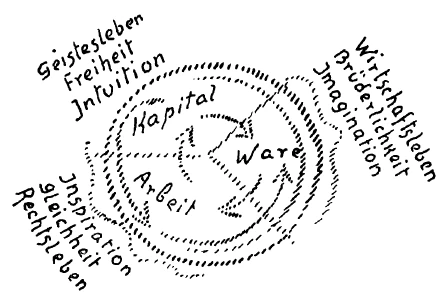
[ 10 ] Dazu ist notwendig, daß intuitive Begriffe in dieser Gesellschaft verbreitet werden. Diese Begriffe, die Sie finden in meinem Buch «Die Kernpunkte der sozialen Frage» über das Kapital, die werden nur in einer Gesellschaft erblühen, die empfänglich ist für intuitive Begriffe. Das heißt: Es wird sich hineinstellen das Kapital in den sozialen Organismus, wenn man wiederum zugeben wird, daß in den Menschen Intuition sein soll. Die Ware wird sich in der richtigen Weise hineinstellen, wenn man zugeben wird, daß Imagination sein soll; und die Arbeit wird sich in der richtigen Weise hineinstellen, wenn man zugeben wird, daß Inspiration sein soll.
[ 10 ] For this to happen, intuitive concepts must become widespread in this society. These concepts—which you will find in my book *The Key Points of the Social Question* regarding capital—will flourish only in a society that is receptive to intuitive concepts. This means: Capital will find its proper place within the social organism when we once again acknowledge that intuition should exist in human beings. The commodity will find its proper place when we acknowledge that imagination should exist; and labor will find its proper place when we acknowledge that inspiration should exist.
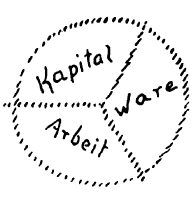
[ 11 ] Wenn Sie dieses Schema nehmen, wenn Sie nicht die drei Begriffe untereinander schreiben, sondern wenn Sie sie so schreiben, wie ich sie in dieses Schema hineingestellt habe, dann können Sie von diesem Schema, wenn Sie es mit all den Begriffen durchdringen, die in meinem Buche stehen über die Dreigliederung, sehr viel lernen. Denn es bestehen Beziehungen hin und her von Arbeit zu Ware, von Ware zu Kapital, indem das Kapital die Ware kauft; es bestehen Beziehungen zwischen Arbeit und Kapital und so weiter, nur müssen Sie sie in dieser Weise anordnen, die drei Begriffe. (Siehe Schema.)
[ 11 ] If you take this diagram—not by listing the three concepts one below the other, but by arranging them as I have in this diagram—then you can learn a great deal from it by applying all the concepts found in my book on the threefold social order. For there are reciprocal relationships between labor and commodities, and between commodities and capital—since capital purchases commodities—and there are relationships between labor and capital, and so on; you simply need to arrange the three concepts in this way. (See diagram.)
[ 12 ] Das ist es, was wir vor allen Dingen verstehen müssen, daß es schon recht ist, wenn man davon redet, in der Zukunft müsse die Menschheit durchdringen die soziale Ordnung; daß aber es notwendig ist, daß diese soziale Ordnung von den Menschen selber verwirklicht wird, indem die Menschen sich bequemen, der Wissenschaft der Eingeweihten zuzuhören von den Imaginationen, Inspirationen und Intuitionen. Es ist eine ernste Sache, denn ich sage Ihnen ja nichts Geringeres damit, als daß es ohne Geisteswissenschaft keine soziale Umgestaltung für die Zukunft gibt; aber das ist wahr. Sie werden niemals die Möglichkeit bekommen, die Menschen zum Verständnis zu bringen in einer solchen Weise, wie es notwendig ist in bezug auf diese Dinge wie Intuition, Imagination, Inspiration, wenn Sie zum Beispiel die Schule dem Staate überlassen. Denn was machen die Staaten aus den Schulen?
[ 12 ] This is what we must understand above all else: that it is indeed correct to speak of humanity’s need to transform the social order in the future; but that it is necessary for this social order to be realized by human beings themselves, by their being willing to listen to the science of the initiates concerning imaginations, inspirations, and intuitions. This is a serious matter, for I am telling you nothing less than that without Spiritual Science there can be no social transformation for the future; but this is true. You will never have the opportunity to bring people to an understanding in the way that is necessary with regard to such things as intuition, imagination, and inspiration if, for example, you leave the schools to the state. For what do states do with schools?
[ 13 ] Nicht wahr, betrachten Sie etwas, was ganz eminent schulmäßig auf der einen Seite und staatsmäßig auf der andern Seite ist. Ja, ich muß Ihnen gestehen, ich finde, es ist etwas Furchtbares! Aber dieses Furchtbare bemerken die Menschen der Gegenwart nicht; dies, was es mit dem Staatsrecht zum Beispiel ist. Das Staatsrecht, es soll ja entstehen im Sinne derjenigen Lebensgewohnheiten, welche die Menschen heute noch als das Richtige in ihre Seele aufnehmen, dadurch, daß meinetwillen Parlamente — ich will auf den Demokratismus schauen, will gar nicht einmal auf das Monarchische, sondern meinetwillen auf den Demokratismus schauen -, also dadurch, daß Parlamente da sind, werden die staatsrechtlichen Dinge beschlossen: da macht man das Staatsrecht, da macht es jeder mündig gewordene Mensch durch seinen Vertreter, das Staatsrecht. Da werden die Dinge beschlossen, dann stehen sie in den Gesetzessammlungen. Dann kommt der Professor, der studiert die Gesetzessammlungen, und dann unterrichtet er dasjenige, was in den Geserzessammlungen steht, selbstverständlich als Staatsrecht, denn das trägt er als Staatsrecht vor. Das heißt, der Staat nimmt ins Schlepptau die Wissenschaft gerade in diesem Punkt im eminentesten Sinn. Der Staatsrechtslehrer darf nichts anderes vortragen als dasjenige, was im Staate als Recht da ist. Man brauchte gar nicht einmal im Grunde genommen den Professor, wenn man in der Lage wäre, die staatsrechtlichen Gesetze auf Rollen zu schreiben, in irgendeinen Phonographen hineinzutun: dann könnte man auch den Phonographen aufs Katheder stellen, der brauchte ja nur das abzurasseln, was die Parlamente beschlossen haben. Das ist dann die Wissenschaft.
[ 13 ] Isn’t it true that you are looking at something that is, on the one hand, eminently academic and, on the other, eminently political? Yes, I must confess to you, I find it terrifying! But people today do not notice this terror—this aspect of constitutional law, for example. Constitutional law is supposed to arise in accordance with those ways of life that people today still accept as right in their hearts; through the fact that—for my part—parliaments exist—I want to look at democracy, I don’t even want to look at the monarchy, but for my part at democracy—so through the fact that parliaments exist, matters of constitutional law are decided: that is where constitutional law is made; that is where every person who has come of age, through their representative, shapes constitutional law. That is where matters are decided, and then they are recorded in the collections of laws. Then comes the professor, who studies the statute books, and then he teaches what is contained in the statute books—naturally as constitutional law, for that is how he presents it. This means that the state draws academia into its orbit in the most eminent sense precisely on this point. The professor of constitutional law may teach nothing other than what exists as law within the state. Basically, one wouldn’t even need the professor if one were able to write the constitutional laws on reels and feed them into some kind of phonograph: then one could also place the phonograph on the lectern; it would only need to rattle off what the parliaments have decided. That, then, is science.
[ 14 ] Das ist nur auf einem extremen Gebiete. Sehen Sie, das ist nichts Inspiriertes, denn Sie werden kaum in der Lage sein zu behaupten, daß das, was in den Parlamenten als Majoritätsbeschlüsse heute zustandekommt, so recht inspirierte Tatsachen sind. Aber umgekehrt muß die Sache werden. Im Geistesleben drinnen, an den Universitäten muß das Staatsrecht entstehen als Wissenschaft zunächst, rein aus der menschlichen geistigen Auffassung heraus. Nur dann kann der Staat die richtige Konfiguration bekommen, wenn die Menschen sie ihm geben. Manche Menschen glauben, die Dreigliederung will die Welt auf den Kopf stellen. O nein, die Welt steht auf dem Kopf, die Dreigliederung will sie nur auf die Beine stellen. Das ist dasjenige, worauf es ankommt.
[ 14 ] That’s only in an extreme area. You see, this is not inspired, for you will hardly be able to claim that what is passed today in parliaments as majority decisions are truly inspired acts. But the situation must be reversed. Within intellectual life, at the universities, constitutional law must first emerge as a science, arising purely from human intellectual understanding. Only then can the state take on the right form—when people give it that form. Some people believe that the threefold social order wants to turn the world upside down. Oh no, the world is already upside down; the threefold social order merely wants to set it right. That is what really matters.
[ 15 ] Sehen Sie, es handelt sich vor allen Dingen heute, in solche Begriffe sich hineinzufinden, sonst gehen wir entgegen der Mechanisierung des Geistes, der Einschläferung, das heißt Vegerarisierung der Seele und der Animalisierung, das heißt der instinktiven Gestaltung der Leiber.
[ 15 ] You see, what matters most today is to come to terms with such concepts; otherwise, we are heading toward the mechanization of the mind, a numbing of the spirit—that is, the vegetation of the soul—and animalization, that is, the instinctive shaping of our bodies.
[ 16 ] Es ist sehr wichtig, sich zu durchdringen mit der Überzeugung, daß in so radikaler Weise gedacht werden muß, wenn der Zukunft irgendein Heil erblühen soll. Es ist also vor allen Dingen notwendig, daß die Menschen einsehen, daß sie den sozialen Organismus auf seine drei gesunden Glieder werden stellen müssen. Was Imagination in bezug auf Ware bedeutet, man wird es nur lernen, wenn das Wirtschaftsleben rein herausgestaltet ist und die Menschen darauf angewiesen sind, das Wirtschaftsleben in Brüderlichkeit zu verwalten. Was Inspiration für die Arbeit bedeutet — daß sie Lust und Liebe zur Arbeit hervorbringt -, das wird nur dann in der Welt sein, wenn in der Tat von den Leuten, die inspiriert sind, durchdrungen wird wenigstens dasjenige, was dann im Parlament als Gleicher zum Gleichen sich gesellt, wenn wirkliche Gleichheit herrscht, das heißt, wenn jeder geltend machen kann das, was in ihm ist, Aber das wird sehr verschieden sein bei dem einen und bei dem andern. Dann wird herrschen können diese Gleichheit im Rechtsleben, und das Rechtsleben wird inspiriert werden müssen — nicht aus dem Banausentum heraus beschlossen, worauf die gewöhnliche Demokratie immer mehr und mehr hingearbeitet hat.
[ 16 ] It is very important to be thoroughly convinced that we must think in such a radical way if any hope for the future is to flourish. Above all, therefore, it is necessary for people to realize that they must build the social organism on its three healthy pillars. What imagination means in relation to goods will only become clear once economic life has been purely restructured and people are called upon to manage it in a spirit of brotherhood. What inspiration means for work—that it brings about joy and love for work—will only exist in the world when people who are inspired truly permeate society with at least that which then unites equals in parliament, when true equality reigns, that is, when everyone can assert what is within them, But this will vary greatly from one person to another. Then this equality will be able to prevail in legal life, and legal life will have to be inspired—not decided upon out of philistinism, toward which ordinary democracy has been striving more and more.
[ 17 ] Und das Kapital wird nur richtig verwertet werden können im sozialen Organismus, wenn die Intuition sich erheben wird zu der Freiheit und die Freiheit erblühen wird aus dem selbst sich entwickelnden Geistesleben. Dann wird herüberströmen aus dem Geistesleben in die Arbeit dasjenige, was herüberzuströmen hat. Es werden solche Ströme sein (siehe die Pfeile). Und diese drei Gebiete werden gerade, wenn sie so gegliedert werden, sich in der richtigen Weise durchdringen.
[ 17 ] And capital will only be able to be utilized properly within the social organism when intuition rises to freedom and freedom blossoms from the self-developing spiritual life. Then what is meant to flow from the spiritual life into work will flow over into it. These will be such streams (see the arrows). And these three spheres, precisely when structured in this way, will permeate one another in the proper manner.
[ 18 ] Einer der ersten Vorwürfe, der mir in Deutschland gemacht worden ist, das war der, daß man gesagt hat: Nun will er gar noch das soziale Leben dreigliedern! Das soziale Leben muß eine Einheit sein! — Aber die Menschen sind nur hypnotisiert von dieser Einheit, weil sie immer den Staat eben als etwas Einheitliches angesehen haben. Sie sind eingewöhnt in diese Begriffe vom einheitlichen Staat. Und derjenige, der von dieser Einheit spricht, der kommt mir vor wie einer, der sagt: Jetzt will der gar einen Gaul haben, der auf vier Füßen steht, der Gaul muß doch eine Einheit sein, der kann doch nicht in vier Beine gegliedert sein. -— Das wird natürlich keiner verlangen. Aber ich will auch nicht den Gaul-«Staat» oder den sozialen Organismus auf ein Bein stellen, sondern auf seine gesunden drei Beine. Und wie die Gauleinheit nicht dadurch seine Einheit verliert, daß er auf vier Beinen steht, so auch der soziale Organismus dadurch nicht, daß man ihn auf seine gesunden drei Glieder stellt. Er kriegt sie gerade dadurch, seine Einheit, daß man ihn auf seine gesunden drei Glieder stellt. Die Menschen können eben heute durchaus nicht von ihren gewohnten Begriffen loskommen. Aber das ist heute das Wichtigste, daß wir nicht bloß glauben, daß einzelne äußerliche Einrichtungen umgewandelt werden sollen, sondern daß wir unsere Ideen, unsere Begriffe, unsere Empfindungen umgestalten müssen. Wir können schon sagen: Wir brauchen andere Köpfe auf unseren Schultern, wenn wir der Zukunft der Menschheit in heilsamer Weise entgegengehen wollen. Das ist notwendig, daß wir andere Köpfe auf unsere Schultern bekommen. Dahinein können sich die Menschen so schwer gewöhnen, weil ihnen die alten Köpfe so lieb sind, diese alten Köpfe, die gewohnt sind, nur dasjenige zu denken, was seit langer Zeit zu denken sich die Menschen gewöhnt haben. Heute müssen wir in bewußter Weise umgestalten das, was in unseren Seelen lebt. Und halten Sie das nicht für eine leichte Aufgabe: Gar mancher glaubt heute, daß er seine Begriffe ja schon umgewandelt hat, er merkt gar nicht, wie sie die alten geblieben sind, besonders auf dem Gebiete des Erziehungswesens. Da macht man kuriose Erfahrungen. Man redet den Leuten von dem, was die Geisteswissenschaft als Begriffe auf dem Gebiete der Pädagogik erzeugt. Sie können heute mit sehr, sehr fortgeschrittenen Lehrern, Schulinspektoren, -direktoren und so weiter reden, die hören Ihnen zu und sagen: Ja, das habe ich schon lange gedacht, ja, das ist ganz meine Meinung. — Aber er hat in Wirklichkeit die entgegengesetzte Meinung von der, die man ihm sagt. Er hat in Wirklichkeit die entgegengesetzte Meinung wie ich, aber er sagt die entgegengesetzte Meinung mit denselben Worten. Er sagt dieselben Worte - und hat die entgegengesetzte Meinung! Und so gehen die Menschen heute aneinander vorbei. Die Worte haben längst den Zusammenhang mit der Geistigkeit verloren, und dieser Zusammenhang muß unbedingt wieder gefunden werden, sonst kommen wir nicht vorwärts.
[ 18 ] One of the first accusations leveled against me in Germany was that people said: “Now he even wants to divide social life into three parts! Social life must be a unity!” — But people are merely hypnotized by this notion of unity because they have always viewed the state as something unified. They are accustomed to these concepts of a unified state. And anyone who speaks of this unity strikes me as someone who says: “Now he even wants a horse that stands on four feet—the horse must be a unity; it can’t be divided into four legs.” — Of course, no one would demand that. But I don’t want to set the “horse-state” or the social organism on one leg either; rather, I want to set it on its three healthy legs. And just as the horse does not lose its unity by standing on four legs, so too does the social organism not lose its unity by being set on its three healthy limbs. It gains its unity precisely by being set on its three healthy limbs. People today simply cannot break free from their familiar concepts. But the most important thing today is that we not merely believe that individual external institutions should be transformed, but that we must reshape our ideas, our concepts, and our feelings. We can already say: We need different minds on our shoulders if we want to move toward the future of humanity in a wholesome way. It is necessary that we acquire different minds. People find it so difficult to adjust to this because they are so attached to their old ways of thinking—these old minds that are accustomed to thinking only what people have long been accustomed to thinking. Today we must consciously transform what lives within our souls. And do not think this is an easy task: Many people today believe they have already transformed their concepts, yet they do not even realize how much they have remained the same, especially in the field of education. One has some curious experiences there. One speaks to people about the concepts that Spiritual Science has developed in the field of pedagogy. You can talk today with very, very progressive teachers, school inspectors, principals, and so on; they listen to you and say: “Yes, I’ve thought that for a long time; yes, that’s exactly my opinion.” — But in reality, they hold the opposite opinion of what you’re telling them. In reality, they hold the opposite opinion from mine, but they express that opposite opinion using the very same words. They use the same words—and hold the opposite opinion! And that is how people pass each other by today. Words have long since lost their connection to spirituality, and this connection must absolutely be reestablished; otherwise, we will not make any progress.
[ 19 ] Also soziale Aufgaben liegen viel mehr im Seelischen, als wir gewöhnlich meinen.
[ 19 ] Social tasks, then, have much more to do with the spiritual realm than we usually realize.