

The Education Question as a Social Issue
GA 296
11 August 1919, Dornach
Translated by Steiner Online Library
Third Lecture
[ 1 ] What I have to say today will be a sort of anecdote. As I have already told you, I would like to speak briefly about three concepts—three concepts which, when fully understood, also lead to an understanding of external social life. I say explicitly: external social life, because these three concepts are derived entirely from the external interactions and cooperation among people. They are the three concepts of commodity, labor, and capital. Now, I have already told you that modern economics of all schools of thought has struggled in vain to achieve complete clarity regarding these concepts. This has not been possible since people began to think consciously in economic terms. Before the beginning of the fifth post-Atlantean epoch—that is, before the mid-15th century—there can be no question whatsoever of people having consciously grasped their mutual social relationships. Life unfolded more or less unconsciously and instinctively in relation to what took place socially from person to person. Since that time, however, because the soul of consciousness was developing in this era, people have had to reflect more and more consciously on social relationships. And so all manner of schools of thought and perspectives on human social coexistence have emerged. It begins with the school of the mercantilists, then with the school of the physiocrats, with Adam Smith, with the various utopian movements—Proudhon, Fourier, and so on—up to modern social democracy on the one hand, and modern neoclassical economics on the other. It is interesting to compare modern social democratic theory—which is based on Marx, Engels, and others—with modern academic economics. Modern academic economics is entirely unproductive. It produces absolutely no concepts that can influence social will. The confused, chaotic concepts of modern academic economics are of no use when one poses the question in this context: What should happen in the social sphere? For this academic economics is thoroughly permeated by views that prevail throughout modern science. And you know, of course, that despite the great, admirable progress of the natural sciences—which the Spiritual Science certainly does not deny—modern academic science actually professes a rejection of anything that springs from the spirit. And so economics seeks only to observe what happens in economic life. But observing what happens in economic life is something nearly impossible in modern times, for the reason that the more people have developed in this modern era, the less they have had any thoughts at all that would have underpinned economic facts. Economic facts have unfolded mechanically of their own accord; people have not followed them with their thoughts. Therefore, the observation of these thoughtless facts of the world market cannot lead to laws and has not led to laws, for our national economy is a practice without theory, without insight, without concepts, without ideas; and our social democratic endeavor is a theory without practice. Taken as it is, this socialist theory can never be put into practice; it is a theory without insight into practice. We suffer from this precisely in modern times: on the one hand, we have economic life—a practice without ideas—and on the other, the mere theory of the Social Democrats, without the possibility of introducing this theory into real economic life. In this regard, we have truly reached a turning point in the historical development of humanity. And you will actually find this easy to understand, because social life must be founded on the relationship between human beings; what people strive for when they want to establish a socially just life must be based on a certain atmosphere. And you see, this is what the threefold social order is all about: that a certain atmosphere be created—an atmosphere within related social spheres. Without this atmosphere among people, social life cannot truly flourish. And it is precisely this atmosphere that the threefold social order is intended to take into account. Today, as I said, I would like to touch on just a few points in this direction.
[ 2 ] If you think of social life as an organism, you must have in your mental image that—albeit transposed into the spiritual-psychic realm—something flows through this organism. Just as blood carries the inhaled and transformed air through the human and animal organisms, so too must something carry, permeate, and circulate throughout the entire social organism.
[ 3 ] Here we come to the very chapter that is so difficult for people today to understand, because they are so ill-prepared for it in their minds, but which must also be understood if we are to speak seriously at all of social restructuring or social reconstruction. It will have to be understood that in the social life of the future, much depends on what people discuss with one another—on what people take seriously as they exchange their ideas, their perceptions, and their feelings. It is not a matter of indifference what views prevail among people if they wish to become social beings. And it is essential for the future that general education not be dominated solely by concepts derived from the natural sciences or industry, but rather by concepts that can serve as foundations for something imaginative, As improbable as this may seem to people today, we will not achieve socialization unless we simultaneously teach people imaginative concepts—that is, concepts that shape the human spirit in a completely different way than the mere abstract concepts of cause and effect, force and substance, matter, and so on, which stem from the world of natural science. With these concepts, which stem from the natural sciences and by which everything is dominated today—even art—with these concepts, one cannot make headway in the social life of the future. We must be able, in the social life of the future, to understand the world once again in images.
[ 4 ] I have already hinted at what this means on several occasions, again with reference to the question of child-rearing. I said the following regarding the question of education. I said that if you engage closely with children, you can effectively teach them—let’s say—the idea of the immortality of the soul by simply showing the child a butterfly chrysalis and demonstrating how the chrysalis breaks open and the butterfly flies out of it; then you explain to the child: “Look, just as the chrysalis is, so is your body, and inside it lives something like a butterfly, only it is invisible. When you die, the butterfly will fly out of you into the spiritual world as well.” — Such comparisons allow one to speak figuratively. But it is not merely necessary to devise such a comparison; if one were to do so, one would simply be acting in accordance with the scientific worldview. For what do people of today’s cultural milieu usually bring to such a comparison—if they ever make one—in terms of the appropriate mood? People today, as soon as they reach adulthood, are very clever—extraordinarily clever. They do not even consider that one might be clever in a different way than they themselves have in their mental images of what it means to be clever. It is, in fact, quite remarkable how people are with regard to this cleverness of theirs today!
[ 5 ] A lecture I gave a few weeks ago was followed by a meeting at a political science association in that city, and there a university professor—obviously a clever man of our time, wouldn’t you say?—spoke about the lecture and related matters. He found that the views I expressed—not only in that lecture but also in all my books—are infantile, that is, at the childhood stage of humanity. You see, I understand quite well such a judgment from an intelligent person of our time; I understand it particularly well when he happens to be a university professor. I understand it for the simple reason that, in the science being referred to here, all truly pictorial life is excluded, and therefore everything that is understood—or rather, not understood—is regarded as childish. Yes, you see, that is precisely what is so peculiar: that people, in today’s “intellectual” mindset, come along and say: If we ever want to use a metaphor such as “the immortal soul can be compared to a butterfly emerging from its chrysalis,” then we, as the “intellectuals,” naturally know that this is a metaphor we have created; we have moved beyond what such an image actually conveys. But the child is childlike; for the child, what one knows in concepts is compared to this image—yet we ourselves do not believe in it. - The mystery lies solely in the fact that the child, too, does not believe in it. The mystery lies in the fact that the child is truly moved by the image only when one believes in it oneself. And this is precisely what a genuine attitude of Spiritual Science is meant to bring us back to—so that we do not see in nature those ghostly things of which natural science speaks, but rather see once again the pictorial, the imaginative. That which emerges from the chrysalis and is present in the butterfly is truly an image of the soul’s immortality, placed within the natural order by the divine world order. And the butterfly that emerges from the chrysalis would not exist if there were no immortal soul. For there cannot be an image—and this is an image—unless truth underlies the image. And so it is with all of nature. What natural science offers is a phantom. One can only approach nature itself when one knows that it is an image of something else.
[ 6 ] And so people will also have to get used to, for example, viewing the human head as an image of a celestial body. The human head is not merely round—as it is—so that it might resemble a head of cabbage, but rather, the human head, as it is shaped, is a replica of a celestial body. All of nature is symbolic, and one must find one’s way into this symbolism; then what can flow through a person when they perceive images will radiate into their hearts, souls, minds, and even their heads—though this is the most difficult part. We will have to speak to one another within the social organism about things expressed in images. And people will have to believe these images. Then, from the realm of science, there will emerge those people who can speak about the actual integration of the commodity into the social organism; for the commodity that is produced corresponds to human need. No abstract concepts can grasp this human need in its social evaluation; rather, only the human mind that has been imbued with the mood arising from an imaginative mental image can know anything about it. Otherwise, there will be no socialization. You can employ the right people in the social organism to identify needs; but if you do not at the same time instill an imaginative mental image into the social organism, it is impossible to achieve a social structuring of the social organism—that is, one must speak in terms of images. As strange as it may sound to those who think in socialist terms today—that for socialization it is necessary for people within the social organism to speak to one another in images that stimulate the imagination—it must nevertheless happen.
[ 7 ] That is what matters. And what constitutes a commodity—one will intuitively understand it in a science in which images are understood—in no other.
[ 8 ] In the society that is to be the society of the future, labor must also prevail in the proper sense. The way people talk about labor today is sheer folly, for labor as such has, in essence, nothing to do with the production of goods. Karl Marx calls a commodity “crystallized labor power.” That is sheer nonsense, nothing more. For what is at stake when a person works is that he consumes himself in a certain way. Now, you can bring about this self-consumption in one way or another. If you have just enough in the bank or in your wallet, you can play sports, exert yourself in the process, and apply your labor power to that sport. But you can also chop wood or do something else. The work can be exactly the same whether you’re chopping wood or playing sports. It does not depend on how much labor you expend, but rather on what this labor is applied to in social life. Labor in and of itself has nothing to do with social life, insofar as this social life is intended to produce goods or commodities. Therefore, in the threefold social organism, there must be a completely different motivation for work than the desire to produce goods. Goods must, so to speak, be produced through work, because work is, after all, directed toward something. But what must underlie a person’s willingness to work must be the joy and love of work. And we will not achieve a social structure for the social organism until we find the methods that make a person want to work—so that working becomes second nature to them.
[ 9 ] This can happen in no other society than one in which you speak of inspired concepts. Never in the future—as in the past, when things were instinctive and atavistic—will the passion and love for work set people ablaze unless you permeate society with such ideas, with such feelings, which come into the world through the inspiration of the initiated. People must carry these concepts in such a way that they know: We have the social organism before us, and we must devote ourselves to it; that is to say, work itself enters their souls because they have an understanding of the social organism. No one other than those to whom inspired concepts—that is, Spiritual Science—are spoken of will possess such an understanding. This means that, in order for work to be reborn among people, we do not need those hollow concepts that are touted today, but rather we need spiritual sciences with which we can penetrate hearts and souls. Then this spiritual science will penetrate hearts and souls in such a way that people will have a desire for and love of work, and work will take its place alongside the commodity in a society that not only hears about images—through those who are the educators of society—but also hears about inspiration and the concepts necessary to ensure that, in our complex society, the means of production are available and that the soil exerts its influence on people in an appropriate manner,
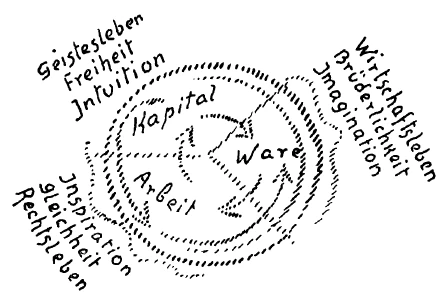
[ 10 ] For this to happen, intuitive concepts must become widespread in this society. These concepts—which you will find in my book *The Key Points of the Social Question* regarding capital—will flourish only in a society that is receptive to intuitive concepts. This means: Capital will find its proper place within the social organism when we once again acknowledge that intuition should exist in human beings. The commodity will find its proper place when we acknowledge that imagination should exist; and labor will find its proper place when we acknowledge that inspiration should exist.
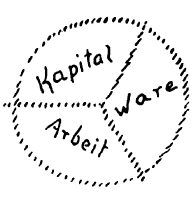
[ 11 ] If you take this diagram—not by listing the three concepts one below the other, but by arranging them as I have in this diagram—then you can learn a great deal from it by applying all the concepts found in my book on the threefold social order. For there are reciprocal relationships between labor and commodities, and between commodities and capital—since capital purchases commodities—and there are relationships between labor and capital, and so on; you simply need to arrange the three concepts in this way. (See diagram.)
[ 12 ] This is what we must understand above all else: that it is indeed correct to speak of humanity’s need to transform the social order in the future; but that it is necessary for this social order to be realized by human beings themselves, by their being willing to listen to the science of the initiates concerning imaginations, inspirations, and intuitions. This is a serious matter, for I am telling you nothing less than that without Spiritual Science there can be no social transformation for the future; but this is true. You will never have the opportunity to bring people to an understanding in the way that is necessary with regard to such things as intuition, imagination, and inspiration if, for example, you leave the schools to the state. For what do states do with schools?
[ 13 ] Isn’t it true that you are looking at something that is, on the one hand, eminently academic and, on the other, eminently political? Yes, I must confess to you, I find it terrifying! But people today do not notice this terror—this aspect of constitutional law, for example. Constitutional law is supposed to arise in accordance with those ways of life that people today still accept as right in their hearts; through the fact that—for my part—parliaments exist—I want to look at democracy, I don’t even want to look at the monarchy, but for my part at democracy—so through the fact that parliaments exist, matters of constitutional law are decided: that is where constitutional law is made; that is where every person who has come of age, through their representative, shapes constitutional law. That is where matters are decided, and then they are recorded in the collections of laws. Then comes the professor, who studies the statute books, and then he teaches what is contained in the statute books—naturally as constitutional law, for that is how he presents it. This means that the state draws academia into its orbit in the most eminent sense precisely on this point. The professor of constitutional law may teach nothing other than what exists as law within the state. Basically, one wouldn’t even need the professor if one were able to write the constitutional laws on reels and feed them into some kind of phonograph: then one could also place the phonograph on the lectern; it would only need to rattle off what the parliaments have decided. That, then, is science.
[ 14 ] That’s only in an extreme area. You see, this is not inspired, for you will hardly be able to claim that what is passed today in parliaments as majority decisions are truly inspired acts. But the situation must be reversed. Within intellectual life, at the universities, constitutional law must first emerge as a science, arising purely from human intellectual understanding. Only then can the state take on the right form—when people give it that form. Some people believe that the threefold social order wants to turn the world upside down. Oh no, the world is already upside down; the threefold social order merely wants to set it right. That is what really matters.
[ 15 ] You see, what matters most today is to come to terms with such concepts; otherwise, we are heading toward the mechanization of the mind, a numbing of the spirit—that is, the vegetation of the soul—and animalization, that is, the instinctive shaping of our bodies.
[ 16 ] It is very important to be thoroughly convinced that we must think in such a radical way if any hope for the future is to flourish. Above all, therefore, it is necessary for people to realize that they must build the social organism on its three healthy pillars. What imagination means in relation to goods will only become clear once economic life has been purely restructured and people are called upon to manage it in a spirit of brotherhood. What inspiration means for work—that it brings about joy and love for work—will only exist in the world when people who are inspired truly permeate society with at least that which then unites equals in parliament, when true equality reigns, that is, when everyone can assert what is within them, But this will vary greatly from one person to another. Then this equality will be able to prevail in legal life, and legal life will have to be inspired—not decided upon out of philistinism, toward which ordinary democracy has been striving more and more.
[ 17 ] And capital will only be able to be utilized properly within the social organism when intuition rises to freedom and freedom blossoms from the self-developing spiritual life. Then what is meant to flow from the spiritual life into work will flow over into it. These will be such streams (see the arrows). And these three spheres, precisely when structured in this way, will permeate one another in the proper manner.
[ 18 ] One of the first accusations leveled against me in Germany was that people said: “Now he even wants to divide social life into three parts! Social life must be a unity!” — But people are merely hypnotized by this notion of unity because they have always viewed the state as something unified. They are accustomed to these concepts of a unified state. And anyone who speaks of this unity strikes me as someone who says: “Now he even wants a horse that stands on four feet—the horse must be a unity; it can’t be divided into four legs.” — Of course, no one would demand that. But I don’t want to set the “horse-state” or the social organism on one leg either; rather, I want to set it on its three healthy legs. And just as the horse does not lose its unity by standing on four legs, so too does the social organism not lose its unity by being set on its three healthy limbs. It gains its unity precisely by being set on its three healthy limbs. People today simply cannot break free from their familiar concepts. But the most important thing today is that we not merely believe that individual external institutions should be transformed, but that we must reshape our ideas, our concepts, and our feelings. We can already say: We need different minds on our shoulders if we want to move toward the future of humanity in a wholesome way. It is necessary that we acquire different minds. People find it so difficult to adjust to this because they are so attached to their old ways of thinking—these old minds that are accustomed to thinking only what people have long been accustomed to thinking. Today we must consciously transform what lives within our souls. And do not think this is an easy task: Many people today believe they have already transformed their concepts, yet they do not even realize how much they have remained the same, especially in the field of education. One has some curious experiences there. One speaks to people about the concepts that Spiritual Science has developed in the field of pedagogy. You can talk today with very, very progressive teachers, school inspectors, principals, and so on; they listen to you and say: “Yes, I’ve thought that for a long time; yes, that’s exactly my opinion.” — But in reality, they hold the opposite opinion of what you’re telling them. In reality, they hold the opposite opinion from mine, but they express that opposite opinion using the very same words. They use the same words—and hold the opposite opinion! And that is how people pass each other by today. Words have long since lost their connection to spirituality, and this connection must absolutely be reestablished; otherwise, we will not make any progress.
[ 19 ] Social tasks, then, have much more to do with the spiritual realm than we usually realize.