

The Education Question as a Social Issue
GA 296
15 August 1919, Dornach
Translated by Steiner Online Library
Fourth Lecture
[ 1 ] From the recent observations we have made here, you will have seen that, among the many issues facing our time, the question of education is the most important. We have, after all, had to emphasize that the entire social issue encompasses, as its most fundamental aspect, precisely the issue of education. And since I hinted eight days ago at the restructuring and transformation of the educational system, you will understand that, within the issue of education itself, the most significant sub-issue is that of the training of the teachers themselves. If one allows the character of the historical epoch—which, strictly speaking, has spanned the period since the middle of the 15th century—to sink in, one gets the impression, as you know, that a wave of materialistic trials swept through human development during this time. And we are now faced with the necessity of working our way out of this materialistic wave and finding our way back to the spirit; the path to the spirit, which was, of course, known to humanity in earlier cultural epochs, but which was then followed by humanity more or less instinctively, unconsciously; a path that was lost so that humanity might seek it of its own accord, out of its own freedom, and which must now be sought consciously, fully consciously.
[ 2 ] The transition that humanity has had to undergo since the mid-15th century is precisely what one might call humanity’s materialistic trial. If one allows the character of this materialistic era to sink in and then, with the insights gained from it, examines cultural development over the last three to four centuries and up to the present day, one finds that it is precisely teacher education that has been most profoundly affected by the materialistic wave and most intensely shaped by it. Nothing else could have made such a lasting impression as the imposition of a materialistic outlook on pedagogical and didactic principles. One need only look carefully at the details of our current educational system to grasp the full extent of the difficulties standing in the way of truly fruitful progress. Consider that it is repeated time and again—especially by those who today believe they are particularly well-qualified to speak on educational matters—that all instruction, starting from the very lowest grade level, must be “concrete”—as it is so often called. I have, in fact, drawn your attention to this on several occasions, for example, regarding how one seeks to make arithmetic instruction “concrete”: calculators are installed in schools! Great importance is placed on the child, as it were, being able to see everything firsthand and then, based on that observation, forming mental images from within their own soul. This drive toward visual learning in education is certainly fully justified in many areas of pedagogy. But it does force us to ask: What becomes of a person if they are educated solely through visual instruction? If a person is educated solely through visual instruction, then they become completely spiritually drained; the inner driving forces of the soul gradually wither away; and a connection forms between the entire human being and the visual environment. And that which should spring from within the soul is gradually killed off within the soul. And much of what results from the current educational system stems precisely from the visual nature of instruction. Of course, people do not realize that they are killing the soul, but in reality they are doing so. And the consequence of this is—as I have already mentioned from other perspectives—what we observe in people today. How many people today are, in fact, troubled souls. How many people today, in their later years, are unable to draw from within themselves what might offer them comfort and hope in difficult times, enabling them to cope with life’s various situations. We see many broken souls today, and we ourselves may well find ourselves at a loss in certain moments.
[ 3 ] All of this is linked to the shortcomings of our educational system and, in particular, to the shortcomings of teacher training. What, then, should we strive for to ensure a prosperous future, especially with regard to teacher training? You see, the fact that a teacher ultimately knows what is usually asked of him in exams is actually a secondary matter, for there he is mostly asked about things he could look up in some textbook before class—things he could prepare for if he needed to. But what is not assessed at all in exams is the teacher’s general state of mind—that is what must constantly flow from them to their students in a spiritual sense. There is a great difference between one teacher entering the classroom and another. When one teacher walks through the classroom door, the children or students feel a certain kinship with their own state of mind; when another teacher enters the classroom, the children or students often do not feel such a kinship at all; on the contrary, they feel a gulf between themselves and the teacher, and all manner of shades of feeling—ranging from indifference to finding the teacher ridiculous or mocking the teacher. All the nuances in between often prove quite detrimental to genuine instruction and true education.
[ 4 ] The question is therefore, first and foremost, a pressing one: How can teacher training be transformed for the future? It cannot be transformed in any other way than by the teacher internalizing the insights into human nature that can come from Spiritual Science. The teacher must be imbued with an understanding of the connection between the human being and the supersensible worlds. They must be able to see in the growing child the evidence that this child has descended from the supersensible world through conception or birth, and that what has descended has clothed itself in a physical body and is acquiring something that the teacher must help the child attain here in the physical world, because the child cannot acquire it in the life between death and a new birth.
[ 5 ] Every child should be viewed by the teacher or educator as a question from the supersensible world to the sensible world. One will not be able to pose this question in a concrete, comprehensive sense—especially not to each individual child—unless one can draw upon the insights regarding human nature derived from Spiritual Science. Over the course of the last three to four centuries, humanity has gradually become more and more accustomed to viewing human beings—I would say—merely physiologically, focusing solely on their external physical constitution. This view of human beings is most harmful to the educator and the teacher. Therefore, it will be necessary above all else for an anthropology derived from anthroposophy to become the foundation of future pedagogy. But this can only happen if the human being is truly viewed from the perspectives we have often touched upon here—perspectives that characterize him in many respects as a threefold being. But one must resolve to truly grasp this threefold division inwardly. I have repeatedly drawn your attention to this from a wide variety of perspectives: how the human being, as he stands before us, is divided into what he is first and foremost—the nervous-sensory human being—which can be expressed in popular terms by saying: First and foremost, the human being is a “head human,” a “head-oriented human.” As the second member of the human being, viewed from the outside, we have the human being in whom the rhythmic processes primarily take place—the chest-human; and then, as you know, connected to the entire metabolic system, the limb-human, the metabolic human, in whom metabolism as such takes place. What the human being is as an active being is outwardly embodied in the physical form of the human being in these three aspects of the human nature as a whole.
[ 6 ] Let us take note of these three aspects of the human nature as a whole: the head human, or the nervous-sensory human; the chest human, or the rhythmic human; and finally, the limb human—in the broadest sense, of course—or the metabolic human.
[ 7 ] The point now is to grasp these three aspects of human nature in their distinctness from one another. This is, of course, inconvenient for modern people, because modern people love schematic classifications. When one says that a human being consists of the head-human, the breast-human, and the limb-human, modern people would prefer to draw a line at the neck—whatever is above that is the head-human. Then they would like to draw another line elsewhere to delimit the breast-human, and in this way they want to have the categorized parts arranged side by side. People today are reluctant to engage with anything that cannot be arranged side by side in such a schematic way.
[ 8 ] But that is not how it is in reality; reality does not draw such distinctions. Above the shoulders, a human being is primarily a head-oriented being, a being of nerves and senses. But they are not solely a being of nerves and senses above the shoulders; for example, the sense of feeling and the sense of warmth extend throughout the entire body, so that the head, in turn, extends throughout the entire body. So one can, if one wishes to put it that way, say: the human head is primarily head. And the chest is, in a sense, less head, but still head. The limbs—or everything that constitutes the metabolic system—are even less “head,” but they are still “head.” So one must actually say: the whole human being is “head,” only the head is primarily “head.” If one were to draw a schematic diagram, then, for example, if one wanted to draw the “head-oriented person,” one would have to draw him like this (see drawing, light hatching).
[ 9 ] The “chest-oriented” person, in turn, is not merely in the chest; he is primarily in the chest organs—the organs in which the heart and the breathing rhythm are most clearly expressed. But breathing also extends into the head; the rhythm of blood circulation extends into the head and into the limbs. So one can say: the human being is indeed “chest” in this region; but he is also “chest” here—albeit to a lesser extent—(see drawing, middle hatching) and here—again to a lesser extent. So, once again, the whole human being is chest, but primarily it is the chest that is the head.
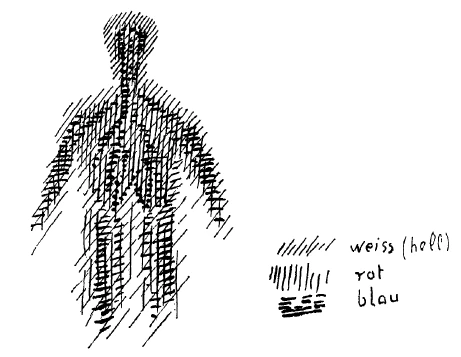
[ 10 ] And again, the human being composed of limbs and metabolism—indeed, this is essentially what he is (see drawing, dark hatching); but these limbs continue in such a way that they are fewer in the chest and fewest of all in the head.
[ 11 ] Just as it is true to say, “The head is the head,” so it is true to say, “The whole person is the head.” Just as it is true to say, “The chest is the chest,” so it is true to say, “The whole person is the chest,” and so on. In reality, things flow into one another. And our understanding is such that we tend to place the parts—the members—side by side. This shows us how little our concepts of knowledge correspond to external reality. In external reality, things flow into one another. And when we make distinctions—such as the head, chest, and metabolic human—we must be aware that we then have to think the separated parts back together again. We must never merely think things apart; we must always think them back together again. A thinking person who only wants to think things apart is like a person who only wants to inhale but not exhale.
[ 12 ] In doing so, you have already provided something that must become a reality, particularly for the thinking of future teachers; they must especially internalize this inwardly flexible thinking, this non-schematic thinking. For it is only by internalizing this non-schematic thinking that they can draw close to reality with their souls. But one cannot come close to reality unless one is able to view this approach from a certain broader perspective as a phenomenon of our time. One must overcome the tendency—which has become increasingly prevalent in recent times—to focus on the details of life when approaching scientific matters; one must move toward linking the details of life to the great questions of life.
[ 13 ] And one question will become significant for the entire future development of spiritual culture: the question of immortality. We will have to gain clarity on how a large portion of humanity actually conceives of this immortality, particularly since the time when many people have even gone so far as to deny immortality altogether. What actually lives within most people who, even today, seek to learn about immortality from the foundations of mainstream religions—what lives within these people? What lives within these people is the urge to know something about what becomes of the soul once a person has passed through the gate of death.
[ 14 ] When we ask about the interest people take in the question of immortality—or, more precisely, in the question of the eternity of the human essence—we receive no other answer than this: the primary interest in the eternity of the human essence is precisely tied to this: What becomes of a person when they pass through the gates of death? A person is conscious of being an “I.” Their thinking, feeling, and willing live within this “I.” The thought of this “I” being destroyed is unbearable to them. Whether they can carry this “I” through death, and what becomes of it after death—this is what interests people above all else. The reason this interest has arisen is essentially that the religious systems—at least those we are considering here for the time being—when they speak of immortality and the eternity of the human essence, have in mind primarily the very question: What becomes of the human soul when a person passes through the gate of death?
[ 15 ] Now you must realize that posing the question of immortality in this way gives it an extraordinarily strong tinge of selfishness. It is, at its core, a selfish impulse that instills in people the desire to know what will become of the core of their being when they pass through the gates of death. And if people today were to practice self-knowledge more than they do now, if they were to consult within themselves and not succumb to illusions as much as they do, then they would already realize how strongly selfishness plays a role in their interest in knowing about the fate of the soul after death.
[ 16 ] This kind of spiritual disposition has once again become particularly strong during the era of materialistic scrutiny over the past three to four centuries. And what has thus taken hold of the human soul as an inner habit of feeling and thinking cannot be overcome by theories or doctrines if these theories or doctrines exist only in abstract form. But the question must nevertheless be raised: Can things remain this way? When it comes to the question of the eternal essence of the human being, must only the egoistic aspect of human nature have a voice?
[ 17 ] When one considers everything related to this complex of questions, one must conclude: The fact that the human state of mind has come to be as I have just described it stems essentially from the fact that religions have neglected the other perspective: to observe the human being as he is born, as he grows into the world from his first infant cry, in that wondrous way in which the soul increasingly pushes its way into physicality; to observe the human being as that which was lived in the spiritual world before birth rises up within him. How often, then, is the question raised today: What carries over from the spiritual realm into the physical human being when a person is born? People ask this again and again: What carries over when a person dies? But they rarely ask: What carries over when a person is born?
[ 18 ] This is where our main focus should lie in the future. We must, so to speak, learn to listen for the revelation of the spiritual-soul aspect in the growing human being, as it was before birth or before conception. We must learn to see in the growing child the continuation of its sojourn in the spiritual world: then our relationship to the eternal core of the human being will become more and more selfless. For if one is not interested in what continues from the spiritual world into physical life, but is interested only in what continues after death, then one is inwardly self-centered. In a certain sense, it fosters a selfless state of mind to look toward that which continues from the spiritual into physical existence.
[ 19 ] Egoism, fundamentally, does not ask about this continuation because it is certain that the human being exists, and it is satisfied with that existence. It is only uncertain whether the human being will still exist after death; therefore, it wants proof of this. Egoism drives him to do this. But true knowledge does not come to man out of egoism, nor even out of that sublimated egoism which we have just characterized as generating an interest in the continuation of spiritual existence after death. And can it really be denied that religions capitalize heavily on this very egoism we have just described? This capitalizing on the egoism we have just described must be overcome. And those who look into the spiritual world know that this overcoming will bring about not merely insights—this overcoming will bring about a completely different attitude on the part of human beings toward their human surroundings. One will feel and sense things quite differently toward a child growing up if one always considers how that which could no longer remain in the spiritual world continues on.
[ 20 ] Just consider for a moment how much a question shifts when viewed from this particular perspective. One could say: Human beings were in the spiritual world before they descended into the physical world through conception or birth. So it must have been up there that they lost sight of their respective goals. The spiritual world must no longer have provided what the soul was striving for. And it must have been from within the spiritual world that the urge arose to descend into the physical world, to clothe oneself in a body, in order to seek in the physical world what could no longer be sought in the spiritual world as the time of birth approached.
[ 21 ] It is an immense deepening of life when one knows how to adopt this perspective—but now with feeling and sensitivity. While one perspective—the egoistic one—constantly urges people to become more and more abstract, to drift into the theoretical, and to lean toward intellectual thinking, the other, non-egoistic perspective will urge people more and more to perceive the world through love and to understand it through love. This is one of the elements that must be incorporated into teacher training: to look toward the pre-birth human being—not merely to sense the mystery of death, but also to sense the mystery of birth in relation to life.
[ 22 ] But then we must learn to elevate anthropology to anthroposophy by truly developing a sense for the forms that are expressed in the threefold human being. I said the other day: Yes, isn’t the human head—that which is primarily the head—spherical in a completely different form, merely superimposed on the rest of the organism? (see drawing). And again, when we consider the chest-human, how does he appear to us? He actually appears to us in such a way that we could take a piece of the head, enlarge it, and have the spine right here (see drawing). While the head carries its center within itself, the thoracic human carries the center very far away from itself. And if you were to imagine it, as it were, as a large head, this large head would belong, so to speak, to a human lying on their back. So that if we regard the spine as an imperfect head, we would have a human lying horizontally and a human standing vertically.
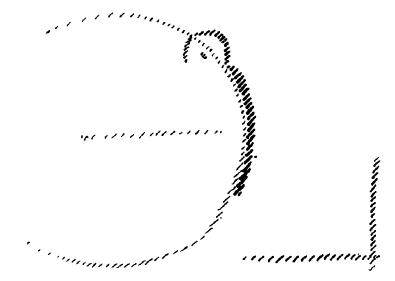
[ 23 ] It becomes even more complicated—so much so that one is not even able to draw it on a plane—when we consider the metabolic human being. In short, from the perspective of form, from the perspective of plastic form, the three aspects of human nature present themselves quite differently. The head is, as it were, a totality; the chest-human is not a totality—it is a fragment; and the metabolic human even more so!
[ 24 ] Now, what makes the human head, the human skull, this self-contained entity? This self-contained entity is the human head because, of all the human body’s parts, this human head is the most adapted to the physical world. As strange as this may seem to you—since you are accustomed to regarding the human head as the noblest part of the human being—it is nevertheless true that this human head is the most adapted to physical existence. The head expresses physical existence the most. So one can say: If one wants to characterize the physical body in its essence, one must look to the head. In terms of the head, the human being is most physical body. In terms of the chest organs and the organs of rhythm, the human being is most etheric body; in terms of the metabolic organs, the human being is most astral body. And the “I”—it has not yet developed any distinct features in the physical world at all.
[ 25 ] Here we have arrived at a point of view that is extremely important to consider. You must understand this point in such a way that you say to yourself: When I look at the human head—that is, what I have drawn (see drawing on page 72, light hatching)—I am also seeing the most essential aspect of the physical body. The head most fully expresses what is manifest in the human being. In the chest-oriented person, the etheric body is more active. In the head, the etheric body is least active; in the chest, it is much more active. Therefore, physically speaking, the chest region of a human being is less perfect than the head. Physically speaking, it is more imperfect. And the metabolic human is even more imperfect, because there, too, the etheric body is very little active, while the astral body is most active. And as I have often emphasized: The “I” is still the baby; it has hardly any physical counterpart yet.
[ 26 ] So you see, one can also describe a human being by saying: A human being consists of the physical body. If you want to answer the question: What is most similar to the human physical body? the answer is: the head. A human being consists of the etheric body. What is most similar to the etheric body? The chest region. A human being consists of the astral body. What is most similar to the astral body? The metabolic human. As for the “I,” there is hardly anything in the physical human being that points to it. Thus, each of the three members of the human being—the head, the nervous-sensory human, the chest human, the rhythmic human, and the metabolic human—becomes an image of something lying behind it: the head as an image of the physical body, the chest as an image of the etheric body, and the metabolism as an image of the astral body. We will have to learn not to view the human being as we do today—by examining a corpse in a clinic and treating a piece of tissue or something similar as just that, regardless of whether it is in the chest or the head. We will have to learn to say to ourselves: the head, chest, and metabolic human beings stand in different relationships to the cosmos and symbolically express different underlying realities. This will expand today’s purely anthropological perspective into the realm of anthroposophy. From a purely physical standpoint, the organs of the chest and the head are equivalent. Whether you dissect the lungs or the brain, physically speaking, one is just as much matter as the other. Spiritually speaking, this is by no means the case. Spiritually speaking, when you dissect the brain, you really have a fairly clear picture of what you are dissecting. When you dissect the chest—for example, the lungs—you have a rather vague picture of what you are dissecting, because the etheric body plays an eminently important role there while the human being is asleep.
[ 27 ] The matter I have just explained has its spiritual counterpart. Those who have made some progress through meditation and through exercises such as those described in our literature gradually come to truly divide the human being into three parts. As you know, I speak of this threefold division from a certain perspective in the chapter of my book *How Does One Gain Knowledge of the Higher Worlds?*, where reference is made to the Guardian of the Threshold. But one can also achieve this threefold division through intense concentration on oneself: by truly separating the head-being (see drawing, light hatching), the chest-being (medium hatching), and the metabolic being (dark hatching). Then one realizes what it is that actually makes the head—the head we have—a head. You see, if through inner concentration you draw out the head with its attachments—draw it out of the rest of the human organism—and then have it before you as a real head, unaffected by the other members of human nature, then it is dead; it no longer lives. It is impossible for you, clairvoyantly, to separate the head from the rest of the human organism without perceiving it as a corpse. With the chest-human, you can do this; he remains alive. And if you separate the astral body by separating the metabolic human, then the astral human runs away from you; he does not remain in that place; he follows the cosmic movements, for he has the astral within him.
[ 28 ] And now imagine that you are standing before a human child, looking at it with the kind of open-minded and rational insight that I have just described. Then look at the human head: it carries death within itself; look at what influences the head from the chest: it animates everything. Look as the child begins to walk, and you will notice: it is actually the astral body that is at work there as the child walks. Now the human being becomes something you can perceive from within. The head—a corpse; the life spreading throughout the human being would be at a standstill if he were completely still. The moment he begins to run, you immediately realize: it is actually the astral body that is running; and it can run because this astral body consumes substances while running and moving—metabolism is active in a certain way. The “I”—how can one observe it? Actually, everything has already been exhausted. If you follow the head-corpse, the animating force of the chest-human, and the running—what remains to observe the “I” externally? I told you, the “I” has hardly any physical counterpart. You can only observe the “I” when you look at the human being in the course of his upward growth. At one year old, the child is very small; at two years old, larger, and so on. When you see the child growing larger and larger, when you piece together what the child is at each successive stage, then you are physically observing the “I.” You never see the “I” in a person simply by standing face-to-face with them; rather, you see the “I” only by observing the person as they grow. If people did not succumb to illusions but saw reality, they would realize that in a person they simply encounter, they do not readily perceive the “I” physically; rather, they actually perceive the “I” only when they observe the person at different stages of life. But when you see a person again twenty years later, you perceive their “I” very strongly through the changes that have taken place in them, especially if you saw them as a child twenty years ago.
[ 29 ] Now I ask you not merely to think through what I have said in a theoretical way, but rather to bring your mental images to life and to consider—when you look at a human being in this way: head—corpse; chest—animation; the movement of the astral body; growth through the “I”—how the whole human being comes to life, who previously stood before you like a wax figure.
[ 30 ] After all, what is it that one usually perceives of a human being with one’s physical eyes and also with one’s mind? A wax figure! And it comes to life when you add what I have just explained!
[ 31 ] To do this, however, you need to assert your perspective—through what Spiritual Science can infuse into sensations, feelings, and the whole relationship of human beings to the world. A running child reveals the astral body to you. And what is inherent in the gesture of running—every child runs differently, after all—stems from the configuration of the various astral bodies. And what is inherent in growth is shaped in part by the “I.”
[ 32 ] You see, karma has a very strong influence on people. Let’s take an example that is no longer familiar to us today: Fichte, Johann Gottlieb Fichte. I have described Johann Gottlieb Fichte to you from a wide variety of perspectives. I have described him to you once as a great philosopher, I have described him to you once as a Bolshevik, and so on, haven’t I? But let’s consider him from yet another perspective. You surely remember that I also showed how Johann Gottlieb Fichte can certainly be counted among the Bolsheviks; now let’s consider him from a different angle. Let’s suppose we were standing on the street and Fichte walked by; we watch him go: a man not very tall, stocky. What does the way he is built reveal? Stunted growth. He plants his feet firmly, especially his heels, and as you watch him, that’s how he walks. The whole essence of Fichte is right there. Not a single nuance of who the man was can escape one’s notice when observing him like this—with his growth stunted by some form of malnutrition in his youth, stocky, his body restrained, planting his heels firmly as he walks. One could hear how he spoke just by observing him from behind like this!
[ 33 ] You see, a spiritual element can enter into the outward aspects of life. However, it cannot enter into the outward aspects of life unless people take on within themselves a mindset that is different from what still prevails in the state of the soul today. For people today, observing their fellow human beings from this perspective would indeed be a rather malicious intrusion of privacy. One would not really wish for this to become widespread, for people today are, for the most part, so shaped by materialism—which has spread more and more—that they do not open letters that do not belong to them only because it is forbidden; otherwise, they would certainly do so. But given such a human mindset, it is not feasible for everything to change among people. Nevertheless, by the middle of the 15th century, the Earth had fulfilled what human beings could not otherwise acquire in their earthly existence except through one human being spiritually meeting another right down into the physical realm. And the more we move toward the future, the more we must learn to perceive spiritually everything that surrounds us in the physical world. And this must begin with the teacher’s educational work with the growing child. Physiognomic pedagogy: the will to solve this greatest of mysteries—the human being—in every single individual through education!
[ 34 ] Now you can sense just how powerful, in our time, is what I have described as a test for humanity. In fact, what I have described points in this direction: to individualize more and more, to regard every human being as a being in and of themselves. This must indeed be our great ideal: No one is like another; each and every one is a being in their own right. If the Earth were to reach its goal without us, as human beings, learning to recognize every human being as a being in their own right, humanity would not achieve its goal on Earth. But how far are we today from the mindset that strives toward this goal! After all, we tend to treat people as if they were all the same today. We view people in such a way that we hardly examine their individual characteristics at all. Hermann Bahr, whom I have often told you about, once revealed in Berlin how contemporary culture is moving toward no longer distinguishing individuals at all. When Hermann Bahr lived in Berlin for a time in the 1890s and participated in Berlin social life, he naturally had a lady on his right and a lady on his left every evening, didn’t he? But when he found himself seated between two ladies the very next evening, the only way he could tell they were different women was from the invitation card—he didn’t really look at them that closely, because, when it came down to it, yesterday’s lady and today’s lady were exactly the same. What he saw in them was exactly the same. And social culture—especially industrial culture—makes people outwardly the same as well; it does not allow individuality to emerge. And so, in the present, we strive for leveling, while humanity’s innermost goal must be to strive for individualization. We conceal individuality the most in the present, and yet we are in the greatest need of seeking it out.
[ 35 ] Beginning to direct the inner gaze of the soul fully toward individuality—this must be part of human education. Teacher training must incorporate the mindset of recognizing individuality in people. We can only do this by bringing our mental image of the human being to life in the way I have described; by truly becoming aware that: It is not a mechanism that moves forward; it is the astral body that moves forward and draws the physical body along with it. And compare what can arise in your soul as an inwardly animated and moving image of the whole human being with what conventional science offers today: the homunculus—a veritable homunculus! Science says nothing about the human being; it merely preaches the homunculus. The real human being—that is the one who, above all, must find his way into pedagogy. But he is completely outside of pedagogy.
[ 36 ] So the question of education is a question of teacher training, and as long as it is not viewed in that light, we are not yet at the point where anything fruitful can happen in education. You see, when viewed from a higher perspective, everything is so interconnected that one aspect truly builds upon the other. Today, people would prefer to teach human activities—inner activities—as separate subjects side by side. Students learn “human studies,” then religion—things that have little to do with one another. In truth, as you have seen, what we observe in human beings borders on the question of immortality, on the question of the eternal nature of human nature. And we had to bring the question of the eternal nature of the human being together with the direct observation of the human being. This dynamic aspect of soul experience must be incorporated into pedagogy in particular. Then entirely different inner abilities will be developed than those fostered today by teacher-training institutions. And that is of very special importance.
[ 37 ] Through today’s reflection, I wanted to help you understand how Spiritual Science must actually permeate everything, and how the major social problems of our time cannot be solved without Spiritual Science.