

The Education Question as a Social Issue
GA 296
10 August 1919, Dornach
Translated by Steiner Online Library
Second Lecture
[ 1 ] If one wishes to understand the task of anthroposophical Spiritual Science in the present and the near future, then—as we heard some time ago and again yesterday—one must take into account the nature of human development, particularly since the mid-15th century. After all, everything that is happening in the present depends on the fact that, since the middle of the 15th century, a driving force has been at work within humanity, impelling each individual to rise to the pinnacle of their personality and become a fully developed person. Such a thing was not possible, nor was it at all the task of humanity in earlier epochs of our post-Atlantean human development. If one wishes to understand the great transformation in which we find ourselves, one must examine such matters even more closely—matters such as those I characterized again yesterday.
[ 2 ] I told you: We still have a Greek mindset in our spiritual life. The way we form our thoughts, the way we are accustomed to thinking about the world, is actually an echo of the Greek mindset. And the way we are accustomed today to viewing the law and everything connected with it is an echo of the Roman mindset. After all, we still view our state as the same entity that was, in essence, the Roman Empire. And only when we come to realize how the threefold structure of the social organism must take effect in this chaotic present will we be able to see clearly and will clearly be able to act.
[ 3 ] The Greek mindset is primarily defined by the fact that Greece, in the most eminent sense, embodied what had been the dominant force in historical development up until the mid-15th century. Spread across the Greek territory was a subjugated population and the conquerors—those who claimed the land for themselves, but who also, invoking their bloodline, shaped the spiritual character of ancient Greece. Consequently, one cannot possibly make sense of the spiritual constitution of ancient Greece unless one takes into account that it was considered legitimate there to think about the social relationships among human beings in the way that arose from the blood characteristics of the Aryan conquering population. Of course, humanity in more recent times has outgrown what served as the foundation for the Greeks. For the Greeks, it was simply a given that there were two kinds of people: those who, so to speak, were meant to worship Mercury, and those who were meant to worship Zeus. These two classes of people were strictly separated from one another. But they thought about the world and its gods in the way that the conquering people, by virtue of their bloodline, were bound to think. Everything was determined by what arose from the clash between a conquered people and a conquering people. Anyone who looks more closely at what lives among people in our present-day society will recognize that, although in our feelings—in what lives subconsciously in our souls—we no longer admit to this aristocratic worldview; but this aristocratic worldview still lives on in our ideas and concepts, especially when we are educated through higher schooling. Higher schooling, particularly the Gymnasium, structures everything related to instruction in a way that is nothing more than a Renaissance, an echo of Greek culture. And this is all the more true of universities—with the exception of technical and agricultural universities, which, of course, had to be shaped by modern life but which, in their external structure, have unfortunately been modeled after the structure of the university system that came over from Greece. Precisely if one holds Greek culture in high esteem for its own time and in its own context, one must, on the other hand, be perfectly clear that a renewal of spiritual life is necessary for our time, and that it will become increasingly intolerable for our time for humanity to be led by souls who have acquired the configuration and character of their concepts in our secondary schools. And, of course, all leading positions today are still occupied by people who acquired their conceptual framework in secondary schools and gymnasiums. It is already necessary today to recognize that the time for a major reckoning—not a minor one—has come, and that one must think about such matters in an appropriate way; one cannot cling to old habits of thought.
[ 4 ] As you know, what in Greek civilization arose from blood ties became abstract in Roman civilization. I have already mentioned this here once before. While the Greek social system—which, after all, cannot be called a state system—emerged entirely from kinship ties, this blood-based element was no longer carried over into Roman society. What was carried over into Roman society was the impulse to organize society in the same way as it had been organized in Greece; but the cause of this organization was no longer felt to lie in blood. And while it would never have occurred to any Greek of earlier times to doubt that there were people of a “lower” sort—the people of the conquered nations—and people of a “higher” sort—the Aryans—this was not the case with the Romans. After all, within the Roman Empire there was a strong awareness that the social hierarchy had been imposed through power and force. You need only recall that, after all, the Romans traced their origins back to that band of robbers near Rome who were summoned together to found Rome as a band of robbers; and that the founder of Rome was not nursed on his mother’s tender milk, but, as you know, was nursed in the forest by an animal—a she-wolf.
[ 5 ] All of these are elements that became so deeply ingrained in the Roman character that, in Rome, social structures were organized primarily on the basis of abstract concepts. Thus, what has been preserved for us in terms of legal and political concepts stems from the Roman mindset.
[ 6 ] You see, a story like this always reminds me of an old friend. I met him when he was already quite old. You see, in his youth—at the age of 18—he had fallen in love with a girl; they had, so to speak, quietly become engaged, but neither of them had any money, so they couldn’t get married, and so they waited, remaining faithful to one another. He was 18 years old when he became engaged, and by the time he could even think about getting married, he was 64 years old—for it was only then that he had earned enough to believe he could now take such a step. So he returned to his hometown, which was near Salzburg, intending to marry the woman he had chosen so long ago. But lo and behold, the church and the parsonage had burned down, and the baptismal certificate could no longer be obtained. There was no record anywhere of where the man had been baptized, and so no one believed that he had ever been born. I still vividly remember when his letter arrived. I was living near Wiener-Neustadt at the time, and that’s when his letter came; in it he wrote—he had been working in Wiener-Neustadt back then, but had traveled to his hometown near Salzburg—in that letter he wrote: “Yes, I do believe it’s quite evident that I was born, simply because I’m here; but people don’t believe I was born because there’s no baptismal certificate!
[ 7 ] I once had a conversation with a lawyer who said: “Yes, in a lawsuit, it doesn’t really matter to us whether the person is actually there or not; we just need the birth certificate.”
[ 8 ] You see, one must keep these stories in mind, for they do, of course, present themselves to us in such grotesque ways here and there. But the spirit that lives in these stories also shows, ultimately, that our entire public life was still built upon the Roman way of life—in some areas more so, in others less so. Isn’t it true that today one is not a citizen of the world simply by virtue of having become a human being and standing as one, but rather one is a citizen of the world by virtue of being recognized and registered as a citizen here or there? All these things can be traced back to the Roman way of life. Blood ties have given way to registration.
[ 9 ] This leads to the fact that today, when these things are in a state of decadence and decline, many people no longer believe they have any intrinsic value as human beings, but instead believe they have value simply because they are ranked within some bureaucratic hierarchy and hold this or that official rank. People would much rather be an impersonal entity derived from Roman legal concepts than a personality. Yet since the fifteenth century, there has been an unconscious, subconscious striving within humanity to build everything upon the pinnacle of the personality. This testifies to the fact that, with regard to our spiritual life and our legal life, the old ways have become outdated, and that we need a renewal—a genuine renewal—in both areas. What is to assert itself as renewal in human souls is connected to many deeper impulses in the development of humanity as a whole.
[ 10 ] Consider once more that, since the middle of the 15th century, the recent development of humanity in terms of knowledge has been particularly shaped by the scientific way of thinking—specifically, by that scientific way of thinking which is based on abstract natural laws, which is founded on sensory perception and on the thoughts one forms about this sensory perception. Nothing else is accepted as valid except what arises from sensory perception and the thoughts one forms about this sensory perception. Now, yesterday—as I also mentioned here before I left last time—I again drew your attention to the fact that there are already enough people today who hold the legitimate view that with such a view of nature as we acquire in the manner just described, one arrives only at a phantom image of nature. What the natural scientist forms as an image of the world is a phantom of the world; it is not the real world. So we must say: Since the middle of the 15th century, humanity has been in a position to form a phantom-like image of the world with regard to one half of it. Behind this, however, lies something very profound for the science of initiation, and we must also bring this to the forefront of our consciousness.
[ 11 ] You see, one cannot alter sensory perception as such; whether one regards it as maya or something else is, in the final analysis, irrelevant to a deeper worldview. One cannot alter sensory perception itself; it is what it is. A red flower is a red flower; it makes no difference whether we regard it as maya or as reality—it is what it is. And so sensory perception as a whole is what it is. The discussion begins only at the moment when we start to reflect on this sensory perception, when we view this sensory perception as this or that, when we interpret it as this or that. That is when the difficulty begins. And why does the difficulty begin there? It begins for the reason that the concepts of humanity we have had to form since the 15th century are different from earlier concepts of humanity. This is not viewed at all in the proper sense in today’s history, which is a “fable convenue,” as I have often said. Anyone who has the opportunity to explore the concepts of humanity prior to the mid-15th century knows that these concepts were full of inner imagery, that these concepts were, in fact, imaginations. The abstract nature of these concepts has only existed in its current form since the mid-15th century.
[ 12 ] Why have we, as humanity, evolved in such a way that, since the mid-15th century, we have had these abstract concepts—of which we are so proud today and within which we move again and again? Why do we, as humanity as a whole, develop these abstract concepts? You see, these abstract concepts that we, as humanity as a whole, form have the peculiar characteristic that, although we apply them to the sensory world, they are actually not at all suited to that sensory world. They are of no use to the sensory world. I expressed this in my *Riddles of Philosophy* in such a way that I said at the time: The way in which human beings form concepts of knowledge about the external world is a side current of their soul’s development. Just as when one thinks of a seed, say, in the earth—which is, after all, actually destined by nature to become a plant again—yet we grind many seeds into flour and eat them as bread. But that is not predetermined in the seed! It is a side development when we ask: Does the seed contain the chemical constituents we need to build our bodies? It is not in the nature, in the essence of the seed—of wheat or rye—to nourish us, but rather to produce new wheat or rye from the grain. Similarly, it is not in our nature to perceive the external world through the concepts we have been adopting since the 15th century; rather, something else is to come of these concepts when we truly immerse ourselves in their essence. These concepts, which people have been developing since the mid-15th century, are in fact the shadows of what we experienced in the spiritual world before we descended from it through conception. So that you can form a mental image—I have often drawn attention to such things (a diagram is drawn): there is birth or conception, and human life proceeds as follows: if you create a mental image of this, our concepts—the conceptual faculties within us—are actually the echoes of what we experienced before our birth or conception (see drawing). And we are actually misusing our conceptual system by applying it to the external sensory world.
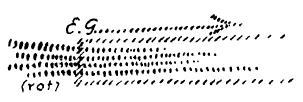
[ 13 ] You see, this underlies Goethe’s conception of nature. Goethe does not seek to express the laws of nature through concepts; he seeks primordial phenomena—that is, synthesized external perceptions—because he senses that our capacity for conceptual thought cannot be directly applied to external nature. We must develop our conceptual faculty as pure thinking. And if we develop it as pure thinking, then it points us toward our pre-birth spiritual existence. In fact, we possess our present-day distinctive thinking precisely in order to attain our spiritual being—before we were clothed in a physical body—through this pure thinking. And until humanity comprehends that it possesses thinking in order to understand itself as spirit, the task of the fifth post-Atlantean epoch has not yet truly taken root in human souls. Our natural science has, in a sense, been forced into the destiny of humanity so that we may remain with pure nature, not speculate about it, but use our concepts only in such a way that we observe it correctly; and then develop our concepts to see what we were like as spirits before we were clothed in a physical body through conception and birth. People still believe today that their conceptual faculties are meant merely to classify external sensory perception and so on; they will be on the right track when they apply the ideas they have held since the middle of the 15th century to the spiritual world in which they existed before they were clothed in a physical body.
[ 14 ] Thus, the human being of the fifth post-Atlantean epoch is himself compelled toward the spiritual, the pre-birth realm; and thus, the human being is also placed by something else into a peculiar situation that he must develop and bring forward. Parallel to the scientific, ghost-like view of nature is industrialism. I already drew attention to this yesterday. And the most essential aspect of industrialism is that the machine—the “vehicle of industrialism”—is spiritually transparent. Nothing remains incomprehensible. I pointed out to you yesterday how even in a mineral itself something remains opaque; the machine, however, is completely transparent. But this has the consequence that the human will, directed toward the machine, is in truth not directed toward a reality, not directed toward the actual world. The machine is, in essence, a chimera in relation to the comprehensive reality of the world. And industrialism introduces into our lives something that renders human will meaningless in a higher sense. It will have a profound impact once the conviction is fully instilled in modern humanity that the machine—and everything that follows in its wake as industrialism—renders human will meaningless. We have already reached the peak of machine efficiency today, for a quarter of what is produced on Earth today is not produced by human will, but by machine power—a quarter of it! That signifies something extraordinary. Human will no longer has any meaning here on Earth.
[ 15 ] You see, when you read something like the speeches of Rabindranath Tagore, for example, you should actually sense something in those speeches that remains incomprehensible to the European—that is, to the European who applies the ordinary European mind, the ordinary European intellect. There is a different underlying tone in what the educated Asian says today, because to the educated Asian, this adaptation of the European mind to the machine is simply something completely incomprehensible, something senseless. For the Oriental, working through the machine, through industrialism, is something senseless. And something equally senseless for the Oriental—whether one in Europe believes it or not—is European politics, born in the machine age. The Oriental sees no meaning in that either. This comes to the fore quite clearly when the educated Oriental speaks, stating that for him this one-quarter of what is happening—which, after all, is not done in the Orient by the old, traditionally educated Oriental people, but actually only by Westerners and their imitators, the Japanese and so on— this one-quarter of the work done by people today is perceived as meaningless labor, because the Oriental, who still possesses a great deal of atavistic insight, knows that everything a person puts into the machine as labor has a very specific characteristic. When a person lets his horse, harnessed to the plow, pull it through the furrow and works alongside the horse, this work with the horse—in which natural forces still play a part—has a meaning that extends beyond the immediate present; this work has a cosmic meaning. When a wasp builds its nest, this wasp nest has a cosmic meaning. When a person kindles a fire by striking flint, causing a spark to fly, using it to ignite tinder, and then lighting the fire, they are connected to nature: it has a cosmic meaning. Modern industrialism has severed us from this cosmic meaning. There is no longer any cosmic meaning when we turn on our electric lights! The cosmic meaning is left behind. And when you walk into a modern factory that is entirely mechanized, it is a hole in the cosmos; it has no significance for cosmic development. When you go into the forest to gather wood, that has a cosmic significance that extends beyond the Earth’s development. When you look at a modern factory with everything it contains, it has no significance beyond the formation of the Earth. Human will is poured into it without it having any cosmic meaning. Consider what that means. It means: since the middle of the 15th century, we have been developing a form of knowledge that is ghostly, that does not come close to reality. We are carrying out more and more of our activities by means of machines; we are performing more and more through industrial activity, and the will we invest in this industrial activity is meaningless for the development of the world.
[ 16 ] The great question confronts the human mind: Does the fact that our knowledge is, to a large extent, illusory and our will meaningless—does this, after all, have any meaning for the development of humanity as a whole? —Yes, it has meaning; it has a profound meaning. Its meaning is that we, as humanity, are thereby urged to go beyond ghostly knowledge and penetrate to a knowledge of reality—a knowledge of reality that does not stop at the observation of nature, but penetrates into the spiritual realm that lies beyond nature. As long as people received the spiritual realm along with their concepts, they could let things take their course; they did not need to make an effort to conquer the spiritual realm on their own. Since, in more recent times, people have been left with only concepts that do not contain the spiritual, but do contain the potential to work their way up to the spiritual, as I have said, the impulse exists within human beings to penetrate from abstract knowledge into real knowledge of the spiritual. And ever since we have had industrialism with its senselessness, we must seek a different meaning for the human will. And we can only seek this if we rise to a worldview that gives meaning to that which is senseless—let us call it industrialism—by drawing meaning from the spiritual, by telling ourselves: We seek tasks that originate in the spirit. In the past, there was no need to do so, because the will could draw its impulses from the spiritual realm through instinct; in the past, there was no need to make a special effort to will from the spiritual realm. Today it is necessary to make a special effort to will from the spiritual realm. And we must counter senseless industrial will with a meaningful will that springs from the spiritual realm.
[ 17 ] Yesterday I gave you an example of how we should educate children. We must recognize that up to the age of 7, because the human being is particularly focused on developing his physical body, he is an imitator; we should make this the foundation of education. From ages 7 to 14, we must understand that we must guide the child’s development according to the principle of authority, and we must make this spiritual insight—which we gain by understanding how the etheric body develops from ages 7 to 14—the driving force behind our educational system. And we must understand how the astral body develops from the ages of 14 to 21, and we must make this insight the driving force behind our educational system. Then—and only then—will we act from the spirit.
[ 18 ] Until the middle of the 15th century, people acted instinctively out of the spirit. We essentially want to immerse ourselves completely in external life, in the mechanical, in mechanisms—even in politics, which has gradually turned states into machines. We must strive to return to a will imbued with the spirit. To do this, however, we must embrace the idea of Spiritual Science; we must, for example, begin in education by basing our approach on what we know from our understanding of the spiritual world, so that we educate in the way that anthroposophical Spiritual Science guides us. Through this stronger, more conscious emphasis on will arising from the spirit, we set forth a counter-image to the senseless will of industrialism.
[ 19 ] Thus, industrialism—with all its desolation of human beings and souls—is presented to us so that, in this ode, we may rouse ourselves to will from the spirit. And the best way to begin to will from the spirit in education is to educate in the way that education should be conducted—from the spirit and its knowledge. Much needs to be rethought in our time. But this requires a carefully and deeply cultivated inner sense of truth. We must be clear today that this inner sense of truth must gradually be applied even in areas where we are not yet accustomed to using it. You see, I believe many people today might be surprised if told: ‘You are right to particularly admire Raphael for his paintings; but if you demand that people today should paint like Raphael, then you are wrong.’ For only those who know that anyone painting today in the manner Raphael did is a poor painter have the right to admire Raphael: for such a painter is not painting in the way that the impulses of our time require. One does not keep pace with the times if one does not perceive these things in such a way as to fully grasp the tasks of a particular era. It is necessary in our time to cultivate an intimate—a very intimate—sense of truth in this direction. But humanity today is also going through the opposite in this regard; for one has the impression that everywhere, the sense of truth has sprung a leak, is not functioning, and that people today shy away from calling what is right “right” and what is wrong “wrong,” that they shy away from identifying a lie as a lie. In this regard, one can indeed experience the most appalling things today, and people are indifferent to such appalling things that one can experience! But the point is that one feels so truthfully, for example, that one knows: Raphael’s painting no longer belongs in the present; it must be viewed as something of the past—and admired as such. It is especially necessary in our time that we pay attention to such things, where the impulse to be true, arising from the deepest depths of the soul, suddenly overtakes us. I often think of a beautiful passage in Herman Grimm’s biography of Michelangelo, where Herman Grimm discusses Michelangelo’s *The Last Judgment*. He also discusses how many such “Last Judgment” paintings were created during that era, and how, in those days, people truly experienced the reality of what had been painted on the wall. People lived within these “Last Judgment” paintings as if they were a reality. One really shouldn’t look at a painting like Michelangelo’s “Last Judgment” today without being aware that we do not feel the same way as the people for whom Michelangelo painted this “Last Judgment,” that we have lost that sense of reality, and that at most we say to ourselves: This is a picture of something, but we no longer believe in it as an immediate reality.
[ 20 ] Just consider this: a person with today’s consciousness—who does not believe that angels actually descend or that demons act as they do in Michelangelo’s painting—stands before this image differently than the people of the time for whom Michelangelo painted, who viewed these images as realities and had them right before their eyes. But precisely when one realizes that what modern people feel when looking at Michelangelo’s “Last Judgment” is something gray, something abstract—precisely then—one is inwardly called upon to sense the entire living tapestry within the images on this wall of the “Last Judgment.” Then one is called upon to ask oneself: How did the people of an era—Michelangelo, to be sure, painted after the fourth post-Atlantean epoch had come to an end, but he painted out of the spirit of that fourth post-Atlantean epoch, standing at the dividing line between the two epochs; I have discussed this once in my lectures on art—how did those people come to envision such grandeur in their imaginations, in their images? This question truly confronts one in all its grandeur, especially when one is aware of how gray, how lifeless, is what modern people feel when faced with such a painting by Michelangelo. And then one must ask about the cause: How is it that human souls back then were able to view the earthly realm in this way? Where did the structure of these images come from?

[ 21 ] The reason lies in the following. In the early days of Christianity, ever since the Mystery of Golgotha intervened in the development of the Earth and gave it its meaning, many things that had existed in the old way had to recede for the time being—things that humanity would later have to reclaim. Among these is the concept of repeated earthly lives. If we represent this “life” graphically (it is drawn), the total human life unfolds as follows: an earthly life, a life in the spiritual world; an earthly life, a life in the spiritual world, and so on. That the total human life unfolds in this way was, after all, the essence of the atavistic, instinctive worldview of ancient times. Christianity first had to awaken something in human beings other than what had been perceived in this ancient wisdom. What means did Christianity initially employ? It introduced human life into human consciousness only up to this point (see drawing: cross): the present earthly life. — The previous life up to the last death, and the human being even before birth, before conception: merely a thought of the Deity, not a human individuality—a thought of the Deity. Before the human being lies the spiritual world, from which he emerges as a thought of the Deity, with his existence as a true human being beginning only at birth. Then life after death was added to this sequence. In a sense, during the early period of Christianity’s development, one’s gaze was “misdirected”: there was life between death and a new birth, earthly life, then again life between death and a new birth, earthly life, and so on; human perception was limited to looking only at the origins of humankind and then at life after death. On the other hand, however, this created a balance and gave rise to the images of the “Last Judgment.” These images of the “Last Judgment” arose because Christianity initially banished the doctrine of pre-existence—the teaching of spiritual existence before conception and before birth—from human perception. Today, once again, the need to recognize repeated earthly lives is welling up from the depths of the human soul. Consequently, the images that focus solely on a single earthly life—with the spiritual world before and after it—are fading. There is an intense need to expand the Christian worldview as it was in the early days. The Mystery of Golgotha has not only worked for those who accept a single earthly life; rather, the Mystery of Golgotha is also valid for those who know of repeated earthly lives. This expansion is needed in the present. And so we must be clear that we are at a point in time where we should use the ghostly nature of ordinary conceptual understanding and the meaninglessness of the will triggered by industrialism to achieve an upsurge toward spiritual knowledge and a will permeated by the spirit, as I have described; but on the other hand, also to expand religious consciousness beyond repeated earthly lives.
[ 22 ] The full significance of this expansion of human consciousness in the present should be deeply, deeply engraved in the soul of every person living today. For it is on this, fundamentally speaking, that it depends whether a person truly understands how to live in the present and prepare for the future in the proper sense. After all, everyone can apply this principle right where they stand in life. And ultimately, even a superficial understanding will lead people to yearn for something that is currently very much at play in the subconscious depths of their inner lives, but which finds it difficult to rise up into full consciousness. You see, the most striking thing about life today is that there are so many torn human souls walking around—souls that are fundamentally troubled, that don’t quite know what to make of life, that ask again and again: “What am I supposed to do? What does life have in store for me?”—souls that try this or that, yet find no satisfaction. There are more and more people who are of such a troubled nature. Where does this come from? It stems from a deficiency in our educational system. Today we educate our children in such a way that we fail to awaken within them the very forces that make a person strong for life: That which makes a person strong by being an imitator until the age of 7, that which makes them strong by following a worthy authority until the age of 14; that they develop love in the right way until the age of 21, for later on it can no longer be developed. What a person lacks—because the powers that must be developed during certain years of youth are not awakened—is what makes them a problematic individual. One simply needs to know this!
[ 23 ] That is why I had to say yesterday: If we truly want to shape the future in a social sense, we must be willing to prepare for this precisely through the education of human beings. To do this, it is necessary that we now truly think on a grand scale—not on a small one—when it comes to these matters. Gradually, our educational system has come to resemble a path leading straight toward what I characterized yesterday as the mechanization of the mind, the vegetation of the soul, and the animalization of the body.
[ 24 ] We must not take that step. We must vigorously develop the powers that can be cultivated in the soul of a human child, so that the person can later draw upon them from the development of their childhood. Today, people look back on their childhood, feel drawn back to it, yet cannot draw anything from it because nothing has been developed. But our educational principles must change fundamentally if we are to get this right! Above all, we must listen very attentively to many things that are currently held in particularly high regard, that are praised as especially beneficial.
[ 25 ] Thus, without going too far, we need to ensure that concentration is achieved in children not through effort, but through the economy of education. We can achieve this—in a way that meets the needs of people today—only if we do away with something that is still very popular today: if we abolish the accursed school schedule, that instrument of destruction for the true development of human faculties. Just think for a moment what it means: arithmetic from 7 to 8, language studies from 8 to 9, geography from 9 to 10, history from 10 to 11! Everything that stirred the soul from 7 to 8 is wiped out from 8 to 9, and so on. In these matters, it is necessary today to get to the bottom of things. We must no longer think at all that school subjects exist simply so that “school subjects” can be taught; rather, we must be clear about this: in children from ages 7 to 14, thinking, feeling, and willing must be developed in the right way. Geography, arithmetic—everything must be used in such a way that thinking, feeling, and willing are developed in the right way.
[ 26 ] In today’s pedagogy, there is much talk about developing individuality and listening to nature to determine which abilities should be cultivated. All just empty phrases! — because these things can only make sense if they are discussed from the perspective of Spiritual Science; otherwise, they remain empty phrases. It will therefore be necessary in the future to say to oneself: For a certain age, for example, it is necessary above all else to teach arithmetic. To do this, one must devote two or three months to teaching arithmetic in the mornings. Not a schedule that mixes everything together, but one that focuses on arithmetic for a while—and then moves on. And to structure these things precisely so that they are attuned to what human nature requires at a specific point in time!
[ 27 ] You can see what tasks a pedagogy oriented toward the future actually entails. These are the positive challenges facing people today who are seriously reflecting on social development. There is still little understanding of this. In Stuttgart, building on our previous social work, a school is now to be established—as far as this is possible within today’s school system. Mr. Molt has decided to found such a school for the children of his factory, the Waldorf-Astoria Factory; other children will be able to join, but of course only a limited number at first. Naturally, we will still have to reckon with the educational goals set by the so-called state. We will have to guide the children toward that goal over the course of this year; we will therefore have to make compromises, but we will be able to weave into what the state already demands—since, according to socialist views, the state is that particularly clever idol—we will have to weave into what is demanded from this side that which true human nature requires. But above all, this must first be recognized. Who today even considers that the school schedule is the bane of a person’s true education? There are people who think along these lines in such a way that one is tempted to say: The world is upside down, and we must set it right again; for there are people today who would like to shorten the class periods even further, teach subjects in half-hour increments, and have them follow one after another. Some people today regard this as an ideal. Just create a mental image of what a tremendous kaleidoscope that creates, one subject after another: religion, arithmetic, geography, drawing, singing! Inside there—in the mind—it then looks as if the pieces in a kaleidoscope have been thrown into disarray; it only “looks like something” to the outside world, for there is not the slightest connection. People simply refuse to believe that it is necessary today to think on a grand scale, not on a small one—to have broad perspectives, comprehensive viewpoints. After all, we see time and again today that people have finally brought themselves to say: Yes, revolution is necessary! Even a large portion of the philistines already believe in the revolution today. I don’t know if that’s exactly the case here, but there are vast regions where even a large portion of the philistines believe in the necessity of the revolution. But when you present them with ideas like those in my book *The Key Points of the Social Question* regarding the threefold social order, they say: “We don’t understand that; it’s complicated.” — Lichtenberg himself did say: “When a mind and a book come together and it sounds hollow, the fault does not always lie with the book.” But, don’t you think, people today don’t believe these things because self-knowledge is not always what is most deeply cultivated in their souls. Yet one does observe that, even across vast regions, the philistines believe in the revolution. But then they say: “Well, you can’t get involved in such grand things, such ideas; you have to tell us—yes, how shoemaking is to be socialized, how pharmacies are to be socialized, how this and that will be socialized; you should tell us how I’ll sell my spices in the revolutionized state.” You gradually realize what people actually mean by such a thing: they mean that there must be a revolution—they’re already quite in agreement with that—but in such a way that everything stays the same, so that nothing actually changes. “How can we turn the world upside down?” some say, “but make sure nothing actually changes!” And the ones who are the most peculiar in this regard are precisely the so-called intellectuals. Yes, one can have particularly strange experiences there. One experience I had to go through time and again was hearing people say: “Yes, three branches—autonomous universities, intellectual life to govern itself—but what will we live on then? Who will pay our salaries if the state no longer pays them?”
[ 28 ] But we must face these issues head-on today. It is essential that we not keep glossing over them time and again. Change must be brought about, especially in the realm of spiritual life.