

Knowledge of the Human Being
and Lesson Planning
GA 302
13 June 1921, Stuttgart
Translated by Steiner Online Library
Second Lecture
[ 1 ] In my opening remarks yesterday, I sought to convey just how important it is to approach the entire teaching process with a fundamental understanding of human beings—and, in a sense, of the school system as a unified organism. And today I would like to present some fundamental principles upon which we can then continue to build.
[ 2 ] If one truly wishes to grasp the essence of the human being in the right way, it is essential to set aside the various prejudices that the modern scientific worldview has already brought with it. If you hear anyone today speaking about human beings and what they do logically—what they develop as logic—you will hear the view that human beings—even if they are not materialists—think with a psychological organism, that they carry out logical functions through this psychological organism, and that they need their brain as a kind of mechanism for carrying out these logical functions. People imagine that all thought functions, all logical operations, are bound to the brain. They then attempt to distinguish logical operations into mental images, judging, and reasoning—drawing conclusions. Isn’t it true that even in the course of instruction, we must practice imagining, judging, reasoning, and drawing conclusions with the children?
[ 3 ] Now this view—that everything logical is, in a sense, a mental function—has become so entrenched that people have gradually lost their unbiased perspective on the reality of this field. And when one speaks of this reality, people will say: Prove it to me. — But the proof really lies in unbiased observation, in discovering how this logical aspect unfolds in human beings. Of the logical functions—imagination, judgment, and inference—only the formation of mental images is actually a true mental function. And we must become very aware that it is actually only the formation of mental images, and not judgment or inference, that is a mental function.
[ 4 ] You will say: Gradually, Spiritual Science will render the head completely obsolete. — But this is in fact something that corresponds to reality in the deepest sense, for as human beings, we do not actually have all that much use for our heads in life between birth and death. Externally, in its form—its physical form, that is—the head is indeed the most perfect thing we possess. But it is so for the reason that it is actually a reflection of our spiritual organization between death and a new birth. In a certain sense, it is a seal imprinted with what we were before our birth, before our conception. Everything that is spiritual and soul-related has been imprinted in our head, so that it represents a mental image of our pre-birth life. And in fact, apart from the physical body, only the etheric body is fully active in our head. The other members of our being—the astral body and the “I”—fill the head, but they reflect their activity within it; they are active in themselves, and the head merely reflects their activity. From the outside, this head appears as an image of the supersensible world. I alluded to this in last year’s course when I drew your attention to the fact that we actually carry the head as a distinct entity upon our human organism. We can regard the rest of the human organism as a kind of carriage and the head as the one riding in this carriage; we could also regard it—if we view the rest of the organism as a horse—as the rider on this horse. It is, in fact, separated from this connection with the rest of the earthly external world. It sits on the body like a parasite and behaves like one as well. It is indeed necessary to abandon the materialistic view that we derive so much from the head—that we need it as a reflective apparatus. That is indeed necessary. We must learn to regard the head as a reflection of our prenatal spiritual-soul organization.
[ 5 ] But a mental image is, in fact, linked to the head, whereas judgment is not. Judgment is actually linked to the middle part of the body, specifically to the arms and hands. In reality, we actually judge with our arms and hands. We imagine with our heads. So when we visualize the content of a judgment, the act of judging itself takes place within the mechanism of the arms and hands, and only the mental image corresponding to that visualization takes place in the head. You will be able to grasp this inwardly and then recognize it as an important pedagogical truth. You can say to yourselves: the middle organism is actually there to convey the world of feeling. The human rhythmic organism is essentially the seat of the emotional world; its actual purpose is to convey the emotional world. Judgment, after all, is deeply related to feeling. Even the most abstract judgment is related to feeling. When we make a judgment: ‘Little Karl is well-behaved’—that is a judgment—then we have a feeling of affirmation; and the feeling of affirmation and negation plays a major role in judgment, as does, in general, the feeling expressed in the predicate in relation to the subject. And only because feeling already belongs so strongly to the semi-conscious do we fail to notice how deeply feeling is involved in judgment. Now, in human beings—because they are meant to be, above all, judging beings—the arm organism is brought into harmony with the rhythmic organism, yet at the same time liberated from the ongoing rhythmic organism. Thus, in the physical connection between the rhythmic organism and the liberated arm organism, we have also expressed, in a physical-sensory way, the nature of the relationship between feeling and judgment.
[ 6 ] Drawing conclusions is, in fact, connected to the legs and feet. Of course, people will laugh at you today if you tell a psychologist that we don’t draw conclusions with our heads, but rather with our legs and feet—but the latter is indeed the truth, and if we as human beings were not organized around our legs and feet, we simply would not be able to draw conclusions. The fact is: We use our etheric body to create a mental image, and it is supported by the structure of the head; but we judge—that is, in a primal, elemental way—with our astral body, and it is supported by the arms and hands for the act of judging. We draw conclusions with our legs and feet, for we draw conclusions with the “I,” which is supported in this process by the legs and feet.
[ 7 ] As you can see from this, the whole person is involved in logic. And it is very important to grasp this—to conceive of the whole person as participating in logic. Modern scholarship knows very little about the human being, precisely because it does not realize that the whole person is involved in logic; it believes that the person operates solely with the head. Yet the human being, insofar as he or she is a person with legs and feet, is embedded in the earthly world in a completely different way than the “head-only” person. You can visualize this, for example, with the following little illustration (see drawing). If you create a mental image of a person schematically, we can form the following concept: Let’s assume that this person is lifting some weight (A) here with this hand—say, a one-kilogram weight. He lifts it with his hand. Let’s now set aside the fact that this person is lifting the one-kilogram weight with his hand; instead, let’s attach a rope here (s), a pulley here (R), run the rope over the pulley, and hang another one-kilogram weight here (B)—or perhaps a slightly heavier weight. If we have a weight that is slightly heavier than the one-kilogram weight, this heavier weight pulls the other one up via this mechanism. We have thus set up a mechanical device that does exactly the same thing as when I use my arm to lift the weight. Isn’t it true that when I lift the weight a little way with my arm, it is exactly the same action as what happens when I attach the heavier weight and let it pull the other one up? I exercise my will, and in doing so I accomplish something that can take place in exactly the same way as it can with purely mechanical devices. What can be observed here with this one-kilogram weight—this lifting—is an entirely objective event. When my will intervenes, the external picture does not change. I then stand, with my will, entirely within the objective world. I connect myself to the objective world. By exercising my will, I no longer distinguish myself from the objective world.
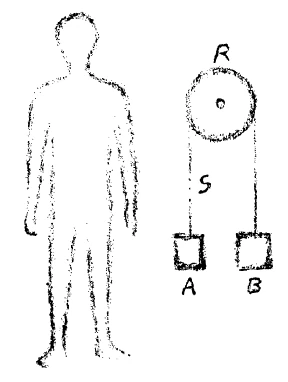
[ 8 ] What I am describing here becomes particularly clear when I walk or do anything at all with my legs. When I walk and move my legs, what the will accomplishes is an entirely objective process; it is something that happens in the world. In the unfolding of the will, it is initially—from the perspective of the external event—essentially irrelevant whether only a mechanical process is taking place or whether my will is intervening. My will merely directs the course of mechanical processes. This is most evident when I perform functions involving my legs and feet. In that moment, I am, in essence, outside of myself; I flow completely in unison with the objective world; I am entirely a part of the objective world.
[ 9 ] I cannot say the same about the mind. The functions of the mind tear me away from the world; I cannot place what I call seeing and hearing—which ultimately leads to a mental image—into the world in this objective way. My head does not belong in the world at all. It is a foreign entity in this earthly world; it is the afterimage of what I was before I descended to Earth. The outermost extremes are the head and the legs, and in the middle—because the will is already at work there, but works specifically in conjunction with feeling—lies the structure of the arms and hands. Please consider how the human being is actually set apart by his head, how he brings the head in from a spiritual world, how the head is, physically speaking, already the witness to the fact that the human being belongs to a spiritual world, and how the human being forces his way into the physical world by adapting, through his organs of feeling and will, to the entire external structure and the external laws. One cannot draw sharp boundaries between external events and one’s own volitional activity. However, one must always draw a sharp boundary between external processes and the mental images conveyed through the head.
[ 10 ] There, I would say, you can draw the guiding principle for understanding human beings even better. The human being is drawn into embryonic life by first developing the head organization. It is nonsense to think that the head organization is merely a matter of heredity. The organization of the head—which is, indeed, spherical—is very much a replica of the cosmos, and the forces of the cosmos are at work there. What the human being receives through the current of heredity flows through the organization of the arms and legs. It is only through these that the human being is truly a child of his or her parents. It is through these that he is connected to earthly forces; for the head is not at all accessible to earthly forces, not even to fertilization. The head is organized from within by the cosmos. And even if the head shows similarities to the parents, this stems from the fact that it develops in connection with the rest of the organism, is nourished by its blood, and is influenced by the rest of the organism. But what the head is in and of itself in its formation is a product of the cosmos. And a product of the cosmos is, above all—insofar as it is bound to the head—that which has to do with the nervous-sensory organism. For we also bring the nervous-sensory organism in from the cosmos and then allow it to grow into the rest of the organism.
[ 11 ] It is indeed very important to consider such things, for in doing so one learns to eliminate nonsense within oneself—as if one were becoming particularly intellectual or spiritual simply by avoiding any mention of the physical and bodily and speaking only of something abstractly intellectual and spiritual. On the contrary, one becomes truly intellectual and truly spiritual when one is able to perceive correctly the relationship between the physical body and the soul and spirit—when one is able to see that, as far as the head is concerned, you are organized from within the cosmos; as far as the leg organism is concerned, you are a child of your parents and ancestors. And these insights then flow very strongly into feeling, for they are insights into realities, whereas the insights conveyed through today’s abstractions—regardless of whether one means these abstractions themselves or the description of the material—have, in essence, nothing at all to do with reality. Therefore, they cannot inspire us through feeling. That which penetrates into reality in this way also stirs us emotionally; therefore, familiarize yourself thoroughly with one thought and try to develop it deeply through education. For this is the thought: it actually makes no difference whether one considers the human being in terms of his physical body—if one considers him correctly—or in terms of his spiritual and soul aspects. When one learns to view the spiritual-soul aspect in the right way, one comes to know it as a creative force that allows the physical-bodily aspect to flow forth from within itself. One sees the spiritual-soul aspect in creative work. And when one views it artistically in the right way, one gradually loses all sense of materiality, and it becomes spiritual all on its own. Through a proper mental image, the physical-bodily aspect is transformed into a spiritual one.
[ 12 ] If one stands on the ground of Spiritual Science, of anthroposophy, it does not matter whether one is a materialist or a spiritualist. It is of no consequence at all. The harmfulness of materialism does not lie in getting to know material phenomena and entities; for if one comes to know them thoroughly, one sheds those silly materialistic concepts, and the whole thing is transformed into something spiritual. The harm lies in the fact that one easily becomes mentally deficient if one focuses on the material and does not think things through to their conclusion, nor delves into what one perceives through the senses. Then one has no grasp of reality. One does not think the material through to its conclusion; for if one does, it becomes spiritual in the mental image. And when one contemplates the spiritual-soul aspect, it does not remain—even when one enters into its reality—that abstract concept which so easily confronts us in today’s understanding, but rather it takes shape and becomes pictorial. Abstract understanding becomes something artistic, and one ultimately arrives at a perception of the material essence. So one can be a materialist or a spiritualist—one arrives at the same thing by both paths, provided one follows them to their conclusion. Nor does the harm of spiritualism lie in grasping the spiritual, but rather in the fact that one easily becomes foolish, turns into a nebulous mystic, sows confusion, views everything only in a nebulous way, and fails to bring it into concrete form.
[ 13 ] It is now very important that, in addition to everything we have already considered regarding the exploration of the child’s nature, you also take into account—as it were—whether the cosmic organization predominates in the child, which is revealed through a sculptural formation of the head, or whether the earthly organization is particularly prominent, which becomes apparent through a sculptural formation of the rest of the human being, namely the limbs. And now it is a matter of treating both types of children—the cosmic children and the earthly children—in the proper way.
[ 14 ] Earthly children: we must be clear that they possess a great deal of hereditary forces, and that these hereditary forces permeate the metabolism of the limbs to an extraordinary degree. We will notice that, even if such children are not melancholic in their general temperament, we can still easily detect—especially when we engage with them from a certain perspective, when we ask them questions, or when we approach them in other ways—a kind of melancholic undertone beneath the surface of their general temperament. This melancholic undertone stems precisely from the earthly aspect of the children, from the earthly aspect of their being.
[ 15 ] We will treat a child in whom we observe this well by trying to help them find their way into music that begins with a melancholic minor quality and moves into a major quality, either by guiding the melancholic minor quality into the major quality or by introducing this transition to the child within the musical piece itself. It is precisely through the physical activity involved in musical eurythmy that an earthly child can be spiritualized. If, in particular, the child has a generally sanguine temperament with slight melancholic traits, painting is also something that can very easily help the child. In any case, even if such a child appears to show little aptitude for music and eurythmy, we must take the greatest care to bring out the innate predisposition that certainly already exists in such a child.
[ 16 ] If we have a child with a particularly well-developed mental structure, then it is again important that we introduce the child to the subjects under consideration—history, geography, and literary history— but we must take special care not to remain merely at the level of contemplation; rather—as I demonstrated yesterday in a different context—we must move on to a form of presentation that evokes emotional states, tensions, and curiosity, which are then relieved, satisfied, and so on.
[ 17 ] It is precisely in these matters that we must once again accustom ourselves to seeing the spiritual and the physical as being in harmony. It is indeed true that this beautiful Greek mental image—which actually viewed the physical and corporeal as being in complete harmony with the spiritual and soulful—has been completely lost. The Greeks actually always saw something in the effect of a work of art on human beings that they also regarded from a physical perspective. They spoke of the crisis of illness, of catharsis, and they spoke in this way also of the effect of a work of art; they spoke in this way also in the context of education. They actually observed such processes as we hinted at yesterday, and we must find our way back to such processes, to such an integration of the spiritual-soul aspects with the physical-bodily aspects.
[ 18 ] It is therefore important that we draw upon all our natural enthusiasm to teach history to children with a strong personal commitment. Children will have plenty of time for objectivity later in life; it develops naturally as they grow older. But to apply this objectivity right now, when we are talking to children about Brutus and Caesar—to try to be objective and not to make the contrast and difference between Brutus and Caesar emotionally tangible—that is poor history teaching. One must be fully immersed in the subject; one need not get carried away or rage, but one must openly express a subtle hint of sympathy and antipathy toward Brutus and Caesar while presenting the story. And the child must be encouraged to empathize with what is being demonstrated to them. Above all, one must present history, geography, geology, and so on with genuine feeling. The latter is particularly interesting when teaching geology and feeling the deepest empathy for the rock lying beneath the earth. In this regard, one might advise every educator to read through Goethe’s treatise on granite with genuine empathy, to see how a personality who immerses himself in nature—not merely with his imagination but with his whole being—establishes a human relationship with the forefather, the ancient and sacred granite. Then, of course, this must be extended to other subjects.
[ 19 ] If we develop this within ourselves, we will naturally be able to involve the child in these things. Of course, the task is often much more difficult; we have to work hard at these things; but on the other hand, this is the only way to bring true life into teaching and education. And fundamentally, everything we convey to the child indirectly through feeling is precisely what fosters growth in their inner life, whereas the mental images we teach are dead and remain dead. After all, through mental images we can teach nothing but reflections; when we teach mental images, we are working with the worthless human head, which has value only in relation to the past, when it was in the spiritual world. That which lies in the blood, that which has significance here on earth—we encounter this by imparting mental images to the child with full feeling.
[ 20 ] It is indeed necessary that we develop within ourselves a sense of something like this hostile, destructive force of the space beneath the receiver of an air pump, and the more vividly we can describe to the child—after the air has been pumped out—the terrifying vacuum beneath the receiver of an air pump, the more we will achieve through this. All these things were contained in the language of the past: *horror vacui*—the horror emanating from a vacuum was sensed. That was embedded in the language, but we must learn to feel it again. One must learn to feel the connection between a vacuum and a very gaunt and emaciated person. Shakespeare already hints that—under certain physical circumstances—one loves the plump and corpulent, not the thin, gaunt ones with bald heads, among whom there is so much that is purely imaginary. So we must sense this kinship between gaunt people—or even a spider—and a vacuum; then, as if through imponderables, we will pass on to the child precisely this sense of the world, which must absolutely be present in human beings.
[ 21 ] Whenever we speak of pedagogy, we must always speak of this connection between the whole human being and objectivity, for only in this way can a certain health be brought into that aspect of teaching which has actually suffered considerably in this materialistic age. You see, one isn’t even in a position to be as brazen as Abderhalden, who, after an introduction to a eurythmy performance in Dornach—I was also speaking at the time about gymnastics, its hygienic significance, and so on—said that he, as a physiologist, did not see in gymnastics anything that was physiologically sound, he saw gymnastics not at all as a means of education, but as the most harmful thing one could imagine. He refused to accept it as a means of education; it was not a means of education, but barbarism. In today’s world, one cannot be so brazen; otherwise, people would attack you very fiercely, just as they do today. When you think about it, doesn’t everything related to gymnastics—that is, whatever is confined solely to the bodily-physical in the worst sense of today’s materialistic science—come across as an idol, as a fetish? Whether it be the intensely physical, the supra-physical, or the sub-physical aspects of Swedish gymnastics, or the physical aspect of German gymnastics. These things amount to viewing the human being as a creature that is solely physical—but according to the flawed mental image that the materialistic age has developed today, not according to the mental image I referred to earlier. The assumption is: a human being should have a certain posture; this posture is described. So one says: the back must not be arched too much, only to a certain degree; the chest must be shaped in a certain way, arms and hands must be moved in a certain way, the entire posture of the body—in short, one does not think of the human being as such, but of the image one has created. This can be sketched; it can be molded out of papier-mâché. Everything that can be said about correct posture in Swedish gymnastics is contained within that papier-mâché sculpture. Then one can use the person as if they were a sack and make them imitate it. When one carries out this procedure, one has nothing at all to do with what is truly human; one is dealing with a papier-mâché figure that embodies everything prescribed by Swedish or German gymnastics. Then one makes the person—without caring what else he is—hold himself in that way, perform such exercises, and so on. Yet no one has actually taken into account that there is a human being standing before them.
[ 22 ] This is precisely why the matter is so reprehensible—it is, in essence, wicked—even though it represents a profound blow to our so-called civilization, because it effectively eliminates the human being—not merely theoretically through science, but practically; the human being is eliminated through this gymnastics. He is turned into an imitator of a papier-mâché figure. And that is not what education should ever be about; rather, it should be about the human being, through gymnastics, adopting the posture and making the movements that he also experiences—internally experiences. And he does experience them. Let’s take the functions of breathing. We must understand that children can be guided to experience, as they inhale, something like—I would say—a faint hint of a delicious dish passing over the palate. But it should not go as far as actually imagining or perceiving a taste; rather, it should be a hint of that sensation as they inhale—they should be able to experience something of the world’s freshness as they breathe. We should let the children breathe in and allow them to sense something of the world’s freshness. We should try to get them to say: “What color is what you’re breathing in, actually?” — and we will find that at the very moment the child truly senses the breath correctly, they will describe it as: “It’s greenish, so naturally green.” — You’ve achieved something when you’ve led the child to perceive the inhalation as greenish. Then you’ll always notice: the child now requires a certain posture for inhaling; through inner experience, it develops the correct posture for inhaling. Then you can have the child do the exercise. Likewise, you must lead the child to experience a corresponding sensation when exhaling. The moment the child says to you while exhaling, “Deep down, I’m actually quite a capable fellow”—when the child perceives exhalation as if they felt like a capable fellow, as if they were sensing their own strength and wanted to share that strength with the world through exhalation: if they have this sensation, then they will also experience in the right way—as something entirely appropriate to them—the corresponding movement of the lower abdomen, the other limbs, and the posture of the head and arms. If they have the full sensation of exhaling just once, then the child will experience the correct movement.
[ 23 ] There we have the human being within; there we truly have the human being before us; there we do not let him, like a sack of flour, merely imitate what a papier-mâché figure does. There we move in harmony with the soul, which draws his physical body along with it. We draw the child’s physical movement out of the child’s spiritual-soul experience. Just as we do this, we should also do so in other ways the child can feel—I mean, in any movements of the arms, the legs, in running and so on, in the mere posture—everywhere we should develop this soul experience that the child’s physical being demands of its own accord. And then—then gymnastics is actually brought into direct connection with eurythmy, and that is exactly how it should be. Eurythmy directly brings a spiritual-soul aspect to light, imbuing and spiritualizing the entire range of human movement. It takes as its starting point what the human being has developed spiritually and soulfully in the course of human evolution. But the physical-bodily aspect, too, can be experienced spiritually. One can experience breathing and metabolism if one takes it far enough in this direction. There, a person can take themselves far enough; there, a person can sense themselves, empathize with their physical body. And then, I would say, what approaches the child on the higher plane as eurythmy can flow into gymnastics. It is certainly possible to build a bridge between eurythmy and gymnastics. But this gymnastics should not be practiced in any other way than by drawing what the child performs in gymnastics out of the experience of the physical body—out of the experience, out of the spiritual-soul experience—and allowing the child to adapt the physical body to what they are experiencing.
[ 24 ] It is, of course, necessary that we learn a great deal by teaching in this way; for one must engage deeply with such mental images if one wishes to apply them for oneself and, in particular, in the classroom. They are difficult to commit to memory. It is almost the same with these mental images as it is for some mathematicians with mathematical formulas; they cannot memorize formulas, but they can reconstruct them instantly. And so it is with us and these mental images we form about the living, physical-spiritual-soul human being: we must always keep them vividly present in our minds. But this actually works to our advantage. Because we act from the perspective of the whole human being, we have a stimulating effect on the children. They will always notice when you yourself have had a lot to do to prepare for a lesson, have wrestled extensively with the material, and then enter the classroom; in such cases, the children learn very differently than when you are the lofty teacher who prepares quite comfortably. I have also met teachers who walked to school quite leisurely and quickly skimmed through the material they were supposed to present. This has a profound impact on teaching: when you yourself are directly grappling—not only with the content to be conveyed but also with other aspects that pertain to teaching skills—you must grapple with these as well.
[ 25 ] There are spiritual connections in life. If you have first heard a song in your mind—one that you then have the child sing—it has a greater effect when the child sings it than if you had not heard it in your mind beforehand. These things are connected. The spiritual world exerts an influence in the physical world. One must apply this influence of the spiritual world, especially in pedagogy and didactics, and, for example, in religious instruction. If, while preparing for it, one feels a natural, devout mood, then this religious instruction will also have an effect on the child. If one does not cultivate this devout mood, then religious instruction will not amount to much for the child.