

The Healthy Development of the Human Being
An Introduction to Anthroposophical Education and Didactics
GA 303
5 January 1922, Dornach
Translated by Steiner Online Library
Fourteenth Lecture
[ 1 ] What I have presented to you as a structure of the human being—and which can serve to attain a comprehensive understanding of humanity—can be described from a wide variety of perspectives; and it is precisely when it is described from these diverse perspectives that the human being gradually arrives at a true understanding of what actually lies behind it. I have spoken to you about the astral body—that is, the aspect of the human being that, in a sense, transcends both spatial and temporal relationships and makes use of them in a free manner. I have attempted to show how this finds expression in dreams and their images by demonstrating that dreams essentially originate from the astral body, and that dreams interweave events separated in time within their images.
[ 2 ] There are many perspectives from which to characterize what the human astral body is. For example, one can also try to gain insight into all those qualities and states that a person develops from within upon reaching sexual maturity, and by observing these states and these forces, one will also gain a picture of the astral body; for with sexual maturity, precisely that which the astral body is—and which a person can freely engage with—comes into being.
[ 3 ] Augustine, the medieval writer, now seeks to approach the astral body in a different way. I must emphasize that in Augustine one can indeed still find the division of the human being in the sense that I present it here—not as a result of conscious anthroposophical research, but rather, in Augustine, it is described on the basis of the instinctive clairvoyance that humanity once possessed. And the way Augustine characterizes this aspect of the astral body—which comes to full expression in human beings at puberty—is quite characteristic of human life. For Augustine actually says: Through the fundamental qualities of the astral body, human beings become acquainted with everything that humanity artificially introduces into the course of human development. When we build a house, manufacture a plow, or construct a spinning machine, the forces that come into play in these processes are bound to the astral body. Through his astral body, a human being actually comes to know what surrounds him in the external world that has been produced by human beings themselves.
[ 4 ] Therefore, it is certainly grounded in a true understanding of human nature when, in the fields of education and instruction, we strive to introduce people—from the moment they reach sexual maturity—to those aspects of life that have been brought about by human beings themselves. Admittedly, this is a more complicated matter today than it was in the time of St. Augustine. Back then, life around people was much simpler. Today it has become complicated. But it is precisely what I have referred to in recent days as “spiritual economy” in education and teaching that must succeed in even today to view the sexually mature individual in such a way that, during the period from the age of fifteen to around twenty—or even beyond twenty—he is gradually educated in such a way that he is guided into the artificial human existence that surrounds him.
[ 5 ] Just consider how much of our entire civilization is actually lacking in this regard. Ask yourself whether there aren’t numerous people today who use the telephone, the streetcar—indeed, one might even say, the steamboat—without having any mental image of what actually happens inside the steamboat, within the telephone, or in the movement of the streetcar. After all, within our civilization, people are completely surrounded by things whose purpose remains a mystery to them. This may seem insignificant to those who believe that the only things of significance in human life are those that take place in conscious experience. Certainly, one can live quite comfortably within the realm of consciousness by simply buying a streetcar ticket and riding to the stop one wishes to reach, or by receiving a telegram without having the slightest idea how it came to be, without ever having seen a Morse code machine. For ordinary consciousness, one might say, this is irrelevant; but for what takes place in the depths of the human soul, it is by no means irrelevant; a person in a world that he makes use of but whose meaning he does not understand is like a person in a prison without a window through which he could look out into the open air.
[ 6 ] The art of education and teaching must be thoroughly permeated by this insight. As the human being—as I described yesterday—enters into the differentiation between man and woman, he or she also becomes ready to enter into the other differentiations of life, and must indeed be introduced into real life. That is why, as our Waldorf schoolchildren approach sexual maturity, we incorporate activities such as spinning and weaving into the curriculum. Of course, this presents a major challenge, and it is difficult to structure the curriculum when one aims to include, from the age of sexual maturity onward, everything that makes a person practical in life; that is, someone who engages with the world with understanding. Of course, in the Waldorf school we also grapple with the external demands of modern life. We must, after all, prepare the students so that they may eventually attend a university in the modern sense, a technical college, and the like. We must therefore include in the curriculum all those elements that we might otherwise consider unnecessary, but which must be included for the reason indicated. Organizing the school curriculum in as spiritually economical a way as possible, especially for those students who are reaching puberty, is indeed a matter of considerable concern. It takes a great deal of effort, but it can be done. It can be done by developing a sense of what is essential in life and then conveying this to the students in the most economical way possible, so that they learn to recognize in the simplest way what they are actually doing when they receive or make a phone call, what the streetcar does in relation to all the other systems, and so on. One need only develop within oneself the ability to distill all these things into the simplest possible formulas; then one can certainly convey these concepts to the students in a way appropriate to their age. For that is what we must strive for: that the students become thoroughly familiar with the essence of our cultural life. - One need only prepare everything in chemistry and physics classes in a way that is suitable for the relevant age group before puberty, so that one can then build upon this foundation to address the very practical aspects of life in the most efficient manner possible once puberty has set in.
[ 7 ] Of course, this also takes into account the fact that students are now reaching an age where they must be differentiated in a certain way—naturally, some in different directions—but above all based on whether they will pursue a more intellectual profession or a more manual one. In this regard, it must certainly be taken into account that an art of education based on a genuine understanding of human nature recognizes, as a matter of course, that the individual aspects of human nature strive toward wholeness. There must simply always be an understanding of how this wholeness is to be pursued. Naturally, we must educate and instruct those students who, by virtue of their particular aptitudes, are suited for more intellectual professions in this spirit. But whatever is developed one-sidedly in a person even in later stages of life must, in a certain sense, be elevated once again to a kind of wholeness through a different kind of development. If, on the one hand, we instill in the student impulses of will that are directed toward a more spiritual aspect, then we must also cultivate the aspect of knowledge—for the astral body demands, when it develops its impulses of will in a certain direction, that the impulses of knowledge lying within it, directed toward the other aspect of life, be developed as well— we must then develop the impulses of knowledge in such a way that the person has at least some insight—and indeed a vivid insight—into areas of practical life that instill in them a sense of the totality of practical life.
[ 8 ] For example, it is certainly a shortcoming in our civilization when—to cite an extreme case—statisticians include in their statistics the amount of soap consumed in a certain territory without having the slightest idea how soap is manufactured. No one can statistically assess soap consumption with a true understanding unless they have at least a general idea of how soap is made.
[ 9 ] You see, because life today has become so complicated that the things one must take into account are almost immeasurable, the principle of “psychological economy” will have to play the greatest possible role. The educational problem that arises in this area is precisely this: to determine, in an economical way, what needs to be done for this age group. It could easily be done if we weren’t still burdened by the dregs of all sorts of educational practices that have traditionally carried over into the present and that actually have no place in contemporary life.
[ 10 ] The Greeks would have looked quite puzzled if young people had first been introduced to Egyptian or Chaldean culture—much as we do with our college students—before being immersed in Greek life. But it is still too early to discuss these matters, because we must, of course, take the realities of modern life fully into account.
[ 11 ] The aim here is, as comprehensively as possible, to familiarize those who are turning toward a more intellectual profession with the practical aspects of the craftsman’s life, and conversely, to familiarize those who are turning toward the craftsman’s life—to the extent that they are capable of judgment—within certain limits with what is offered to people as an intellectual profession. It must be emphasized that we must at least strive to cultivate this practical side of life through the school itself. Nor should craftsmanship be fostered by immediately placing young people among adults in a factory; rather, the school itself should provide the opportunity to take the practical side of life into account, so that the young person can then translate into practical life what he or she has acquired in a short time—I would say, figuratively speaking—from a model. Learning from a model can, in fact, be so practical that the skill in question can certainly be carried over into real life. Nor do I see why—since it has already been successful in our prisons to have prisoners work in such a way that they produce items that then play a role in life on the outside—why items shouldn’t also be produced in school workshops that could then simply be sold out into the wider world.
[ 12 ] But care must be taken to ensure that young people remain in a school-like environment—which, of course, must be a healthy one—for as long as possible; for it simply corresponds to the inner nature of human beings to approach life gradually rather than being thrust into it all at once. Because the older generation has understood so little about what to do with youth, that is precisely why we have today a youth movement that is truly already rooted in the international context—a movement whose profound legitimacy is least understood by the older generation today. It has a profound legitimacy and must certainly be understood in terms of that profound legitimacy. But it must also be guided along the right paths. And, fundamentally, this can only happen if the educational system is steered in the right direction.
[ 13 ] This is what we strive for above all else in the Waldorf school principle: to bring people as close as possible to life itself, so that in their early twenties—when the true “I” steps out into the world with free agency—they can truly develop the right sense of the world, so that they can then truly feel at home in a world from which they are capable of receiving the following sense: I have fellow human beings who are older than I am, who shaped the previous generation. These earlier generations have produced everything I now make use of; but I share a sense of community with these earlier generations. I understand what they have brought into the world. I do not merely sit on the chair my father placed for me, but I learn to understand how this chair came to be.
[ 14 ] Of course, there are many prejudices today that stand in the way of introducing young people to practical life in this way. But I understand it here in a truly practical sense. For it is indeed true: of all the ages that humanity has gone through in its development, the materialistic age into which we have grown is, for human beings themselves, the most spiritual of all. You see, perhaps I can explain this in the following way. I have met Theosophists who strive toward the spiritual; yet they are the purest materialists, for they speak of the physical body—which has a certain density—then they speak of the etheric body—which is thinner, but still possesses a certain density and corporeality—then they speak of the astral body—which is already much thinner, but still retains a certain density in the mental image. Then they speak of all sorts of other beautiful things: one ascends higher and higher, and there the matter becomes so ethereal that one no longer knows what to make of this ethereality; yet everything remains conceived by analogy with materialism—it does not truly rise into the spiritual. — In fact, I have encountered the crudest form of materialism within the Theosophical Society. For example, I had to put up with someone in Paris telling me—after a lecture had been given and I asked what impression this person had gained from it—“Yes, the lecture left such good vibrations in the room!”—so that one almost gets a mental image of the impact of the lecture being smelled. Little by little, everything was reduced to the material realm.
[ 15 ] On the other hand, I am happy to tell those who are willing to listen that I much prefer a materialist who thinks with spirit to a theosophist who ascends into the spiritual world in a materialistic way; for the simple reason that, although the materialist is in error, what he conceives has spirit—real spirit; it is merely a very diluted spirit, an abstract spirit, but spirit is there—real spirit—and one must focus on the reality of life. That is why I often find materialists far more spirited than those who strive to transcend materialism in a materialistic way. Our age is truly geared toward processing the spirit so thinly within itself that it no longer even notices it. Yet we are already developing the most spiritual aspects within our modern technology. In fact, everything upon which an object is based has emerged from the spirit, from the human spirit itself.
[ 16 ] You don’t have to be particularly clever to place a beautiful bouquet of flowers on the table, because nature does that. But you do need to possess a certain degree of intellectual capacity even to design the simplest machine. The intellect is already there; you just don’t notice it because you don’t look back at yourself in the right way. And to possess this spirit is, in fact, extraordinarily difficult for the subconscious human nature to bear if it lacks the necessary understanding of the objective world. This spirit, which we have today poured out as an abstraction over the present, we are gradually learning to bear precisely by finding our way into the practice of life.
[ 17 ] I can assure you: once the anthroposophical art of education is established, it will send far more practical people out into the world than today’s more materialistic art of education, for it will regard the spirit as a creative force—not merely as something one dreams up after closing one’s eyes as much as possible and drifting a little away from external reality. To attain the spirit without losing touch with practical life—that is precisely what the anthroposophical movement seeks to reveal, especially with regard to the practical side of life.
[ 18 ] Well, precisely when one wants to introduce boys and girls—starting from the age of puberty—into practical life in this way, one can sometimes, as a teacher, feel despair at their clumsiness, especially in our time. And one must ask: Is there a path for the age that is actually school-age—between the loss of baby teeth and puberty—that is suitable for turning the whole person into a skilled, capable being? - And there, when one looks to real life rather than to theories—when one allows oneself to be guided by life rather than by abstract ideas—one is led, precisely by pursuing the goal of making people practical, we are led, during the period from the loss of baby teeth to puberty, to introduce as much of beauty—of the truly artistic grasp of life—as possible to the individual. The more one instills in a person an appreciation for beauty, the more that person becomes imbued with an inner understanding of beauty, the better prepared they will be to approach what is truly practical upon reaching sexual maturity, without causing themselves harm for the rest of their lives. Only then, in essence, can one safely approach an understanding of a streetcar or a locomotive if, at the right age, one has acquired an aesthetic understanding of a painting or a sculpture. This is what must be emphasized above all else. But beauty must be regarded as an integral part of life. A sense must be developed everywhere that beauty is not something self-contained, but rather something embedded in life. And in this regard, our modern civilization has much to learn, particularly for the purposes of teaching and education.
[ 19 ] You will see, through individual examples—which I will try to simplify as much as possible—what is actually meant by introducing the child to a sense of beauty that is full of life and steeped in life. You see, one might be introduced to some kind of home-based—and sometimes even school-based—handwork class; there the girls sit with some ribbons and embroider all sorts of patterns onto them, as they say. So let’s say the girls are embroidering something onto a little ribbon, something like this (Drawing 2)—I’m keeping it as simple as possible, just to illustrate the point. If you then ask, “What is this for?”—you might get the answer: “You sew it around the neckline, around the belt, and also along the bottom hem of the dress.”—That’s enough to make you run away when you hear something like that, because it reveals a complete lack of understanding of the reality of life in connection with a sense of beauty. If you have a very vivid sense of what is truly real in life, and you’re shown a young girl or a lady who has sewn such a pattern at the top, in the middle, and at the bottom, then you have roughly the same feeling as if she were being squeezed from top to bottom! You then have to remedy the situation by making it clear that three different patterns of such designs must be embroidered. The top band must be embroidered differently, and the bottom band, in turn, differently.
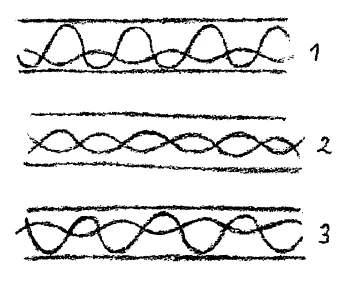
[ 20 ] This pattern should perhaps be embroidered onto this ribbon (the upper one) (Figure 1)—as mentioned, only sketched—and this pattern should be embroidered onto this ribbon (the lower one) (Figure 3). Then this esteemed person can sew this (Figure 1) onto the top of the neck, because that indicates that above it is the neck and the head. That (Figure 2) can then be sewn to the belt, and that (Figure 3) to the bottom of the garment’s hem; for this indicates that this is the bottom and this is the top. For a human being has a bottom and a top, and this must be emphasized if one wishes to bring artistic sensibility into contact with the living. For example, I once discovered that pillows had been adorned with such things (Drawing 4), or something like that. Well, you certainly can’t rest your head on that, because the part in the middle pricks you! You simply can’t lie on it! That certainly doesn’t express what is really supposed to happen with the object.
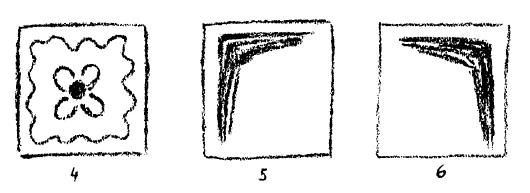
[ 21 ] Of course, you have to do it this way (Figure 5); and now, now you can simply lie down on it so that your face is turned to the right, and you really should lie on the other side with each of these pillows, and you need to have the same arrangement on the left side if you want to arrange it in a truly artistic way (Figures 5 and 6).
[ 22 ] Well, in reality, that’s not how it’s done. But art also involves illusion. And so one must have a sense that a pillow should actually be made in such a way that it truly adapts to a person’s position when lying on their right or left side—that the fiction is assumed: that one has turned the pillow over.
[ 23 ] These things lead us, I would say, into the reality of the artistic world of illusion. And only when one is led into this reality in the proper way does one develop a sense that is, I would say, the antithesis of the merely practical—a sense that is truly experienced in the right way when one is inwardly immersed in a sense of beauty, but a sense of beauty that is full of life.
[ 24 ] These days, it’s especially popular to adorn pompadours with all sorts of such embroidery. Looking at quite a few of these Pompadours, I have to ask: Well, where exactly is the top and where is the bottom? — You have to look at the exterior—at the decoration on it—to see where something is inserted, where the top or bottom is. This is usually not taken into account at all, just as we very rarely do with our books—where you can tell by looking at the book where it opens. Some motif is placed on the cover that actually compels one to leave the book closed, not to open it.
[ 25 ] As I said, I simply want to use these examples to suggest how a sense of beauty truly takes root in life, and how it must be grasped in a way that is full of life. For only when we have developed a sense of beauty in this vital way can we continue to be educated in such a way that we understand how to engage with practical life in the manner demanded today.
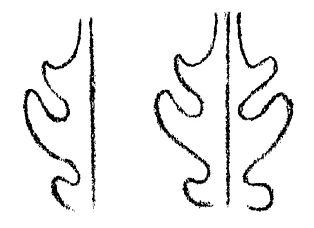
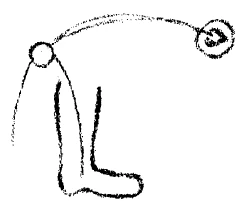
[ 26 ] Now, however, what comes into consideration here is that the child really must be introduced to a sense of reality. I would like to use an example I have devised—one as simple as possible—to show how one can teach the child this sense of reality through beauty. One can go about it this way: Let’s suppose I draw this for the child (see page 265). As an educator, I must now be able to evoke in the child a feeling—and one will soon discover this in a number of children who are, after all, emotionally healthy—that the object is so unbearable because it lacks any sense of reality when viewed directly, and one simply cannot bear it. And I will be able to build on this with the child to the point where I teach them—but by drawing everything out of the child, not by suggesting it from the outside: When you see this, it’s just as if you had a person standing before you who has only the left half of their face, or only a left arm, or only a left foot. You cannot bear what, in reality, cannot appear as something real. One must incorporate this into the sense of beauty; in short, one must lead the child to regard it as a necessity to make the other part complete, and not to consider the matter finished if that other part is missing. Then I cultivate the immediately living sense of beauty. “Beautiful” is etymologically related to “appearance.” I will draw out of the child what truly makes the astral body mobile within them, what causes the astral body to become a functioning part of the human being.
[ 27 ] It is important that we, especially as educators and teachers, cultivate this sense within ourselves; for we will see how we can inspire the children when we approach them in this way. And we will then also cultivate the other artistic aspect in the proper way—the one I have already spoken of in the course of these lectures. I said that when a child starts school during the phase of losing their baby teeth, everything must, in a certain sense, be approached artistically. One should also recount what one tells the child about the surrounding world with an artistic sensibility; otherwise, one falls into what is called anthropomorphism—projecting human characteristics onto nature everywhere. By turning everything into a fairy tale or a legend, one introduces the human element, and one then truly runs the risk of convincing children that certain trees grew for the sole purpose of providing humans with cork and bottle stoppers. Visual education must under no circumstances be permeated by this kind of thinking. Therefore, the images we create for this age group must be born of beauty. Beauty demands vividness, immediate sensation. And what can be immediately sensed as beauty in nature does not call for overly humanized personification, anthropomorphism, or the like, but truly revels in the vivid.
[ 28 ] If we allow the child to develop this sense of beauty in relation to all objects until reaching sexual maturity, then the child will enter practical life in such a way that it approaches these practical aspects of life with a human perspective, and a harmony will develop between the child’s human perspective and the practical aspects of life that are introduced to the child upon reaching sexual maturity.
[ 29 ] But this also has an immensely significant social aspect. The social question must be tackled from many angles that we don’t even consider today. You see, it is entirely possible that all the abominations that surround us today in modern civilization—and you can hardly deny that it is a universal truth that the moment we even approach a big city, we are, from an aesthetic standpoint, surrounded by nothing but ugliness—at least for the most part—that all this ugliness would become something entirely different if, over the course of a few generations, people were raised in such a way that a genuine sense of beauty truly took root!
[ 30 ] Today we have the human being as he presents himself to us in terms of his physical body; we observe him from the outside. And we have the other human being, whom we observe from within, in terms of his “I.” Between the “I” and the physical body lie the astral body and the etheric body. In modern human beings, these are actually atrophying. Today, they are really only present—in a properly developed form—in Eastern people. In all Western people, they are atrophying. They cannot develop freely. We can promote this free development by fostering in people as comprehensive a sense of beauty as possible. They are most receptive to this during their school years. Therefore, everything should actually be geared toward introducing people—particularly between the loss of their baby teeth and sexual maturity—to the perception and experience of beauty. Then they will retain this sense into later life.
[ 31 ] Bringing the artistic into people’s lives is of particular importance for the treatment of the linguistic element. After all, all languages have their origins in immediate experience. In the element of sound, one can certainly still discern—if one can once again discover through one’s own sensibility how the linguistic element developed in accordance with feeling—the meaning that words have experienced or are capable of experiencing. In our abstract lives, this has almost entirely been lost to us, and today we cling one-sidedly to the logical aspect of language, not to its artistic aspect. Certainly, logic is present within languages, but it is the skeleton of language, and that is something dead. The life of language—which can only be sensed in connection with the genius of a language—encompasses much more than this mere logic.
[ 32 ] Try, from this perspective, to sense how the words want to find their way into life. One can certainly say that this is characteristic—I’ll give an example, though I think you’ll understand it even if it comes from an older form of the German language—for instance, when the word “Sucht” is used; this word “Sucht,” for which you can already find an equivalent in English, meant something related to “seeking” at an earlier stage of the German language. The body had an “Sucht,” an illness; it was seeking something it would not otherwise seek. And from the external forms, from the specific manifestations, one could then recognize what it was seeking: jaundice and epilepsy were specific forms of illness. One could sense in the “Sucht” what was actually being represented in life.
[ 33 ] Today, with the exception once again of the peoples of the East—who still retain this sensibility in their language—the farther we go westward, the more we have distanced ourselves from this artistic sensibility toward language. And it is of great importance to find, once again, at least some kind of foundation for such a life within the genius of language, within the linguistic organism. This, in turn, has great—and indeed international—social significance.
[ 34 ] Please forgive me if I use an example close to my heart to explain what I wish to express here. But I ask you not to misunderstand what I am about to say in any way. You see, on page 88 of the translation of my book *The Core Issues of the Social Question*—that is, the book *The Threefold State*—I find the sentence: “The freedom of one cannot prosper without the freedom of all.” This sentence—when I feel it with all the emotional undertones embedded in the language—is—as I said, and this must not be misunderstood—nonsense; it cannot be said, for it conveys something entirely different from the corresponding German sentence in my book: “The freedom of one cannot flourish without the freedom of another.”
[ 35 ] This sentence conveys something entirely different. And if one were to translate it in a way that corresponds to the ideal of translation, one would have to completely rephrase it. One would have to substitute something entirely different. For a translation must, in fact, be crafted in such a way that the book in question, once translated, could have been written as such from within the linguistic genius and linguistic context of that country. No other translation is possible. And I know for certain that even in the astral world, Bentham would react in such a way that his hair would stand on end if he came across this sentence: “The freedom of one cannot prosper without the freedom of all.” It is completely unthinkable. And there is something very special underlying this.
[ 36 ] If you come across this sentence in a book, you’ll naturally object right away, especially if it refers to the school system: “Yes, we do have the freedom...” You’re talking about circumstances that don’t apply at all in England. That’s not the case in the original book—there, it does apply. But in this translation, the point originally intended in the book can’t actually be understood at all. And what’s the reason for that?
[ 37 ] Now I’d like to use a single word to show you what this is based on. You have the word “freedom.” If we wanted to have a corresponding word for it in German that captured the same feeling, we would have to coin the word “Freitum.” And if we had the word “Freitum,” then we could simply translate it lexicographically into English as “freedom,” and it would be unambiguous. That this is not simply possible if one truly takes the genius of the language into account may be illustrated to you, for example, by the fact that in German we can easily use the word “Irrtum.” But “Irrtum” is a well-defined fact that stands as a singular occurrence. If I wanted to use this word with the suffix “heit,” then one would have to—which would be entirely possible in German; the word is not usually used, but it is entirely possible to use it based on the nature of the German language—one would then have to coin the word “Irreheit.” “Irreheit,” however, takes us straight into the innermost being of a person; it is a quality of a person’s inner being. In German, we have no words formed with “heit” that do not refer to something influenced by the human being, that do not bring the matter to the human being. It is even a pity that we do not have the word “Freitum,” for then we could express—without circumlocution—precisely what is specifically felt by the word “freedom.”
[ 38 ] It is precisely this kind of thing that leads one into the depths of linguistic organization, of linguistic genius. Well, you see, when I write my books—even when I write in German—I try as much as possible to write in such a way that the work can be translated into other languages. The Germans then call that a poor style on my part! But that isn’t always possible. However, when it comes to introducing a book into German cultural life, what is specifically German must, of course, be taken into account at times. And so you’ll find the word “Freiheit” in my work, but you should never translate it as “freedom.” My *Philosophy of Freedom* should never bear the title *Philosophy of Freedom* in English; rather, one would first have to determine what title it should bear if the meaning is to be accurately conveyed.
[ 39 ] It’s actually quite interesting—please don’t think of conducting statistical studies as mere pedantry. The things I say from this perspective, I truly do not say recklessly, but rather based on careful research. If I were to write a book on child-rearing, you would find the word “freedom” repeatedly in certain chapters. Just to test this, I picked up a book on education written in English and looked at the corresponding chapters where I would always include the word “freedom.” And lo and behold, in those chapters the word “freedom” did not appear even once—not even once! That is precisely what we must feel and understand, because that is what we need for international understanding. We truly must take this into account as early as school. I take this into consideration in my books—as I just mentioned—and so I am extremely careful in my use of certain words; for if I use the word “Natur” anywhere in a sentence, I am certain that when it is translated into English, it will be rendered as “nature.” There is absolutely no doubt that it will be translated as “nature.” And yet, the entire meaning is distorted if what is felt in German when the word “Natur” is used is simply rendered as “nature” in English.
[ 40 ] That is why you will very often find paraphrases in my work—I would say, prepared for translation; I paraphrase whatever I do not want to evoke a different impression. Of course, I must also use the word “nature” for certain purposes, but in those places where it is important to me that a different, adequate mental image be evoked—particularly in Western languages—I do not include “nature” in my sentence, but instead use “the sensory world,” for that is roughly what “nature” has come to mean today, as the word is used in German.
[ 41 ] And what I often want to say about nature, I can then—prepared for an international audience—express by writing: the sensory world. - I expected the corresponding word to appear in the translation, but lo and behold, I find that it has simply been translated literally once again. This makes it exceptionally important to keep in mind this vitality of linguistic genius, especially when it comes to the artistic treatment of language.
[ 42 ] Aside from the fact—and I just want to point this out in passing—that the linguistic genius of the original has not been captured in the translation, it also says here what, in a strictly lexicographical translation, would read: “The freedom of one cannot flourish without the freedom of all.” But that doesn’t make sense in German either; it isn’t written that way. “The freedom of the one,” it says, “cannot flourish without the freedom of the other”—not “of all,” but “of the other”—and that is what matters.
[ 43 ] As I said, please don’t misunderstand me. I only cited this as an example that came to mind. And I wanted to point out how we have already reached the point today where we no longer experience things—we can see this particularly in language—but rather live right past them. Our civilization has gradually taken on a sloppy character. We must regain the ability to immerse ourselves in words, to live alongside them. Only then will we be able to realize what I have presented as a requirement: that the child, after first being introduced to grammar, then to rhetoric—that is, to beauty—be introduced as well to the artistic dimension of language. And we must introduce the child to the artistic nature of language. This also has international significance, and it is extremely important to realize today that what is called the “social question” must often be viewed from perspectives other than those we adopt today.
FAQs
[ 44 ] Dr. Steiner: A number of questions have been submitted here, and I will try to answer them as best I can in the short time available.
[ 45 ] Regarding the first question:
[ 46 ] The point is that answering the question about the relationship between the sensory and motor nerves is, first and foremost, a matter of interpretation, and that, as long as one adopts a purely physical perspective, one can hardly arrive at any answer other than the conventional one. This conventional answer is that—if I were to draw a schematic diagram, taking a simple nerve pathway as an example—we are dealing with the central organ. Thus, sensation would be conducted from the periphery (N) to the central organ, and the motor impulse would in turn be transmitted from the central organ to the relevant organ.
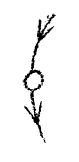
[ 47 ] Now, it is certainly possible—as I said, as long as one remains within the realm of mere material reality—to be satisfied with this explanation. And I also do not believe that any other interpretation can be accepted unless one is willing to turn to the facts that emerge as supersensible—that is, as actual observations—unless one is willing to turn to these facts. I said a few days ago, when I was addressing this question: the difference between the so-called sensory and motor nerves, in anatomical and physiological terms, is not significant. I did not say that there is no difference, but I merely said that the difference is not a significant one, not a major one. The existing difference in anatomical terms also arises when one takes the explanation presented here as a basis. Now, the interpretation is this: we are dealing with only one type of nerve; the so-called sensory and the so-called motor nerves are one type of nerve. It does not matter at all whether one chooses the term “sensory” or “motor” nerves. It does not matter because the mental phenomena—for which these nerves, which, if you will, are tools, physical tools—are not strictly separated from one another. Whenever we have a thought process, we are always dealing with a volitional process operating simultaneously within that thought process, and whenever we have a volitional process—even if this is a process that takes place largely in the unconscious—we are also always dealing with the penetration of thought or the remnant of sensation into that which constitutes the volitional impulse.
[ 48 ] Now, the impulse of the will—regardless of whether it is an immediate impulse or one that arises on the basis of a thought—always originates in the active human being from the higher members of the human being, from the combined activity of the “I” and the astral body. If one traces the impulse of the will and its overall activity within the human being, one does not find that this impulse of the will is mediated by the nerves; rather, the impulse of the will as such intervenes directly in the human metabolism—and indeed in all aspects of it. The difference between the explanation that must be given here on the basis of anthroposophical research and the commonly accepted one lies in the fact that the commonly accepted view assumes that the impulse of will is first transmitted through the nerves and only then conveyed to the relevant organs, which then carry out the movements, for example.
[ 49 ] That is not actually the case; rather, there is a direct effect of the psychological impulse of the will on metabolic processes in the organism. Now, if we are dealing with a sensation—that is, a sensory perception—let us assume, for example—though the process would, of course, have to be described in more detail—let us assume, we were dealing with a visual sensation, then at first glance, upon examining the matter, there would appear to be a process taking place within the eye—a process that occurs in the eye and is transmitted to the optic nerve, that is, to what is also regarded in conventional science as a sensory nerve. This optic nerve is now the physical mediator of vision.
[ 50 ] A correction must take place if one wants to see the truth as opposed to what is commonly assumed. And that is why I spoke only hesitantly of “tools” earlier. The term “tool” for the physically existing organs and organ systems in the human body is actually not entirely accurate; rather, one must note the following: Suppose there were a soft path here (it is drawn). A car would drive along this soft path; the car would then leave tracks—indentations—in the ground. From the tracks, I could describe exactly how the car drove. Now suppose someone were to come along and try to explain these tracks imprinted here in the ground, saying: “Yes, I’ll explain them this way: the earth develops all sorts of forces here that press down on the ground.” - He would be expressing a complete illusion, for it is not at all a matter of the earth doing something, but rather something happening to the earth; the wagon drives over it, and something that has absolutely nothing to do with the earth is what leaves its impressions there.
[ 51 ] Take our brain and nervous system, for example. What is happening there are psychological and spiritual processes—the chariot. What is left behind are traces. These can be found. But everything that is perceived in the brain—everything that can be recorded anatomically and physiologically—is not something connected to the brain itself; rather, it is all shaped by the soul-spiritual. It is therefore no wonder at all that everything that takes place in the soul-spiritual can be found in the brain; but this has nothing to do with the brain. So one should not say that one is dealing with tools, but should understand the entire process as if I had to walk; after all, my walking has nothing to do with the ground—it is not my tool. But if it is not there, I cannot walk. That is how it is. Thinking—the content of the soul—has absolutely nothing to do with the brain; but the brain is the ground upon which this content of the soul is sustained. And through this sustaining, it comes into consciousness.
[ 52 ] So what we have here is actually something quite different from the mental image one usually has. Well, such a counterforce, such resistance, must exist for everything that is sensitive, that is a sensation, that is, everything that constitutes a feeling.
[ 53 ] Just as, for example, a process takes place in the eye that can be perceived with the help of the so-called sensory nerve (see illustration), a process takes place in connection with volitional impulses—say, in the leg—and this process is perceived with the help of the nerve. The so-called sensory nerves are thus organs of perception that extend outward into the senses.
[ 54 ] The so-called motor nerves are nerves that extend inward to perceive what the will is doing, so that there can be an awareness of what the will is directly accomplishing through the metabolic process. We are therefore dealing only with outward sensation and inward sensation. So when I have a so-called motor nerve, it is a nerve of exactly the same nature as the sensory nerve; one is there merely to convey the process in the sense organ as a thought process, and the other is there to convey the process within my inner, physical self as a thought process.
[ 55 ] For if one takes the well-known experiments—which are usually conducted by dissecting or interpreting tabes, specifically tabes dorsalis—and approaches them with genuine seriousness, without the prejudices with which materialistic physiology typically approaches them, then it is precisely through this interpretation that these tabes diseases become particularly understandable. For suppose, for example, that tabes is present. The issue is that the nerve—I will now call it a sensory nerve—which could convey the motor process being carried out to perception, is not functioning; in that case, the motor process is not carried out either, for that is precisely the essence of conscious processes: they must be perceived if they are to be carried out. Here’s the point: Imagine you have a piece of chalk. I want to do something with this piece of chalk. I cannot do anything with it unless I first perceive it. I must perceive it in some way. Thus, in tabes, the mediating nerve must first be present for perception to occur; and if it is damaged, then there is no mediation, and nothing can be perceived. That is why the person loses the ability to use it—just as I simply could not use the piece of chalk in physical life if it were lying somewhere, the room were dark, and I could not find it. Tabes is simply due to the fact that I cannot locate the relevant organs with the help of the sensory nerves that terminate there.
[ 56 ] This is explained in a rough and superficial way at first, but it can certainly be explained in greater detail. The severing of the nerves is, in every single case, absolute proof of this interpretation—provided it is understood correctly. When I present this interpretation to you, it is based entirely on anthroposophical research—that is, on direct observation of what is taking place. The point is simply that what happens externally can be cited as evidence; but what else can be cited is that, for example, a so-called motor nerve in a certain area may be injured or severed; if one then connects it to a sensory nerve and allows it to heal, it functions again as it did before. So one can simply bring the corresponding ends of a so-called sensory nerve and a so-called motor nerve together and allow them to heal, and a unified process takes place. If the nerves were radically different, this could not be the case.
[ 57 ] Now, however, another case may arise, namely this one. Let us assume the simplest case (illustrated below): a so-called sensory nerve that leads to the spinal cord, a so-called motor nerve that branches off from the spinal cord, and yet another sensory nerve—in this case, we are dealing with a unified pathway. In fact, all of this constitutes a single pathway. And when we are dealing with a mere reflexive movement, a single process takes place. So imagine a simple reflexive phenomenon: a fly lands on my eyelid. Through a reflexive movement, I chase the fly away. The entire process is a unified one. What we see here (see diagram) is merely an interruption. So, if I were to flip a switch here, we’d be dealing with a supply line and a discharge line. The process is actually a unified one; it’s just interrupted here (see diagram), just as when I have an electric current, interrupt it here, and then a spark jumps across. Then, when the current is continuous, I simply have a wire here and do not see the spark; if I break the wire, I have the spark here—a break in the continuous circuit occurs. These continuous circuits are also present in the brain. They transmit signals because—just as when I have an electric current flowing through a wire, I interrupt the wire, the spark jumps across, and I see the spark—here I have an interruption of the nerve current (drawing). The nerve fluid, so to speak—if I may use a crude expression—jumps across. But this makes it possible for the soul to consciously experience the entire process. If the unified nerve current were to flow without interruption, it would simply pass right through the human being, and the soul would not be able to experience it. That is all I can say about this for now.
[ 58 ] There are no theories on this subject that vary by country; rather, what is said about these matters is said everywhere, and in fact, when I explain such things and am then asked where one can acquire further knowledge, I always refer to Huxley’s textbook on physiology.
[ 59 ] I just want to add one more thing: this is, after all, a very subtle matter, and the interpretations put forward for it are indeed quite seductive. For the sake of interpretation, the so-called sensory parts of the nerve are severed, and then the motor parts of the nerve are severed, and one then attempts to ensure that what is interpreted as sensation or as motor function—that is, movement—does not occur, even though it is present as such. But if you take everything I’ve said here into account—and especially consider the switch—then, based on this explanation, you’ll also understand all the attempts at severing the nerve.
[ 60 ] Question: How can a teacher best accommodate the activities of children aged five and a half to seven when they ask to do something?
[ 61 ] Dr. Steiner: Well, in children who have reached about this age, what I tried to hint at in the lectures is indeed present. In a sense, a sense of authority seems to be emerging, but essentially, the longing to imitate still predominates. Activities with such children must therefore be organized accordingly. What I have referred to as “animated picture books” is particularly well-suited for use with such children. These are an excellent way to engage their awakening imagination.
[ 62 ] If they ask to do something—and we’ll set up our own kindergarten in Stuttgart as soon as we have the chance and then try this out—if the children want something to do, we’ll try to teach them the simplest ways to draw straight lines and model clay, demonstrating the process to them and letting them watch. Isn’t that right? With children who have passed the stage of losing their baby teeth, you don’t demonstrate the activity to them; instead, you try to get them to create something on their own without showing them how. So, if you then want to introduce writing through drawing or painting, you must, of course, once again rely on imitation. But essentially, in kindergarten for five-and-a-half- to seven-year-old children, one would try to demonstrate these things, which they then imitate in turn, and in this way one can transition from the principle of imitation to the principle of authority.
[ 63 ] Of course, this can also be done in various other ways. It is certainly possible to encourage children by giving them the opportunity to work, even when you are not there. So what I mean is, it is possible, for example, to come up with the following: First, you do something with the child—let’s say, something they have to model or simply trace or something like that; of course, you have to find something appropriate—and then you explain to the child in some way: this is only complete once they have made, say, five or ten such things, which must then, in some way, form a whole again. Then, of course, the child has to set about doing that. In this way, one can combine the principle of imitation with the principle of authority, and one must make use of this approach. It will be particularly appealing to try these things out in practice once we have a kindergarten at the Waldorf School. But of course, it would be entirely appropriate for you to try them out yourselves. I would, of course, go into far too much detail if I were to go beyond these brief suggestions.
[ 64 ] Question: Will this course be available in print in English?
[ 65 ] Dr. Steiner: Of course, matters like this always depend on timing; but I myself would like the content of this course in particular to be finalized as soon as possible based on our shorthand notes, and as soon as that is done, arrangements can of course be made for it to be published in English.
[ 66 ] Question: Should children play musical instruments, and if so, which ones?
[ 67 ] Dr. Steiner: At the Waldorf School, I firmly uphold the principle that, as technical possibilities allow, children should not merely be taught—at least initially—to listen to music, but that at least those children who show some talent for it should actually learn to play a musical instrument. The question should not be posed from the outset as “Which musical instrument?”—rather, the point is that a truly good music teacher will discover that specific talents exist in one child or another, talents that manifest themselves immediately upon the children’s arrival at school in relation to one musical instrument or another. It is certainly the case that we should strive to individualize in this regard. Of course, all of this is still in its early stages at the Waldorf school, but we have at least managed to the point where, in a quite satisfactory manner, small orchestras and quartets have been formed from our Waldorf children in this way. Question: Do you believe that real progress for the future of music lies in composing according to the Greek modes discovered by Miss Schlesinger, and in having instruments such as the piano tuned accordingly? Is it a good idea for us to become accustomed to these modes?
[ 68 ] Dr. Steiner: Well, I would like to say in this regard that, based on various considerations, I must conclude that music will undergo a kind of progress as a result of what I would like to call “intensive melody” playing an ever-greater role. Intensive melody would consist in becoming accustomed to perceiving a tone—which is currently understood as a single note—as a kind of melody in and of itself. People will thus become accustomed to a greater complexity of tones—of the single tone. They will come to this; and when they do, it will also, in a certain sense, bring about a modification of our scale, for the simple reason that the intervals will be filled in a different way—in a more varied way than has been assumed until now. They will be filled in more concretely. And then, I believe, one will once again find a connection in this way to certain elements of what I would like to call “primordial music,” and of which I actually believe I have recognized something very important in Miss Schlesinger’s discoveries regarding modes. I do believe, however, that a path is opening up here to enrich musical sensibility in general and to arrive at certain things that will simply overcome what has entered into music through the—more or less, I would say—random scales that we have. So I do believe that there is a certain prospect for success if this particular discovery is pursued further and if one becomes accustomed to these modes in one’s musical sensibility.
[ 69 ] Question: Will it be possible to teach eurythmy to children with physical disabilities? Or perhaps therapeutic eurythmy, tailored to each individual child?
[ 70 ] Dr. Steiner: That is certainly true. The whole point of eurythmy is simply to find a way to apply it. One need only first look at the general eurythmic forms and consider whether a child with a physical disability can perform these forms directly, despite the specific nature of their disability, or whether they might need to be modified. This is possible in any case. The point, then, will be—and this will be of particular benefit for very young children or small children—to apply ordinary artistic eurythmy to such children. Even in these cases, quite surprising healing processes could result simply through the practice of ordinary eurythmy.
[ 71 ] Therapeutic eurythmy was initially developed by me as a system during the last medical course held here (1921), where it was incorporated into a special course, and this therapeutic eurythmy is, after all, primarily intended to assist in various healing processes. It is certainly also suited to treating physical disabilities. Of course, the point is that for milder physical disabilities, what is already provided by therapeutic eurythmy contains everything necessary. In the case of more severe physical disabilities, it will naturally be a matter of, under certain circumstances, intensifying or modifying the practices in some way. However, if one wishes to focus very strongly on modification, then great caution must be exercised.
[ 72 ] Artistic eurythmy—that is, the forms used in artistic eurythmy—does no harm to anyone, but can only be of benefit. Any harm that might arise in this context lies entirely within the same realm as other human activities, through which a person might also overexert themselves. Of course, just as one can become ill from climbing too many mountains, from running too much, or from working one’s arms too hard under certain circumstances, one can also, naturally, overexert oneself through an excess of eurythmic exercises and thereby bring on all sorts of states of weakness. But this is not inherent in eurythmy itself; rather, it can be caused by all sorts of other factors, and even the most commendable human activities can, of course, lead to a person making themselves ill through them. Thus, in the case of ordinary eurythmy, there is no reason to believe that it could have any harmful effect on anyone. However, when it comes to therapeutic eurythmy, one must take into account what I set forth as a general rule when I taught the course on therapeutic eurythmy back then: therapeutic eurythmy should only be practiced when the entire treatment is conducted under the supervision and guidance of a physician, that is, when a proper diagnosis has been made, so that the appropriate measures can be taken on the basis of that diagnosis.
[ 73 ] It is, of course, particularly important that, when one intensifies the elements involved in therapeutic eurythmy, one should proceed strictly in a medical-surgical sense, and that only a true expert in pathological conditions and pathological peculiarities can determine the correct course of action in this regard. The same principle applies here: just as one cannot allow just anyone to handle poison, one cannot allow just anyone to practice therapeutic eurythmy. And if any harm results from botched treatment, that is not something that can be blamed on therapeutic eurythmy itself.
[ 74 ] Question: Yesterday’s lecture addressed the abnormal spillover of what is appropriate in one stage of life into subsequent stages. This gave rise to the predominantly melancholic, the predominantly phlegmatic, and the predominantly sanguine temperaments. First: How does the distinctly choleric temperament develop? Second: How can one tell in a young child that it has this tendency toward melancholy or toward the other one-sided tendencies? Third: Can this be counteracted even before the child’s teeth begin to fall out?
[ 75 ] Dr. Steiner: The choleric temperament arises essentially because, at one of the specific stages of life—which occur around the age of two, and again at the stage I mentioned between the ages of nine and ten— though there are also similar points later on, but the first two are the most significant—that the “I” exerts a particularly strong influence at each of these times. After all, the “I” is not something that only comes into being at the age of twenty-one; it is merely liberated at a certain age—it is, of course, always present in the human being. It is present in the human being from birth, or rather, from the third week after conception. — So the “I” can certainly reach an extraordinary intensity, and then it exerts a particularly strong influence at this specific point in life. Just consider for a moment what this point in life is all about.
[ 76 ] Between the ages of nine and ten, the “I” exerts a very special influence, in that the individual learns to distinguish himself from his surroundings. For a normal state, a special state of equilibrium is necessary. This special state of equilibrium can be shifted outward; this is also one of the many factors contributing to the sanguine temperament. As I explicitly stated yesterday when discussing this topic, various factors interact here, and yesterday I specifically addressed those that are relevant from a certain perspective.
[ 77 ] However, the focus can also shift inward. This can happen as early as when the child is learning to speak, or even when the child is learning to maintain an upright position and stand on its own. There are opportunities everywhere for the ego to exert too much influence. One must be mindful of this and therefore try not to do anything wrong at these stages of life. For example, one is already doing something wrong if one forces the child to stand upright on its own too early. The child should do this purely by imitation—standing up straight only when it has the ability to imitate the upright posture of adults.
[ 78 ] Now, one might arrive at a particularly profound understanding of this if one considers what something like the human upright posture actually means. Essentially—allowing, of course, for exceptions, but these can be explained precisely because of their exceptional nature—essentially, animals are constituted in such a way that their spinal cord lies parallel to the Earth’s surface. Human beings are constituted in such a way that, in their normal posture, their spinal cord is aligned with the Earth’s radius. This is the radical difference between human beings and animals. And in this radical difference between humans and animals lies the very point that must simply be countered when the purely Darwinian materialists—I do not say “Darwinists,” but rather “Darwinian materialists”—argue that there is no fundamental difference between the human and animal skeletons: both have the same number of bones and so on. Well, that is true, but the animal’s skeleton has the spine in a horizontal position, while the human’s is vertical. This vertical orientation of the spine expresses a relationship to the entire cosmos, and this relationship means that the human being becomes the very bearer of an “I.” When we speak of animals, we speak only of the three bodies: the physical body, the etheric or formative body, and the astral body. An “I” is only possible when a being is organized along the vertical axis.
[ 79 ] I mentioned this once during a lecture. Afterward, someone came up to me and said, “Well, what about when a person is sleeping? Their spine is horizontal then, isn’t it?”
[ 80 ] Such things are by no means understood as they are intended. Of course, the point is not that humans have a spine designed for the vertical position simply because the spine is vertical when they stand, but rather it concerns the entire structure of the human body, it is about the fact that, in adulthood, a human being has all the relationships and mutual positions of the bones arranged in such a way that, when walking, the spine is vertical, whereas in animals it is horizontal. So it really is a matter of the fact that this vertical alignment of the spine essentially constitutes the hallmark of the human being as a bearer of the “I.”
[ 81 ] Now observe how the physiognomic significance, particularly in the vertical line, manifests itself in the human character in a remarkable way. You will see, if only the proper methods of observation are applied, that there are people in whom one can observe such growth abnormalities that, for example, a person is driven by one system within his organic being to reach a certain height; but another system works against this, and he is compressed. This structure of the human organism is entirely possible: that certain predispositions would cause one to be taller than one actually is, yet one is compressed by another system. Something like this was present, for example, in Fichte. Fichte’s stature—I could cite many others; this would also apply to Napoleon, for example, as well as to many others—in Fichte’s case, it was the case that, due to a certain aspect of his organ systems, he could actually have grown taller than he did. Yet he remains compressed. This is then expressed in the fact that the “I” must also adapt to conform to this compression. And within the “I,” the choleric temperament finds its expression. Thus, the choleric disposition can certainly be caused in this way by a human abnormality.
[ 82 ] Regarding the question: How can one tell in a young child that it has this tendency toward melancholy or toward other one-sided tendencies?—well, I believe that anyone who has observed children extensively will hardly need any specific indicators. It really stands out quite clearly. And one need only, so to speak, let one’s human naivety guide one a little, and one can very easily distinguish a choleric child from a melancholic one, can’t one? Just as one can tell the difference between a child who sits there constantly, sulking and gloomy, and one who is running wild. At school, it’s very easy to spot a child who, just after turning their attention to the blackboard, turns to their neighbor, notices something about that neighbor, and then looks out the window again. That’s just sanguine. These are things that lie entirely within the realm of naive observation.
[ 83 ] If one asks further: Can this be counteracted even before the teeth begin to fall out? — the answer is: Yes, essentially by applying the same methods described above—which are used later—in advance, simply by giving them an imitative character.
[ 84 ] So let’s assume you have a rambunctious child of a certain age; by trying to be rambunctious yourself—perhaps when the child feels like it—you can encourage the child to tire itself out through its own rambunctiousness. You’ll certainly achieve something.
[ 85 ] Basically, however, it is not at all necessary at this age, because in most cases it is best to let children experience these things before their teeth fall out. This can sometimes be inconvenient. But this is truly a matter that requires a different way of thinking than is usually possible or customary. I’d rather explain this to you using a comparison, because it might make it easier to understand.
[ 86 ] You see, there are certain lay healers who have no thorough knowledge of the human organism but are able to assess abnormalities and symptoms of illness to a certain extent. With such people, it can happen that they have a patient and say: “Yes, this person has an abnormality in heart function.” What should one do in that case?—It may well be the case that one says: “Let him keep his heart abnormality; for if you try to restore it to so-called normal function, he won’t be able to tolerate it; it is precisely what his organism needs.” And so, in many cases with children, it is precisely necessary to know how long something must remain as it is and be allowed to run its course. That is what must be taken into account.
[ 87 ] Question: How does anthroposophical training prevent a lack of compassion and the destruction of memory when crossing the boundaries of knowledge?
[ 88 ] Dr. Steiner: This question is probably based on the fact that what ordinary consciousness must cope with in life—the very purpose for which ordinary consciousness exists—requires love and the power of memory. One could not get by in ordinary life without this power of memory; without the source of memory, the continuity of the “I” would not exist at all up to a certain point in childhood. There are, after all, plenty of known cases where this continuity is disrupted, where the memory has gaps. That is precisely a pathological condition. And likewise, ordinary life cannot unfold without the presence of love.
[ 89 ] Now, it must be said that when a higher consciousness is developed, it naturally has different contents than ordinary consciousness. Now, it seems to be implied in the underlying premise of this question that, since the limits of knowledge are transcended by supersensible consciousness, one is not dealing with the unfolding of love and the unfolding of memory beyond those limits of knowledge. That is quite correct; but it is also always emphasized that proper training consists in retaining, alongside all other qualities, those qualities that one has developed for ordinary consciousness. Indeed, if you look at the training as I describe it in my book, *How Does One Attain Knowledge of the Higher Worlds?*, you will see that these ordinary qualities of life are actually strengthened as one ascends into higher consciousness. So nothing is taken away from these inner capacities of ordinary consciousness. One simply gains what the elevated consciousness requires. I’d like to use a comparison that may be somewhat trivial—one that isn’t entirely accurate, but which might nevertheless shed a little light on the matter.
[ 90 ] Isn’t it true that if I want to walk on ordinary ground, I mustn’t lose my balance while walking; I need other things as well so that I can walk properly on ordinary ground, without falling over and so on. Well, when you learn to walk on a tightrope, you don’t lose any of the qualities that help you walk on ordinary ground. When you learn to walk on a tightrope, you’re under different conditions, but you can’t really ask the question: Can walking on a tightrope prevent you from walking on ordinary ground? — Just as little can the attainment of a different state of consciousness in any way prevent one from possessing the qualities of ordinary consciousness—by which I certainly do not mean to imply that I wish to compare the attainment of higher consciousness to spiritual tightrope walking. But the fact remains that the qualities one acquires are meant to be fully preserved in ordinary consciousness when one ascends to a heightened state of consciousness.
[ 91 ] Now, since it’s getting late, I’d like to address the remaining questions as quickly as possible, and then—again, since it’s getting late—tell a short story.
[ 92 ] Question: What should we make of the ever-increasing use of educational films in schools, and how can we best make it clear to their advocates that the harm they cause cannot be outweighed by their “educational” value?
[ 93 ] Dr. Steiner: Well, I have tried to get to the bottom of the mystery of film in general, and I have indeed—whether people take offense at this or not, it is simply a fact—had to conclude that what I have called the etheric or Life-Body in these lectures is damaged in an extraordinarily severe way, particularly with regard to the sensory organization, by the consumption of film productions. It is indeed the case that film production actually mechanizes the entire soul-spiritual constitution; it presents itself as an external means of leading people toward a materialistic mindset. I have examined this; especially during the war, when films were used to agitate for all sorts of things, one could see how eagerly people absorbed these film productions—I was not so much interested in observing the films themselves as in observing the audience, and I was able to clearly establish how film is simply part of the overall process of the materialization of humanity, in that materialism is, so to speak, already incorporated into people’s habits of perception. This is a topic that could, of course, be explored at great length, but due to the late hour, I can only offer these brief remarks.
[ 94 ] Question: How should one treat a child who, according to his parents, sang well when he was three years old, but who now—at the age of seven—has completely lost his hearing?
[ 95 ] Dr. Steiner: We would first have to determine whether there is anything that might be masking the child’s hearing at that moment. But if the child really did sing well at the age of three—if it is true, that is, that the child sang well at the age of three—then it should be possible, with appropriate pedagogical guidance, to get the child to sing again. This could be achieved by studying, as far as possible, what habits the child had during the same period in which it sang well, what habits the child otherwise had, what it was engaged in, and what it did—and then, with a certain degree of modification, reintegrating the child into the overall context of its life at that time, and only then approaching the child with singing. One must try—just as singing was once part of a specific context—perhaps something else has even disappeared that is easier to reintroduce than singing—one must simply try to methodically recreate the entire context of the child’s life at that time.
[ 96 ] Question: What is the anthroposophical perspective on Montessori education; what implications does it have for the future?
[ 97 ] Dr. Steiner: I’m actually not very keen on responding to certain contemporary movements, which always have the peculiarity of being pursued with a certain fanaticism, so I’m always reluctant to do so—not that I don’t like answering questions, but I simply mean that it’s not exactly in line with my deepest convictions to answer questions posed in this way: “What is the anthroposophical position on this or that?” — It is not necessary; I consider it my task only to present to the world what can be gained on the basis of anthroposophical research, and I do not consider it my task to shed light on other matters from this perspective.
[ 98 ] I would just like to say that, admittedly, all those endeavors that amount to a certain degree of artificiality—for even that which does not actually belong to normal human life, where one introduces even very young children to something that does not lie within the natural course of human life, but rather invents an artificial system—all of that cannot actually be part of the child’s healthy development. A great deal is being devised in this direction today, and all these methods ultimately boil down to the fact that they are not based on a thorough, genuine understanding of human nature.
[ 99 ] Of course, there is much that is correct in such methods. But in every case, it is necessary to reduce what is correct to what arises from a proper understanding of human nature.
[ 100 ] Well, ladies and gentlemen, regarding the time that will follow, once this has been translated, I would just like to suggest that I do not wish to be so rude as to say that the hour must eventually come to an end, but since I can see that many of you here already feel this need, and since I would like to be polite enough to accommodate it, I will tell you a very short story—it will be quite brief: There was a Hungarian couple who always invited guests over for the evening—in Hungary, people used to be very hospitable back when things weren’t yet in such disarray—and when it reached ten o’clock, the husband would say to his wife: “Well, we must be polite now, my dear; we’ll excuse ourselves—the guests will probably want to go home!”