

Fundamental Spiritual and Soul Forces
in the Art of Education
Spiritual Values in Education and Social Life
GA 305
22 August 1922, Oxford
Translate the original German text into any language:
Versions Available:
Fundamental Spiritual and Soul Forces in the Art of Education, tr. SOL
6. Die Erziehung der jüngeren Kinder: Der Lehrer als Erziehungskünstler II
6. Educating Young Children: The Teacher as an Educator II
[ 1 ] Wie sehr es nötig ist, für die Erziehung und den erziehenden Unterricht den ganzen Menschen zu kennen, das zeigt sich ganz besonders, wenn man beobachtet, welche Entwickelung der Knabe und das Mädchen zwischen dem 11. und 12. Lebensjahre durchmachen. Man beobachtet ja gewöhnlich nur, ich möchte sagen, die gröbere Verwandlung, die gröbere Metamorphose der menschlichen Natur, und man hat kein Auge für die feineren Verwandlungen. Aus diesem Grunde glaubt man, daß man dem Kinde etwas Gutes tut, wenn man nur ausdenkt: Was für körperliche Bewegungen muß das Kind machen, um körperlich stark zu werden. Gerade um das Kind körperlich stark, kräftig und ohne Hemmungen zu machen, muß man im kindlichen Alter den Körper auf dem Umwege der Seele und des Geistes finden.
[ 1 ] Just how essential it is to understand the whole person in order to provide a proper education and instruction becomes particularly evident when one observes the development that boys and girls undergo between the ages of 11 and 12. Usually, people observe—I would say—only the more obvious transformation, the more obvious metamorphosis of human nature, and they have no eye for the more subtle changes. For this reason, people believe they are doing the child a favor by simply thinking: What kinds of physical exercises must the child do to become physically strong? Precisely in order to make the child physically strong, vigorous, and uninhibited, one must, during childhood, discover the body through the detour of the soul and the spirit.
[ 2 ] Zwischen dem 11. und 12. Jahre geht innerlich im Menschen eine große Verwandlung vor sich. Das rhythmische System, Atmungssystem, Blutzirkulationssystem ist das Herrschende, das Dominierende zwischen dem Zahnwechsel und der Geschlechtsreife. Wenn das Kind gegen das 10. Jahr kommt, dann entwickelt sich dasjenige, was im Atmungs- und im Blutzirkulationssystem drinnen waltet; der Takt, der Rhythmus, der da drinnen ist, die entwickeln sich in das Muskelsystem hinein. Die Muskeln werden vom Blut versorgt, und das Blut vibriert in die Muskeln so hinein, wie der Mensch innerlich ist. So daß der Mensch zwischen dem 9. und 11. Jahre sein Muskelsystem so ausbildet, wie es seinen innerlichen rhythmischen Anlagen gemäß ist. Wenn das 11.,12. Jahr herankommt, dann strahlt dasjenige, was im rhythmischen System und im Muskelsystem ist, in das Knochensystem, in das ganze Skelett hinein. Das Skelett ist bis zum 11. Jahre ganz eingeschaltet in das Muskelsystem. Es folgt dem Muskelsystem. Zwischen dem 11., 12. Jahre wird das Skelett so, daß es sich an die Außenwelt anpaßt, Mechanik, Dynamik, die vom Menschen unabhängig ist, geht in das Skelett hinein. Wir müssen uns bequemen, das Skelett so zu behandeln, wie wenn es objektiv wäre, gar nicht am Menschen wäre.
[ 2 ] Between the ages of 11 and 12, a major inner transformation takes place within a person. The rhythmic system—the respiratory and circulatory systems—is the governing, dominant force between the change of teeth and sexual maturity. As the child approaches the age of 10, what governs the respiratory and circulatory systems—the beat and rhythm within them—begins to develop into the muscular system. The muscles are supplied by the blood, and the blood vibrates into the muscles in a way that reflects the person’s inner nature. Thus, between the ages of 9 and 11, a person develops their muscular system in accordance with their inner rhythmic predispositions. As the 11th and 12th years approach, what is present in the rhythmic system and the muscular system radiates into the bony system, into the entire skeleton. Until the age of 11, the skeleton is fully integrated into the muscular system. It follows the muscular system. Between the ages of 11 and 12, the skeleton develops in such a way that it adapts to the external world; mechanics and dynamics independent of the human being enter into the skeleton. We must learn to treat the skeleton as if it were an objective entity, completely separate from the human being.
[ 3 ] Wenn Sie Kinder beobachten unter 11 Jahren, Sie werden sehen, daß alle Bewegungen noch aus dem Inneren herauskommen. Wenn Sie Kinder beobachten nach dem 12. Jahre, Sie werden beobachten, daß sie auf ihre Füße so treten, daß sie immer versuchen das Gleichgewicht zu finden, daß sie das Hebel-Gleichgewicht, das Maschinelle des Skelettsystems innerlich fühlen. Das heißt, zwischen dem 11. und 12. Jahre breitet sich das Geistig-Seelische bis in das Knochensystem hinein aus. Das Geistig-Seelische ist viel innerlicher vorher. Nachher gewinnt der Mensch erst seine völlige Anpassung an die Außenwelt, indem er dasjenige, was er am wenigsten menschlich erlebt, das Knochensystem, erfaßt.
[ 3 ] If you observe children under the age of 11, you will see that all their movements still come from within. If you observe children after the age of 12, you will notice that they step in such a way that they are always trying to find their balance—that they internally sense the lever-like balance, the mechanical aspect of the skeletal system. This means that between the ages of 11 and 12, the spiritual-soul aspect extends into the skeletal system. Before this, the spiritual-soul aspect is much more inwardly focused. Only afterward does the human being achieve complete adaptation to the external world by grasping that which they experience as the least human—the skeletal system.
[ 4 ] Jetzt wird der Mensch eigentlich erst ein richtiges Weltkind. Jetzt muß er erst mit der Mechanik, mit der Dynamik der Welt rechnen. Jetzt erlebt er erst innerlich dasjenige, was man im Leben die Kausalität nennt. In Wirklichkeit hat der Mensch vor dem 11. Jahre gar kein Verständnis für Ursache und Wirkung. Er hört die Worte. Wir glauben, daß der Mensch ein Verständnis hat. Er hat es nicht, weil er vom Muskelsystem aus sein Knochensystem beherrscht. Später, nach dem 12. Jahre, beherrscht das Knochensystem, das sich in die äußere Welt hineinstellt, das Muskelsystem und von da aus Geist und Seele. Und die Folge davon ist, daß der Mensch jetzt ein innerliches, erlebtes Verständnis bekommt von Ursache und Wirkung, von Kraft und von demjenigen, was als Aufrechtes gefühlt wird, was als Horizontales gefühlt wird und so weiter.
[ 4 ] It is only now that a person truly becomes a child of the world. Only now must they take into account the mechanics and dynamics of the world. Only now do they experience inwardly what is called causality in life. In reality, before the age of 11, a person has no understanding of cause and effect at all. They hear the words. We believe that a person has an understanding of it. But they do not, because they control their skeletal system through their muscular system. Later, after the age of 12, the skeletal system—which projects itself into the external world—controls the muscular system and, from there, the mind and soul. And the result of this is that a person now gains an inner, experiential understanding of cause and effect, of force, and of what is felt as vertical, what is felt as horizontal, and so on.
[ 5 ] Sehen Sie, aus diesem Grunde ist es, daß, wenn wir Mineralogie, Physik, Chemie, Mechanik dem Kinde in einer zu intellektuellen Form vor dem 11. Jahre beibringen, wir es in seiner Entwickelung schädigen, denn es kann in seinem ganzen Menschen das Mechanische, das Dynamische noch nicht miterleben. Ebensowenig kann es miterleben vor dem 11. Jahre dasjenige, was in der Geschichte, in der Historie Kausalzusammenhänge sind.
[ 5 ] You see, this is why, if we teach a child mineralogy, physics, chemistry, and mechanics in a form that is too intellectual before the age of 11, we harm the child’s development, because the child cannot yet experience the mechanical and the dynamic aspects as part of their whole being. Nor can the child, before the age of 11, fully grasp the causal relationships found in history.
[ 6 ] Sehen Sie, das gibt einem ein Licht, wie man die Kinder behandeln soll, bevor das Knochensystem seelisch erwacht ist. Solange das Kind von seinem Blutsystem aus noch in seinem Muskelsystem lebt, kann es innerlich erleben die Biographie, kann innerlich erleben, wenn wir ihm beibringen ein abgeschlossenes Geschichtsbild, das ihm gefällt oder mißfällt, mit dem es Sympathie oder Antipathie haben kann, wenn wir ihm beibringen ein Bild von der Erde, wie ich es gestern geschildert habe. Alles das, was Pflanzenwelt ist, kann es als Bild erfassen, weil das Muskelsystem plastisch, innerlich beweglich ist; wenn wir ihm das beibringen, was ich von der Tierwelt gesagt habe, wie die im Menschen lebt, so fühlt das das Kind nach, weil das Muskelsystem weich ist. Wenn wir dem Kinde vor dem 11. Jahre beibringen das Prinzip des Hebels, das Prinzip der Dampfmaschine, dann kann es innerlich nichts davon erleben, weil es Dynamik, Mechanik noch nicht in seinem Leibe, in seinem Körper hat. Wenn wir zur rechten Zeit beginnen mit Physik, Mechanik, Dynamik gegen das 11. und 12. Jahr, da stellen wir im Denken etwas vor das Kind hin, das in seinen Kopf hineingeht, und von dem Inneren des Menschen kommt dem entgegen dasjenige, was das Kind vom Knochensystem aus erlebt. Und es verbindet sich das, was wir dem Kinde sagen, mit dem, was aus dem Körper des Kindes heraus will. So entsteht nicht ein abstraktes, intellektualistisches, sondern ein lebendiges Seelenverständnis. Das ist es, was wir anstreben müssen.
[ 6 ] You see, this sheds light on how to treat children before their skeletal system has awakened spiritually. As long as the child, through its blood system, still lives within its muscular system, it can experience history inwardly; it can experience inwardly—when we teach it a complete historical picture that it likes or dislikes, toward which it can feel sympathy or antipathy—when we teach it a picture of the Earth, as I described yesterday. It can grasp everything that constitutes the plant world as an image because the muscular system is malleable and internally flexible; when we teach it what I have said about the animal world—how it lives within the human being—the child feels it deeply because the muscular system is supple. If we teach a child before the age of 11 the principle of the lever or the principle of the steam engine, the child cannot experience any of this inwardly, because it does not yet possess dynamics or mechanics within its body. If we begin at the right time with physics, mechanics, and dynamics around the 11th and 12th years, we present the child with a mental image that enters their mind, and from within the human being comes what the child experiences through their skeletal system. And what we tell the child connects with what wants to emerge from the child’s body. In this way, an understanding of the soul emerges that is not abstract or intellectualistic, but rather alive. This is what we must strive for.
[ 7 ] Aber wie muß der Lehrer sein, wenn er so etwas anstreben will? Bedenken Sie einmal, wenn der Lehrer aus Anatomie und Physiologie weiß: Dort an der Stelle sitzt der Muskel, dort der Knochen; die Nervenzellen sehen so und so aus - es ist das alles recht sehr schön, aber es ist intellektualistisch; das alles stellt das Kind neben uns hin, so daß das Kind wie undurchsichtig ist. Es ist wie schwarze Kohle, das Kind, wie undurchsichtig. Wir wissen, was da für Muskeln, für Nerven drinnen sind; das wissen wir alles. Aber wir wissen nicht, wie das Zirkulationssystem in das Muskelsystem, in das Knochensystem hineinspielt. Um das zu verstehen, muß unsere Auffassung von dem Bau des Menschen, von der inneren Gestaltung des Menschen eine künstlerische sein. Und der Lehrer muß imstande sein, das Kind künstlerisch, als Artist zu erleben. Ihm muß alles im Kinde innerlich beweglich sein.
[ 7 ] But what kind of teacher must one be if one wants to strive for something like this? Just consider: if the teacher knows from anatomy and physiology that the muscle is located here and the bone there; the nerve cells look like this and that—it’s all very nice, but it’s intellectualistic; all of this places the child beside us, so that the child is, as it were, opaque. The child is like black coal, so opaque. We know what muscles and nerves are inside; we know all that. But we do not know how the circulatory system interacts with the muscular system and the skeletal system. To understand this, our conception of the human form—of the inner structure of the human being—must be an artistic one. And the teacher must be able to experience the child artistically, as an artist. Everything within the child must be inwardly dynamic to the teacher.
[ 8 ] Da wird die Philosophie kommen und wird sagen: Ja, aber wenn man etwas erkennen will, dann muß eben die Sache logisch sein. Ganz richtig, aber so, wie das Kunstwerk logisch sein muß, wenn wir die Welt vor uns haben, und die Welt kann durch künstlerisches Erfassen repräsentiert werden im Inneren. So müssen wir uns eben zu solchem künstlerischen Erfassen bequemen, müssen nicht dogmatisch diktieren: Die Welt muß allein logisch ergriffen werden. Nur wenn der Lehrer seine eigenen Empfindungen, Vorstellungen und Gefühle so innerlich beweglich hat, daß er sieht: Wenn ich dem Kinde dynamische, mechanische Vorstellungen beibringe vor dem 11. Jahre, da stocken diese Vorstellungen im Gehirn, da sammeln sie sich an, da machen sie das Gehirn hart, so daß es später in jugendlichen Jahren zur Migräne wird und noch später sich verhärtet. Wenn ich ihm abgeschlossene Geschichtsbilder beibringe vor dem 11. Jahre, wenn ich ihm Bilder aus der landschaftlichen Pflanzenwelt beibringe, dann gehen die Vorstellungen in das Gehirn hinein, aber durch das übrige Nervensystem in den ganzen Leib hinein. Sie verbinden sich mit dem ganzen Leib, mit dem weichen Muskelsystem. Ich baue mir das, was im Kinde geschieht, liebevoll auf. Die Kohle, die das Kind sonst ist, wenn man nur die tote Anatomie und die Physiologie kennt, wird so durchsichtig. Der Lehrer sieht überall, was in den Bänken vor ihm sitzt, was in dem einzelnen Kinde vor sich geht. Er braucht nicht nachzudenken nach diesen oder jenen didaktischen Grundsätzen, sondern das Kind sagt ihm selber, was mit ihm zu geschehen hat, indem es in seinen Stuhl zurücksinkt, wenn man etwas tut, was dem Kinde nicht angepaßt ist: es wird unaufmerksam. Tut man etwas, was dem Kinde angepaßt ist: es wird lebendig.
[ 8 ] Philosophy will come along and say: Yes, but if one wants to understand something, then the matter must simply be logical. Quite right, but just as a work of art must be logical when we have the world before us, and the world can be represented internally through artistic perception. So we must simply resign ourselves to such artistic perception; we must not dogmatically dictate: “The world must be grasped solely through logic.” Only if the teacher possesses such inner flexibility in his own sensations, mental images, and feelings that he realizes: If I teach the child dynamic, mechanical mental images before the age of 11, these mental images will stagnate in the brain, they will accumulate there, and they will harden the brain, so that later, in adolescence, this leads to migraines and, even later, to a permanent hardening. If I teach the child fixed historical mental images before the age of 11, if I teach the child images from the landscape and plant world, then these mental images enter the brain but also flow through the rest of the nervous system into the entire body. They connect with the whole body, with the soft muscular system. I lovingly build up what is happening within the child. The “lump of coal” that the child otherwise is—when one knows only dead anatomy and physiology—becomes transparent in this way. The teacher sees everywhere what is sitting in the desks before him, what is going on within each individual child. He does not need to reflect on this or that didactic principle; rather, the child tells him himself what needs to happen to him by sinking back into his chair when something is done that is not suited to the child: he becomes inattentive. If something is done that is suited to the child, he comes alive.
[ 9 ] Allerdings, man hat ja manchmal rechte Mühe, die Lebendigkeit der Kinder etwas zu bewältigen. Aber man bewältigt sie, wenn man etwas hat von dem, was heute in der Welt weniger anerkannt wird: Humor. Der Lehrer muß durch die Türe der Klasse Humor in die Klasse hineintragen. Die Kinder können ja zuweilen recht ungezogen werden. Einer unserer Lehrer in der Waldorfschule, der erlebte es an seinen größeren Kindern gerade, die über das 12. Jahr hinaus waren, daß sie plötzlich anfingen, weniger Interesse zu haben am Unterricht und sich gegenseitig Briefe schrieben unter der Bank. Nun, nicht wahr, ein Lehrer, der nicht Humor hat, der wird griesgrämig. Es wird eine schreckliche Szene geben. Was hat unser Lehrer in der Waldorfschule getan? Er ging hin zu den Kindern und erklärte ihnen - das Postwesen. Und die Kinder sahen, er versteht sie. Er ging ein auf ihr gegenseitiges Briefschreiben. Sie bekamen ein leises Schamgefühl, und die Sache war wieder hergestellt.
[ 9 ] Admittedly, it can sometimes be quite a challenge to manage the children’s liveliness. But you can manage it if you have a bit of what is less appreciated in the world today: humor. The teacher must bring humor into the classroom through the classroom door. After all, children can get quite unruly at times. One of our teachers at the Waldorf School experienced this firsthand with his older students, who were past the age of 12, when they suddenly began to lose interest in class and started writing letters to each other under their desks. Well, isn’t it true that a teacher who lacks humor becomes grumpy? There would be a terrible scene. What did our teacher at the Waldorf School do? He went over to the children and explained—the postal system. And the children saw that he understood them. He addressed their letter-writing to one another. They felt a slight sense of shame, and the situation was resolved.
[ 10 ] Es handelt sich darum, daß man tatsächlich Kunst, und insbesondere Menschenkunst ohne Humor nicht bewältigen kann. Das heißt, die pädagogische Kunst besteht auch darinnen, aus der Lehrerschaft das Griesgrämige wegzubringen, und eben starke Freundlichkeit, humoristische, humorvolle Liebe zu den Kindern zu entwickeln, damit nicht die Kinder in dem Lehrer das Bild desjenigen sehen, was er ihnen eigentlich verbietet. Jedenfalls darf das in der Klasse nicht geschehen, daß, wenn das Kind zornig wird und seinen Zorn zum Ausdrucke bringt, der Lehrer geht und sagt: Ich will dir diesen Zorn austreiben! Das ist etwas Furchtbares! - Und er nimmt das Tintenfaß und wirft es auf den Boden, daß es zersplittert. Dadurch bringt man den Zorn nicht aus dem Kinde heraus; nur wenn man dem Kinde zeigen kann, daß sein Zorn Objekt ist, daß er für einen gar nicht da ist, daß man es mit Humor auffaßt, dann erzieht man erst richtig.
[ 10 ] The point is that one cannot truly master art—and especially the art of working with people—without humor. This means that the art of teaching also consists in ridding the teaching staff of their grumpiness and developing a strong sense of friendliness—a humorous, lighthearted love for the children—so that the children do not see in the teacher the very image of what he is actually forbidding them to do. In any case, it must not happen in the classroom that, when a child becomes angry and expresses that anger, the teacher goes up and says, “I’m going to drive that anger out of you!” That is a terrible thing! — And he takes the inkwell and throws it on the floor so that it shatters. That does not drive the anger out of the child; only when one can show the child that his anger is an object, that it is not really directed at him, that one takes it with humor—only then does one truly educate him.
[ 11 ] Ich habe zunächst geschildert, wie der Mensch im allgemeinen von dem Uhnterrichtenden und Erziehenden erfaßt werden muß. Aber der Mensch ist nicht nur so etwas im allgemeinen. Und selbst wenn man schon so genau auf den Menschen eingehen kann, daß er einem durchsichtig wird bis auf die Betätigung des Muskelsystems vor dem 11. Jahre, des Knochensystems nach dem 12, Jahre, so bleibt noch immer das übrig, was ja für eine künstlerisch gemeinte Erziehung und einen künstlerisch gemeinten Unterricht außerordentlich notwendig ist, die Individualität des Menschen. Jedes Kind ist ein anderes Wesen, und es kann nur der allererste Schritt sein zum künstlerisch erkennenden Auffassen des Kindes, wenn man so vorgeht, wie ich es bis jetzt beschrieben habe.
[ 11 ] I began by describing how human beings, in general, must be understood by those who teach and educate them. But human beings are not merely that in general. And even if one can understand a human being so precisely that he becomes transparent to us—down to the activity of the muscular system before the age of 11 and the skeletal system after the age of 12—there still remains what is, after all, extraordinarily necessary for an education and instruction conceived in artistic terms: the individuality of the human being. Every child is a unique being, and proceeding as I have described so far can only be the very first step toward an artistically perceptive understanding of the child.
[ 12 ] Man muß immer mehr und mehr in das Persönliche, in das Individuelle hineingehen können. Da bieten sich zunächst Anhaltspunkte dadurch, daß wir die Kinder, die uns zur Erziehung und zum Unterricht übergeben werden, nach dem 'Temperamente verschieden haben. Die Temperamente wirklich innerlich zu durchschauen, das ist etwas, was innerhalb derjenigen Erziehungskunst, von der ich hier spreche, und die in der Waldorfschule geübt wird, vom Anfange an die allerstärkste Bedeutung bekam.
[ 12 ] One must be able to delve deeper and deeper into the personal, into the individual. A starting point for this is the fact that the children entrusted to us for education and instruction differ in temperament. Gaining a true, inner understanding of the temperaments is something that, within the art of education I am speaking of here—and which is practiced in the Waldorf school—has been of the utmost importance from the very beginning.
[ 13 ] Da haben wir zunächst das melancholische Kind; ein besonderer Menschentypus. Wie tritt es uns entgegen? Es tritt uns zunächst äußerlich als ein stilles, in sich gezogenes Kind entgegen. Aber mit dieser äußerlichen Charakteristik ist nicht viel anzufangen. Wir kommen dem Kinde, das melancholische Anlagen hat, erst nahe, wenn wir sehen, wie gerade beim melancholischen Kinde die rein physische Körperlichkeit den allerstärksten Einfluß ausübt, wenn wir wissen, daß die Melancholie darauf beruht, daß starke Salzablagerungen im Organismus stattfinden, so daß das Kind, das melancholische Anlagen hat, sich schwer fühlt in seinem ganzen physischen Organismus. Ganz anders ist es beim melancholischen Kinde als bei einem anderen, wenn es nur ein Bein heben soll, oder einen Arm heben soll. Da sind Hindernisse, Hemmungen des Beinhebens, des Armhebens da. Es ist ein Gefühl der Schwere, das der seelischen Intention entgegentritt. Das bringt es allmählich dazu, daß das Kind mit der melancholischen Anlage nach innen schaut und nicht freundlich nach außen schaut, weil sein Körper sich so stark bemerklich macht, weil es so viel zu tun hat mit seinem Körper. Erst wenn wir wissen, wie die Seele, die hinauf will, der Geist, der in die Weite will, beschwert werden bei einem melancholischen Kinde durch die körperlichen Einlagerungen, die fortwährend aus den Drüsen heraus, den Körper beschwerend, in das übrige Körpergewebe hineinleben, erst wenn wir dieses Schwerwerden und dadurch Gefangennehmen der Aufmerksamkeit von seiten des Körperlichen richtig verstehen, dann erst kommen wir dem melancholischen Kinde bei.
[ 13 ] First, we have the melancholic child—a distinct type of person. How does this child present itself to us? Outwardly, it initially appears as a quiet, withdrawn child. But this outward characteristic does not tell us much. We can only truly understand a child with melancholic tendencies when we see how, in the melancholic child in particular, purely physical bodily sensations exert the strongest influence; when we realize that melancholy stems from the accumulation of significant salt deposits in the organism, so that the child with melancholic tendencies feels a heaviness throughout their entire physical being. It is quite different for a melancholic child than for any other when asked to lift just one leg or one arm. There are obstacles, inhibitions to lifting the leg or the arm. It is a feeling of heaviness that stands in the way of the soul’s intention. This gradually leads the child with a melancholic disposition to turn inward rather than look outwards with friendliness, because their body makes itself so strongly felt, because they have so much to deal with regarding their body. Only when we understand how the soul—which longs to rise—and the spirit—which longs for the open—are weighed down in a melancholic child by the physical deposits that continually flow from the glands, burdening the body and permeating the rest of the bodily tissue, only when we truly understand this growing heaviness and the resulting capture of attention by the physical, only then can we truly reach the melancholic child.
[ 14 ] Sehr häufig sagt man: Nun ja, das melancholische Kind brütet in sich hinein, ist still, bewegt sich wenig. Und wir veranlassen es dazu, nun gerade recht lebendige Vorstellungen aufzunehmen. Wir wollen es mit seinem Gegenteil heilen. Wir wollen dem melancholischen Kind so beikommen, daß wir es aufmuntern durch allerlei Lustiges, das wir an es heranbringen. Das ist die ganz falsche Methode. Da kommen wir dem melancholischen Kinde gar nicht bei.
[ 14 ] It is very often said: Well, the melancholic child broods inwardly, is quiet, and moves very little. And we encourage the child to take in mental images that are, in fact, quite lively. We want to cure them with their opposite. We want to deal with the melancholic child by cheering them up with all sorts of funny things we introduce to them. That is completely the wrong method. It doesn’t help the melancholic child at all.
[ 15 ] Wir müssen die Möglichkeit haben, durch Mitgefühl und Mitempfindung mit seiner körperlichen Schwere gerade in der Art an das Kind heranzutreten, wie es selber ist. Wir müssen gerade versuchen, an das melancholische Kind nicht lustige, komische Vorstellungen heranzubringen, sondern ernste Vorstellungen heranzubringen, diejenigen, die es selber aus sich herausholt. Wir müssen ihm viel von der Art beibringen, was anklingt an seinen eigenen schweren Organismus.
[ 15 ] We must be able to approach the child—with compassion and empathy for the child’s physical struggles—exactly as the child is. We must try, especially with the melancholic child, not to introduce funny or comical mental images, but rather serious ones—those that the child draws from within itself. We must teach the child many things that resonate with its own heavy constitution.
[ 16 ] Dann werden wir allerdings Geduld haben müssen mit einer solchen Erziehung; denn die wirkt nicht von heute auf morgen, aber sie wirkt durch Jahre hindurch. Sie wirkt so, daß das Kind, indem ihm von außen entgegengebracht wird, was es in sich hat, Heilkräfte dagegen in sich aufnimmt. Wenn wir ihm von außen etwas ganz Fremdes entgegenbringen, wenn wir dem ernsten Kinde das Lustige entgegenbringen, bleibt es gleichgültig gegen das Lustige. Aber wenn wir ihm seine eigene Trauer, Kummer, Sorge entgegenbringen, dann nimmt es von außen das wahr, was es im Inneren selbst hat. Dadurch wird im Inneren die Reaktion, das Gegenteil aufgerufen, und wir heilen gerade pädagogisch, indem wir in einer modernen Form den alten goldenen Grundsatz befolgen: Gleiches wird nicht nur von Gleichem erkannt, sondern Gleiches wird auch durch Gleiches richtig behandelt, geheilt.
[ 16 ] Then, however, we will have to be patient with this kind of education; for it does not take effect overnight, but works over the course of years. It works in such a way that when the child is presented from the outside with what it already possesses within itself, it absorbs healing forces within itself in response. If we present the child with something completely foreign from the outside—if we present the serious child with something playful—the child remains indifferent to the playful element. But if we present the child with its own sadness, grief, and worry, then it perceives from the outside what it already has within itself. This evokes a reaction—the opposite—within the child, and we heal pedagogically by following, in a modern form, the old golden principle: Like is not only recognized by like, but like is also properly treated and healed by like.
[ 17 ] Dann aber, wenn das Kind ein mehr phlegmatisches Temperament hat, dann müssen wir uns klar sein darüber: dieses Kind, das ein mehr phlegmatisches Temperament hat, das lebt weniger in seinem physischen Leib, mehr in dem, was ich in diesen Tagen den Ätherleib genannt habe, den Leib, der flüchtiger ist. Es lebt in dem Ätherischen. Es sieht sonderbar aus, wenn man vom phlegmatischen Kinde sagt: es lebt im Ätherischen, aber es ist so. Das Ätherische, das läßt dasjenige, was in den menschlichen organischen Funktionen vorgeht, das Verdauen, das Wachsen, das läßt es nicht zum Kopfe kommen. Das phlegmatische Kind hat es nicht in seiner Gewalt, Vorstellungen von dem zu bekommen, was in seinem Leib vorgeht. Der Kopf wird untätig. Der Leib wird immer mehr und mehr tätig durch das flüchtige Element, das seine Funktionen in alle Welt zerstreuen möchte. Das phlegmatische Kind ist ganz hingegeben der Welt. Es geht in der Welt auf. Es lebt wenig in sich. Dadurch bringt es uns eine gewisse Gleichgültigkeit entgegen gegenüber dem, was wir mit ihm unternehmen wollen. Wir können nicht an das Kind heran, weil wir ja doch zuletzt durch die Sinne heran müssen. Die hauptsächlichsten Sinne sind im Kopfe. Das phlegmatische Kind kann den Kopf wenig gebrauchen. Der übrige Organismus wird von der Außenwelt in Funktion erhalten.
[ 17 ] But then, if the child has a more phlegmatic temperament, we must be clear about this: this child, who has a more phlegmatic temperament, lives less in his physical body and more in what I have been calling the etheric body these days—the body that is more ephemeral. It lives in the etheric. It sounds strange to say of the phlegmatic child: “It lives in the etheric,” but that is how it is. The etheric prevents what takes place in the human organic functions—digestion, growth—from reaching the head. The phlegmatic child has no control over forming mental images of what is happening within its body. The head becomes inactive. The body becomes more and more active through the fleeting element that seeks to scatter its functions throughout the world. The phlegmatic child is completely devoted to the world. It is absorbed in the world. It lives little within itself. As a result, it shows us a certain indifference toward what we want to do with it. We cannot reach the child because, after all, we must ultimately approach it through the senses. The most important senses are in the head. The phlegmatic child has little use for its head. The rest of the organism is kept functioning by the outside world.
[ 18 ] Wir kommen dem phlegmatischen Kind nur bei, wenn wir nun wiederum, geradeso wie beim melancholischen Kinde, selber zu einer Art Phlegmatiker werden neben ihm, wenn wir uns künstlerisch in seine phlegmatische Stimmung hinein zu versetzen vermögen. Da hat dann das Kind das, was es selber ist, neben sich, und es wird ihm schließlich dasjenige, was es da neben sich hat, zu langweilig. Selbst dem Phlegmatiker wird das zu langweilig, wenn er einen Phlegmatiker als Lehrer neben sich hat! Und wenn wir wieder Geduld haben, so werden wir bemerken, daß sich da irgend etwas entzündet, wenn wir dem phlegmatischen Kind in Phlegma getauchte Vorstellungen, in Phlegma getauchte Vorgänge auch vorführen.
[ 18 ] We can only help the phlegmatic child if, just as with the melancholic child, we ourselves become a sort of phlegmatic person alongside him, if we are able to artistically put ourselves in his phlegmatic frame of mind. Then the child has what it is itself right beside it, and eventually what it has there beside it becomes too boring for it. Even the phlegmatic child finds this too boring when he has a phlegmatic teacher beside him! And if we are patient once more, we will notice that something is sparked when we also demonstrate to the phlegmatic child mental images and processes steeped in phlegm.
[ 19 ] Besonders schwierig zu behandeln ist das sanguinische Kind. Das sanguinische Kind ist dasjenige, bei dem ganz besonders der rhythmische Organismus in einer dominierenden Tätigkeit ist. Der rhythmische Organismus, der ja zwischen dem Zahnwechsel und der Geschlechtsreife an sich im Menschen das Dominierende ist, der kommt zu einer zu großen Herrschaft, zu einer zu großen Domination bei dem sanguinischen Kinde. Daher will das sanguinische Kind von Eindruck zu Eindruck eilen. Es stockt seine Blutzirkulation, wenn die Eindrücke nicht schnell wechseln. Es fühlt sich innerlich beengt, wenn die Eindrücke nicht schnell vorübergehen und andere kommen. Und so kann man sagen: Das sanguinische Kind, das fühlt eine innerliche Beklemmung, wenn es lange seine Aufmerksamkeit auf etwas heften soll; es fühlt, daß es nicht dabei bleiben kann, wendet sich weg, bekommt fremde Gedanken. Es kann schwer gefesselt werden.
[ 19 ] The sanguine child is particularly difficult to deal with. The sanguine child is one in whom the rhythmic organism is especially dominant. The rhythmic organism—which is, in fact, the dominant force in human beings between the change of teeth and sexual maturity—assumes too great a sway, too great a dominance in the sanguine child. For this reason, the sanguine child wants to rush from one impression to the next. Its blood circulation slows down if the impressions do not change quickly. It feels internally constrained if the impressions do not pass quickly and are not replaced by others. And so one can say: The sanguine child feels an inner sense of constriction when it is expected to focus its attention on something for a long time; it feels that it cannot stay with it, turns away, and its thoughts wander. It is difficult to keep its attention focused.
[ 20 ] Wiederum muß ich ein ähnliches sagen für die Behandlung des sanguinischen Kindes: Man versuche, das sanguinische Kind nicht dadurch zu heilen, daß man es nun zwingt, recht lange bei einem Eindrucke zu verweilen, sondern man mache das Gegenteil. Man komme dem Sanguinismus entgegen und wechsle die Eindrücke recht stark, zwinge das Kind gerade dazu, rasch hintereinander Eindrücke aufzunehmen. Wiederum ist es die Reaktion, die sich geltend macht. Dann kann, weil ja das Zirkulationssystem ganz dominierend ist, dann kann es nicht anders als in Antipathie gegen die beschleunigten Eindrücke sich ausleben. Und die Folge davon ist, daß das Kind selber zum Retardieren kommt.
[ 20 ] Once again, I must say something similar regarding the treatment of the sanguine child: One should not attempt to cure the sanguine child by forcing it to dwell on a single impression for a long time, but rather do the opposite. Accommodate the sanguine temperament by varying the impressions quite sharply, and actually force the child to take in impressions in rapid succession. Once again, it is the reaction that comes into play. Then, because the circulatory system is so dominant, it cannot help but express itself in antipathy toward the accelerated impressions. And the result of this is that the child itself begins to slow down.
[ 21 ] In einer noch anderen Weise ist das cholerische Kind zu behandeln. Das cholerische Kind hat die Eigentümlichkeit, daß es immer ein Stück hinter der normalen Menschenentwickelung zurückgeblieben ist. Es sieht das sonderbar aus. Aber nehmen Sie das folgende Bild. Ein acht-, neunjähriges Kind ist als normaler Mensch von einer bestimmten Art, seine Glieder zu bewegen, schnell und langsam, je nach den äußeren Eindrücken. Vergleichen Sie das acht-, neunjährige Kind mit dem drei-, vierjährigen Kind. Das drei-, vierjährige Kind tänzelt noch durchs Leben, beherrscht viel weniger seine Bewegungen. Es hat noch etwas von dem an sich, was das ganz kleine Kind hat. Das beherrscht gar nicht seine Bewegungen, das zappelt, das hat das Seelische noch nicht entwickelt. Aber wenn Säuglinge das Seelische stark entwickelt hätten, dann würden Sie die Säuglinge alle cholerisch finden. Die Säuglinge mit ihrem Zappeln - gerade wenn sie gesund sind, so zappeln sie viel - sind alle cholerisch.
[ 21 ] The choleric child must be treated in yet another way. The choleric child has the peculiarity of always lagging slightly behind normal human development. This may seem strange. But consider the following example. An eight- or nine-year-old child, like a normal person, has a certain way of moving their limbs—fast or slow—depending on external impressions. Compare the eight- or nine-year-old child with the three- or four-year-old child. The three- or four-year-old child still prances through life, having much less control over their movements. There is still something about them that resembles a very young child. That child has no control over its movements at all, fidgets constantly, and has not yet developed its soul. But if infants had a highly developed soul, you would find them all to be choleric. Infants, with their fidgeting—especially when they are healthy, they fidget a lot—are all choleric.
[ 22 ] Das cholerische Kind aber behält etwas zurück von dem Toben und Wüten des ganz kleinen Kindes. Dadurch lebt in dem cholerischen Kinde, dem acht-, neunjährigen Knaben oder Mädchen, drinnen noch der kleine Säugling weiter. Dadurch ist dieses Kind cholerisch, und man muß versuchen, dieses cholerische Kind dadurch zu behandeln, daß man das «kleine Kind», das darinnen ist, allmählich zur Ablähmung bringt.
[ 22 ] The choleric child, however, retains something of the wild, frenzied behavior of the very young child. As a result, the little infant continues to live on inside the choleric child—the eight- or nine-year-old boy or girl. This is why this child is choleric, and one must try to treat this choleric child by gradually calming the “little child” within.
[ 23 ] Das muß nun ganz besonders, ich möchte sagen, mit Humor behandelt werden. Denn hat man so einen richtigen Choleriker mit 8, 9, 10 Jahren, auch noch im späteren Lebensalter vor sich, so kommt man ihm nicht bei, wenn man ihn ermahnt; das macht gar keinen Eindruck, wenn man ihn ermahnt. Aber wenn ich ihn dazu veranlasse, daß er mir eine Erzählung machen muß, die ich selber zuerst vorerzähle, und er muß mir dann recht cholerisch voragieren die Erzählung, er muß mimen, er muß sich nun in seinen kleinen Menschen hineinleben, dann kommt er allmählich dazu, diesen kleinen Menschen in sich zu beruhigen. Er paßt ihn dem Seelischen an. Und indem ich selber seelisch mit dem cholerischen Kind cholerisch werde, aber natürlich, indem ich mich humorvoll immer in der Hand habe, werde ich erreichen, daß das cholerische Kind neben mir ruhiger wird. Wenn der Lehrer zu tanzen beginnt - aber ich bitte, das nicht im schlimmen Sinne aufzufassen —, so hört das Toben des Kindes neben ihm nämlich nach und nach auf. Man muß nur die Fähigkeit haben, einem cholerischen Kinde gegenüber nicht einen roten Kopf zu bekommen, den Kopf nicht lang werden zu lassen, aber in eine Art von künstlerischem Nachempfinden dieses innerlichen Tobens zu kommen. Sie werden sehen, das Kind wird immer stiller und stiller. Es lähmt das innerliche Toben ganz ab.
[ 23 ] This must be handled with particular—I would say—a sense of humor. Because when you’re dealing with a real hothead—whether they’re 8, 9, or 10 years old, or even later in life—you won’t get through to them by lecturing them; it simply doesn’t make any impression when you lecture them. But if I get him to tell me a story—one that I first narrate myself—and he then has to act out the story for me in a rather hot-tempered way, miming the characters and really getting into the role of his little characters, then he gradually learns to calm that little person within himself. He brings him into harmony with his own inner life. And by becoming emotionally angry myself alongside the angry child—but, of course, while always maintaining a sense of humor and keeping myself under control—I will succeed in calming the angry child beside me. When the teacher begins to dance—but please don’t take this in a negative sense—the child’s outburst beside him gradually subsides. One simply needs the ability not to lose one’s temper with a choleric child, not to let one’s temper get the better of one, but to enter into a kind of artistic empathy with this inner turmoil. You will see that the child becomes quieter and quieter. It completely subsides the inner turmoil.
[ 24 ] Aber es muß etwas nicht Gemachtes darinnen liegen. Wenn beim Lehrer etwas Gemachtes, Unkünstlerisches in dem, was er da dem Kinde gibt, liegt, dann wird die Sache eben durchaus keinen Erfolg haben. Der Lehrer muß tatsächlich Künstlerblut in sich haben, damit er das, was er da dem Kinde vormacht, damit er das in einer glaubhaften Weise dem Kinde gegenüber leben läßt; sonst ist es vom Lehrer aus verlogen, und das darf es nicht sein. Es muß durch und durch das Verhältnis des Lehrers zum Kinde wahr sein.
[ 24 ] But there must be something natural in it. If there is something contrived or inartistic in what the teacher gives the child, then the whole endeavor will simply not succeed. The teacher must truly have the spirit of an artist within him so that what he demonstrates to the child, he can bring to life for the child in a credible way; otherwise, it is insincere on the teacher’s part, and that must not be the case. The relationship between the teacher and the child must be genuine through and through.
[ 25 ] Sehen Sie, man kann aber auch dadurch, daß man überhaupt eingeht auf die Temperamente, die Klasse, auch wenn sie etwas groß sein muß, in einer gewissen Weise ordentlich halten. Der Waldorflehrer studiert die Temperamente der Kinder, die ihm übergeben werden. Nun weiß er: Ich habe die Melancholiker, die Phlegmatiker, die Sanguiniker, die Choleriker. Er setzt, womöglich ganz unvermerkt, ohne daß das natürlich bemerkt wird, die Melancholiker zusammen. Er weiß, er hat sie in dieser einen Ecke. Da setzt er die Choleriker zusammen; er weiß, er hat sie in jener Ecke, und so die Sanguiniker, und so die Phlegmatiker. Durch diese Art sozialer Behandlung schleifen sich die Temperamente an ihresgleichen gegenseitig ab. Der Melancholiker wird nämlich munter, wenn er unter Melancholikern sitzt. Und die Choleriker, nun, die heilen sich gründlich, denn es ist am allerbesten, wenn man die tobenden Choleriker sich aneinander ausleben läßt. Wenn sie dann blaue Flecken haben gegenseitig, dann wirkt das ungeheuer kalmierend. So daß man dasjenige, was als, ich möchte sagen, Geheimnisvolles von Mensch zu Mensch wirkt, gerade durch die richtige soziale Behandlung in ein heilsames Fahrwasser bringen kann.
[ 25 ] You see, one can also maintain a certain order in the class—even if it has to be somewhat large—simply by taking the temperaments into account. The Waldorf teacher studies the temperaments of the children entrusted to him. Now he knows: I have the melancholics, the phlegmatics, the sanguine types, and the choleric types. He groups the melancholics together—if possible, quite unobtrusively, without anyone noticing, of course. He knows he has them in this one corner. Then he groups the choleric types together; he knows he has them in that corner, and so on with the sanguine types and the phlegmatics. Through this kind of social interaction, the temperaments wear each other down in the company of their own kind. The melancholic, in fact, becomes cheerful when sitting among other melancholics. And the choleric types—well, they heal themselves thoroughly, for it is best of all to let the raging choleric types take it out on one another. Once they’ve given each other a few bruises, it has an incredibly calming effect. So that what I might call the mysterious force that works from person to person can be steered into a healing course precisely through the right kind of social interaction.
[ 26 ] Und wenn man gar noch den Humor hat, wenn ein Junge ganz besonders cholerisch aufgeregt wird, ihn in den Schulgarten zu schicken, und darauf sieht, daß er die Bäume hinauf- und hinabklettert und endlich dadurch ungeheuer müde wird - wenn er wiederum hineinkommit, hat er sein cholerisches Temperament an sich selber ausgelebt, mit der Natur ausgelebt. Wenn er sich durch Überwindung der Hindernisse ausgelebt hat, dann bekommt man ihn kalmiert nach einiger Zeit zurück.
[ 26 ] And if you even have the sense of humor to send a boy—when he becomes particularly hot-tempered and agitated—out to the school garden, and watch as he climbs up and down the trees until he finally becomes utterly exhausted—when he comes back inside, he will have worked off his hot temper on himself, through his interaction with nature. Once he has worked off his energy by overcoming these obstacles, he returns, calmed down, after a while.
[ 27 ] So, sehen Sie, handelt es sich darum, daß man nun immer mehr und mehr den Weg findet, durch die Temperamente hindurch ganz ins Individuelle des Kindes, in das Persönliche hineinzukommen. Heute sagen sehr viele Leute, man muß individuell erziehen. Ja, aber das Individuum muß man erst finden. Zuerst muß man den Menschen kennen, dann muß man den Melancholiker kennen. Der Melancholiker ist nun nie ein reiner Melancholiker, die Temperamente sind immer vermischt. Ein Temperament ist dominierend. Aber nur, wenn man das einzelne Temperament richtig kennt, findet man den Weg in die Individualität hinein.
[ 27 ] So, you see, the point is that we are now increasingly finding a way to look beyond the temperaments and penetrate deep into the child’s individuality, into their personality. Today, many people say that education must be individualized. Yes, but first you have to find the individual. First you have to know the person; then you have to know the melancholic. The melancholic is never a pure melancholic—the temperaments are always mixed. One temperament is dominant. But only when you truly understand the individual temperament can you find your way into the child’s individuality.
[ 28 ] Das zeigt doch wirklich, daß Erziehungskunst etwas ist, was in intimer Weise gelernt sein will. Die Menschen der Gegenwart - ich habe das noch nicht gehört — fangen ja nicht an, eine Uhr zu kritisieren, wie eine Uhr sein soll dem Werke nach innerlich. Warum? Weil sie das nicht wissen, weil sie nicht wissen, wie die Uhr innerlich wirkt. Kritik über den Gang der Uhr hört man sehr wenig so im gewöhnlichen Gespräch. Kritiken über die Erziehung — man hört sie allerorten. Aber es ist gerade so oftmals, wie wenn die Menschen reden würden über ein Uhrwerk, von dem sie keine Ahnung haben. Man glaubt nur nicht, daß das Erziehen auch intim gelernt sein muß, und daß es nicht genügt, im Abstrakten zu sagen: man muß die Individualität erziehen. Man muß die Individualität erst finden können, indem man den intimen Weg macht durch die Menschenerkenntnis, durch die Erkenntnis der Art und Temperamente. Dann kommt man allmählich an das ganz Individuelle des Menschen heran. Das muß ein Lebensprinzip werden gerade bei dem artistisch gearteten Lehrer und Erzieher.
[ 28 ] This really does show that the art of education is something that must be learned in an intimate way. People today—and I’ve never heard of this—don’t go around criticizing a clock, asking how a clock should function internally. Why? Because they don’t know; because they don’t know how the clock works on the inside. You rarely hear criticism of a watch’s timekeeping in everyday conversation. Criticism of education—you hear it everywhere. But it’s just as often as when people talk about a clockwork mechanism they know nothing about. People simply don’t realize that education, too, must be learned intimately, and that it’s not enough to say, in abstract terms, “one must educate the individual.” One must first be able to discover individuality by taking the intimate path through an understanding of human nature, through an understanding of character and temperament. Only then does one gradually approach what is truly individual in a person. This must become a guiding principle in life, especially for the artistically inclined teacher and educator.
[ 29 ] Es kommt ganz darauf an, daß der Kontakt zwischen dem Lehrer und dem Kinde durchaus in ein künstlerisches Element getaucht ist. Dadurch wird eben in dem Lehrer selber vieles eine Art intuitiven, instinktiven Charakter annehmen, was er in bezug auf die Individualität des Kindes im gegebenen Momente zu tun hat. Nehmen wir, um uns darüber zu verständigen, die Sache möglichst konkret. Stellen wir uns vor, wir haben ein Kind vor uns, das Erziehungsschwierigkeiten dadurch macht, daß wir bemerken: die Anschauungen, die wir ihm vorführen, die Empfindungen, die wir erregen wollen, die Vorstellungen, die wir ihm mitteilen wollen, sie bringen in dem Kopfsystem eine so starke Zirkulation und eine so starke Nervenerregung zustande, daß gewissermaßen das, was ich dem Kinde beibringe, nicht durchkommen kann vom Kopfe aus zu dem übrigen Organismus. Die physische Organisation des Kopfes wird gewissermaßen partiell melancholisch. Das Kind hat Schwierigkeiten, dasjenige, was es sieht, was es empfindet, auch was ihm durch andere Impulse beigebracht wird, vom Kopfe zu seinem übrigen Organismus zu leiten. Es bleibt gewissermaßen das Gelernte im Kopfe stecken. Es kann nicht hinunterdringen in den übrigen Organismus. Wenn man mit künstlerischem Sinn das Kind unterrichtet, dann wird man gerade alles dasjenige, was in der Erziehung und dem Unterricht an künstlerischem waltet, ganz instinktiv danach einrichten. Habe ich ein solches Kind vor mir, so werde ich in ganz anderer Weise ihm das Arbeiten in der Farbe beibringen, das malerische Element, als einem anderen Kinde. Und deshalb, weil das so wichtig ist, wird bei uns in der Waldorfschule von Anbeginne an das malerische Element berücksichtigt. Ich habe ja auseinandergesetzt, wie das Schreiben selbst aus dem Malerischen herausgeholt wird; aber innerhalb dieses Malerischen wiederum kann man individualisieren von Kind zu Kind. Denn da hat man ja gerade Gelegenheit zu individualisieren, indem das Kind selber alles machen muß.
[ 29 ] It is absolutely essential that the interaction between the teacher and the child be thoroughly imbued with an artistic element. As a result, much of what the teacher must do in relation to the child’s individuality at any given moment will take on a kind of intuitive, instinctive character. To clarify this, let’s consider the matter as concretely as possible. Let’s imagine we have a child before us who presents educational challenges because we notice that the concepts we present to him, the feelings we seek to evoke, and the mental images we wish to convey to him, they cause such intense circulation and such strong nervous excitation in the head that, in a sense, what I am teaching the child cannot pass from the head to the rest of the organism. The physical organization of the head becomes, so to speak, partially melancholic. The child has difficulty directing what it sees, what it feels, and even what is imparted to it through other impulses, from the head to the rest of its organism. What has been learned, so to speak, gets stuck in the head. It cannot penetrate down into the rest of the organism. If one teaches the child with an artistic sensibility, then one will quite instinctively adapt everything that is artistic in education and instruction accordingly. If I have such a child before me, I will teach him or her to work with color—the painterly element—in a completely different way than I would with another child. And because this is so important, we take the painterly element into account from the very beginning at the Waldorf School. I have already explained how writing itself is derived from the painterly; but within this painterly aspect, one can in turn individualize the approach from child to child. For there one has the very opportunity to individualize, precisely because the child must do everything on their own.
[ 30 ] Nun nehmen wir an, ich habe ein solches Kind vor mir, wie ich es eben geschildert habe. Ich übe die Malerziehung. Da wird, wenn der richtige künstlerische, artistische Kontakt ist zwischen Lehrer und Schüler, auf dem Blatt Papier, auf dem das Kind mit den Farben arbeitet, durch meine Anleitung etwas anderes entstehen, als bei einem anderen Kinde.
[ 30 ] Now let’s suppose I have before me a child just like the one I’ve just described. I am teaching art. If there is a genuine artistic connection between teacher and student, something different will emerge on the sheet of paper where the child is working with the paints—under my guidance—than would be the case with another child.
[ 31 ] Ich will Ihnen ungefähr schematisch auf die Tafel aufzeichnen, was bei einem solchen Kinde, bei dem gewissermaßen die Empfindungen, die Vorstellungen im Kopfe stocken, auf dem Blatt Papier, auf dem es malt, entstehen muß. Da muß ungefähr so etwas entstehen: da wird solch ein Farbenfleck sein (gelb), dann wird weitergehend solch ein Farbenfleck irgendwie sein (lila), denn auf die Harmonik der Farben kommt es an. Dann wird ein Übergang sein (orange), der Übergang wird noch weiter verteilt sein, und das Ganze wird vielleicht, um nach außen einen Abschluß zu bekommen, etwa so nach außen schließen (blau). So wird es auf dem Blatte aussehen bei dem Kinde, bei dem gewissermaßen die Vorstellungen in dem Kopfe stocken.
[ 31 ] I’d like to sketch out on the board, in a rough diagram, what must appear on the sheet of paper on which such a child—whose sensations and mental images, so to speak, are stuck in their head—is drawing. Something like this must emerge: there will be a spot of color like this (yellow), then further on there will be another spot of color like this (purple), because the harmony of the colors is what matters. Then there will be a transition (orange); the transition will be spread out even further, and the whole thing will perhaps, in order to have a closing edge on the outside, end outwardly something like this (blue). This is what it will look like on the sheet of paper for a child whose mental images, so to speak, are stuck in their head.
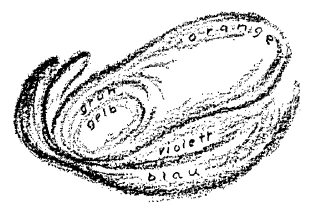
[ 32 ] Nehmen Sie an, ich habe ein anderes Kind, bei dem ich sehe, daß die Vorstellungen gar nicht im Kopfe stocken, sondern daß sie gewissermaßen durch den Kopf wie durch ein Sieb durchsickern und alles in den Leib hineingeht, daß das Kind nicht fassen kann, weil sein Kopf ein Sieb ist. Er hat Löcher, er ist durchlässig. Es sickert alles hinunter. Das muß man eben empfinden, daß das beim Kind so ist, daß das Zirkulationssystem des anderen Organismus alles in sich hereinsaugen will. Dann kommt man eben instinktiv, intuitiv dazu, dem Kinde die Anleitung zu geben zu etwas, das nun etwas ganz anderes ist. Bei einem solchen Kinde werden Sie etwa folgendes auf dem Papier sehen (es wird gezeichnet): Da werden Sie sehen, wie weniger die Farben ineinander sich gestalten, rund; Sie werden mehr sehen, daß die Farben in die Länge gehen, daß das Farbige in das Zeichnerische übergeht, daß Schlingen eintreten, die auf das Zeichnen hinweisen. Sie werden auch sehen, daß die Farben nicht sehr differenziert sind; hier (bei der ersten Zeichnung) sind sie stark differenziert; hier, bei der zweiten Zeichnung, sind sie weniger differenziert.
[ 32 ] Suppose I have another child in whom I see that mental images do not at all get stuck in the head, but rather seep through the head, as it were, like through a sieve, and everything goes into the body—things the child cannot grasp because its head is a sieve. It has holes; it is permeable. Everything seeps right through. You simply have to sense that this is how it is with the child—that the circulatory system of the other organism wants to draw everything into itself. Then you instinctively, intuitively come to the point of guiding the child toward something that is now something entirely different. With such a child, you will see something like the following on the paper (as it is drawn): You will see that the colors blend into one another less, in a rounded way; you will see more that the colors extend lengthwise, that the colored elements give way to the drawn elements, and that loops appear that point toward drawing. You will also see that the colors are not very differentiated; here (in the first drawing) they are strongly differentiated; here, in the second drawing, they are less differentiated.
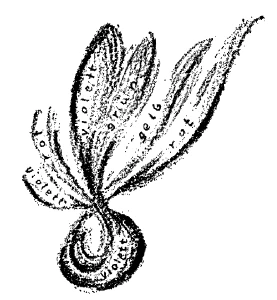
[ 33 ] Wenn man das dann ausführt mit wirklichen Farben — nicht mit dem ekelhaften Material der Kreide, was das Ganze nicht wiedergeben kann -, dann wird man gerade von diesem Erleben des rein Farbigen auf der einen Seite und des formhaften Farbigen auf der anderen Seite wohltätig heilend zurückwirken auf diejenigen Eigenschaften des Kindes, von denen ich gesprochen habe.
[ 33 ] If one then carries this out using real colors—not that disgusting chalk, which cannot render the whole thing—then this very experience of pure color on the one hand and form-filled color on the other will have a beneficial, healing effect on those qualities in the child that I have spoken of.
[ 34 ] Ebenso werden Sie, wenn Sie, sagen wir, einen Knaben oder ein Mädchen haben, das die Vorstellung stocken hat im Kopfe, das sie nicht hinunterbringt, mit diesem Knaben oder mit diesem Mädchen mit anderen Absichten in die Turnhalle gehen, als mit einem Kinde, das den Kopf wie ein Sieb hat, wo alles hinuntergeht in den übrigen Körper und in die Zirkulation des übrigen Körpers hinein. Sie gehen mit den beiden Kindergruppen in die Turnhalle. Die einen Kinder, bei denen alles wie ein Sieb ist, alles hinuntergeht, die lassen Sie so turnen, daß sie abwechselnd die Turnbewegungen machen und dann etwas rezitieren oder singen. Die andere Turngruppe, wo alles in dem Kopfe stockt, die lassen Sie möglichst so die Bewegungen machen, daß die Kinder schweigen müssen dabei. Und so können Sie ganz aus der Natur des Kindes heraus den Übergang bilden zwischen der körperlichen Erziehung und der seelischen Eigentümlichkeit. Sie müssen in anderer Weise turnen lassen ein Kind, das stockende Vorstellungen hat und in anderer Weise ein Kind, das Vorstellungen hat, die wie ein Sieb durch den Kopf durchgehen.
[ 34 ] Similarly, if you have, say, a boy or a girl whose mental image is slow to grasp concepts—who can’t process them—you’ll take that boy or girl to the gym with different intentions than you would a child whose mental image is like a sieve, where everything flows down into the rest of the body and into the body’s circulatory system. You take both groups of children to the gym. The first group, whose minds are like a sieve—where everything flows through—you have them exercise by alternating between performing the gymnastic movements and then reciting or singing something. The other group, where everything gets stuck in their heads, you have them perform the movements in such a way that the children must remain silent while doing them. And in this way, you can create a transition—based entirely on the child’s nature—between physical education and their psychological disposition. You must have a child with stagnant mental images exercise in one way, and a child whose mental images pass through their head like water through a sieve exercise in another way.
[ 35 ] Das ist dasjenige, woran man sieht, wie ungeheuer bedeutungsvoll es ist, den Unterricht als Ganzes gestalten zu können. Es ist etwas Furchtbares, wenn auf der einen Seite in der Klasse der Lehrer den Unterricht erteilt, und dann die Kinder in die Turnschule geschickt werden. Der Turnlehrer weiß gar nichts von dem, was in der Klasse vor sich geht, und er hält nun nach einem Schema den Turnunterricht. Der Turnunterricht muß ganz und gar ein Ergebnis desjenigen sein, was man mit den Kindern in der Klasse erfahren hat. So daß eben in der Waldorfschule angestrebt wird, möglichst, soweit es geht, bis in die Nebenfächer in den unteren Klassen alles, wenigstens all dasjenige, was zur Menschenbildung führen soll, nur einer Lehrkraft zu übergeben.
[ 35 ] This is precisely what shows just how incredibly important it is to be able to structure the lesson as a whole. It is terrible when, on the one hand, the teacher is teaching the class, and then the children are sent off to gym class. The physical education teacher knows nothing at all about what is going on in the classroom, and so he conducts the physical education lesson according to a set routine. Physical education must be entirely a result of what has been experienced with the children in the classroom. Thus, in the Waldorf school, the aim is, as far as possible—even extending to the supplementary subjects in the lower grades—to entrust everything, at least all that is intended to contribute to the development of the whole person, to a single teacher.
[ 36 ] Dadurch wird gerade eben in bezug auf das Artistische allerdings von dieser Lehrkraft das Höchste gefordert, und auch die willigste, liebevollste Hingabe gefordert. Aber man erreicht auf eine andere Weise kein Heilsames für die Menschheitsentwickelung.
[ 36 ] This, however, demands the very highest from this teacher—especially in terms of artistic ability—as well as the most willing and loving dedication. But there is no other way to achieve what is beneficial for the development of humanity.
[ 37 ] Nun, meine sehr verehrten Anwesenden, ich werde nun in den nächsten Vorträgen – einerseits, um jene Bewegungskunst, die gerade mit dem ganzen Menschen zusammenhängt, um die Eurythmie noch verständlicher zu machen –, Ihnen vorzuführen haben plastische, malerische Figuren, die wir ausgeführt haben in dem Atelier in Dornach, um im Farbigen und im Formhaften die Eurythmie vorzuführen. Ich werde auf der einen Seite diese Figuren vorführen, die also das innere Wesen, das künstlerische Wesen der Eurythmie zeigen sollen, und ich werde auf der anderen Seiten dann Ihnen morgen auch vorführen dasjenige, was an solcher Malerei und anderem Künstlerischen die kleinen und die größeren Kinder unserer Waldorfschule leisten.
[ 37 ] Well, my dear friends, in the upcoming lectures—on the one hand, to make eurythmy, that art of movement so closely connected to the whole human being, even more understandable—I will be presenting to you sculptural and painterly figures that we have created in the studio in Dornach, in order to demonstrate eurythmy through color and form. On the one hand, I will present these figures, which are intended to reveal the inner essence—the artistic essence—of eurythmy; and on the other hand, tomorrow I will also show you the work that the younger and older children of our Waldorf School have produced in painting and other artistic endeavors.