

Fundamental Spiritual and Soul Forces
in the Art of Education
Spiritual Values in Education and Social Life
GA 305
22 August 1922, Oxford
Translated by Steiner Online Library
6. Educating Young Children: The Teacher as an Educator II
[ 1 ] Just how essential it is to understand the whole person in order to provide a proper education and instruction becomes particularly evident when one observes the development that boys and girls undergo between the ages of 11 and 12. Usually, people observe—I would say—only the more obvious transformation, the more obvious metamorphosis of human nature, and they have no eye for the more subtle changes. For this reason, people believe they are doing the child a favor by simply thinking: What kinds of physical exercises must the child do to become physically strong? Precisely in order to make the child physically strong, vigorous, and uninhibited, one must, during childhood, discover the body through the detour of the soul and the spirit.
[ 2 ] Between the ages of 11 and 12, a major inner transformation takes place within a person. The rhythmic system—the respiratory and circulatory systems—is the governing, dominant force between the change of teeth and sexual maturity. As the child approaches the age of 10, what governs the respiratory and circulatory systems—the beat and rhythm within them—begins to develop into the muscular system. The muscles are supplied by the blood, and the blood vibrates into the muscles in a way that reflects the person’s inner nature. Thus, between the ages of 9 and 11, a person develops their muscular system in accordance with their inner rhythmic predispositions. As the 11th and 12th years approach, what is present in the rhythmic system and the muscular system radiates into the bony system, into the entire skeleton. Until the age of 11, the skeleton is fully integrated into the muscular system. It follows the muscular system. Between the ages of 11 and 12, the skeleton develops in such a way that it adapts to the external world; mechanics and dynamics independent of the human being enter into the skeleton. We must learn to treat the skeleton as if it were an objective entity, completely separate from the human being.
[ 3 ] If you observe children under the age of 11, you will see that all their movements still come from within. If you observe children after the age of 12, you will notice that they step in such a way that they are always trying to find their balance—that they internally sense the lever-like balance, the mechanical aspect of the skeletal system. This means that between the ages of 11 and 12, the spiritual-soul aspect extends into the skeletal system. Before this, the spiritual-soul aspect is much more inwardly focused. Only afterward does the human being achieve complete adaptation to the external world by grasping that which they experience as the least human—the skeletal system.
[ 4 ] It is only now that a person truly becomes a child of the world. Only now must they take into account the mechanics and dynamics of the world. Only now do they experience inwardly what is called causality in life. In reality, before the age of 11, a person has no understanding of cause and effect at all. They hear the words. We believe that a person has an understanding of it. But they do not, because they control their skeletal system through their muscular system. Later, after the age of 12, the skeletal system—which projects itself into the external world—controls the muscular system and, from there, the mind and soul. And the result of this is that a person now gains an inner, experiential understanding of cause and effect, of force, and of what is felt as vertical, what is felt as horizontal, and so on.
[ 5 ] You see, this is why, if we teach a child mineralogy, physics, chemistry, and mechanics in a form that is too intellectual before the age of 11, we harm the child’s development, because the child cannot yet experience the mechanical and the dynamic aspects as part of their whole being. Nor can the child, before the age of 11, fully grasp the causal relationships found in history.
[ 6 ] You see, this sheds light on how to treat children before their skeletal system has awakened spiritually. As long as the child, through its blood system, still lives within its muscular system, it can experience history inwardly; it can experience inwardly—when we teach it a complete historical picture that it likes or dislikes, toward which it can feel sympathy or antipathy—when we teach it a picture of the Earth, as I described yesterday. It can grasp everything that constitutes the plant world as an image because the muscular system is malleable and internally flexible; when we teach it what I have said about the animal world—how it lives within the human being—the child feels it deeply because the muscular system is supple. If we teach a child before the age of 11 the principle of the lever or the principle of the steam engine, the child cannot experience any of this inwardly, because it does not yet possess dynamics or mechanics within its body. If we begin at the right time with physics, mechanics, and dynamics around the 11th and 12th years, we present the child with a mental image that enters their mind, and from within the human being comes what the child experiences through their skeletal system. And what we tell the child connects with what wants to emerge from the child’s body. In this way, an understanding of the soul emerges that is not abstract or intellectualistic, but rather alive. This is what we must strive for.
[ 7 ] But what kind of teacher must one be if one wants to strive for something like this? Just consider: if the teacher knows from anatomy and physiology that the muscle is located here and the bone there; the nerve cells look like this and that—it’s all very nice, but it’s intellectualistic; all of this places the child beside us, so that the child is, as it were, opaque. The child is like black coal, so opaque. We know what muscles and nerves are inside; we know all that. But we do not know how the circulatory system interacts with the muscular system and the skeletal system. To understand this, our conception of the human form—of the inner structure of the human being—must be an artistic one. And the teacher must be able to experience the child artistically, as an artist. Everything within the child must be inwardly dynamic to the teacher.
[ 8 ] Philosophy will come along and say: Yes, but if one wants to understand something, then the matter must simply be logical. Quite right, but just as a work of art must be logical when we have the world before us, and the world can be represented internally through artistic perception. So we must simply resign ourselves to such artistic perception; we must not dogmatically dictate: “The world must be grasped solely through logic.” Only if the teacher possesses such inner flexibility in his own sensations, mental images, and feelings that he realizes: If I teach the child dynamic, mechanical mental images before the age of 11, these mental images will stagnate in the brain, they will accumulate there, and they will harden the brain, so that later, in adolescence, this leads to migraines and, even later, to a permanent hardening. If I teach the child fixed historical mental images before the age of 11, if I teach the child images from the landscape and plant world, then these mental images enter the brain but also flow through the rest of the nervous system into the entire body. They connect with the whole body, with the soft muscular system. I lovingly build up what is happening within the child. The “lump of coal” that the child otherwise is—when one knows only dead anatomy and physiology—becomes transparent in this way. The teacher sees everywhere what is sitting in the desks before him, what is going on within each individual child. He does not need to reflect on this or that didactic principle; rather, the child tells him himself what needs to happen to him by sinking back into his chair when something is done that is not suited to the child: he becomes inattentive. If something is done that is suited to the child, he comes alive.
[ 9 ] Admittedly, it can sometimes be quite a challenge to manage the children’s liveliness. But you can manage it if you have a bit of what is less appreciated in the world today: humor. The teacher must bring humor into the classroom through the classroom door. After all, children can get quite unruly at times. One of our teachers at the Waldorf School experienced this firsthand with his older students, who were past the age of 12, when they suddenly began to lose interest in class and started writing letters to each other under their desks. Well, isn’t it true that a teacher who lacks humor becomes grumpy? There would be a terrible scene. What did our teacher at the Waldorf School do? He went over to the children and explained—the postal system. And the children saw that he understood them. He addressed their letter-writing to one another. They felt a slight sense of shame, and the situation was resolved.
[ 10 ] The point is that one cannot truly master art—and especially the art of working with people—without humor. This means that the art of teaching also consists in ridding the teaching staff of their grumpiness and developing a strong sense of friendliness—a humorous, lighthearted love for the children—so that the children do not see in the teacher the very image of what he is actually forbidding them to do. In any case, it must not happen in the classroom that, when a child becomes angry and expresses that anger, the teacher goes up and says, “I’m going to drive that anger out of you!” That is a terrible thing! — And he takes the inkwell and throws it on the floor so that it shatters. That does not drive the anger out of the child; only when one can show the child that his anger is an object, that it is not really directed at him, that one takes it with humor—only then does one truly educate him.
[ 11 ] I began by describing how human beings, in general, must be understood by those who teach and educate them. But human beings are not merely that in general. And even if one can understand a human being so precisely that he becomes transparent to us—down to the activity of the muscular system before the age of 11 and the skeletal system after the age of 12—there still remains what is, after all, extraordinarily necessary for an education and instruction conceived in artistic terms: the individuality of the human being. Every child is a unique being, and proceeding as I have described so far can only be the very first step toward an artistically perceptive understanding of the child.
[ 12 ] One must be able to delve deeper and deeper into the personal, into the individual. A starting point for this is the fact that the children entrusted to us for education and instruction differ in temperament. Gaining a true, inner understanding of the temperaments is something that, within the art of education I am speaking of here—and which is practiced in the Waldorf school—has been of the utmost importance from the very beginning.
[ 13 ] First, we have the melancholic child—a distinct type of person. How does this child present itself to us? Outwardly, it initially appears as a quiet, withdrawn child. But this outward characteristic does not tell us much. We can only truly understand a child with melancholic tendencies when we see how, in the melancholic child in particular, purely physical bodily sensations exert the strongest influence; when we realize that melancholy stems from the accumulation of significant salt deposits in the organism, so that the child with melancholic tendencies feels a heaviness throughout their entire physical being. It is quite different for a melancholic child than for any other when asked to lift just one leg or one arm. There are obstacles, inhibitions to lifting the leg or the arm. It is a feeling of heaviness that stands in the way of the soul’s intention. This gradually leads the child with a melancholic disposition to turn inward rather than look outwards with friendliness, because their body makes itself so strongly felt, because they have so much to deal with regarding their body. Only when we understand how the soul—which longs to rise—and the spirit—which longs for the open—are weighed down in a melancholic child by the physical deposits that continually flow from the glands, burdening the body and permeating the rest of the bodily tissue, only when we truly understand this growing heaviness and the resulting capture of attention by the physical, only then can we truly reach the melancholic child.
[ 14 ] It is very often said: Well, the melancholic child broods inwardly, is quiet, and moves very little. And we encourage the child to take in mental images that are, in fact, quite lively. We want to cure them with their opposite. We want to deal with the melancholic child by cheering them up with all sorts of funny things we introduce to them. That is completely the wrong method. It doesn’t help the melancholic child at all.
[ 15 ] We must be able to approach the child—with compassion and empathy for the child’s physical struggles—exactly as the child is. We must try, especially with the melancholic child, not to introduce funny or comical mental images, but rather serious ones—those that the child draws from within itself. We must teach the child many things that resonate with its own heavy constitution.
[ 16 ] Then, however, we will have to be patient with this kind of education; for it does not take effect overnight, but works over the course of years. It works in such a way that when the child is presented from the outside with what it already possesses within itself, it absorbs healing forces within itself in response. If we present the child with something completely foreign from the outside—if we present the serious child with something playful—the child remains indifferent to the playful element. But if we present the child with its own sadness, grief, and worry, then it perceives from the outside what it already has within itself. This evokes a reaction—the opposite—within the child, and we heal pedagogically by following, in a modern form, the old golden principle: Like is not only recognized by like, but like is also properly treated and healed by like.
[ 17 ] But then, if the child has a more phlegmatic temperament, we must be clear about this: this child, who has a more phlegmatic temperament, lives less in his physical body and more in what I have been calling the etheric body these days—the body that is more ephemeral. It lives in the etheric. It sounds strange to say of the phlegmatic child: “It lives in the etheric,” but that is how it is. The etheric prevents what takes place in the human organic functions—digestion, growth—from reaching the head. The phlegmatic child has no control over forming mental images of what is happening within its body. The head becomes inactive. The body becomes more and more active through the fleeting element that seeks to scatter its functions throughout the world. The phlegmatic child is completely devoted to the world. It is absorbed in the world. It lives little within itself. As a result, it shows us a certain indifference toward what we want to do with it. We cannot reach the child because, after all, we must ultimately approach it through the senses. The most important senses are in the head. The phlegmatic child has little use for its head. The rest of the organism is kept functioning by the outside world.
[ 18 ] We can only help the phlegmatic child if, just as with the melancholic child, we ourselves become a sort of phlegmatic person alongside him, if we are able to artistically put ourselves in his phlegmatic frame of mind. Then the child has what it is itself right beside it, and eventually what it has there beside it becomes too boring for it. Even the phlegmatic child finds this too boring when he has a phlegmatic teacher beside him! And if we are patient once more, we will notice that something is sparked when we also demonstrate to the phlegmatic child mental images and processes steeped in phlegm.
[ 19 ] The sanguine child is particularly difficult to deal with. The sanguine child is one in whom the rhythmic organism is especially dominant. The rhythmic organism—which is, in fact, the dominant force in human beings between the change of teeth and sexual maturity—assumes too great a sway, too great a dominance in the sanguine child. For this reason, the sanguine child wants to rush from one impression to the next. Its blood circulation slows down if the impressions do not change quickly. It feels internally constrained if the impressions do not pass quickly and are not replaced by others. And so one can say: The sanguine child feels an inner sense of constriction when it is expected to focus its attention on something for a long time; it feels that it cannot stay with it, turns away, and its thoughts wander. It is difficult to keep its attention focused.
[ 20 ] Once again, I must say something similar regarding the treatment of the sanguine child: One should not attempt to cure the sanguine child by forcing it to dwell on a single impression for a long time, but rather do the opposite. Accommodate the sanguine temperament by varying the impressions quite sharply, and actually force the child to take in impressions in rapid succession. Once again, it is the reaction that comes into play. Then, because the circulatory system is so dominant, it cannot help but express itself in antipathy toward the accelerated impressions. And the result of this is that the child itself begins to slow down.
[ 21 ] The choleric child must be treated in yet another way. The choleric child has the peculiarity of always lagging slightly behind normal human development. This may seem strange. But consider the following example. An eight- or nine-year-old child, like a normal person, has a certain way of moving their limbs—fast or slow—depending on external impressions. Compare the eight- or nine-year-old child with the three- or four-year-old child. The three- or four-year-old child still prances through life, having much less control over their movements. There is still something about them that resembles a very young child. That child has no control over its movements at all, fidgets constantly, and has not yet developed its soul. But if infants had a highly developed soul, you would find them all to be choleric. Infants, with their fidgeting—especially when they are healthy, they fidget a lot—are all choleric.
[ 22 ] The choleric child, however, retains something of the wild, frenzied behavior of the very young child. As a result, the little infant continues to live on inside the choleric child—the eight- or nine-year-old boy or girl. This is why this child is choleric, and one must try to treat this choleric child by gradually calming the “little child” within.
[ 23 ] This must be handled with particular—I would say—a sense of humor. Because when you’re dealing with a real hothead—whether they’re 8, 9, or 10 years old, or even later in life—you won’t get through to them by lecturing them; it simply doesn’t make any impression when you lecture them. But if I get him to tell me a story—one that I first narrate myself—and he then has to act out the story for me in a rather hot-tempered way, miming the characters and really getting into the role of his little characters, then he gradually learns to calm that little person within himself. He brings him into harmony with his own inner life. And by becoming emotionally angry myself alongside the angry child—but, of course, while always maintaining a sense of humor and keeping myself under control—I will succeed in calming the angry child beside me. When the teacher begins to dance—but please don’t take this in a negative sense—the child’s outburst beside him gradually subsides. One simply needs the ability not to lose one’s temper with a choleric child, not to let one’s temper get the better of one, but to enter into a kind of artistic empathy with this inner turmoil. You will see that the child becomes quieter and quieter. It completely subsides the inner turmoil.
[ 24 ] But there must be something natural in it. If there is something contrived or inartistic in what the teacher gives the child, then the whole endeavor will simply not succeed. The teacher must truly have the spirit of an artist within him so that what he demonstrates to the child, he can bring to life for the child in a credible way; otherwise, it is insincere on the teacher’s part, and that must not be the case. The relationship between the teacher and the child must be genuine through and through.
[ 25 ] You see, one can also maintain a certain order in the class—even if it has to be somewhat large—simply by taking the temperaments into account. The Waldorf teacher studies the temperaments of the children entrusted to him. Now he knows: I have the melancholics, the phlegmatics, the sanguine types, and the choleric types. He groups the melancholics together—if possible, quite unobtrusively, without anyone noticing, of course. He knows he has them in this one corner. Then he groups the choleric types together; he knows he has them in that corner, and so on with the sanguine types and the phlegmatics. Through this kind of social interaction, the temperaments wear each other down in the company of their own kind. The melancholic, in fact, becomes cheerful when sitting among other melancholics. And the choleric types—well, they heal themselves thoroughly, for it is best of all to let the raging choleric types take it out on one another. Once they’ve given each other a few bruises, it has an incredibly calming effect. So that what I might call the mysterious force that works from person to person can be steered into a healing course precisely through the right kind of social interaction.
[ 26 ] And if you even have the sense of humor to send a boy—when he becomes particularly hot-tempered and agitated—out to the school garden, and watch as he climbs up and down the trees until he finally becomes utterly exhausted—when he comes back inside, he will have worked off his hot temper on himself, through his interaction with nature. Once he has worked off his energy by overcoming these obstacles, he returns, calmed down, after a while.
[ 27 ] So, you see, the point is that we are now increasingly finding a way to look beyond the temperaments and penetrate deep into the child’s individuality, into their personality. Today, many people say that education must be individualized. Yes, but first you have to find the individual. First you have to know the person; then you have to know the melancholic. The melancholic is never a pure melancholic—the temperaments are always mixed. One temperament is dominant. But only when you truly understand the individual temperament can you find your way into the child’s individuality.
[ 28 ] This really does show that the art of education is something that must be learned in an intimate way. People today—and I’ve never heard of this—don’t go around criticizing a clock, asking how a clock should function internally. Why? Because they don’t know; because they don’t know how the clock works on the inside. You rarely hear criticism of a watch’s timekeeping in everyday conversation. Criticism of education—you hear it everywhere. But it’s just as often as when people talk about a clockwork mechanism they know nothing about. People simply don’t realize that education, too, must be learned intimately, and that it’s not enough to say, in abstract terms, “one must educate the individual.” One must first be able to discover individuality by taking the intimate path through an understanding of human nature, through an understanding of character and temperament. Only then does one gradually approach what is truly individual in a person. This must become a guiding principle in life, especially for the artistically inclined teacher and educator.
[ 29 ] It is absolutely essential that the interaction between the teacher and the child be thoroughly imbued with an artistic element. As a result, much of what the teacher must do in relation to the child’s individuality at any given moment will take on a kind of intuitive, instinctive character. To clarify this, let’s consider the matter as concretely as possible. Let’s imagine we have a child before us who presents educational challenges because we notice that the concepts we present to him, the feelings we seek to evoke, and the mental images we wish to convey to him, they cause such intense circulation and such strong nervous excitation in the head that, in a sense, what I am teaching the child cannot pass from the head to the rest of the organism. The physical organization of the head becomes, so to speak, partially melancholic. The child has difficulty directing what it sees, what it feels, and even what is imparted to it through other impulses, from the head to the rest of its organism. What has been learned, so to speak, gets stuck in the head. It cannot penetrate down into the rest of the organism. If one teaches the child with an artistic sensibility, then one will quite instinctively adapt everything that is artistic in education and instruction accordingly. If I have such a child before me, I will teach him or her to work with color—the painterly element—in a completely different way than I would with another child. And because this is so important, we take the painterly element into account from the very beginning at the Waldorf School. I have already explained how writing itself is derived from the painterly; but within this painterly aspect, one can in turn individualize the approach from child to child. For there one has the very opportunity to individualize, precisely because the child must do everything on their own.
[ 30 ] Now let’s suppose I have before me a child just like the one I’ve just described. I am teaching art. If there is a genuine artistic connection between teacher and student, something different will emerge on the sheet of paper where the child is working with the paints—under my guidance—than would be the case with another child.
[ 31 ] I’d like to sketch out on the board, in a rough diagram, what must appear on the sheet of paper on which such a child—whose sensations and mental images, so to speak, are stuck in their head—is drawing. Something like this must emerge: there will be a spot of color like this (yellow), then further on there will be another spot of color like this (purple), because the harmony of the colors is what matters. Then there will be a transition (orange); the transition will be spread out even further, and the whole thing will perhaps, in order to have a closing edge on the outside, end outwardly something like this (blue). This is what it will look like on the sheet of paper for a child whose mental images, so to speak, are stuck in their head.
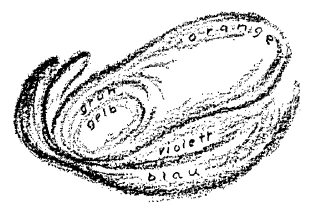
[ 32 ] Suppose I have another child in whom I see that mental images do not at all get stuck in the head, but rather seep through the head, as it were, like through a sieve, and everything goes into the body—things the child cannot grasp because its head is a sieve. It has holes; it is permeable. Everything seeps right through. You simply have to sense that this is how it is with the child—that the circulatory system of the other organism wants to draw everything into itself. Then you instinctively, intuitively come to the point of guiding the child toward something that is now something entirely different. With such a child, you will see something like the following on the paper (as it is drawn): You will see that the colors blend into one another less, in a rounded way; you will see more that the colors extend lengthwise, that the colored elements give way to the drawn elements, and that loops appear that point toward drawing. You will also see that the colors are not very differentiated; here (in the first drawing) they are strongly differentiated; here, in the second drawing, they are less differentiated.
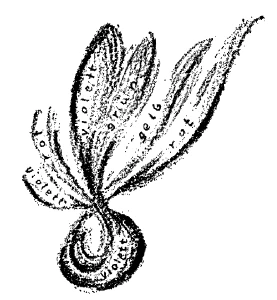
[ 33 ] If one then carries this out using real colors—not that disgusting chalk, which cannot render the whole thing—then this very experience of pure color on the one hand and form-filled color on the other will have a beneficial, healing effect on those qualities in the child that I have spoken of.
[ 34 ] Similarly, if you have, say, a boy or a girl whose mental image is slow to grasp concepts—who can’t process them—you’ll take that boy or girl to the gym with different intentions than you would a child whose mental image is like a sieve, where everything flows down into the rest of the body and into the body’s circulatory system. You take both groups of children to the gym. The first group, whose minds are like a sieve—where everything flows through—you have them exercise by alternating between performing the gymnastic movements and then reciting or singing something. The other group, where everything gets stuck in their heads, you have them perform the movements in such a way that the children must remain silent while doing them. And in this way, you can create a transition—based entirely on the child’s nature—between physical education and their psychological disposition. You must have a child with stagnant mental images exercise in one way, and a child whose mental images pass through their head like water through a sieve exercise in another way.
[ 35 ] This is precisely what shows just how incredibly important it is to be able to structure the lesson as a whole. It is terrible when, on the one hand, the teacher is teaching the class, and then the children are sent off to gym class. The physical education teacher knows nothing at all about what is going on in the classroom, and so he conducts the physical education lesson according to a set routine. Physical education must be entirely a result of what has been experienced with the children in the classroom. Thus, in the Waldorf school, the aim is, as far as possible—even extending to the supplementary subjects in the lower grades—to entrust everything, at least all that is intended to contribute to the development of the whole person, to a single teacher.
[ 36 ] This, however, demands the very highest from this teacher—especially in terms of artistic ability—as well as the most willing and loving dedication. But there is no other way to achieve what is beneficial for the development of humanity.
[ 37 ] Well, my dear friends, in the upcoming lectures—on the one hand, to make eurythmy, that art of movement so closely connected to the whole human being, even more understandable—I will be presenting to you sculptural and painterly figures that we have created in the studio in Dornach, in order to demonstrate eurythmy through color and form. On the one hand, I will present these figures, which are intended to reveal the inner essence—the artistic essence—of eurythmy; and on the other hand, tomorrow I will also show you the work that the younger and older children of our Waldorf School have produced in painting and other artistic endeavors.