

Fundamental Spiritual and Soul Forces
in the Art of Education
Spiritual Values in Education and Social Life
GA 305
21 August 1922, Oxford
Translated by Steiner Online Library
5. The Education of Young Children: The Teacher as an Educator I
[ 1 ] Just as a child’s teeth gradually fall out and are replaced around the age of 7, so too—to an even greater degree—does the major transformation in the physical, emotional, and spiritual organism that I have discussed in this presentation. And therefore, in education and instruction, it must also be taken into account that the child gradually transforms from an imitative being into one who develops in accordance with the authority of the educator or teacher. For this reason, there must not be an abrupt transition in the way the child is treated around the age of 7—that is, at the age when the child enters elementary school for education. What is said here further on regarding the beginning of education in elementary school must be understood in this sense.
[ 2 ] In the art of education discussed here, everything should be geared toward nurturing, as it develops, the innate potential within the child. Therefore, all instruction must be placed at the service of education. In essence, one educates, and instruction is, so to speak, used as a means to educate.
[ 3 ] The educational principle advocated here requires that the child develop the proper sense of direction in life at the appropriate age. However, this is only possible in a satisfactory manner if the child is not, from the outset, led to engage in activities that are unnatural to him or her.
[ 4 ] However, in a certain sense, it is quite unnatural in this day and age—at this advanced stage of human civilization—to immediately require a child in his or her sixth or seventh year of life to imitate the conventional forms of reading and writing.
[ 5 ] When one considers the letters we use today for reading and writing, one must conclude that there is no connection between what a child, driven by his or her natural inclination, wants to create at the age of seven and these letters. Consider that when humanity first began to write, it used pictorial symbols that imitated an object or an event in the external world; or writing was done out of volition, such that the written forms expressed volitional processes, as in cuneiform, for example. It was only from what emerged as pictographic writing that the entirely abstract letter forms developed—the ones that catch the eye today or that take shape as they flow from the writing hand.
[ 6 ] If we teach these letters to a very young child, we are imposing something completely foreign on them, something that does not correspond at all to their nature. But we must be clear about what it means when we simply force something foreign into the child, into the child’s entire organism. It is as if we were to accustom the child at an early age to wearing clothes that are far too tight, that do not fit, and that then ruin the child’s organism. Today, when people—I would say—observe only superficially, they simply do not realize what inhibitions will arise in the child’s own organism later in life, simply because the child was approached in the wrong way when it came to reading and writing.
[ 7 ] The art of education, based on an understanding of human nature, proceeds in such a way that it truly brings out everything in the child; it does not merely say that the child’s individuality should be developed, but actually does so. This is achieved by not starting with reading at all. The child also begins with fidgeting and expressions of will, not with looking. Looking comes only later. And so it is necessary not to start with reading, but with writing—though writing must be approached in such a way that it emerges naturally from the child’s entire being. That is why we begin with writing instruction, not reading instruction, and gradually guide the child toward writing through what the child itself wishes to develop through imitation—using its own will and hands.
[ 8 ] I’d like to illustrate this with an example. Imagine we prompt the child to say the word “fish,” and as we prompt the child to say the word, we try to bring the shape of the fish to the child’s mind using very simple lines, something like this (a drawing is made), so that we sketch something for the child in a simple way that imitates the shape of the fish, and then we also try to have the child copy it. And then we lead the child to perceive the letter “F” from the word “fish.” From “fish” we move on to “F,” and the shape of the fish gives us the opportunity to gradually form the letter “F.” So we allow the letter form to emerge artistically from what passes from perception into the will.
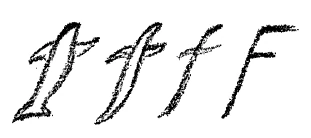
[ 9 ] In this way, we do not introduce an external “F”; that would be a demon to the child—something completely foreign forced into its body. Instead, we draw out from the child what it has seen at the market. We gradually transform that into the “F.”
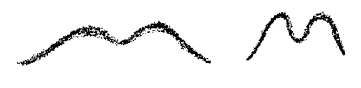
[ 10 ] This brings us close to the origins of writing, for writing, too, arose in a similar way. But it is not necessary for the teacher to engage in antiquarian studies and, as it were, repeat the story of how pictographic writing came into being in order to teach this to the child. What matters is to give free rein to a lively imagination and to allow what leads from the object, from immediate life, into the shapes of the letters to emerge even today. You will have every possible opportunity there to derive letter shapes for the child from life itself. Let the child say “M,” let them feel how the “M” vibrates on their lips, and then try to teach them the shape of the lips as a form; then you will be able to move gradually from the “M” that vibrates on the lips to the written letter “M.” And so, if you try to proceed not in an intellectualistic way but spiritually and imaginatively, you will be able to draw out of the child everything that gradually leads to the child learning to write. The child learns to write more slowly than is often the case today. But when parents come and say, “My child is eight or nine years old and still can’t write very well!”—we must always tell them: Everything that is learned more slowly at a certain age becomes more firmly and healthily integrated into the child’s organism than what is forced upon them.
[ 11 ] It is important to note that this approach also allows the teacher’s individuality to come to the fore. Since we already have many students at the Waldorf School, we’ve had to establish parallel classes; we have two first-grade classes, two second-grade classes, and so on. If you visit one of the first-grade classes, you can see how writing instruction is derived from painting and drawing; you can observe how the teacher approaches this in a particular way. Let’s say, in one class you find that it is done exactly as has just been demonstrated here. You go into the other class, first-grade class B; you find a different teacher; the same lesson is being taught there, but you see something entirely different. You see that there the teacher has the children running around in a kind of eurythmic movement, allowing the form to emerge from their own bodily movement. And whatever the child traces out is then fixed as a letter. And in this way, a third method, a fourth method, and so on are possible. You can see the same lesson being taught in very different ways in the various parallel classes. Why? Well, because it matters whether one teacher with this “temperament” and another teacher with a different temperament are teaching the lesson. Only when there is the right connection between the teacher and the entire class can the lesson be beneficial. Therefore, every teacher must teach in a way that suits them. But just as life can take on the most diverse forms, so too can a lesson—an education based on life—take on the most diverse forms.
[ 12 ] When you establish educational principles, you expect them to be followed. You write them down in a book. And a good teacher is one who follows these principles: 1, 2, 3, and so on. Well, I am completely convinced that if 12 people—or any number of people—were to get together today—people today are all incredibly smart and clever—they would come up with the most wonderful program for what should happen in education: 1, 2, 3, and so on. I’m not being sarcastic; I really mean it. You can come up with the most wonderful ideas in abstract principles. But whether you can actually put what you’ve come up with into practice is an entirely different question. That’s where life comes into play. And when it comes to life—I ask you: there is life within all of you; you are all human beings, yet you all look different. No two people are exactly alike. Life manifests itself in the most diverse forms. Everyone has a different face. When you establish abstract principles, you walk into a classroom, and you’d like to see the same thing done everywhere. When one establishes principles based on life itself, one knows how diverse life is, how each individual manifests itself in the most varied ways. For we must regard even Black people as human beings, and in them, after all, the human form is realized in a completely different way than in us, for example. And so the point is that every kind of pedantry, but also every kind of schematism, must be kept at bay if the art of education is to be understood as something living—a concept supported precisely by the fact that the art of education is made into a true art, and the teacher is made into an artist. Thus, in the Waldorf school, we are in a position to teach writing through artistic means. Then reading can be learned almost effortlessly afterward. It comes a little later than usual, but it can be learned almost effortlessly.
[ 13 ] Once we are fully immersed in this—and in the coming days I will have some of our children’s paintings from the Waldorf School to show—once we are so deeply engaged in introducing the visual arts to the child, our task is then to incorporate the musical element into the curriculum as early as possible. For the musical element—especially when the focus is less on the content of the music and more on rhythm and meter, and on developing a feel for rhythm and meter—provides a good foundation for strength and for the energy of the will, particularly if it is cultivated in the right way right from the start of elementary school. And as I mentioned in the introduction to the eurythmy demonstration, we also introduce eurythmy into children’s education. I will speak more about this—specifically about eurythmy in the classroom—in a later lecture. For now, I would like to illustrate in more detail how the first lessons are drawn out as education in an artistic way, from the very nature of the human being.
[ 14 ] We must take into account that, during the early phase of this stage of life—between the change of teeth and sexual maturity—the child is, above all, still unable to distinguish between what is inwardly human and what is outwardly the environment or nature. For the child, both of these merge into one until the age of 9 or 10. The child feels this or that inwardly. Outwardly, let us say, the child observes a phenomenon—the sun rising or something similar. The same forces that the child senses within itself when it experiences displeasure or pain, it also senses in the sun and moon, in trees and plants. We should not talk the child out of this. We should put ourselves in the child’s shoes and, in education before the age of nine, treat everything as if no boundary had yet been drawn between the inner world of the human being and the outer world of nature. We can do this only if we make our lessons as vivid as possible, if we let the plants act in a human way, let them speak to one another as humans would, if we let the sun speak to the moon, and if we infuse everything with a human quality. Today there is a genuine aversion to so-called anthropomorphism. But the child who has not experienced anthropomorphism in their relationship to the environment will lack a part of their humanity in later life, and the teacher must have a disposition to immerse themselves so vividly, spiritually, and emotionally in the entire environment that the child can fully follow along by virtue of what is already present within them.
[ 15 ] This, however, presupposes that the teacher has done an enormous amount of work before entering the classroom. The preparation required of the teacher is very demanding under the influence of the educational principle we have discussed. As a teacher, one must do as much as possible in advance in order to make the best possible use of the time spent in the classroom. This is something that even teachers learn only slowly and gradually. And it is only through this slow and gradual learning that one is able to truly take the child’s individuality into account.
[ 16 ] Perhaps I may cite a personal example to illustrate this. Before I became involved with the Waldorf School, I had, for a long time, had to deal with all sorts of educational approaches. For instance, when I was still young myself, I was once entrusted with the upbringing of a boy who, approaching his 11th year, was essentially still completely undeveloped. He hadn’t learned anything at all. As proof of what he had learned, I was given a school notebook showing what the boy had accomplished on the last exam he had been forced to take. All that could be seen in it was a large hole that he had erased with an eraser—nothing else. Moreover, the boy really did have pathological lifestyle habits. The entire family—which was not inclined to send the boy into a trade (that may be a prejudice, but such prejudices are, of course, to be expected in social life)—the entire family was unhappy. The family doctor was certain the boy would amount to nothing. Well, I was tasked with educating four children in this family. The others were normal—I was to help raise this boy as well. I said, “I’ll give it a try.” One can’t promise that this or that will happen in such a case, but everything that can be done will be done; I just need to be given complete freedom in his upbringing. Only the mother understood the freedom I was asking for, so that even the entire teaching process had to be fought for against the rest of the family, except for the mother. But I eventually got the teaching assignment. And I now needed to spend as little time as possible directly on teaching the boy. Let’s say that if I were to spend about half an hour teaching the boy, I had to prepare for three hours beforehand in order to pack as much as possible into the lesson as efficiently as possible. But I also had to calculate precisely at what time of day the music lessons, for example, would be scheduled. If the child was overworked, he would immediately turn pale, and one could see his health deteriorating. But by understanding the child’s entire pathological condition—by knowing what could be attributed to the hydrocephalus—it was possible not only to nurture the child’s emotional well-being but also to help him progress to the point where, after a year and a half—having previously been able to do nothing more than erase a large hole in his notebook—he was able to attend high school. And I was able to continue helping him through the high school grades, accompanying him almost to the very end of high school. Under the influence of this education—that is, by guiding the process spiritually—his head grew smaller. I know that a doctor might say: “His head would have grown smaller anyway.” Certainly, but as it grew smaller, the right kind of development had to take place emotionally and spiritually. The young man in question went on to become a very capable doctor. He died while serving as a doctor during the war, but only after he had nearly reached the age of 40.
[ 17 ] The particular focus there was on achieving efficiency in teaching through adequate preparation for education. Well, that must become a general principle. This is the goal of the art of education I wish to discuss here. To do this, however, it is necessary—if what is to be passed on to the child is to come alive in such a way that the whole of nature comes to life—to have first worked through everything one presents so thoroughly that one no longer struggles with the material at all, so that one can devote all one’s energy to shaping, through the power of one’s own personality, what one brings to the child. And then one will naturally come to the point where all the lesson material becomes vivid and concrete, so that the child immerses themselves in the material not merely with their intellect, but with their whole being.
[ 18 ] That is why we draw primarily on fairy-tale narratives, but also on fictional stories that relate to nature. In fact, at first we teach neither language nor any other subject; rather, we simply bring the world to life for the child through imagery. And this kind of instruction then ties in perfectly with what ultimately leads, through the power of imagery, to writing and reading.
[ 19 ] In this way, we enable the child—somewhere between the ages of 9 and 10—to express themselves in writing and to read to the extent that is beneficial for this age group, and we thereby reach that important point in the child’s life to which I have already alluded, which lies somewhere between the ages of 9 and 10.
[ 20 ] This important stage in a child’s life is also reflected in a person’s outward appearance. A remarkable difference, a remarkable differentiation, begins to emerge between boys and girls. I will have more to say about what this means in a school that has both boys and girls, as the Waldorf School does. It is important to know that a significant differentiation between boys and girls occurs. Around the age of 10, girls begin to grow relatively faster than boys. The boys lag behind in their growth. The girls outgrow the boys. Then, once the girls and boys have reached puberty, the boys begin to outgrow the girls again. They grow faster, so to speak, precisely at this age.
[ 21 ] Between the ages of 9 and 10, the outward physical differences between boys and girls already indicate that a child is entering an important stage of life. This is expressed in the fact that the child is learning to distinguish between itself and nature. Before that, there is not really a plant at all, but rather a being that is green and has red flowers, and within which there is a little spirit, just as there is a little spirit within the child itself. The plant—this being—only begins to make sense to the child around the age of 10. One must simply be able to empathize with this. Therefore, it is only toward this age that lessons should be structured in such a way that one speaks of the surroundings as if they were an external world.
[ 22 ] Then one can begin with what is usually regarded as school subjects, such as botany. But it is precisely through botany that I can illustrate how one must proceed realistically—in the best sense of the word—in structured education. If we first show a child a single plant, we are acting quite unnaturally, for that is not a whole. A plant—especially when it has been pulled up—is not a whole. In our age of realism and materialism, people have little sense of the material and natural world; otherwise, they would feel what I have just said. Is a plant a whole? No, if we have pulled it out of the ground and placed it here, it will perish very soon. It is not in its nature to be uprooted. It is only something within the soil, united with the soil. A stone is a whole in and of itself. I can place it anywhere; it remains the same. I cannot carry a plant just anywhere; it is no longer the same. It is only immediately what it is—together with the soil around its roots, with the forces sprouting from the soil, and with all the solar forces that happen to fall on this particular part of the earth—that is when the plant is a whole. To consider a plant in isolation is just as absurd as if we were to pluck out a hair and consider the hair on its own, as if it were a thing in and of itself. After all, a hair comes into being only as part of an organism and can only be understood in connection with an organism. This means that in the study of plants, one cannot start from the individual plant—and certainly not from the plant’s essence—but rather from the landscape, the geographical context, and what the earth is like in a specific place. And plants must be considered in connection with the entire earth.
[ 23 ] When we speak of the Earth, we speak as physicists—or, at most, as geologists. Let’s create a mental image: The Earth is a self-contained totality of physical forces and mineral forces, and it could exist even if there were no plants, no animals, and no humans on it at all. But that is an abstraction. The Earth that the physicist or geologist has in mind is an abstraction. It does not actually exist in reality. There is only the Earth that is covered everywhere by plants. We must be aware, when we describe geological phenomena, that we are describing an insubstantial abstraction solely for the convenience of our intellect. However, we should not teach children this insubstantial abstraction from the very beginning; rather, we should bring the Earth to life for them as an organism. First, of course, the landscape that the child knows; and then, just as one shows a child an animal with fur—and one could not make the concept of a single hair understandable to the child if it knew nothing at all about the animal—so too must one bring the Earth to life as a living organism and then show how plants grow and thrive on it. Thus, botany is taught by presenting the Earth as a living entity, as an organism—beginning with the part of the landscape the child is familiar with. Of course, this also involves an abstract concept, for one landscape cannot exist without another on Earth; but one must then be aware that one must also start from something incomplete. Nevertheless, one can gradually awaken in the child—once again through the power of imagery—what is necessary to teach them about plants.
[ 24 ] This gradually introduces the child to the outside world. The child develops a sense of the concept of “objectivity.” The child becomes attuned to the earthly realm. This is best achieved by introducing the child to the plant world in this natural way.
[ 25 ] Children must be introduced to the animal world in a completely different way—and somewhat later. Again, describing individual animals is something that is entirely disjointed. After all, one could almost say: It is pure chance that a lion is a lion and a camel is a camel. Yes, when observing a lion—no matter how well it is depicted or even presented to the child at the menagerie—the child is still merely making a chance observation; the same goes for the camel. At first, this observation has no meaning at all when viewed from the perspective of living beings. What about animals? Well, anyone who approaches an animal not with abstract intellectuality but with pictorial perception will find a piece of humanity in every animal. One animal has particularly well-developed legs, which in humans serve the whole body. Another animal has its sensory organs—one sensory organ in particular—developed to the extreme. One animal has a particularly keen sense of smell; another, when in flight, is particularly endowed with sight. And when we take the entire animal kingdom as a whole, we find, distributed in abstract forms throughout the animal world, that which, when synthesized, constitutes the human being. When I synthesize all animals, I arrive at the human being. A particular characteristic or group of abilities found in humans is developed in a one-sided, external form in a specific animal species. When we study the lion—we don’t need to demonstrate this to a child in this way; we can illustrate it with simple images—we find that, in particular, what in humans are the chest organs and heart organs are developed in a one-sided way in the lion. In the cow, what in humans are the digestive organs is developed in a one-sided way, and when I consider, for example, what floats around in our blood as white blood cells, I am directed to the simplest, most primitive animals. The entire animal kingdom together forms the human being—synthetically, not as a mere sum, but synthetically interwoven.
[ 26 ] This is something I can certainly present to the child in a primitive, simple way. I can even convey this to the child in a very vivid way by pointing out the characteristics of the lion—how they must be subdued, must be absorbed into what constitutes individuality in human beings. Yes, even what lives in the camel morally and spiritually can be presented in such a way that one shows how what lives in the camel is subordinated and integrated into human nature. So that the human being is a synthesis of the lion, the eagle, the monkey, the camel, the cow, and everything else. The entire animal kingdom is viewed as human nature laid out in its various parts.
[ 27 ] This is the other side that the child then takes in during the 11th and 12th years. After separating the plant world from itself—allowing the perception of the plant world’s objectivity and its connection to the objective earth to take effect in its soul—the child comes to know the close relationship between the animal world and human beings: the subjective aspect. And in this way, the universe is once again brought together with the human being in a way that corresponds to the child’s sensibility. It is precisely through this process that the child’s power of discernment is properly developed. In other words, the child is educated out of the living reality of the world.
[ 28 ] Then we will see that what we always demand will follow naturally. One can go on for a long time in abstract pedagogy, insisting: “You must not overload the child’s memory. It is not good to overload the child’s memory.” Anyone can see this in the abstract. However, it is less clear what overloading the memory means for a person’s life: namely, that later in life one may observe them suffering from rheumatism or gout. — Unfortunately, medical observation is not extended to cover the entire course of a person’s life. One can observe some people with rheumatism or gout who had no predisposition to these conditions at all; what was present as a very slight predisposition may have been brought on simply by overloading the memory—by having to remember too much. But one must not place too little strain on the memory either. For if one places too little strain on the memory, sensitive conditions can very easily arise in the physical organism, particularly between the ages of 16 and 24.
[ 29 ] And how does one strike a balance between overloading and underloading the memory? By teaching in a vivid, visual way, as I have described, the child absorbs as much from the lesson as it can handle. The relationship is similar to that between eating and feeling full. This does, however, result in children at different levels of advancement, and one must deal with them accordingly without always keeping them in the same grade level. But one can have a relatively large class, and the child does not “eat” more intellectually than it can handle—if I may put it that way—because the organism naturally rejects what it cannot handle. One thus builds upon life, just as one teaches and educates based on life itself.
[ 30 ] Even at an early age, a child is already predisposed to the first elements of arithmetic. But it is precisely in the art of arithmetic that one can observe how all too easily an intellectualistic element creeps into the child’s mind too early. Arithmetic as such is, after all, not entirely foreign to any human being at any age. It develops out of human nature, and there cannot be such a disconnect between human abilities and arithmetic operations as there is between these abilities and the letters of a subsequent culture. Nevertheless, it is of immense importance that arithmetic instruction be presented to the child in the proper way. Ultimately, this can only be judged by someone who is able to observe the entirety of human life from a certain spiritual foundation.
[ 31 ] Two things seem, logically speaking, to be quite far apart: math instruction and moral principles. People usually do not even bring math instruction into the discussion of moral principles because, at first glance, they see no logical connection. But for those who look at this not merely logically but with a sense of life, the situation is such that a child who has been introduced to arithmetic in the right way will have a completely different sense of moral responsibility in later life than a child who has not been introduced to arithmetic in the right way. And, it may seem extremely paradoxical to you, but since I am speaking of realities—and not of what our age imagines—I do not wish to shy away from such paradoxes, especially since the truth often appears paradoxical to our age. For if we, as human beings, had understood in past decades how to properly immerse the human soul in arithmetic instruction, we would not have Bolshevism in Eastern Europe today. This is what emerges, what one sees inwardly: the forces through which the ability that finds expression in arithmetic connects with what also stirs the moral nature within the human being.
[ 32 ] Now you may understand me even better if I explain the principle of arithmetic instruction to you just a little bit. Today, arithmetic is often based on the idea that we begin by adding one thing to another. But just consider what a foreign activity this is for the human soul—adding one pea to the others, and every time something is added, giving it a new name. The transition from one to two, then on to three—this counting is, after all, something that takes place quite arbitrarily as an activity within the human being. But there is another way to count. We find this alternative by looking back a bit in the history of human culture. For originally, people did not count by placing one pea next to another—adding one unit to another—and thereby creating something new that, at least initially, has very little to do with what came before in the life of the soul. Instead, they counted in roughly the following way. People would say to themselves: What one has in life is always a whole that must be understood as a whole, and the most diverse things can indeed constitute a single unit. If I have a crowd of people before me, it is, at first, a single unit. If I have a single person before me, that person is also a single unit. Unity is, in essence, something entirely relative. I take this into account when I do not count 1, 2, 3, 4, and so on, but when I count in the following way: and so on—when I break down the whole, because I thus start from unity and seek the parts within unity as multiplicity. This is also the original conception of counting. Unity has always been the whole, and it was within unity that people first sought the numbers. People did not conceive of numbers as arising through the addition of 1 to 1, but rather imagined all numbers as contained within a single unity, emerging organically from that unity.

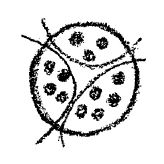
[ 33 ] Applied to arithmetic instruction as a whole, this yields the following: Instead of placing peas one by one, you present the child with a pile of peas. (A drawing is provided.) The pile of peas represents the whole. This is the starting point. And now, for example, you teach the child: I have the pile of peas—or, let’s say, to make it vividly clear to the child, a pile of apples—and three children, perhaps three children of different ages who have different appetites, and we want to do something related to real life. What can we do here? Well, we can divide the pile of apples in a certain way, and then regard the whole pile as a sum equal to the individual parts into which we have divided it. We have the pile of apples there, and we say: We have three parts, and in this way we teach the child that the total is equal to the three parts. Total = 3 parts. This means that in addition, we do not start with the individual parts and then arrive at the total; rather, we start with the total and move on to the parts. In this way, we start with the whole and move on to the addends, to the parts, in order to gain a vivid understanding of addition. For what matters in addition is always the sum, and the parts—the components—are what must be contained within the sum in a certain way.
[ 34 ] In this way, one is able to guide the child toward life in such a way that the child fits into it, grasps the whole, and does not always move from the few to the many. And this exerts an extraordinarily strong influence on the child’s entire inner life. If the child becomes accustomed to adding, then precisely that moral disposition arises which primarily fosters a tendency toward the desirable. When one moves from the whole to the parts, and when multiplication is taught accordingly, the child develops a tendency not to cultivate the desire for the desirable so strongly, but rather to develop what, in the sense of the Platonic worldview, can be called prudence—moderation in the noblest sense of the word. And there is a deep connection between what one finds morally pleasing or displeasing and the way one has learned to handle numbers. At first glance, there seems to be no logical connection between dealing with numbers and moral ideas and impulses—so little, in fact, that anyone who wishes to think purely in intellectual terms might scoff at the very mention of it. It may seem ridiculous to them. It is also quite understandable that someone might laugh at the idea that, when adding, one should start with the sum rather than the addends. But when one considers the real connections in life, one realizes that the things that seem most logically distant are often very close to one another in actual existence.
[ 35 ] Thus, what develops in the child’s soul through exposure to numbers is of immense importance for the way the child responds to us when we seek to present moral examples to the child’s soul, through which the child is to develop a sense of approval or disapproval, antipathy or sympathy toward good and evil. We will find a child who has a receptive sensibility for the good if we have taught the child to handle numbers in the appropriate way.