

Fundamental Spiritual and Soul Forces
in the Art of Education
Spiritual Values in Education and Social Life
GA 305
23 August 1922, Oxford
Translated by Steiner Online Library
7. The Waldorf School as an Organism
[ 1 ] When people speak of “organization” today, they usually mean that something is to be organized, that something is to be set up. If I were to speak today about the organization of the Waldorf School, it is not—and cannot be—meant in this sense, for one can really only organize that which is, in a certain sense, mechanical. One can organize the structure of a factory or any other institution where the parts are to be held together into a whole by the idea one imprints upon them. But just imagine how absurd it would be to demand that one organize the human organism. It is organized; it is there, and one must accept it as an organism. One must study it. One must come to understand its structures as those of an organism, as those of an organization.
[ 2 ] In this sense, a school such as the Waldorf School is, from the very beginning, an organism and cannot be organized by—as I have already hinted—drawing up a program specifying how the school is to be structured: Paragraph 1, Paragraph 2, and so on. I have already said that I am, from the outset, completely convinced—without any irony—that if 5 or 12 people were to get together today—and people today are, after all, all very clever, very intelligent—they would be able to work out an ideal school program in which there is absolutely nothing to improve: Paragraph 1, Paragraph 2, and so on. Paragraph 12 and so on; and the only question that arises is: Can this be implemented in practice? — And it will very soon become clear that while very fine curricula can be devised, in practice one is faced with a fully formed organism when establishing a school.
[ 3 ] This school is made up of a faculty that, after all, isn’t molded from wax. Paragraph 1 or Paragraph 5 might say: the teacher should be this way or that way. The teaching staff isn’t made of something you can mold out of wax; rather, you have to seek out each individual teacher and accept them with the abilities they possess. Above all, you must understand what abilities they have. You must understand whether they are, first and foremost, a good elementary school teacher or a good teacher for the higher grades. It is therefore a matter of this: just as, in order to understand the human organism, one must understand the nose or the ear, so one must understand the individual teacher if one wants to accomplish anything at all. It is not abstract programmatic principles that matter, but the realities one faces. If one could mold teachers out of wax, then one could create programs. But that is not possible. So, first and foremost, one is faced with the reality of the teaching staff. One must know them thoroughly. Above all, this is the first principle in the organization of the Waldorf school: that the teaching staff—since I am responsible for the spiritual leadership of the Waldorf school—is known to me in all its individual details.
[ 4 ] The second group consists of the children, and in this regard, establishing the Waldorf School presented some practical difficulties. For this Waldorf School was initially founded by Emil Molt in Stuttgart out of all the emotions that prevailed in 1918 and 1919, after the war had ended. It was founded because people believed they were, at first, undertaking a social initiative. They realized that, socially speaking, there wasn’t much that could be done with the adults; they got along for a few weeks in Central Europe after the war ended. Afterward, they immediately fell back into the prejudices that had developed among the various social classes. That is why the idea arose to focus first on the next generation. And since it was Emil Molt, an industrialist in Stuttgart, who founded the school, there was no need to go out and recruit children; instead, the school was initially filled with the children of his factory workers. So, initially, the children we received were essentially working-class children—about 150 children from Molt’s factory. These approximately 150 children were then supplemented by the vast majority of children from the Anthroposophical Society in Stuttgart and the surrounding area; thus, we had to work with about 200 children at the beginning.
[ 5 ] But this also created a situation that, in the ideal sense, made the school a truly inclusive one. For we had a core group of working-class children, and the children of anthroposophists were not, at first, working-class children, but came from all walks of life, from the lowest to the highest social classes. Thus, from the very beginning, all distinctions based on social status or class were eliminated, in part due to the social foundation of the Waldorf School. And this was indeed the goal—and remains so—that the only consideration, the sole consideration, is what is universally human. The Waldorf School is guided solely by pedagogical and didactic principles; there is absolutely no consideration given to whether a child is from a working-class family or whether it might have been the child of a former emperor, had that child sought admission to the Waldorf School. Only pedagogical and didactic principles applied and will continue to apply. Thus, from the very beginning, the Waldorf School was conceived as a school for all.
[ 6 ] But of course this also presented difficulties, because children from working-class families enter school at ages 6 or 7 with different lifestyle habits than children from other social classes. But in this regard, the differences very soon proved to be exceptionally beneficial—even if, of course, one must overlook minor details, which can be overcome with a certain amount of effort. You can easily imagine these minor details; they mostly relate to outward habits, and it is sometimes not easy to get children to shed everything they bring with them into school. But even that can certainly be achieved with a little good will, although some children from so-called higher social classes, who are not accustomed to carrying one thing or another with them, then bring these unpleasant habits home, where their parents notice them in an unpleasant way.
[ 7 ] Well, so there were the children on the other side. At first, I would say, those were the lesser difficulties. The greater difficulty arose from the fact that the Waldorf School was guided by the ideal of educating purely in the spirit of understanding human nature—of presenting to the child each week exactly what the child itself required.
[ 8 ] We immediately established the Waldorf School as an eight-grade elementary school, so that we had children ranging in age from 6 or 7 to 14 or 15. At first, these children came from a wide variety of schools. They had the most varied educational backgrounds—by no means always the kind we considered appropriate for an eight- or eleven-year-old child. Consequently, in the first year, we could by no means fully rely on what we regarded as the ideal of education. We could not simply follow Paragraph 1 or Paragraph 2; instead, we had to proceed according to the individual characteristics of the children who were admitted to each class. And yet, that would have been the lesser difficulty.
[ 9 ] The greater difficulty is this: no educational method, no matter how ideal, should tear a person away from life. After all, a person is not some abstract entity that can be “produced” through education and then considered finished; rather, a person is the child of certain parents. He or she has grown out of the social order. Once educated, the child must reenter this social order. You see, if you were to educate a child in a way that corresponds absolutely to an ideal, by the time the child is 14 or 15, while this might indeed be very ideal, the child would not be able to find its way in today’s world—it would not know what to do. So it was not merely a matter of realizing an ideal—and it still isn’t in the Waldorf school—but rather of educating the child in such a way that it always finds a connection to life today, to today’s social order. It does no good to say that this social order is bad. Whether it is good or bad, we simply have to live within it. And that is the point: we must live within it, which means we cannot simply pull the children out of it. So I was faced with the extraordinarily difficult task of, on the one hand, fulfilling an educational ideal, and on the other hand, coming to terms with the full reality of the present.
[ 10 ] Of course, the school authorities had to regard what is accomplished in other schools as a kind of ideal. They always say, however, that the ideal cannot be achieved; one can only do what is possible, and practical realities demand this or that. But precisely in practice, when one has to deal with them, they regard everything that has already been established by the state authorities or the relevant agencies as something exceptionally good, and what is organized in the manner of the Waldorf School as a kind of quirk—something one does when one isn’t quite in one’s right mind!
[ 11 ] Well, don’t you think people sometimes let such quirks slide because they tell themselves: “Well, we’ll see what it turns out to be.” — But still, you have to take it into account, and so I tried to work things out with the following compromise. I proposed in a memorandum that I be given three years for my little quirk, so that by then the children would be ready to transition to regular schools. So I drafted a memorandum to the effect that, if the children were admitted, by the end of the third grade—that is, by the age of nine—they would have reached the point where they could enter the fourth grade at another school. Only for the interim period, I said, did I want absolute freedom to be able to give the children each week what follows from an understanding of human nature. Then, again, I requested freedom from the age of 9 to 12. Upon reaching the age of 12, the children should once more have reached a level where they can enter a regular public school, and again, once they have left school. It will be the same when the children—indeed, as I said, the young ladies and young gentlemen—leave school to attend a university or another institution of higher education: for the period from puberty until the start of their university studies, there should be complete freedom; but by then they should be ready to transfer to any college or university of their choice, for the Dornach Free University will not yet be widely recognized as an institution to which one can transfer when people wish to enter the wider world, of course.
[ 12 ] Thus, through this parallelism with the conventional school system, an attempt was made to reconcile what should actually be sought with what already exists, to bring them into a certain harmony. For in no respect does the Waldorf school strive for anything that is impractical; rather, in every respect, through this “quirk,” it seeks to realize what is truly practical in life.
[ 13 ] Therefore, it cannot be a matter of designing the school based on some clever idea in one’s head—for that would result in a construction, not an organization—but rather, it can only be a matter of truly studying, week by week, what already exists as an organism. And indeed, for those who engage in observing people—which also includes observing children—the most concrete educational guidelines emerge month by month. Just as, after all, a doctor, when faced with a patient, cannot say right away during the first examination what needs to be done, but must study the person gradually because a human being is an organism, so too is it a matter of continuously studying such an organism as the school—and even more so. For it may be, for example, that the specific composition of the teaching staff and student body—say, in the year 1920—requires a completely different approach than that needed for the teaching staff and student body in the year 1924, because the teaching staff may have changed due to new additions, and the student body will certainly be different. In contrast, paragraphs 1 through 12 could be as beautifully written as possible, but they would be of no use; the only thing that is useful is what one actually gains from observing the classroom on a daily basis.
[ 14 ] And that is why, when I speak of the organization of the Waldorf school, its heart is the teachers’ conference—or rather, the series of teachers’ conferences that are held from time to time. When I am able to be in Stuttgart myself, these conferences take place under my leadership; otherwise, they are held at relatively short intervals. There, everything concerning the entire school—including the experiences individual teachers have in their own classrooms—is discussed in the finest detail before the entire teaching staff. Thus, these teachers’ conferences continually strive to shape the school into a single organism, just as the human body is an organism because it has a heart. Of course, these faculty meetings are much less about abstract principles and much more about the teachers’ goodwill toward one another and their willingness to set aside any kind of rivalry. And above all, it is about the fact that one can only propose something that benefits others if one has the appropriate love for each individual child. But I do not mean the kind of love that is often spoken of, but rather the kind of love that one has precisely as an art teacher.
[ 15 ] This love has a different nuance than ordinary love. It is, after all, a different nuance, but still, anyone who can feel deep compassion for sick people as human beings already possesses a general love for humanity. But in order to treat a sick person, one must also—please don’t misunderstand me, but it’s true—be able to have a love for the illness itself. One must also be able to speak of a “beautiful” illness. It is, of course, very terrible for the patient, but for the one who must treat it, it is a beautiful illness. Under certain circumstances, it can be a magnificent illness. It may be very terrible for the patient, but for the one who must put oneself in their shoes—who must be able to treat it with love—it is a magnificent illness. And so even a completely good-for-nothing boy—a “Strick,” as we say in German—can, under certain circumstances, be so extraordinarily interesting because of the way he lives out his “Strick-ness,” how bad he is, how good-for-nothing he is, that one can love him extraordinarily. For example, we have a very interesting case at the Waldorf School—a boy who is very abnormal. He attended the Waldorf School from the very beginning; he entered first grade right away. He had the peculiar habit that whenever the teacher turned around, he would run up to the teacher and hit him. The teacher treated this good-for-nothing with extraordinary love and extraordinary interest. He patted him on the head, led him back to his seat, and didn’t even act as if he’d noticed that the boy had hit him from behind. This boy can only be helped by taking his entire background into account. One must understand the parental environment from which he emerged and must understand his pathology. But then one can make progress with him despite his good-for-nothingness, if one is able to love precisely this kind of good-for-nothingness. There is something endearing about someone who is particularly good-for-nothing.
[ 16 ] So for the educator, this is quite different from how it is for someone who views things more from the outside. And so it really comes down to developing this special love that I have just spoken of. Then one will also know what to say in the teachers’ conference. For nothing is more useful for the measures one must take with healthy children than what one can observe in children with developmental challenges.
[ 17 ] You see, healthy children are relatively difficult to study because all their traits are blurred. It is not so easy to determine how each individual characteristic is situated within the whole and how it interacts with the others. In the case of a sick child, where a complex of characteristics is present, one very quickly comes to the conclusion that this particular complex of characteristics should also be treated pathologically. This approach can then be applied to healthy children.
[ 18 ] Through this kind of organization, we have at least managed to ensure that the unique nature of the Waldorf School has been recognized in a short time, as evidenced by the fact that the number of children we had at the beginning—about 200, as I mentioned—grew rapidly, and we have now already reached a total of about 700 children, who are now spread across all grades (up to the 12th), so that the Waldorf School is now truly organized as a unified school in the best sense of the word. We had to establish parallel classes for most grades, especially the lower ones, so that we have a 1st Grade A, a 1st Grade B, and so on, because we gradually ended up with too many children for a single class. This, of course, places ever greater demands on the Waldorf School. For when one attempts to conceive the entire organization out of life itself, every child who joins us offers a new lesson and a new way of doing things that one must adapt to in order to cope, together with the organism that has gained a new member, through the corresponding study of the human being.
[ 19 ] We have organized the Waldorf School so that the main lessons are held in the morning. In the summer, they begin a little earlier; in the winter, they start around 8:00 or 8:15 a.m. A distinctive feature of these main lessons is that what is commonly called a “timetable” has been eliminated. We do not have a schedule in the conventional sense; rather, a subject is selected for this two-hour morning lesson—which is interrupted by a break for the younger children—and that subject is completed within four to six weeks. Then another subject is taken up. This means that the children do not have religion from 8 to 9, natural history from 9 to 10, and arithmetic from 10 to 11—that is, they are not constantly being thrown into something different—but rather, for example, in October they have four weeks of arithmetic, then three weeks of natural history, and so on.
[ 20 ] Whatever might be criticized here—such as the fact that children might forget something, or that material covered as a coherent whole might fade from memory—must be compensated for by the efficiency of instruction and the competence of the teaching staff. Only in the final weeks of the school year are the subjects reviewed, providing a sort of summary of the school year. Through this process, the child becomes fully immersed in a particular subject.
[ 21 ] An exception must be made for foreign language instruction, which in our schools is actually focused on speaking. This is because in Waldorf schools, instruction in foreign languages—currently English and French, as far as we are able—begins as soon as the child enters elementary school, and the child learns to speak the language in question right from the start. The child learns the language while avoiding even the thought of translation as much as possible. Thus, the word in the foreign language is linked to the object itself, not to the corresponding word in German. This means that the child gets to know the table anew in a foreign language; they do not learn the foreign word by translating it from the German word “Tisch.” As a result, the child actually learns—and this is particularly evident in younger children—to immerse themselves in a language that is not their mother tongue. In doing so, we ensure that abstract or intellectual aspects of grammar are not introduced to very young children at all. Children can only begin to understand grammar between the ages of 9 and 10, at that crucial point I have already mentioned.
[ 22 ] These language classes are generally held between 10 a.m. and 12 p.m. This is therefore the time when we, if I may put it that way, teach what falls outside the main lessons, which are always held in the early morning hours. This time also includes everything related to religious instruction. I will speak later about this religious instruction, as well as moral instruction and discipline. But for now, I would like above all to emphasize that the afternoon hours are set aside for singing, music, and eurythmy. During this time, the child should, as far as possible, experience everything involved in instruction and education with their whole being.
[ 23 ] And special consideration can now be given to ensuring that everything that is taught and instilled reaches the whole person, particularly when instruction—as I have described it—forms a unified whole that springs from the heart of the teachers’ conferences. This becomes particularly evident when instruction flows from the more spiritual realm into the more fully physical and practical aspects of life. And it is precisely this transition into the physical and practical aspects of life that is the primary focus of Waldorf school instruction.
[ 24 ] And so the goal is to help children learn to use their hands more and more, building upon what the use of hands in play initially was for very young children—through a certain artistic element—which, however, must be drawn out of the child itself.
[ 25 ] We achieve this by having the children do all kinds of practical work. We are currently only able to do this starting in the 6th grade; some of these activities are appropriate for an earlier age, but—as I have already mentioned—we simply had to make compromises; the ideal will only be achievable later on, at which point a nine-year-old child will be able to do the same practical work that an eleven- or twelve-year-old does now. But these practical tasks have the character of free work and of leading into the artistic realm. The child should work out of their own volition, not because of something that has been prescribed for them.
[ 26 ] So, in a kind of arts-and-crafts class, we guide the child to carve all sorts of objects and to make all sorts of things based on their own ideas. One experiences how, in a lesson built on the living, the children actually bring things out of themselves. Let me give an example. We let the children carve objects that are half artistic, half practical. For example, you can put something inside this bowl. We let the children carve in these forms so that they develop a sense of form and design from within themselves, so that they create something that takes shape out of their own will and pleasure. But in the process, something very remarkable emerges.
[ 27 ] Suppose, for a moment, that at some point we taught human anatomy in class in a way that is particularly necessary for this grade level at school. We explained to the children the structure of the skeletal system; we also explained to them the structure of the external body and the functioning of the human organism. Because the lessons are structured in such an artistic way—as I have described over the past few days—the children have absorbed this material vividly. It has penetrated their will, not merely their thoughts or their minds. And then, when they set out to create something like this, you can see that it lives on in their hands. The forms take on different shapes depending on what we focus on in class. It finds its full expression in the forms. You can see this in the sculptural creations the children make during the morning lessons from 8 to 10 a.m., because what is intended to be taught truly penetrates the whole person.
[ 28 ] This can only be achieved by taking into account how things work in nature. Allow me to say something rather heretical: people love to put dolls in children’s hands—especially “beautiful” dolls. People don’t realize that children don’t actually want them. They reject them, but they’re forced upon them. Beautiful dolls, beautifully painted ones! It’s much better to give children a handkerchief—or, if a handkerchief is too good for that, something else; you do it together—make a head here, draw a nose, two eyes, and so on—and healthy children much prefer to play with that than with “beautiful” dolls, because it leaves something for their imagination; whereas, if the doll is designed to be as beautiful as possible—with rosy cheeks, even—there’s nothing left for the imagination. The child becomes emotionally stunted next to the beautiful doll.
[ 29 ] But this points to the way in which we should draw out of the child that which the child itself is now shaping. And there, you see, when our children reach the 6th grade and begin to develop things on their own based on their sense of form, they reveal themselves just as in these small examples we have brought with us (wooden dolls). The things are exactly as they grow out of the individuality of a particular child.
[ 30 ] The key point, however, is to make children aware at an early age of how they actually want to conceive of life—based on inner flexibility, not inner rigidity. Therefore, when you gradually allow children—through play—to create things that are serious and meaningful to them, you must try to infuse flexibility into the process. You see, things like this—which, I believe, is a truly extraordinary figure (a carved bear)—captivate children right from the start, and they also add these moving parts to it themselves, without being instructed to do so, so that the figure’s tongue even moves when it’s set in motion. Or the children bring their imagination into the project; they don’t make a cat that’s well-behaved, but rather incorporate what they observe—without understanding the deeper connections—such as the cat’s arched back, quite accurately.
[ 31 ] I always place particular emphasis on children engaging with toys that move—that is, toys that are not merely static but through which they learn to act. In this way, the children create things that bring them extraordinary joy as they gradually complete them. They don’t just make realistic objects; drawing entirely from their own imagination, they create stories about gnomes and the like.
[ 32 ] You’ll certainly find ways to put such things together in more complicated ways; you aren’t told that this is possible, but the child is simply guided so that he can create such a funny little fellow (a moving raven) on his own, and then he looks grumpy and sad again.
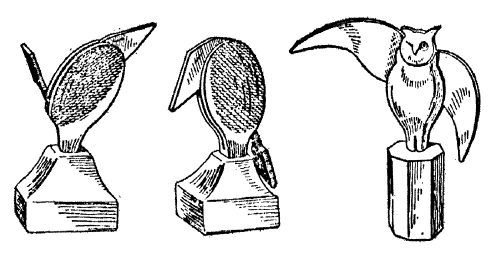
[ 33 ] And when a child manages to make something like that (an owl with movable wings), they feel especially satisfied! So this is what children between the ages of 11 and 15 do—and now the older ones as well—but we’ll gradually have to scale it back to even earlier grades, where the shapes will become simpler.
[ 34 ] Well, in addition to these manual skills classes, we have actual handicraft classes. And it’s worth noting that in Waldorf schools, boys and girls are always seated together in every class. We have boys and girls seated together all the way up to the highest grade. So in fact—with minor variations, of course— and the higher we go into the upper grades, the more differentiation is naturally required, but the fact remains that, on the whole, boys actually learn the same crafts as girls, and it turns out in a remarkable way just how much the little boys enjoy knitting or crocheting, and how the girls also do crafts that are usually reserved for boys. This also achieves something socially: mutual understanding between the sexes, which must be our primary goal today, since we have not yet made any social progress in this regard and still live amid the greatest prejudices. And it is indeed true that it is a blessing when something like what I intend to show you in the following example is achieved.
[ 35 ] We also had a small school like that in Dornach. It has now been banned because of Swiss freedom, and we can only begin to offer instruction there to advanced young ladies and gentlemen, because that freedom makes it necessary that free schools simply not be established alongside public schools. Well, isn’t that something that has nothing to do with pedagogy itself? But we were able to try working in a small school in Dornach for a while. It will probably be possible in the near future to establish such a free school in Basel after all. — But at the Waldorf School, as I said, boys and girls work together in mixed-gender handicraft classes. All sorts of things come to fruition in those classes. Boys and girls work together there quite peacefully. For example, you won’t be able to easily distinguish between these two pieces of work—even if you don’t go into the finer details of how the boys’ and girls’ work differ (two doilies).
[ 36 ] The only thing that has turned out in a curious way is this: in the highest class we have formed so far—where sixteen- and seventeen-year-old boys and girls are mixed together—we also move on to spinning and weaving, so that the students are actually introduced to practical life and get to know life as well— now here’s the curious thing: the boys don’t want to spin themselves; instead, they want to help the girls. The girls are supposed to spin, and the boys want to act as assistants—they want to play the role of chivalrous knights. That is the only thing that has emerged so far: when it comes to spinning, the boys want to serve the girls. But otherwise, we have seen that the boys do all kinds of handicrafts.
[ 37 ] An attempt is now also being made to structure handicraft lessons based on the goals of art instruction. This does not mean having the children draw a design and then embroider it, but rather actually allowing them to work with color first and foremost from their very being as human beings. Of course, it is immensely important to first awaken in the child a genuine experience of color. If you take the small tubes of paint that are usually available in stores and let the children paint with a brush using paint from the palette, they learn nothing at all. It is essential that they learn to live with color—not by painting from the palette, but by taking colors dissolved in water from the paint dish. This gives the child a sense of how one color can coexist with another, a sense of inner harmony, and an inner experience of color. And even if this sometimes presents difficulties—the classroom doesn’t always look very good after a painting lesson because not all children are very skilled, and sometimes they aren’t very receptive in this regard—even if this causes difficulties, there is still tremendous progress when children are first introduced to the element of color in this way, so that they learn to paint based on their experience of color, without trying to imitate anything naturalistically. Then, I would say, the color surface and color form emerge of their own accord across the surface of the paper. And this is how painting is done in Waldorf schools, and also in Dornach—the children first paint their experience of color. It all depends on the juxtaposition and superimposition of colors. In this way, the child immerses themselves in the color, and then, little by little, they naturally come to draw form out of the color. You can see here—though with more advanced children—that even without focusing on drawing, a formed, shaped figure has already been brought forth from the color. But the same principle is also applied when teaching very young children. For example, we have works here that aim to foster an experience of color. Here, the child is not “painting” something, but rather living out the color itself. The act of “painting” something can come much later. If one begins to “paint” something too early, the sense of the living is lost, and the sense of the lifeless takes its place.
[ 38 ] If one proceeds in this way, the transition to something concrete in the world is much more vivid than if one does not lay this foundation. You see, children who have first learned to live through color—who, for example, paint the island of Sicily as part of their geography lessons—end up creating a map. And in this way, artistic work and even geography lessons come together.
[ 39 ] When you evoke a sense of color harmony in this way, you enable the children to create objects that serve some purpose in life. This book cover is not drawn first; rather, the child learns to experience color, and only afterward does the child design something like a book cover. The aim here is to awaken a genuine sense of life in the child. It is precisely through form and color that one can deeply introduce the child to life.
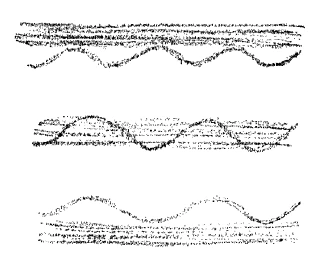
[ 40 ] One sometimes finds that something terrible happens: someone has a collar made for a dress, then a belt, and a hem at the bottom—and all of them feature the same pattern. You see this from time to time. It is, of course, the most dreadful thing that can happen in life, from an artistic standpoint. A child must learn early on that a band intended for the neck tends to open up downward in some way, to pull downward; that the belt must have an effect on both sides, and that the hem of the dress at the bottom must somehow strive upward and stand up at the bottom; so that the dreadful thing does not happen—that a child learns simply to design a ribbon artistically—but rather, the child must know how the ribbon must look, depending on whether it is placed on this or that part of the human body. For example, when making a book cover, one must know that when looking at the book, one opens it in a certain way. There must be a difference between the top and the bottom. This sense of space, this sense of form—the child must necessarily grow into it. This then extends into the limbs. This is a form of instruction that sometimes has a much stronger effect on the physical body than abstract gymnastics. And so you see, what emerges from the work with colors is precisely what then becomes all kinds of useful objects, which are then handled in such a way that the child truly perceives color next to color and form upon form, and the whole belongs to something—and that is why I do it this way.
[ 41 ] This is what belongs in every detail, in the vitality of the work itself. The classroom is meant to be a preparatory school for life. You will find all sorts of interesting things among the projects there, including something made by a relatively young girl (an egg warmer).
[ 42 ] I can’t show you everything in this presentation, but I’d just like to point out that we’ve brought along all sorts of beautiful things from the Waldorf School. Here you will also find two songbooks by Mr. Baumann, the music director at the Waldorf School, from which you will be able to see what kinds of songs and musical material we generally cover at the Waldorf School. Then, from one of the girls—since, of course, we couldn’t bring many things with us due to border restrictions—we have all sorts of items, which you can see reproduced here. But they’re all crafted in a three-dimensional style, just as they are here. As you can see, the children have some very nice ideas; they’re simply capturing life as it is; the items are carved from wood.
[ 43 ] Here (on this map) you can still see how one can be led into a full life when one starts out with a lively sense of the first principle. You can see this here on this map: first you have the experience of color, and then you experience it soulfully—by first having the experience of color, you experience it soulfully; here you see Greece, experienced soulfully. The child grows by first finding its way into the color experiences related to what it learns in geography class; it grows into saying to itself: “I must paint the island of Crete in a certain color, and the coast of Asia Minor like this, and the Peloponnese like that.” Through color, the child learns to express itself artistically, and a map truly becomes an inner, soulful creation.
[ 44 ] Just think how children experience the earth anew when they do so from within—after first seeing it depicted here, as Crete has been painted, or the Peloponnese, or northern Greece—and when they have the corresponding sensation with each such color, then what Greece truly is also comes alive in their souls, and the child, in a sense, recreates Greece anew from within itself. In this way, a person truly takes the world into themselves as a living reality. And things come alive quite differently in children when they are allowed to relive reality—the very ordinary, dry reality of everyday life—in this way, after they have first learned to experience the elements through which it expresses itself—I would say, the “syllables” and “words” of color—artistically through simple paintings.