

The Art of Education
Based on Understanding Human Nature
GA 311
14 August 1924, Torquay
Translate the original German text into any language:
Versions Available:
The Art of Education Based on Understanding Human Nature, tr. SOL
Dritter Vortrag
Third Lecture
[ 1 ] Heute wollen wir noch einiges über das Allgemeinere der Erziehungskunst während der Lebensepoche zwischen dem Zahnwechsel und der Geschlechtsreife charakterisieren, um dann in der nächsten Stunde auf Spezielleres in der Behandlung einzelner Gegenstände und einzelner Lebenszustände eingehen zu können.
[ 1 ] Today we would like to outline some general principles of the art of education during the period of life between the change of teeth and sexual maturity, so that in the next class we can then address more specific aspects of dealing with individual subjects and life situations.
[ 2 ] Wenn das Kind zwischen dem 9. und 10. Lebensjahr angekommen ist, dann kann es sich zunächst von seiner Umgebung unterscheiden. Der Unterschied zwischen Subjekt und Objekt - Subjekt = das Eigene, Objekt = das Andere - tritt eigentlich erst in diesem Zeitpunkt wirklich auf, und wir können dann beginnen, von Außendingen zu sprechen, während wir vorher diese Außendinge so behandeln müssen, als ob sie eigentlich eins wären mit dem Körper des Kindes. Wir sollen die Außendinge wie sprechende, handelnde Menschen behandeln, sagte ich gestern. Dadurch hat das Kind das Gefühl, daß die Außenwelt einfach eine Fortsetzung seines eigenen Wesens ist.
[ 2 ] Once a child has reached the age of 9 or 10, they can begin to distinguish themselves from their surroundings. The distinction between subject and object—subject = the self, object = the other—actually only truly emerges at this point, and we can then begin to speak of external things, whereas before we had to treat these external things as if they were, in fact, one with the child’s body. “We should treat external things as if they were speaking, acting human beings,” I said yesterday. This gives the child the feeling that the outside world is simply an extension of its own being.
[ 3 ] Nun handelt es sich darum, das Kind, wenn es das 9. oder 10. Jahr überschritten hat, in einige elementare Tatsachen, Wesenheiten der Außenwelt einzuführen, in die Tatsachen des Pflanzenreiches und des Tierreiches. Von anderen Gegenständen werden wir noch sprechen. Aber gerade bei diesen Dingen müssen wir sehen, daß wir das Kind so einführen, wie es die Menschennatur verlangt.
[ 3 ] Now the task is to introduce the child, once he or she has passed the age of 9 or 10, to certain elementary facts—the realities of the external world—specifically, the facts of the plant and animal kingdoms. We will discuss other subjects later. But it is precisely with these things that we must ensure we introduce the child in a way that is in keeping with human nature.
[ 4 ] Das erste, was wir dabei tun müssen, ist eigentlich das, daß wir alle Lehrbücher wegwerfen. Denn so wie heute Lehrbücher beschaffen sind, enthalten sie nichts über das Pflanzen- und Tierreich, was man den Kindern eigentlich beibringen kann. Diese Lehrbücher von heute sind gut, um erwachsenen Menschen Kenntnisse von Pflanzen und Tieren beizubringen; aber wir verderben die Individualität des Kindes, wenn wir diese Lehrbücher in der Schule benützen. Und man kann schon sagen: Lehrbücher, Handbücher, welche Anleitung dazu geben, wie man in der Schule vorzugehen hat, sind eben heute nicht vorhanden. Es handelt sich nämlich um folgendes:
[ 4 ] The first thing we need to do is actually throw away all the textbooks. Because the way textbooks are written today, they contain nothing about the plant and animal kingdoms that can actually be taught to children. Today’s textbooks are good for teaching adults about plants and animals; but we stifle a child’s individuality when we use these textbooks in school. And it’s fair to say: textbooks and manuals that provide guidance on how to proceed in school simply do not exist today. The situation is as follows:
[ 5 ] Wenn man dem Kinde einzelne Pflanzen vorlegt und an einzelnen Pflanzen dies oder jenes behandeln läßt, so hat man ja zunächst etwas getan, was keiner Wirklichkeit entspricht. Eine Pflanze für sich hat keine Wirklichkeit. Wenn Sie sich ein Haar ausreißen und dieses Haar betrachten, als ob es eine Sache für sich wäre, so hat das keine Wirklichkeit. Im trivialen Leben sagt man zu allem, was man mit Augen irgendwie begrenzt vor sich sieht, es habe eine Wirklichkeit. Aber es ist doch etwas anderes, ob man einen Stein, den man beurteilt, vor sich sieht oder ob man ein Haar oder eine Rose vor sich sieht. Der Stein wird nach zehn Jahren noch gerade dasselbe sein, was er heute ist, die Rose nach zwei Tagen nicht mehr; sie ist nur eine Realität am ganzen Rosenstock daran. Das Haar hat gar keine Realität für sich, es ist nur eine Realität mit dem ganzen Kopf, am ganzen Menschen. Und wenn man nun hinausgeht auf die Felder und Pflanzen ausreißt, dann ist es so, wie wenn man der Erde die Haare ausgerissen hätte. Denn die Pflanzen gehören zur Erde ganz genau so, wie die Haare zum Organismus des Menschen gehören. Ein Haar für sich zu betrachten, wie wenn es irgendwo für sich entstehen würde, ist ja ein Unsinn.
[ 5 ] If you present individual plants to a child and have the child treat this or that aspect of individual plants, you have, in fact, initially done something that does not correspond to reality. A plant in and of itself has no reality. If you pluck out a hair and look at it as if it were a thing in and of itself, it has no reality. In everyday life, we say that everything we see before us—within the limits of our vision—has a reality. But it is quite another matter whether we see a stone before us that we are judging, or whether we see a strand of hair or a rose. The stone will still be exactly the same in ten years as it is today; the rose will no longer be the same after two days—it is only a reality in relation to the entire rosebush. A strand of hair has no reality of its own; it is only a reality in relation to the whole head, to the whole person. And when one goes out into the fields and pulls up plants, it is as if one had pulled the hair out of the earth. For plants belong to the earth just as much as hair belongs to the human organism. To view a single strand of hair in isolation, as if it were arising on its own somewhere, is, after all, nonsense.
[ 6 ] Ebenso ist es ein Unsinn, eine grüne Botanisiertrommel zu nehmen, Pflanzen nach Hause zu tragen und jede Pflanze für sich zu betrachten. Das entspricht nicht der Realität, und auf diese Weise ist es nicht möglich, daß man richtige Natur- und Menschenerkenntnis erwirbt.
[ 6 ] Likewise, it is nonsense to take a green botanical basket, carry plants home, and examine each plant individually. This does not reflect reality, and in this way, it is not possible to gain a true understanding of nature and humanity.
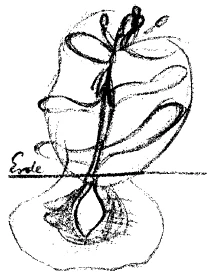
[ 7 ] Wenn Sie hier eine Pflanze haben (siehe Zeichnung D), so ist das allein nicht die Pflanze, sondern zu der Pflanze gehört noch dasjenige, was da als Boden darunter ist, unbegrenzt weit, vielleicht sehr weit. Es gibt Zeichnung I Pflanzen, die lassen noch Würzelchen in sehr großer Weite ausstrahlen. Daß dieses Stück Erde, in dem die Pflanze drinnen ist, in weitem Umkreise dazu gehört, das kann Sie die Tatsache lehren, daß man Dünger in die Erde hineingeben muß, wenn man von gewissen Pflanzen will, daß sie richtig wachsen. Fs lebt nicht bloß das Stück Pflanze, es lebt auch dasjenige, was hier ist (siehe Zeichnung D), es lebt mit, gehört zur Pflanze dazu; die Erde lebt mit.
[ 7 ] If you have a plant here (see drawing D), that alone is not the plant; rather, the plant also includes what lies beneath it as soil, extending indefinitely, perhaps very far. There are plants—as shown in Drawing I—that send out tiny roots over a very wide area. The fact that this patch of earth, in which the plant is embedded, belongs to it over a wide radius can be seen from the fact that you have to add fertilizer to the soil if you want certain plants to grow properly. It is not only the part of the plant that lives; what is here (see Drawing D) also lives—it lives along with it, is part of the plant; the earth lives along with it.
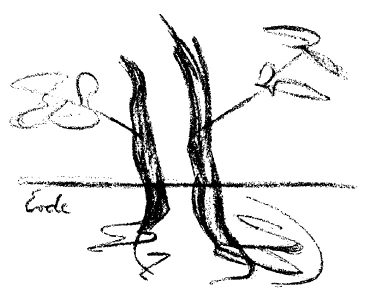
[ 8 ] Es gibt Pflanzen, die blühen im Frühling, sprossen auf gegen Mai, Juni und tragen ihre Früchte im Herbst. Dann verwelken sie, sterben ab. Sie stecken drinnen in der Erde, aber die gehört zu ihnen dazu. - Es gibt aber auch Pflanzen, die nehmen die Kräfte der Erde aus der Umgebung. Das wäre die Erde (siehe Zeichnung II); jetzt nimmt die Wurzel die Kräfte, die in der Umgebung sind, in sich auf. Weil sie jetzt die Kräfte in sich aufgenommen hat, kommen die Kräfte der Erde da herauf, es wird ein Baum daraus.
[ 8 ] There are plants that bloom in the spring, sprout around May or June, and bear fruit in the fall. Then they wither and die. They are buried in the earth, but the earth is part of them. - But there are also plants that draw the earth’s forces from their surroundings. That would be the earth (see Drawing II); now the root absorbs the forces present in its surroundings. Because it has now absorbed these forces, the earth’s forces rise up from there, and a tree grows from it.
[ 9 ] Was ist denn ein Baum? Ein Baum ist eine Kolonie von vielen Pflanzen. Ob Sie da einen Hügel haben, der nur weniger lebt und auf dem viele Pflanzen darauf sind, oder ob Sie den Stamm eines Baumes haben, wo in einem viel lebendigeren Zustand die Erde sich hineingezogen hat, das ist einerlei. Sie können gar nicht sachlich eine Pflanze für sich betrachten.
[ 9 ] What exactly is a tree? A tree is a colony of many plants. Whether you have a mound that is relatively lifeless and covered with many plants, or whether you have the trunk of a tree, where the earth has been drawn into it in a much more vibrant state, it makes no difference. You cannot objectively consider a plant in isolation.
[ 10 ] Fahren Sie über eine Gegend, oder noch besser, gehen Sie in einer Gegend, in der bestimmte geologische Formationen sind, zum Beispiel rot liegender Sand, und schauen sich die Pflanzen an: Es sind zumeist Pflanzen darauf mit gelb-rötlichen Blüten. Es gehören die Blüten zum Boden dazu. Boden und Pflanze ist eine Einheit, wie Ihre Kopfhaut und Ihre Haare.
[ 10 ] Drive through an area—or, even better, walk through an area—where there are certain geological formations, such as exposed red sand, and take a look at the plants: You’ll mostly find plants there with yellowish-reddish flowers. The flowers are part of the soil. The soil and the plant form a single unit, just like your scalp and your hair.
[ 11 ] Daher dürfen Sie mit dem Kind nicht einerseits Geographie und Geologie, andrerseits Botanik betrachten. Das ist ein Unsinn. Sondern Geographie, Beschreibung des Landes und Betrachtung der Pflanzen muß immer eines sein; denn die Erde ist ein Organismus, und die Pflanzen sind so wie Haare an diesem Organismus. Und das Kind muß die Vorstellung bekommen können, daß die Erde und die Pflanzen zusammengehören, daß jedes Stück Erde diejenigen Pflanzen trägt, die zu diesem Stück Erde gehören.
[ 11 ] Therefore, you must not teach the child geography and geology on the one hand, and botany on the other. That is nonsense. Rather, geography—the description of the land—and the study of plants must always be one and the same; for the Earth is an organism, and plants are like hair on this organism. And the child must be able to form a mental image of the fact that the Earth and plants belong together, that every piece of land bears the plants that belong to that piece of land.
[ 12 ] Es ist also richtig, daß Sie die Pflanzenkunde nur im Zusammenhange mit der Erde betrachten und dem Kinde eine deutliche Empfindung davon hervorrufen, daß die Erde ein lebendiges Wesen ist, das Haare hat. Die Haare sind die Pflanzen. - Sehen Sie, man sagt von der Erde, daß sie eine Schwerkraft habe, Gravitation. Die rechnet man zu der Erde dazu. Aber die Pflanzen gehören mit ihrer Wachstumskraft ebenso zu der Erde hinzu. Es gibt gar nicht eine Erde für sich und Pflanzen für sich, gerade so wenig, wie es in der Realität Haare für sich und Menschen für sich gibt. Das gehört zusammen.
[ 12 ] So it is correct that you should view botany only in connection with the Earth and help the child develop a clear sense that the Earth is a living being that has hair. The hair is the plants. - You see, people say that the Earth has a force of gravity. This is considered part of the Earth. But plants, with their power of growth, are just as much a part of the Earth. There is no such thing as the Earth on its own and plants on their own—just as there are not, in reality, hairs on their own and people on their own. They belong together.
[ 13 ] Und wenn Sie das dem Kinde beibringen, was Sie aus der Botanisiertrommel herausnehmen und es benennen lassen, so bringen Sie ihm eine Unwirklichkeit bei. Das hat Folgen für das Leben; denn das Kind wird niemals von der Pflanzenkunde aus, die Sie ihm so beibringen, ein Verständnis dafür gewinnen, wie man zum Beispiel den Acker behandeln muß, wie man ihn lebendig machen muß mit dem Dünger. Ein Verständnis dafür, wie man den Acker behandeln soll, bekommt das Kind nur, wenn es weiß, wie der Acker mit der Pflanze zusammenhängt. Weil die Menschen in unserer Zeit mehr und mehr keinen Sinn für Realität mehr haben - ich habe Ihnen in der ersten Stunde gesagt, die Praktiker haben ihn am wenigsten, sie sind alle Theoretiker heute -, weil die Menschen von der Realität keine Spur mehr haben, deshalb betrachten sie alles für sich, alles gesondert.
[ 13 ] And when you teach a child to take something out of the botany drum and have them name it, you are teaching them something unreal. This has consequences for life; for the child will never, through the botany you teach them in this way, gain an understanding of how, for example, to tend a field, or how to bring it to life with fertilizer. A child can only gain an understanding of how to tend a field if they know how the field is connected to the plant. Because people in our time increasingly lack a sense of reality—I told you in the first lesson that practitioners have it the least; they are all theorists today—because people have lost all trace of reality, they therefore view everything in isolation, everything separately.
[ 14 ] Und so ist es gekommen, daß in vielen, vielen Gegenden seit fünfzig, sechzig Jahren alle Feldprodukte dekadent geworden sind. Es hat neulich in Mitteleuropa einen landwirtschaftlichen Kongreß gegeben. Da haben die Landwirtschafter selbst gestanden: Die Früchte werden so schlecht, daß man gar nicht hoffen kann, daß in fünfzig Jahren die Früchte noch genießbar sind für die Menschen.
[ 14 ] And so it has come to pass that, for fifty or sixty years now, the quality of all agricultural produce has been declining in many, many regions. There was recently an agricultural congress in Central Europe. There, the farmers themselves admitted: The crops are becoming so poor that one cannot even hope that in fifty years they will still be edible for humans.
[ 15 ] Warum? Weil die Leute nicht verstehen, den Boden mit dem Dünger lebendig zu machen. Aber die Menschen können das nicht verstehen, wenn man ihnen solche Begriffe beibringt wie: die Pflanzen seien etwas für sich. Gerade so wenig, wie ein Haar etwas für sich ist, ist die Pflanze etwas für sich. Wenn das Haar etwas für sich wäre, gut, dann wäre es Ja einerlei, dann könnte man es, damit es wächst, in ein Stück Wachs oder Talg hineinstecken! Aber es wächst eben in der Kopfhaut.
[ 15 ] Why? Because people don’t understand how to bring the soil to life with fertilizer. But people can’t understand this if you teach them concepts such as: plants are something in and of themselves. Just as a strand of hair is not a thing in and of itself, neither is a plant. If a strand of hair were a thing in and of itself—well, then it wouldn’t matter; you could stick it into a piece of wax or tallow to make it grow! But it grows right out of the scalp.
[ 16 ] Will man erkennen, wie die Erde mit der Pflanze zusammengehört, dann muß man wissen, in welche Art von Erde eine Pflanze hineingehört. Und wie man diese Erde noch düngen muß, das kann man nur dadurch wirklich erkennen, daß man Erde und Pflanzenwelt als eine Einheit betrachtet, daß man wirklich die Erde wie einen Organismus anschaut und die Pflanze als etwas, was innerhalb dieses Organismus wächst.
[ 16 ] If one wants to understand how the soil and the plant belong together, one must know what kind of soil a plant belongs in. And the only way to truly understand how to fertilize this soil is by viewing the soil and the plant world as a single entity—by truly regarding the soil as an organism and the plant as something that grows within that organism.
[ 17 ] Dadurch aber bekommt das Kind von vornherein das Gefühl, auf einem lebendigen Boden zu stehen. Dies hat für das Leben eine große Bedeutung. Denn bedenken Sie nur, wie man sich heute vorstellt, daß die geologischen Schichten entstehen. Man stellt sich vor: Das hat sich so übereinandergelagert. Aber alles das, was Sie als geologische Schichten sehen, sind ja nur verhärtete Pflanzen, verhärtetes Lebendiges. Nicht nur die Steinkohlen waren früher Pflanzen, die mehr im Wasser als in der festen Erde wurzelten und dazugehörten zur Erde, sondern auch Granit, Gneis und so weiter sind von pflanzlicher und tierischer Natur her.
[ 17 ] But this gives the child, right from the start, the feeling of standing on living ground. This is of great significance for life. Just consider the mental image people have today of how geological strata are formed. They imagine: “These layers were deposited one on top of the other.” But everything you see as geological strata is, after all, nothing more than fossilized plants—fossilized living matter. Not only were coal deposits once plants that took root more in water than in solid earth and were part of the earth, but granite, gneiss, and so on are also of plant and animal origin.
[ 18 ] Auch dafür bekommt man nur Verständnis, wenn man Erde und Pflanzen als Ganzes zusammen betrachtet. Es handelt sich ja bei diesen Dingen nicht bloß darum, daß das Kind Kenntnisse erhält, sondern darum, daß es die richtigen Empfindungen erhält. Das sieht man aber erst wiederum ein, wenn man eine solche Sache geisteswissenschaftlich betrachtet.
[ 18 ] This, too, can only be understood when one considers the earth and plants as a whole. After all, these matters are not merely about the child acquiring knowledge, but about the child developing the right feelings. However, this can only be fully grasped when one approaches such matters from a perspective of Spiritual Science.
[ 19 ] Denken Sie nur einmal, Sie sind von dem besten Willen beseelt, Sie sagen sich: Das Kind muß alles anschaulich lernen, also muß es auch die Pflanze anschaulich lernen. Ich halte es früh an, schön in einer schönen Botanisiertrommel Pflanzen hereinzubringen. Ich zeige ihm alles, denn es ist die Realität. Ich glaube nämlich, es ist die Realität, es ist ja Anschauungsunterricht. - Nur - man schaut eben dasjenige an, was keine Wirklichkeit ist. Mit diesem Anschauungsunterricht treibt man den ärgsten Unfug in der Gegenwart!
[ 19 ] Just imagine for a moment that you’re filled with the best of intentions and you tell yourself: “The child must learn everything through direct observation, so it must also learn about plants through direct observation.” I start early, bringing plants home in a beautiful botanical collection case. I show the child everything, because it’s reality. I believe, in fact, that it is reality—after all, it is visual instruction. —Only—one is looking at precisely that which is not reality. With this kind of visual instruction, people are getting up to the worst kind of mischief these days!
[ 20 ] Da lernt das Kind die Pflanze so kennen, als ob es gleichgültig wäre, ob ein Haar in Wachs oder in einer Menschenhaut wächst. In Wachs wächst es ja nicht. Wenn ein Kind solche Begriffe aufnimmt, dann widersprechen sie ganz dem, was das Kind aufgenommen hat, bevor es aus der geistigen Welt heruntergestiegen ist auf die Erde. Denn da hat die Erde ganz anders ausgeschaut. Da trat dem Kinde, das heifßt der Seele des Kindes lebendig diese Zusammengehörigkeit des mineralischen Erdreiches und des Pflanzlichen, das herauswächst, entgegen. Warum? Weil das Kind etwas, was noch nicht mineralisch ist, sondern erst auf dem Wege ist, mineralisch zu werden, das Ätherische aufnehmen muß, damit es sich überhaupt verkörpern kann. Es muß sich in das Pflanzliche hineinwachsen. Und das Pflanzliche erscheint mit der Erde verwandt.
[ 20 ] In this way, the child comes to understand the plant as if it made no difference whether a hair grows in wax or in human skin. After all, it doesn’t grow in wax. When a child absorbs such concepts, they completely contradict what the child had absorbed before descending from the spiritual world to Earth. For back then, the Earth looked quite different. There, the child—that is, the child’s soul—encountered this living connection between the mineral soil and the plant life growing from it. Why? Because the child—which is not yet mineral but is only on the path to becoming mineral—must take in the etheric in order to incarnate at all. It must grow into the plant realm. And the plant realm appears to be related to the earth.
[ 21 ] Diese ganze Empfindungsreihe, die das Kind erlebt, wenn es heruntersteigt aus der vorirdischen Welt in die irdische, diese ganze reiche Welt wird ihm konfus gemacht, chaotisch gemacht, wenn man es so anleitet, Pflanzenkunde zu lernen, wie man es gewöhnlich tut; während das Kind innerlich aufjauchzt, wenn es die Pflanzenwelt im Zusammenhang mit der Erde kennenlernt.
[ 21 ] This entire range of sensations that the child experiences as it descends from the pre-earthly world into the earthly one—this entire rich world—becomes confused and chaotic for the child if it is taught botany in the way it usually is; whereas the child rejoices inwardly when it comes to know the plant world in connection with the earth.
[ 22 ] In einer ähnlichen Weise muß betrachtet werden, wie man das Kind in die tierische Welt einführt. Beim Tiere wird es ja schon der trivialen Betrachtung auffallen: Es gehört nicht zur Erde. Es läuft über die Erde dahin. Es kann an diesem Orte, an jenem Orte sein. Man hat es also mit ganz anderen Verhältnissen der Erde zu tun, als bei der Pflanze. Aber beim Tiere kann einem etwas anderes auffallen.
[ 22 ] In a similar way, we must consider how to introduce the child to the animal world. In the case of animals, even a casual observer will notice that they do not belong to the earth. They move across the earth; they can be here or there. Thus, we are dealing with conditions on earth that are entirely different from those of plants. But with animals, something else may strike one.
[ 23 ] Wenn wir die verschiedenen Tiere, die auf der Erde leben, zunächst ihren seelischen Eigenschaften nach betrachten, finden wir grausame Raubtiere, wir finden sanfte Lämmer und auch tapfere Tiere. Zum Beispiel unter den Vögeln sind manche ganz tapfere Streiter; auch unter den Säugetieren haben wir tapfere Tiere. Dann finden wir majestätische Tiere, wie die Löwen. Wir finden die mannigfaltigsten seelischen Eigenschaften. Und wir sagen uns bei jeder einzelnen Tierart, diese Tierart sei dadurch charakterisiert, daß sie diese oder jene Eigenschaft hat. Wir nennen den Tiger grausam, und die Grausamkeit ist seine beträchtlichste, bedeutendste Eigenschaft. Wir nennen das Schaf geduldig. Geduld ist seine beträchtlichste Eigenschaft. Wir nennen den Esel träge, weil er, wenn er auch nicht in Wirklichkeit so furchtbar träge ist, ein gewisses Gebaren hat, das stark an die Trägheit erinnert. Namentlich ist der Esel träge im Verändern seiner Lebenslage. Wenn er es gerade in seiner Laune hat, langsam zu gehen, kann man ihn nicht dazu bringen, daß er schnell geht. Und so hat jedes Tier seine besonderen Eigenschaften.
[ 23 ] If we first consider the various animals that live on Earth in terms of their spiritual qualities, we find cruel predators, gentle lambs, and brave animals. For example, among the birds there are some very brave fighters; we also find brave animals among the mammals. Then we find majestic animals, such as lions. We find the most diverse spiritual qualities. And for each individual animal species, we say to ourselves that this species is characterized by having this or that quality. We call the tiger cruel, and cruelty is its most notable, most significant quality. We call the sheep patient. Patience is its most notable quality. We call the donkey sluggish because, even if it isn’t actually that terribly sluggish, it has a certain demeanor that strongly suggests sluggishness. In particular, the donkey is sluggish when it comes to changing its circumstances. If it happens to be in the mood to walk slowly, you cannot get it to walk quickly. And so every animal has its own special traits.
[ 24 ] Beim Menschen aber können wir nicht so denken. Wir können nicht denken, daß der eine Mensch zahm, geduldig, der andere grausam, der dritte tapfer ist. Wir würden es einseitig finden, wenn die Menschen so über die Erde verteilt wären. Sie haben schon auch in gewissem Sinne solche Eigenschaften in Einseitigkeit ausgebildet, aber doch nicht in solchem Maße wie die Tiere. Wir finden viel mehr gerade beim Menschen - und namentlich, wenn wir den Menschen erziehen wollen -, daß wir ihm zum Beispiel gewissen Dingen und Tatsachen des Lebens gegenüber Geduld beibringen sollen, anderen Dingen und Lebenstatsachen gegenüber Tapferkeit, anderen Dingen und Lebenslagen gegenüber vielleicht irgendwie sogar etwas Grausamkeit, obwohl das in homöopathischer Dosis an die Menschen heranzubringen ist. Gewissen Dingen gegenüber wird der Mensch einfach durch seine natürliche Entwickelung auch Grausamkeiten zeigen und so weiter.
[ 24 ] But when it comes to human beings, we cannot think that way. We cannot think that one person is docile and patient, another cruel, and a third brave. We would find it one-sided if people were distributed across the earth in this way. In a certain sense, they have indeed developed such traits to a one-sided degree, but not to the same extent as animals. Rather, we find—especially when we seek to educate human beings—that we should, for example, teach them patience in the face of certain things and facts of life, courage in the face of other things and facts of life, and perhaps even a certain degree of cruelty in the face of other things and life situations, although this must be introduced to them in homeopathic doses. In response to certain things, humans will simply display cruelty as a result of their natural development, and so on.
[ 25 ] Aber wie ist es denn da eigentlich, wenn wir diese seelischen Eigenschaften beim Menschen und bei den tierischen Wesen betrachten? Beim Menschen finden wir, daß er eigentlich alle Eigenschaften haben kann, wenigstens die alle Tiere zusammen haben. Diese haben sie einzeln für sich; der Mensch hat immer ein bißchen von allem. Er ist nicht so majestätisch wie der Löwe, aber er hat etwas von Majestät. Er ist nicht so grausam wie der Tiger, aber er hat etwas von Grausamkeit. Er ist nicht so geduldig wie das Schaf, aber er hat etwas von Geduld. Er ist nicht so träge wie der Esel - wenigstens nicht alle Menschen -, aber er hat etwas von dieser Trägheit an sich. Das haben alle Menschen. Man kann sagen, wenn man die Sache ganz richtig betrachtet: Der Mensch hat in sich Löwen-Natur, SchafNatur, Tiger-Natur, Esel-Natur. Alles hat er in sich. Nur ist alles in sich harmonisiert. Alles schleift sich an dem anderen ab. Der Mensch ist der harmonische Zusammenfluß oder, wenn man es gelehrter ausdrücken will, die Synthese von all den verschiedenen seelischen Eigenschaften, die das Tier hat. Und gerade dann ist das Rechte beim Menschen erzielt, wenn er in seine Gesamtwesenheit die gehörige Dosis Löwenheit, Schafheit, die gehörige Dosis Tigerheit, die gehörige Dosis Eselheit und so weiter richtig einführt, wenn das alles in rechtem Maße in den Menschen eingetaucht ist und mit allem anderen in dem richtigen Verhältnis steht.
[ 25 ] But what is the reality of the situation when we consider these psychological traits in humans and in animals? We find that humans can actually possess all the traits—at least those that all animals possess collectively. Animals possess these traits individually; humans, however, always have a little bit of everything. He is not as majestic as the lion, but he has a touch of majesty. He is not as cruel as the tiger, but he has a touch of cruelty. He is not as patient as the sheep, but he has a touch of patience. He is not as sluggish as the donkey—at least not all humans—but he has a touch of that sluggishness about him. All humans have that. One could say, if one looks at the matter quite correctly: Human beings possess within themselves the nature of the lion, the nature of the sheep, the nature of the tiger, and the nature of the donkey. They possess all of these within themselves. It’s just that everything is harmonized within them. Each trait is tempered by the others. Human beings are the harmonious convergence—or, to put it in more scholarly terms, the synthesis—of all the various psychological qualities possessed by animals. And the right balance in a human being is achieved precisely when they correctly incorporate into their entire being the proper measure of lion-like qualities, sheep-like qualities, tiger-like qualities, donkey-like qualities, and so on—when all of this is imbued in the human being to the right degree and stands in the proper proportion to everything else.
[ 26 ] Schon ein altes griechisches Sprichwort sagt sehr schön: «Tapferkeit, wenn sie sich eint mit Klugheit, bringt dir Segen. Wandelt die Tapferkeit jedoch allein, folget Verderben ihr nach.» Wenn der Mensch nur tapfer wäre, wie manche Vögel, die fortwährend streiten, nur tapfer sind, so würde er nicht viel Segensreiches im Leben für sich anrichten. Aber wenn die Tapferkeit so ausgebildet ist beim Menschen, daß sie sich mit der Klugheit vereinigt, so wie wiederum gewisse Tiere nur klug sind, dann ist es beim Menschen das Rechte.
[ 26 ] An ancient Greek proverb puts it beautifully: “Bravery, when combined with wisdom, brings you blessings. But if bravery stands alone, ruin follows in its wake.” If humans were merely brave—as some birds, which are constantly quarreling, are merely brave—they would not achieve much that is beneficial in life. But when bravery is developed in humans in such a way that it is united with wisdom—just as certain animals are merely wise—then that is the right state of affairs for humans.
[ 27 ] Beim Menschen handelt es sich also darum, daß eine synthetische Einheit, eine Harmonisierung all desjenigen, was im Tierreiche ausgebreitet ist, vorhanden ist. So daß wir das Verhältnis so umschreiben können: da ist das eine Tier - ich zeichne schematisch -, da das zweite, eine dritte Tierart, eine vierte und so weiter, alle Tiere, die auf der Erde möglich sind.
[ 27 ] In the case of human beings, then, what is at stake is the existence of a synthetic unity—a harmonization of everything that is spread out across the animal kingdom. So we can describe the relationship as follows: there is one animal—I’ll draw a diagram—then a second, a third species, a fourth, and so on—all the animals that are possible on Earth.
[ 28 ] Wie verhalten sich die zum Menschen?
[ 28 ] How do they behave toward humans?
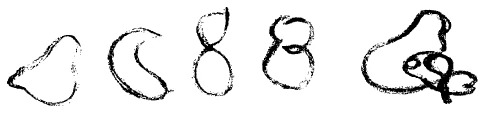
[ 29 ] So, daß? der Mensch zunächst so etwas hat (es wird gezeichnet) wie die eine Tierart, aber gemildert, er hat es nicht ganz. Und da schließt gleich das andere daran an (siehe Zeichnung), aber wiederum nicht ganz. Da geht das über in ein Stück von dem Nächsten, und dann schließt sich dieses daran an (siehe letzte Zeichnung der Reihe), so daß der Mensch alle Tiere in sich schließt. Das Tierreich ist ein ausgebreiteter Mensch, und der Mensch ist ein zusammengezogenes Tierreich; alle Tiere sind synthetisch vereint durch den Menschen. Der ganze Mensch analysiert, ist das ganze Tierreich.
[ 29 ] So that? Human beings initially possess something (as depicted) like a single animal species, but in a tempered form—they do not possess it fully. And this is immediately followed by the next one (see drawing), but again, not fully. From there, it transitions into a part of the next one, and then this one follows on from it (see the last drawing in the series), so that human beings encompass all animals within themselves. The animal kingdom is a human being spread out, and human beings are a condensed animal kingdom; all animals are synthetically united through human beings. The whole human being, when analyzed, is the entire animal kingdom.
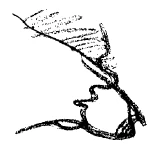
[ 30 ] So ist es auch mit der Gestalt. Denken Sie sich einmal, wenn Sie das menschliche Antlitz haben (es wird gezeichnet), und dieses hier wegschneiden (siehe Zeichnung) und etwas nach vorne setzen, wenn das also weiter nach vorne geht, wenn es nicht harmonisiert ist mit dem ganzen Antlitz, wenn die Stirne tiefer geht, wird ein Hundekopf daraus. Wenn Sie in einer etwas anderen Weise den Kopf formen, wird ein Löwenkopf daraus und so weiter.
[ 30 ] The same is true of the figure. Just imagine: if you have a human face (it’s being drawn), and you cut this part away (see drawing) and bring something forward—if it protrudes further forward, if it isn’t in harmony with the whole face, if the forehead slopes downward—it turns into a dog’s head. If you shape the head in a slightly different way, it turns into a lion’s head, and so on.
[ 31 ] Auch in bezug auf seine übrigen Organe kann man überall finden, daß der Mensch auch in der äußeren Gestalt gemildert, harmonisiert hat das, was auf die übrigen Tiere ausgebreitet ist.
[ 31 ] With regard to his other organs as well, one can see everywhere that man has, even in his external form, softened and harmonized what is widespread among other animals.
[ 32 ] Denken Sie sich, wenn Sie eine watschelnde Ente haben, etwas von dem, was da watschelt, haben Sie nämlich auch zwischen den Fingern, nur ist es da zurückgezogen. Und so ist alles, was im Tierreiche zu finden ist, auch an Gestalt, im Menschenreiche vorhanden. Auf diese Weise findet der Mensch sein Verhältnis zum Tierreich. Er lernt erkennen, wie die Tiere alle zusammen ein Mensch sind. Der Mensch ist vorhanden in den 1800 Millionen Exemplaren von mehr ‘oder weniger großem Wert auf Erden. Aber er ist noch einmal als ein Riesenmensch vorhanden. Das ganze Tierreich ist ein Riesenmensch, nur nicht synthetisiert, sondern analysiert in lauter Einzelheiten.
[ 32 ] Just imagine: when you see a waddling duck, you have something of that waddle right there between your fingers—it’s just tucked away. And so everything that can be found in the animal kingdom, including its form, is also present in the human kingdom. In this way, humans find their relationship to the animal kingdom. They learn to recognize how all the animals together constitute a human being. Humanity is present in the 1,800 million specimens of greater or lesser value on Earth. But it is also present once again as a giant human being. The entire animal kingdom is a giant human being—not synthesized, but analyzed in every detail.
[ 33 ] Es ist so: Wenn alles an Ihnen elastisch wäre, aber so elastisch, daß es nach verschiedenen Richtungen hin verschieden elastisch sein könnte, und Sie nach einer gewissen Richtung hin elastisch sich ausdehnen würden, so würde ein gewisses Tier daraus entstehen. Wenn man Ihnen die Augengegend aufreißen würde, würde wiederum, wenn es entsprechend elastisch sich aufdunsen würde, ein anderes Tier entstehen. So trägt der Mensch das ganze Tierreich in sich.
[ 33 ] Here’s the thing: If everything about you were elastic—but so elastic that it could be elastic in different ways in different directions—and if you were to stretch elastically in a certain direction, a certain animal would emerge from that. If the area around your eyes were to be torn open, and if it were to swell up with corresponding elasticity, another animal would emerge. Thus, human beings carry the entire animal kingdom within themselves.
[ 34 ] So hat man einmal in früheren Zeiten die Geschichte des Tierreiches auch gelehrt. Das war eine gute, gesunde Erkenntnis. Sie ist verlorengegangen, aber eigentlich erst verhältnismäßig spät. Zum Beispiel hat man im 18. Jahrhundert noch ganz gut gewußt, wenn dasjenige, was der Mensch in der Nase hat, den Riechnerv, wenn der genügend groß ist, nach hinten sich fortsetzt, so wird ein Hund daraus. Wenn aber der Riechnerv verkümmert und wir nur ein Stückchen vom Riechnerv haben, und das andere Stückchen sich ummetamorphosiert, so entsteht unser Nerv für das intellektuelle Leben.
[ 34 ] That is how the history of the animal kingdom was once taught in earlier times. That was a sound, healthy understanding. It has been lost, but actually only relatively recently. For example, in the 18th century, people still understood quite well that if the olfactory nerve—which humans have in their noses—is large enough and extends backward, it develops into a dog. But if the olfactory nerve atrophies and we are left with only a small portion of it, while the other portion undergoes a metamorphosis, this gives rise to our nerve for intellectual life.
[ 35 ] Wenn Sie den Hund anschauen, wenn er so riecht, so hat er von der Nase nach hinten die Fortsetzung seines Riechnervs. Er riecht die Eigentümlichkeit der Dinge; er stellt sie nicht vor, er riecht alles. Er hat nicht einen Willen und eine Vorstellung, sondern er hat einen Willen und einen Geruch für alle Dinge. Einen wunderbaren Geruch! Die Welt ist für den Hund nicht uninteressanter als für den Menschen. Der Mensch kann sich alles vorstellen. Der Hund kann alles riechen. Wir haben ein paar, nicht wahr, sympathische und antipathische Gerüche; aber der Hund hat vielerlei Gerüche. Denken Sie nur einmal, wie der Hund im Geruchssinn spezialisiert. Polizeihunde gibt es in der neueren Zeit. Man führt sie an den Ort, wo einer war, der etwas stibitzt hat. Der Hund faßt sogleich die Spur des Menschen auf, geht ihr nach und findet ihn. Das alles beruht darauf, daß es wirklich eine ungeheure Differenzierung, eine reiche Welt der Gerüche gibt für den Hund. Davon ist der Träger der nach rückwärts in den Kopf, in den Schädel hineingehende Riechnerv.
[ 35 ] When you look at a dog as it sniffs, you see that its olfactory nerve extends from its nose all the way back. It senses the unique qualities of things; it doesn’t create mental images—it simply smells everything. It doesn’t have a single will and a single mental image, but rather a will and a sense of smell for all things. What a wonderful sense of smell! The world is no less interesting to a dog than it is to a human. Humans can create mental images of anything. Dogs can smell anything. We have a few—don’t we?—pleasant and unpleasant smells; but dogs have a wide variety of smells. Just think for a moment how specialized a dog’s sense of smell is. Police dogs have become common in recent times. They are led to the place where someone who has stolen something was. The dog immediately picks up the person’s scent, follows it, and finds him. All of this is based on the fact that there really is an immense range of distinctions, a rich world of smells for the dog. This is conveyed by the olfactory nerve, which runs backward into the head, into the skull.
[ 36 ] Wenn wir den Riechnerv durch die Nase des Hundes zeichnen, müssen wir ihn nach rückwärts zeichnen (es wird gezeichnet). Beim Menschen ist nur ein Stückchen geblieben da unten, das andere ist umgebildet und steht hier unter unserer Stirn. Es ist ein metamorphosierter, ein transformierter Riechnerv. Mit dem bilden wir unsere Vorstellungen. Deshalb können wir nicht so riechen, wie der Hund, aber wir können vorstellen. Wir tragen den riechenden Hund in uns, nur umgebildet. Und so alle Tiere.
[ 36 ] When we draw the olfactory nerve through a dog’s nose, we have to draw it backward (it is drawn that way). In humans, only a small portion remains down there; the rest has been transformed and is located here beneath our forehead. It is a metamorphosed, a transformed olfactory nerve. We use it to form our mental images. That is why we cannot smell the way a dog does, but we can imagine. We carry the scent-perceiving dog within us, only in a transformed form. And so it is with all animals.
[ 37 ] Davon muß man eine Vorstellung hervorrufen. Es gibt einen deutschen Philosophen, Schopenhauer, der hat ein Buch geschrieben: «Die Welt als Wille und Vorstellung». Das Buch ist ja nur für Menschen. Hätte ein genialer Hund es geschrieben, so hätte er geschrieben: «Die Welt als Wille und Gerüche», und ich bin überzeugt davon, das Buch wäre viel interessanter als das Buch, das Schopenhauer geschrieben hat.
[ 37 ] One must evoke a mental image of this. There is a German philosopher, Schopenhauer, who wrote a book: *The World as Will and Representation*. The book is, of course, intended only for humans. If a brilliant dog had written it, he would have written: “The World as Will and Smells,” and I am convinced that the book would be much more interesting than the one Schopenhauer wrote.
[ 38 ] Man sehe sich die verschiedenen Formen der Tiere an, beschreibe sie nicht so, als ob jedes Tier für sich dastehen würde, sondern versuche, vor den Kindern immer die Vorstellung hervorzurufen: Sieh einmal, so schaut der Mensch aus. Wenn du dir den Menschen nach dieser Richtung verändert denkst, vereinfachst, vereinigt denkst, kriegst du das Tier. Wenn du zu irgendeinem Tiere, sagen wir zum Beispiel einem niederen Tiere, der Schildkröte, etwas hinzufügst, unten ein Känguruh, die Schildkröte über das Känguruh setzest, so hast du oben etwas wie einen verhärteten Kopf; das ist die Schildkrötenform in gewisser Beziehung. Und unten das Känguruh, das sind die Gliedmaßen des Menschen in einer gewissen Weise.
[ 38 ] Look at the different forms of animals; do not describe them as if each animal stood on its own, but always try to evoke a mental image in the children: Look, this is what a human being looks like. If you imagine a human being transformed in this way—simplified and synthesized—you get an animal. If you add something to any animal—let’s say, for example, a lower animal, the turtle—a kangaroo at the bottom, and place the turtle on top of the kangaroo, then at the top you have something like a hardened head; that is the turtle’s form in a certain sense. And at the bottom, the kangaroo represents the human limbs in a certain way.
[ 39 ] So kann man überall in der weiten Welt finden, wie man eine Beziehung herausfinden kann zwischen dem Menschen und den verschiedenen Tieren.
[ 39 ] Thus, all over the world, one can find examples of how to identify a relationship between humans and various animals.
[ 40 ] Sie lachen jetzt über diese Dinge. Das schadet nichts. Es ist ganz gut, wenn in der Klasse auch gelacht wird, denn nichts ist besser in die Klasse hineinzubringen als Humor. Wenn die Kinder auch lachen können, wenn sie nicht nur immer den Lehrer mit einem furchtbar langen Gesicht sehen und selber versucht sind, solche langen Gesichter zu machen und zu glauben, wenn man auf der Schulbank sitzt, muß man eben ein langes Gesicht machen - wenn das nicht der Fall ist, sondern wenn Humor hineingebracht wird, wenn man die Kinder dazu bringt, zu lachen, dann ist das das beste Unterrichtsmittel. Ernste Lehrer, ganz ernste Lehrer, die erreichen nichts mit den Kindern.
[ 40 ] You’re laughing at these things now. That’s okay. It’s actually good to have some laughter in the classroom, because nothing is better to bring into the classroom than humor. If the children can laugh too—if they don’t just always see the teacher with a terribly long face and are tempted to make such long faces themselves, believing that when you’re sitting at your desk, you simply have to look serious—if that’s not the case, but instead humor is brought into the classroom, if you get the children to laugh, then that’s the best teaching tool. Serious teachers—very serious teachers—achieve nothing with the children.
[ 41 ] Also, da haben Sie das Tierreich im Prinzip, wie ich es Ihnen zunächst darstellte. Von Einzelheiten können wir dann sprechen, wenn Zeit dazu ist. Aber Sie ersehen daraus, daß der Mensch lehrend das Tierreich so behandeln kann, daß das Tierreich ein ausgebreiteter Mensch ist.
[ 41 ] So, there you have the animal kingdom in principle, as I first described it to you. We can discuss the details when we have time. But you can see from this that, for educational purposes, humans can treat the animal kingdom as if it were a human being expanded out.
[ 42 ] Das gibt für das Kind wiederum eine sehr, sehr feine, schöne Empfindung ab. Denn nicht wahr, das Kind lernt, wie ich Ihnen angedeutet habe, die Pflanzenwelt als zur Erde gehörig kennen, und die Tiere als zu sich gehörig. Es wächst das Kind mit dem ganzen Erdenbereich zusammen. Es steht nicht mehr bloß auf dem toten Erdboden, sondern es steht auf dem lebendigen Erdboden und empfindet die Erde als Lebendiges. Es bekommt allmählich die Vorstellung, es stehe auf dem Erdboden so, wie wenn es auf einem großen Organismus stünde, wie zum Beispiel auf einem Walfisch. Das ist auch die richtige Empfindung. Das allein führt in die ganze menschliche Weltempfindung hinein.
[ 42 ] This, in turn, evokes a very, very subtle and beautiful feeling in the child. For, as I have suggested to you, the child learns to recognize the plant world as belonging to the earth, and the animals as belonging to itself. The child grows together with the entire realm of the earth. It no longer stands merely on dead soil, but on living soil, and perceives the earth as a living entity. Gradually, the child develops a mental image that it stands on the earth as if it were standing on a large organism—such as a whale. That is also the correct mental image. That alone leads into the whole human perception of the world.
[ 43 ] Und von den Tieren bekommt das Kind die Empfindung, als ob alle Tiere etwas Verwandtes hätten mit dem Menschen, aber auch die Vorstellung, daß der Mensch etwas über alle Tiere Hinausragendes hat, weil er alle Tiere in sich vereint. All das naturwissenschaftliche Geschwätz, daß der Mensch von einem Tiere abstamme, wird belacht werden von solchen Menschen, die so erzogen worden sind. Denn man wird erkennen, daß der Mensch das ganze Tierreich, die einzelnen Glieder synthetisch in sich vereinigt.
[ 43 ] And from animals, the child gains the sense that all animals are somehow related to human beings, but also a mental image that human beings possess something that transcends all animals, because they unite all animals within themselves. All that scientific drivel about humans descending from an animal will be laughed at by people who have been raised in this way. For one will recognize that humans synthesize the entire animal kingdom—its individual members—within themselves.
[ 44 ] Ich sagte Ihnen, zwischen dem 9. und 10. Jahre kommt der Mensch so weit, daß er unterscheidet zwischen sich als Subjekt und der Außenwelt als Objekt. Er unterscheidet sich von der Umwelt. Früher konnte man nur Märchen, Legenden erzählen, wo die Steine und Pflanzen sprechen, handeln wie Menschen. Da unterschied sich das Kind noch nicht von der Umgebung. Jetzt, wo es sich unterscheidet, müssen wir es wiederum auf einer höheren Stufe mit der Umgebung zusammenbringen. Jetzt müssen wir ihm den Boden, auf dem es steht, so zeigen, daß der Boden in selbstverständlicher Weise mit seinen Pflanzen zusammengehört. Dann bekommt es einen praktischen Sinn, wie ich Ihnen gezeigt habe, auch für die Landwirtschaft. Es wird wissen, man düngt, weil man die Erde in einer gewissen Weise lebendig braucht unter einer Pflanzenart. Es betrachtet nicht die einzelne Pflanze, die es aus der Botanisiertrommel herausnimmt, als ein Ding für sich, betrachtet aber auch nicht ein Tier als ein Ding für sich, sondern das ganze Tierreich als einen über die Erde sich ausbreitenden, großen analysierten Menschen. Es weiß dann der Mensch, wie er auf der Erde steht, und es weiß der Mensch, wie sich die Tiere zu ihm verhalten.
[ 44 ] I told you that between the ages of 9 and 10, a person reaches the point where they can distinguish between themselves as a subject and the outside world as an object. They distinguish themselves from their environment. Before that, one could only tell fairy tales and legends in which stones and plants speak and act like humans. Back then, the child did not yet distinguish itself from its surroundings. Now that it does, we must, in turn, bring it together with its surroundings on a higher level. Now we must show it the ground on which it stands in such a way that the ground naturally belongs together with its plants. Then it gains a practical understanding, as I have shown you, even for agriculture. It will know that we fertilize because we need the earth to be alive in a certain way for a particular plant species. It does not regard the individual plant—which it takes out of the botanical specimen drum—as a thing in and of itself, nor does it regard an animal as a thing in and of itself, but rather the entire animal kingdom as a great, analyzed human being spreading across the earth. Then human beings will know their place on Earth, and they will know how animals relate to them.
[ 45 ] Das ist von einer ungeheuren Bedeutung, daß wir in dem Kinde vom 10. Jahre an bis gegen das 12, Jahr hin diese Vorstellungen, Pflanze - Erde, Tier - Mensch, erwecken. Dadurch stellt sich das Kind mit seinem ganzen Seelen-, Körper- und Geistesleben in einer ganz bestimmten Weise in die Welt hinein.
[ 45 ] It is of immense importance that we awaken these mental images—plant and earth, animal and human—in the child from the age of 10 until around the age of 12. Through this, the child positions itself in the world in a very specific way with its entire life of soul, body, and spirit.
[ 46 ] Dadurch, daß wir dem Kinde eine Empfindung - und das alles muß eben empfindungsgemäß künstlerisch an das Kind herangebracht werden -, daß wir ihm eine Empfindung beibringen für die Zusammengehörigkeit von Pflanzen und Erdboden, wird das Kind klug, wird wirklich klug und gescheit; es denkt naturgemäß. Dadurch, daß wir ihm probieren beizubringen - sei es nur im Unterricht, Sie werden sehen, daß es dabei herauskommt -, wie es zu dem Tiere steht, lebt der Wille aller Tiere im Menschen auf, und zwar in Differenzierung, in entsprechender Individualisierung; alle Eigenschaften, alles Formgefühl, das sich in dem Tiere ausprägt, lebt in dem Menschen. Der Wille des Menschen wird dadurch impulsiert, und der Mensch wird dadurch in einer naturgemäßen Weise seiner Wesenheit nach in die Welt hineingestellt.
[ 46 ] By instilling in the child a sense—and all of this must be presented to the child artistically in a way that appeals to the child’s senses—by teaching the child a sense of the interconnectedness of plants and the soil, the child becomes wise, truly wise and intelligent; the child thinks in a natural way. By trying to teach the child—even if only in class; you will see that this is the result—how to relate to animals, the will of all animals comes to life within the human being, and indeed in a differentiated, appropriately individualized way; all the characteristics, all the sense of form that manifests itself in animals, lives within the human being. This impels the human will, and through this, the human being is placed in the world in a way that is natural to his or her very nature.
[ 47 ] Warum gehen denn heute die Menschen in der Welt so, ich möchte sagen, entwurzelt von allem herum? Den Menschen, wenn sie heute in der Welt herumgehen, sieht man es schon an, sie gehen nicht ordentlich, sie treten nicht ordentlich auf, sie schleppen die Beine nach. Das andere haben sie im Sport gelernt, aber das ist dann wiederum etwas Unnatürliches. Aber vor allen Dingen, sie denken trostlos! Sie wissen nicht was Rechtes anzufangen im Leben. Sie wissen etwas anzufangen, wenn man sie an die Nähmaschine oder an das Telefon stellt oder wenn eine Eisenbahnfahrt oder eine Reise um die Welt arrangiert wird. Aber mit sich selbst wissen sie nichts anzufangen, weil sie nicht in entsprechender Weise durch die Erziehung in die Welt hineingestellt worden sind. Aber das kann man nicht dadurch, daß man die Phrase drechselt, man solle den Menschen richtig erziehen, sondern das kann man nur dadurch, daß man wirklich im Einzelnen, Konkreten so etwas für den Menschen findet, wie, daß man die Pflanze richtig in den Erdboden hineinsenkt und das Tier in der richtigen Weise neben den Menschen stellt. Dann steht der Mensch in der richtigen Weise auf dem Erdboden darauf, und dann stellt er sich in der richtigen Weise zur Welt. Das muß man durch den ganzen Unterricht erreichen. Das ist wichtig, das ist wesentlich.
[ 47 ] Why do people in the world today walk around—I’d say—so uprooted from everything? When people walk around in the world today, you can already tell: they don’t walk properly, they don’t step properly—they drag their feet. They’ve learned the other way in sports, but that, in turn, is something unnatural. But above all, their thoughts are bleak! They don’t know what to do with their lives. They know what to do when you put them at a sewing machine or a telephone, or when a train trip or a trip around the world is arranged. But they don’t know what to do with themselves, because they haven’t been properly prepared for the world through their upbringing. But this cannot be achieved by merely repeating the cliché that one should educate people properly; rather, it can only be achieved by truly finding, in the individual and concrete details, something for the person—such as planting a seed correctly in the soil and placing an animal in the right way alongside a person. Then the human being stands on the ground in the right way, and then he relates to the world in the right way. This must be achieved through the entire educational process. That is important; that is essential.
[ 48 ] Es wird immer darauf ankommen, daß wir für ein jedes Lebensalter dasjenige finden, was nach der Entwickelung des Menschen von diesem Lebensalter selber gefordert wird. Dazu brauchen wir eben wirkliche Menschenbeobachtung, wirkliche Menschenerkenntnis. Betrachten wir noch einmal die zwei Dinge, die ich eben auseinandergesetzt habe: Das Kind bis zum 9. oder 10. Jahre fordert die Belebung der ganzen äußeren Natur, weil es sich noch nicht unterscheidet von dieser äußeren Natur. Wir werden dem Kinde eben dann Märchen erzählen, Legenden, Mythen erzählen. Wir werden selber etwas erfinden für das Allernächstliegende, um dem Kinde in Form der Erzählungen, Schilderungen, der bildhaften Darstellungen künstlerisch dasjenige beizubringen, was seine Seele aus den verborgenen Tiefen, in denen sie in die Welt eintritt, herausholt. Wenn wir wiederum das Kind nach dem 9., 10. Jahre haben, zwischen dem 10. und 12. Lebensjahre, stellen wir es so in die Tier- und Pflanzenwelt hinein, wie wir es eben geschildert haben.
[ 48 ] It will always be essential that we find, for every stage of life, what is required by the development of the human being at that very stage. To do this, we need genuine observation of human beings and genuine understanding of them. Let us consider once more the two points I have just discussed: The child up to the age of 9 or 10 requires the enlivening influence of the entire external natural world, because the child is not yet distinct from that external natural world. It is precisely then that we will tell the child fairy tales, legends, and myths. We will invent something ourselves for the immediate surroundings, in order to artistically impart to the child—through stories, descriptions, and pictorial representations—what its soul draws out from the hidden depths from which it enters the world. When, in turn, the child reaches the age of 9 or 10—between the ages of 10 and 12—we introduce them to the world of animals and plants in the way we have just described.
[ 49 ] Nun muß man sich aber klar werden darüber, daß der heute so beliebte Kausalitätsbegriff, Ursachenbegriff, beim Kinde auch in diesem Lebensalter, im 10., 11. Jahre, noch gar nicht als ein Bedürfnis des Begreifens vorhanden ist. Wir gewöhnen uns ja heute, alles nach Ursache und Wirkung zu betrachten. Die naturwissenschaftliche Erziehung der Menschen hat es dahin gebracht, daß man überall nach Ursache und Wirkung alles betrachtet. Sehen Sie, dem Kinde bis zum 11. oder 12. Jahre so von Ursache und Wirkung zu reden, wie man es im alltäglichen Leben tut, wie man es heute gewohnt ist, ist gerade so, wie man dem Farbenblinden von Farben spricht. Man redet an der Seele des Kindes vorbei, wenn man in dem Stile redet, in dem heute von Ursache und Wirkung geredet wird. Vorerst braucht das Kind lebendige Bilder, bei denen man niemals nach Ursache und Wirkung frägt. Nach dem 10. Jahre soll man wiederum nicht Ursache und Wirkung, sondern Bilder nach Ursache und Wirkung hinstellen.
[ 49 ] However, we must realize that the concept of causality—the idea of causes—which is so popular today, is not yet a cognitive need for children even at this age, in their 10th or 11th year. After all, we’ve become accustomed today to viewing everything in terms of cause and effect. The scientific education of people has led to a situation where everything is viewed through the lens of cause and effect. You see, speaking to a child up to the age of 11 or 12 about cause and effect in the way we do in everyday life—as we’re accustomed to doing today—is just like talking about colors to someone who is colorblind. One speaks right past the child’s soul when speaking in the style in which cause and effect are discussed today. For the time being, the child needs vivid images in which one never asks about cause and effect. After the age of 10, one should again not present cause and effect, but rather images that suggest cause and effect.
[ 50 ] Erst gegen das 12. Jahr hin wird das Kind reif, von Ursachen und Wirkungen zu hören. So daß man diejenigen Erkenntniszweige, die es mit Ursache und Wirkung hauptsächlich zu tun haben, in dem Sinne, wie man heute von Ursache und Wirkung redet, die leblose Naturphysik und so weiter eigentlich erst in den Lehrplan zwischen dem 11. und 12. Lebensjahre einführen soll. Vorher sollte man über Mineralien, über Physikalisches, über Chemisches nicht zu dem Kinde reden. Es fügt sich nicht in das Lebensalter des Kindes ein.
[ 50 ] It is not until around the age of 12 that a child is ready to learn about cause and effect. Thus, those branches of knowledge that deal primarily with cause and effect—in the sense in which we speak of cause and effect today, such as inanimate natural physics and so on—should actually not be introduced into the curriculum until between the ages of 11 and 12. Before that, one should not speak to the child about minerals, physics, or chemistry. It does not fit in with the child’s stage of development.
[ 51 ] Und weiter, wenn man Geschichtliches betrachtet, so soll das Kind auch bis gegen das 12. Jahr hin in der Geschichte Bilder bekommen, Bilder von einzelnen Persönlichkeiten, Bilder von Ereignissen, überschaubar schön gemalte Bilder, wo die Dinge lebendig vor der Seele stehen, nicht eine Geschichtsbetrachtung, in der man immer das Folgende als die Wirkung vom Vorhergehenden betrachtet, worauf die Menschheit so stolz geworden ist. Diese pragmatische Geschichtsbetrachtung, die nach Ursachen und Wirkungen sucht in der Geschichte, ist etwas, was das Kind ebensowenig auffaßt wie der Farbenblinde die Farbe. Und außerdem bekommt der Mensch eine ganz falsche Vorstellung vom Leben, vom fortlaufenden Leben, wenn man ihm alles immer nur nach Ursachen und Wirkungen beibringt. Ich möchte Ihnen das durch ein Bild klarmachen.
[ 51 ] Furthermore, when it comes to history, children should be presented with images—up until around the age of 12—images of individual figures, images of events: clearly structured, beautifully painted images in which things come alive before the soul—not a historical perspective in which one always views what follows as the effect of what preceded it, something of which humanity has become so proud. This pragmatic approach to history, which seeks causes and effects, is something a child grasps just as little as a color-blind person grasps color. Moreover, a person develops a completely false mental image of life—of life as it unfolds—if everything is always taught to them solely in terms of causes and effects. I would like to illustrate this with an example.
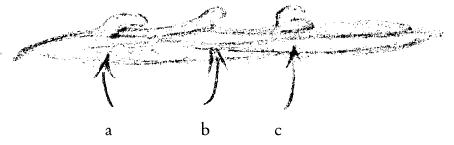
[ 52 ] Denken Sie sich, da fließt ein Strom dahin (es wird gezeichnet). Er zeigt Wellen. Sie werden nicht immer richtig gehen, wenn Sie die Welle c aus der Welle b und diese aus der Welle a hervorgehen lassen, wenn Sie sagen, c ist die Wirkung von b, und b von a; es walten da unten in den Tiefen noch allerlei Kräfte, welche diese Wellen aufblasen. Und so ist es in der Geschichte. Da ist nicht immer das, was 1910 geschieht, die Wirkung von dem, was 1909 geschehen ist, und so weiter, sondern für diese Wirkungen aus den Tiefen der Strömung in der Entwickelung, was die Wellen aufwirft, dafür muß beim Menschen sehr frühzeitig eine Empfindung eintreten. Sie tritt aber nur ein, wenn man spät erst die Ursachen und Wirkungen einführt, gegen das 12. Jahr hin, und vorher Bilder hinstellt.
[ 52 ] Imagine a river flowing along (it is drawn). It forms waves. You won’t always get it right if you have wave c emerge from wave b and that from wave a, if you say c is the effect of b, and b of a; all sorts of forces are at work down there in the depths, causing these waves to swell. And so it is in history. What happens in 1910 is not always the effect of what happened in 1909, and so on; rather, for these effects arising from the depths of the current of development—which set the waves in motion—a sense of them must arise in a person very early on. But this sensitivity only arises if one introduces causes and effects relatively late, around the age of 12, and presents images beforehand.
[ 53 ] Es stellt dies wiederum Anforderungen an die Phantasie des Lehrers. Diesen muß er aber genügen. Er wird schon genügen, wenn er für sich Menschenkenntnis erwirbt. Und darum handelt es sich.
[ 53 ] This, in turn, places demands on the teacher’s imagination. But the teacher must meet these demands. He will be able to do so if he acquires an understanding of human nature. And that is what this is all about.
[ 54 ] So wie man wirklich aus der Natur des Menschen heraus erzieht und unterrichtet, muß nun dem Unterricht, wie ich ihn eben dargestellt habe, die Erziehung in bezug auf moralische Qualitäten parallel gehen. Ich möchte da zum Schluß noch einzelnes hinzufügen. Auch da handelt es sich darum, daß man aus der Natur des Kindes abliest, wie man es zu behandeln hat. Wenn man dem Kinde schon mit sieben Jahren den Ursachen- und Wirkungsbegriff beibringt, handelt man gegen die Entwickelung der menschlichen Natur. Wenn man aber das Kind durch gewisse Dinge strafen will, so handelt man oftmals mit gewissen Strafen auch gegen die Entwickelung der menschlichen Wesenheit.
[ 54 ] Just as one educates and instructs in accordance with human nature, the instruction I have just described must be accompanied by an education focused on moral qualities. I would like to add a few final points here. Here, too, the key is to discern from the child’s nature how one should treat him or her. If one teaches a child the concept of cause and effect as early as age seven, one is acting against the development of human nature. But if one wishes to punish a child for certain things, one often acts against the development of the human being through certain punishments as well.
[ 55 ] In der Waldorfschule konnten wir dabei ganz schöne Erfahrungen machen. Wie wird in gewöhnlichen Schulen oftmals gestraft? Kinder haben in der Stunde etwas nicht ordentlich gemacht, man läßt sie nachsitzen, und sie müssen zum Beispiel Rechnungen machen. Da hat sich in der Waldorfschule etwas Sonderbares herausgestellt mit drei oder vier Kindern, denen man gesagt hatte: Ihr wart unordentlich, ihr müßt nachsitzen und Rechnungen machen! - Da sagten die anderen: Da wollen wir aber auch dableiben und Rechnungen machen! - Denn sie sind so erzogen, daf3 das Rechnungenmachen etwas Gutes ist, nicht etwas, womit man bestraft wird. Man soll beim Kinde gar nicht die Meinung hervorrufen, daß Rechnungenmachen im Nachsitzen etwas Schlimmes ist. Deshalb wollte die ganze Klasse auch dableiben und nachsitzen und Rechnungen machen. Man soll also nicht Dinge wählen, die gar nicht eine Strafe darstellen können, wenn das Kind im geraden Seelenleben erzogen werden soll.
[ 55 ] We had some really interesting experiences with this at the Waldorf School. How are children often punished in regular schools? If children don’t do something properly during class, they’re made to stay after school, and they have to do math problems, for example. But something remarkable happened at the Waldorf School with three or four children who had been told: “You were disruptive; you have to stay after school and do math problems!”—To which the others replied: “Well, then we want to stay too and do math problems!”—Because they have been raised to believe that doing math problems is a good thing, not something used as a punishment. One should never give a child the impression that doing arithmetic during detention is a bad thing. That is why the whole class wanted to stay behind, do detention, and do arithmetic. Therefore, one should not choose activities that cannot possibly be considered a punishment if the child is to be raised with a balanced inner life.
[ 56 ] Oder ein anderes Beispiel: Dr. Stein, ein Lehrer in der Waldorfschule, hat sich manches sehr Gute, manchmal im Momente ausgesonnen in bezug auf die Erziehung. Er bemerkte einmal, daß seine Schüler sich unter der Bank Briefchen zureichten. Sie schrieben sich Briefe, gaben also nicht acht, und steckten die Briefe unter der Bank dem Nachbarn zu, und der wieder die Antwort zurück. Nun hat Dr. Stein nicht angefangen zu schimpfen über das Briefeschreiben und gesagt: Ich will euch bestrafen! - oder so etwas, sondern er hat ganz plötzlich angefangen, einen Vortrag über das Postwesen zu halten. Die Kinder waren frappiert, daß plötzlich über das Postwesen gesprochen wurde; aber sie sind dann doch darauf gekommen, weshalb über das Postwesen gesprochen wurde. Und diese feine Art, Übergänge zu finden, die beschämt dann. Die Kinder waren beschämt, und das Briefeschreiben hat aufgehört, einfach wegen der Gedanken, die er eingeflochten hat über das Postwesen.
[ 56 ] Or another example: Dr. Stein, a teacher at the Waldorf School, has come up with many excellent ideas—sometimes on the spot—regarding education. He once noticed that his students were passing little notes to each other under the desk. They were writing letters to each other—not paying attention—and slipping the letters under the desk to their neighbor, who would then pass the reply back. Now, Dr. Stein didn’t start scolding them about writing letters and say, “I’m going to punish you!”—or anything like that—but instead he suddenly began to give a lecture on the postal system. The children were taken aback that the topic of the postal system had suddenly come up; but they eventually figured out why he was talking about it. And this subtle way of making transitions—that’s what puts them to shame. The children were ashamed, and the letter-writing stopped, simply because of the ideas he wove into his talk about the postal system.
[ 57 ] Und so muß man Erfindungsgabe haben, wenn man eine Klasse leiten will. Man muß nicht stereotyp durchaus auf dasjenige gehen, was so hergebracht ist, sondern man muß sich tatsächlich in das ganze Wesen des Kindes hineinversetzen können und wissen, daß eine Besserung - und mit der Strafe will man ja schließlich eine Besserung unter Umständen viel eher eintritt, wenn auf diese Weise eine Beschämung hervorgerufen wird, aber ohne daß man sich an den Einzelnen wendet, daß das ganz unvermerkt vor sich geht, als wenn man im groben Sinne straft. Gerade auf diese Weise, wenn man mit einem gewissen Geist in der Klasse drinnen steht, richtet sich so manches ein, was sonst gar nicht ins Gleichgewicht zu bringen ist.
[ 57 ] And so one must be resourceful if one wants to lead a class. One must not rigidly adhere to established methods, but must actually be able to put oneself in the child’s shoes and understand that improvement—and after all, punishment is intended to bring about improvement—is much more likely to occur under certain circumstances if a sense of shame is evoked in this way, but without singling out the individual—so that it happens completely unnoticed—rather than punishing in a crude sense. Precisely in this way, when one stands in the classroom with a certain spirit, many things fall into place that otherwise cannot be brought into balance at all.
[ 58 ] Vor allen Dingen fordert ja das Erziehen und Unterrichten von dem Lehrer Selbsterkenntnis. Er darf zum Beispiel nicht so erziehen wollen, daß er ein Kind, das Tintenkleckse gemacht hat auf das Blatt oder auf die Schulbank, weil es ungeduldig oder zornig geworden ist über etwas, was der Nachbar gemacht hat, nun anschreit wegen der Tintenspritzer: Du darfst nicht zornig werden! Zornig werden ist keine Eigenschaft, die ein guter Mensch haben darf! Ein Mensch muß nicht zornig werden, sondern in Ruhe alles ertragen! Wenn du mir noch einmal zornig wirst, dann, dann schmeiße ich dir das Tintenfaß an den Kopf!
[ 58 ] Above all, educating and teaching require self-awareness on the part of the teacher. For example, a teacher must not try to educate a child—who has made ink splatters on a sheet of paper or on the desk because he became impatient or angry over something his neighbor did—by yelling at him about the ink splatters: “You must not get angry! Getting angry is not a trait a good person should have!” A person must not get angry, but must endure everything calmly! If you get angry at me one more time, then—then I’ll throw the inkwell at your head!
[ 59 ] Ja, wenn in dieser Weise erzogen wird, wie es sehr häufig geschieht, dann wird sehr wenig erreicht werden. Der Lehrer muß sich immer in der Hand haben; er darf vor allen Dingen nie in die Fehler verfallen, die er an seinen Schülern rügt. Da muß man aber wissen, wie das Unbewußte der Kinder wirkt. Das, was der Mensch an bewußtem Verstand, Gemüt, Wille hat, ist nur ein Teil des seelischen Lebens; im Untergrund waltet schon beim Kinde eben der astralische Leib mit seiner ungeheuren Klugheit und Vernünftigkeit.
[ 59 ] Yes, if children are educated in this way—as is very often the case—then very little will be achieved. The teacher must always maintain self-control; above all, he must never fall into the very mistakes he reproaches his students for. But to do this, one must understand how children’s unconscious minds work. What a person possesses in terms of conscious intellect, emotion, and will is only a part of their spiritual life; even in a child, the astral body, with its immense intelligence and rationality, is already at work beneath the surface.
[ 60 ] Nun ist es mir immer ein Greuel gewesen, wenn ein Lehrer in einer Klasse drinnensteht, das Buch in der Hand hat und aus dem Buch heraus unterrichtet oder wenn er ein Heft hat, worin er sich aufnotiert hat, was er fragen will, und immer hineinschauen muß. Gewiß, das Kind denkt nicht gleich daran mit seinem Oberbewußtsein; aber die Kinder sind gescheit in ihrem Unterbewußtsein und man sieht, wenn man solches zu sehen vermag, daß sie sich sagen: Der weiß ja das gar nicht, was ich lernen soll. Warum soll ich das lernen, was der nicht weiß? Das ist immer das Urteil im Unterbewußten bei Kindern, die aus einem Buch oder Heft vom Lehrer unterrichtet werden.
[ 60 ] Now, it has always been an abomination to me when a teacher stands in the middle of a classroom, holding a book in his hand and teaching straight from the book, or when he has a notebook in which he has jotted down the questions he wants to ask and has to keep looking at it. Certainly, the child does not immediately think of this with his conscious mind; but children are clever in their subconscious, and if one is able to perceive it, one can see that they say to themselves: “He doesn’t even know what I’m supposed to learn. Why should I learn something he doesn’t know?” That is always the subconscious judgment of children who are taught by a teacher using a book or notebook.
[ 61 ] Man muß auf solches Imponderable, auf solche Feinheiten im Unterricht außerordentlich viel geben. Denn sobald das Unterbewußtsein des Kindes, das Astralische, bemerkt, der Lehrer weiß etwas selber nicht, er muß erst ins Heft hineinschauen, dann findet es unnötig, daß es selber dies lerne. Und der Astralleib wirkt viel sicherer als das Oberbewußtsein des Kindes.
[ 61 ] One must place extraordinary importance on such intangible factors, on such subtleties in teaching. For as soon as the child’s subconscious—the astral body—notices that the teacher does not know something himself and must first look it up in the textbook, the child will feel it is unnecessary to learn this on his own. And the astral body acts with far greater certainty than the child’s conscious mind.
[ 62 ] Ich wollte diese Bemerkungen einmal in diesen Vortrag einflechten. Wir werden spezielle Fächer und Erziehungsetappen beim Kinde dann in den nächsten Tagen einfügen.
[ 62 ] I wanted to weave these remarks into this lecture. We will then incorporate specific subjects and stages of a child’s education over the next few days.