

The Art of Education
Based on Understanding Human Nature
GA 311
15 August 1924, Torquay
Translate the original German text into any language:
Versions Available:
The Art of Education Based on Understanding Human Nature, tr. SOL
Vierter Vortrag
Fourth Lecture
[ 1 ] Ich habe ausgeführt, wie man versuchen soll, in schildernder, in Bilder darstellender Form in den Jahren zwischen dem Zahnwechsel und dem 9. und 10. Lebensjahre alles dasjenige an das Kind heranzubringen, was die Seele des Kindes dann aufnehmen soll, so aufnehmen soll, daß das Aufgenommene dann in naturgemäßer Weise weiterwirkt, weiterwirken kann durch das ganze Leben. Es ist das natürlich nur dann möglich, wenn man nicht tote Vorstellungen und Empfindungen in dem Kinde wachruft, sondern solche Vorstellungen und Empfindungen, die leben.
[ 1 ] I have explained how, in the years between the loss of baby teeth and the ages of 9 and 10, one should strive to present to the child—in a descriptive, pictorial form—all that which the child’s soul is then meant to absorb, and to absorb it in such a way that what is absorbed continues to have an effect—and can continue to have an effect—in a natural way throughout the child’s entire life. Of course, this is only possible if one does not awaken lifeless mental images and feelings in the child, but rather those that are alive.
[ 2 ] Um das zu können, muß man sich selber erst das Gefühl für das Leben des Seeleninhaltes aneignen. Man wird Geduld haben müssen als Lehrender und Erziehender mit der eigenen Selbsterziehung, mit dem Erwecken dessen in der Seele, was wirklich keimen und wachsen kann in der Seele. Man wird in dieser Beziehung an sich selbst die schönsten Entdeckungen machen können. Man darf nur nicht, um solche Entdeckungen machen zu können, den Mut gleich beim ersten Anhub verlieren.
[ 2 ] To be able to do this, one must first develop a sense of the life of the soul’s inner content. As a teacher and educator, one must have patience with one’s own self-education, with awakening in the soul that which can truly sprout and grow there. In this regard, one will be able to make the most beautiful discoveries within oneself. One must simply not lose heart right at the very beginning in order to make such discoveries.
[ 3 ] Der Mensch sollte, wenn er irgendeine Tätigkeit beginnt, die eine geistvolle Tätigkeit sein soll, es eigentlich unter allen Umständen ertragen können, ungeschickt zu sein. Wer nicht ertragen kann, ungeschickt zu sein, die Dinge zuerst dumm und unvollkommen zu machen, der wird sie aus dem Innern heraus eigentlich niemals vollkommen machen können. Und insbesondere im lehrenden und erziehenden Beruf müssen wir erst dasjenige in unserer eigenen Seele entzünden, was wir eigentlich ausüben sollen; richtig entzünden. Wenn es uns gelingt, ein- oder zweimal bildhafte Darstellungen zu ersinnen, bei denen wir sehen, daß sie bei den Kindern einschlagen, dann werden wir nämlich eine merkwürdige Entdeckung an uns selber machen: Wir werden sehen, daß uns dann das Erfinden von solchen Bildern immer leichter und leichter wird, daß wir nach und nach so erfinderische Menschen werden, wie wir uns das von uns gar nicht vorgestellt hätten.
[ 3 ] When a person undertakes any activity that is meant to be an intellectual endeavor, they should, under all circumstances, be able to tolerate being clumsy. Those who cannot tolerate being clumsy—who cannot tolerate doing things poorly and imperfectly at first—will never truly be able to do them perfectly from within. And especially in the teaching and educational professions, we must first kindle within our own souls that which we are actually meant to practice—kindle it properly. If we succeed in devising vivid illustrations once or twice—and see that they resonate with the children—then we will make a remarkable discovery about ourselves: We will see that inventing such images becomes easier and easier for us, and that, little by little, we become as inventive as we never would have imagined ourselves to be.
[ 4 ] Aber dazu gehört eben, mutvoll zunächst vielleicht sehr weit neben dem Richtigen danebenzutapsen. Man kann ja sagen, dann sollte ich gar nicht Erzieher werden, wenn ich zunächst ganz ungeschickt an die Kinder herantrete! Ja, da muß Sie eben die anthroposophische Weltanschauung weiterbringen. Da müssen Sie sich sagen: Irgend etwas führt mich karmisch zu den Kindern, so daß ich auch als ungeschickter Erzieher einmal bei ihnen sein kann. Und diejenigen, bei denen ich nicht ungeschickt sein darf, die werden mir eben durch das Karma in späteren Jahren erst gebracht.
[ 4 ] But that means having the courage to stumble along at first—perhaps very far off the mark. One might say, “Then I shouldn’t become a teacher at all if I approach the children so clumsily at first!” Yes, that’s where the anthroposophical worldview must carry you forward. You have to tell yourself: Something is leading me karmically to the children, so that even as a clumsy educator, I can be with them at some point. And those with whom I must not be clumsy—they will be brought to me by karma only in later years.
[ 5 ] Dieses mutvolle sich Hineinwagen in das Leben braucht der Lehrer und Erzieher - wie überhaupt die Erziehungsfrage gar nicht eine Lehrer-, sondern eine Kinderfrage ist.
[ 5 ] Teachers and educators need this courageous willingness to venture into life—after all, the question of education is not really a matter for teachers, but for children.
[ 6 ] Und so möchte ich Ihnen gewissermaßen ein Beispiel geben für etwas, was so sich in die Seele des Kindes senken kann, daß es mit dem Kinde wächst und daß man auch später noch in der Lage ist, darauf zurückzukommen und spätere Empfindungen und Gefühle aus den ursprünglich gegebenen hervorzuholen.
[ 6 ] And so I would like to give you, in a sense, an example of something that can sink so deeply into a child’s soul that it grows with the child, and that even later on, one is still able to return to it and draw later sensations and feelings from those originally given.
[ 7 ] Nichts ist nützlicher und fruchtbarer im Unterricht, als wenn Sie dem Kinde zwischen dem 7. und 8. Lebensjahre etwas in Bildern geben und später, vielleicht im 13., 14. Lebensjahre, wieder in irgendeiner Form darauf zurückkommen können. Gerade aus dem Grunde wird bei uns in der Waldorfschule versucht, die Kinder möglichst lange bei einer Lehrkraft zu lassen. Die Kinder werden, wenn sie in die Schule kommen, mit dem 7. Lebensjahre einer Lehrkraft übergeben. Die steigt dann mit den Klassen auf, soweit es eben geht. Das ist deshalb gut, damit die Dinge, die einmal keimhaft in dem Kinde veranlagt werden, immer wieder und wiederum den Inhalt der Erziehungsmittel abgeben können.
[ 7 ] Nothing is more useful and fruitful in the classroom than presenting a child with something through pictures between the ages of 7 and 8 and then, perhaps when the child is 13 or 14, being able to revisit it in some form. It is precisely for this reason that we at the Waldorf School try to keep the children with the same teacher for as long as possible. When children enter school at age 7, they are assigned to a teacher. That teacher then moves up with the classes as far as possible. This is beneficial because it allows the seeds of knowledge sown in the child to repeatedly serve as the basis for educational materials.
[ 8 ] Denken wir uns nun, wir bringen einem sieben- oder achtjährigen Kinde eine Bilder enthaltende Erzählung. Das Kind braucht die Bilder nicht sogleich zu verstehen. Warum das ist, werde ich Ihnen nachher sagen. Es handelt sich nur darum, daß das Kind angemutet wird dadurch, daß der Erzieher die Sache, ich möchte sagen, in graziöser Form vorbringt. Nehmen wir an, ich erzähle dem Kinde folgendes:
[ 8 ] Let’s imagine we’re presenting a story with pictures to a seven- or eight-year-old child. The child does not need to understand the pictures right away. I will explain why that is later. The point is simply that the child is captivated by the fact that the educator presents the story, I would say, in a graceful manner. Let’s suppose I tell the child the following:
[ 9 ] «Da war einmal in einem Walde, wo die Sonne durch Bäume drang, ein Veilchen, ein bescheidenes Veilchen unter einem Baume, der große Blätter hatte. Und das Veilchen konnte durch eine Öffnung, die durch die Baumkrone entstanden ist, hindurchschauen. Und das Veilchen sah, indem es hindurchschaute durch die weite Öffnung in dem Walde, den blauen Himmel. Das kleine Veilchen sah zum ersten Male den blauen Himmel, denn es war an dem Morgen dieses Tages eben erst aufgeblüht. Nun erschrak das Veilchen, als es den blauen Himmel sah und geriet in große Angst. Aber es wußte noch nicht, warum es in so große Angst geraten war.
[ 9 ] “Once upon a time, in a forest where the sun shone through the trees, there was a violet—a humble violet—growing beneath a tree with large leaves. And the violet could see through a gap in the tree’s canopy. And as it looked through the wide opening in the forest, the violet saw the blue sky. The little violet saw the blue sky for the first time, for it had just bloomed that very morning. Now the violet was startled when it saw the blue sky and became very frightened. But it did not yet know why it had become so frightened.
[ 10 ] Da lief ein Hund vorbei, ein Hund, der nicht gut aussah, der etwas bissig und böse aussah. Und das Veilchen fragte den Hund: Sag mir einmal, was ist denn das da oben, das Blaue, das so ist wie ich? - denn es war der Himmel auch blau, wie das Veilchen blau war.
[ 10 ] A dog ran by—a dog that didn’t look very nice, that looked a bit snappy and mean. And the violet asked the dog, “Tell me, what is that up there, that blue thing that looks just like me?”—for the sky, too, was blue, just as the violet was blue.
[ 11 ] Und der Hund in seiner Bosheit sagte: Oh, das ist ein riesengroßes Veilchen, wie du, und dieses riesengroße Veilchen ist so groß geworden, daß es dich mächtig schlagen kann.
[ 11 ] And the dog, in his malice, said, “Oh, that’s a huge violet, just like you, and this huge violet has grown so big that it can give you a mighty good beating.”
[ 12 ] Und das Veilchen bekam eine noch viel größere Angst, denn es glaubte, dieses Veilchen da oben wäre so groß gewachsen, weil es da sein sollte zum Schlagen von ihm selber. Und das Veilchen zog seine Blütenblätter ganz zusammen und wollte nicht mehr hinaufschauen zu dem großen Veilchen und verbarg sich unter einem großen Blatt des Baumes, das gerade durch einen Windstoß heruntergefegt wurde. Und so blieb es den ganzen Tag, indem es sich in seiner Angst versteckt hatte vor dem großen Himmelsveilchen.
[ 12 ] And the little violet became even more frightened, for it believed that the violet up there had grown so large because it was meant to strike it. And the violet drew its petals tightly together and refused to look up at the big violet anymore, hiding under a large leaf from the tree that had just been swept down by a gust of wind. And so it remained all day, hiding in fear from the big sky violet.
[ 13 ] Und als der nächste Morgen kam, da hatte das Veilchen die ganze Nacht noch nicht geschlafen, denn es hatte immer nur nachgedacht, wie es sich verhielte mit dem großen blauen Himmelsveilchen, von dem es geschlagen werden sollte. Und immer erwartete es, daf3 jetzt und jetzt der erste Schlag kommen sollte, und er war nicht gekommen.
[ 13 ] And when the next morning came, the violet hadn’t slept at all that night, for it had been thinking the whole time about what would happen with the big blue sky violet that was supposed to strike it. And it kept expecting the first blow to come any minute now, but it hadn’t come.
[ 14 ] Und am Morgen, da kroch das Veilchen hervor, weil es jetzt gar nicht müde war, denn es hatte die Nacht hindurch immer nachgedacht und war frisch und nicht müde - Veilchen werden müde, wenn sie schlafen und werden nicht müde, wenn sie nicht schlafen - und das erste, was das Veilchen sah, war die aufgehende Sonne und das Morgenrot. Und als das Veilchen das Morgenrot sah, da wurde es gar nicht ängstlich. Und es war innerlich erfreut und froh über das Morgenrot.
[ 14 ] And in the morning, the violet crawled out, because it wasn’t tired at all—it had been thinking all night long and was refreshed and not tired—violets get tired when they sleep and don’t get tired when they don’t sleep—and the first thing the violet saw was the rising sun and the dawn. And when the violet saw the dawn, it wasn’t afraid at all. And it was inwardly delighted and happy about the dawn.
[ 15 ] Nach und nach kam wiederum, als das Morgenrot sich verlor, der weißlich-blaue Himmel hervor. Er wurde immer blauer und blauer. Und das Veilchen mußte wieder denken, was der Hund gesagt hatte, daß das ein großes Veilchen wäre, was es selber schlagen würde.
[ 15 ] Little by little, as the dawn light faded, the whitish-blue sky reappeared. It grew bluer and bluer. And the violet couldn't help but think again of what the dog had said—that it would grow into a big violet all on its own.
[ 16 ] Und siehe da, da kam ein Lamm vorbei. Und jetzt wollte das Veilchen wiederum fragen, was das da oben wäre. Was ist denn das da oben? sagte das Veilchen. Da sagte das Lamm: Das ist ein großes Veilchen, blau wie du selber. - Jetzt wurde das Veilchen schon wiederum ängstlich und meinte, es würde von dem Lamm nur wieder dieselbe Auskunft bekommen wie von dem bösen Hund. Aber das Lamm war gut und fromm. Und weil es so gute und fromme Augen machte, da fragte das Veilchen noch einmal: Ach, mein liebes Lamm, wird mich denn das große Veilchen da oben schlagen?
[ 16 ] And lo and behold, a lamb came by. And now the violet wanted to ask again what that thing up there was. “What is that up there?” said the violet. Then the lamb said, “That’s a big violet, blue just like you.” - Now the violet grew afraid again and thought the lamb would give it the same answer as the mean dog had. But the lamb was kind and gentle. And because it looked at the violet with such kind and gentle eyes, the violet asked once more: “Oh, my dear lamb, will that big violet up there hit me?”
[ 17 ] O nein, antwortete das Lamm, das wird dich nicht schlagen, das ist ein großes Veilchen, und seine Liebe ist so vielmal größer als deine eigene Liebe, als es mehr blau ist, als du mit deiner kleinen Gestalt blau bist.
[ 17 ] “Oh no,” replied the lamb, “it won't hurt you. It's a big violet, and its love is so many times greater than your own love—just as it is bluer than you are, with your little form.”
[ 18 ] Und da verstand das Veilchen gleich, daß das ein großes Veilchen ist, das gar nicht schlagen wird, sondern das so viel Blau hat, um so viel mehr Liebe zu haben, und daß das große Veilchen das kleine Veilchen schützen wird vor allem, was feindlich ist in der Welt. Und da fühlte sich das kleine Veilchen so wohl, weil alles, was es sah als Blau in dem großen Himmelsveilchen, ihm vorkam wie die göttliche Liebe, die ihm von allen Seiten zuströmte. Und es schaute das kleine Veilchen immer auf, wie wenn es beten wollte zu dem Gott der Veilchen.»
[ 18 ] And then the little violet understood right away that this was a big violet that would never wither, but had so much blue that it could hold so much more love, and that the big violet would protect the little violet from everything hostile in the world. And then the little violet felt so at ease, because everything it saw as blue in the big sky violet seemed to it like divine love, flowing toward it from all sides. And the little violet always looked up, as if it wanted to pray to the God of Violets.”
[ 19 ] Wenn man so etwa den Kindern erzählt, dann werden sie zweifellos zuhören. Sie hören immer zu bei solchen Dingen. Nur, man muß aus einer solchen Stimmung heraus erzählen, daß die Kinder, wenn sie nun die Erzählung gehört haben, ein wenig das Bedürfnis haben, diese Erzählung auch innerlich seelisch zu verarbeiten. Das ist sehr wichtig. Und das hängt alles davon ab, wie man in der Lage ist, durch sein eigenes Fühlen die Kinder in Disziplin zu halten. Deshalb muf) man sogleich, wenn man so etwas bespricht, wie das, was ich eben besprochen habe, das Disziplinhalten daneben hinstellen.
[ 19 ] If you tell the children something like this, they will undoubtedly listen. They always listen to things like that. However, you have to tell the story in such a way that, once the children have heard it, they feel a slight need to process it emotionally and inwardly. That is very important. And it all depends on how well you’re able to maintain discipline among the children through your own feelings. That’s why, as soon as you discuss something like what I just discussed, you must also emphasize the importance of discipline right alongside it.
[ 20 ] Wir bekamen einmal eine Lehrkraft in die Waldorfschule, die konnte ausgezeichnet erzählen, ganz ausgezeichnet erzählen, aber sie machte auf die Kinder nicht den Eindruck, daß die Kinder in ganz selbstverständlicher Liebe zu ihr hinsahen. Was war die Folge? Wenn die eine anregende Erzählung gegeben worden war, dann wollten die Kinder sogleich eine zweite haben. Und die Lehrkraft gab nach, hatte eine zweite vorbereitet. Jetzt wollten die Kinder gleich eine dritte haben; die Lehrkraft gab nach, hatte eine dritte vorbereitet. Und so kam es zuletzt, daß diese Lehrkraft nach und nach nicht mehr genügend vorbereiten konnte. - Es ist ja auch notwendig, daß man nicht unausgesetzt wie mit einer Dampfpumpe fortwährend in die Kinder hineinpumpt - wir werden gleich hören, wie man abwechseln soll -, sondern es handelt sich darum, daß man jetzt weiter geht, daß man das Kind zunächst fragen läßt, daß man einem Kinde ansieht an seinem Gesichte, an seinen Mienen, es will einen etwas fragen. Man läßt es fragen und unterhält sich dann über die Frage mit dem Kinde in Anlehnung an die eben gegebene Erzählung.
[Error: DeepL copy failed][ 21 ] So wird einen ein kleines Kind wahrscheinlich fragen: Warum hat denn der Hund eine so böse Antwort gegeben? - Da wird man dem Kinde dann schon in der ganz kindlichen Weise beibringen können: Der Hund ist ein Wesen, das zum Wachedienst bestimmt ist, der den Leuten graulich machen soll, der gewöhnt ist, die Leute vor sich fürchten zu machen. Und man wird dem Kinde erklären können, warum der Hund diese Antwort gegeben hat. Man wird ihm auch erklären können, warum das Lamm jene Antwort gegeben hat, die ich angegeben habe. Man wird in dieser Beziehung, nachdem man die Erzählung gegeben hat, lange mit den Kindern fortsprechen können, und man wird finden: Eine Frage bringt bei den Kindern gerade die andere. Alle werden zuletzt auf alles Mögliche und Unmögliche übergehen. Da handelt es sich darum, daß man in der Tat jene selbstverständliche Autorität, von der wir noch viel sprechen werden, in die Klasse hineinbringt. Sonst geschieht es, daß, während man sich mit einem Kinde unterhält, fangen gleich die anderen an Allotria, allerlei Unfug zu treiben. Und wenn man dann genötigt ist, sich umzudrehen und Verweise zu geben, so hat man schon verloren. Man muß gerade bei kleineren Kindern die Gabe haben, viel unbemerkt zu lassen.
[ 20 ] We once had a teacher at the Waldorf School who was an excellent storyteller—truly excellent—but she did not make the impression on the children that they looked up to her with a natural, spontaneous affection. What was the result? Whenever she told one inspiring story, the children immediately wanted a second one. And the teacher gave in; she had prepared a second one. Now the children wanted a third one right away; the teacher gave in; she had prepared a third one. And so it eventually came to pass that this teacher gradually could no longer prepare enough. - After all, it is also necessary not to constantly “pump” information into the children as if with a steam pump—we will hear shortly how one should vary the approach—but rather to take it a step further: to first let the child ask a question, to observe a child’s face and expressions to see if they want to ask something. We let the child ask the question and then discuss it with the child, drawing on the story that was just told.
[ 22 ] So zum Beispiel konnte ich einmal einen unserer Lehrer sehr bewundern. Da war ein richtiger Range in der Klasse - jetzt ist er schon ganz ordentlich geworden nach ein paar Jahren -, und siehe da, während der Lehrer sich etwas in der ersten Bank mit einem Kinde beschäftigt hat, springt er flugs aus der Bank heraus und gibt dem Lehrer eins hinten drauf. Ja, wenn der Lehrer nun eine große Geschichte gemacht hätte, wäre der Junge immer ungezogen geblieben. Aber der Lehrer tat, als hätte er es nicht bemerkt. Gewisse Dinge muß man eben gar nicht bemerken und da durch das Positive wirken, durch die Art und Weise wiederum, wie man sich mit diesem Kinde im Positiven beschäftigt. In der Regel ist das Bemerken von Negativem etwas sehr Schlimmes.
[ 22 ] For example, there was a time when I really admired one of our teachers. There was a real rascal in the class—he’s actually become quite well-behaved now after a few years—and lo and behold, while the teacher was busy with a child in the front row, he quickly jumped out of his seat and smacked the teacher on the back. Yes, if the teacher had made a big deal out of it, the boy would have remained undisciplined. But the teacher acted as if he hadn’t noticed. There are certain things you simply don’t need to notice; instead, you can have a positive influence through the way you engage with that child in a positive manner. As a rule, noticing the negative is a very bad thing.
[ 23 ] Wenn man nicht Disziplin halten kann, wenn man nicht die selbstverständliche Autorität hat - wodurch man sie erwirbt, werde ich ja noch besprechen -, dann kommt eben das heraus, was bei jener Lehrerin herausgekommen ist. Die betreffende Lehrkraft konnte eine Erzählung an die andere fügen, die Kinder waren immer in Spannung, nur durfte die Spannung nicht nachlassen. Wenn diese Lehrkraft nun übergehen wollte zu entspannen, was ja auch da sein muß - denn sonst werden die Kinder zuletzt vollständige Nervenbündel -, da ging das eine Kind aus der Bankreihe heraus, fing an zu spielen, das andere ging, um einige Turnübungen zu machen, das dritte machte Eurythmie, das vierte prügelte sich mit einem andern; ein anderes lief hinaus zur Türe, und so war bald ein Getriebe, daß man die Kinder nicht wieder zusammenbringen konnte, um die weitere spannende Erzählung zu hören.
[ 23 ] If you can’t maintain discipline, if you don’t have the natural authority—how one acquires it is something I’ll discuss later—then you end up with exactly what happened with that teacher. The teacher in question could string one story after another; the children were always on the edge of their seats, but the tension was never allowed to let up. Now, whenever this teacher wanted to shift to a more relaxed phase—which is also necessary, after all—because otherwise the children would eventually become complete bundles of nerves—one child would step out of the row of desks and start playing, another would go off to do some gymnastics, a third would do eurythmy, a fourth would get into a fight with another; another ran out the door, and soon there was such a commotion that it was impossible to get the children back together to hear the rest of the exciting story.
[ 24 ] Es handelt sich eben überall darum, aus welchem Milieu heraus auch das Gute in der Klasse behandelt wird. In diesen Dingen kann man wirklich die sonderbarsten Erfahrungen machen. Da handelt es sich dabei durchaus um so etwas, wie, ob die Lehrkraft selber Selbstvertrauen genug hat zu sich oder nicht.
[ 24 ] It all comes down to the context in which the subject of goodness is taught in the classroom. You can really have the strangest experiences in this regard. It really boils down to whether or not the teacher has enough self-confidence.
[ 25 ] Die Lehrkraft muß mit einem solchen Gemüte, in einer solchen Seelenstimmung in die Klasse hereinkommen, daß sie geeignet ist, sich wirklich in die Seele der Kinder ganz zu vertiefen. Wodurch erreicht man dieses? Dadurch, daß man seine Kinder kennt. Sie werden sehen, daß sich darinnen in verhältnismäßig kurzer Zeit eine Praxis erringen läßt, selbst wenn man fünfzig oder noch mehr Kinder in der Klasse hat. Man lernt seine Kinder kennen; man lernt seine Kinder vorstellen; man weiß, welches Temperament das einzelne Kind hat, welche Begabung es hat, welche Physiognomie es hat und so weiter.
[ 25 ] The teacher must enter the classroom with such a disposition, in such a state of mind, that she is able to truly immerse herself completely in the children’s souls. How does one achieve this? By getting to know one’s students. You will see that, in a relatively short time, it is possible to develop this skill, even if you have fifty or more students in the class. You get to know your students; you learn to create a mental image of them; you know each child’s temperament, their talents, their facial features, and so on.
[ 26 ] Bei unseren Lehrerkonferenzen, die die Seele des ganzen Unterrichtes sind, werden gerade diese einzelnen Kinderindividualitäten sorgfältig besprochen, so daß das Hinschauen auf die Kinderindividualitäten das Wesentliche desjenigen bildet, was im Laufe der Lehrerkonferenzen die Lehrer selber lernen. Dadurch vervollkommnen sich die Lehrer. Das Kind gibt eigentlich eine große Anzahl von Rätseln auf, und im Lösen dieser Rätsel entwickeln sich die Empfindungen, die man in die Klasse hineintragen muß.
[ 26 ] At our teachers’ conferences—which are the very heart of our entire teaching—it is precisely these individual children’s unique qualities that are carefully discussed, so that observing these individual qualities forms the essence of what the teachers themselves learn during the course of these conferences. Through this process, the teachers refine their skills. The child actually presents a great many puzzles, and in solving these puzzles, the sensibilities that must be brought into the classroom develop.
[ 27 ] Daher kommt es, daß wenn eine Lehrkraft in der Klasse ist - man kann es manchmal erfahren -, die nicht innerlich selber erfüllt ist von dem, was in den Kindern lebt, so balgen sich die Kinder in der Klasse, wenn sie kaum fünf Minuten angefangen hat, geben gar nicht acht, treiben nur Späße. Man kann erleben, daß es dann nicht weiter geht mit einer solchen Lehrkraft; man muß sie durch eine andere ersetzen. Musterhaft ist die ganze Klasse vom ersten Tage an bei der anderen Lehrkraft!
[ 27 ] That is why, as one sometimes observes, when a teacher is in the classroom who is not inwardly filled with what lives within the children, the children start squabbling within five minutes of the lesson beginning; they pay no attention at all and just fool around. One can see that things don’t work out with such a teacher; she must be replaced by another. With the other teacher, the entire class is exemplary from the very first day!
[ 28 ] Diese Dinge können Sie erleben. Es hängt lediglich davon ab, wie die Seelenverfassung der Lehrkraft ist; ob die Seelenverfassung wirklich so ist, daf% die Lehrkraft geneigt ist, morgens meditierend sich die ganze Schar der Kinder mit ihren Eigentümlichkeiten durch die Seele ziehen zu lassen.
[ 28 ] You can experience these things. It depends solely on the teacher’s state of mind—whether that state of mind is truly such that the teacher is inclined, while meditating in the morning, to let the entire group of children, with all their individual quirks, pass through their soul.
[ 29 ] Sie werden sagen: Dazu braucht man ja eine Stunde. Das braucht man nicht. Wenn man eine Stunde braucht, so kann man es eben nicht. Wenn man dazu zehn Minuten oder eine Viertelstunde braucht, dann kann man es. Gewiß, anfangs wird es schwierig gehen, aber nach und nach muß dieser innerliche psychologische Blick erworben werden, der es möglich macht, daß die Lehrkraft schnell die Dinge überschaut.
[ 29 ] You might say, “That takes an hour.” It doesn’t. If it takes an hour, then you simply can’t do it. If it takes ten minutes or a quarter of an hour, then you can do it. Certainly, it will be difficult at first, but little by little, you must acquire this inner psychological insight that enables the teacher to quickly grasp the big picture.
[ 30 ] Sehen Sie, man muß, um die Stimmungen zu erzeugen, die notwendig sind, um dieses bildhaft Erzählerische in die Kinder hineinzubringen, vor allen Dingen einen guten Blick haben für die Temperamente der Kinder. Deshalb gehört es schon zur Methodik des ganzen Erziehungs- und Unterrichtsbetriebes, zunächst die Temperamente der Kinder entsprechend zu behandeln. Und es stellt sich heraus, daß die beste Behandlung für die Temperamente diese ist, zunächst einmal die Kinder gleichen Temperamentes zusammenzusetzen. Erstens ist es für den Lehrer übersichtlich, wenn er weiß, da drüben hat er die Choleriker, dort drüben hat er die Melancholiker, da die Sanguiniker. Er hat dadurch einen Anhaltspunkt zum Erkennen der ganzen Klasse.
[ 30 ] You see, in order to create the moods necessary to instill this pictorial narrative quality in children, one must, above all, have a keen eye for the children’s temperaments. That is why it is already part of the methodology of the entire educational and instructional process to first address the children’s temperaments appropriately. And it turns out that the best way to address these temperaments is, first of all, to group children of the same temperament together. For one thing, it makes things clearer for the teacher when he knows that over there are the choleric children, over there the melancholic ones, and over there the sanguine ones. This gives him a point of reference for understanding the entire class.
[ 31 ] Einfach schon dadurch, daß man das Kind nach seinem Temperament studiert und es nach seinem Temperament setzt, hat man wiederum an sich selber etwas getan, um in der Klasse die nötige selbstverständliche Autorität zu halten. Die Dinge kommen gewöhnlich aus anderen Untergründen, als man meint. Und innere Arbeit muß der Lehrende und Erziehende schon an sich verrichten.
[ 31 ] Simply by observing the child’s temperament and placing him or her according to that temperament, one has, in turn, done something for oneself to maintain the necessary, natural authority in the classroom. Things usually stem from different underlying causes than one might think. And teachers and educators must do this inner work on themselves first.
[ 32 ] Wenn Sie die Phlegmatiker zusammensetzen, so üben sie gegenseitige Selbstkorrektur. Sie werden sich nämlich so langweilig, daß sie mit der Zeit gegen das Phlegma Antipathie bekommen; dann wird es immer besser und besser. Die Choleriker prügeln sich und puffen sich und werden zuletzt der Prügel und Püffe der andern Choleriker überdrüssig. Und so schleifen sich die einzelnen Temperamente, gerade wenn sie zusammensitzen, außerordentlich gut aneinander ab.
[ 32 ] When you bring phlegmatic people together, they correct each other. They become so bored with one another that, over time, they develop an aversion to phlegmatic behavior; then things get better and better. The choleric types beat and shove one another and eventually grow weary of the beatings and shoves from the other choleric types. And so the individual temperaments, precisely when they are together, temper each other exceptionally well.
[ 33 ] Aber auch der Lehrende selber soll, indem er mit den Kindern etwa solche Dinge wie die eben gegebene Erzählung durchspricht, die selbstverständliche instinktive Gabe in sich entwickeln, das Kind nach seinem Temperament zu behandeln.
[ 33 ] But the teacher himself, too, by discussing with the children things such as the story just told, should develop within himself the natural, instinctive gift of treating each child according to his or her temperament.
[ 34 ] Habe ich ein phlegmatisches Kind, so behandle ich, wenn ich irgendwie im Anklange an eine solche Erzählung mit dem Kinde spreche, das Kind selber mit einem noch größeren Phlegma, als es selber hat. Ein sanguinisches Kind, das immer von einem Eindruck zum anderen läuft, bei keinem festhalten kann, bei dem versuche ich, die Eindrücke noch schneller wechseln zu lassen, als es selber sie behandelt. Einem cholerischen Kinde versuche man, möglichst in stößiger Weise, so daß man selber ins Cholerische hineinkommt, die Dinge beizubringen, und Sie werden sehen, wie es nach und nach sich abstößt in seiner Cholerik an der dargestellten Cholerik des Erziehers. Gleiches muß mit Gleichem behandelt werden. Nur darf man dabei nicht lächerlich werden. Und so bringt man es allmählich dahin, wirklich die Stimmung zu erzeugen, in der solch eine Erzählung nicht bloß gegeben, sondern auch besprochen werden kann.
[ 34 ] If I have a phlegmatic child, whenever I speak to the child in a way that even remotely resembles such a story, I treat the child with even greater phlegmatism than the child possesses. With a sanguine child—who is always rushing from one impression to the next, unable to hold on to any of them—I try to make the impressions change even faster than the child processes them. With a choleric child, try to teach them things in as abrupt a manner as possible—so that you yourself become choleric—and you will see how, little by little, the child’s choleric nature is repelled by the educator’s demonstrated choleric nature. Like must be treated with like. But one must not become ridiculous in the process. And so one gradually succeeds in creating the mood in which such a story can not only be told but also discussed.
[ 35 ] Aber man bespreche eine Erzählung zuerst, ehe man sie wiederholen läßt. Die schlimmste Methode ist diese, eine solche Erzählung zu geben und dann zu sagen: Du, Edith Müller, mußt mir das jetzt wieder erzählen. - Das hat gar keinen Sinn. Ein Sinn kommt nur in die Sache, wenn über dieselbe gescheit oder töricht - man braucht in der Klasse nicht immer gescheit zu reden, es kann auch töricht geredet werden, man wird das zumeist zuerst tun - eine Zeitlang gesprochen wird. Dadurch wird dem Kinde die Sache zu eigen. Und dann kann man sich es eventuell wieder erzählen lassen. Das ist aber das weniger Wichtige. Denn zunächst ist nicht das das Wichtige, daß das Kind sich eine solche Sache gedächtnismäßig aneignet. Darauf kommt es sogar in diesem Lebensalter zwischen dem Zahnwechsel und dem 9. oder 10. Jahr, von dem ich jetzt spreche, sehr wenig an; es ist sogar besser, wenn man so rechnet, daß das Kind sich dasjenige gedächtnismäßig aneignen kann, was ihm bleibt, und das, was es vergißt, mag es eben vergessen. Auf die Ausbildung des Gedächtnisses kann man bei anderen Unterrichtsstoffen sehen als bei diesen Erzählungen, wie ich auch noch ausführen werde.
[ 35 ] But let’s discuss a story first before having the students repeat it. The worst method is to present such a story and then say: “Hey, Edith Müller, you have to retell this to me now.”—That makes no sense at all. The matter only becomes meaningful if it is discussed for a while—whether sensibly or foolishly; you don’t always have to speak sensibly in class—you can also speak foolishly, and you’ll usually do that at first. This allows the child to make the matter their own. And then, if necessary, you can have them retell it. But that’s the less important part. For, at first, what matters isn’t that the child commits such a thing to memory. Even at this age—between the loss of baby teeth and the age of 9 or 10, which I’m talking about now—that matters very little; it is actually better to assume that the child will retain in memory what sticks with them, and whatever they forget, well, let them forget it. The development of memory can be addressed through other instructional materials rather than these stories, as I will explain further.
[ 36 ] Nun wollen wir einmal ein klein wenig die Frage behandeln: Warum habe ich denn gerade eine solche Erzählung mit einem solchen Inhalte gewählt? Das ist aus dem Grunde geschehen, weil die Vorstellungen, die in dieser Erzählung spielen, mit dem Kinde wachsen können. Sie haben alles mögliche in der Erzählung, worauf Sie später zurückkommen können: Das Veilchen wird ängstlich, weil es das große Veilchen am Himmel sieht. Das braucht man mit dem kleinen Kinde noch nicht zu erörtern. Später, wenn man nötig hat, kompliziertere Lehrstoffe durchzunehmen, kann bei Gelegenheit, wenn irgendwo die Angst auftritt, auf dieses zurückgekommen werden. In dieser Erzählung tritt Kleines und Großes auf. Kleines und Großes kommt wiederholt, immer wieder und wieder im Leben vor und wirkt aufeinander; man kann später darauf zurückkommen. Vorkommt in dieser Erzählung aber vor allen Dingen zunächst der bissige Rat des Hundes, nachher der wohlwollende, liebevolle Rat des Lammes. Was kann da später, wenn das hervorgeholt wird, nachdem das Kind so etwas in der Seele liebgewonnen hat und reif ist dazu, an Betrachtungen angeknüpft werden über das Gute und das Böse, über die entgegengesetzten Empfindungen, die in der Seele wurzeln! Noch bei einem sehr reifen Kinde kann man auf diese einfache kindliche Erzählung wieder zurückkommen, kann ihm klarmachen, daß man ja oftmals nur Angst hat vor einer Sache, weil man sie mißversteht, weil sie schlecht dargestellt wird. Dieses Zwiespältige im Empfindungsleben, das man vielleicht später bei diesem oder jenem Lehrstoffe zu besprechen hat, kann in der wunderbarsten Weise gefunden werden, wenn man im späteren Leben auf diese Erzählung zurückkommt.
[ 36 ] Now let’s briefly address the question: Why did I choose this particular story with this specific content? I did so because the mental images presented in this story can grow along with the child. The story contains all sorts of elements that you can return to later: The little violet becomes frightened because it sees the big violet in the sky. There’s no need to discuss this with a small child just yet. Later, when it becomes necessary to cover more complex material, you can revisit this point whenever fear arises in the context of other topics. In this story, both small and large things appear. Small and large things occur repeatedly—over and over again—in life and interact with one another; you can return to them later. But what appears in this story first and foremost is the dog’s biting advice, followed by the lamb’s benevolent, loving advice. What reflections can be drawn from this later, when the story is revisited—after the child has come to cherish it in their heart and is ready for it—regarding good and evil, and the opposing feelings that take root in the soul! Even with a very mature child, one can return to this simple, childlike story and make it clear to the child that often we are afraid of something simply because we misunderstand it, because it is portrayed in a negative light. This ambivalence in emotional life—which one may later need to discuss in connection with this or that subject matter—can be discovered in the most wonderful way when one returns to this story later in life.
[ 37 ] Und im Religionsunterricht, der ja erst später auftreten muß, wie schön ist diese Erzählung gerade zu benützen, indem man zeigt, wie das Kind die religiösen Gefühle entwickelt an dem Großen, das der Beschützer des Kleinen ist, und wie man das echte religiöse Gefühl entwickeln muß dadurch, daß man in sich dasjenige findet, was an dem Großen beschützend auftritt. Das kleine Veilchen ist ein kleines blaues Wesen. Der Himmel ist ein großes blaues Wesen. Daher ist der Himmel der blaue Gott des Veilchens.
[ 37 ] And in religious education—which, of course, must come later—how wonderful it is to use this story right now, by showing how the child develops religious feelings through the larger being who acts as the little one’s protector, and how one must cultivate genuine religious feeling by finding within oneself that which manifests as protective in the larger being. The little violet is a small blue being. The sky is a large blue being. Therefore, the sky is the violet’s blue God.
[ 38 ] Es wird das auf mehrfacher Stufe im Religionsunterricht zu benützen sein. Wie schön kann man später anknüpfen, vergleichen, wie das menschliche Innere selbst ein Göttliches ist! Man kann später zu dem Kinde sagen: Sieh einmal, dieses große Himmelsveilchen, der Veilchen-Gott, der ist ganz blau, in alle Weiten. Jetzt denkst du dir ein kleines Stück herausgeschnitten, das ist das kleine Veilchen. So ist Gott überhaupt groß wie der Welten-Ozean. Deine Seele ist ein Tropfen von Gott. Aber so, wie das Wasser des Meeres, wenn es einen Tropfen bildet, dasselbe Wasser ist wie das große Meer, so ist deine Seele dasselbe, was der große Gott ist, nur eben ein kleiner Tropfen.
[ 38 ] This can be used at various levels in religious education. How beautifully one can later build on this, draw comparisons, and show how the human inner self is itself divine! Later, you can say to the child: Look, this big sky violet—the violet God—is completely blue, stretching out into all directions. Now imagine cutting out a small piece of it; that is the little violet. In this way, God is as vast as the ocean of the world. Your soul is a drop of God. But just as the water of the sea, when it forms a drop, is the same water as the great sea, so your soul is the same as the great God—only a small drop.
[ 39 ] Und so wird man es, wenn man die richtigen Bilder findet, für das ganze kindliche Alter einrichten können, daß man später auf diese Bilder wiederum zurückkommen kann, wenn das Kind reifer ist. Aber es handelt sich darum, daß der Lehrer selber Gefallen und Sympathie für diese Bildhaftigkeit findet. Und Sie werden sehen, wenn Sie ein Dutzend solcher Erzählungen durch Ihre Erfindungsgabe ausgebildet haben, dann können Sie sich gar nicht mehr retten; sie kommen überall, wo Sie gehen und stehen. Denn die menschliche Seele ist ein unversieglicher Quell, die es hervorbringen kann, wenn ihr nur einmal das Hervorzubringende auf der ersten Stufe entlockt ist.
[ 39 ] And so, if you find the right images, you will be able to structure the entire childhood period in such a way that you can return to these images later, when the child is more mature. But the key is that the teacher himself must find pleasure and appeal in this imagery. And you will see that once you have developed a dozen such stories through your imagination, there will be no escaping them; they will follow you wherever you go and wherever you stand. For the human soul is an inexhaustible source that can bring forth these stories once what is to be brought forth has been elicited from it at the very first stage.
[ 40 ] Der Mensch ist nur so träge, daß er die ersten Anstrengungen nicht machen will, um dasjenige, was in der Seele drinnen sitzt, aus sich hervorzubringen.
[ 40 ] Human beings are simply so lazy that they are unwilling to make the initial effort required to bring forth what lies within their souls.
[ 41 ] Wir wollen uns nun einen anderen Zweig des bildhaften Lehrens und Erziehens einmal vor die Seele führen. Dabei wird es sich darum handeln, daß gerade bei dem ganz kleinen Kinde der Intellekt, der Verstand, der abgesondert in der Seele wirkt, noch nicht eigentlich ausgebildet werden soll, sondern alles Denken soll am Anschaulichen, am Bildlichen entwickelt werden.
[ 41 ] Let us now turn our attention to another branch of pictorial teaching and education. The point here is that, especially in very young children, the intellect—the understanding that functions separately within the soul—should not yet be developed in the strict sense, but rather all thinking should be developed through the concrete and the pictorial.
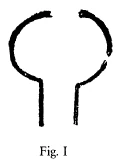
[ 42 ] Nun wird man schon mit etwa achtjährigen Kindern ganz gut Übungen der folgenden Art machen können, wenn sie auch zunächst ungeschickt sind: Man stelle zum Beispiel vor das Kind diese Figur hin (Fig. I, das Dunklere). Und nun versuche man auf alle Weise, das Kind dahin zu bringen, daß es aus sich selbst heraus das Gefühl bekommt: Das ist nicht fertig, da fehlt etwas. Man wird natürlich nach der Individualität des Kindes vorgehen müssen, um das Gefühl dieses Fehlens hervorzubringen. Man wird zum Bei spiel zu dem Kinde sagen müssen: Sieh einmal diese linke Hälfte, die geht doch bis da herunter, und die rechte nur bis dahin. Das ist doch nicht schön, wenn das eine ganz bis da herunter geht, das andere nicht, nur bis daher. Und so wird man das Kind allmählich dazu bringen, daß es diese Figur ergänzt, daß es wirklich empfindet: Die Figur ist nicht fertig, Fig. I die muß ergänzt werden. Und es wird das Kind dazu gebracht werden können, dieses zu der Figur hinzuzusetzen. Ich zeichne das rot, was das Kind natürlich auch weiß zeichnen kann; was von dem Kinde ergänzt werden soll, ist von mir durch eine andere Farbe angedeutet (Fig. I, heller). Das Kind wird sich zunächst höchst ungeschickt benehmen, aber es wird nach und nach im Ausgleichen von etwas ein denkendes Anschauen und ein anschauendes Denken entwickeln. Das Denken wird ganz im Bild bleiben.
[ 42 ] Even with children as young as eight, it is quite possible to do exercises of the following kind, even if they are clumsy at first: For example, place this figure in front of the child (Fig. I, the darker one). And now try in every way to guide the child so that they develop the feeling on their own: “This isn’t finished; something is missing.” Of course, you’ll have to proceed according to the child’s individuality in order to bring out this sense of something missing. For example, you’ll have to say to the child: “Look at this left half—it goes all the way down to there, but the right half only goes as far as here.” “That’s not nice—one goes all the way down to there, but the other doesn’t, only up to here.” And in this way, one will gradually lead the child to complete this figure, so that the child truly feels: “The figure isn’t finished; Fig. I needs to be completed.” And the child can be guided to add this to the figure. I’ll draw the part in red—which the child, of course, can also draw; what the child is to complete is indicated by me in a different color (Fig. I, lighter). At first, the child will be extremely clumsy, but little by little, in the process of balancing things out, they will develop a thinking gaze and a gazing thought. The thinking will remain entirely within the picture.
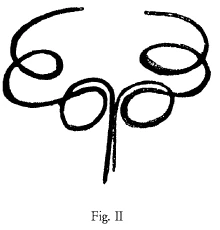
[ 43 ] Und habe ich einmal ein paar Kinder in der Klasse dazu gebracht, in dieser einfachen Weise die Dinge zu ergänzen, dann werde ich weiter vordringen können. Dann werde ich vielleicht noch diese Figur dem Kinde vorzeichnen (Fig. ID). Nun werde ich diese komplizierte Figur als unfertig von dem Kinde empfinden lassen und das Kind veranlassen, nun dasjenige, was geschehen kann zur Fertigstellung, zu machen (Fig. II, heller). Auf diese Weise werde ich in dem Kinde Formgefühl hervorrufen, Formgefühl, durch welches das Kind veranlaßt wird, Symmetrie, Harmonie zu empfinden.
[ 43 ] And once I have gotten a few children in the class to complete the figures in this simple way, I will be able to move forward. Then I might even sketch this figure for the child (Fig. ID). Now I will have the child perceive this complicated figure as unfinished and encourage the child to do what is necessary to complete it (Fig. II, lighter). In this way, I will awaken a sense of form in the child—a sense of form that prompts the child to perceive symmetry and harmony.
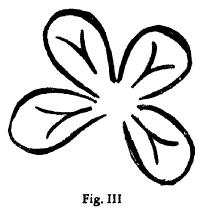
[ 44 ] Das kann nun wiederum weiter ausgebildet werden. Ich kann zum Beispiel dem Kinde ein Gefühl davon hervorrufen, welches die innere an- Fig. I geschaute Gesetzmäßigkeit dieser Figur ist (Fig. III). Ich bringe dem Kind diese Figur vor. Das Kind bekommt schon ein Gefühl davon, daß diese Linie hier zusammengeht, die andere Linie hier auseinandergeht. Dieses Sichschließen und Auseinandergehen, das ist dasjenige, was ich dem Kinde gut beibringen kann.
[ 44 ] This, in turn, can be further developed. For example, I can help the child develop a sense of the inner regularity inherent in this figure (Fig. I) (Fig. III). I present this figure to the child. The child already gets a sense that this line converges here, while the other line diverges here. This converging and diverging—that is precisely what I can teach the child well.
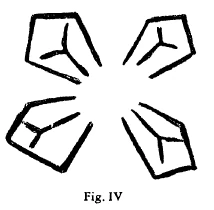
[ 45 ] Jetzt gehe ich dazu über und mache folgende Figur dem Kinde vor (Fig. IV): Ich mache die krummen Linien zu geraden mit Ecken, und ich veranlasse das Kind, nun selber diese innere Linie in der entsprechenden Weise zu machen. Man wird manche Mühe haben mit achtjährigen Kindern; aber gerade bei Achtjährigen ist dann der Erfolg ein außerordentlich großer, wenn man sie veranlassen kann, auch wenn man es vorher gezeigt hat, bei weiteren Figuren das selber zu machen. Man muß das Kind dazu bringen, nun seinerseits die inneren Figuren nachzumachen, mit demselben Charakter, nur in der Eckigkeit vorzugehen.
[ 45 ] Now I move on to this and demonstrate the following figure to the child (Fig. IV): I turn the curved lines into straight lines with corners, and I encourage the child to draw this inner line in the same way. One will encounter some difficulty with eight-year-olds; but it is precisely with eight-year-olds that the success is extraordinarily great if one can encourage them—even after having demonstrated it beforehand—to do this themselves with subsequent figures. One must get the child to now copy the inner figures on their own, maintaining the same character but proceeding with angular lines.
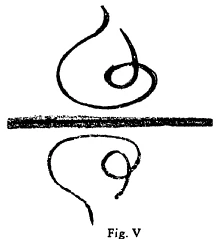
[ 46 ] Auf diese Weise erzieht man das Kind zum wirklichen Formgefühl, zum Empfinden in der Harmonie, in der Symmetrie, in dem Sichentsprechen und so weiter. Und dann kann man von solchen Dingen dazu übergehen, bei dem Kinde eine Vorstellung davon hervorzurufen, wie sich etwas spiegelt. Wenn hier (Fig. V) eine Wasseroberfläche ist, hier irgendein Gegenstand, ruft man in dem Kinde die Vorstellung hervor und zeigt ihm, wie sich das spiegelt. - Auf diese Weise kann man das Kind nach und nach in die Harmonien hineinführen, die sonst auch in der Welt herrschen.
[ 46 ] In this way, one teaches the child a genuine sense of form—an appreciation of harmony, symmetry, mutual correspondence, and so on. And then, building on these concepts, one can move on to helping the child develop a mental image of how things are reflected. If there is a water surface here (Fig. V) and some object here, one evokes a mental image in the child and shows him or her how it is reflected. — In this way, one can gradually introduce the child to the harmonies that otherwise prevail in the world.
[ 47 ] Man kann dann auch dazu übergehen, das Kind an sich selber geschickt werden zu lassen im anschaulichen bildhaften Denken: Zeige mir mit deiner linken Hand das rechte Auge! Zeige mir mit deiner rechten Hand das rechte Auge! Zeige mir mit deiner rechten Hand das linke Auge! Zeige mir von rückwärts aus mit der rechten Hand die linke Schulter! Mit der linken Hand die rechte Schulter! Zeige mir mit der rechten Hand dein linkes Ohr! Zeige mir mit der linken Hand das linke Ohr! Zeige mir mit der rechten Hand deine rechte große Zehenspitze und so weiter. Man kann also das Kind an sich selber die kuriosesten Übungen machen lassen. Zum Beispiel auch: Beschreibe einen Kreis mit deiner rechten Hand um die linke! Beschreibe einen Kreis mit deiner linken Hand um die rechte! Beschreibe zwei Kreise, die die Hände ineinander bilden! Beschreibe zwei Kreise, mit der einen Hand nach der einen Seite, mit der anderen Hand nach der anderen Seite! Man lasse es immer schneller und schneller machen. Bewege schnell den mittleren Finger deiner rechten Hand! Bewege schnell den Daumen der rechten Hand! Bewege schnell den kleinen Finger!
[ 47 ] You can then move on to having the child practice visual, pictorial thinking: Show me your right eye with your left hand! Show me your right eye with your right hand! Show me your left eye with your right hand! Show me your left shoulder from behind with your right hand! Show me your right shoulder with your left hand! Show me your left ear with your right hand! Show me your left ear with your left hand! Show me the tip of your right big toe with your right hand, and so on. So you can have the child do the most curious exercises on themselves. For example: Draw a circle with your right hand around your left! Draw a circle with your left hand around your right! Draw two circles with your hands interlocked! Draw two circles, with one hand going one way and the other hand going the other way! Have them do it faster and faster. Move the middle finger of your right hand quickly! Move the thumb of your right hand quickly! Move your little finger quickly!
[ 48 ] So läßt man am Kinde selber mit rascher Geistesgegenwart allerlei Übungen machen. Was ist der Erfolg solcher Übungen? Wenn ein Kind solche Übungen um das 8. Lebensjahr herum macht, so lernt es durch solche Übungen denken, und zwar denken für das Leben. Wenn man direkt denken lernt durch den Kopf, so ist das nicht denken für das Leben, dann wird man später denkmüde. Dagegen wenn man in dieser Weise am eigenen Körper in schneller Geistesgegenwart auszuführende Bewegungen macht, bei denen nachgedacht werden muß, dann wird man später lebensklug; man wird einen Zusammenhang bemerken können zwischen der Lebensklugheit eines Menschen im 35., 36. Jahre und dem, was man an solchen Übungen hat machen lassen im 7. und 8. Jahre. So hängen eben die verschiedenen Epochen des Lebens zusammen.
[ 48 ] In this way, one has the child perform all sorts of exercises on its own with quick presence of mind. What is the result of such exercises? When a child does these exercises around the age of 8, it learns through them to think—specifically, to think for life. If one learns to think directly with the mind, that is not thinking for life; one will later grow weary of thinking. On the other hand, if one performs movements with one’s own body in this way—requiring quick presence of mind and careful thought—one will later become wise in the ways of the world; one will be able to discern a connection between a person’s wisdom at the age of 35 or 36 and the exercises they were made to do at the ages of 7 and 8. This is precisely how the various stages of life are interconnected.
[ 49 ] Und aus dieser Menschenkenntnis heraus muß) man versuchen, wirklich das einzurichten, was man an das Kind heranzubringen hat.
[ 49 ] And based on this understanding of human nature, one must) try to truly establish what one needs to impart to the child.
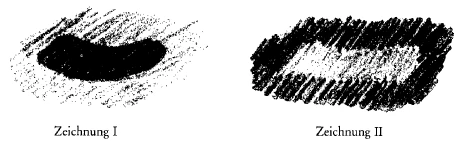
[ 50 ] So kann man auch gewisse Harmonisierungen in den Farben erreichen. Nehmen wir an, ich mache zunächst mit dem Kinde die Übung, daß ich solch eine Malerei bringe (siehe Zeichnung I). Jetzt bringen wir ihm bei, indem wir sein Gefühl erregen, daß neben dieser roten Farbfläche (innen) eine grüne Farbfläche sich harmonisch gut fühlen läßt. Das muß natürlich mit Farben ausgeführt werden, dann sieht man es besser. Jetzt versucht man dem Kinde klarzumachen: Ich werde die Sache einmal umdrehen. Schau, ich mache hier (innen) das Grün (Zeichnung II); was wirst du mir da rundherum machen? - Dann wird das Kind rundherum rot malen. Man bekommt dadurch, daß man diese Dinge macht, das Kind dazu, allmählich die Harmonik der Farben zu empfinden. Das Kind lernt wissen: Wenn ich hier in der Mitte eine rote Fläche habe, ringsherum Grün (Zeichnung I), so muß ich, wenn nun das Rot grün wird, das Grüne rot machen. Dieses Sichentsprechen von Farbe und Form auf das Kind wirken lassen, das ist von einer ungeheuren Bedeutung gerade in diesem Lebensalter gegen das 8. Jahr hin.
[ 50 ] This is also a way to achieve a certain harmony in colors. Let’s say I first do the following exercise with the child: I bring in a painting like this (see Drawing I). Now we teach the child—by stimulating their senses—that a green area of color next to this red area (inside) creates a sense of harmony. Of course, this must be done with actual colors; that way, it’s easier to see. Now we try to explain to the child: I’m going to turn the picture around. Look, I’ll paint the green here (inside) (Drawing II); what will you paint around it? — Then the child will paint red all around it. By doing these things, we help the child gradually develop a sense of color harmony. The child learns to understand: If I have a red area here in the middle, surrounded by green (Drawing I), then when the red turns green, I must make the green red. Allowing this interplay of color and form to take effect on the child is of immense importance, especially at this age, around the 8th year.
[ 51 ] Was man braucht, um mit einem solchen innerlich zu gestaltenden Unterricht vorwärtszukommen, das ist - ja, ich muß es durch ein Negatives ausdrücken -, das ist: kein Stundenplan! In der Waldorfschule haben wir sogenannten Epochenunterricht, keinen Stundenplan. Die Beschäftigung mit einem Gegenstande wird vier bis sechs Wochen fortgesetzt. Wir haben nicht von 8 bis 9 Uhr Rechnen, von 9 bis 10 Uhr Lesen, von 10 bis 11 Uhr Schreiben, sondern wir nehmen eine Materie, mit der wir uns fortlaufend im Hauptunterricht beschäftigen, Morgen für Morgen vier Wochen lang. Erst dann wechseln wir, wenn die Kinder entsprechend weit gekommen sind. Wir wechseln niemals so ab, daß wir von 8 bis 9 Uhr Rechnen und von 9 bis 10 Uhr Lesen haben, sondern wir treiben Rechnen sechs Wochen lang für sich, wir treiben ein anderes Fach auch vier oder sechs Wochen lang für sich, je nachdem, was es ist. Wir haben nur in einzelnen Fällen, von denen ich noch sprechen werde, Stundenpläne. In der Hauptsache, bei dem sogenannten Hauptunterricht, haben wir strenge den Epochenunterricht eingeführt. Diese Epochen hindurch nehmen wir nur Gleichartiges, wie eines aus dem anderen hervorgeht.
[ 51 ] What is needed to make progress with this kind of internally structured instruction is—yes, I must express it in negative terms—is: no class schedule! In Waldorf schools, we have what is called “block instruction,” not a class schedule. We focus on a single subject for four to six weeks. We don’t have math from 8 to 9 a.m., reading from 9 to 10 a.m., and writing from 10 to 11 a.m.; instead, we take a subject and work on it continuously in the main lesson, morning after morning for four weeks. Only then do we move on, once the children have progressed far enough. We never alternate in such a way that we have math from 8 to 9 a.m. and reading from 9 to 10 a.m.; instead, we focus on math for six weeks on its own, and we focus on another subject for four or six weeks on its own, depending on what it is. We have timetables only in specific cases, which I will discuss later. For the most part, in what is known as “main lessons,” we have strictly implemented block teaching. Throughout these blocks, we focus only on related topics, as one topic flows naturally into the next.
[ 52 ] Dadurch entheben wir das Kind des ungeheuer innerlich seelisch Störenden, daß es in einer Stunde Dinge auf seine Seele wirken lassen muß, die in der nächsten Stunde wieder ausgelöscht werden. Diese Dinge können nicht vermieden werden, wenn nicht dieser sogenannte Epochenunterricht eingeführt wird.
[ 52 ] In this way, we spare the child from the immense inner emotional distress caused by having to allow things to affect their soul in one hour only to have them erased again the very next hour. These things cannot be avoided unless this so-called “epoch teaching” is introduced.
[ 53 ] Gewiß, es wird gegen diesen Epochenunterricht vielfach eingewendet, daß die Kinder die Dinge wieder vergessen. Allein das ist ja eine Sache, die nur für einzelne Unterrichtsfächer, zum Beispiel für das Rechnen in Betracht kommt, und da kann man durch kleine Wiederholungen die Sache ausbessern. Für die meisten Unterrichtsfächer kann überhaupt dieses Vergessen keine große Rolle spielen, jedenfalls nicht im Verhältnis zu dem, was gewonnen wird, an Ungeheurem gewonnen wird dadurch, daß das Kind konzentriert eine gewisse Epoche hin bei einer Materie festgehalten wird.
[ 53 ] Certainly, a common objection to this period-based teaching is that children forget what they’ve learned. However, this is an issue that applies only to certain subjects—such as arithmetic—and even there, the problem can be remedied through brief review sessions. For most subjects, this forgetting does not play a major role at all—at least not in comparison to what is gained, the immense benefits gained by keeping the child focused on a particular subject area for a certain period of time.