

The Art of Education
Based on Understanding Human Nature
GA 311
15 August 1924, Torquay
Translated by Steiner Online Library
Fourth Lecture
[ 1 ] I have explained how, in the years between the loss of baby teeth and the ages of 9 and 10, one should strive to present to the child—in a descriptive, pictorial form—all that which the child’s soul is then meant to absorb, and to absorb it in such a way that what is absorbed continues to have an effect—and can continue to have an effect—in a natural way throughout the child’s entire life. Of course, this is only possible if one does not awaken lifeless mental images and feelings in the child, but rather those that are alive.
[ 2 ] To be able to do this, one must first develop a sense of the life of the soul’s inner content. As a teacher and educator, one must have patience with one’s own self-education, with awakening in the soul that which can truly sprout and grow there. In this regard, one will be able to make the most beautiful discoveries within oneself. One must simply not lose heart right at the very beginning in order to make such discoveries.
[ 3 ] When a person undertakes any activity that is meant to be an intellectual endeavor, they should, under all circumstances, be able to tolerate being clumsy. Those who cannot tolerate being clumsy—who cannot tolerate doing things poorly and imperfectly at first—will never truly be able to do them perfectly from within. And especially in the teaching and educational professions, we must first kindle within our own souls that which we are actually meant to practice—kindle it properly. If we succeed in devising vivid illustrations once or twice—and see that they resonate with the children—then we will make a remarkable discovery about ourselves: We will see that inventing such images becomes easier and easier for us, and that, little by little, we become as inventive as we never would have imagined ourselves to be.
[ 4 ] But that means having the courage to stumble along at first—perhaps very far off the mark. One might say, “Then I shouldn’t become a teacher at all if I approach the children so clumsily at first!” Yes, that’s where the anthroposophical worldview must carry you forward. You have to tell yourself: Something is leading me karmically to the children, so that even as a clumsy educator, I can be with them at some point. And those with whom I must not be clumsy—they will be brought to me by karma only in later years.
[ 5 ] Teachers and educators need this courageous willingness to venture into life—after all, the question of education is not really a matter for teachers, but for children.
[ 6 ] And so I would like to give you, in a sense, an example of something that can sink so deeply into a child’s soul that it grows with the child, and that even later on, one is still able to return to it and draw later sensations and feelings from those originally given.
[ 7 ] Nothing is more useful and fruitful in the classroom than presenting a child with something through pictures between the ages of 7 and 8 and then, perhaps when the child is 13 or 14, being able to revisit it in some form. It is precisely for this reason that we at the Waldorf School try to keep the children with the same teacher for as long as possible. When children enter school at age 7, they are assigned to a teacher. That teacher then moves up with the classes as far as possible. This is beneficial because it allows the seeds of knowledge sown in the child to repeatedly serve as the basis for educational materials.
[ 8 ] Let’s imagine we’re presenting a story with pictures to a seven- or eight-year-old child. The child does not need to understand the pictures right away. I will explain why that is later. The point is simply that the child is captivated by the fact that the educator presents the story, I would say, in a graceful manner. Let’s suppose I tell the child the following:
[ 9 ] “Once upon a time, in a forest where the sun shone through the trees, there was a violet—a humble violet—growing beneath a tree with large leaves. And the violet could see through a gap in the tree’s canopy. And as it looked through the wide opening in the forest, the violet saw the blue sky. The little violet saw the blue sky for the first time, for it had just bloomed that very morning. Now the violet was startled when it saw the blue sky and became very frightened. But it did not yet know why it had become so frightened.
[ 10 ] A dog ran by—a dog that didn’t look very nice, that looked a bit snappy and mean. And the violet asked the dog, “Tell me, what is that up there, that blue thing that looks just like me?”—for the sky, too, was blue, just as the violet was blue.
[ 11 ] And the dog, in his malice, said, “Oh, that’s a huge violet, just like you, and this huge violet has grown so big that it can give you a mighty good beating.”
[ 12 ] And the little violet became even more frightened, for it believed that the violet up there had grown so large because it was meant to strike it. And the violet drew its petals tightly together and refused to look up at the big violet anymore, hiding under a large leaf from the tree that had just been swept down by a gust of wind. And so it remained all day, hiding in fear from the big sky violet.
[ 13 ] And when the next morning came, the violet hadn’t slept at all that night, for it had been thinking the whole time about what would happen with the big blue sky violet that was supposed to strike it. And it kept expecting the first blow to come any minute now, but it hadn’t come.
[ 14 ] And in the morning, the violet crawled out, because it wasn’t tired at all—it had been thinking all night long and was refreshed and not tired—violets get tired when they sleep and don’t get tired when they don’t sleep—and the first thing the violet saw was the rising sun and the dawn. And when the violet saw the dawn, it wasn’t afraid at all. And it was inwardly delighted and happy about the dawn.
[ 15 ] Little by little, as the dawn light faded, the whitish-blue sky reappeared. It grew bluer and bluer. And the violet couldn't help but think again of what the dog had said—that it would grow into a big violet all on its own.
[ 16 ] And lo and behold, a lamb came by. And now the violet wanted to ask again what that thing up there was. “What is that up there?” said the violet. Then the lamb said, “That’s a big violet, blue just like you.” - Now the violet grew afraid again and thought the lamb would give it the same answer as the mean dog had. But the lamb was kind and gentle. And because it looked at the violet with such kind and gentle eyes, the violet asked once more: “Oh, my dear lamb, will that big violet up there hit me?”
[ 17 ] “Oh no,” replied the lamb, “it won't hurt you. It's a big violet, and its love is so many times greater than your own love—just as it is bluer than you are, with your little form.”
[ 18 ] And then the little violet understood right away that this was a big violet that would never wither, but had so much blue that it could hold so much more love, and that the big violet would protect the little violet from everything hostile in the world. And then the little violet felt so at ease, because everything it saw as blue in the big sky violet seemed to it like divine love, flowing toward it from all sides. And the little violet always looked up, as if it wanted to pray to the God of Violets.”
[ 19 ] If you tell the children something like this, they will undoubtedly listen. They always listen to things like that. However, you have to tell the story in such a way that, once the children have heard it, they feel a slight need to process it emotionally and inwardly. That is very important. And it all depends on how well you’re able to maintain discipline among the children through your own feelings. That’s why, as soon as you discuss something like what I just discussed, you must also emphasize the importance of discipline right alongside it.
[Error: DeepL copy failed][ 20 ] We once had a teacher at the Waldorf School who was an excellent storyteller—truly excellent—but she did not make the impression on the children that they looked up to her with a natural, spontaneous affection. What was the result? Whenever she told one inspiring story, the children immediately wanted a second one. And the teacher gave in; she had prepared a second one. Now the children wanted a third one right away; the teacher gave in; she had prepared a third one. And so it eventually came to pass that this teacher gradually could no longer prepare enough. - After all, it is also necessary not to constantly “pump” information into the children as if with a steam pump—we will hear shortly how one should vary the approach—but rather to take it a step further: to first let the child ask a question, to observe a child’s face and expressions to see if they want to ask something. We let the child ask the question and then discuss it with the child, drawing on the story that was just told.
[ 22 ] For example, there was a time when I really admired one of our teachers. There was a real rascal in the class—he’s actually become quite well-behaved now after a few years—and lo and behold, while the teacher was busy with a child in the front row, he quickly jumped out of his seat and smacked the teacher on the back. Yes, if the teacher had made a big deal out of it, the boy would have remained undisciplined. But the teacher acted as if he hadn’t noticed. There are certain things you simply don’t need to notice; instead, you can have a positive influence through the way you engage with that child in a positive manner. As a rule, noticing the negative is a very bad thing.
[ 23 ] If you can’t maintain discipline, if you don’t have the natural authority—how one acquires it is something I’ll discuss later—then you end up with exactly what happened with that teacher. The teacher in question could string one story after another; the children were always on the edge of their seats, but the tension was never allowed to let up. Now, whenever this teacher wanted to shift to a more relaxed phase—which is also necessary, after all—because otherwise the children would eventually become complete bundles of nerves—one child would step out of the row of desks and start playing, another would go off to do some gymnastics, a third would do eurythmy, a fourth would get into a fight with another; another ran out the door, and soon there was such a commotion that it was impossible to get the children back together to hear the rest of the exciting story.
[ 24 ] It all comes down to the context in which the subject of goodness is taught in the classroom. You can really have the strangest experiences in this regard. It really boils down to whether or not the teacher has enough self-confidence.
[ 25 ] The teacher must enter the classroom with such a disposition, in such a state of mind, that she is able to truly immerse herself completely in the children’s souls. How does one achieve this? By getting to know one’s students. You will see that, in a relatively short time, it is possible to develop this skill, even if you have fifty or more students in the class. You get to know your students; you learn to create a mental image of them; you know each child’s temperament, their talents, their facial features, and so on.
[ 26 ] At our teachers’ conferences—which are the very heart of our entire teaching—it is precisely these individual children’s unique qualities that are carefully discussed, so that observing these individual qualities forms the essence of what the teachers themselves learn during the course of these conferences. Through this process, the teachers refine their skills. The child actually presents a great many puzzles, and in solving these puzzles, the sensibilities that must be brought into the classroom develop.
[ 27 ] That is why, as one sometimes observes, when a teacher is in the classroom who is not inwardly filled with what lives within the children, the children start squabbling within five minutes of the lesson beginning; they pay no attention at all and just fool around. One can see that things don’t work out with such a teacher; she must be replaced by another. With the other teacher, the entire class is exemplary from the very first day!
[ 28 ] You can experience these things. It depends solely on the teacher’s state of mind—whether that state of mind is truly such that the teacher is inclined, while meditating in the morning, to let the entire group of children, with all their individual quirks, pass through their soul.
[ 29 ] You might say, “That takes an hour.” It doesn’t. If it takes an hour, then you simply can’t do it. If it takes ten minutes or a quarter of an hour, then you can do it. Certainly, it will be difficult at first, but little by little, you must acquire this inner psychological insight that enables the teacher to quickly grasp the big picture.
[ 30 ] You see, in order to create the moods necessary to instill this pictorial narrative quality in children, one must, above all, have a keen eye for the children’s temperaments. That is why it is already part of the methodology of the entire educational and instructional process to first address the children’s temperaments appropriately. And it turns out that the best way to address these temperaments is, first of all, to group children of the same temperament together. For one thing, it makes things clearer for the teacher when he knows that over there are the choleric children, over there the melancholic ones, and over there the sanguine ones. This gives him a point of reference for understanding the entire class.
[ 31 ] Simply by observing the child’s temperament and placing him or her according to that temperament, one has, in turn, done something for oneself to maintain the necessary, natural authority in the classroom. Things usually stem from different underlying causes than one might think. And teachers and educators must do this inner work on themselves first.
[ 32 ] When you bring phlegmatic people together, they correct each other. They become so bored with one another that, over time, they develop an aversion to phlegmatic behavior; then things get better and better. The choleric types beat and shove one another and eventually grow weary of the beatings and shoves from the other choleric types. And so the individual temperaments, precisely when they are together, temper each other exceptionally well.
[ 33 ] But the teacher himself, too, by discussing with the children things such as the story just told, should develop within himself the natural, instinctive gift of treating each child according to his or her temperament.
[ 34 ] If I have a phlegmatic child, whenever I speak to the child in a way that even remotely resembles such a story, I treat the child with even greater phlegmatism than the child possesses. With a sanguine child—who is always rushing from one impression to the next, unable to hold on to any of them—I try to make the impressions change even faster than the child processes them. With a choleric child, try to teach them things in as abrupt a manner as possible—so that you yourself become choleric—and you will see how, little by little, the child’s choleric nature is repelled by the educator’s demonstrated choleric nature. Like must be treated with like. But one must not become ridiculous in the process. And so one gradually succeeds in creating the mood in which such a story can not only be told but also discussed.
[ 35 ] But let’s discuss a story first before having the students repeat it. The worst method is to present such a story and then say: “Hey, Edith Müller, you have to retell this to me now.”—That makes no sense at all. The matter only becomes meaningful if it is discussed for a while—whether sensibly or foolishly; you don’t always have to speak sensibly in class—you can also speak foolishly, and you’ll usually do that at first. This allows the child to make the matter their own. And then, if necessary, you can have them retell it. But that’s the less important part. For, at first, what matters isn’t that the child commits such a thing to memory. Even at this age—between the loss of baby teeth and the age of 9 or 10, which I’m talking about now—that matters very little; it is actually better to assume that the child will retain in memory what sticks with them, and whatever they forget, well, let them forget it. The development of memory can be addressed through other instructional materials rather than these stories, as I will explain further.
[ 36 ] Now let’s briefly address the question: Why did I choose this particular story with this specific content? I did so because the mental images presented in this story can grow along with the child. The story contains all sorts of elements that you can return to later: The little violet becomes frightened because it sees the big violet in the sky. There’s no need to discuss this with a small child just yet. Later, when it becomes necessary to cover more complex material, you can revisit this point whenever fear arises in the context of other topics. In this story, both small and large things appear. Small and large things occur repeatedly—over and over again—in life and interact with one another; you can return to them later. But what appears in this story first and foremost is the dog’s biting advice, followed by the lamb’s benevolent, loving advice. What reflections can be drawn from this later, when the story is revisited—after the child has come to cherish it in their heart and is ready for it—regarding good and evil, and the opposing feelings that take root in the soul! Even with a very mature child, one can return to this simple, childlike story and make it clear to the child that often we are afraid of something simply because we misunderstand it, because it is portrayed in a negative light. This ambivalence in emotional life—which one may later need to discuss in connection with this or that subject matter—can be discovered in the most wonderful way when one returns to this story later in life.
[ 37 ] And in religious education—which, of course, must come later—how wonderful it is to use this story right now, by showing how the child develops religious feelings through the larger being who acts as the little one’s protector, and how one must cultivate genuine religious feeling by finding within oneself that which manifests as protective in the larger being. The little violet is a small blue being. The sky is a large blue being. Therefore, the sky is the violet’s blue God.
[ 38 ] This can be used at various levels in religious education. How beautifully one can later build on this, draw comparisons, and show how the human inner self is itself divine! Later, you can say to the child: Look, this big sky violet—the violet God—is completely blue, stretching out into all directions. Now imagine cutting out a small piece of it; that is the little violet. In this way, God is as vast as the ocean of the world. Your soul is a drop of God. But just as the water of the sea, when it forms a drop, is the same water as the great sea, so your soul is the same as the great God—only a small drop.
[ 39 ] And so, if you find the right images, you will be able to structure the entire childhood period in such a way that you can return to these images later, when the child is more mature. But the key is that the teacher himself must find pleasure and appeal in this imagery. And you will see that once you have developed a dozen such stories through your imagination, there will be no escaping them; they will follow you wherever you go and wherever you stand. For the human soul is an inexhaustible source that can bring forth these stories once what is to be brought forth has been elicited from it at the very first stage.
[ 40 ] Human beings are simply so lazy that they are unwilling to make the initial effort required to bring forth what lies within their souls.
[ 41 ] Let us now turn our attention to another branch of pictorial teaching and education. The point here is that, especially in very young children, the intellect—the understanding that functions separately within the soul—should not yet be developed in the strict sense, but rather all thinking should be developed through the concrete and the pictorial.
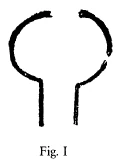
[ 42 ] Even with children as young as eight, it is quite possible to do exercises of the following kind, even if they are clumsy at first: For example, place this figure in front of the child (Fig. I, the darker one). And now try in every way to guide the child so that they develop the feeling on their own: “This isn’t finished; something is missing.” Of course, you’ll have to proceed according to the child’s individuality in order to bring out this sense of something missing. For example, you’ll have to say to the child: “Look at this left half—it goes all the way down to there, but the right half only goes as far as here.” “That’s not nice—one goes all the way down to there, but the other doesn’t, only up to here.” And in this way, one will gradually lead the child to complete this figure, so that the child truly feels: “The figure isn’t finished; Fig. I needs to be completed.” And the child can be guided to add this to the figure. I’ll draw the part in red—which the child, of course, can also draw; what the child is to complete is indicated by me in a different color (Fig. I, lighter). At first, the child will be extremely clumsy, but little by little, in the process of balancing things out, they will develop a thinking gaze and a gazing thought. The thinking will remain entirely within the picture.
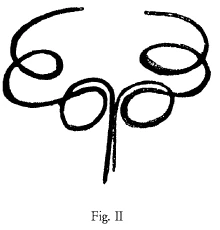
[ 43 ] And once I have gotten a few children in the class to complete the figures in this simple way, I will be able to move forward. Then I might even sketch this figure for the child (Fig. ID). Now I will have the child perceive this complicated figure as unfinished and encourage the child to do what is necessary to complete it (Fig. II, lighter). In this way, I will awaken a sense of form in the child—a sense of form that prompts the child to perceive symmetry and harmony.
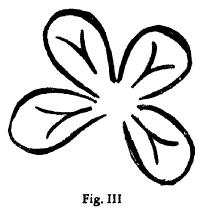
[ 44 ] This, in turn, can be further developed. For example, I can help the child develop a sense of the inner regularity inherent in this figure (Fig. I) (Fig. III). I present this figure to the child. The child already gets a sense that this line converges here, while the other line diverges here. This converging and diverging—that is precisely what I can teach the child well.
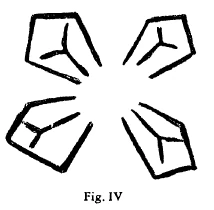
[ 45 ] Now I move on to this and demonstrate the following figure to the child (Fig. IV): I turn the curved lines into straight lines with corners, and I encourage the child to draw this inner line in the same way. One will encounter some difficulty with eight-year-olds; but it is precisely with eight-year-olds that the success is extraordinarily great if one can encourage them—even after having demonstrated it beforehand—to do this themselves with subsequent figures. One must get the child to now copy the inner figures on their own, maintaining the same character but proceeding with angular lines.
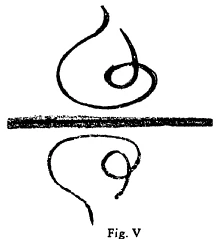
[ 46 ] In this way, one teaches the child a genuine sense of form—an appreciation of harmony, symmetry, mutual correspondence, and so on. And then, building on these concepts, one can move on to helping the child develop a mental image of how things are reflected. If there is a water surface here (Fig. V) and some object here, one evokes a mental image in the child and shows him or her how it is reflected. — In this way, one can gradually introduce the child to the harmonies that otherwise prevail in the world.
[ 47 ] You can then move on to having the child practice visual, pictorial thinking: Show me your right eye with your left hand! Show me your right eye with your right hand! Show me your left eye with your right hand! Show me your left shoulder from behind with your right hand! Show me your right shoulder with your left hand! Show me your left ear with your right hand! Show me your left ear with your left hand! Show me the tip of your right big toe with your right hand, and so on. So you can have the child do the most curious exercises on themselves. For example: Draw a circle with your right hand around your left! Draw a circle with your left hand around your right! Draw two circles with your hands interlocked! Draw two circles, with one hand going one way and the other hand going the other way! Have them do it faster and faster. Move the middle finger of your right hand quickly! Move the thumb of your right hand quickly! Move your little finger quickly!
[ 48 ] In this way, one has the child perform all sorts of exercises on its own with quick presence of mind. What is the result of such exercises? When a child does these exercises around the age of 8, it learns through them to think—specifically, to think for life. If one learns to think directly with the mind, that is not thinking for life; one will later grow weary of thinking. On the other hand, if one performs movements with one’s own body in this way—requiring quick presence of mind and careful thought—one will later become wise in the ways of the world; one will be able to discern a connection between a person’s wisdom at the age of 35 or 36 and the exercises they were made to do at the ages of 7 and 8. This is precisely how the various stages of life are interconnected.
[ 49 ] And based on this understanding of human nature, one must) try to truly establish what one needs to impart to the child.
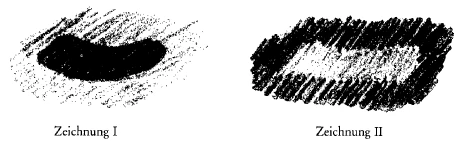
[ 50 ] This is also a way to achieve a certain harmony in colors. Let’s say I first do the following exercise with the child: I bring in a painting like this (see Drawing I). Now we teach the child—by stimulating their senses—that a green area of color next to this red area (inside) creates a sense of harmony. Of course, this must be done with actual colors; that way, it’s easier to see. Now we try to explain to the child: I’m going to turn the picture around. Look, I’ll paint the green here (inside) (Drawing II); what will you paint around it? — Then the child will paint red all around it. By doing these things, we help the child gradually develop a sense of color harmony. The child learns to understand: If I have a red area here in the middle, surrounded by green (Drawing I), then when the red turns green, I must make the green red. Allowing this interplay of color and form to take effect on the child is of immense importance, especially at this age, around the 8th year.
[ 51 ] What is needed to make progress with this kind of internally structured instruction is—yes, I must express it in negative terms—is: no class schedule! In Waldorf schools, we have what is called “block instruction,” not a class schedule. We focus on a single subject for four to six weeks. We don’t have math from 8 to 9 a.m., reading from 9 to 10 a.m., and writing from 10 to 11 a.m.; instead, we take a subject and work on it continuously in the main lesson, morning after morning for four weeks. Only then do we move on, once the children have progressed far enough. We never alternate in such a way that we have math from 8 to 9 a.m. and reading from 9 to 10 a.m.; instead, we focus on math for six weeks on its own, and we focus on another subject for four or six weeks on its own, depending on what it is. We have timetables only in specific cases, which I will discuss later. For the most part, in what is known as “main lessons,” we have strictly implemented block teaching. Throughout these blocks, we focus only on related topics, as one topic flows naturally into the next.
[ 52 ] In this way, we spare the child from the immense inner emotional distress caused by having to allow things to affect their soul in one hour only to have them erased again the very next hour. These things cannot be avoided unless this so-called “epoch teaching” is introduced.
[ 53 ] Certainly, a common objection to this period-based teaching is that children forget what they’ve learned. However, this is an issue that applies only to certain subjects—such as arithmetic—and even there, the problem can be remedied through brief review sessions. For most subjects, this forgetting does not play a major role at all—at least not in comparison to what is gained, the immense benefits gained by keeping the child focused on a particular subject area for a certain period of time.