

The Art of Education
Based on Understanding Human Nature
GA 311
16 August 1924, Torquay
Translated by Steiner Online Library
Fifth Lecture
[ 1 ] If one wants to teach a child something, one must already understand something of the true nature of the matter, so as not to focus, in teaching and upbringing, on things that are far removed from life. Everything that is close to life can be understood. One could also say: What one truly understands must be close to life. Abstractions are not close to life.
[ 2 ] The fact is that today, teachers and educators often have only abstract notions of certain things from the outset; they are not closely connected to real life when it comes to certain matters. This creates the greatest difficulties for education and instruction. Just consider the following: Try to think about how you came to count things; what it actually means when you count. You will probably find that the thread of your inquiry breaks off somewhere—that you have learned to count, but do not really know what you are doing when you count.
[ 3 ] Now all sorts of theories are devised for pedagogy—on how to teach a child the concept of numbers and how to teach counting—and people usually follow these theories. Even if this approach yields outward success, it fails to reach the whole person—this kind of counting, or other such matters that are remote from real life, simply cannot do so. Modern times have, in fact, demonstrated precisely how much they live in abstractions by inventing things like the calculator for classroom use. People in commercial offices may use calculators as they please—that is none of our concern—but in the classroom, the calculator, which appeals exclusively to the intellect, prevents from the outset an approach to numbers that is appropriate to the child’s nature.
[ 4 ] The point is to truly draw counting from real life. Above all, it will be important to realize from the outset that it cannot possibly be expected that the child will fully understand everything that is taught to him or her. The child must accept much on authority, but must do so naturally and appropriately.
[ 5 ] Therefore, you may find that what I am about to tell you regarding teaching children to count might still be difficult for a child. But that’s all right. It is extremely significant that there are moments in a person’s life—perhaps in one’s 30s or 40s—when one says to oneself: “Now I understand something that I absorbed back then, at age 8 or 9—or even earlier—on the authority of others.”—That is invigorating. On the other hand, anyone who considers all the things that people today want to introduce into the classroom as “visual instruction” may indeed be driven to despair by how trivial these things are made in order to, as they say, make them more accessible to the child’s understanding.
[ 6 ] Just imagine: you take even the smallest child—one who’s still quite clumsy at this—and you say to him: “Look, you’re standing there now. Here, I’ll take a piece of wood. And here’s a knife.” Now I’m going to cut this piece of wood. Can I do that to you, too?”—The child will realize on its own that I can’t do that to it. And now I can say to the child: “Look, if I can cut the wood, then the wood isn’t like you, and you aren’t like the wood, because I can’t cut you. So there’s a difference between you and the wood.” The difference lies in the fact that you are a unity. The wood is not a unity. You are a unity. I cannot cut you up. That which you are—precisely because I cannot cut you up—is what I call a unity.
[ 7 ] Now, we will gradually begin to teach the child a symbol for this unit. We draw a line: I. We thus teach the child that it is a unit, and we draw this line to represent it.
[ 8 ] Now we can move on from the wood and the comparison with the child, and say to the child: Look, there’s your right hand, and there’s your left hand, too. And you’ll be able to teach the child: If you had only this one hand, then this one hand could move anywhere, just like you yourself. But if you keep going like this, then you can’t meet yourself; you can’t touch yourself. But when this hand and that hand move, then they can touch each other; then they can come together. That’s different from when you’re just walking alone. Because you’re walking alone, you’re a unity. But one hand can meet the other hand. That’s no longer a unity; that’s a duality. You see, you’re one, but you have two hands. You can describe that like this: II.
[ 9 ] In this way, you bring about the concept of unity and duality from within the child itself.
[ 10 ] Now continue, call out a second child, and say: “But when you walk, you can also meet each other; you can also touch each other. You are a pair. But another one can join you. That cannot be the case with hands.” This is how you can move on to the concept of a trio with the child: III.
[ 11 ] In this way, one can derive the number from what a human being is: one goes from the human being to the number. A human being is a living thing, not something abstract.
[ 12 ] And you can go on to say: Look, you still have some kind of duality somewhere. - You keep doing this until the child comes to understand its two legs and feet. Then you say: “But you’ve already seen the neighbor’s dog—does it walk on just two legs, too?” - Then the child will come to recognize, in the four lines IIII, the way the neighbor’s dog supports itself, and in this way will gradually learn to construct the number from real-life experience.
[ 13 ] So it’s good when the teacher keeps an open mind and looks at everything with understanding. This could work quite well, because one first—as is only natural—begins to write these so-called Roman numerals—since that is what the child naturally grasps right away—and then the transition can be made from the four, using the hand, to the five: V. Then one tells the child: This is how it works—if you hold that one (the thumb) back, you can use these four like this: IIII. But then the thumb is added, and now there are five: V.
[ 14 ] I once found myself talking to a teacher who had gotten as far as four in his explanation of Roman numerals, but couldn’t figure out why the Romans decided not to simply draw five lines side by side, but instead to use this symbol, V, for the number five. He had managed to explain things quite well up to IIII. So I said: Well, let’s try it this way—let’s spread our five fingers apart so that they form two rows, and then we’ve got it: There’s our hand inside the Roman five. That’s also how the Roman five came to be. The hand is right there inside it.
[ 15 ] In such a short course, of course, one can only explain the principle. But this approach gives children the opportunity to grasp numbers directly from real-life experiences. And only then—once they have derived the numbers directly from real life in this way—should one attempt to practice counting by reciting the numbers one after another. But try to do this in a way that doesn’t leave the children indifferent. Before you tell them, “Now recite the numbers one after another: 1, 2, 3, 4, 5, 6, 7, 8, 9, and so on,” start with the rhythm. Let’s say we move from 1 to 2 = 1 2, 1 2, 1 2; we have the child emphasize the 2 more strongly, and then move on to 3 in the same rhythmic way = 1 2 3, 1 2 3. In this way, we embed the rhythm into the sequence of numbers and thereby also develop the child’s ability to synthesize concepts. In this way, we truly succeed, in a natural manner, in teaching the child numbers based on the very nature of numbers.
[ 16 ] People usually believe that they invented numbers by repeatedly adding one to another. But that is not true at all; the mind does not count at all. In everyday life, people have no idea what a strange, useless organ this human mind actually is for earthly life. It exists for beauty, certainly, because the face pleases others. It has many other virtues as well, but it is not actually all that well-suited for intellectual activities, for whatever it possesses intellectually always leads back to a previous earthly life; it is that previous earthly life transformed. And for a human being, having a head really only makes sense if he knows something about his past earthly lives. Everything else does not come from the head at all. For in reality, we count on our fingers in the subconscious. In reality, we count 1–10 on our fingers and continue with 11, 12, 13, 14 on our toes. You can’t see it, but that’s how you count up to 20. And what you do in the body in this way is merely reflected in the head. The head merely observes everything. The human head is really just a mirror of what the body does. The body thinks and counts; the head is merely a spectator.
[ 17 ] This head bears a curious resemblance to something else. If you have a car here (it’s drawn) and you’re sitting comfortably inside it, you don’t do a thing—the driver up front is the one who has to work hard. You sit inside and are driven through the world. It’s the same with the head; it doesn’t exert itself—it’s simply on your body, letting itself be carried calmly through the world and watching everything. Everything that is done in intellectual life is done by the body. Mathematical calculations are performed by the body, thinking is done by the body, and feeling is done by the body as well. - The calculator stems precisely from the misconception that people calculate with their heads. When children are taught arithmetic using a calculator, they strain their heads, and their heads in turn strain the body, because it is the body that must actually do the calculating. People fail to take into account that the body must do the calculating. That is important. That is why it is right to let children count with their fingers and also with their toes—and indeed, it would be quite good if we encouraged children to develop as much dexterity as possible. For example, there is nothing better in life than making people dexterous in every way! This cannot be achieved through sports; sports do not actually make one dexterous. But it does foster dexterity, for example, when you have a person hold a stylus between the big toe and the next toe and teach them to write with their foot—to write numbers with their foot. This is something that can be quite significant, because in truth, a person’s entire body is permeated by the soul and the spirit. The head is the passenger who leans back and does nothing, while the body is the driver everywhere; it must do everything.
[ 18 ] And so one must try, from a wide variety of angles, to build up what the child is supposed to learn as counting. So it is important that, after working this way for a while, one also moves beyond eliciting counting merely by adding one to another—which is, in fact, the least important form of counting—and instead teaches the child: This is the unit. Now we divide it off (see drawing): This is the duality. It is not a case of placing one “unity” next to another to form a “two,” but rather the “two” has emerged from the “unity.” This is the “unity” (see above); this is now the “three.” In this way, one can evoke a mental image of the unit as the all-encompassing concept, the very thing that encompasses the duality, the trinity, and the quaternity. When one learns to count in this way (see diagram)—1, 2, 3, 4, and so on—the child’s concepts come alive. This gives rise to an inner understanding of numerical relationships within the child.
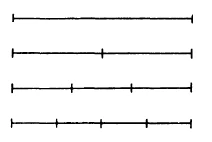
[ 19 ] In certain periods of antiquity, people were not at all familiar with our concepts of counting—where one simply places one bean next to another or sets one bead next to another on an abacus—but instead simply said: The unit is the largest; every “two” is only half of it, and so on. In this way, you get to the essence of counting—concretely, through external objects. A child’s thinking should always be developed solely through external objects and concrete examples, keeping abstraction at bay as much as possible.
[ 20 ] The child is then gradually given the opportunity to work through the number sequence up to a certain point—let’s say, first up to 20, then 100, and so on. But one should proceed in this way in order to teach the child to count in a lively, engaging way. A child can then count. The child should first learn to really count—I say this explicitly—not arithmetic right away, but counting. The child should be able to count before moving on to arithmetic.
[ 21 ] Once the child has been introduced to counting, the next step is to approach arithmetic. Arithmetic, too, must be drawn from the living. The living is always a whole and is first given as a whole. One does a disservice to a person by causing them to always assemble a whole from parts, rather than teaching them to look at a whole and then break that whole down into parts. By encouraging the child to look at a whole, to structure it, and to divide it, one introduces the child to the living world.
[ 22 ] One often fails to notice much of what the materialistic era has actually done to human culture. Today, people don’t even bat an eye at it; instead, they take it for granted to let children play with building blocks—to have individual blocks and assemble a structure out of them. From the very beginning, this leads the child away from what is alive. By its very nature, the child has no need to assemble a whole from parts. The child has many other, albeit more inconvenient, needs. If the child is ever given a watch, for example, it immediately feels the urge to take it apart, to break the whole down into its parts—and this corresponds much more to the human nature: to observe how a whole is structured into its parts.
[ 23 ] This is precisely what must now also be taken into account in math instruction. You can see from the following example that this has an impact on culture as a whole.
[ 24 ] Well into the 13th and 14th centuries, people did not place much emphasis on assembling a whole from its parts in human thought. That only emerged later. The master builder constructed much more by starting from the idea of the whole and breaking it down into parts than by assembling a building from parts. The concept of assembling from parts actually did not enter human civilization until later. And that led people to begin thinking of everything as composed of the tiniest parts. This gave rise to the atomic theory in physics. It stems solely from education. Our eminent scholars would not speak at all in such terms about these tiny caricatures of demons—for they are caricatures of demons—about atoms, if we had not become accustomed in our education to assembling everything from parts. That is how atomism came about. Today we criticize atomism; but in reality, such criticism is quite superfluous, because people cannot break free from what they have become accustomed to thinking incorrectly over the past four to five centuries: thinking from the parts toward the whole, rather than from the whole into the parts.
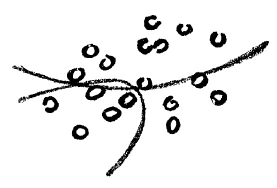
[ 25 ] This is something you should keep in mind, especially when teaching math. When you approach a forest from a distance, you first see the forest as a whole, and only when you get closer do you break it down into individual trees. That’s how you must proceed with arithmetic as well. After all, you never have, say, 1, 2, 3, 4, 5 in your wallet—instead, you have a pile of coins. You have the 5 together. That’s a whole. That’s what you have at first. Likewise, when you cook a pot of pea soup, you don’t have 1, 2, 3, 4, 5, all the way up to 30 or 40 peas—you have a pile of them. Nor, when you have a basket of apples, do you have 1, 2, 3, 4, 5, 6, 7, and so on—individual apples—but rather a pile of apples in your basket. You have a whole. What does it matter to us at first how many we have? We have a pile of apples (it is drawn). Now we’re taking this pile of apples home. There are three children there. At first, we don’t even want to assume that we’ll divide them right away so that each child gets the same amount. Maybe one child is small and the other is big. We reach in, give the bigger child a bigger pile and the smaller child a smaller pile; we divide the pile of apples we have into three parts.
[ 26 ] Sharing is such a strange thing anyway! Once upon a time, a mother had a large piece of bread and said to one of her children, whose name was Heinrich: “Now you must share it, but share it in a Christian way.” - Then Heinrich asked, “What does it mean to share in a Christian way?” - “Well,” said the mother, “you have to cut the bread into a smaller piece and a larger piece; give the larger one to your sister Anna, and keep the smaller one for yourself.” - To that, Heinrich replied, “No, then let Anna be the one to share in a Christian way!”
[ 27 ] We need to use other concepts to help us here. We do this by, for example, giving one child this (see the division in the drawing), the second child this pile, and the third child this pile. So that we can keep track of everything clearly, we first count the entire pile, since the child already knows how to count. There are 18 apples. Now I have to count them. How many does the first child have? 5. How many does the second child have? 5. How many does the third child have? 8.
[ 28 ] So I started with the whole thing—the whole pile of apples—and divided it into three parts.
[ 29 ] Very often in class, teachers say: “You have 5, then another 5, and 8; add them together, and that makes 18.” This approach starts with the individual parts and moves toward the whole. But this gives the child dead concepts, not living ones. If you start with the whole—the 18—and break it down into its addends, that’s how you get the addition.
[ 30 ] So don’t teach by starting with the individual addends or summands; instead, start with the sum—which is the whole—and break it down into the individual addends. Then you can go on to say: But now I can also break it down differently. “I can divide it this way… I now have different addends, but the whole always remains the same.” By approaching addition not as it is very often approached—starting with the addends and then the sum—but by starting with the sum and then the addends, you arrive at very lively, flexible concepts. You also realize that where only the number matters, the whole is simply something that remains constant; the individual summands—the addends—can change. This peculiar characteristic of numbers—that one can conceive of the addends grouped in various ways—comes across very clearly in this process.
[ 31 ] Then you can go on to say: But if something is not merely a number, but contains the number within itself—as a human being does—then it cannot be divided in various ways. For example, if you take the human torso and the parts attached to it—the head, arms, and feet—you cannot divide the whole in any arbitrary way; you cannot say, “I’ll cut out one foot this way, the hand that way, and so on,” but rather it is already structured in a specific way by nature.
[ 32 ] Where it is merely a matter of counting, there is no natural structure, so I can divide it up in various ways.
[ 33 ] This is what gives you the opportunity to bring life and a lively flow into the classroom. All pedantry falls away from the lesson, and you will see that something enters the lesson that the child needs very much: humor enters the lesson—in a healthy sense, not in a childish sense. And humor must enter the lesson.
[ 34 ] Make sure to translate the word “humor” correctly; it’s always misunderstood in class!
[ 35 ] This is how you should proceed in class: Always start from the whole. Suppose, for example, you want to do the following, based entirely on real-life situations. The mother sent little Marie to get some apples. Little Marie received 25 apples. The shopkeeper’s wife wrote this down on a piece of paper. Little Marie comes home and brings only 10 apples. Here is the fact, taken from real life: Mariechen received 25 apples and brought only 10 home. Mariechen is an honest girl; she really didn’t eat a single apple on the way, but she still only brought 10 apples home. Now someone else comes running along—who is also honest—and brings back all the apples that Mariechen lost along the way. Now the question arises: How many will he bring? You can see him coming from a distance. Now you want to know in advance how many he’s bringing. Well, Mariechen has arrived; she brought 10 apples, and she had received 25—you can see that on the note the woman wrote down. So she lost 15 apples.
[ 36 ] You see, now you’ve done the calculation. Usually, it’s done this way: You’re given something, you’re supposed to subtract something, and then something remains. But in life—as you’ll see for yourself—it’s much more common to know what you originally had and what’s left over, and to have to find what’s been lost. So, to make the process come alive, you should perform the subtraction by starting with the minuend and the remainder and seeking the subtrahend; not by starting with the minuend and the subtrahend and seeking the remainder. That’s lifeless. It comes alive when you start with the minuend and the remainder and seek the subtrahend. That’s how you bring life into your lessons.
[ 37 ] You'll see what I mean if you consider the example of the mother and Mariechen and the one who brings the subtrahend. Mariechen has lost the subtrahend from the minuend, and the way to justify this is to ask the one who is coming next—whom you can see approaching—how much he must bring. That’s when real life comes into the whole subtraction. If you simply ask, “How much is left over?”—that brings only lifelessness into the child’s soul. You must always be mindful to instill the living, not the lifeless, into the child.
[ 38 ] And so you can continue from there. You can approach multiplication by saying: The whole, the product, is given; how can you figure out how many times something appears in that product? You see, that’s where you get to something alive. Just think how lifeless it is when you say: I’m dividing up this whole group of people—there are three here, another three there, and so on—and now I ask: how many times three are there?—That’s lifeless; there’s no life in it.
[ 39 ] If I take the opposite approach—taking the whole group and asking how often any given group appears within it—then I can bring the lesson to life. For example, I can say to the children: “Look, there are a certain number of you here in the class. Let’s count them.” There are 45 of you. Now I’ll pick out 5—1, 2, 3, 4, 5—and put them over there. Now I’ll have you count: how many times do these 5 appear within these 45? You see, I’m looking at the whole again, not the part. How many more groups of five can I make? That leads me to realize there are still eight groups of five in there. So I do it the other way around: I start with the whole—the product—and figure out how many times a factor appears in it. This way, I bring the different types of calculations to life and, above all, start from the concrete. And this is what matters: that we never, never, never detach thinking from the concrete; otherwise, intellectualism and abstraction will take hold of the child too early, and we will ruin the whole child. We make them dry, and moreover, we foster in them—we will speak later of spiritual, soul, and physical education—we foster in them the drying up of the physical body as well, sclerosis.
[ 40 ] Once again, much depends on teaching children to count as has been observed here, so that they remain agile and dexterous even in old age. If you teach them to count using the human body as I have described—1, 2, 3, 4, 5, 6, 7, 8, 9, 10, and then continue with the toes—yes, it would be quite good to get children accustomed to actually counting to 20 with their fingers and toes, not with a calculator—if you teach children this, then you will see that through this childlike meditation —for when one counts on one’s fingers, when one counts with one’s toes, one must also think about the fingers and toes; this is a form of meditation on one’s own body, and indeed a healthy form of meditation—one brings life into the body. Then, in old age, one’s limbs remain agile; they hold their own because they have learned to count through the entire organism. If one thinks only with the head—and not with the limbs and the rest of the organism—then later on they cannot hold their own, and one develops gout.
[ 41 ] I would now like to show you, using a specific example—one that can indeed play a very special role in the classroom—how everything in education and instruction must be derived from the concrete, rather than from what is often called “concrete instruction” today. It is the case of the Pythagorean theorem, which you are all surely familiar with if you are going to teach, and which you may already have grasped in a similar way, but let us discuss it today nonetheless. You see, the Pythagorean theorem represents something that can indeed be set as a goal for geometry in the classroom. One can structure geometry in such a way that one says: We want to organize everything so that it culminates in the Pythagorean theorem—that the square of the hypotenuse of a right triangle is equal to the sum of the squares of the two legs. It’s truly magnificent when you really take that in.
[ 42 ] I was once asked to teach geometry to a lady who was already quite elderly at the time, simply because she loved it so much. I don’t know if she had forgotten everything—but she probably hadn’t learned much at the girls’ schools, where girls are educated in that way—in any case, she knew nothing about geometry. So I began and worked my way up to the Pythagorean theorem. Now, the Pythagorean theorem was indeed something extraordinarily striking to the lady. One is simply accustomed to this striking quality. But isn’t it true that one should simply understand that, if I have a right-angled triangle here (it is drawn), the area formed by the square on the hypotenuse is equal to the sum of the areas of the two squares on the legs (Fig. I). That is, if I plant potatoes and arrange them at equal distances everywhere, then when I plant this field and that one with potatoes, I will plant exactly as many potatoes as there are here in this field. That is something striking, something quite striking, and when you look at it that way, you can’t really grasp it.
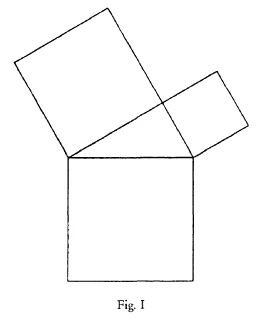
[ 43 ] And it is precisely the fact that one cannot fully grasp it—that it is something so wondrous—that should be used in the classroom to enliven the soul; one should rely on the fact that one is not dealing with something so terribly transparent that one is forced to admit it time and again. One might say that with the Pythagorean theorem, it is like this: One can believe in it, but one must lose that belief immediately afterward. One must believe anew, time and again, that the square of the hypotenuse is equal to the sum of the squares of the two legs.
[ 44 ] Now, one can certainly find all sorts of proofs, and the proof should actually be presented quite clearly. It is easy to provide, as long as the triangle is isosceles. If you have an isosceles right triangle here (it is drawn in Fig. II), then this is one leg, this is the other leg, and this is the hypotenuse. What I am now drawing in orange (1, 2, 3, 4) is the square on the hypotenuse. What I’m drawing in blue are the squares on the two legs (2, 5; 4, 6).
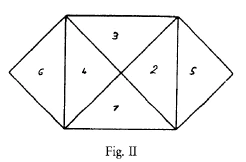
[ 45 ] Now, if I plant potatoes here in the correct way in these two blue fields (2, 5; 4, 6), I will get the same amount as if I planted potatoes in the orange field (1, 2, 3, 4). The orange square is the square on the hypotenuse, and the two blue squares (2, 5; 4, 6) are the squares on the two legs.
[ 46 ] Now you can easily prove this by saying: The two pieces (2, 4) from the two blue squares that fall inside (the hypotenuse square) are already inside. You can move that one (5) up here (to 3). If you cut out the whole thing, you can place the piece (6) on top of this (on 1), and you’ll have it right away. So, the matter is quite straightforward when you have what’s called a right-angled isosceles triangle. But if you don’t have a right-angled isosceles triangle, but rather one with different sides (as in Fig. ID), you can do the following: Draw this triangle again (Fig. II: ABC). Now draw the square over the hypotenuse ABDE. Now you can draw as follows: You can draw the triangle ABC that you have here onto this: BDF. Then you can draw this triangle ABC—or rather, this BDF, which is the same thing—again here: AEG. Since you now have this triangle here again, you can draw the square over this one leg like this (in red): CAGH. Now, what I’ve drawn in red is the square over that one leg (CAGH).
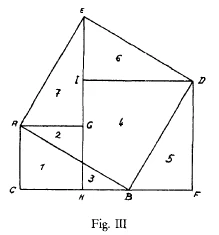
[ 47 ] As you can see, I can now also draw the triangle here: DEI. Here it is. Then, in what I’m now drawing in green here, I have the square above the other cathetus: DIHF; then I have two of them there—the square above one cathetus and the square above the other cathetus. I’m just using this cathetus AG for one and this cathetus DI for the other. The triangles are here (AEG) and there (DEI); but they’re the same (that is, congruent). Where do I have the square on the hypotenuse? I’ll draw that in purple so we can tell them apart clearly: ABDE. I have the square on the hypotenuse here. Now I need to show on the figure itself that red (1, 2) and green (3, 4, 5) together give purple (2, 4, 6, 7).
[ 48 ] Now you can easily see: I’ll start with this red square (1, 2) here; the part that both squares have in common (2) overlaps. Now the piece from the green square (4) comes into play. So I have this figure (2, 4), which you see drawn there and which is nothing other than a piece of the purple square ABDE—yes, a piece of the purple square. This piece of the purple square ABDE contains this piece of the red square (2); only this corner here (1) remains; it does not yet contain that. But this figure also contains this corner of the green square (4). Now I just have to figure out how to fit in what’s left over (1, 3, 5).
[ 49 ] Now take a look: You have a small piece left over from the red square (1), a small piece from the green square (3), and this entire triangle (5) left over, which also belongs to the green square DIHF. Now take what you have here—what’s left over there—and place it there; take what’s left over here (5) and place it there (6). Now you also have the corners left over here (1, 3). If you cut those out, you’ll see clearly that these two areas (1, 3) have fallen into this area (7). Of course, it could be drawn even more clearly, but I think you’ll get the idea. It’s now just a matter of explaining it more precisely through language. In this way, simply by superimposing the areas, you have shown that the Pythagorean theorem is correct. If you use precisely this method of superimposition, you will discover something. Although you’ll see—if you cut it out rather than drawing it—that it’s very easy to grasp, nevertheless, when you think about it later, you’ll forget it again. You have to search for it again and again. You can’t quite commit it to memory, so you have to search for it anew time and again. And that’s good. In fact, that’s quite good. It corresponds to the Pythagorean theorem. One should arrive at it again and again anew. Even after understanding it, one should keep forgetting it. This corresponds to the striking quality of the Pythagorean theorem. This is what brings the living essence into the matter. You’ll see—if you have the students do this over and over again, they’ll have to work it out for themselves. They won’t come up with it right away; they’ll have to think it through each time. But this corresponds to the inner vitality of the Pythagorean theorem. It is not at all good to prove the Pythagorean theorem in such a way that it can be understood in a flat, philistine manner; it is much better to forget it again and again and have to search for it anew each time. This corresponds to the striking aspect of the theorem—that it is, after all, something remarkable that the square of the hypotenuse is equal to the sum of the squares of the two legs.
[ 50 ] Now, you can quite effectively teach geometry to eleven- or twelve-year-old children to the point where you can explain the Pythagorean theorem using a comparison of areas; the children will be absolutely delighted once they’ve grasped it, and they’ll become enthusiastic. That made them happy. Now they’ll want to do it over and over again, especially if you let them cut it out. There will only be a few intellectualized good-for-nothings who remember it quite well and manage to do it time and again. Most children—the more sensible ones—will keep cutting the pieces the wrong way and fiddling with them until they figure out how it’s supposed to be done. But this is precisely what makes the Pythagorean theorem so wonderful, and one shouldn’t try to escape this wonder—one should remain immersed in it.