

The Art of Education
Based on Understanding Human Nature
GA 311
18 August 1924, Torquay
Translated by Steiner Online Library
Sixth Lecture
[ 1 ] Following up on what has been said, we would now like to discuss a few more points that may relate to the method, and in this regard I would like to note that, naturally, in the few lectures that can be held here, it is not possible to elaborate further on the individual pedagogical suggestions—if I may call them that—that I have offered; rather, we can only discuss matters of principle. And once you have received these insights here, you will then be able to study the seminar courses at the Waldorf School and understand them thoroughly.
[ 2 ] We must take another close look at the child during the period between the loss of baby teeth and sexual maturity, and we must be clear that in the years before the loss of baby teeth, the child’s inherited characteristics are by far the most decisive factors. The child receives, so to speak, a “model body” from the father and mother, which is completely shed by the time of tooth replacement, and this is replaced by a new body during the first seven-year period of life. Tooth replacement is, after all, merely the outward expression of this replacement by a new body, upon which the soul-spiritual aspect now works. I have told you: If the soul-spiritual is strong, then under certain circumstances the child will change significantly during the school years—from the change of teeth to sexual maturity—compared to the characteristics it previously possessed. If the individuality is weak, the result will be something very similar to the inherited characteristics. And even in children of elementary school age, we will have to look for profound similarities with their parents or grandparents.
[ 3 ] Now we must be clear that it is actually only with the change of teeth that the independent activity of the human etheric body begins. During the first seven years of life, the etheric body must devote all the independent activity it can muster to truly form the second physical body. Thus, during the first seven years of life, this etheric body is a true inner artist within the child—a sculptor. This sculptural power, which the etheric body applies to the physical body, becomes free and emancipated at the age of seven with the change of teeth. It can then become active on the soul level.
[ 4 ] Therefore, the child certainly has the urge to create forms through modeling or painting. After all, throughout the first seven years of life, the etheric body has been modeling and painting on the physical body. Now that it has nothing more—or at least not as much—to do with the physical body, it wants to carry out this activity externally. Therefore, if you as a teacher have a good understanding of the forms found in the human organism—and thus know what the child likes to sculpt from modeling materials or what they like to paint—then you will be able to provide the child with good guidance. However, you must yourself have a kind of artistic understanding of the human organism. That is why it is so important for the teacher—since today’s teacher training programs do not address this at all—to try to engage in modeling activities themselves. You will see that even if you have learned a great deal about a lung or a liver, or, let’s say, the intricate connections of blood vessels, you do not know as much as you would if you were to recreate the whole thing in wax or modeling clay. Suddenly, you begin to understand the subject in a completely different way. With the lung, for example, you have to shape one half differently from the other—it isn’t symmetrical. One half clearly has two sections, while the other has as many as three. Before you learn this, you’re always forgetting which is left and which is right. When you model these peculiar asymmetrical shapes in wax or modeling clay, you get the sense that you can’t turn the left side to the right or the right side to the left—just as you can’t place the heart on the right side. You also get the sense that it fits into the organism in its proper form. You get the feeling, when you model it correctly, that it simply cannot be any other way—that the lung gradually assumes an upright position, that it straightens up as you walk. When you then model the lungs of animals, you will see—or you will grasp from the shape itself—that the lung lies horizontally. And the same applies to other organs.
[ 5 ] So you must try to teach anatomy in a truly vivid way—using something that doesn’t actually mimic the human body but merely consists of shapes—so that the child can mold or even draw these shapes. And you will see that the child has an urge to create shapes that connect to the inner workings of the human organism. You even have some quite remarkable experiences in this regard during the course of the lesson.
[ 6 ] Since this is a natural part of a method such as the Waldorf school method, we have incorporated human studies into the curriculum everywhere, particularly in grades 4, 5, 6, and 7. The children paint with us right from the start, and from a certain age onward, they also sculpt. Now, it is very interesting to see that when you simply let the children work on their own after explaining something to them about the human body—the lungs or another organ—they begin to create forms resembling the lungs or similar structures, entirely on their own. It’s very interesting to see how the child shapes things out of their own human nature. And that’s why it’s so important that you truly embrace this sculptural method, that you find ways to enable yourselves to faithfully recreate the forms of human organs—whether with wax, modeling clay, or, for all I care—as our children often do—with dirt from the street. Well, if you don’t have any other material, that’s a very good material.
[ 7 ] This is the inner urge, the inner longing of the etheric body: to be active in a sculptural and painterly way. Therefore, it is very easy to connect with this urge, this longing, and thus to draw out the letters from the shapes the child paints, or even from the shapes the child forms plastically, because one then structures the lesson based on a genuine understanding of human nature. This must take place at that stage.
[ 8 ] Now let’s continue. The human being does not consist solely of the physical body and the etheric body—which then emancipates itself and becomes free at the age of 7—but also of the astral body and the “I.” What, then, is the state of the astral body in a child between the ages of 7 and 14? It does not actually become fully active until sexual maturity. Only then does it begin to function fully within the human organism. But while between birth and the change of teeth the etheric body is, so to speak, drawn out of the physical body and becomes independent, between the ages of 7 and 14 the astral body is gradually drawn in; and when it is fully integrated—when the astral body is no longer merely loosely connected but intimately permeates the physical and etheric bodies—then the human being has reached the stage of sexual maturity.
[ 9 ] In boys, one can see from the change in their voices that the astral body is now fully inside the larynx; in women, one can see from the development of other organs—such as the breasts—that the astral body has now fully entered the physical body. The astral body slowly enters the human body from all sides.
[ 10 ] The lines and directions it follows are the nerve tracts. Following the nerve tracts, from the outside in, the astral body draws in. It begins there, gradually contracting from the surroundings, starting with the skin, and then contracting inwardly to fill the entire body. Before that, it is a loose cloud in which the child lives. Then it contracts, intimately enveloping all the organs, and—to put it roughly—chemically binding itself to the organism, to the physical and etheric tissues.
[ 11 ] But there is something special about this process. When the astral body penetrates inward from the body’s periphery, it advances along the nerves, which then converge in the spinal column. (A diagram is drawn.) The head is up there. Slowly, it also advances through the cranial nerves, crawling along the nerves toward the central organs, toward the spinal cord, and into the head, gradually making its way in and filling everything out.
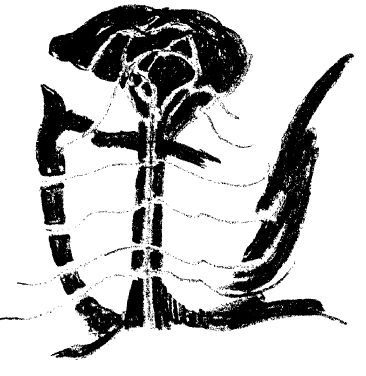
[ 12 ] What is particularly important here is the way breathing interacts with the entire nervous system. In fact, this interaction between breathing and the entire nervous system is something quite unique to the human organism. As a teacher or educator, one should have the most subtle sense of this. Only when one has this subtle sensitivity will one be able to teach properly. So the inhaled air enters the body, spreads out, travels upward through the spinal canal (see diagram), spreads throughout the brain, always accompanying the nerve tracts, travels back down, and follows the pathways through which it can then be expelled as carbon dioxide. In this way, the inhaled air continuously works on the nervous system: it spreads out, travels upward through the spinal canal, spreads further, becomes infused with carbon dioxide, travels back down, and is exhaled. This entire breathing process, as it proceeds along the nerve tracts, is only fully integrated by the astral body into the physical body over the course of the period when the child is of school age—between the change of teeth and puberty. So that during this time, as the astral body gradually integrates itself with the help of the breath, it plays upon what is stretched out like strings in the center of the spinal canal. Our nerves are truly a kind of lyre, a musical instrument—indeed, an inner musical instrument—whose sound resonates upward into the head.
[ 13 ] And when the teeth begin to fall out—it happens earlier, of course, but at that stage the astral body is still loosely connected—but with the loss of the baby teeth, the astral body begins to make distinct use of the breath flowing through the individual nerve strands, like the strings of a violin.
[ 14 ] All of this, however, is fostered when you teach the child what singing is all about. And you must have the sense that the child is a musical instrument when singing; you must stand before the class where you teach singing and music with the clear sense that every child is a musical instrument and feels within themselves the joy of making sound.
[ 15 ] For sound is produced by this particular circulation of the breath. This is inner music. And that is why, whereas at first—during the first seven years of life—the child learns everything solely through imitation, we must now try to have the child learn to sing based on the inner sense of well-being that comes from creating melodies and rhythms. When you stand in front of the class and teach singing, you must have a certain mental image—for which I’d like to use a comparison that’s a bit rough around the edges, but which will make my point clear. I don’t know how many of you have had the opportunity, but hopefully most of you have at least once had the chance to observe a herd of cows after they have eaten and are lying in the pasture, now digesting their food. The digestive process of a herd of cows is truly something quite marvelous. Within the cow there is something like a reflection of the entire world. As digestion takes place in the cow’s digestive system—as the processed food passes into the blood vessels and lymphatic vessels—the cow experiences such a sense of well-being that is, at the same time, a form of insight. Every cow has a wonderful aura while digesting, in which the whole world is reflected. It is the most beautiful sight one can see—a herd of cows lying in the meadow, digesting, and through that process comprehending the whole world. In us humans, all of this has been pushed down into the subconscious so that the mind can reflect what the body is processing through self-awareness.
[ 16 ] We humans are actually at a disadvantage because our minds prevent us from truly experiencing the beautiful things that, for example, cows experience. We would know much more about the world if, for example, we could experience the digestive process. Of course, we would then have to experience it with a genuine sense of understanding, not with the feeling a person has when they remain in the subconscious during the digestive process. Well, that should make clear what I’m actually trying to say. I do not mean to say that the digestive process should now be brought into consciousness in education, but I do mean to say that something must truly be present in the child at a higher level: this sense of well-being arising from the inner process of sound. Just think, if the violin could feel what is going on inside it! We merely listen to the violin; it is out there, we are strangers to the entire process of sound production; we hear only its outward sensory manifestation. If the violin could sense how each string vibrates in harmony with the others, it would indeed experience bliss—provided, of course, that the piece is good. So you must let the child experience these little moments of bliss; you must truly evoke a sense of music throughout the child’s entire being, and take genuine joy in it yourself.
[ 17 ] Of course, you have to know something about music. But teaching involves this artistic element that I just explained.
[ 18 ] Therefore, because the actual course of development in human beings between the loss of baby teeth and sexual maturity demands it, it is necessary to begin music instruction with children right from the start and, as far as possible, to first accustom the child—entirely empirically, without theory—to singing little songs. Yes, nothing more than letting them sing little songs—and sing them well! And only gradually move on to simpler pieces, so that the child gradually comes to understand what melody, rhythm, and meter are, and so on. First and foremost, we should get the children used to singing simple little songs—and playing them simply as well—as best they can. Unless their natural aptitude clearly precludes it, we at the Waldorf School begin immediately upon the children’s arrival to have them play some instrument, to learn to handle an instrument right away—as I said, as best as their abilities allow. But we should encourage the children to experience as early as possible what it is like when their own musical nature flows over into the objective instrument. For this purpose, the piano—which is really meant to be nothing more than a kind of memorization instrument—is, of course, the least suitable for the child. We should use a different instrument with the child, preferably one that can be played by blowing into it. But of course, one must exercise a great deal of artistic tact in this process and also, I would say, a great deal of authority. So, ideally, an instrument that can be played by blowing into it. Children benefit most from this when they learn to play a simple wind instrument and gradually come to understand music. Of course, one can have the very worst experiences when children start playing wind instruments. But on the other hand, there is something wonderful in the child’s experience when they must take this entire configuration of air—which otherwise surrounds them—and, holding it internally along the nerve pathways, continue it and direct it inward. There, the person feels their organism expanded. Processes that are otherwise confined to the interior of the organism are transferred to the outside world. It is similar when a child learns to play the violin, where the processes—the music that lives there—are directly transmitted, where the person feels how the musicality within them passes through the bow to the strings, and so on.
[ 19 ] But begin teaching children music and singing as early as possible! This is something of particular importance: that one not only provide instruction in the arts in general, but also begin immediately with the arts themselves—painting, sculpting, and music—when the child enters elementary school, and ensure that all of this truly becomes an inner, human possession.
[ 20 ] It is particularly important that we focus on the stage in a child’s development between the ages of 9 and 10 with regard to language acquisition. I have already described this stage between the ages of 9 and 10, when the child actually begins to distinguish itself from its surroundings. Until then, the child feels at one with its surroundings. We will therefore begin working with the child appropriately, as I have indicated, when it starts school. The child should not actually start school before the transition to permanent teeth begins. Any schooling that takes place before that is, in essence, nonsense; if we are compelled by the law to do so, we must, of course, but it is not appropriate from a pedagogical and artistic standpoint. It is appropriate from a pedagogical and artistic standpoint to admit the child to school only after the change of teeth. Then, as I have indicated, one begins with the artistic and works on developing the shapes of the letters from within the artistic realm; that one also begins in this way with independent artistic expression, as I have explained, and that one treats everything related to nature in a fairy-tale-like, legendary, and mythical manner, as I have also explained. But it is important, with regard to language instruction, to take into account this stage of life between the ages of 9 and 10.
[ 21 ] Under no circumstances should language instruction, before this stage of development has been reached, include any intellectual analysis of language—that is, nothing about grammar, nothing about sentence structure, or anything of the sort. Until this stage of life, around the age of 9 or 10, the child must speak in exactly the same way that it otherwise acquires any other habits; it must acquire speech through habit. Only when the child learns to distinguish itself from its surroundings may what the child accomplishes on its own—that is, speech—be considered. Only from that point on should one speak of nouns, adjectives, verbs, and so on—not before. Before that, the child should simply speak and be allowed to develop through speech.
[ 22 ] At Waldorf schools, we have the opportunity to do this because as soon as a child joins us in elementary school, they learn two foreign languages in addition to their native language.
[ 23 ] We welcome the child into school. At first, the child has block-structured lessons—I have described what block-structured teaching entails—during the first school hours in the morning, followed immediately by English and French lessons for the young child. In doing so, we try to teach these languages in such a way that the relationship between one language and the other is not taken into account at all. Before the stage of development I described—between the ages of 9 and 10—we completely disregard the fact that, for example, “Tisch” in German means “table” in English, or that “essen” in German means “eat” in English. We do not link each language to words from another language, but rather to the objects themselves. The child learns to name—whether in French or in English—the blanket, the lamp, the chair. Thus, in the 7th, 8th, and 9th years, no emphasis is placed on translation—that is, on converting a word from one language to another—but rather the child simply learns to speak the language by referring to external objects, so that the child does not need to know or even think about the fact that when it says “table” in English, this is “Tisch” in German, and so on. That is not an issue for the child; it does not even come up during the lesson, because up to that point, no language comparison or anything of the sort has been done with the child.
[ 24 ] This gives the child the opportunity to learn language from its very essence—and every language from the essence from which it originates: the emotional element. - What, then, is language in its sounds? - For language is, after all, made up of sounds. It is either the expression of something inner and spiritual—in which case the vowel is present—or it is the expression of something external—in which case the consonant is present. But one must first feel this. Let’s suppose the child is to feel what lies, for example, in the word “water.” We will not use this, as I am about to describe it, in the classroom; rather, we should simply structure the lesson so that the child truly associates feeling with the vowel and perceives the consonant as the imitation of something external. The child already does this because it is inherent in the human being; but we should not suppress it—rather, we should build upon it.
[ 25 ] Because, you see, what is A? — Well, that’s not part of the lesson; it’s just something you should know! — What is A? When the sun rises, I stand in awe before the rising sun: Ah! A is always an expression of astonishment, of wonder. A fly lands on my forehead, and I make this gesture: E. That is the expression of repulsion, of shooing it away: E. In English, this shifts somewhat compared to German, but it is still present in every language—here, too, as an expression of astonishment and wonder.
[ 26 ] Now take a characteristic word: roll—the rolling of a ball; in English: roll. There you have the R. Who wouldn’t sense (see Drawing I) that I’m passing it on—the L. R would be just like this (Drawing II). Z continues. Z is always the flow of value. “Roll”—there you have an external process imitated in the consonant (see Drawing II).
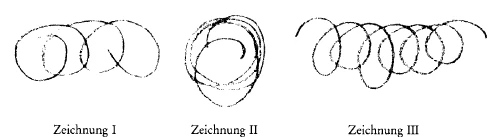
[ 27 ] Thus, the entire language is to be understood either as arising from feelings of inner astonishment, wonder, resistance, self-assertion, and so on, or from the impulse to imitate in the case of consonants. This should not be suppressed in the child. The child should learn to develop sounds based on objects and on its emotional relationship to them. Everything should be drawn from a sense of language. The child should truly feel the sound “roll”: r-o-l-l. This applies to every word.
[ 28 ] Modern, civilized people have completely lost that. They believe that a word is something written down or something entirely abstract. People can no longer truly immerse themselves in language. Primitive languages still convey emotion throughout the language; the most “civilized” languages, on the other hand, make language abstract. Just look at your own English language: how the second half of the words is discarded, flung away—how one skips right over the actual feeling in the sounds! But the child must remain rooted in the feeling of language.
[ 29 ] And one should actively cultivate this sense of language by choosing characteristic words that allow one to explore this feeling. In German, we have the word Kopf for what a person has up there. In English, we have “head,” and in Italian, we have “testa.” Now, what do you do when you approach language as abstractly as people usually do? You say, “In German, the head is called Kopf; in Italian, testa; in English, head.” But none of that is true—it’s all nonsense.
[ 30 ] Look, “head”—what is that? A head is that which is shaped, shaped in a somewhat round way. When you say “head,” you’re expressing that shape. If you say “testa”—you see it in the words “testament” and “to testify”—you’re expressing that the head establishes something. But it expresses something entirely different. We say of what sits up there: that is the determiner, the testator = *testa*. In English, it is believed that the head is the most essential part of a person. You know, this view is not entirely correct. So in English, we say *bead*—the most important thing, that toward which everything is directed, where everything converges.
[ 31 ] So, people express different things. Different things are expressed in different languages. If one wanted to refer to the same thing, an English speaker and an Italian speaker would both say “head.” But they are not referring to the same thing. In the original human language, the same thing was referred to everywhere. That is why the original human language was the same for everyone. Then people went their separate ways and began to designate things differently; this is how the various words came about. If one designates different things as “the same,” then one no longer senses what lies within. And it is very important not to drive out this sense of language; it must remain within. That is why one should not introduce the study of language before the age of 9 or 10.
[ 32 ] Only then should one move on to what a noun, verb, adjective, and so on are—not before, not before the age of 9 or 10; otherwise, one observes in the child something that is inherent in the child itself. But the child cannot grasp this, because it has not yet distinguished itself from its surroundings. And it is very important to keep this clearly in mind: do not introduce any grammar, nor any comparative linguistics, before the age of 9 or 10! Then the child will experience something similar in speaking as it does in singing.
[ 33 ] I have tried to illustrate this inner sense of well-being that comes from singing by comparing it to the inner sense of well-being that rises from the digestive organs of cows in a pasture as they digest their food. And such a sense of inner well-being—or at least a sense of the essence of things—so that children can feel what is contained in a word, so that they can feel its inner “flow”—that must be present. Language must be experienced inwardly; it must not merely be thought about with the head. Today, most people think about language only with their heads. That is why, when they want to know what is correct in a language or what should be translated from one language to another, they simply reach for a dictionary. The words are arranged there in such a way that “testa” or “head” is listed. And so the impression arises that they are the same. But they are not the same. It always refers to something different. And that can only be described through feeling. This must be taken into account in language instruction. There is also another—spiritual—element. When a person dies, or before they descend to Earth, they have, for example, no way of understanding so-called nouns. The so-called dead person knows nothing at all about nouns. They know nothing of the objects that are named by them. They still know something about qualities. So there is a way to communicate with the dead through qualities. But even that soon comes to an end. Communication through verbs—words of action, active and passive terms—lasts the longest, and the longest of all is the expression of sensations: Oh! Ah! I, E; the dead retain these interjections the longest.
[ 34 ] From this you can also see how the human soul, if it is not to become entirely devoid of spirit, must truly live through interjections. Interjections are, in reality, all vowels. And the consonants—which, in any case, are very soon lost as such after death or were not present before the descent to Earth—are imitations of the external world. We should truly experience this in our feelings and observe where this lies in the child, and not drive it out through premature instruction in nouns, adjectives, and so on, but rather allow that instruction to begin only between the ages of 9 and 10.
[ 35 ] We have now introduced eurythmy into the Waldorf school from the very beginning of elementary school instruction—this visible language in which a person reveals themselves through movements performed individually and in groups, just as they would otherwise reveal themselves through speech. Now, it is indeed the case that if a child is not spoiled in language instruction by a teacher who disregards the child’s sense of language—that is, if the child’s sense of language is preserved—then the child experiences the transition to eurythmy as just as natural for human beings as a very young child finds it natural to learn spoken language. One has not the slightest difficulty introducing eurythmy to children. They want it if they are healthily developed children. One can always investigate where some pathological factor lies if the children do not want to engage with eurythmy. They want to practice eurythmy just as naturally as they want to learn to speak as very young children, provided all their organs are healthy. This is because the child feels a particularly strong urge to express what it experiences inwardly through its own will. This is already evident when a child begins to laugh and cry at an early age, in the specific facial expressions that convey emotions.
[ 36 ] You will have to rely quite heavily on metaphors and comparisons if you want to say that a dog or another animal is laughing. In any case, it does not laugh in the same way as a human being, nor does it cry like a human being. However, in animals, gestures and movements that convey inner experiences into the realm of the will are fundamentally different from those in humans.
[ 37 ] Well, just as human speech follows certain laws, so too does what is expressed through eurythmy. Speech is, after all, not something arbitrary. For example, in English, if a word is “water,” you cannot substitute another vowel for the “a”; you cannot say “water” and so on. Speech follows certain laws. Eurythmy, too, follows such laws. With ordinary bodily gestures, one is still free in a certain sense, although even there people do many things out of instinct. When they are thinking, they touch their forehead with their fingers; when they want to indicate that something is not true, they do this...—they shake their head and hand, as if to erase it. Transforming inner and outer experience into such law-governed movements—just as speech transforms inner experience into sound—is precisely what eurythmy is; and the child wants to learn eurythmy. Therefore, the fact that eurythmy instruction is not already part of today’s education is proof that no effort is being made to draw human abilities out of nature, out of the very essence of the human being; for if one does that, eurythmy arises quite naturally.
[ 38 ] This does not detract from physical education classes or physical exercise classes, but it is something different, and as a teacher or educator, one should clearly understand this distinction. Gymnastics classes, as they are taught today, and all athletic activities and so on are different from eurythmy. Both can coexist very well. For you see, the concept of space is very often understood by people in a completely abstract way; people do not take into account that space is something concrete. Isn’t it true that people today have become so accustomed to thinking of the Earth as round that they have a mental image: The person who lives here says that when he jumps, he jumps upward. His antipode—who has his legs down there and his head up there—jumps down, or so people imagine. But that’s not something you can actually experience. —I once read a book, *Views on Natural Philosophy*, in which the author sought to ridicule the idea that heaven is above by saying: “Down there, at the antipodes, heaven must then be below!” - But things aren’t quite that simple. We don’t judge the world and space in such a way that we completely remove ourselves from the picture and treat space as something abstract. Certain philosophers do that—Hume, Mill, and Kant. But none of that is true; it’s actually nonsense. Space is something entirely concrete and perceived by human beings. And human beings feel themselves to be within space and feel the need to position themselves within it. When they position themselves within the balance of space, within its various orientations, this gives rise to sports, gymnastics, and physical exercise. There, human beings want to position themselves within space.
[ 39 ] For example, anyone who performs this gymnastic movement (with arms extended) feels as if they are extending both arms horizontally. Anyone who jumps feels as if they are propelling their body upward using their own strength. That is gymnastics. Those are gymnastic exercises.
[ 40 ] Anyone who feels that they are holding something they sense inwardly—I, in deep thought—may also make this movement, but in that case, the inner soul is infused into the movement. In this way, the person reveals their inner self. This is what they do in eurythmy. Eurythmy is thus the revelation of the inner self. In eurythmy, what a person can experience in breathing and blood circulation—insofar as these become soul-related—is expressed. In physical education, gymnastics, and sports, a person feels as if space were filled with directions, structures, and all manner of possibilities. They leap into these, orient themselves according to them, and even set up such apparatus for themselves. They climb a ladder, pull themselves up on a rope, and so on. Here, the person orients themselves according to the external space.
[ 41 ] That is the difference between gymnastics and eurythmy. Eurythmy allows the inner life to flow outward and thereby becomes a true expression of the human being, just like speech; it is a visible language.
[ 42 ] Through physical exercise, gymnastics, and sports, human beings integrate themselves into the external world, adapt to it, and test whether they fit into the world in one way or another. This is not a language; it is not a revelation of humanity; rather, it is a demand the world places on humans—that they be capable of functioning in the world, that they be able to find their place in it. And one must be aware of this distinction.
[ 43 ] This difference is reflected in the fact that the physical education teacher encourages children to perform movements that help them adapt to the outside world.
[ 44 ] The eurythmy teacher expresses what is within the human being. One must, in turn, feel and sense this; then eurythmy, physical education, and gymnastics—and, as far as I’m concerned, sports exercises as well—will take their proper place in the curriculum. We’ll talk more about this tomorrow.