

The Art of Education
Based on Understanding Human Nature
GA 311
18 August 1924, Torquay
Translate the original German text into any language:
Versions Available:
The Art of Education Based on Understanding Human Nature, tr. SOL
Sechster Vortrag
Sixth Lecture
[ 1 ] Wir wollen nun im Anschlusse an die gemachten Ausführungen noch einiges, was auf die Methode Bezug haben kann, besprechen, und dazu möchte ich bemerken, daß man natürlich in den wenigen Vorträgen, die hier gehalten werden können, nicht so vorgehen kann, daß einzelne pädagogische Winke, möchte ich sagen, die ich gegeben habe, weiter ausgeführt werden, sondern wir können ja nur Prinzipielles erörtern. Und Sie werden ja dann auch die Seminarkurse der Waldorfschule studieren und sie wohl durchgreifend verstehen können, wenn Sie diese Winke hier empfangen.
[ 1 ] Following up on what has been said, we would now like to discuss a few more points that may relate to the method, and in this regard I would like to note that, naturally, in the few lectures that can be held here, it is not possible to elaborate further on the individual pedagogical suggestions—if I may call them that—that I have offered; rather, we can only discuss matters of principle. And once you have received these insights here, you will then be able to study the seminar courses at the Waldorf School and understand them thoroughly.
[ 2 ] Wir müssen das Kind noch einmal recht ins Auge fassen zwischen dem Zahnwechsel und der Geschlechtsreife, müssen uns klar sein darüber, daß in den Jahren vor dem Zahnwechsel durchaus die vererbten Merkmale in dem Kinde das Maßgebende sind. Das Kind erhält sozusagen von Vater und Mutter einen Modellkörper, der bis zum Zahnwechsel vollständig abgeworfen wird, und der wird während der ersten siebenjährigen Lebensepoche durch einen neuen Körper ersetzt. Der Zahnwechsel ist ja nur der äußere Ausdruck dieses Ersatzes durch einen neuen Körper, an dem das Seelisch-Geistige nun arbeitet. Ich habe Ihnen gesagt: Ist das Seelisch-Geistige stark, dann wird unter Umständen das Kind während der Schulperiode vom Zahnwechsel bis zur Geschlechtsreife sich sehr ändern gegenüber den Eigenschaften, die es vorher gehabt hat. Ist die Individualität schwach, so wird etwas zustande kommen, was den Vererbungsmerkmalen sehr ähnlich ist. Und noch bei dem volksschulmäßigen Kinde werden wir auf tiefgehende Ähnlichkeiten mit den Eltern oder Voreltern hinzusehen haben.
[ 2 ] We must take another close look at the child during the period between the loss of baby teeth and sexual maturity, and we must be clear that in the years before the loss of baby teeth, the child’s inherited characteristics are by far the most decisive factors. The child receives, so to speak, a “model body” from the father and mother, which is completely shed by the time of tooth replacement, and this is replaced by a new body during the first seven-year period of life. Tooth replacement is, after all, merely the outward expression of this replacement by a new body, upon which the soul-spiritual aspect now works. I have told you: If the soul-spiritual is strong, then under certain circumstances the child will change significantly during the school years—from the change of teeth to sexual maturity—compared to the characteristics it previously possessed. If the individuality is weak, the result will be something very similar to the inherited characteristics. And even in children of elementary school age, we will have to look for profound similarities with their parents or grandparents.
[ 3 ] Nun müssen wir uns darüber klar sein, daß mit dem Zahnwechsel eigentlich erst die selbständige Tätigkeit des Ätherleibes des Menschen beginnt. Der Ätherleib hat in den ersten sieben Lebensjahren mit allem, was er an selbständiger Betätigung aufbringen kann, zu tun, um den zweiten physischen Körper wirklich zu bilden. So daß dieser Ätherleib in den ersten sieben Lebensjahren ein ausgesprochener innerer Künstler im Kinde ist, ein Plastiker, ein Bildhauer. Diese bildhauerische Kraft, die da vom Ätherleib auf den physischen Leib angewendet wird, wird frei, emanzipiert sich mit dem siebenten Lebensjahre mit dem Zahnwechsel. Sie kann sich dann seelisch betätigen.
[ 3 ] Now we must be clear that it is actually only with the change of teeth that the independent activity of the human etheric body begins. During the first seven years of life, the etheric body must devote all the independent activity it can muster to truly form the second physical body. Thus, during the first seven years of life, this etheric body is a true inner artist within the child—a sculptor. This sculptural power, which the etheric body applies to the physical body, becomes free and emancipated at the age of seven with the change of teeth. It can then become active on the soul level.
[ 4 ] Daher hat das Kind durchaus den Drang, Formen plastisch oder auch malerisch zu bilden. Der Ätherleib hat ja die sieben ersten Lebensjahre hindurch an dem physischen Leib plastiziert und gemalt. Jetzt will er diese Tätigkeit, da er an dem physischen Leib nichts weiter oder wenigstens nicht so viel zu tun hat, außen ausführen. Wenn Sie daher als Lehrer selber recht gut kennen, welche Formen am menschlichen Organismus vorkommen, und daher wissen, was das Kind aus plastischen Stoffen heraus gern formt oder was es mit Farben gerne hinmalt, dann werden Sie dem Kinde eine gute Anleitung geben können. Sie müssen aber selber eine Art künstlerischer Anschauung haben vom menschlichen Organismus. Daher ist es schon wichtig für den Lehrer, weil die heutige Seminarbildung darinnen noch gar nichts tut, daß er versucht, sich selber plastisch zu betätigen. Sie werden sehen, wenn Sie noch soviel gelernt haben über eine Lunge oder über eine Leber, oder sagen wir, irgendwelche verwickelten Zusammenhänge von Gefäßen, Sie wissen nicht soviel, als wenn Sie das Ganze einmal in Wachs oder in Plastilin nachbilden. Da fangen Sie plötzlich an, ganz anders über die Sache zu wissen. Bei der Lunge müssen Sie ja die eine Hälfte anders bilden als die andere. Sie ist ja nicht symmetrisch. Die eine hat deutlich zwei, die andere sogar drei Abschnitte. Bevor Sie das lernen, vergessen Sie überhaupt immer wiederum, was links und rechts ist. Wenn Sie diese merkwürdigen asymmetrischen Formen in Wachs oder Plastilin herausbilden, dann bekommen Sie das Gefühl, Sie können nicht das Linke rechts und das Rechte links herumstellen, geradesowenig, wie Sie das Herz auf der rechten Seite machen können. Sie bekommen auch das Gefühl, das sitzt darinnen in seiner Form im Organismus. Sie bekommen das Gefühl, wenn Sie es richtig ausbilden, daß es gar nicht anders möglich ist, als daß die Lunge nach und nach in eine aufrechte Stellung geht, daß sie sich aufrichtet beim Gehen. Wenn Sie dann Lungenformen von Tieren bilden, so werden Sie sehen, oder Sie greifen es der Form an, daß die Lunge horizontal liegt. Und so auch bei anderen Organen.
[ 4 ] Therefore, the child certainly has the urge to create forms through modeling or painting. After all, throughout the first seven years of life, the etheric body has been modeling and painting on the physical body. Now that it has nothing more—or at least not as much—to do with the physical body, it wants to carry out this activity externally. Therefore, if you as a teacher have a good understanding of the forms found in the human organism—and thus know what the child likes to sculpt from modeling materials or what they like to paint—then you will be able to provide the child with good guidance. However, you must yourself have a kind of artistic understanding of the human organism. That is why it is so important for the teacher—since today’s teacher training programs do not address this at all—to try to engage in modeling activities themselves. You will see that even if you have learned a great deal about a lung or a liver, or, let’s say, the intricate connections of blood vessels, you do not know as much as you would if you were to recreate the whole thing in wax or modeling clay. Suddenly, you begin to understand the subject in a completely different way. With the lung, for example, you have to shape one half differently from the other—it isn’t symmetrical. One half clearly has two sections, while the other has as many as three. Before you learn this, you’re always forgetting which is left and which is right. When you model these peculiar asymmetrical shapes in wax or modeling clay, you get the sense that you can’t turn the left side to the right or the right side to the left—just as you can’t place the heart on the right side. You also get the sense that it fits into the organism in its proper form. You get the feeling, when you model it correctly, that it simply cannot be any other way—that the lung gradually assumes an upright position, that it straightens up as you walk. When you then model the lungs of animals, you will see—or you will grasp from the shape itself—that the lung lies horizontally. And the same applies to other organs.
[ 5 ] So müssen Sie versuchen, wirklich plastisch Anatomie zu treiben, um etwas, was gar nicht den menschlichen Körper nachahmt, sondern nur Formen hat, um das beim Kinde formen oder auch malen zu lassen. Und Sie werden sehen, das Kind hat den Drang, Formen zu machen, die an das Innere des menschlichen Organismus anknüpfen. Man bekommt da sogar ganz merkwürdige Erfahrungen im Laufe des Unterrichts.
[ 5 ] So you must try to teach anatomy in a truly vivid way—using something that doesn’t actually mimic the human body but merely consists of shapes—so that the child can mold or even draw these shapes. And you will see that the child has an urge to create shapes that connect to the inner workings of the human organism. You even have some quite remarkable experiences in this regard during the course of the lesson.
[ 6 ] Wir haben ja, weil das für eine solche Methode, wie die Waldorfschul-Methode selbstverständlich ist, überall den Menschenkundeunterricht angefügt, namentlich so in der 4., 5., 6., 7. Klasse. Die Kinder malen bei uns schon vom Anfange an, und von einem gewissen Lebensalter an bildhauern sie auch. Nun ist es sehr interessant, wenn man die Kinder einfach so darauflos arbeiten läßt, nachdem man ihnen etwas erklärt hat vom Menschen, die Lunge oder ein anderes Organ, dann fangen sie an, solche Formen aufzubauen, wie die Lunge oder die dem ähnlich sind, und zwar ganz von selber. Das ist sehr interessant zu sehen, wie das Kind aus seiner eigenen Menschenwesenheit heraus formt. Und deshalb ist es so notwendig, daß Sie sich auf diese plastische Methode wirklich einlassen, sich Mittel suchen, wodurch Sie in die Lage kommen, die Formen der menschlichen Organe sinngemäß wirklich nachzubilden, mit Wachs oder in Plastilin oder meinetwillen - wie es oftmals auch unsere Kinder machen - in Straßenschmutz. Nun ja, wenn man anderes Material nicht hat, so ist das ein sehr gutes Material.
[ 6 ] Since this is a natural part of a method such as the Waldorf school method, we have incorporated human studies into the curriculum everywhere, particularly in grades 4, 5, 6, and 7. The children paint with us right from the start, and from a certain age onward, they also sculpt. Now, it is very interesting to see that when you simply let the children work on their own after explaining something to them about the human body—the lungs or another organ—they begin to create forms resembling the lungs or similar structures, entirely on their own. It’s very interesting to see how the child shapes things out of their own human nature. And that’s why it’s so important that you truly embrace this sculptural method, that you find ways to enable yourselves to faithfully recreate the forms of human organs—whether with wax, modeling clay, or, for all I care—as our children often do—with dirt from the street. Well, if you don’t have any other material, that’s a very good material.
[ 7 ] Das ist der innere Drang, die innere Sehnsucht des Ätherleibes: so plastisch-malerisch tätig zu sein. Daher kann man sehr leicht an diesen Drang, an diese Sehnsucht anknüpfen und so die Buchstaben aus den Formen hervorholen, die das Kind malt, oder auch aus den Formen, die das Kind plastisch ausbildet, weil man wirklich aus Menschenerkenntnis heraus dann den Unterricht gestaltet. Das muß auf jener Stufe geschehen.
[ 7 ] This is the inner urge, the inner longing of the etheric body: to be active in a sculptural and painterly way. Therefore, it is very easy to connect with this urge, this longing, and thus to draw out the letters from the shapes the child paints, or even from the shapes the child forms plastically, because one then structures the lesson based on a genuine understanding of human nature. This must take place at that stage.
[ 8 ] Nun weiter. Der Mensch besteht ja nicht nur aus seinem physischen Leib und dem Ätherleib, der dann mit dem 7. Jahre sich emanzipiert und frei wird, sondern auch noch aus dem astralischen Leib und dem Ich. Was ist denn mit dem astralischen Leib bei dem Kinde zwischen dem 7. und 14. Lebensjahre? Der kommt zur vollen Tätigkeit eigentlich erst mit der Geschlechtsreife. Da wirkt er erst ganz im menschlichen Organismus drinnen. Aber während zwischen der Geburt und dem Zahnwechsel der ätherische Leib gewissermaßen aus dem physischen herausgezogen wird, selbständig wird, zieht man zwischen dem 7. und 14. Jahre den astralischen Leib nun nach und nach an; und wenn er ganz angezogen ist, wenn der astralische Leib nicht mehr bloß lose verbunden ist, sondern den physischen und Ätherleib ganz innig durchdringt, dann ist der Mensch auf dem Lebenspunkt der Geschlechtsreife angelangt.
[ 8 ] Now let’s continue. The human being does not consist solely of the physical body and the etheric body—which then emancipates itself and becomes free at the age of 7—but also of the astral body and the “I.” What, then, is the state of the astral body in a child between the ages of 7 and 14? It does not actually become fully active until sexual maturity. Only then does it begin to function fully within the human organism. But while between birth and the change of teeth the etheric body is, so to speak, drawn out of the physical body and becomes independent, between the ages of 7 and 14 the astral body is gradually drawn in; and when it is fully integrated—when the astral body is no longer merely loosely connected but intimately permeates the physical and etheric bodies—then the human being has reached the stage of sexual maturity.
[ 9 ] Beim Knaben sieht man an der Verwandlung der Stimme, daß der astralische Leib nun ganz im Kehlkopf drinnen ist; bei der Frau an der Ausbildung anderer Organe, Brustorgane und so weiter, daß der astralische Leib nun ganz eingezogen ist. Der astralische Leib zieht langsam in den menschlichen Leib hinein von allen Seiten.
[ 9 ] In boys, one can see from the change in their voices that the astral body is now fully inside the larynx; in women, one can see from the development of other organs—such as the breasts—that the astral body has now fully entered the physical body. The astral body slowly enters the human body from all sides.
[ 10 ] Die Linien und die Richtungen, die er verfolgt, das sind die Nervenstränge. Den Nervensträngen nach, von außen nach innen, zieht der Astralleib ein. Er fängt da an, von der Umgebung, von der Haut aus allmählich und dann sich innerlich zusammenzuziehen, den ganzen Körper auszufüllen. Vorher ist er eine lose Wolke, in der das Kind lebt. Dann zieht er sich zusammen, ergreift innig all die Organe, verbindet sich, wenn wir grob sprechen, chemisch mit dem Organismus, mit dem physischen und ätherischen Gewebe.
[ 10 ] The lines and directions it follows are the nerve tracts. Following the nerve tracts, from the outside in, the astral body draws in. It begins there, gradually contracting from the surroundings, starting with the skin, and then contracting inwardly to fill the entire body. Before that, it is a loose cloud in which the child lives. Then it contracts, intimately enveloping all the organs, and—to put it roughly—chemically binding itself to the organism, to the physical and etheric tissues.
[ 11 ] Aber dabei ist etwas Besonderes der Fall. Wenn da von der Körperperipherie aus der astralische Leib nach innen vordringt, dann dringt er den Nerven nach vor, die sich da dann im Rückgrat vereinigen. (Es wird gezeichnet.) Da oben ist der Kopf. Langsam dringt er auch durch die Kopfnerven vor, krabbelt sich da an den Nerven gegen die Zentralorgane, gegen das Rückenmark, gegen den Kopf hinein, kommt so nach und nach hinein und füllt alles aus.
[ 11 ] But there is something special about this process. When the astral body penetrates inward from the body’s periphery, it advances along the nerves, which then converge in the spinal column. (A diagram is drawn.) The head is up there. Slowly, it also advances through the cranial nerves, crawling along the nerves toward the central organs, toward the spinal cord, and into the head, gradually making its way in and filling everything out.
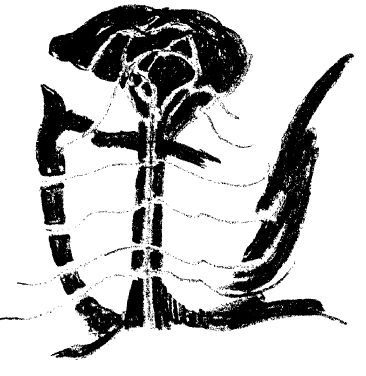
[ 12 ] Was nun besonders in Betracht kommt, das ist die Art, wie die Atmung mit dem ganzen Nervensystem zusammenwirkt. In der Tat, dieses Zusammenwirken der Atmung mit dem ganzen Nervensystem ist etwas ganz Besonderes im menschlichen Organismus. Dafür sollte man als Lehrer, als Erzieher das allerfeinste Gefühl haben. Nur dann, wenn man dieses feine Gefühl hat, wird man richtig unterrichten können. Es geht da also die Atemluft in den Körper hinein, breitet sich aus, geht durch den Rückenmarkskanal da hinauf (siehe Zeichnung), breitet sich im Gehirn aus, kommt immer zusammen mit den Nervensträngen, geht wieder herunter und verfolgt die Wege, wodurch sie dann als Kohlensäure ausgestoßen werden kann. So daß wir fortwährend das Nervensystem von der eingeatmeten Luft bearbeitet haben, die sich ausbreitet, durch den Rückenmarkskanal hinaufgeht, sich ausbreitet, mit Kohlenstoff sich durchdringt, wiederum zurückgeht und ausgeatmet wird. Dieses ganze Atmen, wie es längs der Nervenstränge geht, wird erst im Laufe der Zeit, in der das Kind gerade schulpflichtig ist, zwischen dem Zahnwechsel und der Geschlechtsreife ganz eingeschaltet von seiten des astralischen Leibes in den physischen Leib. So daß der astralische Leib in dieser Zeit, indem er sich nach und nach mit Hilfe der Atemluft hineinschaltet, auf demjenigen spielt, was da wie Saiten aufgespannt ist, in der Mitte auf dem Rückenmarkskanal. Es ist wirklich eine Art von Leier, ein Musikinstrument, unsere Nerven, richtig ein innerliches Musikinstrument, das da in den Kopf hinauftönt.
[ 12 ] What is particularly important here is the way breathing interacts with the entire nervous system. In fact, this interaction between breathing and the entire nervous system is something quite unique to the human organism. As a teacher or educator, one should have the most subtle sense of this. Only when one has this subtle sensitivity will one be able to teach properly. So the inhaled air enters the body, spreads out, travels upward through the spinal canal (see diagram), spreads throughout the brain, always accompanying the nerve tracts, travels back down, and follows the pathways through which it can then be expelled as carbon dioxide. In this way, the inhaled air continuously works on the nervous system: it spreads out, travels upward through the spinal canal, spreads further, becomes infused with carbon dioxide, travels back down, and is exhaled. This entire breathing process, as it proceeds along the nerve tracts, is only fully integrated by the astral body into the physical body over the course of the period when the child is of school age—between the change of teeth and puberty. So that during this time, as the astral body gradually integrates itself with the help of the breath, it plays upon what is stretched out like strings in the center of the spinal canal. Our nerves are truly a kind of lyre, a musical instrument—indeed, an inner musical instrument—whose sound resonates upward into the head.
[ 13 ] Und wenn der Zahnwechsel beginnt - es ist natürlich schon früher der Fall, aber da ist der Astralleib noch lose -, aber mit dem Zahnwechsel beginnt der astralische Leib deutlich sich mit der Atemluft der einzelnen Nervenstränge wie Saiten einer Violine zu bedienen.
[ 13 ] And when the teeth begin to fall out—it happens earlier, of course, but at that stage the astral body is still loosely connected—but with the loss of the baby teeth, the astral body begins to make distinct use of the breath flowing through the individual nerve strands, like the strings of a violin.
[ 14 ] Das alles aber wird befördert, wenn Sie dem Kinde dasjenige beibringen, was gesanglich ist. Und Sie müssen ein Gefühl haben, das Kind ist ein Musikinstrument, indem es singt; müssen vor der Klasse stehen, wo Sie Gesangunterricht, Musikunterricht erteilen, mit dem deutlichen Gefühl: Jedes Kind ist ein Musikinstrument und fühlt innerlich das Wohlgefühl des Tönens.
[ 14 ] All of this, however, is fostered when you teach the child what singing is all about. And you must have the sense that the child is a musical instrument when singing; you must stand before the class where you teach singing and music with the clear sense that every child is a musical instrument and feels within themselves the joy of making sound.
[ 15 ] Denn das Tönen wird durch diese besondere Zirkulation des Atems bewirkt. Das ist innerliche Musik. Und daher muß man, während das Kind anfangs, in den ersten sieben Lebensjahren, alles durch Nachahmung nur lernt, nun versuchen, daß das Kind jetzt nach innerem Wohlgefühl, das es bekommt beim Melodienbilden, beim Rhythmenbilden, den Gesang lernt. Wenn Sie vor der Klasse stehen und Gesangunterricht erteilen, müssen Sie eine Vorstellung haben, für die ich einen Vergleich gebrauchen möchte, der etwas ins Grobe geht, aber der Ihnen das, was ich meine, deutlich machen wird. Ich weiß nicht, wie viele von Ihnen, aber hoffentlich werden die meisten es schon dahin gebracht haben, einmal eine Kuhherde sich anzuschauen, wenn die Kuhherde gefressen hat und daliegt auf der Weide und nun verdaut. Solch ein Verdauen einer Kuhherde ist tatsächlich etwas ganz Wunderbares. Da ist in der Kuh etwas wie ein Abbild der ganzen Welt vorhanden. Die Kuh empfindet in ihrem Verdauungsapparat, in ihrem Ernährungsapparat, wenn da verdaut wird, wenn da die verarbeiteten Speisen übergehen in Blutgefäße, Lymphgefäße, wenn das alles vor sich geht, empfindet die Kuh ein solches Wohlgefallen, das zu gleicher Zeit Erkenntnis ist. Jede Kuh hat eine wunderbare Aura beim Verdauen, in der sich die ganze Welt spiegelt. Es ist das Schönste, was man sehen kann, solch eine Kuhherde, auf der Wiese liegend, verdauend und im Verdauen die ganze Welt begreifend. Bei uns Menschen ist das alles ins Unterbewußte hinuntergerückt, damit der Kopf das spiegeln kann, was der Körper sich erkennend verarbeitet.
[ 15 ] For sound is produced by this particular circulation of the breath. This is inner music. And that is why, whereas at first—during the first seven years of life—the child learns everything solely through imitation, we must now try to have the child learn to sing based on the inner sense of well-being that comes from creating melodies and rhythms. When you stand in front of the class and teach singing, you must have a certain mental image—for which I’d like to use a comparison that’s a bit rough around the edges, but which will make my point clear. I don’t know how many of you have had the opportunity, but hopefully most of you have at least once had the chance to observe a herd of cows after they have eaten and are lying in the pasture, now digesting their food. The digestive process of a herd of cows is truly something quite marvelous. Within the cow there is something like a reflection of the entire world. As digestion takes place in the cow’s digestive system—as the processed food passes into the blood vessels and lymphatic vessels—the cow experiences such a sense of well-being that is, at the same time, a form of insight. Every cow has a wonderful aura while digesting, in which the whole world is reflected. It is the most beautiful sight one can see—a herd of cows lying in the meadow, digesting, and through that process comprehending the whole world. In us humans, all of this has been pushed down into the subconscious so that the mind can reflect what the body is processing through self-awareness.
[ 16 ] Wir sind tatsächlich schlecht daran als Menschen, weil der Kopf es nicht dazu kommen läßt, die schönen Dinge wirklich zu erleben, die zum Beispiel die Kühe erleben. Wir würden viel mehr von der Welt wissen, wenn wir zum Beispiel den Verdauungsvorgang erleben könnten. Wir müßten ihn dann natürlich nur wirklich mit dem Gefühl des Erkennens erleben, nicht mit dem Gefühl, das der Mensch hat, wenn er im Unterbewußten bleibt im Verdauungsvorgang. Nun, das sollte uns klarmachen, was ich eigentlich sagen will. Ich will damit nicht sagen, der Verdauungsvorgang sei in der Pädagogik nun ins Bewußtsein heraufzubringen, aber ich will sagen, daß etwas auf einer höheren Stufe wirklich beim Kinde vorhanden sein muß: dieses Wohlgefühl des inneren Verlaufes eines Tönens. Denken Sie nur, wenn die Violine fühlen würde, was in ihr vorgeht! Wir hören der Violine nur zu, die ist draußen, wir sind fremd dem ganzen Entstehen des Tones, wir hören nur den äußeren Sinnesschein davon. Wenn die Violine empfinden könnte, wie jede Saite vibriert mit der anderen, die würde ja Seligkeiten erleben - vorausgesetzt, daß das Stück gut ist. So müssen Sie das Kind diese kleinen Seligkeiten erleben lassen, müssen wirklich Musikgefühl im ganzen Organismus hervorrufen, selber richtig Freude daran haben.
[ 16 ] We humans are actually at a disadvantage because our minds prevent us from truly experiencing the beautiful things that, for example, cows experience. We would know much more about the world if, for example, we could experience the digestive process. Of course, we would then have to experience it with a genuine sense of understanding, not with the feeling a person has when they remain in the subconscious during the digestive process. Well, that should make clear what I’m actually trying to say. I do not mean to say that the digestive process should now be brought into consciousness in education, but I do mean to say that something must truly be present in the child at a higher level: this sense of well-being arising from the inner process of sound. Just think, if the violin could feel what is going on inside it! We merely listen to the violin; it is out there, we are strangers to the entire process of sound production; we hear only its outward sensory manifestation. If the violin could sense how each string vibrates in harmony with the others, it would indeed experience bliss—provided, of course, that the piece is good. So you must let the child experience these little moments of bliss; you must truly evoke a sense of music throughout the child’s entire being, and take genuine joy in it yourself.
[ 17 ] Natürlich muß man etwas von Musik verstehen. Aber zum Unterrichten gehört dieses künstlerische Element, das ich eben jetzt auseinandergesetzt habe.
[ 17 ] Of course, you have to know something about music. But teaching involves this artistic element that I just explained.
[ 18 ] Daher ist es notwendig, weil das der wirkliche Verlauf der Vorgänge im Menschenwesen zwischen dem Zahnwechsel und der Geschlechtsreife fordert, ganz von Anfang an mit den Kindern auch Musikunterricht zu treiben und möglichst zunächst das Kind gewöhnen, ganz empirisch, ohne Theorie, kleine Liedchen zu singen. Ja nichts anderes als kleine Liedchen singen lassen, und die aber gut singen! Und nach und nach erst zum Einfacheren übergehen, damit das Kind erst nach und nach sich aneignet, was Melodie, Rhythmus, Takt ist und so weiter. Zunächst aus dem Ganzen heraus die Kinder gewöhnen, einfache Liedchen zu singen, einfach zu spielen auch, so gut es nur geht. Wenn nicht die Anlage ganz dagegen spricht, beginnen wir in der Waldorfschule sogleich, wenn die Kinder in die Schule kommen, sie auch auf irgendeinem Instrument spielen zu lassen, ein Instrument gleich handhaben zu lernen, wie gesagt, so gut es die Möglichkeiten gestatten. Aber man sollte die Kinder veranlassen, möglichst früh zu fühlen, wie das ist, wenn das eigene musikalische Wesen nun hinüberfließt in das objektive Instrument. Dazu ist das Klavier, das ja eigentlich nur eine Art Memorierinstrument sein sollte, natürlich am schlechtesten anzuwenden für das Kind. Man sollte ein anderes Instrument bei dem Kinde verwenden, womöglich ein Instrument, auf dem geblasen werden kann. Aber natürlich muß man dabei sehr viel künstlerischen Takt haben und sehr viel auch, ich möchte sagen, Autorität haben. Also womöglich solch ein Instrument, wo geblasen werden kann. Davon haben die Kinder am allermeisten, wenn sie irgendein einfaches Blasinstrument handhaben lernen und allmählich Musik verstehen lernen. Natürlich kann man die allerschlimmsten Erfahrungen machen, wenn die Kinder zu blasen anfangen. Aber es ist auf der anderen Seite etwas Wunderbares im Erleben des Kindes, wenn es diese ganze Konfiguration der Luft, die es sonst umwebt, innerlich längs der Nervenstränge hält, nun fortsetzen muß und hineinleiten muß. Da fühlt der Mensch seinen Organismus vergrößert. Vorgänge, die sonst nur im Organismus drinnen sind, werden auf die Außenwelt übergeleitet. Ähnlich ist es auch, wenn das Kind Violine spielen lernt, wo die Vorgänge, die Musik, die da lebt, direkt übertragen wird, wo der Mensch fühlt, wie das Musikalische in ihm durch den Bogen auf die Saiten übergeht und so weiter.
[ 18 ] Therefore, because the actual course of development in human beings between the loss of baby teeth and sexual maturity demands it, it is necessary to begin music instruction with children right from the start and, as far as possible, to first accustom the child—entirely empirically, without theory—to singing little songs. Yes, nothing more than letting them sing little songs—and sing them well! And only gradually move on to simpler pieces, so that the child gradually comes to understand what melody, rhythm, and meter are, and so on. First and foremost, we should get the children used to singing simple little songs—and playing them simply as well—as best they can. Unless their natural aptitude clearly precludes it, we at the Waldorf School begin immediately upon the children’s arrival to have them play some instrument, to learn to handle an instrument right away—as I said, as best as their abilities allow. But we should encourage the children to experience as early as possible what it is like when their own musical nature flows over into the objective instrument. For this purpose, the piano—which is really meant to be nothing more than a kind of memorization instrument—is, of course, the least suitable for the child. We should use a different instrument with the child, preferably one that can be played by blowing into it. But of course, one must exercise a great deal of artistic tact in this process and also, I would say, a great deal of authority. So, ideally, an instrument that can be played by blowing into it. Children benefit most from this when they learn to play a simple wind instrument and gradually come to understand music. Of course, one can have the very worst experiences when children start playing wind instruments. But on the other hand, there is something wonderful in the child’s experience when they must take this entire configuration of air—which otherwise surrounds them—and, holding it internally along the nerve pathways, continue it and direct it inward. There, the person feels their organism expanded. Processes that are otherwise confined to the interior of the organism are transferred to the outside world. It is similar when a child learns to play the violin, where the processes—the music that lives there—are directly transmitted, where the person feels how the musicality within them passes through the bow to the strings, and so on.
[ 19 ] Aber möglichst früh gerade diesen Unterricht im Musikalischen und im Gesanglichen bei den Kindern beginnen! Das ist etwas, was von einer ganz besonderen Bedeutung ist, daß man nicht nur artistisch allen Unterricht erteilt, sondern auch mit dem eigentlich Artistischen, mit dem Malen, mit dem plastischen Arbeiten und mit dem Musikalischen sogleich beginnt, wenn das Kind in die Volksschule kommt, und darauf sieht, daß das alles wirklich inneres menschliches Eigentum wird.
[ 19 ] But begin teaching children music and singing as early as possible! This is something of particular importance: that one not only provide instruction in the arts in general, but also begin immediately with the arts themselves—painting, sculpting, and music—when the child enters elementary school, and ensure that all of this truly becomes an inner, human possession.
[ 20 ] Es ist von besonderer Wichtigkeit, daß wir den Punkt in der Lebensentwickelung des Kindes zwischen dem 9. und 10. Jahre mit Bezug auf die Erlernung des Sprachlichen ins Auge fassen. Ich habe Ihnen ja diesen Punkt zwischen dem 9. und 10. Jahre charakterisiert, wo das Kind eigentlich erst lernt, sich von seiner Umgebung zu unterscheiden. Bis dahin fühlt es sich eins mit seiner Umgebung. Wir werden also sachgemäß mit dem Kinde so beginnen, wie ich es angedeutet habe, wenn es in die Schule kommt. Es sollte eigentlich nicht in die Schule kommen, bevor der Zahnwechsel beginnt. Alles frühere schulmäßige Lernen ist im Grunde genommen Unfug; wenn wir durch die Gesetze gezwungen werden, müssen wir es ja tun, aber sachgemäß pädagogisch-künstlerisch ist es nicht. Sachgemäß pädagogisch-künstlerisch ist, das Kind erst mit dem Zahnwechsel in die Schule hereinzubekommen. Dann hat man es zunächst, wie ich angedeutet habe, mit dem Künstlerischen beginnend, damit zu tun, die Buchstabenformen aus dem Künstlerischen herauszuarbeiten; daß man auch in dieser Weise mit dem selbständig Künstlerischen beginnt, wie ich es auseinandergesetzt habe, daß man alles dasjenige, was sich auf die Natur bezieht, in der märchenhaften, legendenhaften, mythenhaften Art behandelt, wie ich es auch auseinandergesetzt habe. Aber wichtig ist, in bezug auf den Sprachunterricht Rücksicht zu nehmen auf diese Lebensepoche zwischen dem 9. und 10. Lebensjahr.
[ 20 ] It is particularly important that we focus on the stage in a child’s development between the ages of 9 and 10 with regard to language acquisition. I have already described this stage between the ages of 9 and 10, when the child actually begins to distinguish itself from its surroundings. Until then, the child feels at one with its surroundings. We will therefore begin working with the child appropriately, as I have indicated, when it starts school. The child should not actually start school before the transition to permanent teeth begins. Any schooling that takes place before that is, in essence, nonsense; if we are compelled by the law to do so, we must, of course, but it is not appropriate from a pedagogical and artistic standpoint. It is appropriate from a pedagogical and artistic standpoint to admit the child to school only after the change of teeth. Then, as I have indicated, one begins with the artistic and works on developing the shapes of the letters from within the artistic realm; that one also begins in this way with independent artistic expression, as I have explained, and that one treats everything related to nature in a fairy-tale-like, legendary, and mythical manner, as I have also explained. But it is important, with regard to language instruction, to take into account this stage of life between the ages of 9 and 10.
[ 21 ] Der Sprachunterricht darf unter keinen Umständen, bevor dieser Lebenspunkt eingetreten ist, irgend etwas enthalten von intellektueller Betrachtung der Sprache, also nichts von Grammatik, nichts von Satzbau und dergleichen. Das Kind muß bis zu diesem Lebenspunkt im 9. oder 10. Lebensjahre ganz so sprechen, wie es sonst irgendwelche Gewohnheiten sich aneignet; gewohnheitsmäßig muß es sich das Sprechen aneignen. Erst wenn das Kind sich unterscheiden lernt von der Umgebung, darf auch dasjenige, was das Kind selber vollbringt, also das Sprechen, betrachtet werden. Erst von da ab sollte man von Hauptwort, Eigenschaftswort, Verbum und so weiter sprechen, nicht früher. Vorher soll das Kind einfach sprechen und im Sprechen erhalten sein.
[ 21 ] Under no circumstances should language instruction, before this stage of development has been reached, include any intellectual analysis of language—that is, nothing about grammar, nothing about sentence structure, or anything of the sort. Until this stage of life, around the age of 9 or 10, the child must speak in exactly the same way that it otherwise acquires any other habits; it must acquire speech through habit. Only when the child learns to distinguish itself from its surroundings may what the child accomplishes on its own—that is, speech—be considered. Only from that point on should one speak of nouns, adjectives, verbs, and so on—not before. Before that, the child should simply speak and be allowed to develop through speech.
[ 22 ] Wir haben ja in der Waldorfschule Gelegenheit, dies durchzuführen, weil sogleich, wenn das Kind zu uns in die Volksschule, in die Elementarschule kommt, es außer seiner Muttersprache zwei fremde Sprachen lernt.
[ 22 ] At Waldorf schools, we have the opportunity to do this because as soon as a child joins us in elementary school, they learn two foreign languages in addition to their native language.
[ 23 ] Wir nehmen das Kind in die Schule herein. Es hat zunächst seinen epochenmäßigen Unterricht - ich habe das charakterisiert, was Epochenunterricht ist - in den ersten Schulstunden am Morgen, und daran schließt sich dann gleich für das kleine Kind ein Unterricht im Englischen und Französischen. Dabei versuchen wir diesen Sprachunterricht so zu erteilen, daß gar nicht das Verhältnis der einen Sprache zur anderen dabei in Betracht kommt. Wir sehen vor dem Lebenspunkt, den ich charakterisiert habe, zwischen dem 9. und 10. Jahre ganz ab davon, daß, sagen wir, der Tisch im Deutschen Tisch, im Englischen table heißt, daß essen im Deutschen essen, im Englischen eat heißt. Wir knüpfen jede Sprache nicht an Worte einer anderen Sprache an, sondern an die unmittelbaren Gegenstände. Das Kind lernt benennen, sei es im Französischen, sei es im Englischen, die Decke, die Lampe, den Stuhl. Es wird also im 7., 8., 9. Jahre noch nicht irgendwie Wert aufs Übersetzen gelegt, das heißt aufs Umsetzen eines Wortes aus einer Sprache in die andere, sondern das Kind lernt einfach in der Sprache sprechen in Anlehnung an die äußeren Gegenstände, so daß das Kind gar nicht zu wissen braucht oder nicht daran zu denken braucht, daß, wenn es im Englischen table sagt, das im Deutschen Tisch heißt und so weiter. Das gibt es nicht für das Kind; es kommt gar nicht darauf während der Stunde, denn es wird bis dahin keinerlei Sprachvergleich oder so etwas mit dem Kinde getrieben.
[ 23 ] We welcome the child into school. At first, the child has block-structured lessons—I have described what block-structured teaching entails—during the first school hours in the morning, followed immediately by English and French lessons for the young child. In doing so, we try to teach these languages in such a way that the relationship between one language and the other is not taken into account at all. Before the stage of development I described—between the ages of 9 and 10—we completely disregard the fact that, for example, “Tisch” in German means “table” in English, or that “essen” in German means “eat” in English. We do not link each language to words from another language, but rather to the objects themselves. The child learns to name—whether in French or in English—the blanket, the lamp, the chair. Thus, in the 7th, 8th, and 9th years, no emphasis is placed on translation—that is, on converting a word from one language to another—but rather the child simply learns to speak the language by referring to external objects, so that the child does not need to know or even think about the fact that when it says “table” in English, this is “Tisch” in German, and so on. That is not an issue for the child; it does not even come up during the lesson, because up to that point, no language comparison or anything of the sort has been done with the child.
[ 24 ] Dadurch bekommt das Kind die Möglichkeit, die Sprache aus dem Elemente heraus zu lernen, und jede Sprache aus dem Elemente, aus dem sie stammt, aus dem Gefühlselemente. - Was ist denn die Sprache in ihren Lauten? - Denn aus Lauten besteht ja die Sprache. Sie ist entweder der Ausdruck von innerem Seelischem, dann steht der Vokal da; oder sie ist der Ausdruck von Äußerlichem, dann steht der Konsonant da. Aber das muß man zuerst fühlen. Nehmen wir an, das Kind soll dasjenige fühlen, was zum Beispiel in dem Worte water liegt. Wir werden das, so wie ich es jetzt sagen werde, nicht im Unterricht gebrauchen, sondern wir sollen nur den Unterricht so einrichten, daß das Kind wirklich mit dem Vokal Gefühl verbindet und mit dem Konsonanten die Nachahmung von etwas Äußerem empfindet. Es tut das Kind das schon, weil das in der menschlichen Wesenheit liegt; aber wir sollen das nicht austreiben, sondern wir sollen daran anknüpfen.
[ 24 ] This gives the child the opportunity to learn language from its very essence—and every language from the essence from which it originates: the emotional element. - What, then, is language in its sounds? - For language is, after all, made up of sounds. It is either the expression of something inner and spiritual—in which case the vowel is present—or it is the expression of something external—in which case the consonant is present. But one must first feel this. Let’s suppose the child is to feel what lies, for example, in the word “water.” We will not use this, as I am about to describe it, in the classroom; rather, we should simply structure the lesson so that the child truly associates feeling with the vowel and perceives the consonant as the imitation of something external. The child already does this because it is inherent in the human being; but we should not suppress it—rather, we should build upon it.
[ 25 ] Denn, sehen Sie, was ist A? - Also das gehört nicht zum Unterricht, das dient nur dazu, daß Sie es wissen! - Was ist A? Ich stehe, wenn die Sonne aufgeht, bewundernd vor der aufgehenden Sonne: Ah! A ist immer der Ausdruck des Erstaunens, der Verwunderung. Eine Fliege setzt sich auf meine Stirne, ich mache: E. Das ist der Ausdruck des Abwehrens, des Wegmachens: E. Im Englischen verschiebt sich das gegenüber dem Deutschen, es ist aber doch in jeder Sprache, auch hier der Ausdruck des Erstaunens, des Verwunderns da.
[ 25 ] Because, you see, what is A? — Well, that’s not part of the lesson; it’s just something you should know! — What is A? When the sun rises, I stand in awe before the rising sun: Ah! A is always an expression of astonishment, of wonder. A fly lands on my forehead, and I make this gesture: E. That is the expression of repulsion, of shooing it away: E. In English, this shifts somewhat compared to German, but it is still present in every language—here, too, as an expression of astonishment and wonder.
[ 26 ] Jetzt nehmen Sie ein charakteristisches Wort: rollen, das Rollen einer Kugel, im Englischen: roll. Da haben Sie das R. Wer sollte da nicht fühlen (siehe Zeichnung I), daß ich es weitergebe, das L. R wäre nur so (Zeichnung II). Z geht weiter. Z ist immer das Werterfließen. Roll, da haben Sie einen äußeren Vorgang in den Konsonanten nachgeahmt (siehe Zeichnung II).
[ 26 ] Now take a characteristic word: roll—the rolling of a ball; in English: roll. There you have the R. Who wouldn’t sense (see Drawing I) that I’m passing it on—the L. R would be just like this (Drawing II). Z continues. Z is always the flow of value. “Roll”—there you have an external process imitated in the consonant (see Drawing II).
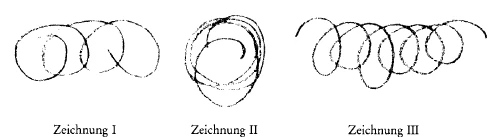
[ 27 ] So ist die ganze Sprache entweder aus dem Gefühl des inneren Erstaunens, Verwunderns, Sichwehrens, Sichbehauptens und so weiter und aus dem Nachahmegefühl bei den Konsonanten zu verstehen. Das soll man dem Kinde nicht austreiben. Es soll fühlen lernen an den Gegenständen und an seinem Gefühlsverhältnis zu den Gegenständen, den Laut zu entfalten. Es soll alles aus dem Sprachgefühl heraus geholt werden. Das Kind soll wirklich bei dem roll fühlen: r-o-l-l. So ist es bei jedem Worte.
[ 27 ] Thus, the entire language is to be understood either as arising from feelings of inner astonishment, wonder, resistance, self-assertion, and so on, or from the impulse to imitate in the case of consonants. This should not be suppressed in the child. The child should learn to develop sounds based on objects and on its emotional relationship to them. Everything should be drawn from a sense of language. The child should truly feel the sound “roll”: r-o-l-l. This applies to every word.
[ 28 ] Das hat ja der moderne zivilisierte Mensch ganz verloren. Er glaubt, das Wort ist etwas Aufgeschriebenes oder irgend etwas ganz Abstraktes. Der Mensch kann sich ja gar nicht mehr eigentlich in die Sprache hineinleben. Primitive Sprachen, die haben noch überall das Gefühl in der Sprache; die zivilisiertesten Sprachen, die machen die Sprache abstrakt. Sehen Sie nur einmal in der eigenen englischen Sprache, wie die zweite Hälfte der Worte weggeworfen, weggeschleudert wird, wie man da über das eigentliche Fühlen in den Lauten wegspringt! Aber das Kind muß im Gefühl der Sprache erhalten bleiben.
[ 28 ] Modern, civilized people have completely lost that. They believe that a word is something written down or something entirely abstract. People can no longer truly immerse themselves in language. Primitive languages still convey emotion throughout the language; the most “civilized” languages, on the other hand, make language abstract. Just look at your own English language: how the second half of the words is discarded, flung away—how one skips right over the actual feeling in the sounds! But the child must remain rooted in the feeling of language.
[ 29 ] Und dieses Sprachgefühl sollte man, indem man charakteristische Worte nimmt, an denen man dies Gefühl erörtern kann, geradezu pflegen. Im Deutschen haben wir für das, was der Mensch da oben hat, das Wort Kopf. Im Englischen haben wir head, im Italienischen haben wir testa. Nun, was tut man, wenn man sich zu der Sprache so abstrakt verhält, wie man das gewöhnlich tut? Man sagt, im Deutschen heißt der Kopf: Kopf, im Italienischen testa, im Englischen head, Aber das ist ja alles nicht wahr, das ist ja alles Unsinn.
[ 29 ] And one should actively cultivate this sense of language by choosing characteristic words that allow one to explore this feeling. In German, we have the word Kopf for what a person has up there. In English, we have “head,” and in Italian, we have “testa.” Now, what do you do when you approach language as abstractly as people usually do? You say, “In German, the head is called Kopf; in Italian, testa; in English, head.” But none of that is true—it’s all nonsense.
[ 30 ] Sehen Sie, Kopf, was ist das? Kopf ist dasjenige, was geformt ist, so rundlich geformt ist. Da drückt man die Form aus, wenn man Kopf sagt. Sagt man testa, Sie sehen das in dem Worte "Testament, testieren, so drückt man aus, daß der Kopf etwas feststellt. Man drückt etwas ganz anderes aus. Man sagt zu dem, was da droben sitzt: das ist der Feststeller, der Testierer = testa. Im Englischen ist man der Ansicht, daß der Kopf das Hauptsächlichste des Menschen ist. Sie wissen Ja, diese Ansicht ist nicht ganz richtig. Man sagt also im Englischen bead, das Wichtigste, dasjenige, wohin alles zielt, worinnen alles zuammenkommt.
[ 30 ] Look, “head”—what is that? A head is that which is shaped, shaped in a somewhat round way. When you say “head,” you’re expressing that shape. If you say “testa”—you see it in the words “testament” and “to testify”—you’re expressing that the head establishes something. But it expresses something entirely different. We say of what sits up there: that is the determiner, the testator = *testa*. In English, it is believed that the head is the most essential part of a person. You know, this view is not entirely correct. So in English, we say *bead*—the most important thing, that toward which everything is directed, where everything converges.
[ 31 ] Man drückt also Verschiedenes aus. Es wird in den verschiedenen Sprachen Verschiedenes ausgedrückt. Wollte man dasselbe bezeichnen, würde der Engländer und der Italiener ebenso Kopf sagen. Aber er bezeichnet nicht dasselbe. In der menschlichen Ursprache wurde überall dasselbe bezeichnet. Daher ist die menschliche Ursprache für alle dieselbe gewesen. Dann haben sich die Menschen getrennt, haben die Dinge verschieden bezeichnet; dadurch kamen die verschiedenen Worte. Wenn man Verschiedenes als «gleich» bezeichnet, dann wird nicht mehr gefühlt, was drinnen ist. Und das ist sehr notwendig, daß man das Sprachgefühl nicht heraustreibe; das muß drinnen bleiben. Deshalb darf man auch eine Sprachbetrachtung nicht vor dem 9. oder 10. Jahre eintreten lassen.
[ 31 ] So, people express different things. Different things are expressed in different languages. If one wanted to refer to the same thing, an English speaker and an Italian speaker would both say “head.” But they are not referring to the same thing. In the original human language, the same thing was referred to everywhere. That is why the original human language was the same for everyone. Then people went their separate ways and began to designate things differently; this is how the various words came about. If one designates different things as “the same,” then one no longer senses what lies within. And it is very important not to drive out this sense of language; it must remain within. That is why one should not introduce the study of language before the age of 9 or 10.
[ 32 ] Da erst sollte man übergehen zu dem, was Hauptwort, Zeitwort ist, Substantiv, Adjektiv, Verbum und so weiter, nicht früher, nicht vor dem 9. oder 10. Jahre; sonst betrachtet man am Kinde etwas, was an ihm selber ist. Das kann es aber nicht fassen, weil es sich noch nicht unterscheidet von seiner Umgebung. Und das ist sehr wichtig, unmittelbar ins Auge zu fassen: nichts von Grammatik, auch nichts von Sprachvergleichung vor dem 9. oder 10. Lebensjahr eintreten zu lassen! Dann bekommt das Kind etwas Ähnliches beim Sprechen, wie es beim Singen bekommt.
[ 32 ] Only then should one move on to what a noun, verb, adjective, and so on are—not before, not before the age of 9 or 10; otherwise, one observes in the child something that is inherent in the child itself. But the child cannot grasp this, because it has not yet distinguished itself from its surroundings. And it is very important to keep this clearly in mind: do not introduce any grammar, nor any comparative linguistics, before the age of 9 or 10! Then the child will experience something similar in speaking as it does in singing.
[ 33 ] Ich habe versucht, dieses innere Wohlgefühl beim Singen zu veranschaulichen durch das innere Wohlgefühl, welches aufsteigt aus den Verdauungsorganen der Kühe auf der Weide, wenn sie verdauen. Und ein solches inneres Wohlgefühl, oder wenigstens Sachgefühl, so daß die Kinder fühlen, was in einem Worte ist, daß sie das innerliche «Rollen» fühlen, das muß vorhanden sein. Es muß innerlich die Sprache erlebt werden, nicht bloß mit dem Kopf gedacht werden. Heute denken zumeist die Menschen die Sprache nur noch mit dem Kopf. Daher nehmen sie eben einfach, wenn sie wissen wollen, was in einer Sprache richtig ist, was von einer Sprache in die andere übersetzt werden soll, ein Wörterbuch. Die Wörter sind da so zusammengestellt, daß da «testa» oder «Kopf» steht. Und so bildet sich das Gefühl, als ob das gleich wäre. Es ist aber nicht gleich. Es ist immer etwas anderes bezeichnet. Und das kann nur aus dem Gefühl heraus bezeichnet werden. Das ist notwendig zu berücksichtigen beim Sprachunterricht. Dazu kommt noch ein anderes - geistiges Element. Wenn der Mensch stirbt oder bevor er auf die Erde heruntersteigt, hat er zum Beispiel gar keine Möglichkeit, sogenannte Substantiva zu verstehen. Der sogenannte Tote weiß gar nichts von Substantiven. Was da von Gegenständen benannt wird, davon weiß er nichts. Er weiß noch etwas von Eigenschaften. Man hat also eine Möglichkeit, sich mit den Toten zu verständigen über Eigenschaften. Das hört auch bald auf. Am längsten dauert das Verständigen über Verben, über Tätigkeitsworte, aktive und passive Bezeichnungen, und am allerlängsten die Bezeichnung der Empfindungen: Oh! Ah! I, E; diese Interjektionsbezeichnungen bewahrt sich der Tote am allerlängsten.
[ 33 ] I have tried to illustrate this inner sense of well-being that comes from singing by comparing it to the inner sense of well-being that rises from the digestive organs of cows in a pasture as they digest their food. And such a sense of inner well-being—or at least a sense of the essence of things—so that children can feel what is contained in a word, so that they can feel its inner “flow”—that must be present. Language must be experienced inwardly; it must not merely be thought about with the head. Today, most people think about language only with their heads. That is why, when they want to know what is correct in a language or what should be translated from one language to another, they simply reach for a dictionary. The words are arranged there in such a way that “testa” or “head” is listed. And so the impression arises that they are the same. But they are not the same. It always refers to something different. And that can only be described through feeling. This must be taken into account in language instruction. There is also another—spiritual—element. When a person dies, or before they descend to Earth, they have, for example, no way of understanding so-called nouns. The so-called dead person knows nothing at all about nouns. They know nothing of the objects that are named by them. They still know something about qualities. So there is a way to communicate with the dead through qualities. But even that soon comes to an end. Communication through verbs—words of action, active and passive terms—lasts the longest, and the longest of all is the expression of sensations: Oh! Ah! I, E; the dead retain these interjections the longest.
[ 34 ] Daraus können Sie auch sehen, wie die menschliche Seele darauf angewiesen ist, wenn sie nicht ganz ungeistig werden soll, in den Interjektionen wirklich zu leben. Interjektionen sind ja in Wirklichkeit alle Vokale. Und die Konsonanten, die ja ohnedies sehr bald auch als solche verlorengehen nach dem Tode oder nicht vorhanden waren vor dem Herabsteigen zur Erde, die sind Nachahmungen des Äußeren. Das sollen wir im Gefühl wirklich erleben und darauf sehen, wo das beim Kinde liegt, und es nicht austreiben durch einen frühzeitigen Unterricht in Substantiven, Adjektiven und so weiter, sondern den eigentlich erst zwischen dem 9. und 10. Jahr beginnen lassen.
[ 34 ] From this you can also see how the human soul, if it is not to become entirely devoid of spirit, must truly live through interjections. Interjections are, in reality, all vowels. And the consonants—which, in any case, are very soon lost as such after death or were not present before the descent to Earth—are imitations of the external world. We should truly experience this in our feelings and observe where this lies in the child, and not drive it out through premature instruction in nouns, adjectives, and so on, but rather allow that instruction to begin only between the ages of 9 and 10.
[ 35 ] Wir haben nun in der Waldorfschule vom Anfange des Volksschulunterrichtes an die Eurythmie eingeführt, diese sichtbare Sprache, in der der Mensch durch Bewegungen, die er an sich selbst und in Gruppen ausführt, sich so offenbart, wie er sich sonst durch die Sprache offenbart. Nun ist es tatsächlich so, wenn das Kind nicht im Sprachunterricht verdorben wird durch einen das Sprachgefühl nicht berücksichtigenden Erzieher, wenn es also im Sprachgefühl erhalten wird, dann empfindet das Kind den Übergang zur Eurythmie gerade so selbstverständlich für den Menschen, wie das ganz kleine Kind es selbstverständlich findet, die Lautsprache zu lernen. Man hat nicht die geringste Schwierigkeit, Eurythmie an die Kinder heranzubringen. Sie wollen sie, wenn sie gesund entwickelte Kinder sind. Man kann immer nachforschen, wie irgendwo etwas Pathologisches sitzt, wenn die Kinder nicht an die Eurythmie herankommen wollen. Sie wollen ebenso selbstverständlich eurythmisieren, wie sie als ganz kleine Kinder sprechen lernen wollen, wenn die Organe alle gesund sind. Das ist aus dem Grunde, weil das Kind besonders kräftig den Drang fühlt, das innerlich Erlebte auch willensgemäß an sich zum Ausdruck zu bringen. Das äußert sich ja schon dann, wenn der Mensch als Kind frühzeitig zum Lachen und Weinen übergeht, in den besonderen physiognomischen Äußerungen für Gefühle.
[ 35 ] We have now introduced eurythmy into the Waldorf school from the very beginning of elementary school instruction—this visible language in which a person reveals themselves through movements performed individually and in groups, just as they would otherwise reveal themselves through speech. Now, it is indeed the case that if a child is not spoiled in language instruction by a teacher who disregards the child’s sense of language—that is, if the child’s sense of language is preserved—then the child experiences the transition to eurythmy as just as natural for human beings as a very young child finds it natural to learn spoken language. One has not the slightest difficulty introducing eurythmy to children. They want it if they are healthily developed children. One can always investigate where some pathological factor lies if the children do not want to engage with eurythmy. They want to practice eurythmy just as naturally as they want to learn to speak as very young children, provided all their organs are healthy. This is because the child feels a particularly strong urge to express what it experiences inwardly through its own will. This is already evident when a child begins to laugh and cry at an early age, in the specific facial expressions that convey emotions.
[ 36 ] Sie werden schon recht sehr in Metaphern, in Vergleichen sprechen müssen, wenn Sie von einem Hund oder einem anderen Tier sagen wollen, es lache. Es lacht jedenfalls nicht in derselben Weise wie der Mensch, weint auch nicht wie der Mensch. So aber sind beim Tiere überhaupt Gebärden, Bewegungen, die das innerlich Erlebte in das Willenselement hineintragen, etwas ganz anderes als beim Menschen.
[ 36 ] You will have to rely quite heavily on metaphors and comparisons if you want to say that a dog or another animal is laughing. In any case, it does not laugh in the same way as a human being, nor does it cry like a human being. However, in animals, gestures and movements that convey inner experiences into the realm of the will are fundamentally different from those in humans.
[ 37 ] Nun, so gesetzmäßig, wie der Mensch spricht, ist auch dasjenige, was in der Eurythmie zum Ausdrucke kommt. Sprechen ist ja nichts Willkürliches. Man kann nicht, wenn es im Englischen zum Beispiel water heißt, an Stelle des a auch einen anderen Vokal hersetzen, man kann nicht sagen: water und dergleichen. Fs ist gesetzmäßig, das Sprechen. So ist auch das Eurythmische gesetzmäßig. Bei den gewöhnlichen Gebärden des Leibes ist man noch in gewissem Sinne frei, obwohl der Mensch auch da manches aus einem Instinkt heraus macht. Wenn er nachdenkt, dann greift er mit den Fingern an die Stirn; wenn er andeuten will, daß etwas nicht wahr ist, macht er so ..., er schüttelt den Kopf und die Hand, löscht es aus. Das innere und äußere Erleben in so gesetzmäßigen Bewegungen überführen in das Bild, wie die Sprache das innere Erleben in den Laut überführt, das ist eben die Furythmie; und das Kind will Eurythmie lernen. Deshalb ist die Tatsache, daß in der heutigen Erziehung nicht schon Eurythmieunterricht ist, ein Beweis dafür, daß man gar nicht darauf bedacht ist, die menschlichen Fähigkeiten aus der Natur, aus dem Wesen des Menschen herauszuholen; denn dann kommt man ganz von selbst auf die Eurythmie, wenn man das tut.
[ 37 ] Well, just as human speech follows certain laws, so too does what is expressed through eurythmy. Speech is, after all, not something arbitrary. For example, in English, if a word is “water,” you cannot substitute another vowel for the “a”; you cannot say “water” and so on. Speech follows certain laws. Eurythmy, too, follows such laws. With ordinary bodily gestures, one is still free in a certain sense, although even there people do many things out of instinct. When they are thinking, they touch their forehead with their fingers; when they want to indicate that something is not true, they do this...—they shake their head and hand, as if to erase it. Transforming inner and outer experience into such law-governed movements—just as speech transforms inner experience into sound—is precisely what eurythmy is; and the child wants to learn eurythmy. Therefore, the fact that eurythmy instruction is not already part of today’s education is proof that no effort is being made to draw human abilities out of nature, out of the very essence of the human being; for if one does that, eurythmy arises quite naturally.
[ 38 ] Dadurch wird dem Turnunterricht, dem Unterricht in den Leibesübungen kein Abbruch getan, aber es ist etwas anderes, und man soll diesen Unterschied als Lehrer, als Erzieher gut einsehen. Es ist der gymnastische Unterricht, wie er heute getrieben werden kann, und alles sportliche Treiben und so weiter etwas anderes als Eurythmie. Beide können nebeneinander sehr gut bestehen. Denn sehen Sie, der Begriff des Raumes wird ja von den Menschen sehr häufig ganz abstrakt gefaßt, die Menschen nehmen keine Rücksicht darauf, daß der Raum etwas Konkretes ist. Nicht wahr, die Menschen haben sich heute so daran gewöhnt, die Erde rund zu denken, daß sie sich vorstellen: Derjenige, der hier wohnt, sagt, wenn er springt, er springt hinauf. Sein Gegenfüßler, der da unten die Beine und da oben den Kopf hat, der springt hinunter, so denkt sich der Mensch. Aber das ist ja nichts Erlebbares. - Ich habe einmal ein Buch gelesen, Anschauungen über Naturphilosophie, da wollte der Autor dieses, daß der Himmel oben ist, dadurch lächerlich machen, indem er sagte: Da unten bei den Antipoden ist dann der Himmel unten! - Aber so arm sind die Dinge nicht. Wir urteilen nicht so über die Welt und den Raum, daß wir uns ganz ausschalten und den Raum als irgend etwas Abstraktes hinstellen. Das tun bestimmte Philosophen, Hume und Mill und Kant. Aber das ist ja alles nicht wahr, ist eigentlich ein Unsinn. Der Raum ist etwas ganz Konkretes und vom Menschen Empfundenes. Und der Mensch fühlt sich im Raume drinnen und fühlt die Notwendigkeit, sich in den Raum hineinzustellen. Wenn er sich ins Gleichgewicht des Raumes, in die verschiedenen Lagen des Raumes hineinstellt, so entsteht das Sportliche, das Gymnastische, das Turnen. Da will der Mensch sich hineinlagern in den Raum.
[ 38 ] This does not detract from physical education classes or physical exercise classes, but it is something different, and as a teacher or educator, one should clearly understand this distinction. Gymnastics classes, as they are taught today, and all athletic activities and so on are different from eurythmy. Both can coexist very well. For you see, the concept of space is very often understood by people in a completely abstract way; people do not take into account that space is something concrete. Isn’t it true that people today have become so accustomed to thinking of the Earth as round that they have a mental image: The person who lives here says that when he jumps, he jumps upward. His antipode—who has his legs down there and his head up there—jumps down, or so people imagine. But that’s not something you can actually experience. —I once read a book, *Views on Natural Philosophy*, in which the author sought to ridicule the idea that heaven is above by saying: “Down there, at the antipodes, heaven must then be below!” - But things aren’t quite that simple. We don’t judge the world and space in such a way that we completely remove ourselves from the picture and treat space as something abstract. Certain philosophers do that—Hume, Mill, and Kant. But none of that is true; it’s actually nonsense. Space is something entirely concrete and perceived by human beings. And human beings feel themselves to be within space and feel the need to position themselves within it. When they position themselves within the balance of space, within its various orientations, this gives rise to sports, gymnastics, and physical exercise. There, human beings want to position themselves within space.
[ 39 ] Wer zum Beispiel diese gymnastische Bewegung macht (Arme gestreckt), der hat das Gefühl, er legt seine beiden Arme in die horizontale Richtung hinein. Wer springt, der hat das Gefühl, seinen Körper durch dessen eigene Kraft nach aufwärts zu bewegen. Das ist Turnen. Das sind gymnastische Übungen.
[ 39 ] For example, anyone who performs this gymnastic movement (with arms extended) feels as if they are extending both arms horizontally. Anyone who jumps feels as if they are propelling their body upward using their own strength. That is gymnastics. Those are gymnastic exercises.
[ 40 ] Wer das Gefühl hat, er hält etwas innerlich Empfundenes, I, sinnend, der macht vielleicht auch diese Bewegung, aber da wird das innere Seelische in die Bewegung hineingelegt. Da offenbart der Mensch sein Inneres. Das tut er in der Eurythmie. Eurythmie ist also die Offenbarung des Inneren. In der Eurythmie wird dasjenige, was der Mensch erleben kann beim Atmen, bei der Blutzirkulation, insofern diese seelisch werden, zum Ausdruck gebracht. Beim Turnen, bei Gymnastik, Sport fühlt der Mensch, als ob der Raum überall Richtungen und Stellagen und alles mögliche hätte. In die springt er hinein, nach denen richtet er sich, macht sich auch solche Geräte zurecht. Er klettert auf einer Leiter hinauf, er zieht sich an einem Seil hinauf und so weiter. Da richtet sich der Mensch nach dem äußeren Raume.
[ 40 ] Anyone who feels that they are holding something they sense inwardly—I, in deep thought—may also make this movement, but in that case, the inner soul is infused into the movement. In this way, the person reveals their inner self. This is what they do in eurythmy. Eurythmy is thus the revelation of the inner self. In eurythmy, what a person can experience in breathing and blood circulation—insofar as these become soul-related—is expressed. In physical education, gymnastics, and sports, a person feels as if space were filled with directions, structures, and all manner of possibilities. They leap into these, orient themselves according to them, and even set up such apparatus for themselves. They climb a ladder, pull themselves up on a rope, and so on. Here, the person orients themselves according to the external space.
[ 41 ] Das ist der Unterschied zwischen der Gymnastik und der Eurythmie. Die Eurythmie läßt das seelische Leben nach außen fließen und wird dadurch zu einer wirklichen Äußerung des Menschen, wie die Sprache; sie ist eine sichtbare Sprache.
[ 41 ] That is the difference between gymnastics and eurythmy. Eurythmy allows the inner life to flow outward and thereby becomes a true expression of the human being, just like speech; it is a visible language.
[ 42 ] Durch das Turnen, die Gymnastik, den Sport fügt sich der Mensch in den äußeren Raum hinein, paßt sich der Welt an, probiert, ob er so und so in die Welt hineinpaßt. Das ist nicht eine Sprache, das ist nicht eine Offenbarung des Menschen, sondern das ist eine Forderung der Welt an den Menschen, daß er für die Welt tüchtig sein kann, daß er sich in die Welt hineinfinden kann. Und diesen Unterschied muß man merken.
[ 42 ] Through physical exercise, gymnastics, and sports, human beings integrate themselves into the external world, adapt to it, and test whether they fit into the world in one way or another. This is not a language; it is not a revelation of humanity; rather, it is a demand the world places on humans—that they be capable of functioning in the world, that they be able to find their place in it. And one must be aware of this distinction.
[ 43 ] Dieser Unterschied drückt sich darinnen aus, daß der Turnlehrer, der Gymnastiklehrer die Kinder dazu veranlaßt, solche Bewegungen zu machen, wodurch sie sich der Außenwelt anpassen.
[ 43 ] This difference is reflected in the fact that the physical education teacher encourages children to perform movements that help them adapt to the outside world.
[ 44 ] Der Eurythmielehrer drückt dasjenige aus, was im Innern des Menschen ist. Das muß man wiederum fühlen, empfinden; dann werden Eurythmie-, Turn- und Gymnastikunterricht, meinetwillen auch Sportübungen, die richtige Stellung im Unterrichte haben. Darüber wollen wir dann morgen weitersprechen.
[ 44 ] The eurythmy teacher expresses what is within the human being. One must, in turn, feel and sense this; then eurythmy, physical education, and gymnastics—and, as far as I’m concerned, sports exercises as well—will take their proper place in the curriculum. We’ll talk more about this tomorrow.