

The Art of Education
Based on Understanding Human Nature
GA 311
19 August 1924, Torquay
Translated by Steiner Online Library
Seventh Lecture
[ 1 ] We would like to highlight a few points from the methodology. Of course, given the limited time available, we can really only present a few selected examples.
[ 2 ] If we consider the period of time a person spends between losing their baby teeth and reaching sexual maturity, we see that it can be divided into three parts, and these three parts must be taken into account when guiding a child through elementary school.
[ 3 ] First, we have the period of life up to the point I have described, at which the child begins to distinguish itself from its surroundings, recognizing the difference between the subject—which is the child itself—and the things of the external world, which are objects to the child. Up to this point, we must certainly educate the child in such a way that everything within the child and everything outside the child bears a unified character. I have already described to you how this can be done artistically. Then, in our discussion of the plant and animal kingdoms, we have already seen how one transitions to describing the external world. And when these things are presented in a very elementary way, one arrives at around the age of 12. From this age of 12 until sexual maturity lies the third stage, in which we can actually begin to move on to inanimate nature—where the child, in essence, is just beginning to truly grasp the inanimate.
[ 4 ] So we can say: From age 7 to about 9 1/2 or 9 1/3, the child takes everything in spiritually. There is nothing that the child would not take in spiritually. The trees, the stars, the clouds, the stones—everything is taken in spiritually. From about 9 1/3 to about 11 2/3 years of age, however, the child already perceives the difference between the spiritual, which it sees within itself, and what is merely alive. And we can speak of the living—of the entire Earth as a living being. In other words, the spiritual and the living. Then, from 11 2/3 to about 14 years of age, the child distinguishes between the spiritual, the living, and the dead—that is, everything connected through causes and effects.
[ 5 ] We should not speak to the child at all about inanimate objects until he or she is approaching the age of 12. Only then should we begin to talk about minerals, physical phenomena, chemical phenomena, and so on. One must simply realize that the reality is such that, in a child between the loss of baby teeth and puberty, it is still predominantly the imagination—not the intellect—that is at work, and that one must rely on the imagination in every situation. Therefore, as I have often said, one must cultivate the imagination within oneself in a special way. If one does not do this, if one moves too early to all sorts of intellectual activities, then the child cannot undergo its physical development in a proper sense. And much of what is pathological in our present time stems precisely from the fact that, in this materialistic age, too much emphasis has been placed on the intellect in children between the loss of baby teeth and puberty.
[ 6 ] We must begin gently with the realm of the dead—for the dead must be grasped through the intellect—only when the child approaches the age of 12. Then we can introduce the child to minerals, physical phenomena, chemical phenomena, and so on. But even there, we should connect everything to life as much as possible; not simply, let’s say, start with a mineral collection, but rather start with the earth’s surface, with the mountains, so that we first describe the mountains as they shape the earth; then talk about how the mountains are covered with earth at the base. The higher we go, the more barren the mountains become, and the fewer plants are found there. Now we begin to speak of the barrenness of the mountains and then draw attention to the fact that there are minerals there. So we start with the mountains and work our way toward the minerals.
[ 7 ] Then, once we have described the mountain range in a truly vivid way, we take a mineral—any mineral—and show it, saying: “This is what you would find if you were to climb this path up the mountain. That’s where you’ll find it.” Once you’ve done this for a few minerals, you can move on to discussing the minerals themselves. But the first thing is that, here too, we must start from the whole and not from the part. This is of extraordinary importance.
[ 8 ] And it is equally important to approach physical phenomena from the perspective of life. Rather than simply beginning to teach physics as it appears in today’s textbooks, one should, for example, start by lighting a match and first let the child observe how the match begins to burn. One should draw the child’s attention to all the details: what the flame looks like, how it appears from the outside, how it looks on the inside; when the flame is extinguished, that a black spot remains, a black tip; only then should one begin to explain how the fire on the match came about. The fire on the match came about because heat was generated, and so on. Connect everything to real life!
[ 9 ] For example, don’t start with the lever and say: A lever consists of a beam that is supported, with a force acting on one arm and a force acting on the other arm, as is very often explained in physics textbooks. You shouldn’t do it that way; instead, start with the scale. You should mentally guide the child to imagine a shop where items are weighed on a scale, and only then move on to the concept of equilibrium, as well as to the concepts of weight and gravity. In other words, develop physics from real-life examples everywhere. And the same applies to chemical phenomena.
[ 10 ] The essential point is that one should consider the individual physical and mineral phenomena starting from life itself. If one proceeds differently—that is, if one starts from abstraction—then something very peculiar happens to the child; the child easily becomes tired during class. The child does not get tired when one starts from life; the child gets tired when one starts from abstraction.
[ 11 ] Now, the golden rule of teaching is that the child must not become tired at all. There is something very peculiar about today’s so-called experimental pedagogy. In experimental pedagogy, one determines when a child becomes tired as a result of some mental activity. From this, one then concludes how long a child should be engaged with a particular subject so that the child does not become tired.
[ 12 ] This entire view is wrong—thoroughly wrong! For you see, the matter is this—you can read about it in my books, particularly in *Cycles*, but also in my book *On the Mysteries of the Soul*—: The human being consists of three parts: the nervous-sensory human being —I just want to refresh your memory on this—which is everything that supports the human being spiritually in its activity; the rhythmic human being, which encompasses all respiratory rhythms, blood circulation, and so on; and the metabolic-limb human being, which encompasses everything that is transformed through the physical substances.
[ 13 ] If we consider a child’s development from birth through the change of teeth, it is particularly the organization of the head—the nervous and sensory system—that plays a key role. In the early stages of life, the child develops from the head outward. You just need to understand this clearly. First, take a look at a human embryo—that is, the unborn child. The head is already well-developed. Everything else is still underdeveloped. Then the child is born. Externally, the head is still the most developed part, and all growth and development originates from the head.
[ 14 ] This is no longer the case for children between the ages of 7 and 14. The respiratory rhythm, the blood rhythm—the entire rhythm—prevails between the time a child loses their baby teeth and reaches sexual maturity. Only the rhythm!
[ 15 ] But what about rhythm? Just think about it: when I think a lot—especially when I have to study a lot—I get tired, mentally exhausted. When I have to walk a lot—that is, when I strain my limbs—I also get tired. The mental system, the nervous-sensory system, and the metabolic-limb system can become tired, but the rhythmic system cannot become tired at all.
[ 16 ] Just think about it: you have to breathe all day long. Your heart beats even at night; it must never stop between birth and death. It must beat continuously in rhythm. It must not grow tired—it never grows tired at all.
[ 17 ] Now, in education and teaching, you must turn to the system that governs human beings. So, between the time of losing baby teeth and reaching sexual maturity, you must address the rhythm through images. You must structure everything you describe and everything you do in such a way that the head is involved as little as possible, so that the heart, the entire rhythm, and everything that is artistic and rhythmic is involved. What is the result? That through such instruction, the child does not become tired at all, because the focus is on the rhythmic system and not on the head.
[ 18 ] People are so terribly clever, and in this materialistic age they’ve come up with the idea that children must always be allowed to run around between classes. Now, it’s certainly good to let them run around, but of course it should be for emotional reasons—because of the joy they derive from it. Experiments have also been conducted, and it has been found that when children are properly taught, they become less tired during class than when they are running around outside. Moving their limbs tires them more; whereas what you properly convey in class should not tire them at all. And the more you unfold vivid imagery before the children, the less you strain their intellect, the more vividly you describe things—the more you engage only their rhythmic system—the less the child becomes tired. So when experimental psychologists come and investigate how tired the child becomes, what have they actually been investigating? How poorly you have taught! If you had taught well, they would not have been able to observe any fatigue at all.
[ 19 ] We must come to the point where, for children in elementary school, we rely solely on the rhythmic system. And for this rhythmic system—which never tires and requires no effort at all when engaged in the proper way—one does not need the intellectual, but rather the pictorial, that which springs from the imagination. Therefore, you must absolutely give free rein to the imagination in school. Even in the later years, from age 11 2/3 to 14, you must still use the imagination to bring lifeless things to life and connect them to real life! It is entirely possible to connect all physical phenomena to real life. To do this, you simply must have imagination; that is what is necessary.
[ 20 ] Furthermore, the focus will be on allowing this imagination to take the lead, above all, in what is called an essay—when the child is asked to write an essay or to develop an idea on their own. The key here is not to have the child write an essay on anything that has not first been discussed in great detail, so that the child is thoroughly familiar with the subject. And as a teacher and educator, one should have spoken about the subject on one’s own initiative. Then, under the influence of what you yourself have said, the child should write their essay. You should not deviate from this approach even in the final years before puberty. Here, too, one should not let the child write blindly; rather, one should awaken in the child the sense that nothing should appear in the essay that does not maintain the mood evoked in the child by the fact that the subject of the essay has been discussed with the teacher or educator. Here, too, liveliness must prevail. The teacher’s liveliness must pass on to the child’s liveliness.
[ 21 ] All teaching and all education must, as you can see from all of this, be drawn from life. This is often said even today. People say that teaching must be done in such a way that the subject matter is brought to life and is true to reality. But one must first truly develop a sense of what is true to reality. I would like to illustrate how, even when one adheres to sound theoretical principles of education, one sometimes proceeds in practice—using an example from my own experience.
[ 22 ] I once walked into a classroom—I won’t say where—and they were working on a math problem. The problem was given to draw a connection between addition and real life. You shouldn’t just add 14 2/3, 16 5/6, and 25 3/5; instead, you should use something from real life. Well, the math problem went something like this: One person was born on March 25, 1895, a second on August 27, 1898, and a third on December 3, 1899. How old are these three people combined? That was the question. And the calculation was carried out seriously as follows: from 1895 to the year 1924 is 29 3/4. That’s how old the first one is. The second one is about 26 1/2 years old by 1924, and the third—since he was born on December 3—we can say is 25 years old. Now it was said that if you add these numbers together, you get their combined age.
[ 23 ] But now I’d like to ask: How are they supposed to manage to grow old together at all, in any sense? How does that work? Sure, the numbers add up quite nicely; but how do you make that sum a reality? They’re all living at the same time, after all. So, there’s no way they can experience that together in any way! That’s not at all realistic when you do a calculation like that.
[ 24 ] Someone showed me that this was a calculation taken from a textbook. I then looked at that textbook. It contained several such witty remarks.
[ 25 ] I have found in some areas that this, in turn, has a positive impact on life, and that is the most important thing.
[ 26 ] So what we do in school ultimately finds its way back into real life! If we teach incorrectly in school, if we teach in such a way that we introduce something into a calculation that has no basis in reality, then this way of thinking is absorbed by young people and carried into their lives. I don’t know if it’s the same in England, but in Central Europe it’s the case everywhere that when, say, several criminals are charged and sentenced together, you sometimes find it reported in the newspapers: all five together received prison sentences totaling 75 1/2 years. One received 10 years, another 20, and so on, but they add them all up. You can find this in the newspapers time and again. Now I would like to know what such a total actually means. For the individual who has been convicted, the 75 years combined certainly have no meaning; but taken together, they will all be done sooner. So it has no reality.
[ 27 ] You see, that’s the important thing—that you have to face reality in everything you do. You’re practically poisoning a child by giving them a math problem like that, which is completely impossible in reality.
[ 28 ] You must guide the child to think only of things that actually exist in life. Then reality will once again be carried from the classroom into life. In our time, we suffer terribly from people’s unrealistic thinking. The teacher really needs to give this serious thought.
[ 29 ] There is a theory in our time which, although the people who formulated it are considered extraordinarily brilliant, arose purely from education; it is the so-called theory of relativity. I hope you have already heard something about this theory, which is associated with the name Einstein. Much of it is correct. I do not wish to dispute what is correct, but it is extended in the following way. Let us say, for example, that a cannon is fired somewhere. Now it is said: After a certain amount of time, you hear the cannon’s bang if you are a certain number of miles away. Now, if you’re not standing still, they say, but are moving along with the sound—traveling in the same direction—you’ll hear the sound later. You’ll perceive the bang later, and the faster you move away, the later the sound will reach you. If you do the opposite—if you move toward the sound—it will reach you earlier and earlier.
[ 30 ] Well, if one follows this line of thought, one arrives at the theoretical possibility—though not a realistic one—that one could travel toward the sound faster than the sound itself travels. And if you think this through to its logical conclusion, you end up saying to yourself: There is also a possibility of hearing the sound before the cannon is even fired!
[ 31 ] This is precisely what such theories—which stem from thinking that is out of touch with reality—lead to. Those who can think correctly in reality can sometimes endure immense pain. In Einstein’s books, you’ll even find a description of how to take a clock, send it out into outer space at the speed of light, and then have it return; it explains what happens to this clock when it goes out at the speed of light and comes back again. But now I would like to take a realistic look at this clock—to see what it looks like as it races out into space at that speed and returns again. The point is that one must never stray from reality in one’s thinking.
[ 32 ] This is the root of the problem with our education: that so much of it is detached from reality. Much of what is done today in model kindergartens is also based on this. There, activities have been devised for the child to do. In reality, one should not let the child do anything—even in play—other than what is an imitation of life. Thus, all the Fröbel activities and the like that have been devised are actually harmful. The point is precisely that one should let the child do only what is an imitation of life, even in play. This is of immense importance.
[ 33 ] And that is why, as I have already told you, one should not design toys that are, as they say, artistically crafted; rather, when it comes to dolls or anything else, one should leave as much room as possible for the child’s imagination. This is of great importance.
[ 34 ] This is precisely what I would like to emphasize here: that you must ensure that nothing is included in the lessons or education that is not in some way connected to real life. This must always be taken into account when the child is encouraged to describe something on their own. One should always point out to the child when they stray from reality. The intellect never penetrates reality as deeply as the imagination does. The imagination can err, but it penetrates reality; the intellect, in fact, always remains on the surface. And that is why it is so infinitely necessary for the teacher to be grounded in reality within the classroom. So that the teacher can be grounded in reality within the classroom, we have, in Waldorf pedagogy, the teachers’ conference as the soul of the entire educational process. In this teachers’ conference, where the teachers come together, each one contributes what they themselves have learned from their class—from the collective experience of their students—so that everyone can learn from one another. And no school is truly alive unless, in this way, the conference—the gathering of teachers—is, from time to time, the most important thing of all.
[ 35 ] You can actually learn an incredible amount there. At the Waldorf school, we have mixed-gender classes, with girls and boys sitting side by side. Now, quite apart from what the boys and girls say to each other or what they exchange with one another on a conscious level, one can notice a clear difference between classes in which there are more girls than boys, and classes in which there are more boys than girls or in which boys and girls are equally represented. I have been investigating this for years, and it has always been evident: a class with more girls than boys is something entirely different.
[ 36 ] In a class where there are more girls than boys, one soon discovers that, as a teacher, one becomes relatively less tired because the girls grasp concepts more easily and with greater enthusiasm than the boys. But one also finds numerous other differences. Above all, one very quickly discovers that the boys themselves become quicker to grasp concepts when they are in the minority, while the girls lose this ability when they are in the minority. And so there are numerous differences that do not stem from communication or mutual interaction, but remain intangible—they are imponderables.
[ 37 ] One must be extremely attentive to all these matters. All of these matters—both those that pertain to entire classes and those that pertain to individual students—are thoroughly discussed at our faculty meetings, so that every teacher actually has the opportunity to pay special attention to students’ distinctive individual characteristics.
[ 38 ] Of course, this is difficult in the Waldorf school method: You have to think much more than usual in traditional classroom instruction about how to truly help the students progress. After all, the goal is to teach in such a way—and everything I have explained to you is designed to facilitate this—that one discerns from the child’s age what should be presented to them at that stage of life.
[ 39 ] Now consider this: if, without a second thought, you hold back a child who is between the ages of 9 and 10—that is, in the grade appropriate for that age, as they say—and don’t let them move on, then the following year they will be taught material intended for an age they haven’t yet reached. That is why we avoid at all costs holding children back when they, as they say, do not meet the learning objectives. It is more inconvenient than simply holding the children back and having them repeat the grade; but we avoid doing that. Our only corrective measure is to place those who are very weak in a class for intellectually challenged children. They are then taught by Dr. Karl Schubert, who has his own special expertise and skill in this area.
[ 40 ] However, these classes also include students from all other classes who are, in one way or another, less gifted. Of course, since we have so many children, we cannot also set up many classes for the mentally disabled.
[ 41 ] As I said, we do not leave the children behind in the classroom, but strive to include them under all circumstances, so that the children can truly find what is appropriate for their age.
[ 42 ] For those children who cannot progress further—who cannot continue to participate in all school instruction until they reach puberty, that is, until they must leave elementary school—we strive, through the entire structure of the curriculum, to guide them in two directions toward a worldview in harmony with life; on the one hand, by structuring all natural history and history lessons in such a way that the child ultimately gains a certain understanding of human nature—that is, knows roughly what place human beings occupy in the world. The study of humanity is therefore the focal point around which we organize everything. This enables us to truly bring the study of humanity to a kind of conclusion when the children reach the 7th and 8th grades—that is, when they are 13 or 14 years old. By then, through everything the child has learned up to that point, the child has the opportunity to form a mental image of the laws, forces, and substances involved in human beings themselves, and how human beings are connected to everything physical, everything emotional, and everything spiritual in the world. So that the child knows—in their own way, of course—what a human being is within the entire cosmos. This is what we strive to achieve with the child, on the one hand.
[ 43 ] On the other hand, we try to guide the child toward an understanding of life. It is indeed true today that most people—especially those who grow up in the city—have no idea how, say, any given material, such as paper, is made, and so on. Many people do not know how the paper they write on is made. Many people do not know how the fabric they wear is produced, or, if they have leather shoes, how the leather is made.
[ 44 ] Just think about how countless people drink beer and have no idea how it’s made. That’s actually quite astonishing when you come to think of it. Well, of course, not everything can be done in this way, but we try as much as possible to ensure that the child has a general idea of how work is done in a wide variety of trades, and that the child also truly learns to perform tasks that are part of everyday life.
[ 45 ] It is extremely difficult to provide an education that is truly in tune with real life, given the demands that authorities place on children today. We have had the most unpleasant experiences in this regard. For example, on one occasion—because the parents’ circumstances made it necessary—we had to dismiss a student who had just completed the second grade and was in the third grade. He was to continue his studies at another school. We were then subjected to the most bitter reproaches, because he had not progressed as far in arithmetic as they wanted him to, nor in reading, nor in writing. And they wrote to us, saying they didn’t know what to do with his eurythmy, his painting, and everything else he can do there.
[ 46 ] Therefore, if one is to educate children in a way that is in keeping with real life and an understanding of human nature, one must teach them to read, write, and so on to a proficient level at the age that is expected today. And so it is also necessary to teach children a great deal of what is simply required by today’s customs.
[ 47 ] Therefore, even in Waldorf schools, we are naturally compelled to introduce the children to certain things that we do not consider to stem from a genuine understanding of human nature. Nevertheless, we try as much as possible to introduce the children to life.
[ 48 ] So, if it were feasible, I would very much like to hire a shoemaker as a teacher. That’s not possible, however, because it cannot be integrated into the curriculum according to today’s requirements. But for example, so that the child really learns how to make shoes—and knows, not just theoretically but through hands-on experience, what it takes to make shoes—I would have very much liked to have had a shoemaker on the teaching staff at the Waldorf School from the very beginning. It just wasn’t possible because we can’t get along with the authorities. It would actually help us cope with life. But we are still trying to turn the children into practical workers.
[ 49 ] When you visit a Waldorf school, you can see how the children beautifully bind books, do all kinds of cardboard crafts, and how they are guided to create truly artistic handicrafts. At our school, needlework instruction for girls is not taught in the way things are generally viewed today. Let’s consider, for example, what women wear as clothing. No distinction is made, you see, between anything worn up here—such as a belt—and anything worn down below as trim. No attention is paid to the fact that something worn at the neck must have the characteristic of being worn at the neck (see Drawing I); it is drawn only schematically. No attention is paid to the fact that when looking at something worn on a belt, there is something at the top, something at the bottom, and so on (see Drawing II).
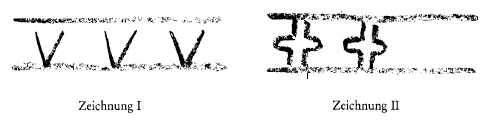
[ 50 ] Or we never let children make, say, a pillow that’s the same on both sides; instead, you can tell just by looking at the pillow which side is meant for lying on. You can also tell from the pillow that there’s a difference between right and left, and so on. So life is woven into and incorporated into everything that’s made there. And the children learn a great deal from this. In this way, we also seek to integrate the children into life.
[ 51 ] We try to do this in every detail, for example, through the grading system. I have never in my life been able to grasp what it means to say that a child’s abilities correspond to a 2, a 3, or a 2 1/2. I don’t know if they do this in England as well—giving numbers or letters on report cards that are supposed to indicate what the child is capable of. In Central Europe, they give a 3 or a 4. We don’t issue report cards like that; instead, every teacher knows every child and describes them in the report card, detailing what the child truly achieves in terms of their abilities—in their own words, based on their capabilities and progress. And then, every year, we include a motto in each child’s report card that can serve as a guiding principle for them in the coming year. This is what the report card looks like: First comes the child’s name, followed by a motto; then the teacher describes—without using stereotypical letters or numbers—simply what the child is like and how they have progressed in the individual subjects. So the report card is always a personal account. The children always take great joy in these report cards, and the parents also get a clear mental image of how their child is doing in school.
[ 52 ] We place great importance on maintaining genuine contact with each child’s family, so that the school can gain insight into the family through the child. Only then can one truly understand the child; only then does one know how to address each of the child’s characteristics. It is not the case that noticing a certain trait in one child is the same as noticing that same trait in another child; for the same trait means something entirely different in one child than it does in another.
[ 53 ] Let’s say, for example, that one child shows a certain amount of agitation; another child also shows agitation. Yes, it’s not at all a matter of simply knowing that the child is agitated and that you should do something to help calm them down; rather, it’s a matter of recognizing in one child: This one is agitated because he has an agitated father and is imitating him; the other child is agitated because he has a weak heart, he has a heart condition. So one must always be able to address the underlying causes of these characteristics. And that is precisely what teachers’ conferences are for. They are there to truly study the human being and thereby allow, in the study of human nature—I would say—a continuous stream to flow through the school. One studies the school in the teachers’ conferences. Through this, the other things one needs arise of their own accord. The essential point is that the teachers’ conferences are a continuous, ongoing study.
[ 54 ] Those are the conditions I wanted to share with you regarding the practical arrangements.
[ 55 ] Of course, there would still be plenty more to discuss if we could continue this course for several weeks. But of course we can’t. Therefore, I’d like to ask you, when we meet here tomorrow, to voice whatever is on your mind in the form of questions, so that we can use tomorrow’s session for you to ask questions and for me to answer them.