

The Art of Education
Based on Understanding Human Nature
GA 311
20 August 1924, Torquay
Translated by Steiner Online Library
Q&A
[ 1 ] The first question asked is:
[ 2 ] What exactly is the difference between multiplication and division in this teaching method? Or is there supposed to be no such difference at all in the early school years?
[ 3 ] The question probably arises from the fact that I said one should perform multiplication in such a way that the so-called multiplicand—a factor, not the product—is revealed, and that the other factor is sought. Of course, in the usual sense of the word, this actually amounts to a division. It is generally regarded as a division. If one does not cling too tightly to words, one can then understand division in the following way, in accordance with this.
[ 4 ] One might say: If you divide a whole in a certain way, how much is the part? And this is simply another way of asking the same question: By what must you multiply a number to obtain a certain number?
[ 5 ] So, if you frame the question in terms of division, you are dealing with division. If you frame the question in terms of multiplication, you are dealing with multiplication. And it is precisely the close connection in thought that exists between multiplication and division that becomes quite apparent here.
[ 6 ] However, the child should be made aware early on that there are actually two ways to understand division. One way is the one I have just hinted at. Here, one examines how large the part is when I divide a whole into a certain number of parts. Here, I start with the whole and look for the part. That is one type of division.
[ 7 ] The other method is this: I start with the part and determine how many times the part fits into the whole. In this case, division is not a matter of dividing, but of measuring. And this distinction between dividing and measuring should, if possible, be taught to children early on, without resorting to pedantic terminology. Then division and multiplication will soon cease to be merely formal arithmetic exercises, as is very often the case, and will become rooted in real life.
[ 8 ] Thus, for the first few years of school, the only real difference between multiplication and division will likely be in the terminology used; but it is also important to point out that this difference is, in essence, much smaller than the one between subtraction and addition. And it is precisely this that is crucial for such concepts to sink in with the child.
[ 9 ] So one cannot say that no distinction at all should be made during the early school years; but it should be made exactly as I have just indicated.
[ 10 ] At what age and how should one move from the concrete to the abstract in arithmetic?
[ 11 ] One should approach this question as follows: One should first try to keep everything in arithmetic concrete, and above all, refrain entirely from any abstraction until the stage of life between the ages of 9 and 10. Until then, one should try as much as possible to remain in the concrete realm—that is, to link everything directly to life.
[ 12 ] Then, once this has been done for 2 to 2 1/2 years—and one has truly made sure to calculate not with abstract numbers but with concrete facts expressed in numerical form—one will see that, precisely when it comes to arithmetic, the transition to the abstract is extraordinarily easy. It is easy because, by treating numbers in this way with the child, one has brought such life into the numbers that one can then easily move on to the abstract treatment of addition, subtraction, and so on.
[ 13 ] The goal, then, will be to delay the transition from the concrete to the abstract as long as possible, until the point in life that I have indicated as occurring between the ages of 9 and 10.
[ 14 ] A great help in making the transition from the concrete to the abstract in arithmetic is doing math where you need it most in life—when counting and spending money; and in that regard, you’re in a better position here than we are over on the continent, because over on the continent we use the decimal system for everything. Here, with your money, you have a system that’s even more user-friendly than the decimal system. I don’t know if you find it more user-friendly; but if you didn’t find it more user-friendly than the decimal system, that would be pathological. The only healthy approach is to have a number system for money that is as concrete as possible. Here you still count using the base-12 and base-20 systems, which we, as they say, have already moved beyond on the continent. Surely you already use the decimal system for measuring as well?
[ 15 ] One participant says that this is not found in everyday life, only in the scientific world.
[ 16 ] So even there, you still have the more intuitive measurement system! These are the things that actually make everything more concrete. It’s only when writing numbers that you also have the decimal system.
[ 17 ] What is the basis of this decimal system? It is based on the fact that it originally arose naturally. I have told you that it is not the head that forms the number, but the whole body that forms the number. The head merely reflects the number, and it is natural that we actually have 10—or at most 20—as numbers. Now, we start with the number 10 because we have 10 fingers. After all, we only write numbers from 1 to 10; then we begin to treat numbers as concrete entities again.
[ 18 ] Let’s write, for example: 2 donkeys. Here, the donkey is a concrete thing and 2 is the number. I could just as easily say 2 dogs. But when you write 20, that’s nothing other than 2 times 10. Here, 10 is treated as a concrete thing. And so our number system is based on the fact that, when things start to get confusing—when we can no longer grasp the whole picture—we begin to treat the number itself as something concrete, and then abstract it again. We wouldn’t make any progress in arithmetic if we didn’t treat the number itself—no matter what it is—as a concrete thing and then abstract it again. After all, 100 is just 10 times 10. Whether I have 10 times 10 and treat it as 100, or whether I have 10 times 10 dogs, it’s actually the same thing—in one case the dogs, in the other the 100, are treated as concrete things. So the very secret of arithmetic is that one treats the number itself, in turn, as something concrete. And if you consider this, you’ll find that a similar transition takes place in everyday life. We speak of “2 twelves,” “2 dozen,” just as we speak of “2 tens.” The only difference is that we don’t have such a term for the tens, because the decimal system has already been conceptualized under the auspices of abstraction. All other systems still conceptualize a quantity in a much more concrete way: a dozen, a shilling. How much is a shilling? A shilling is 12 pence here.
[ 19 ] However, a schilling can, under certain circumstances, be a quantity of 30 pieces, and that is considered a single unit. You see, in the village where I lived for a long time, there were houses on both sides of the village street. There were walnut trees in front of every house. And when fall came, the boys would shake the nuts down and save them for the winter. And when they came to school, they would brag. One would say, “I already have 5 schillings,” and another would say, “I already have 10 schillings’ worth of nuts.” They focused on tangible things. One schilling was always 30 nuts. The farmers just had to make sure they harvested their nuts before the trees were completely stripped of them. A “nut schilling,” as it was also called—that is, a unit. Buying these was a right, and it happened in full view of everyone.
[ 20 ] And so, precisely by using this counting with concrete examples—1 dozen, 2 dozen, 1 pair, 2 pairs, and so on—one can find the transition from the concrete to the abstract. After all, we don’t say “4 gloves,” but “2 pairs of gloves”; we don’t say “4 shoes,” but “2 pairs of shoes.” By using this method, one can make the transition from the concrete to the abstract and, in this way, gradually prepare for everything. And it is actually only between the ages of 9 and 10 that one transitions to abstract numbers.
[ 21 ] When and how should art classes be taught?
[ 22 ] Drawing instruction is really about shedding a little artistic light on the question. You have to keep in mind that drawing is actually, at first, a kind of pretense. What does drawing mean, anyway? Drawing means representing something through lines.
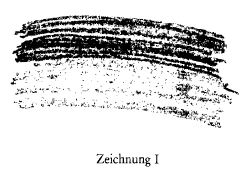
[ 23 ] Well, in reality, there aren't actually any lines at all. What actually exists is, for example, this: Here is the sea (see drawing ]). It appears as a color (green); above it is the sky. The sky, in turn, appears as a color (blue). If you place the two colors side by side, you have the sea below and the sky above (see drawing I). The line emerges of its own accord where the colors meet. To say that here (see drawing, horizon line) the sky meets the sea is, in fact, already a very significant abstraction. Therefore, artistically speaking, one initially feels that one should depict reality in such a way as to capture it in colors—or, for that matter, in light and dark.
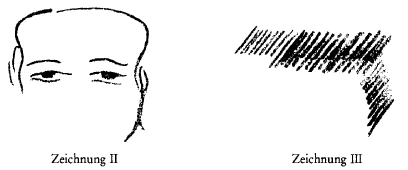
[ 24 ] What is actually there when I depict a face? Is that ever actually there? (The outlines of a face are drawn. Drawing IL.) Is there such a thing? There’s no such thing at all. What actually exists is this (it is hatched; Drawing III). Well, and so on—there are certain areas of light and dark, and from these a face emerges. Adding lines to form a face is, after all, a deception. It doesn’t exist at all.
[ 25 ] When one perceives things artistically, one will feel everywhere the urge to bring out what is there from the black-and-white or from the color. The lines then emerge on their own. Only when one approaches what reveals itself in chiaroscuro or in color—the boundaries of the colors that arise of their own accord—and traces them do the lines of the drawing emerge.
[ 26 ] Therefore, drawing instruction must not be based on sketching, but rather on painting, on the application of color, and on light and dark.
[ 27 ] And art education as such has real value only if it is developed with the awareness that it does not represent anything real. The fact that people have placed so much importance on drawing has caused tremendous confusion in our entire way of thinking. This has given rise to everything we find, say, in optics, where people endlessly draw lines that are supposed to be rays of light. But where do such rays of light actually exist? Nowhere, in fact. What we have in reality are images. You make a hole in the wall somewhere; the sun shines in, and an image forms on a screen. At most, you can see the images in the dust in the room—and the dirtier the room is, the more clearly you can see the direction—and again, you see the images that the light creates from the dust particles. But what is usually drawn there as lines—as so-called rays of light—is merely imagined. Everything that is actually drawn is imagined. And only when one begins to teach a child something like perspective—where the very manner of explanation already involves abstraction—can one begin to depict the act of aiming, of seeing in lines.
[ 28 ] But don’t teach the child to draw a horse or a dog by making lines; instead, the child should pick up the brush and paint the dog, bring it to life on the page. In any case, it’s not about drawing. The outline of the dog doesn’t actually exist. Where is it? It emerges on its own when you put onto paper what is already there. Our Waldorf school is now sought out not only by children, but even by teachers. A great many people who are teachers in the outside world would also like to be employed at the Waldorf school because they like it better there. Well, quite a few people have actually approached me recently and presented themselves in the manner in which they’ve been prepared through the seminars to now be teachers. One does get a bit of a shock even from the history teachers and the language teachers and so on, but the most dreadful are the art teachers, because they practice a craft that has absolutely no place in artistic sensibility; it simply doesn’t exist.
[ 29 ] And the result of this is—I’m not naming any names, so I can speak impartially—that it’s almost impossible to talk to art teachers, because they’re such withered people, such terribly inhuman people. They have absolutely no concept of reality. Because drawing is their profession, they have cut themselves off from all reality. It is terrible to talk to them, quite apart from the fact that they want to teach drawing in school—something we have not introduced at all in the Waldorf School. But the soul configuration of these people, who pursue this unreal art of drawing, is also quite peculiar. These people never have any moisture on their tongues; their tongues are always completely dry. It is terrible how these drawing teachers gradually become this way, simply because they are engaged in something completely unreal. I would like to answer the question posed simply by saying: Wherever possible, the starting point should be painting, not drawing. That is the essential point.
[ 30 ] I’d like to explain the question a little more clearly so that you don’t misunderstand. Otherwise, you might think I have something personal against art teachers. Let me put it this way: There’s a group of children sitting there. The sun is shining in from this side—that’s what I’m telling this group of children. This sun shines down on something, creating all kinds of light—light everywhere (a drawing is being made; see the drawing on page 137). I see bright spots. The sunlight is falling everywhere, all over the place. Wherever the sun shines like this, I see patches of light everywhere (white in the drawing). Over there, I don’t see any patches of light; I see darkness (blue). But I also see the darkness there beneath the patches of light, just a little bit. Then I look at something that, when the light falls on it like this, appears greenish. It appears greenish. When the light falls on it, it turns whitish. But then, before the actual black shadow appears, I see it as greenish, and here beneath the black shadow there’s also a greenish hue, and then there are these strange things in between. The light doesn’t quite penetrate there.
[ 31 ] You see, I’ve been talking about light and shadow, and about how there are places where the light doesn’t reach, and I’ve drawn a tree. I’ve only been talking about light, about color, and I’ve drawn a tree. You can’t actually paint the tree; you can only include light and shadow and green—and at most, if the fruit is pretty little apples, add some yellow for my sake. But you should speak of color, light, and shadow. And so you should indeed speak of what is really there—only of color, light, and shadow. One should draw only in geometry and in what is related to geometry. There, one deals with lines. But that, too, is a mental construct. Whereas one should not draw realities—concrete realities—with a pen, but rather let a tree, for example, emerge from light and dark and from colors. That is what truly lies at the heart of life.
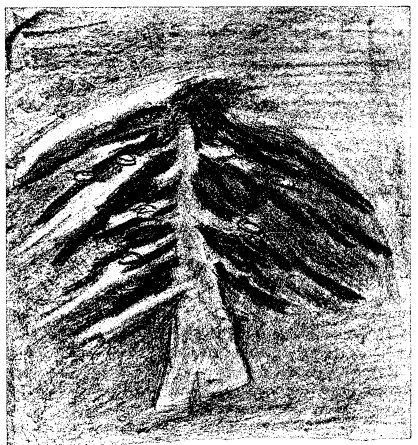
[ 32 ] For example, it would be barbaric if a real art teacher were to come along and have students trace the lines of the painted tree here. In reality, there are light spots and dark spots. That’s what nature does. If someone were to draw lines there, it would be a deception.
[ 33 ] Should the direct method—without translation—also be used for Latin and Greek?
[ 34 ] However, Latin and Greek are an exception in this regard. After all, Latin and Greek do not need to be directly adapted to everyday life, since these languages are no longer spoken, and we actually have them among us only as dead languages. Thus, in the teaching of Latin and Greek—one should actually begin with Greek and then move on to Latin—in this instruction, which, incidentally, cannot begin immediately with the child but only at a later age, the translation method may well be justified in a certain sense.
[ 35 ] After all, our goal is not to converse in Latin and Greek, but to understand the ancient authors. We use these languages in the truest sense of the word—precisely for the purpose of translation. When is Latin needed? A doctor needs Latin. And why is that still the case today? It stems from the continuation of an ancient custom. Ancient customs are passed down without anyone knowing what purpose they serve.
[ 36 ] This is true of many things, such as medals and decorations. They were once of great significance and were also deeply symbolic. But today, that is no longer the case. They have simply lingered on as habits. And the same is true, for example, of the fact that a doctor does, after all, have an interest in being able to converse with another person at the patient’s bedside and to name things without alarming the patient—that is, in using a language that the other person cannot understand. One’s only thought is to translate what one is thinking into Latin. And so it is also the case that we do not use this same method in Greek and Latin, though we apply it to all living languages.
[ 37 ] Now the question arises again—the one that is asked every time I am in England whenever the topic of education comes up in any way.
[ 38 ] How should physical education be taught, and should sports such as hockey, cricket, and so on be played in an English school, and if so, how?
[ 39 ] It is by no means the intention of the Waldorf school method to suppress these things. They can certainly be practiced, simply because they play a major role in English life and the child is meant to grow into life. However, one should not succumb to the illusion that this has any other significance than precisely this: that one should not make the child unworldly. To believe that sports are of tremendous value for development is a mistake. It does not have great value for development; it has value only because it is a popular trend, and one certainly should not make the child an outsider to the world or exclude them from all trends. People love sports in England, so one should also introduce the child to sports. One should not take a philistine stance against that which—well, may perhaps be philistine.
[ 40 ] And as for the actual question of “how this should be taught,” there is very little to say, since with these things it really comes down, more or less, to demonstrating it and letting the child imitate it. To go so far as to devise special, contrived methods would be something that is simply not appropriate.
[ 41 ] In physical education—that is, gymnastics class—the point is to actually learn from anatomy and physiology in which position any part of the body should be placed so that it contributes to the body’s lightness. It is also about truly sensing what makes the body agile, light, and flexible. And once you sense that, it’s simply a matter of demonstrating it. Suppose you have a high bar. Usually, all sorts of exercises are performed on it. The most beneficial exercise on the high bar is usually not done. It consists of hanging from the high bar, hooked in this way, and then swinging, grasping the bar, swinging back, and grasping it again. You don’t actually jump; rather, you hang from the bar, fly through the air, perform various movements, grip the bar in different ways—and this creates a variation in the configuration of the arm muscles that actually has a healing effect on the entire organism.
[ 42 ] One must study which movements—which internal movements of the muscles—have a beneficial effect on the body, and then one will discover which movements to teach. And then one simply needs to demonstrate them; for the method consists precisely in demonstration.
[ 43 ] How should religious education be taught at different stages of life?
[ 44 ] Since I always speak solely from a practical perspective, I must say that the Waldorf school method is an educational method, not something intended to introduce a worldview or anything sectarian into the school. So here, too, I can only speak about life within the Waldorf school principle itself.
[ 45 ] We had it relatively easy in Württemberg, where there was still a very liberal school law when the Waldorf School was established. In Württemberg, the authorities really showed us great flexibility. It was even possible for me to insist on hiring the teachers myself, regardless of whether they had passed any state exam or not. I’m not saying that everyone who passes a state exam is unsuitable to be a teacher! I don’t mean to say that. But still, I didn’t see a state exam as a prerequisite for becoming a teacher at the Waldorf School.
[ 46 ] And so, in this regard, things have actually gone quite well. But one thing was necessary right from the start: we had to take a very firm stand and say, “We are a school of method.” We do not interfere with the way social life currently is. Rather, through anthroposophy, we find the best method of teaching; thus, we are a school based purely on method.
[ 47 ] That is why I arranged things so that religious instruction was not included in our school curriculum from the outset, but rather that Catholic religious instruction was entrusted to the Catholic priest, Protestant instruction to the Protestant pastor, and so on.
[ 48 ] In the early years, most of the students came from a factory—initially from the Moltschen factory; many of them were children of dissidents or of non-religious parents. Naturally, however, our commitment to education required that we also provide them with some religious instruction. We established optional religious instruction for these children. So we now have a method for this optional religious instruction.
[ 49 ] For this free religious instruction, we first teach gratitude through contemplation of all things in nature. Whereas legends and myths usually simply recount what things—stones, plants, and so on—do, the aim here is to direct the child’s gaze toward sensing the divine in all things. So, in a certain sense, we begin with what I would call a form of religious naturalism in a childlike form.
[ 50 ] Children, in turn, do not understand the Gospels until the period between the ages of 9 and 10 that I have indicated. Only then can one move on to the Gospels, and later to the Old Testament. So the only option is to teach children, at first in general terms, a kind of natural religion. We have our own method for this. A prescribed religion would, of course, have to proceed in a similar manner. It would have to make use of the positive aspects of that prescribed religion in order to teach them to the child in a more general way, without yet referring to biblical history.
[ 51 ] Only then, between the ages of 9 and 10, should one move on to the Gospels, and only much later to the Old Testament—not until the ages of 12 or 13.
[ 52 ] That is roughly how one would have to conceive of non-denominational religious instruction. We do not concern ourselves with Catholic and Protestant instruction. We simply leave that to the Catholic and Protestant pastors to provide. For non-denominational religious instruction, we also hold a kind of service every Sunday. There is a special service for everyone, and a special service for those who leave school at age 14. The nature of these services has really developed organically over the years; they serve exceptionally well to deepen religious sentiment and are experienced by the children as exceptionally solemn.
[ 53 ] We also allow parents to attend this service, and it has become apparent that this voluntary religious instruction serves to revitalize Christianity in an exceptionally positive way. And there is true Christianity in the Waldorf school, because through this naturalistic religion in the early years, the child is gradually raised to an understanding of the mystery of Christ in the higher grades.
[ 54 ] Our free religious education classes are gradually becoming truly overcrowded with participants. All kinds of children are coming over from the Protestant pastor’s and the Catholic priest’s congregations. But we do not engage in any agitation. We’re already having a hard time finding religious education teachers, and that’s why we don’t even particularly like it when too many children come over—not least so that the school doesn’t get a reputation for being an anthroposophical denominational school. We certainly don’t want that. It was solely our pedagogical conscience that compelled us to introduce this independent religious education class. But the children are running away from Catholic and Protestant religious education classes, coming over here in ever-greater numbers, and wanting the open religious education classes. They like them better. It’s not our fault that they’re running away from those classes. I don’t know if it’s our fault that they’re coming to us. But as I said, the arrangement was originally as follows: Religious education was initially taught by the respective pastors. So if you ask what kind of religious education we have, I can only speak for what we offer as “free religious education” here—which is exactly what I’ve just described.
[ 55 ] Should the topics covered in period-based instruction be taught in a specific order?
[ 56 ] Of course, this is something that could be discussed at length, but it wouldn’t be of much practical value. In the early grades, it will amount to little more than alternating between different subjects—primarily for instruction in writing, then a gradual transition to reading, followed by arithmetic and a few other subjects. One will find that whether one takes things in one order or the other, it is of no great significance. Thus, at least in our experience so far, we have not felt any need to pay special attention to such an order.
[ 57 ] Should French and German be taught from the very beginning in an English school? When children start school at age 5 or 6, in a kind of kindergarten class, should they also be taught these languages?
[ 58 ] First, I would like to note that the question of whether French and German should be taught from the very beginning in an English school is, I believe, one that should be decided solely on the basis of practical considerations. If one finds that life makes it necessary to study these particular languages, then one should do so. We have introduced French and English at the Waldorf School because French still offers much that can be learned on an inner level—something that cannot be learned from any other language—a certain sense of rhetoric, which is quite beneficial when it is present. And we have introduced English because it is, after all, a global language and will continue to become more and more so.
[ 59 ] Well, I don’t necessarily want to decide whether French and German should be taught in English schools; rather, one should simply adapt to whatever circumstances of life make it necessary. It won’t matter so much which other languages are chosen, but rather that other languages are studied at all.
[ 60 ] Likewise, it is a good idea to send children to school as early as ages 5 and 6—which one really shouldn’t do—if one is already teaching them languages at that age. That is appropriate for this age group. One can also engage in some language learning before the age of tooth replacement. However, formal language instruction should not begin until after the teeth have been replaced. If children are already being placed in a kind of kindergarten class, one should use this opportunity to teach them language specifically, and if possible, postpone other instruction until the teeth have been replaced.
[ 61 ] I would like to conclude by saying—and this will no doubt seem obvious to you—that it has given me deep satisfaction to see that you have such an active interest in bringing the Waldorf school method to fruition here in England, and that you are working with such energy to establish a school here based on our anthroposophical method. And I would like to express my hope that you will succeed in using what you were able to learn from our seminar courses in Stuttgart, what you heard in the various other courses that have also been held here in England, and what I was recently able to offer here in the form of a few aphoristic remarks—that you will be able to use all of this to establish a truly good school based on the anthroposophical method here in England.
[ 62 ] You just have to consider how much depends on the very first attempt actually succeeding. If it doesn’t, then much is lost, because everything else will be judged based on that first attempt. And a great deal depends on you making that first move in such a way that the world realizes: It is something that neither indulges in abstract, amateurish school reform plans nor is anything else of an amateurish nature; it is something that truly arises from an understanding of the human being, which is then to be transformed into the art of education—and which, along with many other things, is actually demanded of our civilization, which finds itself in such a difficult situation.
[ 63 ] With this, I would like to offer you some very good ideas to guide you in establishing a school here based on the anthroposophical method.