

The Art of Education
Based on Understanding Human Nature
GA 311
14 August 1924, Torquay
Translated by Steiner Online Library
Third Lecture
[ 1 ] Today we would like to outline some general principles of the art of education during the period of life between the change of teeth and sexual maturity, so that in the next class we can then address more specific aspects of dealing with individual subjects and life situations.
[ 2 ] Once a child has reached the age of 9 or 10, they can begin to distinguish themselves from their surroundings. The distinction between subject and object—subject = the self, object = the other—actually only truly emerges at this point, and we can then begin to speak of external things, whereas before we had to treat these external things as if they were, in fact, one with the child’s body. “We should treat external things as if they were speaking, acting human beings,” I said yesterday. This gives the child the feeling that the outside world is simply an extension of its own being.
[ 3 ] Now the task is to introduce the child, once he or she has passed the age of 9 or 10, to certain elementary facts—the realities of the external world—specifically, the facts of the plant and animal kingdoms. We will discuss other subjects later. But it is precisely with these things that we must ensure we introduce the child in a way that is in keeping with human nature.
[ 4 ] The first thing we need to do is actually throw away all the textbooks. Because the way textbooks are written today, they contain nothing about the plant and animal kingdoms that can actually be taught to children. Today’s textbooks are good for teaching adults about plants and animals; but we stifle a child’s individuality when we use these textbooks in school. And it’s fair to say: textbooks and manuals that provide guidance on how to proceed in school simply do not exist today. The situation is as follows:
[ 5 ] If you present individual plants to a child and have the child treat this or that aspect of individual plants, you have, in fact, initially done something that does not correspond to reality. A plant in and of itself has no reality. If you pluck out a hair and look at it as if it were a thing in and of itself, it has no reality. In everyday life, we say that everything we see before us—within the limits of our vision—has a reality. But it is quite another matter whether we see a stone before us that we are judging, or whether we see a strand of hair or a rose. The stone will still be exactly the same in ten years as it is today; the rose will no longer be the same after two days—it is only a reality in relation to the entire rosebush. A strand of hair has no reality of its own; it is only a reality in relation to the whole head, to the whole person. And when one goes out into the fields and pulls up plants, it is as if one had pulled the hair out of the earth. For plants belong to the earth just as much as hair belongs to the human organism. To view a single strand of hair in isolation, as if it were arising on its own somewhere, is, after all, nonsense.
[ 6 ] Likewise, it is nonsense to take a green botanical basket, carry plants home, and examine each plant individually. This does not reflect reality, and in this way, it is not possible to gain a true understanding of nature and humanity.
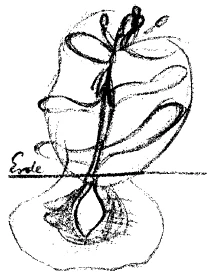
[ 7 ] If you have a plant here (see drawing D), that alone is not the plant; rather, the plant also includes what lies beneath it as soil, extending indefinitely, perhaps very far. There are plants—as shown in Drawing I—that send out tiny roots over a very wide area. The fact that this patch of earth, in which the plant is embedded, belongs to it over a wide radius can be seen from the fact that you have to add fertilizer to the soil if you want certain plants to grow properly. It is not only the part of the plant that lives; what is here (see Drawing D) also lives—it lives along with it, is part of the plant; the earth lives along with it.
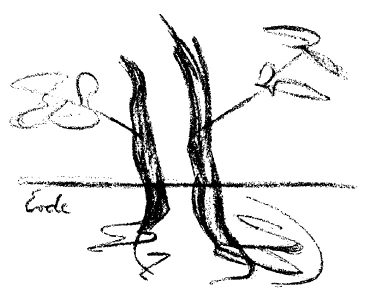
[ 8 ] There are plants that bloom in the spring, sprout around May or June, and bear fruit in the fall. Then they wither and die. They are buried in the earth, but the earth is part of them. - But there are also plants that draw the earth’s forces from their surroundings. That would be the earth (see Drawing II); now the root absorbs the forces present in its surroundings. Because it has now absorbed these forces, the earth’s forces rise up from there, and a tree grows from it.
[ 9 ] What exactly is a tree? A tree is a colony of many plants. Whether you have a mound that is relatively lifeless and covered with many plants, or whether you have the trunk of a tree, where the earth has been drawn into it in a much more vibrant state, it makes no difference. You cannot objectively consider a plant in isolation.
[ 10 ] Drive through an area—or, even better, walk through an area—where there are certain geological formations, such as exposed red sand, and take a look at the plants: You’ll mostly find plants there with yellowish-reddish flowers. The flowers are part of the soil. The soil and the plant form a single unit, just like your scalp and your hair.
[ 11 ] Therefore, you must not teach the child geography and geology on the one hand, and botany on the other. That is nonsense. Rather, geography—the description of the land—and the study of plants must always be one and the same; for the Earth is an organism, and plants are like hair on this organism. And the child must be able to form a mental image of the fact that the Earth and plants belong together, that every piece of land bears the plants that belong to that piece of land.
[ 12 ] So it is correct that you should view botany only in connection with the Earth and help the child develop a clear sense that the Earth is a living being that has hair. The hair is the plants. - You see, people say that the Earth has a force of gravity. This is considered part of the Earth. But plants, with their power of growth, are just as much a part of the Earth. There is no such thing as the Earth on its own and plants on their own—just as there are not, in reality, hairs on their own and people on their own. They belong together.
[ 13 ] And when you teach a child to take something out of the botany drum and have them name it, you are teaching them something unreal. This has consequences for life; for the child will never, through the botany you teach them in this way, gain an understanding of how, for example, to tend a field, or how to bring it to life with fertilizer. A child can only gain an understanding of how to tend a field if they know how the field is connected to the plant. Because people in our time increasingly lack a sense of reality—I told you in the first lesson that practitioners have it the least; they are all theorists today—because people have lost all trace of reality, they therefore view everything in isolation, everything separately.
[ 14 ] And so it has come to pass that, for fifty or sixty years now, the quality of all agricultural produce has been declining in many, many regions. There was recently an agricultural congress in Central Europe. There, the farmers themselves admitted: The crops are becoming so poor that one cannot even hope that in fifty years they will still be edible for humans.
[ 15 ] Why? Because people don’t understand how to bring the soil to life with fertilizer. But people can’t understand this if you teach them concepts such as: plants are something in and of themselves. Just as a strand of hair is not a thing in and of itself, neither is a plant. If a strand of hair were a thing in and of itself—well, then it wouldn’t matter; you could stick it into a piece of wax or tallow to make it grow! But it grows right out of the scalp.
[ 16 ] If one wants to understand how the soil and the plant belong together, one must know what kind of soil a plant belongs in. And the only way to truly understand how to fertilize this soil is by viewing the soil and the plant world as a single entity—by truly regarding the soil as an organism and the plant as something that grows within that organism.
[ 17 ] But this gives the child, right from the start, the feeling of standing on living ground. This is of great significance for life. Just consider the mental image people have today of how geological strata are formed. They imagine: “These layers were deposited one on top of the other.” But everything you see as geological strata is, after all, nothing more than fossilized plants—fossilized living matter. Not only were coal deposits once plants that took root more in water than in solid earth and were part of the earth, but granite, gneiss, and so on are also of plant and animal origin.
[ 18 ] This, too, can only be understood when one considers the earth and plants as a whole. After all, these matters are not merely about the child acquiring knowledge, but about the child developing the right feelings. However, this can only be fully grasped when one approaches such matters from a perspective of Spiritual Science.
[ 19 ] Just imagine for a moment that you’re filled with the best of intentions and you tell yourself: “The child must learn everything through direct observation, so it must also learn about plants through direct observation.” I start early, bringing plants home in a beautiful botanical collection case. I show the child everything, because it’s reality. I believe, in fact, that it is reality—after all, it is visual instruction. —Only—one is looking at precisely that which is not reality. With this kind of visual instruction, people are getting up to the worst kind of mischief these days!
[ 20 ] In this way, the child comes to understand the plant as if it made no difference whether a hair grows in wax or in human skin. After all, it doesn’t grow in wax. When a child absorbs such concepts, they completely contradict what the child had absorbed before descending from the spiritual world to Earth. For back then, the Earth looked quite different. There, the child—that is, the child’s soul—encountered this living connection between the mineral soil and the plant life growing from it. Why? Because the child—which is not yet mineral but is only on the path to becoming mineral—must take in the etheric in order to incarnate at all. It must grow into the plant realm. And the plant realm appears to be related to the earth.
[ 21 ] This entire range of sensations that the child experiences as it descends from the pre-earthly world into the earthly one—this entire rich world—becomes confused and chaotic for the child if it is taught botany in the way it usually is; whereas the child rejoices inwardly when it comes to know the plant world in connection with the earth.
[ 22 ] In a similar way, we must consider how to introduce the child to the animal world. In the case of animals, even a casual observer will notice that they do not belong to the earth. They move across the earth; they can be here or there. Thus, we are dealing with conditions on earth that are entirely different from those of plants. But with animals, something else may strike one.
[ 23 ] If we first consider the various animals that live on Earth in terms of their spiritual qualities, we find cruel predators, gentle lambs, and brave animals. For example, among the birds there are some very brave fighters; we also find brave animals among the mammals. Then we find majestic animals, such as lions. We find the most diverse spiritual qualities. And for each individual animal species, we say to ourselves that this species is characterized by having this or that quality. We call the tiger cruel, and cruelty is its most notable, most significant quality. We call the sheep patient. Patience is its most notable quality. We call the donkey sluggish because, even if it isn’t actually that terribly sluggish, it has a certain demeanor that strongly suggests sluggishness. In particular, the donkey is sluggish when it comes to changing its circumstances. If it happens to be in the mood to walk slowly, you cannot get it to walk quickly. And so every animal has its own special traits.
[ 24 ] But when it comes to human beings, we cannot think that way. We cannot think that one person is docile and patient, another cruel, and a third brave. We would find it one-sided if people were distributed across the earth in this way. In a certain sense, they have indeed developed such traits to a one-sided degree, but not to the same extent as animals. Rather, we find—especially when we seek to educate human beings—that we should, for example, teach them patience in the face of certain things and facts of life, courage in the face of other things and facts of life, and perhaps even a certain degree of cruelty in the face of other things and life situations, although this must be introduced to them in homeopathic doses. In response to certain things, humans will simply display cruelty as a result of their natural development, and so on.
[ 25 ] But what is the reality of the situation when we consider these psychological traits in humans and in animals? We find that humans can actually possess all the traits—at least those that all animals possess collectively. Animals possess these traits individually; humans, however, always have a little bit of everything. He is not as majestic as the lion, but he has a touch of majesty. He is not as cruel as the tiger, but he has a touch of cruelty. He is not as patient as the sheep, but he has a touch of patience. He is not as sluggish as the donkey—at least not all humans—but he has a touch of that sluggishness about him. All humans have that. One could say, if one looks at the matter quite correctly: Human beings possess within themselves the nature of the lion, the nature of the sheep, the nature of the tiger, and the nature of the donkey. They possess all of these within themselves. It’s just that everything is harmonized within them. Each trait is tempered by the others. Human beings are the harmonious convergence—or, to put it in more scholarly terms, the synthesis—of all the various psychological qualities possessed by animals. And the right balance in a human being is achieved precisely when they correctly incorporate into their entire being the proper measure of lion-like qualities, sheep-like qualities, tiger-like qualities, donkey-like qualities, and so on—when all of this is imbued in the human being to the right degree and stands in the proper proportion to everything else.
[ 26 ] An ancient Greek proverb puts it beautifully: “Bravery, when combined with wisdom, brings you blessings. But if bravery stands alone, ruin follows in its wake.” If humans were merely brave—as some birds, which are constantly quarreling, are merely brave—they would not achieve much that is beneficial in life. But when bravery is developed in humans in such a way that it is united with wisdom—just as certain animals are merely wise—then that is the right state of affairs for humans.
[ 27 ] In the case of human beings, then, what is at stake is the existence of a synthetic unity—a harmonization of everything that is spread out across the animal kingdom. So we can describe the relationship as follows: there is one animal—I’ll draw a diagram—then a second, a third species, a fourth, and so on—all the animals that are possible on Earth.
[ 28 ] How do they behave toward humans?
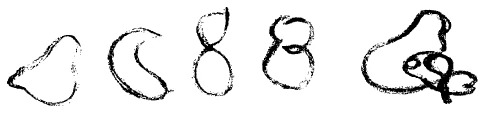
[ 29 ] So that? Human beings initially possess something (as depicted) like a single animal species, but in a tempered form—they do not possess it fully. And this is immediately followed by the next one (see drawing), but again, not fully. From there, it transitions into a part of the next one, and then this one follows on from it (see the last drawing in the series), so that human beings encompass all animals within themselves. The animal kingdom is a human being spread out, and human beings are a condensed animal kingdom; all animals are synthetically united through human beings. The whole human being, when analyzed, is the entire animal kingdom.
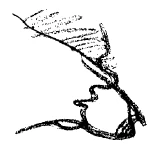
[ 30 ] The same is true of the figure. Just imagine: if you have a human face (it’s being drawn), and you cut this part away (see drawing) and bring something forward—if it protrudes further forward, if it isn’t in harmony with the whole face, if the forehead slopes downward—it turns into a dog’s head. If you shape the head in a slightly different way, it turns into a lion’s head, and so on.
[ 31 ] With regard to his other organs as well, one can see everywhere that man has, even in his external form, softened and harmonized what is widespread among other animals.
[ 32 ] Just imagine: when you see a waddling duck, you have something of that waddle right there between your fingers—it’s just tucked away. And so everything that can be found in the animal kingdom, including its form, is also present in the human kingdom. In this way, humans find their relationship to the animal kingdom. They learn to recognize how all the animals together constitute a human being. Humanity is present in the 1,800 million specimens of greater or lesser value on Earth. But it is also present once again as a giant human being. The entire animal kingdom is a giant human being—not synthesized, but analyzed in every detail.
[ 33 ] Here’s the thing: If everything about you were elastic—but so elastic that it could be elastic in different ways in different directions—and if you were to stretch elastically in a certain direction, a certain animal would emerge from that. If the area around your eyes were to be torn open, and if it were to swell up with corresponding elasticity, another animal would emerge. Thus, human beings carry the entire animal kingdom within themselves.
[ 34 ] That is how the history of the animal kingdom was once taught in earlier times. That was a sound, healthy understanding. It has been lost, but actually only relatively recently. For example, in the 18th century, people still understood quite well that if the olfactory nerve—which humans have in their noses—is large enough and extends backward, it develops into a dog. But if the olfactory nerve atrophies and we are left with only a small portion of it, while the other portion undergoes a metamorphosis, this gives rise to our nerve for intellectual life.
[ 35 ] When you look at a dog as it sniffs, you see that its olfactory nerve extends from its nose all the way back. It senses the unique qualities of things; it doesn’t create mental images—it simply smells everything. It doesn’t have a single will and a single mental image, but rather a will and a sense of smell for all things. What a wonderful sense of smell! The world is no less interesting to a dog than it is to a human. Humans can create mental images of anything. Dogs can smell anything. We have a few—don’t we?—pleasant and unpleasant smells; but dogs have a wide variety of smells. Just think for a moment how specialized a dog’s sense of smell is. Police dogs have become common in recent times. They are led to the place where someone who has stolen something was. The dog immediately picks up the person’s scent, follows it, and finds him. All of this is based on the fact that there really is an immense range of distinctions, a rich world of smells for the dog. This is conveyed by the olfactory nerve, which runs backward into the head, into the skull.
[ 36 ] When we draw the olfactory nerve through a dog’s nose, we have to draw it backward (it is drawn that way). In humans, only a small portion remains down there; the rest has been transformed and is located here beneath our forehead. It is a metamorphosed, a transformed olfactory nerve. We use it to form our mental images. That is why we cannot smell the way a dog does, but we can imagine. We carry the scent-perceiving dog within us, only in a transformed form. And so it is with all animals.
[ 37 ] One must evoke a mental image of this. There is a German philosopher, Schopenhauer, who wrote a book: *The World as Will and Representation*. The book is, of course, intended only for humans. If a brilliant dog had written it, he would have written: “The World as Will and Smells,” and I am convinced that the book would be much more interesting than the one Schopenhauer wrote.
[ 38 ] Look at the different forms of animals; do not describe them as if each animal stood on its own, but always try to evoke a mental image in the children: Look, this is what a human being looks like. If you imagine a human being transformed in this way—simplified and synthesized—you get an animal. If you add something to any animal—let’s say, for example, a lower animal, the turtle—a kangaroo at the bottom, and place the turtle on top of the kangaroo, then at the top you have something like a hardened head; that is the turtle’s form in a certain sense. And at the bottom, the kangaroo represents the human limbs in a certain way.
[ 39 ] Thus, all over the world, one can find examples of how to identify a relationship between humans and various animals.
[ 40 ] You’re laughing at these things now. That’s okay. It’s actually good to have some laughter in the classroom, because nothing is better to bring into the classroom than humor. If the children can laugh too—if they don’t just always see the teacher with a terribly long face and are tempted to make such long faces themselves, believing that when you’re sitting at your desk, you simply have to look serious—if that’s not the case, but instead humor is brought into the classroom, if you get the children to laugh, then that’s the best teaching tool. Serious teachers—very serious teachers—achieve nothing with the children.
[ 41 ] So, there you have the animal kingdom in principle, as I first described it to you. We can discuss the details when we have time. But you can see from this that, for educational purposes, humans can treat the animal kingdom as if it were a human being expanded out.
[ 42 ] This, in turn, evokes a very, very subtle and beautiful feeling in the child. For, as I have suggested to you, the child learns to recognize the plant world as belonging to the earth, and the animals as belonging to itself. The child grows together with the entire realm of the earth. It no longer stands merely on dead soil, but on living soil, and perceives the earth as a living entity. Gradually, the child develops a mental image that it stands on the earth as if it were standing on a large organism—such as a whale. That is also the correct mental image. That alone leads into the whole human perception of the world.
[ 43 ] And from animals, the child gains the sense that all animals are somehow related to human beings, but also a mental image that human beings possess something that transcends all animals, because they unite all animals within themselves. All that scientific drivel about humans descending from an animal will be laughed at by people who have been raised in this way. For one will recognize that humans synthesize the entire animal kingdom—its individual members—within themselves.
[ 44 ] I told you that between the ages of 9 and 10, a person reaches the point where they can distinguish between themselves as a subject and the outside world as an object. They distinguish themselves from their environment. Before that, one could only tell fairy tales and legends in which stones and plants speak and act like humans. Back then, the child did not yet distinguish itself from its surroundings. Now that it does, we must, in turn, bring it together with its surroundings on a higher level. Now we must show it the ground on which it stands in such a way that the ground naturally belongs together with its plants. Then it gains a practical understanding, as I have shown you, even for agriculture. It will know that we fertilize because we need the earth to be alive in a certain way for a particular plant species. It does not regard the individual plant—which it takes out of the botanical specimen drum—as a thing in and of itself, nor does it regard an animal as a thing in and of itself, but rather the entire animal kingdom as a great, analyzed human being spreading across the earth. Then human beings will know their place on Earth, and they will know how animals relate to them.
[ 45 ] It is of immense importance that we awaken these mental images—plant and earth, animal and human—in the child from the age of 10 until around the age of 12. Through this, the child positions itself in the world in a very specific way with its entire life of soul, body, and spirit.
[ 46 ] By instilling in the child a sense—and all of this must be presented to the child artistically in a way that appeals to the child’s senses—by teaching the child a sense of the interconnectedness of plants and the soil, the child becomes wise, truly wise and intelligent; the child thinks in a natural way. By trying to teach the child—even if only in class; you will see that this is the result—how to relate to animals, the will of all animals comes to life within the human being, and indeed in a differentiated, appropriately individualized way; all the characteristics, all the sense of form that manifests itself in animals, lives within the human being. This impels the human will, and through this, the human being is placed in the world in a way that is natural to his or her very nature.
[ 47 ] Why do people in the world today walk around—I’d say—so uprooted from everything? When people walk around in the world today, you can already tell: they don’t walk properly, they don’t step properly—they drag their feet. They’ve learned the other way in sports, but that, in turn, is something unnatural. But above all, their thoughts are bleak! They don’t know what to do with their lives. They know what to do when you put them at a sewing machine or a telephone, or when a train trip or a trip around the world is arranged. But they don’t know what to do with themselves, because they haven’t been properly prepared for the world through their upbringing. But this cannot be achieved by merely repeating the cliché that one should educate people properly; rather, it can only be achieved by truly finding, in the individual and concrete details, something for the person—such as planting a seed correctly in the soil and placing an animal in the right way alongside a person. Then the human being stands on the ground in the right way, and then he relates to the world in the right way. This must be achieved through the entire educational process. That is important; that is essential.
[ 48 ] It will always be essential that we find, for every stage of life, what is required by the development of the human being at that very stage. To do this, we need genuine observation of human beings and genuine understanding of them. Let us consider once more the two points I have just discussed: The child up to the age of 9 or 10 requires the enlivening influence of the entire external natural world, because the child is not yet distinct from that external natural world. It is precisely then that we will tell the child fairy tales, legends, and myths. We will invent something ourselves for the immediate surroundings, in order to artistically impart to the child—through stories, descriptions, and pictorial representations—what its soul draws out from the hidden depths from which it enters the world. When, in turn, the child reaches the age of 9 or 10—between the ages of 10 and 12—we introduce them to the world of animals and plants in the way we have just described.
[ 49 ] However, we must realize that the concept of causality—the idea of causes—which is so popular today, is not yet a cognitive need for children even at this age, in their 10th or 11th year. After all, we’ve become accustomed today to viewing everything in terms of cause and effect. The scientific education of people has led to a situation where everything is viewed through the lens of cause and effect. You see, speaking to a child up to the age of 11 or 12 about cause and effect in the way we do in everyday life—as we’re accustomed to doing today—is just like talking about colors to someone who is colorblind. One speaks right past the child’s soul when speaking in the style in which cause and effect are discussed today. For the time being, the child needs vivid images in which one never asks about cause and effect. After the age of 10, one should again not present cause and effect, but rather images that suggest cause and effect.
[ 50 ] It is not until around the age of 12 that a child is ready to learn about cause and effect. Thus, those branches of knowledge that deal primarily with cause and effect—in the sense in which we speak of cause and effect today, such as inanimate natural physics and so on—should actually not be introduced into the curriculum until between the ages of 11 and 12. Before that, one should not speak to the child about minerals, physics, or chemistry. It does not fit in with the child’s stage of development.
[ 51 ] Furthermore, when it comes to history, children should be presented with images—up until around the age of 12—images of individual figures, images of events: clearly structured, beautifully painted images in which things come alive before the soul—not a historical perspective in which one always views what follows as the effect of what preceded it, something of which humanity has become so proud. This pragmatic approach to history, which seeks causes and effects, is something a child grasps just as little as a color-blind person grasps color. Moreover, a person develops a completely false mental image of life—of life as it unfolds—if everything is always taught to them solely in terms of causes and effects. I would like to illustrate this with an example.
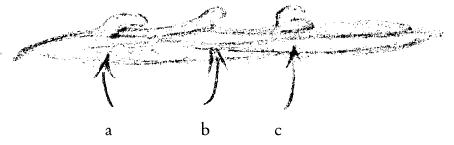
[ 52 ] Imagine a river flowing along (it is drawn). It forms waves. You won’t always get it right if you have wave c emerge from wave b and that from wave a, if you say c is the effect of b, and b of a; all sorts of forces are at work down there in the depths, causing these waves to swell. And so it is in history. What happens in 1910 is not always the effect of what happened in 1909, and so on; rather, for these effects arising from the depths of the current of development—which set the waves in motion—a sense of them must arise in a person very early on. But this sensitivity only arises if one introduces causes and effects relatively late, around the age of 12, and presents images beforehand.
[ 53 ] This, in turn, places demands on the teacher’s imagination. But the teacher must meet these demands. He will be able to do so if he acquires an understanding of human nature. And that is what this is all about.
[ 54 ] Just as one educates and instructs in accordance with human nature, the instruction I have just described must be accompanied by an education focused on moral qualities. I would like to add a few final points here. Here, too, the key is to discern from the child’s nature how one should treat him or her. If one teaches a child the concept of cause and effect as early as age seven, one is acting against the development of human nature. But if one wishes to punish a child for certain things, one often acts against the development of the human being through certain punishments as well.
[ 55 ] We had some really interesting experiences with this at the Waldorf School. How are children often punished in regular schools? If children don’t do something properly during class, they’re made to stay after school, and they have to do math problems, for example. But something remarkable happened at the Waldorf School with three or four children who had been told: “You were disruptive; you have to stay after school and do math problems!”—To which the others replied: “Well, then we want to stay too and do math problems!”—Because they have been raised to believe that doing math problems is a good thing, not something used as a punishment. One should never give a child the impression that doing arithmetic during detention is a bad thing. That is why the whole class wanted to stay behind, do detention, and do arithmetic. Therefore, one should not choose activities that cannot possibly be considered a punishment if the child is to be raised with a balanced inner life.
[ 56 ] Or another example: Dr. Stein, a teacher at the Waldorf School, has come up with many excellent ideas—sometimes on the spot—regarding education. He once noticed that his students were passing little notes to each other under the desk. They were writing letters to each other—not paying attention—and slipping the letters under the desk to their neighbor, who would then pass the reply back. Now, Dr. Stein didn’t start scolding them about writing letters and say, “I’m going to punish you!”—or anything like that—but instead he suddenly began to give a lecture on the postal system. The children were taken aback that the topic of the postal system had suddenly come up; but they eventually figured out why he was talking about it. And this subtle way of making transitions—that’s what puts them to shame. The children were ashamed, and the letter-writing stopped, simply because of the ideas he wove into his talk about the postal system.
[ 57 ] And so one must be resourceful if one wants to lead a class. One must not rigidly adhere to established methods, but must actually be able to put oneself in the child’s shoes and understand that improvement—and after all, punishment is intended to bring about improvement—is much more likely to occur under certain circumstances if a sense of shame is evoked in this way, but without singling out the individual—so that it happens completely unnoticed—rather than punishing in a crude sense. Precisely in this way, when one stands in the classroom with a certain spirit, many things fall into place that otherwise cannot be brought into balance at all.
[ 58 ] Above all, educating and teaching require self-awareness on the part of the teacher. For example, a teacher must not try to educate a child—who has made ink splatters on a sheet of paper or on the desk because he became impatient or angry over something his neighbor did—by yelling at him about the ink splatters: “You must not get angry! Getting angry is not a trait a good person should have!” A person must not get angry, but must endure everything calmly! If you get angry at me one more time, then—then I’ll throw the inkwell at your head!
[ 59 ] Yes, if children are educated in this way—as is very often the case—then very little will be achieved. The teacher must always maintain self-control; above all, he must never fall into the very mistakes he reproaches his students for. But to do this, one must understand how children’s unconscious minds work. What a person possesses in terms of conscious intellect, emotion, and will is only a part of their spiritual life; even in a child, the astral body, with its immense intelligence and rationality, is already at work beneath the surface.
[ 60 ] Now, it has always been an abomination to me when a teacher stands in the middle of a classroom, holding a book in his hand and teaching straight from the book, or when he has a notebook in which he has jotted down the questions he wants to ask and has to keep looking at it. Certainly, the child does not immediately think of this with his conscious mind; but children are clever in their subconscious, and if one is able to perceive it, one can see that they say to themselves: “He doesn’t even know what I’m supposed to learn. Why should I learn something he doesn’t know?” That is always the subconscious judgment of children who are taught by a teacher using a book or notebook.
[ 61 ] One must place extraordinary importance on such intangible factors, on such subtleties in teaching. For as soon as the child’s subconscious—the astral body—notices that the teacher does not know something himself and must first look it up in the textbook, the child will feel it is unnecessary to learn this on his own. And the astral body acts with far greater certainty than the child’s conscious mind.
[ 62 ] I wanted to weave these remarks into this lecture. We will then incorporate specific subjects and stages of a child’s education over the next few days.