

The Art of Education
Based on Understanding Human Nature
GA 311
13 August 1924, Torquay
Translated by Steiner Online Library
Second Lecture
[ 1 ] Yesterday I pointed out how we must conceive of a complete turning point in a child’s development during the change of teeth. The fact is that what is called heredity—inherited characteristics—plays a direct role only during the first stage of a person’s life. Subsequently, during the first seven years, a second life organism is gradually built up in physical form; this is shaped according to the model of the inherited organism and is, so to speak, complete by the time the change of teeth takes place. If the individuality—which descends from the spiritual, pre-earthly world—is weak, then the second organism resembles the inherited one. If, however, the individuality is strong, we see how, between the age of 7, the change of teeth, and sexual maturity—that is, around the age of 14—a kind of victory over the inherited characteristics gradually takes shape. The children change; they transform themselves, even in their outward physical form.
[ 2 ] It is particularly interesting, however, to observe the characteristics of the soul that emerge during this second stage of life. In the first stage of life, before the child’s teeth come in, the child is, in a sense, entirely a sensory organ. You must take this in the most literal sense: entirely a sensory organ.
[ 3 ] Consider, for example, the human eye or the human ear. What is the defining characteristic of such a sensory organ? The defining characteristic is that the sensory organ is highly receptive to impressions from the outside world. And when you look at the eye, you can actually see within it what kind of process is taking place. In a sense, during the first seven years of life, the child is entirely eye. Consider that—I’ll leave out everything else—an image of every object outside is formed in the eye, an inverted image. That is, after all, what elementary physics teaches everyone. So what is out there in the world is present as an image inside the eye. Well, that’s where physics stops. But it is actually only the beginning of what one should know about the eye—that an image is formed inside it—it is the most superficial physical fact.
[ 4 ] If physics were to examine this image with a keen sense of observation, it would find that, depending on the nature of this image, circulation takes place within the choroid. The blood circulation throughout the entire choroid is influenced by the nature of the image. The entire eye adjusts itself according to these factors. These are, after all, subtle processes that are not taken into account by conventional physics.
[ 5 ] But the child is all eyes during the first seven years. If—let’s say—something dramatic happens near the child, such as an outburst of anger, if someone gets angry, then the whole child will have an inner image of that outburst. The etheric body forms an image. From this, something related to the outburst of anger is transmitted into the entire circulatory system and the entire vascular metabolism.
[ 6 ] This is the case during the first seven years, and after that, the organism adapts. Of course, these are not crude things. They are subtle things; but if a child grows up around an angry father or an angry teacher, then the vascular system will adapt to and orient itself toward anger. Throughout the child’s entire life, what emerges from this ingrained predisposition will remain.
[ 7 ] These are the most important things when it comes to a child. What you say to the child, what you teach the child—that doesn’t make an impression; what makes an impression is that the child imitates in speech what you say to him. But who you are—whether you are good and express that goodness in your gestures, or whether you are evil, angry, and express that in your gestures—in short, everything you yourself do is reflected within the child. That is the essential point. The child is entirely a sensory being, reacting to everything that is evoked within them as an impression by other people. Therefore, the essential point is not to believe that the child can learn what is good or bad, or can learn this or that, but to know this: Everything one does in the child’s presence is transformed within the child’s organism—in mind, soul, and body. The health of the child’s entire life depends on how one behaves in the child’s presence. The inclinations the child develops depend on how one behaves in the child’s presence.
[ 8 ] All those things that are usually recommended in kindergartens—that one should do this or that with the children—are no good. Most of what is presented as kindergarten instruction is, in fact, exceptionally clever. One must, I would say, be utterly delighted by the cleverness of what was devised for kindergartens over the course of the 19th century. The children learn so much there—they’re almost learning to read already. They’re given letters that they have to place into cut-out letter shapes and things like that. It all looks terribly clever, and one can so easily be tempted to believe that this is something that’s good for the children. It’s of no use whatsoever! In reality, it’s completely useless. The whole soul of the child is corrupted by it. The child is corrupted right down to the body, right down to their health. Such kindergarten activities produce weaklings in both body and soul later in life.
[ 9 ] If, on the other hand, we were simply to bring the children into the kindergarten and behave in such a way that the children could imitate us—if we were to do all sorts of things that the children would imitate of their own accord, just as they are accustomed to doing from their soul’s nature in their pre-earthly existence—then this would indeed lead to the children becoming like us, but it is up to us to be such that they can become like us.
[ 10 ] You see, this is what we must take into account for the first seven years of life—not what you regard, in words and outward appearance, as a moral viewpoint.
[ 11 ] It’s worth considering whether you’re making a terribly grumpy face, giving the child the impression that you’re a sourpuss; this can harm the child throughout their entire life. That is why it is so essential, especially for young children, that as an educator you become completely absorbed in what it means to observe people and experience human life. It doesn’t matter at all what specific goals you set for yourself. What matters is what kind of person you are. It’s easy to come up with programs these days, because everyone is so clever these days. I’m not saying this ironically. In our time, people are simply that clever. If just a few people get together and decide that this or that should happen in the classroom or in education, something clever will always come of it. I have yet to encounter any foolish educational or teaching programs; they are always very clever. But what matters is not that we have such programs, but that we have people in schools who can work in the way I have just described. This attitude must be developed, for attitude is actually of immense importance, especially during the stage of a child’s life when the child is entirely a sensory being.
[ 12 ] Once the child has gone through the process of losing baby teeth, the child is no longer a sensory organ to the same degree as before. This process begins to diminish between the ages of three and four; but until then, the child has very special characteristics that are actually largely unknown. When you eat something—something sweet or sour—you feel it on your tongue and palate. When a child drinks milk, it feels the taste of the milk throughout its entire body, because the body itself is also a sensory organ when it comes to taste. It tastes through the entire body. And this can sometimes lead to quite remarkable experiences.
[ 13 ] There are children—they are rare these days, because children, after all, model themselves after adults—who, by the time they are 15, 16, or 20, have become like withered children, losing their freshness; but even in our time, one can still experience—though it is difficult for such children—that they are truly nothing but sensory organs. For example, I met a little boy; when you presented him with something he was supposed to enjoy—and he already sensed that he would enjoy it—he didn’t just approach it with the organs one normally uses to approach food, but he rowed toward it with his hands and feet; he was entirely an organ of taste. The remarkable thing is that by the time he was 9 or 10 years old, he became an excellent eurythmist and developed a deep understanding of eurythmy. So what had manifested itself in his paddling toward food was developed in his organs of the will.
[ 14 ] But I do not mention such things to amuse you, but rather to use them as examples of how one should observe. It is very rare in life for people to tell you such things, but they happen all the time. People overlook these characteristic expressions of life, and then they come up with their own ideas about how to educate, instead of observing life.
[ 15 ] Life is interesting everywhere, from morning till night. Even the smallest things are interesting. Just watch, for example, people taking a pear from the dessert table. No two people take a pear in the same way—it’s always different. A person’s entire character is revealed in the way they take a pear from the bowl and place it on their plate—or don’t place it on their plate at all, but instead bring it straight to their mouth, and so on.
[ 16 ] If we were to develop a greater sense of observation for such things in life, that horror in schools—which, unfortunately, we see so often today—would not arise. You hardly see any children anymore who hold their pen or stylus properly. Somehow, the stylus or pen is held incorrectly because people lack the ability to observe correctly. This is difficult in general. It is not easy even in Waldorf schools. Very often, one enters a class where one first has to set things straight regarding penmanship, pencil grip, and so on. In this regard, one should by no means overlook the fact that the human being is a whole—that is, the human being must acquire dexterity in all directions. So observation of life—that is what the teacher, the educator, needs even for the little things in life. And if you absolutely want to formulate something into principles, then take this as the first principle of a true pedagogical art: You must be able to observe life in all its manifestations.
[ 17 ] You can never learn enough in this area. Just take a look at children from behind. Some walk by placing the entire sole of their foot on the ground, while others tiptoe on the balls of their feet. There are all kinds of variations in between. Yes, when you want to raise a child, you have to know exactly how they walk. For a child who steps firmly onto the ground with their heels demonstrates, through this small aspect of physical expression, that they were firmly rooted in life during their previous incarnation—that they were interested in everything during their previous earthly life.
[ 18 ] With such a child, therefore, one must ensure that... one draws things out of the child as much as possible, for there is much within children who step firmly with their heels. In contrast, children who tiptoe—barely touching the ground with their heels—have lived their previous earthly life in a fleeting manner. One will not be able to draw much out of them; one must make sure to do a lot in their presence so that they, too, can imitate it.
[ 19 ] And so one must observe and experience the transition during the change of teeth. One will then find that the child, above all else, develops the gift of symbolism—the gift of imagination—from the fact that it was previously entirely a sensory being, and one must take this into account, even in play. Our materialistic age is terribly at fault in this regard. For example, today one can find so-called “beautiful” dolls for children everywhere. Oh, they have such beautifully shaped faces, wonderfully painted cheeks, even eyes that close when you lay them down to sleep, real hair—and all sorts of other features! But this kills the child’s imagination. The child can no longer create anything in their imagination from this figure. Nor does the child derive as much joy from them. In contrast, if you make a doll yourself out of a napkin or a handkerchief—with two ink blots for eyes, one ink blot for a mouth, and arms shaped however you like—then the child can add so much more through their imagination. It’s especially good for the child to be able to add as much as possible, to develop their imagination and their capacity for symbolic play. That’s what we must strive for with them: to give them as few ready-made, so-called “beautiful” things as possible. For the “beauty” of a doll like the one I described earlier—with real hair and so on—is only conventionally beautiful; in truth, this doll is actually hideous because it is inartistic.
[ 20 ] What matters is becoming fully aware of how, during the stage of life that includes the change of teeth, the child transitions into the life of the imagination—not into the life of the intellect, but into the life of the imagination. As a teacher or educator, you must be able to foster this development. Those who possess true insight into human nature deep within their souls are capable of developing a life of imagination. It is indeed true that insight into human nature thaws the inner life of the soul and brings a smile to the face. Grumpiness stems from ignorance. Certainly, one may have a diseased organ and, as a result, exhibit certain pathological features in the face. But these are not the deciding factors; the child looks past them. What, however, is expressed in one’s facial features from the very depths of the soul—a soul filled with an understanding of human nature—is what enables the teacher to become a true educator.
[ 21 ] Based on the nature of the imagination, education must therefore take place between the loss of baby teeth and sexual maturity. One might say that what is present in the child during the early years—namely, that the child is entirely a sensory being—becomes more internalized, more psychological. After all, the sensory organs do not think. The sense organs perceive images—or rather, they form images from external objects. Even though what the child produces as a sense organ initially becomes part of the soul, it does not become a thought but rather an image—albeit a soul image, an image of the imagination. Therefore, one must work with images in the presence of the child.
[ 22 ] Well, it is least possible to work with images when one introduces something completely foreign to the child from the very beginning. But what is completely foreign to the child is, for example, what we have today in our writing—whether in handwritten or printed letters. After all, the child has absolutely no connection to something like an “A.” Why should the child have any connection to something like an “A”? Why should the child be in any way interested in an “L”? These letters are, after all, something completely foreign to the child. Nevertheless, when the child starts school, we simply approach the child and try to teach these things. The result is that the child feels completely alienated from what it is now expected to accomplish. And if one approaches the child with these things even before the child’s teeth have fallen out—making the child cram all sorts of cut-out letter shapes into templates—one is occupying the child with things that are entirely foreign to it, to which it has not the slightest connection.
[ 23 ] In contrast, the child possesses an artistic sensibility and a symbolic imagination from the very beginning. One must appeal to this, one must turn to this. And one must try, at first, not to approach these conventional letters at all—which are given in the writing and printing of civilized humanity—but one must first try, I would say, in a spiritual way—forgive me for using the word—to go through the cultural development of humanity together with the child.
[ 24 ] People used to have pictographic writing—that is, they drew something on a sheet of paper that reminded them of the object. We don’t need to study cultural history, but we can convey to the child the meaning and spirit of what people intended with pictographic writing; then the child will feel right at home with it.
[ 25 ] Just think about the following. Let’s take the word “Mund” (mouth in English). If you ask the child to draw a mouth—but to draw it by painting, letting them make splotches of red paint—and then have the child say the word and say: Now don’t say the whole word, just start it—M—and let’s gradually shape the upper lip (see drawing) into this M; that way, we’ll get the M to come out of the mouth we drew at the beginning.
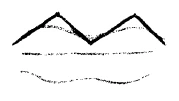
[ 26 ] That is, in fact, how writing came into being; however, it is difficult to tell from the words today that the letters were once pictures, because the words have all shifted over the course of linguistic development. Originally, every sound had its own picture, and its pictorial representation was unambiguous.
[ 27 ] There is no need to go back to these original characters, but one can invent. The teacher must be inventive; he must create from the spirit of the subject.
[ 28 ] Let's take the word “Fisch,” which is also “fish” in English. Have the child draw or paint a kind of fish, and have them say the beginning of the word: F; little by little, they'll bring the F out of the picture.
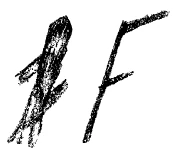
[ 29 ] And so, in fact, for all consonants—if you are creative—you can find images for them; you can draw them out of the interplay between painting and drawing.
[ 30 ] This is more inconvenient than the methods commonly used today. Above all, if you have the children do this for two or three hours, you then have to clean up the artwork afterward and put away everything the children used. But that’s just what has to be done; there’s no other choice.
[ 31 ] From this you can see how to derive letters from the image and, in turn, how to derive the image from everyday life. And that is what one should do. Do not start by teaching reading; rather, begin with drawing-as-painting and painting-as-drawing, let the letters emerge from that, and only then move on to reading.
[ 32 ] For the consonants, you’ll find something everywhere that you can use as a starting point. You just have to look. You’ll find something like that everywhere to help you form the initial sound, the first letter, of a word. It’s not so easy for the vowels. But for the vowels, perhaps the following is possible. Imagine you say to the child: “Look at the beautiful sun! You simply have to admire it. Stand up like this so you’re looking up to admire the beautiful sun.” - Now the child is standing there, looking up and expressing amazement: “Ah!” - Draw that as well. That is actually the Hebrew “A,” the sound of amazement. Now you just need to make it smaller and can gradually transition to the letter “A.”
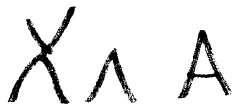
[ 33 ] And so, if you present inner spiritual concepts—namely, eurythmic concepts—to the child, placing the child in this situation yourself, you will also bring out the vowels. Eurythmy will be an immensely powerful aid to you in this, because the sounds are already formed in eurythmy. Just think of “O”—one embraces something; one embraces something lovingly.

[ 34 ] From this, you can derive the phonetic symbol O. You can actually derive the vowels from the gesture, from the sign.
[ 35 ] This is how one works from observation, from the imagination. One will then succeed in having the children gradually derive the sounds and letters from the objects. One must start from the image. The letter, as it exists today in our civilization, has a history behind it. It is something simplified from an image, and one can no longer recognize from today’s magical symbol what the image was like.
[ 36 ] When the Europeans—these “superior people”—came to America, back when there were still “savages” there—the Native Americans—and such things were still happening as late as the mid-19th century—and they showed these “savages” written characters, printed matter, the Native Americans ran away because they thought those letters were little devils, and they said: The Palefaces—as the Native Americans called the Europeans—communicate through little devils, through demons.
[ 37 ] But those are just letters to children, too. They don’t mean anything to children at all. The child senses—and rightly so—that there is something demonic about letters; they have already become a magical tool, precisely because they are symbols.
[ 38 ] One must start with the image. The image is not a magical symbol; it is something real, and so one must work from it.
[ 39 ] Then people come along and say: “Yes, but the children won’t learn to read and write until later.”—People only say that because today we don’t know how harmful it is for children to learn to read and write at an early age. It’s very bad if you can write early. Reading and writing, as we know them today, are actually meant for people in their later years—around age 11 or 12. And the more you’re spared from having to master reading and writing before then, the better it is for your later years. Someone who still could not write properly by the age of 14 or 15—I can speak from my own experience here, because I could not do so at 14 or 15—does not hinder their later spiritual development as much as someone who was already able to read and write at an early age, around 7 or 8. These are things that teachers, in particular, must observe.
[ 40 ] Of course, today—since private schools are meant to prepare children for life in the public sphere—we cannot proceed as we actually should. But one can still achieve a great deal if one understands these things. It is all about understanding. Above all, one must know and recognize deeply that one should not teach reading before teaching writing, for in writing—especially when it arises from painting-like drawing and drawing-like painting—the whole person is engaged. The fingers are involved, the posture of the body—the whole person is involved. In reading, only the head is involved. And one should introduce to the child as late as possible that which activates only one part of the organism and leaves the rest indifferent. The most important thing is to first set the whole person in motion, in activity, and only then a part of it.
[ 41 ] However, if one wishes to proceed in this way, one cannot expect to receive instructions down to the smallest detail, but only a guideline, a direction. Therefore, especially with this teaching method—which is based on anthroposophy—you can expect nothing other than absolute freedom, but also the free, creative imagination of the teacher and educator.
[ 42 ] At the Waldorf School, we are, I would say, blessed with a rather questionable level of success. We started with 130 or 140 students, whom we received from Emil Molt’s industrial enterprise—who were, so to speak, “compulsory students” at the time—as well as a few children of anthroposophists. In the short time since the Waldorf School was founded, it has grown to the point where we now have over 800 children and between 40 and 50 teachers—a somewhat questionable success, because things are gradually becoming unmanageable. From the structure of the Waldorf School, which I will describe to you, you will already see how difficult it is to keep track of everything. Of course, it can be managed, for reasons I will also hint at later. We’ve had to set up parallel classes—three concurrent 5th and 6th-grade classes, a, b, and c. These are still overcrowded and still have more children than other classes in the school.
[ 43 ] So there’s one teacher in Class A and another in Class B. Imagine what that’s like in a “properly organized” life. You walk into 1st Grade Class A; inside, the children are being drilled according to a specific method that’s considered the best. Now you walk into first-grade Class B. It could just as well be labeled “A”—only different children are sitting inside—because both classes operate the same way, since that is the “right method.” Of course, people figure this out based on their intelligence. The intellectual realm is unambiguous, and that is how it must be.
[ 44 ] You won’t find that at all at our Waldorf school. When you walk into first-grade class A here, you’ll see a teacher inside who is teaching writing; she has the children make all kinds of shapes—let’s say out of string—and then she has them transform these shapes into artistic forms, and little by little, letters emerge. A second teacher prefers a different approach. If you walk into Class B, you’ll find that this teacher has the children dancing around; they’re meant to experience the shapes through their own bodies. Then she has them capture those shapes. You’ll never find that things are done exactly the same way in Classes A, B, or C. The same thing happens, but in very different ways. A freely creative imagination reigns there. There are no set rules; there is only the spirit of the Waldorf school. It is very important to grasp this. The teacher is autonomous. Within this spirit, the teacher is entirely free to do what he or she considers right. You might say: “Well, if everyone can do whatever they want, then the most chaotic things could happen in school.” Then you walk into 5th Grade A, and who knows what kind of hocus-pocus is going on there. Then you walk into 5th Grade B, and somewhere a game of chess is being played. The essential point, however, is that this is not how it is in the Waldorf school. You find freedom everywhere, and yet in every class there is a spirit that corresponds to the children’s age.
[ 45 ] If you take the seminar courses, you will see that they allow the greatest freedom, and yet they bring into the classroom exactly what belongs there. And the remarkable thing is, no teacher has ever objected to this. Everyone embraces the unified spirit entirely of their own free will. No one rebels; no one wants anything extra. On the contrary, there is often even a desire to talk at length in the conferences about what should happen in the classes.
[ 46 ] Why doesn’t any teacher rebel against the curriculum? We’ve been dealing with this for years now. What do you think is the reason for this? Everyone considers it reasonable. They don’t find it unreasonable at all. They find it quite reasonable in its freedom, because it is connected to what is now true, genuine knowledge of human nature.
[ 47 ] But it is precisely when one comes to these things—creating lesson material from the imagination—that one sees that freedom must prevail in school. And it does prevail. And every teacher here has the feeling not only that they are drawing on what they themselves truly conceive and find in their imagination, but I am becoming increasingly convinced—whether I am sitting in staff meetings with my Waldorf teachers or entering the classroom—that, in fact, everyone forgets, once they are in the classroom, that the curriculum was ever fixed or established. In the moment they are teaching, they actually regard it as their own creation. That is the feeling I have when I walk in.
[ 48 ] These are the things that result when a genuine understanding of human nature is taken as the foundation. I must tell you this, even though you might think it is said out of vanity; but it is not said out of vanity, but so that you may know it and be able to do the same, and see how that which comes from a genuine understanding of human nature truly enters into the child.
[ 49 ] All teaching and all education must be based on the imagination. One must be clear about the fact that, before the age of 9 or 10, a child does not know how to distinguish itself from its surroundings as a separate “I.” Out of a certain instinct, the child has long since begun to speak of itself in the first person. But in truth, the child actually feels at home in the whole world. It feels connected to the entire world. In this regard, some rather fanciful notions prevail today. When speaking of primitive peoples, it is said that they have animism as their worldview and treat inanimate objects as if they were animated. And people believe they understand the child when they say that, in its own sphere, it behaves just like a savage, like a primitive human. If it bumps into a sharp-edged object, it strikes it because it believes it is animated.
[ 50 ] But that is not true at all. In reality, the child is not animating things; rather, it simply cannot yet distinguish between the living and the non-living. It regards everything as a single entity, and itself as part of that entity along with its surroundings. It is only between the ages of 9 and 10 that the child actually learns to distinguish itself from its surroundings. This must be taken into account in the strictest sense if one wishes to plan the entire curriculum effectively.
[ 51 ] It is necessary to discuss everything—plants, animals, even stones—in the child’s surroundings in such a way that these things seem to speak to one another, behave toward one another as humans do, communicate with one another, and hate and love one another. One must be able to use anthropomorphism in the most imaginative way; to treat everything exactly as one would treat a human being. And not by imbuing them with a soul in some witty way, but rather in a manner the child is capable of grasping, since the child does not yet distinguish between the inanimate and the animate. For the child, there is still no reason to think that the stone has no soul while the dog has one; rather, the child first makes the distinction that the dog moves but the stone does not. Yet the child does not attribute this movement to the presence of a soul. The point is that one can indeed treat everything animated and alive as if human beings were speaking, thinking, and feeling with one another—as if human beings were developing sympathies and antipathies toward one another. Therefore, everything presented to the child at this age must be cast in the form of fairy tales, legends, and animated narratives. In this way, the child receives the very, very best foundation for its instinctive, imaginative, and spiritual nature. And this is what must be ensured.
[ 52 ] If the child is filled with all sorts of intellectualism during this period—and this will happen if one does not translate everything one presents to the child into visual imagery—then the child will later feel the effects of this in its vascular system, as well as in its circulatory system. One must regard the child—in spirit, soul, and body—as a unified whole; this must be emphasized time and again.
[ 53 ] To be able to do this, the teacher must possess an artistic sensibility in his or her soul, must have an artistic disposition; for what the teacher imparts to the child is not merely what one conceives or what can be expressed in concepts, but—if I may use the expression—it is, in fact, the very imponderables of life. An immense amount is unconsciously passed on from the teacher, from the educator, to the child. The teacher must be aware of this, especially when telling the child fairy tales, stories imbued with spirit, or legends. In our materialistic age, it happens very, very often that one senses all too clearly that the teacher regards what he or she is telling as merely childish; it is something in which he or she does not believe. Here, you see, is where anthroposophy—as the guide and leader of true knowledge of the human being—truly comes into its own. In anthroposophy, we realize that a concept can be expressed infinitely more richly when it is clothed in imagery than when it is reduced to an abstract concept. A child with a healthy disposition has the need to visualize everything and also to receive images.
[ 54 ] One can always point to Goethe in this regard, who was forced to learn to play the piano as a boy. He was instructed on how to use his first finger, his second finger, and so on. But he didn’t like that, and in the face of his dry, pedantic teacher—for Goethe’s old father was a die-hard philistine, a real Frankfurt philistine, who naturally preferred philistine teachers because they’re the good ones, aren’t they—well, that was repugnant to the boy Goethe, too abstract; so he invented the “Deuterling” for himself—not the index finger, which is abstract, but the Deuterling. The child wants the image; wants to feel himself as an image. So it’s simply necessary to take into account that the teacher needs imagination, must be artistic. Then he approaches the child with the necessary liveliness. And this liveliness has an immeasurable effect on the child in the very best sense.
[ 55 ] The fact is that, through anthroposophy, we are learning once again to believe in legends, fairy tales, and myths themselves, because they express a higher truth in the imagination. We find our way back into the spiritual approach to the mythical, the legendary, and the fairy-tale-like. As a result, when we speak to a child, our words—imbued with our own belief in these things—flow toward the child. This brings truth between the educators and the child; whereas so often, so much untruth prevails between educators and children. Untruth prevails immediately when the teacher says: “The child is stupid, I am smart; the child believes in fairy tales, so I must tell them to the child. That is what is proper for the child.”—Then the intellect immediately intrudes into the storytelling.
[ 56 ] However, right between the loss of baby teeth and puberty, children have an exceptionally keen sense of whether a teacher is guided by reason or imagination. Reason has a stifling, withering effect on a child’s life, while imagination enlivens and stimulates it.
[ 57 ] We certainly need to make these general concepts our own. We will discuss these matters in greater detail over the next few days, but I would like to share one final thought with you before concluding.
[ 58 ] Between the ages of 9 and 10, something extraordinarily significant occurs for the child. The teacher must be aware of this. In abstract terms, what happens between the ages of 9 and 10 is that the child learns to distinguish itself from its surroundings, perceiving itself as the “I” and the surroundings as the “outside”—as something not belonging to the “I.” But that is the matter expressed in abstract terms. The reality is—and of course all this is approximate—that at this age, the child has some difficulty reaching out to their beloved teacher. In most cases, the child doesn’t even express what is weighing on their mind, but rather something else. But one must then realize that this comes from the innermost depths of the soul. And there one must find the right response, the right way to behave. An immense amount depends on this for the entire life of the person in question. For, you see, you cannot possibly educate, teach, or work with children of this age unless you are a natural authority figure—unless the child feels that something is true because you consider it true, that something is beautiful because you find it beautiful and point it out, and that something is good because you consider it good. You must be the child’s representative of the good, the true, and the beautiful. The child must be drawn to truth, goodness, and beauty because it is drawn to you.
[ 59 ] Now, between the ages of 9 and 10, this feeling arises quite instinctively in the child’s subconscious: “I’ve learned everything from the teacher, from the educator—but where did they get it? What lies behind it?” There’s no need to elaborate further. If one resorts to definitions or explanations at this point, it is harmful. But what is important is to find a heartfelt, soul-filled word for the child—or words, since this usually takes longer, with the difficulties persisting for weeks or months—so that one can navigate past this obstacle and maintain one’s authority in the child’s eyes. This is the crisis of the principle of authority in the child. If one is up to the task, if one knows how to infuse so much soul into the way one confronts the difficulties that arise at this point in life, if one approaches the child with the necessary depth, credibility, and sincerity that one preserves one’s authority; then something has been gained not only because the child retains faith in the teacher’s authority—which is, of course, good for future instruction—but it is inherent in human nature that, precisely at this age, between the ages of 9 and 10, one must not waver in one’s belief in the goodness of others. Otherwise, all the inner security that is meant to guide them through life will be shaken.
[ 60 ] This is of immense importance, and we must adhere to such things. Far more important than all the tricky, minute details prescribed in educational theory is knowing what happens at a particular point in a child’s life and how one must respond to it, so that such a response may then cast the right light on the child’s entire life.