

The Educational Value
of Understanding Human Nature
GA 313
11 April 1921, Dornach
Translate the original German text into any language:
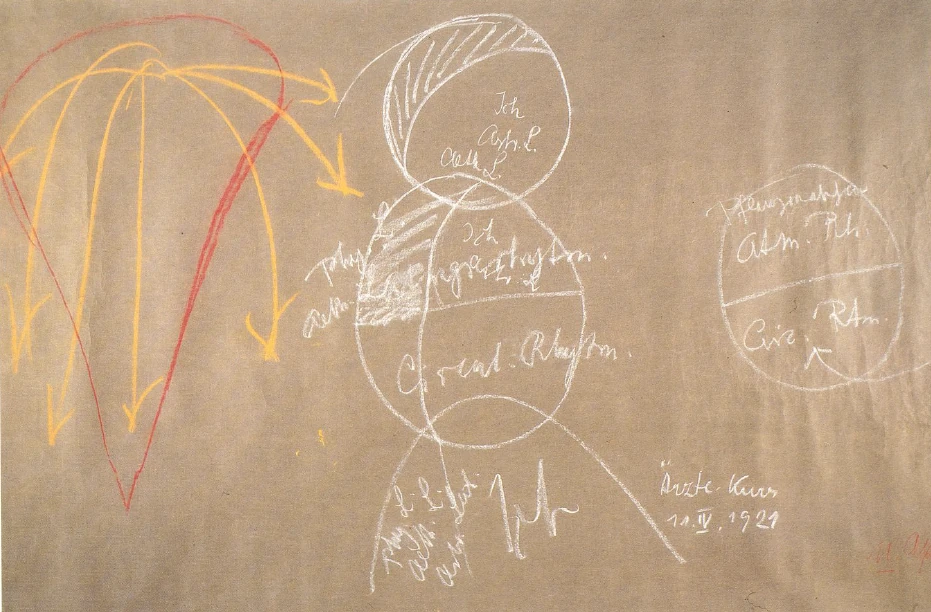
Versions Available:
Spiritual-Scientific Perspectives on Therapy, tr. SOL
Erster Vortrag
First Lecture
[ 1 ] Es ist zu hoffen, daß dieser Ergänzungskursus zu dem vorjährigen doch wiederum einiges wird bringen können, was in wirklichem Sinne als eine Ergänzung wird aufgefaßt werden können und was namentlich dann, wenn wir gegen das Ende des Kursus hin kommen werden, sich zu einer Anzahl therapeutischer Ausblicke kristallisieren wird. Ich werde mich in diesem Kursus bestreben, von einer anderen Seite die Dinge ins Auge zu fassen, die auch den Gegenstand unserer vorigen Kursbetrachtung bildeten, die Dinge des kranken und des zu heilenden Menschen. Aber wir werden dadurch, daß wir die Sache von einer anderen Seite betrachten, wesentlich nicht nur etwa zu anderen Gesichtspunkten kommen, sondern auch zu einer Erweiterung des Stoffes, den wir betrachtet haben. Ich möchte nämlich diesmal zeigen, wie dasjenige, was Sie alle als Anthroposophen kennen, die Gliederung des Menschen in physischen Leib, Ätherleib und so weiter, gewissermaßen beim Krankwerden und beim Geheiltwerden wirkt. Während ich mich das vorige Mal mehr darauf beschränken mußte, zunächst die äußere Offenbarung des inneren Menschen darzustellen, werde ich diesmal versuchen zu zeigen, wie diese verschiedenen Glieder des Menschen beeinflußt werden von demjenigen, was Stoffe außer dem Menschen sind, was namentlich diejenigen Stoffe sind, die dann als Heilmittel verwendet werden können, und was als Heilmittel wirken kann, indem es den menschlichen Organismus anders als bloß stofflich beeinflußt. Hier muß ich allerdings einleitend sogleich eine Voraussetzung machen.
[ 1 ] It is to be hoped that this supplementary course to last year’s will once again be able to offer something that can truly be regarded as a supplement and that, especially as we approach the end of the course, will crystallize into a number of therapeutic perspectives. In this course, I will endeavor to approach from a different angle the very topics that formed the subject of our previous course—namely, the conditions of the sick person and the person in need of healing. But by viewing the matter from a different angle, we will not only arrive at different perspectives but also achieve a broadening of the material we have examined. For this time, I would like to show how what you all know as anthroposophists—the division of the human being into physical body, etheric body, and so on—works, so to speak, in the processes of becoming ill and being healed. While last time I had to limit myself more to describing the outer manifestation of the inner human being, this time I will attempt to show how these various parts of the human being are influenced by substances outside the human being—namely, those substances that can then be used as remedies—and what can act as a remedy by influencing the human organism in ways other than merely materially. Here, however, I must immediately make a preliminary assumption.
[ 2 ] Wir konnten auch das letztemal, als wir hier über denselben Gegenstand sprachen, in vieler Beziehung von Stofflichem und überhaupt von Physischem als Heilmittel sprechen. Wir werden in dem Augenblicke, wo wir zu den höheren Gliedern der menschlichen Natur, zu den übersinnlichen Gliedern der menschlichen Natur nunmehr übergehen müssen, nicht mehr in derselben Art von Stoffen sprechen können. Wir werden es zwar, ich möchte sagen tun, um Abbreviaturen zu haben, um in abgekürzter Weise sprechen zu können, aber wir werden uns einer prinzipiellen Tatsache während dieser ganzen Auseinandersetzung bewußt werden müssen. Wir werden uns nämlich bewußt werden müssen, daß man dann nicht in der Art vom Stofflichen ausgehen kann, wie man das gewöhnt ist heute in der landläufigen Wissenschaft, wenn man des Menschen Beziehung zur Umwelt, des Menschen Verhalten im gesunden und kranken Zustande wirklich verstehen will. Dasjenige, wovon man ausgehen muß, sind eigentlich nicht Stoffe, sondern Vorgänge, ist nichts Fertiges, sondern ist ein Geschehen. Und wenn wir vom Stoff reden, so müssen wir eigentlich uns vorstellen, daß wir im Stoffe, in dem, was uns im äußeren Sinnenschein als Stoff erscheint, nichts anderes vorliegend haben als einen Prozeß, einen zur Ruhe gekommenen Vorgang.
[ 2 ] Last time, when we discussed the same topic here, we were also able to speak in many respects about the material and, more generally, the physical as a means of healing. At the moment when we must now move on to the higher aspects of human nature—to the supersensible aspects of human nature—we will no longer be able to speak of the same kinds of substances. We will, I would say, do so—for the sake of abbreviations, to be able to speak in a condensed manner—but we will have to become aware of a fundamental fact throughout this entire discussion. Namely, we will have to realize that one cannot proceed from the material realm in the way one is accustomed to today in conventional science if one truly wishes to understand the human being’s relationship to the environment and human behavior in both healthy and diseased states. What one must take as a starting point is not actually matter, but processes; it is not something finished, but rather a process of becoming. And when we speak of matter, we must actually have in our mental image that in matter—in what appears to us in the external sensory perception as matter—we have nothing other than a process, a process that has come to rest.
[ 3 ] Wenn wir, sagen wir Kieselerde vor uns haben, so sprechen wir die Kieselerde zunächst als einen Stoff an. Aber das Wesentliche haben wir dann gar nicht getroffen, wenn wir den sogenannten Körper, der eine gewisse Grenze hat, in die Vorstellung aufnehmen. Das Wesentliche haben wir nur getroffen, wenn wir den sehr umfassenden Vorgang ins Seelenauge fassen, der als ein einzelner Vorgang im ganzen Universum vorhanden ist, und der gewissermaßen als Vorgang sich kristallisieren kann, der zur Ruhe kommen kann, der in eine Art von Gleichgewichtslage kommen kann, und der sich dann, wenn er zur Ruhe gekommen ist, äußert in dem, was wir als Kieselerde anschauen. Ein Wesentliches ist es, die Wechselwirkung ins Auge zu fassen zwischen den Vorgängen im Innern des Menschen und den Vorgängen, welche sich draußen im Universum abspielen, mit dem sowohl der gesunde wie der kranke Mensch in einer fortwährenden Wechselwirkung steht.
[ 3 ] When we have, say, silica before us, we initially refer to silica as a substance. But we have not grasped the essence at all if we conceive of the so-called body—which has certain boundaries—in a mental image. We have grasped the essence only when we take in with the eye of the soul the very comprehensive process that exists as a single process throughout the entire universe—a process that can, so to speak, crystallize, come to rest, reach a kind of equilibrium, and then, once it has come to rest, manifest itself in what we perceive as silica. It is essential to grasp the interplay between the processes within the human being and those taking place outside in the universe, with which both the healthy and the sick person are in constant interaction.
[ 4 ] Damit wir morgen dann mit unserem eigentlichen Stoff beginnen können, möchte ich heute einleitend dasjenige vor Ihnen vorbringen, was uns zu Vorstellungen über diese Wechselwirkung wirklich führen kann. Dazu müssen wir aus anthroposophischer Geisteswissenschaft heraus die Wesenheit des Menschen wirklich zu erfassen suchen. Ich werde mich, ich möchte sagen zunächst schematisch ausdrücken, indem ich dasjenige, was ich oftmals vorgetragen habe als die Dreigliederung des Menschen, wirklich in seiner Konzentrierung im räumlichen Menschen heute hier ins Auge fassen will. Wir wissen ja, wenn wir unterscheiden den Nerven-Sinnesmenschen, daß er hauptsächlich im Kopfe konzentriert ist, daß aber dasjenige, was da im Kopfe konzentriert ist, sich doch über den ganzen Menschen ausdehnt, im ganzen Menschen vorhanden ist, daß der Mensch sozusagen im Kopf nur am meisten ein Nerven-Sinneswesen ist, daß auf der andern Seite der ganze Mensch Kopf ist, aber eben weniger Kopf in den übrigen zwei Gliedern als im Kopfe. Und so können wir uns dasjenige, was wir Nerven-Sinnesmensch nennen, im Haupte lokalisiert denken. Dann aber müssen wir uns, damit wir für unsere jetzigen Zwecke diese Gliederung des Menschen fruchtbar machen können, den rhythmischen Menschen, der alles dasjenige umfassen würde, was Atmungs- und Zirkulationsorganismus ist, eigentlich als wieder zweigliedrig denken: das eine Glied, welches mehr nach dem Atmungssystem hintendiert, das andere, das mehr nach dem Zirkulationssystem hintendiert. Und in dieses Zirkulationssystem fügt sich dann alles dasjenige ein, was den Zusammenhang darstellt des Gliedmaßenmenschen mit dem Stoffwechselmenschen.
[ 4 ] So that we can begin our actual subject matter tomorrow, I would like to start today by presenting to you what can truly lead us to a mental image of this interaction. To do this, we must seek to truly grasp the essence of the human being from the perspective of anthroposophical Spiritual Science. I will—I might say—begin by expressing myself schematically, by truly focusing today on what I have often presented as the threefold division of the human being, as it is concentrated in the physical human being. We know, of course, when we distinguish the nerve-sense human being, that it is concentrated mainly in the head, but that what is concentrated there extends throughout the entire human being and is present in the whole person; that the human being is, so to speak, most of all a nerve-sense being in the head, and that, on the other hand, the whole human being is head, though there is less “head” in the other two members than in the head itself. And so we can conceive of what we call the “nervous-sensory human being” as being localized in the head. But then, in order to make this division of the human being fruitful for our present purposes, we must actually conceive of the rhythmic human being—which would encompass everything that constitutes the respiratory and circulatory organism—as being divided into two parts: one part tending more toward the respiratory system, the other toward the circulatory system. And everything that constitutes the connection between the human being as a system of limbs and the human being as a metabolic system is then integrated into this circulatory system.
[ 5 ] Wenn man das menschliche Haupt studiert, dann studiert man also gewissermaßen dasjenige Glied des menschlichen Organismus, das am meisten Nerven-Sinnesmensch ist. Die Organisation des menschlichen Hauptes, sie unterscheidet sich ganz wesentlich von der Organisation der anderen Glieder des Menschen, auch mit Bezug auf die höhere Gliedform dieser menschlichen Wesenheit. Wenn wir nämlich das Haupt des Menschen vom Gesichtspunkte geisteswissenschaftlicher Betrachtung ins Auge fassen, so ist dieses Haupt eine Art Abdruck, man könnte sogar sagen eine Art Abscheidung des Ich, des astralischen Leibes und des ätherischen Leibes. Und dann kommt noch der physische Leib für das Haupt in Betracht. Aber dieser physische Leib ist gewissermaßen in einer anderen Weise im Haupte vorhanden als dasjenige Physische, das Abdruck ist des Ich, des astralischen Leibes, des ätherischen Leibes. Ich darf wohl auch hier, ich möchte sagen das Höhere dieser Sache hervorheben, indem ich darauf aufmerksam mache, daß das menschliche Haupt, so wie es zunächst veranlagt ist im menschlichen Embryo, nicht etwa bloß aus den Kräften des elterlichen Organismus heraus sich gestaltet, sondern daß im menschlichen Haupte kosmische Kräfte wirken, daß einfach in den Menschen kosmische Kräfte hineinwirken. In demjenigen, was wir die ätherischen Kräfte nennen, wirkt noch viel von dem elterlichen Organismus, aber schon im Ätherischen wirken kosmische Kräfte aus dem vorgeburtlichen, oder sagen wir vor der Konzeption liegenden geistig-seelischen Leben. Und gar im Astralischen und im Ich wirkt dasjenige nach, was eben vor der Konzeption in der geistigen Welt gelebt hat. Das wirkt so nach, daß es am menschlichen Haupte formt. Das Ich schafft sich seinen Abdruck am menschlichen Haupte, der astralische Leib schafft sich seinen physischen Abdruck, der ätherische Leib schafft sich den physischen Abdruck. Nur der physische Leib, der ja eben erst hier auf der physischen Erde erhalten wird, ist sozusagen ein Primär-Wirksames, der ist nicht Abdruck, sondern der ist ein Primär-Wirksames, so daß ich sagen kann, wenn ich schematisch zeichne, die menschliche Hauptesbildung ist so, daß sie ein Abdruck des Ich ist. Das organisiert sich da drinnen - wir werden von dieser Organisation noch öfter zu sprechen haben -, das organisiert sich in einer gewissen Weise. Es organisiert sich hauptsächlich zunächst dadurch, daß es die Wärmeverhältnisse des Hauptes in sich differenziert. Ferner differenziert da drinnen der astralische Leib, der vorzugsweise in demjenigen organisierend enthalten ist, was das Haupt als gasige, luftartige Prozesse durchdringt (siehe Zeichnung). Dann drückt sich ab der ätherische Leib, und dann ist dasjenige, was für das Haupt physischer Leib ist, ein physischer Prozeß, ein wirklich physischer Prozeß (siehe Zeichnung, schraffiert). Ich werde ihn dadurch andeuten, daß ich gewissermaßen schematisch in der Zeichnung hinweise auf denjenigen Teil des Hauptes, der das knöcherige Hinterhaupt ist, wenn da etwa die Augen liegen würden. Aber es erstreckt sich dasjenige, was hier an physischen Kräften konzentriert ist, wiederum über das ganze Haupt. Da, in diesem physischen Teil der menschlichen Hauptesbildung ist ein wirklicher primärer physischer Prozeß. Das ist nicht der Ausdruck von irgend etwas anderem, sondern da ist dasjenige vorhanden, was seinen eigenen Prozeß vollführt. Aber in diesem physischen Hauptesprozeß, da haben wir eigentlich doch eine Dualität darinnen, ein Zusammenwirken von zwei Prozessen. Dasjenige, was da geschieht, ist ein Zusammenwirken von zwei Prozessen, die eigentlich nur zu verstehen sind, wenn man sie nun geistesforscherisch zusammenschaut mit gewissen anderen Prozessen, welche draußen im Universum stattfinden.
[ 5 ] When one studies the human head, one is, in a sense, studying the part of the human organism that is most fundamentally a being of nerves and senses. The organization of the human head differs quite significantly from that of the other parts of the human being, even with regard to the higher form of this human entity. For when we consider the human head from the perspective of Spiritual Science, this head is a kind of imprint—one might even say a kind of projection—of the “I,” the astral body, and the etheric body. And then there is also the physical body to consider in relation to the head. But this physical body is, so to speak, present in the head in a different way than the physical aspect that is the imprint of the “I,” the astral body, and the etheric body. I would like to emphasize the higher aspect of this matter by pointing out that the human head, as it is initially formed in the human embryo, does not take shape merely from the forces of the parental organism, but that cosmic forces are at work in the human head—that cosmic forces simply act within the human being. In what we call the etheric forces, much of the parental organism is still at work, but even within the etheric, cosmic forces are at work from the spiritual-soul life that existed before birth—or, let us say, before conception. And especially in the astral body and in the “I,” what was lived in the spiritual world prior to conception continues to have an effect. This effect shapes the human head. The “I” creates its imprint on the human head; the astral body creates its physical imprint; the etheric body creates its physical imprint. Only the physical body—which, after all, is acquired here on the physical Earth—is, so to speak, a primary active force; it is not an imprint, but rather a primary active force, so that I can say, if I were to draw a schematic diagram, that the formation of the human head is such that it is an imprint of the “I.” This organizes itself within—we will have to speak of this organization more often—it organizes itself in a certain way. It organizes itself primarily, at first, by differentiating the thermal conditions of the head within itself. Furthermore, the astral body, which is contained in an organizing capacity primarily within what permeates the head as gaseous, air-like processes, differentiates itself there (see drawing). Then the etheric body takes shape, and what constitutes the physical body of the head is a physical process, a truly physical process (see drawing, hatched). I will indicate this by pointing out, schematically so to speak in the drawing, that part of the head which is the bony occiput—as if the eyes were located there. But what is concentrated here in terms of physical forces extends, in turn, over the entire head. There, in this physical aspect of human head formation, is a genuine primary physical process. This is not the expression of anything else; rather, what is present there carries out its own process. But within this physical process of the head, we actually find a duality—an interplay of two processes. What takes place there is an interplay of two processes that can truly be understood only when, from a spiritual-scientific perspective, they are considered in conjunction with certain other processes taking place out there in the universe.

[ 6 ] Wenn Sie draußen im Universum, im Urgebirge denjenigen Prozeß sehen, der sich in der Schieferbildung ausdrückt, namentlich in alledem, was von der Kieselerde aus in die Schieferbildung führt, dann haben Sie in den Kräften, die da drinnen, in diesem Prozesse, dem von der Kieselerde ausgehenden Schieferbildungsprozesse, wirken, den polarisch entgegengesetzten Prozeß von dem, der sich hier einerseits in der physischen Hauptesbildung abspielt. Es ist dieses ein wichtiger Zusammenhang zwischen dem Menschen und seiner Umgebung. Es ist einmal im menschlichen Haupte dieser Prozeß wiederum drinnen, der sich draußen im Mineralisieren abspielt. Es ist ja heute, ich möchte sagen schon fast für die Geologie klar, wenn auch noch nicht ganz, daß alles, was der Prozeß der Schieferbildung ist, der Prozeß aller derjenigen Mineralisierung, an der die Kieselerde, Silizium, beteiligt ist, mit dem zusammenhängt, was man Entvegetabilisierung nennen könnte. Wir müssen gewissermaßen mineralisch gewordene Pflanzenwelt in der Schieferbildung suchen, und indem wir dieses Entvegetabilisieren zu erfassen suchen, was gleichbedeutend ist mit der Schieferbildung der Erde, ergreifen wir denjenigen Prozeß, der in einer anderen Weise in seinem polarischen Gegenteil hier im menschlichen Haupte spielt. Mit dem spielt aber ein anderer Prozeß zusammen. Und diesen anderen Prozeß, der mit diesem zusammenspielt, müssen wir wiederum draußen in der Welt suchen. Wir müssen ihn da suchen, wo sich zum Beispiel Kalkgebirge bilden. Und wir haben es wiederum heute schon fast als eine geologische Wahrheit für die äußere Wissenschaft daliegen, daß Kalkgebirge im wesentlichen auf einem Prozeß der Erdbildung, den wir Entanimalisierungsprozeß nennen können, beruhen. Es ist das der entgegengesetzte Prozeß des Tierwerdens. Und wiederum der polarisch entgegengesetzte Prozeß spielt hier drinnen. Wenn wir also dem Silizium und dem Kalzium, die zur Ruhe gekommene Prozesse sind, einen Anteil an der menschlichen physischen Hauptesbildung zuschreiben, so müssen wir uns klar sein, daß dadurch in diese menschliche physische Hauptesbildung etwas hineinspielt, was draußen, in der ganzen Natur unserer Erde wenigstens, eine sehr bedeutsame Rolle spielt. Wir können uns zu gleicher Zeit jetzt schon vorbereitend darüber orientieren, daß, wenn wir hinschauen auf der einen Seite auf die Kieselerde, auf das Silizium, daß das eine wesentliche Verwandtschaft hat mit demjenigen, was gerade im physischen Haupte vor sich geht; wenn ich von Silizium spreche, so ist es eben der zur Ruhe gekommene Prozeß. Dasjenige wiederum, was Kalkbildungsprozeß ist, was im Kalzium zur Ruhe kommt, das hat etwas zu tun mit alledem, was der entgegengesetzte Pol ist, was polarisch mit der anderen Kraft zusammenwirkt im menschlichen physischen Haupte. Diese Prozesse, die wir geradezu heute noch rund um uns herum aufsuchen können, stehen im menschlichen Haupte im Zusammenhange mit anderen Prozessen, die wir auf der Erde nicht finden, die nur im Abdruck vorhanden sind, indem das Haupt eben Abdruck ist von ätherischem Leib, astralischem Leib und Ich.
[ 6 ] When you observe, out there in the universe, in the primordial mountains, the process that manifests itself in the formation of shale, namely in everything that leads from silica to the formation of shale, then you will find in the forces at work within this process—the process of shale formation originating from silica—the polar opposite of the process that takes place here, on the one hand, in the physical formation of the head. This is an important connection between the human being and his environment. This process—which takes place externally in mineralization—is also present within the human head. It is, in fact, almost clear today—I would say almost clear to geology, even if not yet entirely—that the entire process of slate formation, the process of all mineralization in which silica (silicon) is involved, is connected to what one might call “de-vegetalization.” We must, so to speak, seek out the plant world that has become mineralized in the formation of shale; and by seeking to grasp this “de-vegetalization”—which is synonymous with the Earth’s shale formation—we grasp the very process that plays out in a different way, as its polar opposite, here within the human head. However, another process interacts with this one. And we must, in turn, seek this other process—which interacts with the first—out in the world. We must look for it where, for example, limestone mountains form. And today it is already almost an established geological fact for external science that limestone mountains are essentially based on a process of Earth formation that we can call the process of de-animalization. It is the opposite process of becoming animal. And here, in turn, the polar opposite process is at work. So when we attribute a role in the formation of the human physical head to silicon and calcium—which are processes that have come to rest—we must be clear that this introduces into the formation of the human physical head something that plays a very significant role out there, at least in the entire natural world of our Earth. At the same time, we can already begin to orient ourselves to the fact that, when we look on the one hand at silica, at silicon, it has an essential connection to what is taking place precisely in the physical head; when I speak of silicon, it is precisely the process that has come to rest. That which, in turn, is the process of calcification—which comes to rest in calcium—has something to do with everything that constitutes the opposite pole, the force that interacts polaristically with the other force in the human physical head. These processes, which we can still observe all around us today, are connected in the human head to other processes that we do not find on Earth, but which exist only as imprints, since the head is itself an imprint of the etheric body, the astral body, and the I.
[ 7 ] In bezug auf diese Glieder der menschlichen Natur haben wir eben Prozesse zur Ruhe gebracht, die nicht unmittelbare Erdprozesse sind. Nur dasjenige, was ich Ihnen für das eigentliche physische Haupt gesagt habe, ist im Menschen ein eigentlicher Erdenprozeß. Die andern Prozesse sind nicht eigentliche Erdenprozesse, obwohl wir, wie wir sehen werden, sie mit Erdenprozessen in Zusammenhang finden.
[ 7 ] With regard to these aspects of human nature, we have just brought processes to rest that are not direct earthly processes. Only what I have described to you as the actual physical head is a true earthly process in the human being. The other processes are not true earthly processes, although, as we shall see, we find them connected to earthly processes.

[ 8 ] Damit wir zu einer Übersicht kommen, möchte ich gleich sagen, wenn ich nun zu dem zweiten Gliede des menschlichen Organismus übergehe — nennen wir es grob, indem wir lokalisieren, das Brustglied. Es ist dasjenige Glied im menschlichen Organismus, das im wesentlichen den rhythmischen Menschen umfaßt, und wir wollen es gleich schematisch teilen in alles dasjenige, was Atmungsrhythmus umfaßt und in alles dasjenige, was Zirkulationsrhythmus umfaßt. Wenn wir dieses zweite Glied der menschlichen Wesenheit nun als Ganzes ins Auge fassen wollen, müssen wir folgendes sagen. Alles dasjenige, was ich hier (siehe Zeichnung) als Organisation des Atmungsrhythmus im weitesten Sinne bezeichnet habe, das ist so, daß es zunächst ein Abdruck von Ich und astralischem Leib ist. Also wie das Haupt ist ein Abdruck von Ich, astralischem Leib und Ätherleib, so ist dasjenige, was hier Atmungsrhythmus ist, Abdruck von Ich und astralischem Leib, und es hat ein nun primär für sich Wirksames (siehe Zeichnung, schraffiert), in dem aber zusammenwirken physischer Leib und Ätherleib. Im menschlichen Haupte ist primär für sich wirksam nur der physische Leib. Der Ätherleib ist ja auch Abdruck. In dem Atmungsrhythmussystem ist aber primär ein Ineinanderwirken von physischem und ätherischem Leib wirksam, und Abdruck ist nur Ich und astralischer Leib. Das ist ja im Wesentlichen auch noch vorhanden in der Organisation für den Zirkulationsrhythmus, aber schwächer, weil sich der ganze Stoffwechselorganismus in das Zirkulationssystem hineinschiebt. Aber da beginnt schon dasjenige, was dann auch gültig ist für den Gliedmaßen-Stoffwechselmenschen. Da haben wir es dann zu tun mit dem, daß die Gliedmaßen mit alledem, was als Stoffwechsel hereinragt - mit Ausnahme der eigentlichen Zirkulation, also der Bewegung, die da ist —, im wesentlichen ein Abdruck des Ich und ein Zusammenwirken von physischem Leib, Ätherleib und Astralleib sind (siehe Tafel 1 Zeichnung), so daß wir sagen können: Wenn wir den Brustmenschen ins Auge fassen, dann haben wir in ihm von Abdrucksorganisation eigentlich nur dasjenige, was sich auf Ich und astralischen Leib bezieht, und wir haben in ihm wirksam eine primäre Organisation, die nun nicht bloß physisch ist, sondern die das Physische vom Ätherischen durchgliedert erscheinen läßt. Das ist stärker der Fall beim Atmungsrhythmus, und beim Zirkulationsorganismus ist es so, daß nun schon das andere vom Stoffwechselsystem hineinspielt.
[ 8 ] To provide an overview, I would like to say right away that as I now turn to the second member of the human organism—let us call it, roughly speaking, the chest member. It is the member of the human organism that essentially encompasses the rhythmic human being, and let us immediately divide it schematically into everything that comprises the respiratory rhythm and everything that comprises the circulatory rhythm. If we now wish to consider this second member of the human being as a whole, we must say the following. Everything that I have described here (see drawing) as the organization of the respiratory rhythm in the broadest sense is, in fact, first and foremost an imprint of the I and the astral body. Just as the head is an imprint of the “I,” the astral body, and the etheric body, so too is what we here call the respiratory rhythm an imprint of the “I” and the astral body; and it has an aspect that is primarily active in and of itself (see diagram, hatched), within which, however, the physical body and the etheric body interact. In the human head, only the physical body acts primarily on its own. The etheric body is, after all, also an imprint. In the respiratory rhythm system, however, what is primarily at work is an interaction between the physical and etheric bodies, and the imprint consists only of the “I” and the astral body. This is essentially still present in the organization of the circulatory rhythm as well, but to a lesser degree, because the entire metabolic organism is integrated into the circulatory system. But this is where what then also applies to the metabolic human being in the limbs begins. Here we are dealing with the fact that the limbs, with everything that extends into them as metabolism—with the exception of the actual circulation, that is, the movement that is present there—are essentially an imprint of the “I” and an interaction of the physical body, the etheric body, and the astral body (see Plate 1, drawing), so that we can say: When we consider the chest-centered human being, we find in him, in terms of imprinted organization, only that which relates to the “I” and the astral body; and we find in him a primary organization that is not merely physical, but one that causes the physical to appear as if structured by the etheric. This is even more pronounced in the case of the respiratory rhythm, and in the circulatory system, the metabolic system also comes into play.

[ 9 ] Das sehen Sie in verschiedener Art für die verschiedenen Glieder des Menschen zusammenspielen. Für diese verschiedenen physischen Glieder, die wir als Hauptessystem, Brustsystem, Gliedmaßensystem bezeichnen, spielen in verschiedener Weise ineinander diejenigen Glieder, die wir sonst in der Geisteswissenschaft physischen Leib, Ätherleib, astralischen Leib und Ich nennen. Das Haupt des Menschen, so wie es als Prozeß dasteht, ist eigentlich im wesentlichen physischer Leib, denn das, was nicht physischer Leib ist, ist Abdruck von Ich, astralischem Leib und Ätherleib. Dasjenige, was der mittlere Mensch ist, ist im wesentlichen ein Zusammenwirken von physischem Leib und Ätherleib. Dasjenige, was nicht physischer Leib und Ätherleib ist, ist ein Abdruck von Ich und astralischem Leib. Der GliedmaßenStoffwechselmensch vollends - nur geht das ineinander bei den letzten zwei -, ist eigentlich ein Ineinanderwirken von physischem Leib, Ätherleib und astralischem Leib - es geht das nur in die anderen Glieder, wie ich Ihnen auseinandergesetzt habe, über - und ein Abdruck des Ich (siehe Zeichnung S. 16).
[ 9 ] You can see this interplay taking place in various ways among the different parts of the human being. For these various physical parts—which we refer to as the head system, the chest system, and the limb system—the parts that we otherwise call, in Spiritual Science, the physical body, the etheric body, the astral body, and the “I” interact with one another in various ways. The human head, as it exists as a process, is essentially the physical body, for whatever is not the physical body is an imprint of the I, the astral body, and the etheric body. What constitutes the average human being is essentially an interplay between the physical body and the etheric body. That which is not the physical body or the etheric body is an imprint of the I and the astral body. The human being in terms of limb metabolism—though the last two overlap—is essentially an interaction of the physical body, the etheric body, and the astral body—this only extends into the other limbs, as I have explained to you—and an imprint of the “I” (see drawing on p. 16).
[ 10 ] Nun handelt es sich darum, daß wir zunächst ins Auge fassen, was wir für das, was wir zum Beispiel hier für den Anteil jenes Prozesses am Physischen, an der physischen Kopforganisation, den wir in der Kieselerde zur Ruhe gekommen auffassen müssen, im mittleren Menschen finden können. Da liegt das Eigentümliche vor, daß im mittleren Menschen der Prozeß der Kieselerdebildung stärker, verbreiteter wirkt. Er wirkt im Kopfe feiner. Er wirkt hier im mittleren Menschen stärker, verbreiteter, gewissermaßen differenzierter. Und er wirkt am stärksten im Gliedmaßen-Stoffwechselmenschen. Wenn wir also denjenigen Prozeß ins Auge fassen, den wir als gebunden an die Kieselerde aufgefaßt haben, so müssen wir sagen: Dieser Prozeß wirkt am stärksten da, wo er dem Ich zu Hilfe kommen soll - wir werden die Wechselwirkung dann zu anderen Prozessen sehen - in bezug auf die Wirkung des selbständigen Ich, das nur seinen Abdruck hat im physischen Stoffwechselmenschen. Es wirkt dieser Kieselerde erzeugende Prozeß am stärksten da, wo er dem Ich zu Hilfe kommen soll, für die Wirkung dieses Ich auf den Stoffwechsel-Gliedmaßenmenschen. Es wirkt dieser Prozeß, der also durch die Kieselerde charakterisiert werden kann, etwas schwächer da, wo er bloß dem astralischen Leib zu helfen braucht, und er wirkt am schwächsten da, wo er dem ätherischen Leib bloß zu helfen braucht, im Kopfe.
[ 10 ] Now the point is that we must first consider what we can find in the middle human being regarding, for example, the aspect of that process in the physical realm—specifically, in the physical organization of the head—which we must regard as having come to rest in silica. What is peculiar here is that in the middle human being, the process of silica formation is stronger and more widespread. It acts more subtly in the head. Here, in the middle human being, it acts more strongly, more widely, and, in a sense, in a more differentiated way. And it acts most strongly in the human being whose metabolism is centered in the limbs. So when we consider the process that we have understood to be bound to silica, we must say: This process is strongest where it is meant to assist the “I”—we will then see the interaction with other processes—in relation to the effect of the independent “I,” which leaves its imprint only in the physical metabolic human. This process of silica formation is most active where it is meant to assist the “I” in its influence on the metabolic limb-human. This process, which can thus be characterized by silica, is somewhat weaker where it need only assist the astral body, and it is weakest where it need only assist the etheric body, in the head.
[ 11 ] Das könnte auch im umgekehrten Sinne so gesagt werden: Mit Bezug auf dasjenige, was wir als den Prozeß anzusehen haben, der in der Kieselerde zur Ruhe kommt, haben wir zu sagen, in der menschlichen Hauptesorganisation wirkt dieser Prozeß am meisten stofflich. Er wirkt in bezug auf das Dynamische als Kraft am schwächsten. Aber da, wo er am schwächsten als Kraft wirkt, da wirkt er am stärksten, wenn er sich dem nähert, wo er dann im Stoff zur Ruhe kommt. Fassen wir also die Kieselerde auf als den Stoff, der uns vorliegt, so müssen wir sagen: ihre Wirksamkeit ist am stärksten im Kopfe. Fassen wir sie auf als das äußere Anzeichen eines Prozesses, dann müssen wir sagen: ihre schwächste Wirkung ist im Kopfe. Da wo die stärkste Stoffwirkung ist, ist die schwache dynamische Wirkung. Im mittleren Menschen halten sich gerade mit Bezug auf die Kieselerde die Stoff- und Kraftwirkung ungefähr das Gleichgewicht. Und in bezug auf den Gliedmaßen-Stoffwechselmenschen ist die Kraftwirkung im wesentlichen so, daß sie die Oberhand hat. Da ist die schwächste Stoffwirkung und die stärkste Kraftwirkung, so daß dasjenige, was Kieselerde erzeugender Prozeß ist, eigentlich den ganzen Menschen durchorganisiert. Wenn wir uns nun gefragt haben, wie sich das Wechselverhältnis darstellt zwischen demjenigen, was physische Kopforganisation ist, und der äußeren Umgebung, mit der der Mensch in Wechselwirkung steht, dann können wir uns auch fragen, wie die Wechselwirkung des mittleren Menschen, insofern er die Organisation des Atmungsrhythmus hat, zu der Umgebung draußen beschaffen ist.
[ 11 ] This could also be expressed in the opposite way: With regard to what we must regard as the process that comes to rest in silica, we must say that in the human organism as a whole, this process has its greatest material effect. In terms of its dynamic aspect, it has the weakest effect as a force. But where it acts weakest as a force, it acts strongest as it approaches the point where it then comes to rest in the substance. So if we consider silica as the substance before us, we must say: its effect is strongest in the head. If we consider it as the outward sign of a process, then we must say: its weakest effect is in the head. Where the strongest material effect is, there is the weak dynamic effect. In the average human being, the material and force effects are roughly in balance, particularly with regard to silica. And with regard to the human being as a metabolic entity of the limbs, the force effect essentially has the upper hand. There, the material effect is weakest and the force effect strongest, so that the process that produces silica actually permeates the entire human being. Now, having asked ourselves what the relationship is between the physical organization of the head and the external environment with which the human being interacts, we can also ask what the nature of the interaction is between the middle human being—insofar as it possesses the organization of the respiratory rhythm—and the external environment.
[ 12 ] Wenn man geisteswissenschaftlich den menschlichen Kopf studieren und verstehen will, dann muß man hinschauen auf die beiden Prozesse in der Erdbildung, auf den kalkbildenden Prozeß und auf den kieselerde- oder meinetwillen auch kieselsäurebildenden Prozeß. Wir werden auf das noch näher eingehen können. Dasjenige nun, was weniger nach außen, weniger peripherisch liegt, was mehr nach dem Inneren hinein liegt beim Menschen, die Organisation für das rhythmische Atmungssystem, die bietet uns, indem sie nun ein Zusammenspielen ist, primär ein Zusammenspielen von Physischem und Ätherischem, in das sich die Abdrücke von Ich und Astralischem hineinverweben, zunächst nirgends etwas in der Umwelt, was direkt als Prozeß schon dasteht, was unmittelbar in der Natur, die wir antreffen, als Prozeß schon dasteht. Wenigstens gewöhnlich ist es so nicht der Fall. Wollen wir da einen charakteristischen Prozeß finden für dasjenige, was da geschieht durch dieses eigentümliche Zusammenwirken von Ich, astralischem Leib - die mehr oder weniger frei sind, weil sie sich Abdrücke geschafft haben - und demjenigen, was primär ein Zusammenwirken von Physischem und Ätherischem ist, wollen wir uns für dieses ganze Ineinanderwirken, wollen wir uns für das irgendeinen Prozeß in der Außenwelt suchen, so müssen wir ihn, damit wir ihn ordentlich haben, eigentlich erst selber erzeugen. Wenn wir Pflanzenstoffe verbrennen und Pflanzenasche bekommen, so ist dasjenige, was sich da als Prozeß abbildet, darstellt in dem Verbrennen und in dem Erzeugen der Asche und in dem dann Zur-Ruhe-Kommen der Asche — wir werden von den einzelnen Aschen reden -, was sich da abbildet im Feuerprozeß und im Aschebildungsprozeß, das ist in einer ähnlichen Weise verwandt mit dem Atmungsprozeß, wie der Kieselerdeprozeß mit dem Prozesse verwandt ist, der sich physisch im Haupte abspielt. Und wenn wir dasjenige wirksam machen wollen, was von diesem Aschebildungsprozeß sein Korrelat hat im Atmungsrhythmusprozeß, dann können wir es natürlich nicht in den Atem einführen wir können das niemals im menschlichen Organismus -, sondern wir müssen es in dasjenige einführen, das gewissermaßen der andere Pol des betreffenden ist. Wenn ich dieses hier herauszeichne (siehe Zeichnung S. 20), so haben wir hier Atmungsrhythmusprozeß, Zirkulationsrhythmusprozeß: Im Atmungsrhythmusprozeß sind Pflanzenaschen dasjenige, was uns die wirksamen Prozesse charakterisiert. Aber wir müssen diese Pflanzenascheprozesse zur Wirksamkeit bringen auf dem Umwege durch den Stoffwechsel in dem anderen Pol, im Zirkulationsrhythmusorganismus (siehe Zeichnung S. 20). Wir müssen diese Pflanzenasche, das heißt die Kräfte, dem Zirkulationsrhythmus einverleiben, damit sie dann ihre polarische Gegenwirkung im Atmungsrhythmusprozeß hervorrufen.
[ 12 ] If one wishes to study and understand the human head from a Spiritual Science perspective, one must look at the two processes involved in the formation of the Earth: the process of lime formation and the process of silica formation—or, if you will, the process of silicic acid formation. We will be able to go into this in greater detail later. Now, that which lies less on the outside, less peripherally, and more toward the inner core of the human being—the organization of the rhythmic respiratory system—offers us, in that it is an interplay, primarily an interplay of the physical and the etheric, into which the imprints of the ego and the astral body are woven—at first, there is nothing in the environment that already exists directly as a process, nothing that is immediately present in the nature we encounter as a process. At least, this is not usually the case. If we wish to find a characteristic process for what is happening there through this peculiar interplay of the ego, the astral body—which are more or less free because they have created imprints—and that which is primarily an interplay of the physical and the etheric, if we wish to find, for this entire interplay, if we are to seek some process in the external world for this entire interplay, then—in order to have it properly—we must actually first create it ourselves. When we burn plant matter and obtain plant ash, what is reflected there as a process—manifested in the burning, in the formation of the ash, and in the ash’s subsequent settling —we will speak of the individual ashes—what is manifested there in the process of fire and in the process of ash formation is related to the respiratory process in a similar way that the silica process is related to the process that takes place physically in the head. And if we wish to activate that which has its counterpart in the respiratory rhythm process within this ash-formation process, then we cannot, of course, introduce it into the breath—we can never do so in the human organism—but rather we must introduce it into that which is, so to speak, the other pole of the process in question. If I illustrate this here (see drawing on p. 20), we have the respiratory rhythm process and the circulatory rhythm process: In the respiratory rhythm process, plant ashes are what characterize the active processes. But we must bring these plant ash processes into effect indirectly through metabolism in the other pole, in the circulatory rhythm organism (see diagram on p. 20). We must incorporate this plant ash—that is, these forces—into the circulatory rhythm so that they may then evoke their polar counteraction in the respiratory rhythm process.

[ 13 ] Diese Zusammenhänge stellen sich ja wohl gleich für die Anschauung so dar, daf man sieht, für das Verständnis des menschlichen Organismus sind sie im eminentesten Sinne wichtig. Denn wir bekommen jetzt, so wie wir uns sagen mußten, dasjenige, was uns vorliegt im kieselerdebildenden Prozeß, hat mit dem ganzen Menschen etwas zu tun, so bekommen wir, indem wir das anwenden hier jetzt auf den Pflanzenveraschungsprozeß, eine Vorstellung von diesem mittleren Menschen, der sich auch wiederum, weil er eine Atmung und einen Zirkulationsrhythmus hat, gewissermaßen zweigliedert. Wir bekommen eine Vorstellung, indem wir uns sagen: Wenn wir zunächst das Obere, den Atmungsrhythmus ins Auge fassen, so ist der Bau dieser Organe im wesentlichen bedingt durch einen Prozeß, der polarisch entgegengesetzt ist dem Prozeß, der uns erscheint, wenn wir Pflanzliches verbrennen und Asche bekommen. Es ist gewissermaßen ein Kampf im Atmungsrhythmusprozeß, ein fortwährender Kampf gegen das Pflanzenaschebilden, aber ein Kampf, der sich nicht abspielt, ohne daß dasjenige, was das Gegenteil davon ist, wirklich herausfordernd für diesen Prozeß in den Organismus eindringt. Wir sind als Menschen auf die Erde gestellt, in der es Kieselerdeprozesse gibt, Kalkerdeprozesse gibt. Wir würden nicht Menschen sein, wenn diese Prozesse uns erfüllen würden. Wir sind dadurch Menschen, daß wir die polarisch entgegengesetzten Prozesse in uns tragen, daß wir also dem Kieselbildungsprozeß entgegenwirken können und den entgegengesetzten Pol in uns tragen, daß wir dem Kalkbildungsprozeß entgegenwirken, indem wir den entgegengesetzten Pol in uns tragen. Diese Pole tragen wir in uns durch unsere Hauptesbildung, durch den ganzen Menschen dann in jener Abstufung, wie ich es dargestellt habe. Durch unseren Atmungsrhythmus tragen wir den Kampf in uns gegen den Pflanzenveraschungsprozeß. Wir tragen in uns den entgegengesetzten Pol dieses Pflanzenveraschungsprozesses. Es wird, wenn man diese Dinge ins Auge faßt, nicht wunderbar erscheinen, daß gewissermaßen, wenn ich mich grob ausdrücke, Stoß Gegenstoß hervorruft. Es ist ganz klar, wenn ich den kieselerdebildenden Prozeß im Organismus entsprechend intensiver mache, daß die Gegenwirkung modifiziert wird; und ebensogut ist es klar, daß, wenn ich das Produkt des Verbrennungsprozesses einführe in den Organismus, die Gegenwirkung erzeugt wird, und die große Frage entsteht: Wie bekommen wir dieses Wirken und Gegenwirken in unsere Gewalt? - Das ist dasjenige, was ich, wenn ich es abstrakt bezeichne, immer dadurch ausdrücke, daß ich sage, es kommt darauf an, erstens zu erkennen, welches die Prozesse - aber bis ins Ich herauf - im menschlichen Organismus sind, und welches die Prozesse draußen, außerhalb des menschlichen Organismus sind. Diese Prozesse sind differenziert drinnen und draußen. Aber drinnen und draußen sind sie polarisch einander entgegengesetzt. Und in dem Augenblicke, wo irgend etwas, was eigentlich seiner Natur nach außerhalb meiner Haut liegen soll, wo das innerhalb meiner Haut liegt, oder in dem Augenblicke, wo etwas, und sei es nur durch einen leisen Körperdruck, von außen nach dem Innern wirkt, was eigentlich nicht eine Wirkung von außen nach dem Innern sein sollte, entsteht die innere Gegenwirkung, und in dem Augenblicke habe ich die Aufgabe, eine solche innere Gegenwirkung zu irgend etwas zu erzeugen. Wenn ich zum Beispiel konstatiere, daß im Menschen statt des normalen kieselerdeentgegenwirkenden Prozesses eine zu große, eine zu intensive Neigung zu diesem Prozesse besteht, so habe ich das von außen dadurch zu regulieren, daß ich den betreffenden Stoff zuführe und die Gegenwirkung hervorrufe; die kommt schon von selber.
[ 13 ] These connections are, in fact, immediately apparent to the observer, and one can see that they are of the utmost importance for understanding the human organism. For we now realize—as we had to tell ourselves—that what we observe in the process of silica formation has something to do with the whole human being; and by applying this here to the process of plant incineration, we gain a mental image of this middle human being, who, in turn, because he has a respiratory and circulatory rhythm, is, so to speak, divided into two parts. We gain a mental image by saying to ourselves: If we first consider the upper part—the respiratory rhythm—the structure of these organs is essentially determined by a process that is polar opposites to the process that appears to us when we burn plants and obtain ash. It is, in a sense, a struggle within the respiratory rhythm process—a constant struggle against the formation of plant ash—but a struggle that does not take place without the very opposite of this process actually penetrating the organism as a challenge to it. We, as human beings, are placed on Earth, where there are silica processes and there are calcium processes. We would not be human if these processes were to fill us. We are human precisely because we carry within us the polar opposites of these processes—that is, because we can counteract the silica-formation process by carrying its opposite pole within us, and because we counteract the lime-formation process by carrying its opposite pole within us. We carry these poles within us through the formation of our head, and through the whole human being, in the gradations I have described. Through our breathing rhythm, we carry within us the struggle against the process of plant incineration. We carry within us the opposite pole of this process of plant incineration. When one considers these things, it will not seem surprising that, so to speak—if I may put it bluntly—a push gives rise to a counter-push. It is quite clear that if I intensify the silica-forming process in the organism accordingly, the counteraction is modified; and it is just as clear that if I introduce the product of the combustion process into the organism, the counteraction is generated, and the big question arises: How do we bring this interplay of action and counteraction under our control? - This is what I, when describing it in abstract terms, always express by saying that it depends, first of all, on recognizing which processes—extending all the way up to the “I”—occur within the human organism, and which processes occur outside the human organism. These processes are differentiated between inside and outside. But inside and outside, they are polar opposites. And the moment something—which by its very nature should lie outside my skin—lies within my skin, or the moment something—even if only through a slight physical pressure—acts from the outside toward the inside, which should not actually be an effect from the outside toward the inside, an inner counteraction arises; and at that moment, I have the task of generating such an inner counteraction to that something. If, for example, I observe that in a person, instead of the normal process counteracting silica, there is an excessive, overly intense tendency toward this process, then I must regulate this from the outside by administering the relevant substance and inducing the counteraction; this arises of its own accord.
[ 14 ] Das ist dasjenige, was einen dazu führt, allmählich diese Wechselwirkung des Menschen und seiner Außenwelt durchschauen zu können. Wenn Sie wirklich dazu kommen zu verstehen, wie dem Ich als Kraftwirkung dasjenige am meisten entgegenkommt, was in dem kieselerdebildenden Prozeß liegt, wenn das Ich wirken will durch Gliedmaßen und Stoffwechsel, wenn Sie ferner wissen, daß dasjenige, was Stoffwirkung ist im kieselerdebildenden Prozeß, am stärksten wirkt im menschlichen Haupte, und sich dann sagen können, daß dasjenige, was Kraftwirkung ist, in einer verminderten Intensität im menschlichen Haupte dem Ich da zu Hilfe kommen muß, dann haben Sie eine Möglichkeit hineinzuschauen, wie dieses Ich abgestuft im Menschen wirkt. Nun, wenn man das Verhältnis des Ich des Menschen zum Gliedmaßen-Stoffwechselsystem ins Auge faßt, so liegt eigentlich in diesem Verhältnisse der Ursprung des menschlichen Egoismus. Es gehört diesem System des menschlichen Egoismus ja auch das Sexualsystem an. Und das Ich wirkt gerade auch auf dem Umwege durch das Sexualsystem am meisten das menschliche Wesen mit Egoismus durchdringend.
[ 14 ] This is what enables one to gradually gain insight into this interaction between the human being and the external world. If you truly come to understand how what lies in the silica-forming process most directly corresponds to the “I” as a force effect—when the “I” wishes to act through the limbs and metabolism—and if you further realize that what constitutes a material effect in the silica-forming process is most strongly at work in the human head, and if you can then tell yourself that what is a force effect must come to the aid of the “I” in the human head—albeit with reduced intensity—then you have an opportunity to glimpse how this “I” works in a graded manner within the human being. Now, when one considers the relationship between the human “I” and the limb-metabolic system, the origin of human egoism actually lies in this relationship. The sexual system, after all, also belongs to this system of human egoism. And it is precisely through the sexual system—as a roundabout route—that the “I” most profoundly permeates the human being with egoism.
[ 15 ] Wenn Sie das erfassen, werden Sie sagen: Dann ist ja ein gewisser Gegensatz vorhanden zwischen der Art, wie sich das Ich der Kieselerde bedient, um auf den Menschen vom Gliedmaßensystem aus zu wirken, und der [Art], wie dieses Ich vom menschlichen Haupte aus durch die Kieselerde wirkt. Da wirkt es gewissermaßen egoismusfrei. Und wenn man das geisteswissenschaftlich durchforscht, sieht man, es wirkt differenzierend.
[ 15 ] If you grasp this, you will say: Then there is indeed a certain contrast between the way the “I” makes use of silica to influence the human being through the limb system, and the [way] in which this “I” acts through silica from the human head. There, it acts, so to speak, free of egoism. And when one investigates this from a Spiritual Science perspective, one sees that it has a differentiating effect.
[ 16 ] Wenn ich schematisch diese merkwürdige Wirkung darstellen sollte, so müßte ich so sagen: Dasjenige, was das Ich - also jetzt als wirkliches Organisationselement - im Menschen durch die Kieselerde (siehe Zeichnung, rot) vom Gliedmaßensystem aus tut, das ist im wesentlichen den Menschen zusammenfassend, gewissermaßen alles, was im Menschen vorhanden ist an Säften in eine undifferenzierte Einheit bindend, so daß es ein undifferenziertes einheitliches Ganzes ist.
[ 16 ] If I were to illustrate this remarkable effect schematically, I would have to say: What the “I”—now understood as a genuine organizing element—does in the human being through the silica (see diagram, red) from the limb system is, in essence, to synthesize the human being; in a sense, it binds all the fluids present in the human being into an undifferentiated unity, so that it forms an undifferentiated, unified whole.

[ 17 ] Alles dasjenige, was derselbe Prozeß ist, aber mit der in bezug auf das Kraftliche so wenig wie möglich intensiven Kieselerdebildung, das wirkt im entgegengesetzten Sinne (siehe Zeichnung S. 22, gelb), das wirkt differenzierend, ausstrahlend. Von unten herauf wird der Mensch zusammengefaßt, undifferenziert gemacht durch die Kieselerde, von oben herunter wird er differenziert, auseinanderdifferenziert. Das heißt aber in bezug auf den Menschen, die im Haupte organisch vorhandenen Kräfte werden differenziert für ihre Wirkung auf die einzelnen Organe. Sie werden gewissermaßen angeregt durch den eigentümlichen Kieselerdeprozeß im Hauptesorganismus, ordentlich in ihren Organen zu wirken, sich ordentlich zu verteilen auf Herz, Leber und so weiter.
[ 17 ] Everything that is part of the same process, but with silica formation that is as non-intensive as possible in terms of its force, acts in the opposite direction (see diagram on p. 22, yellow); it acts in a differentiating, radiating manner. From below, the human being is unified and made undifferentiated by silica; from above, he is differentiated, broken down into distinct parts. But this means, with regard to the human being, that the forces primarily present in the head are differentiated in their effects on the individual organs. They are, so to speak, stimulated by the unique silica process in the head organism to act properly within their organs, to distribute themselves properly to the heart, liver, and so on.
[ 18 ] Wir stehen da vor demjenigen Prozeß, der, wenn er von unten nach oben wirkt, alles durcheinanderwirft im Menschen, wenn er von oben nach unten wirkt, alles plastisch auseinandergliedert, gewissermaßen die Organisation beherrscht und durch die einzelnen Organe hindurch ordentlich macht. Wenn wir uns auf der andern Seite eine Anschauung aneignen darüber, was beim Menschen auf der einen Seite durch dieses Ineinanderwerfen auftritt, auf der andern Seite durch dieses Auseinandertreiben in die verschiedenen Organe - also das differenzierende Organisieren im Gegensatze zu dem synthetisierenden Organisieren -, und wie das beim einzelnen Menschen unregelmäßig sein kann, dann lernen wir allmählich den Menschen behandeln nach dieser Richtung hin, wenn irgend etwas nicht in Ordnung ist mit ihm. Wir werden das in den folgenden Vorträgen sehen. Nur müssen wir in bezug auf Untersuchungen nach dieser Richtung außerordentlich vorsichtig sein. Denn sehen Sie, was tut, sagen wir die äußere Wissenschaft, wenn sie den menschlichen Organismus untersucht? Diese äußere Wissenschaft sagt zum Beispiel: Im menschlichen Organismus ist Kieselerde, im menschlichen Organismus ist Fluor, im menschlichen Organismus ist Magnesium, im menschlichen Organismus ist Kalzium. Die äußere Wissenschaft sagt also von der Kieselerde, sie ist in den Haaren, sie ist im Blut und sie ist im Harn. Nun, nehmen wir einmal diese zwei: Die Kieselerde ist in den Haaren und ist im Harn.
[ 18 ] We are faced here with a process that, when it acts from the bottom up, throws everything into disarray within the human being; when it acts from the top down, it systematically breaks everything down, so to speak, governing the organization and bringing order through the individual organs. If, on the other hand, we gain an understanding of what occurs in human beings—on the one hand, through this intermingling, and on the other, through this dispersal into the various organs—that is, differentiating organization as opposed to synthesizing organization— and how this can be irregular in the individual human being, then we gradually learn to treat the human being in this direction when something is not right with them. We will see this in the following lectures. However, we must be extremely cautious when it comes to investigations in this direction. For you see, what does, let’s say, external science do when it examines the human organism? This external science says, for example: There is silica in the human organism, there is fluorine in the human organism, there is magnesium in the human organism, there is calcium in the human organism. So external science says of silica that it is found in the hair, in the blood, and in the urine. Well, let’s take these two: Silica is found in the hair and in the urine.
[ 19 ] Für die materialistische Wissenschaft liegt eben nichts anderes vor als dieses, daß, wenn man die Haare untersucht, sich darinnen Kieselerde findet, und wenn man den Harn untersucht, sich darinnen Kieselerde findet. Aber das ist gar nicht das Wesentliche, daß sich irgendein Stoff irgendwo drinnen findet. Das ist nämlich gar nicht das Wesentliche, denn die Kieselerde in den Haaren ist darinnen, damit sie von dort aus tätig ist. Wir haben die Haare nämlich nicht umsonst, sondern von den Haaren gehen auch Kräfte wiederum nach dem Organismus, und zwar wiederum feinste Kräfte, feinste Kräfte gehen aus den Haaren wiederum zurück in den Organismus hinein. Im Harn haben wir die Kieselerde aus dem Grunde, weil sie da ist als etwas, was sonst überschüssig ist. Da wird dasjenige, was nicht gebraucht wird, ausgesondert. Das ist ganz gleichgültig, daß sie drinnen ist, da ist sie nicht tätig, da wird diejenige herausbefördert, die nicht tätig sein soll, die zu viel ist. Da ist gerade diejenige Kieselerde drinnen, die im Organismus nicht drinnen sein darf, die also für ihn nicht die allergeringste Bedeutung hat. So ist es, wenn wir irgendwelche einzelne Stoffe untersuchen, nehmen wir an, Magnesium. Wenn in den Zähnen kein Magnesium wäre, so könnten es keine Zähne sein, denn für die Zähne leben im Magnesiumprozeß diejenigen Kräfte, die am Aufbau der Zähne gerade im eminentesten Sinne beteiligt sind. Sie haben das gehört aus dem Vortrag von Professor Römer. Aber Magnesium, sagt nun die materialistische Wissenschaft, ist auch in der Milch. Aber in der Milch hat das Magnesium keine Bedeutung. Da verdankt die Milch dem Milchdasein, daß sie mächtig genug ist, das Magnesium auszuscheiden, das da drinnen ist; in der Milch hat das Magnesium als solches nichts zu suchen. Wir können es dann analysieren natürlich, aber im milchbildenden Prozeß liegt die Sache so, daß der milchbildende Prozeß entstehen kann dadurch, daß er die Magnesiumkräfte abstoßen kann. Wir erfahren nur dadurch etwas über diesen eigentümlichen Gegensatz, der im zähnebildenden Prozeß und im milchbildenden Prozeß ist, daß wir wissen, das Magnesium, das ist im Zahnbildungsprozeß etwas Wesentliches, etwas, was dynamisch dahinein gehört. Im Milchbildungsprozeß ist es dasjenige, was als das fünfte Rad am Wagen ausgeschieden wird. Und in ähnlicher Weise ist es zum Beispiel mit dem Fluor, das im Schmelz der Zähne ein Wesentliches ist, ohne das wir den ganzen Zahnevolutionsprozeß nicht verstehen. Im Harn ist es auch vorhanden, aber eben als Ausscheidungsprozeß, ohne daß es darinnen eine Bedeutung hat. Das Fluor, das im Harn vorhanden ist, das ist eben dasjenige, das auszuscheiden der Organismus mächtig genug ist, weil er es nicht brauchen kann.
[ 19 ] For materialistic science, there is simply nothing more to it than this: when one examines hair, silica is found in it, and when one examines urine, silica is found in it. But that is not the essential point at all—that some substance is found somewhere inside. That is not the essential point at all, because the silica in the hair is there so that it can act from that location. We do not have hair for no reason; rather, forces also flow from the hair back into the organism—and these are the finest forces; the finest forces flow from the hair back into the organism. Silica is present in urine for the reason that it is there as something that is otherwise in excess. What is not needed is excreted there. It is entirely irrelevant that it is present there; it is not active there; rather, what is expelled is the silica that is not meant to be active—the excess silica. It is precisely that silica that is present there which must not be present in the organism—which therefore has not the slightest significance for it. This is how it is when we examine any individual substances—let us take magnesium, for example. If there were no magnesium in the teeth, they could not be teeth, for the forces that are involved in the formation of the teeth in the very highest sense live in the magnesium process. You heard this in Professor Römer’s lecture. But magnesium, says materialistic science, is also found in milk. Yet in milk, magnesium has no significance. Milk owes its very nature as milk to the fact that it is powerful enough to excrete the magnesium contained within it; magnesium, as such, has no place in milk. We can, of course, analyze it, but in the milk-forming process, the situation is such that the milk-forming process can arise precisely because it is able to repel the magnesium forces. We only learn about this peculiar contrast between the tooth-forming process and the milk-forming process because we know that magnesium is something essential in the tooth-forming process—something that dynamically belongs there. In the milk-forming process, it is the element that is excreted as the “fifth wheel on the wagon.” And similarly, this is the case, for example, with fluoride, which is an essential component of tooth enamel; without it, we cannot understand the entire process of tooth development. It is also present in urine, but only as a byproduct of excretion, without having any significance there. The fluoride present in urine is precisely what the organism is powerful enough to excrete because it cannot use it.
[ 20 ] Die bloße physische Untersuchung, ob irgend etwas irgendwo ist, die entscheidet eigentlich über das Wesentliche gar nicht, sondern man muß überall wissen, ob irgend etwas als Aktives mit Recht an der betreffenden Stelle ist, oder ob es dort ist, weil es herausgeschmissen worden ist. Das entscheidet. Und das ist das Wesentliche, daß wir uns solche Begriffe aneignen, um den Menschen und übrigens auch die anderen organischen Wesen zu verstehen in ihren gesunden und kranken Zuständen. Man ist ja allerdings immer genötigt, wenn man mehr populär spricht, alle diese Hilfen nicht in Anspruch nehmen zu können, weil heute viel zu wenig allgemeine Bildung vorhanden ist in unserem Zeitalter über feinere Begriffe, und man muß dann mehr in Abstraktionen reden und wird dann nicht eigentlich verständlich. Im Bekämpfen des Materialismus wird man sehr häufig nicht verständlich. Steigt man aber herunter - man könnte noch in ganz andere Regionen heruntersteigen - in das Charakteristische derjenigen Gebiete, die eigentlich der Wissenschafter nun kennen soll und für die ihm Fakten vorliegen, die er untersuchen kann, dann kommt man gerade durch Geisteswissenschaft an diejenigen Stellen , wo man zeigen kann, daß eine Vorstellung von irgend etwas, was man als Stoff analysiert, mit physisch-chemischer Wissenschaft untersucht hat, worüber man sagen kann, da ist dies darinnen und da ist dies darinnen, wie einen eine solche Vorstellung zu gar nichts führt als eigentlich zu Irrtümern.
[ 20 ] A mere physical examination to determine whether something is present somewhere does not actually determine what is essential; rather, one must determine in every case whether something is rightfully present at the location in question as an active entity, or whether it is there because it has been expelled. That is what matters. And that is the essential point: that we acquire such concepts in order to understand human beings—and, for that matter, other organic beings as well—in their healthy and diseased states. Of course, when speaking in more accessible terms, one is always forced to forgo all these conceptual tools, because in our age there is far too little general education regarding more subtle concepts, and one must then speak more in abstractions, which makes one’s meaning less clear. In combating materialism, one very often fails to make oneself understood. But if one descends—and one could descend even further into entirely different realms—into the characteristic features of those areas that the scientist is actually supposed to know and for which he has facts at his disposal that he can investigate, then it is precisely through Spiritual Science that one arrives at those points where one can demonstrate that a mental image of something—which has been analyzed as matter and investigated using physical and chemical science—about which one can say, ‘this is in it and that is in it’—how such a mental image leads to nothing but error.
[ 21 ] Das ist dasjenige, was ich als Einleitung geben wollte heute. Morgen wollen wir dann davon weiterreden.
[ 21 ] That's what I wanted to share as an introduction today. Tomorrow, we'll continue talking about it.